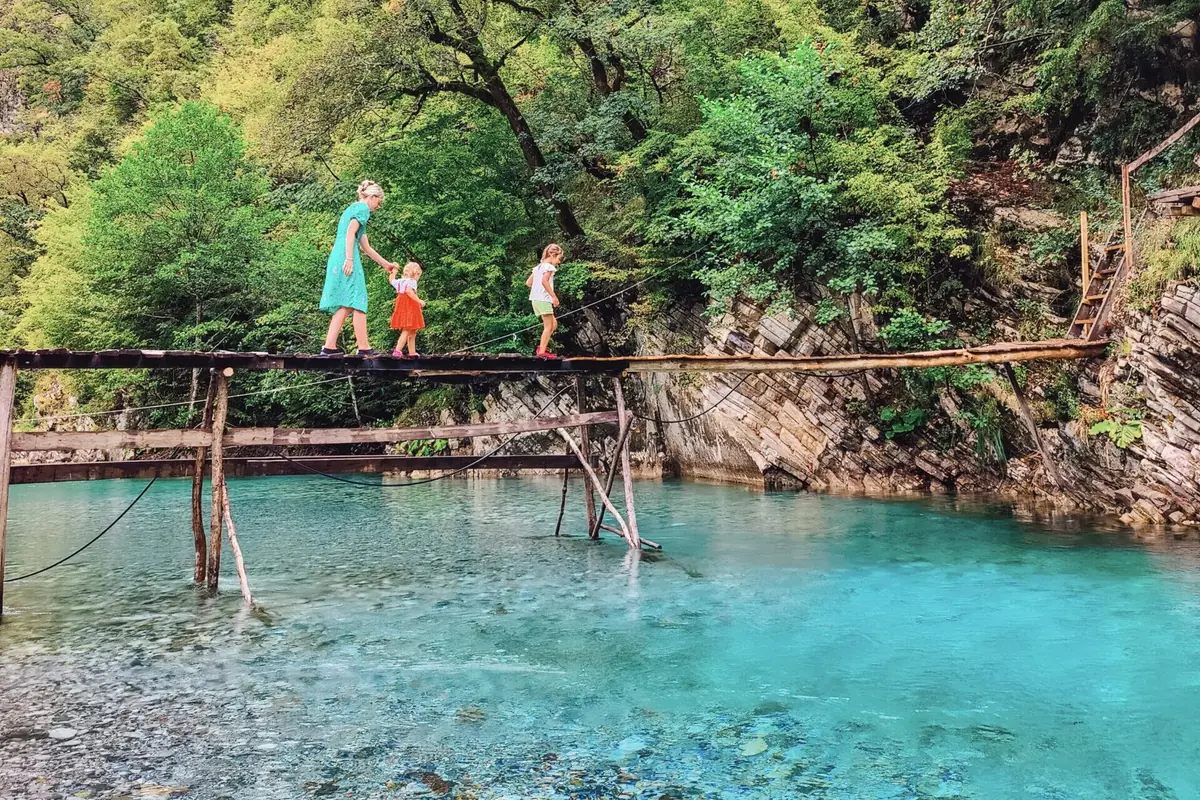
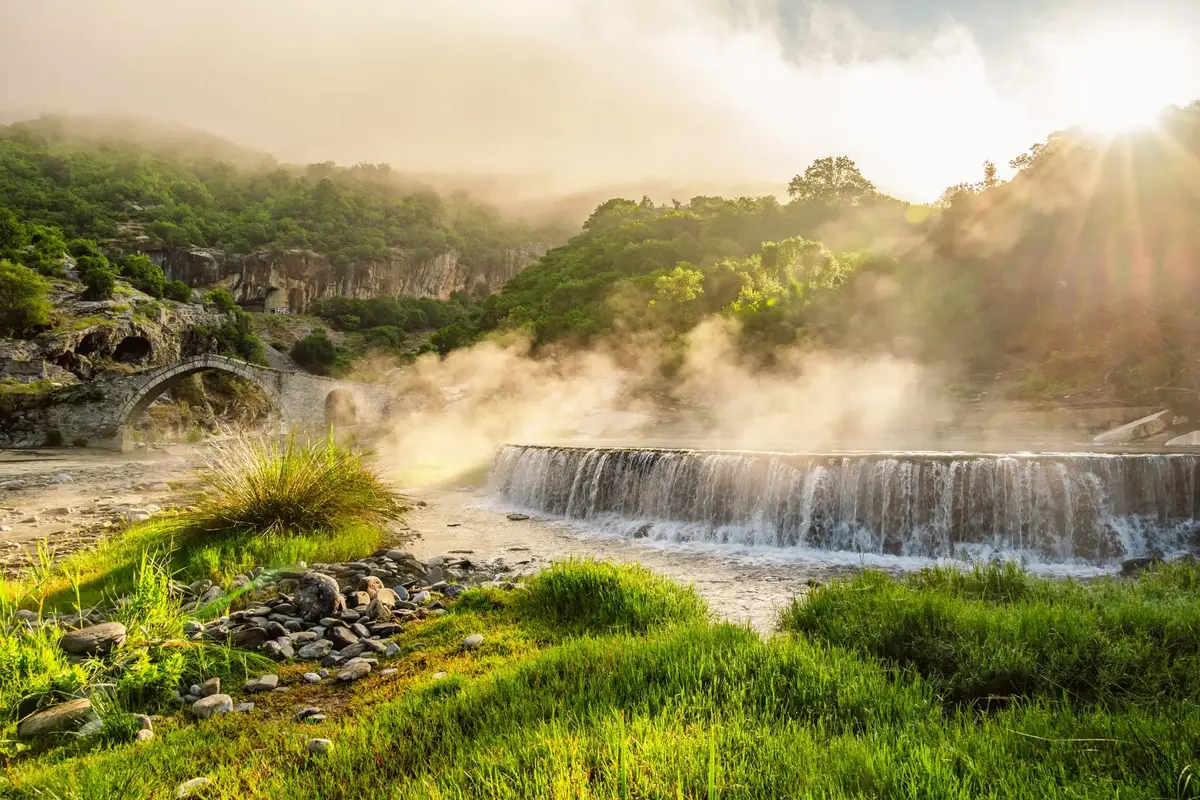
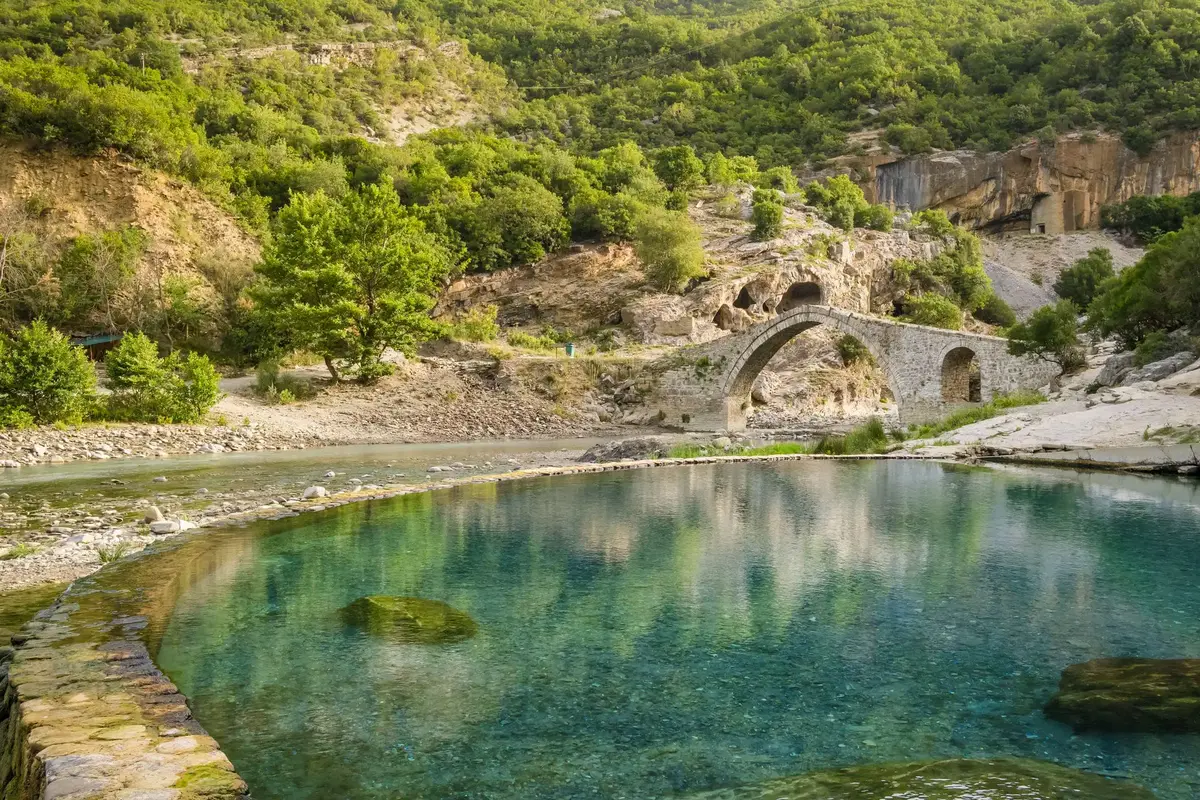
Roughly 150 miles south of Tirana, an arched Ottoman bridge spans a turquoise canyon where six stone-rimmed pools glow milky blue. Benja Hot Springs is free, lukewarm, sulfurous, and worth the drive — but only if you arrive prepared. This guide tells US travelers what to expect, what to skip, and how to slot Benja into a broader Albania trip.
Benja Hot Springs at a glance
Entry to Benja Hot Springs is free year-round with no gate, no hours, and no booking. Parking near the Kadiut Bridge runs about 200 lek (around $2.50 USD). Bring water shoes, a towel, swimwear worn under your clothes, sunscreen, drinking water, and a trash bag — there are no facilities on site.
- Cost: $0 entry, ~$2.50 parking
- Drive from Tirana: 4 to 4.5 hours (~150 miles / 240 km)
- Drive from Sarandë: ~2 hours (~60 miles / 95 km)
- Drive from Gjirokastër: ~1.5 hours (~37 miles / 60 km)
- GPS: 40.244403° N, 20.432430° E
- Pools on site: 6 (2 main basins by the bridge)
- Water temperature: 72–82°F (22–28°C)
- Facilities: None — no restrooms, no showers, no changing rooms
Pro Tip: I ran out of small bills at the Berat coffee stop and almost lost a parking spot to a campervan. Break a 2,000-lek note before you leave Përmet — the attendant rarely has change.
What is Benja Hot Springs and where exactly is it?
Benja Hot Springs (also spelled Bënjë or Benje; in Albanian, Llixhat e Bënjës) is a cluster of mineral pools on the Lengarica River in southern Albania’s Gjirokastër County. The site sits at the mouth of Lengarica Canyon beside the Kadiut Bridge, about 9 miles (14 km) southeast of Përmet town and 150 miles (240 km) south of Tirana.
Orientation at a glance:
- Country: Albania
- County: Gjirokastër
- Municipality: Përmet
- Village: Bënjë (Petran administrative unit)
- Pronunciation: BEN-yeh
- Altitude: ~755 feet (230 meters)
- Address: Rruga e Benjes, Përmet, Gjirokastër County 6401
The name “Llixhat e Bënjës” translates roughly as “the spas of Bënjë.” Google Maps places the pin “Benja Thermal Baths” at the parking lot beside the bridge — but the unsigned left turn off the main Përmet–Leskovik road in the village of Petran is the cue most drivers miss. Locals slow down for the turn; follow them, not the GPS arrow.
If you’ve searched “Benja Hot Springs” and found Thai or Saraburi results, those are a different keyword collision. The destination indexed under this name is firmly in Albania.
How much does Benja Hot Springs cost in US dollars?
Pool access is completely free. Parking at the lot near the Kadiut Bridge costs about 200 lek (~$2.50 USD) per vehicle, collected in cash by an attendant at the entrance. Wild camping along the river is free; the campervan plot near the lot runs roughly 1,500 lek ($18 USD) per night with electricity — modest line items against your broader Albania travel costs.
Itemized costs in USD:
- Entry to the pools: Free
- Parking (per vehicle, not per person): 200 lek (~$2.50)
- Campervan overnight: ~1,500 lek (~$18)
- Local minibus from Përmet: ~200 lek (~$2.50)
- Taxi from Përmet (round trip, negotiated): 1,500–2,500 lek ($18–$30)
- Day tour from Sarandë: from €94.35 (~$100) per person via Cool Destinations
- Day tour from Gjirokastër (rafting + Benja): from $54 via Experience Gjirokastra
The Bank of Albania reference rate hovers around 1 USD = 82 lek, so prices in this guide convert at roughly that ratio. Tour operators along the coast quote in euros; small inland businesses quote in lek. Always select “lek” if an ATM offers dynamic currency conversion to dollars or euros — the conversion rate is consistently bad.
Pro Tip: The attendant collects 200 lek per car, not per person. A rental with four passengers pays the same as a solo motorbike, so split the spot.
How do you get to Benja Hot Springs from Tirana, Sarandë, and Gjirokastër?
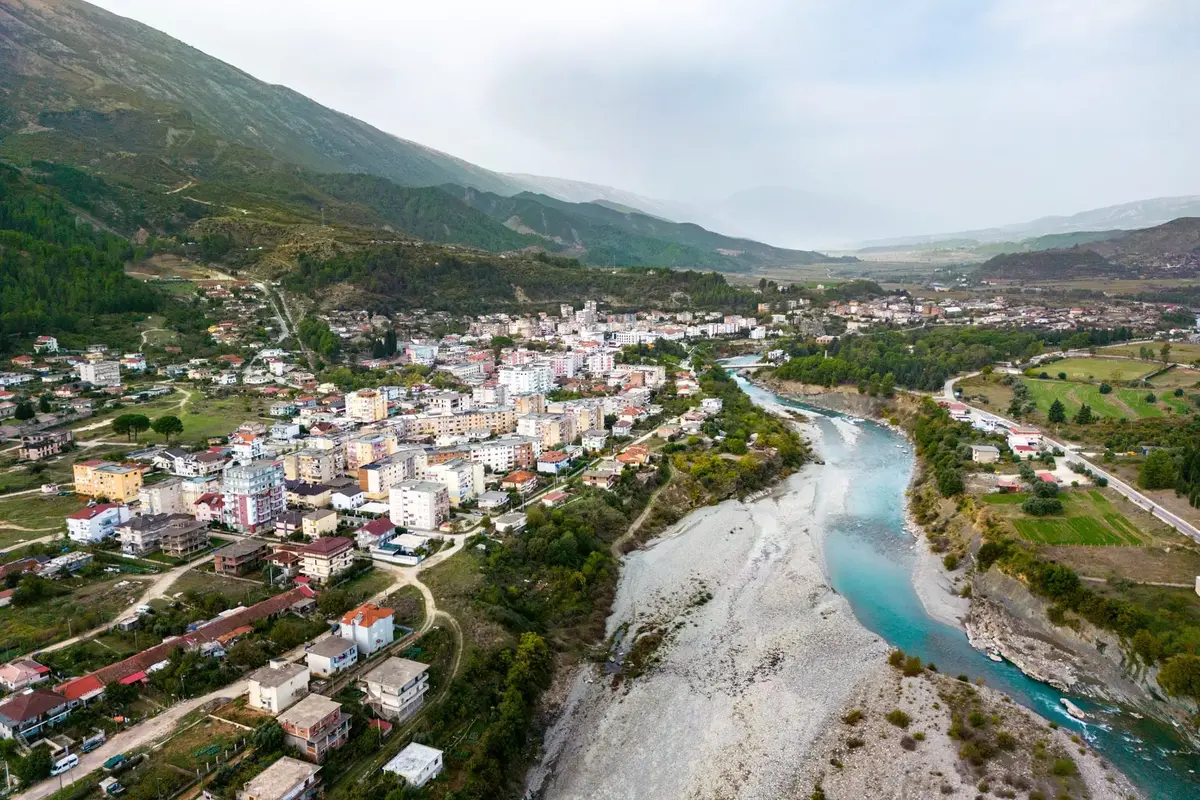
Most travelers start this trip in Tirana and spend a day there before heading out. From the capital, the fastest route is to drive south through Lushnjë and Tepelenë to Përmet — about 150 miles (240 km), 4 to 4.5 hours. From Sarandë, allow 2 hours via Gjirokastër. There is no direct public bus to the springs; you must reach Përmet first, then take a taxi or local minibus the final 9 miles southeast.
Driving from Tirana — the road-trip default
Pick up a rental at Tirana International Airport “Nënë Tereza” (TIA), 7 miles (11 km) northwest of central Tirana, and budget 4 hours 30 minutes including a coffee stop in Berat or Tepelenë. Roads are paved but narrow on the final stretch from Përmet to Bënjë. Most rental cars in Albania are manual transmission; confirm an automatic when booking if you need one.
A few notes on driving in Albania for US travelers:
- Speed limits: 30 mph (50 km/h) in town, 56 mph (90 km/h) rural, 68 mph (110 km/h) motorway
- BAC limit: 0.01% — effectively zero
- International Driving Permit: recommended (cheap insurance against police questions)
- Fuel: stations are manned; gas runs roughly $7.50–$8 per gallon
- Best overnight: Berat or Përmet itself
Bus and taxi — no car needed
Per Gjirafa Travel, the Tirana–Përmet corridor offers 23 daily departures covering 150 miles (242 km) in about 4 hours 26 minutes for €12.22 (~$13 USD). The route is operated by three companies: Dhembeli Sh.P.K, Fjoart Travel, and Trans-Sopoti. The first bus leaves Tirana at 5:30 a.m. and the last at 5 p.m.
From Përmet’s main bridge taxi stand:
- Round-trip taxi to Benja: 1,500–2,500 lek ($18–$30) — agree the fare before getting in
- Local minivan (furgon): runs mornings only, 8 a.m. to noon, ~200 lek
- Hitchhiking: common and considered safe by solo female travelers I’ve met on the road
Day tours from Sarandë, Gjirokastër, or Tirana
Operators like Albania Rafting Group and Experience Gjirokastra package the springs with Lengarica Canyon hiking or Vjosa rafting. Cool Destinations sells a 5-hour Sarandë thermal baths tour at €94.35 per person; Tripadvisor lists a Gjirokastër rafting and Benja combo from Experience Gjirokastra (product code 101099P23) starting near $54 USD. Tours include transport and a guide but rarely include lunch.
Pro Tip: If you’re already driving the southern Albania loop (Tirana–Berat–Përmet–Gjirokastër–Sarandë), skip the tour. The 14-km final stretch from Përmet is the easiest piece of the entire trip.
When is the best time to visit Benja Hot Springs?
Spring (April–May) and fall (mid-September–October) deliver the best balance of mild air, modest crowds, and lush canyon greenery — the same shoulder seasons that make the best time to visit Albania overall. Summer weekends are crowded after 11 a.m., and the pools feel bath-warm rather than hot. Winter is steamy and dramatic when the air drops below freezing, but the 72–82°F (22–28°C) water can feel cold getting in and out.
Month-by-month air temperature in Përmet:
- January: 30–48°F (-1 to 9°C) — empty, steamy, dramatic
- April: 45–66°F (7–19°C) — wildflowers in the canyon
- July: 64–88°F (18–31°C) — busiest weekends
- October: 50–70°F (10–21°C) — best foliage
- December: 32–52°F (0–11°C) — cold soak, warm raki
A safety note that nearly every guide buries: the Lengarica Canyon water level can rise quickly after heavy rain. If the parking lot is muddy or the river is brown, do not walk into the canyon to reach the upper pools. Stay at the bridge basins and watch the flow.
Pro Tip: Show up before 9 a.m. on weekdays. Tour buses from Sarandë and Gjirokastër pull in around 11, and parking gets tight by noon during summer.
What is the experience actually like?
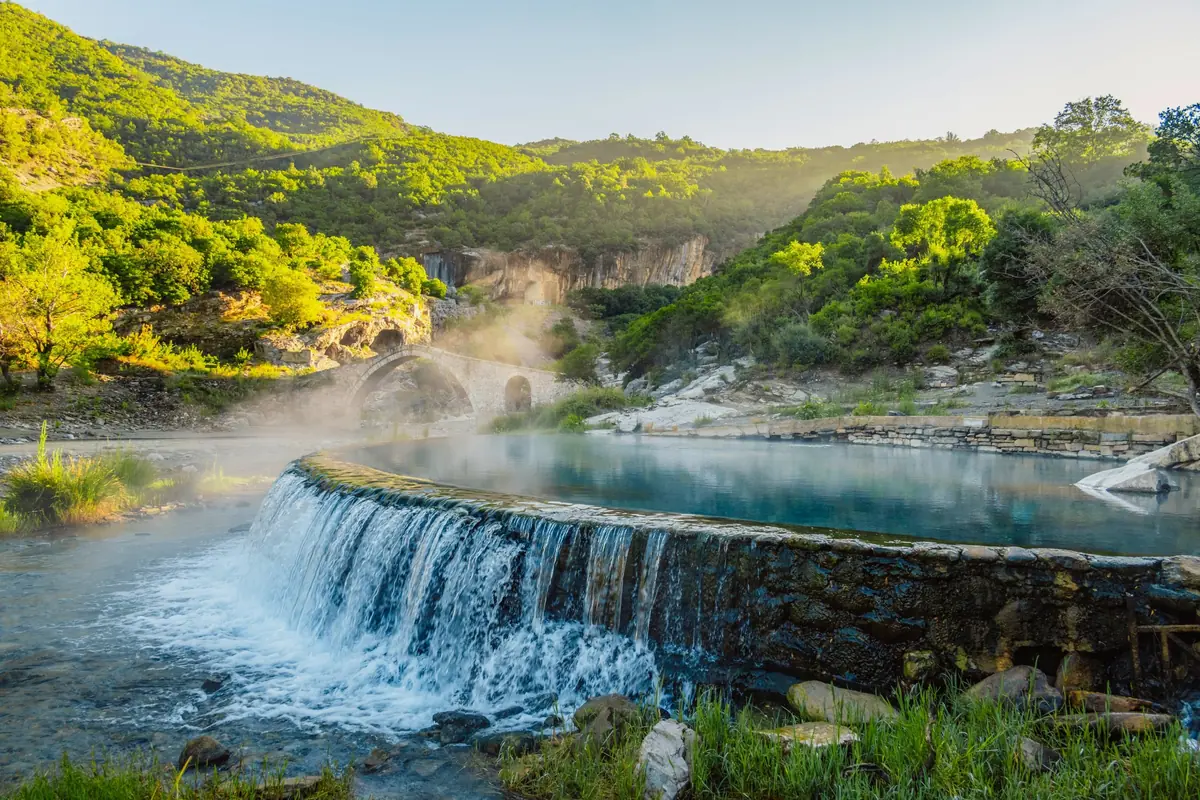
Benja is a long, lazy mineral float, not a hot-tub plunge. The sulfur scent reaches you before the steam does. The 72–82°F (22–28°C) water feels velvety and faintly soapy on the skin, the cold Lengarica River rushes two feet from your shoulder, and the stones underfoot are slick with mineral film. Plan on 30–40 minutes before you cool off.
Cross the 18th-century stone bridge and the largest pool functions like an infinity edge over the river; the second basin, tucked under the bridge arch, fits maybe five or six adults comfortably. Water shoes are not optional here.
Sensory details no other guide will give you:
- Smell: noticeable sulfur on arrival; your nose calibrates within ten minutes and you stop registering it until you climb out
- Feel: silky, faintly soapy, and just warm enough to relax into for 30–40 minutes before you cool off
- Sound: the cold Lengarica River rushing past two feet from your shoulder, with a canyon echo that amplifies kids’ voices
- Sight: pale blue-green water against ochre travertine rock, the bridge above framing every photo
- Surprise: the temperature is at least 15°F lower than most US visitors expect
On my first visit, I had braced for a 100°F soak. The water hit my ribcage at maybe 78°F and my brain rewrote the entire trip — this is a long, lazy mineral float, not a hot-tub plunge. Adjust your expectations downward and the experience improves immediately.
How many pools are there, and which one is best?
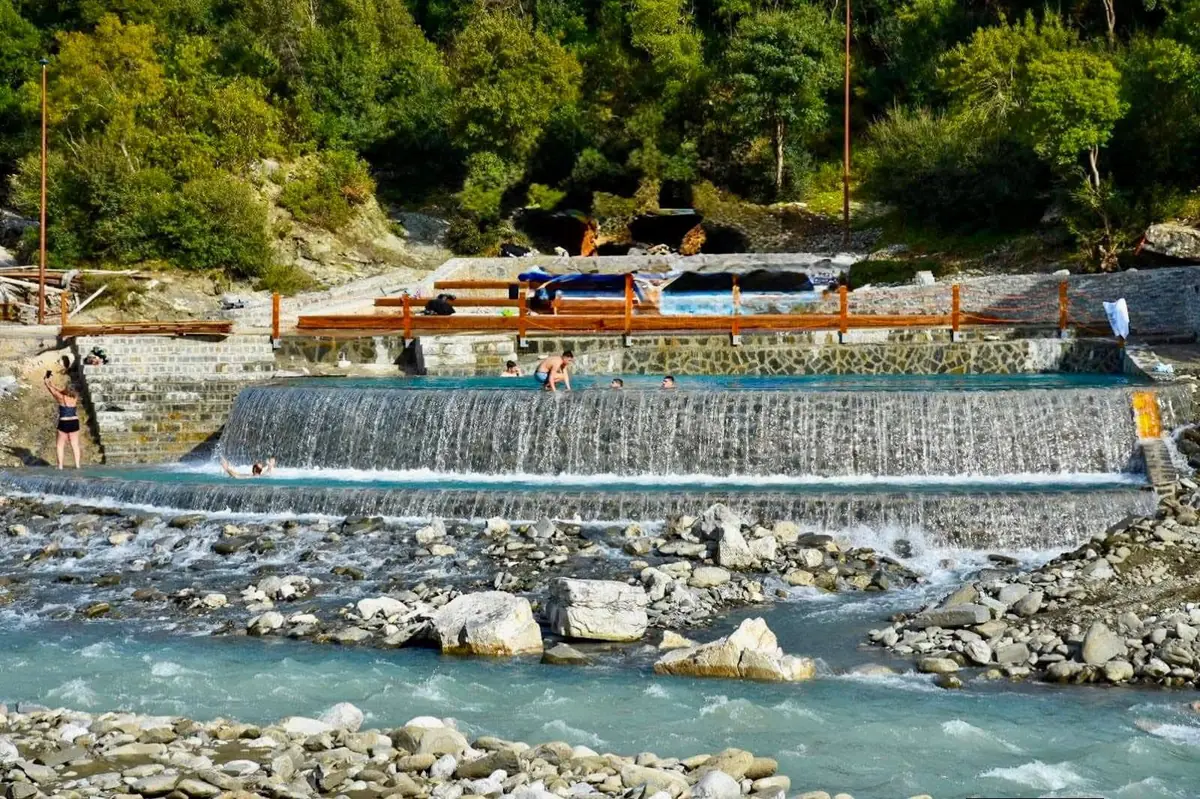
Six naturally fed mineral pools sit along the Lengarica River, with two large stone-rimmed basins immediately at the Kadiut Bridge. Walk five minutes upstream into the canyon to find smaller, quieter pools — one runs cooler, one runs slightly warmer than the bridge basins. Locals attribute different healing properties to each pool’s mineral mix; in practice, choose by crowd level rather than chemistry.
The pool layout, walking from the parking lot:
- Pool 1: largest infinity-edge basin, fits 15–20 — the photo everyone takes
- Pool 2: under the bridge arch, fits 5–6 — best shade in summer
- Pool 3: 5 minutes upstream, knee-deep, cooler water
- Pool 4: 8 minutes upstream, deeper, warmer
- Pools 5 and 6: further into the canyon, often empty on weekdays
Spring flow rate runs 8 to 40 liters per second across the system. The mineral profile is chloro-sodium-calcium with sulfur, fluoride, and silica. Folk medicine credits the water with helping skin, kidney, rheumatic, and gastric conditions; the scientific evidence is thin, but the relaxation effect is real.
Pro Tip: Five minutes upstream from the bridge, on a slick limestone shelf, sits a pool maybe four feet across. It was empty at 10 a.m. on a July weekday while the bridge pools held 40 people. The walk requires water shoes — the rocks are sharp and slippery.
What should you bring (and what to leave behind)?
There are no changing rooms, restrooms, showers, or restaurants on site — only a seasonal drinks kiosk in summer. Wear swimwear under your clothes, bring a quick-dry towel, water shoes, drinking water, snacks, sunscreen, a flashlight if you plan to explore the canyon’s old tunnels, and a trash bag (the bins overflow). A waterproof phone pouch protects gear from spray.
Beyond your general Albania packing list, here’s the full Benja kit:
- Swimwear (worn under your clothes from the start)
- Quick-dry travel towel
- Water shoes (Teva, Keen, or similar — flip-flops will fail)
- Sunscreen (the canyon walls don’t shade the bridge pools until 4 p.m.)
- 1.5 liters of drinking water per person
- Snacks or a packed lunch
- Small lek bills for parking (200 lek note is ideal)
- Trash bag — pack out everything
- Waterproof phone pouch
- Flashlight or headlamp (for the canyon tunnels)
- Modest swimwear in shoulder season — locals dominate weekday mornings
- A change of clothes for the drive back; your swimsuit will smell of sulfur
What’s the story behind the Kadiut Bridge?
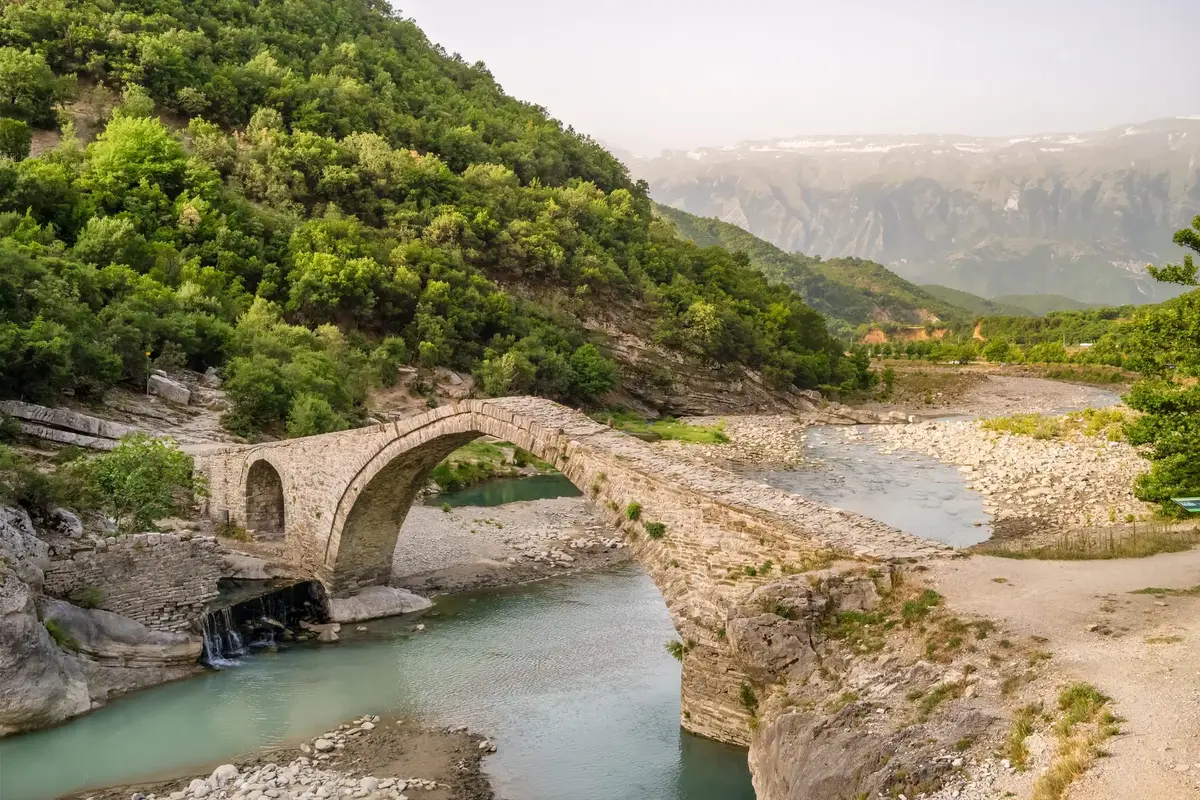
The Kadiut Bridge (Ura e Kadiut, “Judge’s Bridge”) was built around 1760 under Ali Pasha of Tepelena. Its single stone arch — about 6 feet (1.8 meters) wide, with no railings — connected logging villages in the Dangëlli region with farmland near Përmet. Local legend says a corrupt judge (kadi in Turkish) was thrown from it. Cross slowly; the parapet is gone.
Historical context worth knowing:
- Builder: Ali Pasha of Tepelena, the Ottoman governor of Janina
- Construction: ca. 1760
- Material: dressed limestone, original mortar
- Width: ~6 feet (1.8 meters), no railings
- Local nickname: “Judge’s Bridge”
- Nearby archaeology: Neolithic karst caves in the canyon dated to 7000–3000 BC
The restored Church of the Virgin Mary (Kisha e Shën Mërisë) sits in Bënjë village, 10 minutes’ walk from the parking lot, and is worth the detour if the door is unlocked. The Orthodox Church of Leus, a 30-minute drive away, has frescoes that justify a half-day add-on for art-minded travelers.
What else is worth doing around Benja Hot Springs?
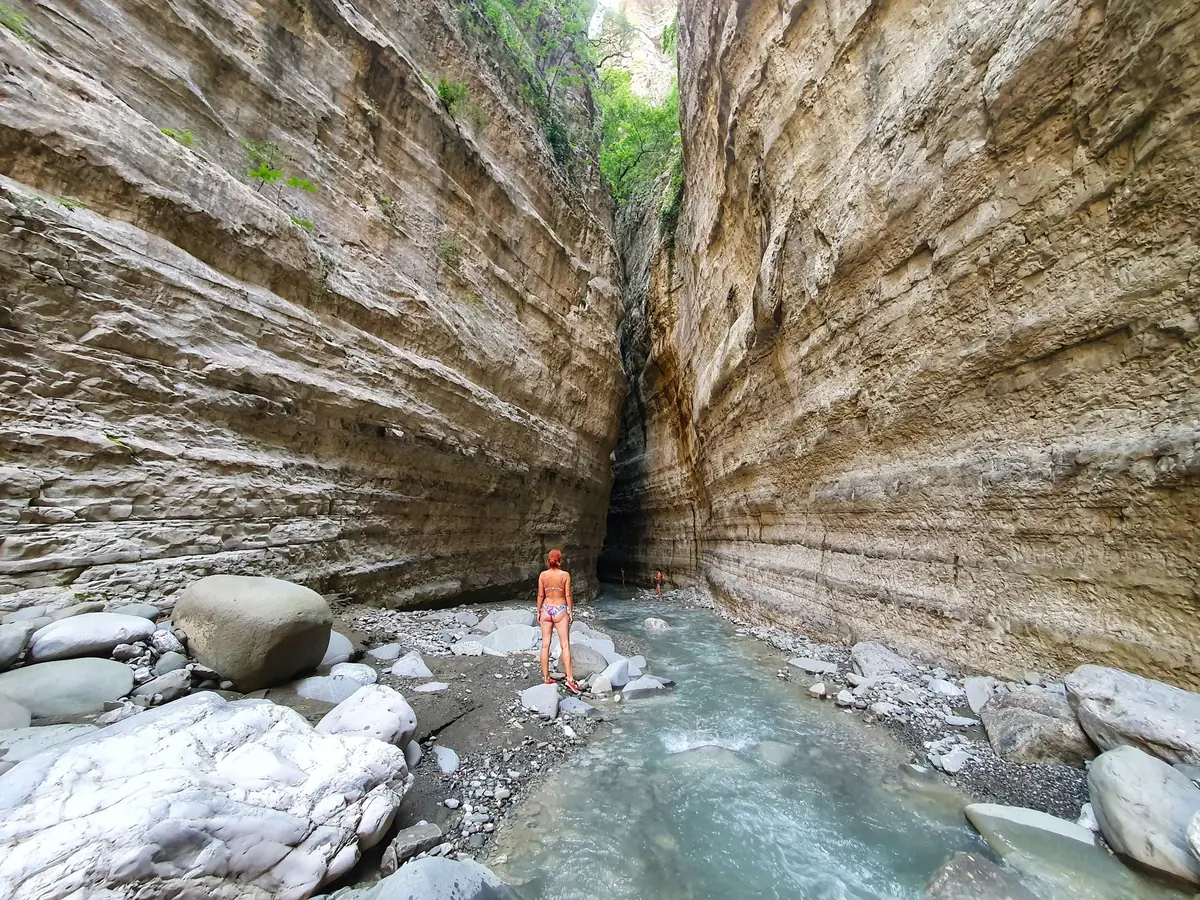
Pair the soak with the Lengarica Canyon hike — a 3 to 4 mile (5 to 7 km) loop, moderate difficulty, taking 3 to 4 hours. Walk through the canyon entrance behind the last pool to find limestone walls up to 490 feet (150 meters) tall, narrow passages 10 feet (3 meters) wide, and prehistoric caves. No permit is needed for the canyon itself.
The Vjosa Wild River National Park — the first wild river national park in Europe, and now a UNESCO biosphere reserve — borders the area and offers half-day rafting trips.
Add-on options from Benja:
- Lengarica Canyon hike: 3–4 hours, moderate, no permit needed
- Pidgeon Cave: 525 feet (160 meters) long, requires headlamp
- Vjosa rafting: half-day, $40–$60 per person via Albania Rafting Group
- Horseback riding: 2-hour tours from Bënjë village
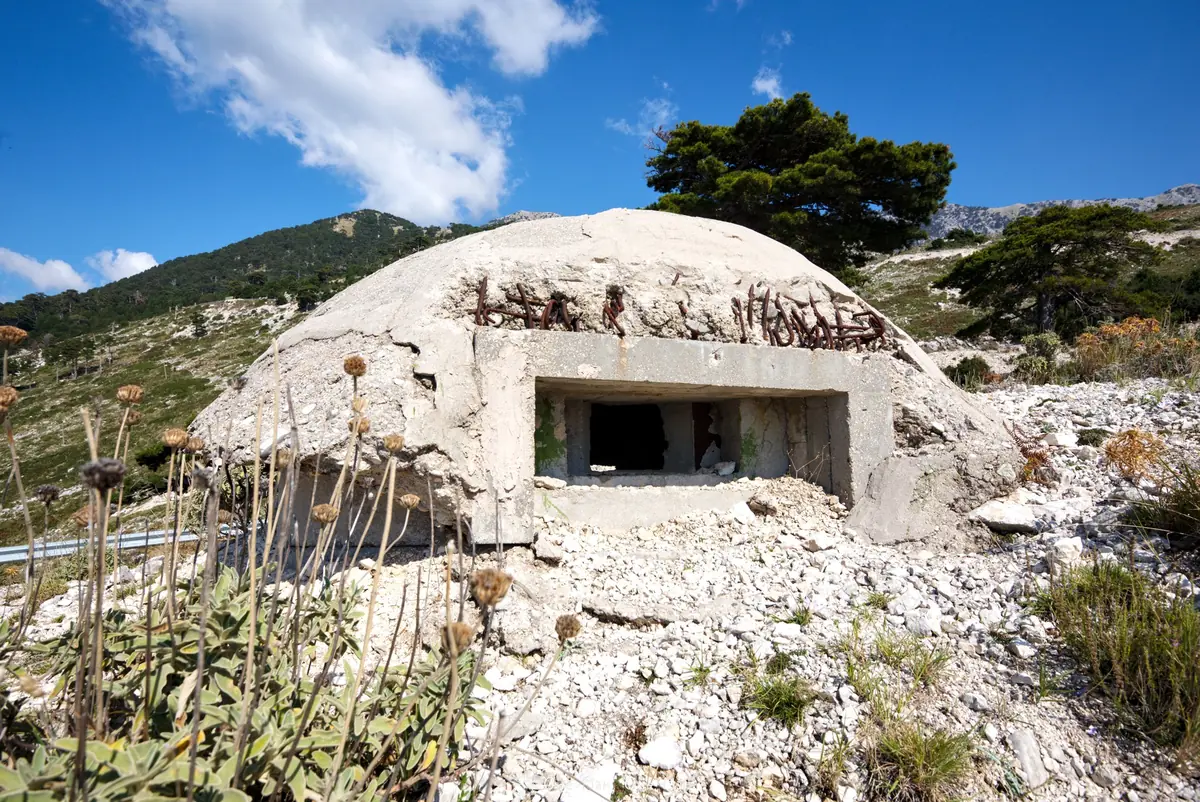
- Communist-era tunnels: short, dark, ankle-deep water in spots
The four secondary thermal pools dotted inside the canyon are smaller and harder to reach; the upper pool is a 25-minute walk in shallow water. Do not attempt this stretch in wet weather — it floods fast.
Where should you stay near Benja Hot Springs?
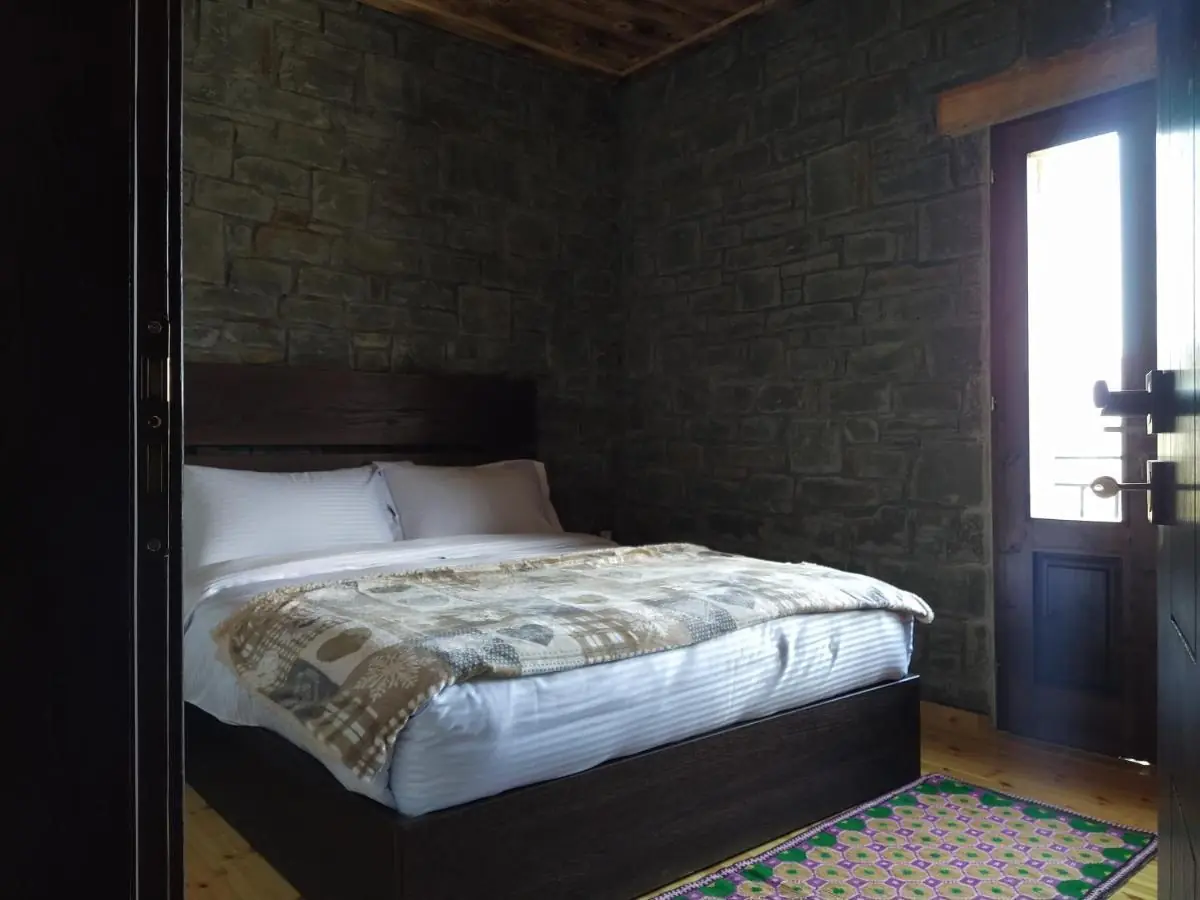
Most US travelers base in Përmet (9 miles from the springs) for restaurants and walkability, but a handful of guesthouses sit closer to the canyon. Rooms in town run $30–$55 a night; the closest guesthouses to the bridge let you soak at sunrise with no driving. Wild camping is allowed, and a campervan plot near the parking lot runs about 1,500 lek ($18) per night.
Top-rated stays include Traditional Guesthouse Permet (Booking.com 9.5/10 across 260 reviews, with a 9.9 staff sub-score), Chri Chri Guesthouse in Leus, and Stone House Guesthouse in Petran.
Best in town (Përmet)
The town center sits on the Vjosa River about a 25-minute drive from the springs. Walking access to restaurants like Trifilia and Oxhaku, plus Pasticeri Bleta for breakfast, makes Përmet the most practical base.
- Traditional Guesthouse Permet: from $45/night, family-run, walkable to everything
- Funky Guest House & Adventures: from $30/night, hostel-style, organizes day trips
- Hotel Alvero Permet: from $55/night, the only mid-range hotel option in town
Closest to the springs
If your priority is a sunrise soak with no driving, stay within a 5-minute drive of the bridge.
- Mulliri i Bënjës: from $35/night, also a campground and rafting outfitter
- Stone House Guesthouse Petran: from $50/night, restored 120-year-old stone house
- Albturist Ecocamp: tent and bungalow options from $20/night
Splurge or unique
For a meal-and-bed experience that justifies the drive, the village guesthouses outside Përmet lean into Albanian agrotourism, with garden-to-table cooking the in-town hotels can’t match.
- Chri Chri Guesthouse, Leus: from $70/night, 4×4 access, set-menu dinners on a view terrace
- Bujtina Lugina e Vjosës: from $60/night, family land with home-cured cheese and raki
How does Benja compare to other Albanian hot springs?
Benja is the most photogenic and the only major free option, but the lukewarm water disappoints visitors expecting hot-tub heat. Llixhat e Elbasanit (~133°F / 56°C) delivers genuinely hot water with hotel infrastructure. Peshkopi’s spa (~109°F / 43°C) is built for bookable wellness courses. Sarandaporo near Leskovik is quieter and more remote. Choose Benja for scenery, Elbasan for heat, Peshkopi for treatment.
Albanian hot springs at a glance:
- Benja Thermal Baths (Përmet): 72–82°F (22–28°C), free, scenic canyon, 4.5 hr from Tirana
- Llixhat e Elbasanit (Elbasan): ~133°F (56°C), hotel-attached, $5–$15 entry, 1 hr from Tirana
- Llixhat e Peshkopisë (Peshkopi): ~109°F (43°C), medical spa, treatment packages, 2.5 hr from Tirana
- Sarandaporo / Vronomero (Leskovik): ~95°F (35°C), free, undeveloped, 5 hr from Tirana
- Bilaj thermal spring (Fushë-Krujë): ~131°F (55°C), small, local-only, 1 hr from Tirana
- Holta Canyon springs (Gramsh): ~97°F (36°C), remote, hike required, 3 hr from Tirana
If hot is what you want, drive to Elbasan instead. If you want the photograph and a $0 entry fee, Benja is the answer.
How does Benja compare to a US hot springs experience?
Imagine the rustic, free wading pools at Yellowstone’s Boiling River — closed indefinitely after the historic flood that reshaped northern Yellowstone, per the National Park Service — set inside a slot canyon as dramatic as Zion’s Narrows, with an arched stone bridge for a backdrop. Benja is closer in spirit to Travertine Hot Springs in California’s Eastern Sierra than to the developed pools at Glenwood Springs or Hot Springs, Arkansas.
Quick comparison for US travelers:
- Glenwood Hot Springs (Colorado): $30 entry, 90–104°F, full resort — Benja is the opposite
- Hot Springs, Arkansas: bathhouse row, $35–$45 — Benja has zero infrastructure
- Travertine Hot Springs (California): free, undeveloped, 95–105°F — closest analog to Benja but warmer
- Yellowstone Boiling River: closed indefinitely after flooding — Benja fills the gap for free wild soaking
- Mystic Hot Springs (Utah): $25 entry, claw-foot tubs — Benja is wilder, colder, and free
The biggest mental shift for Americans: Benja has no rules, no lifeguards, no posted hours, and no liability waiver. You walk in, soak, and leave. That freedom is part of the appeal — and part of why you should bring your own first-aid kit.
What do US citizens need to know about visiting Albania?
When it comes to visa requirements, Albania is unusually relaxed: per the U.S. Embassy in Tirana, US citizens may stay for up to one year without a residence permit — the most generous policy in Europe. The currency is the Albanian lek (1 USD ≈ 82 lek). Driving is on the right. Tirana International Airport offers free unlimited Wi-Fi, and Vodafone or One Albania prepaid SIM cards are sold in arrivals for about $10 USD.
Visa and entry rules
US passport holders need no visa, no e-visa, and no advance application.
- Passport validity: at least 3 months beyond intended stay (6 months recommended)
- Maximum visa-free stay: 1 year
- Re-entry rule: after a full-year stay, remain outside Albania for at least 90 days before returning (per al.usembassy.gov)
- Vaccinations: none required
- Onward travel proof: occasionally requested at the border
Money and ATMs
Albania’s cash-and-ATM rules are simple: the country runs on cash for small purchases — parking, taxis, market food — and cards for everything else.
- Local currency: Albanian lek (ALL)
- Bank of Albania reference rate: ~82 lek per USD
- ATM fees: 300–700 lek (~$4–$9) per withdrawal
- Card acceptance: Visa and Mastercard widely accepted; American Express rare
- Dynamic currency conversion: always decline — choose lek
Driving and rentals
The roads are better than the reputation, but the driving culture is faster and more aggressive than US norms.
- Default transmission: manual (request automatic at booking)
- Side of road: right
- BAC limit: 0.01% (effectively zero)
- IDP: recommended (US license alone is technically valid for short stays)
- Toll roads: none
- Fuel: ~$7.50–$8 per gallon
Connectivity
Free Wi-Fi covers TIA and most cafes, but for the canyon you’ll want one of the local prepaid SIM cards; expect signal drops at Benja itself.
- Vodafone Albania prepaid SIM: ~1,000 lek (~$12) for 30 GB
- One Albania prepaid SIM: similar pricing
- Roaming: most US carriers charge $10/day; a local SIM is cheaper for stays over 3 days
Frequently asked questions
Are Benja Hot Springs free to visit?
Yes. Entry is free year-round with no gate, ticket, or operating hours. Drivers pay roughly 200 lek (~$2.50 USD) for parking near the Kadiut Bridge. Wild camping by the river is also free; the campervan plot near the lot runs about 1,500 lek (~$18 USD) per night.
How hot is the water at Benja Hot Springs?
Pool temperatures sit between 72 and 82°F (22–28°C) — lukewarm, not hot-tub hot. Springs flow at 8 to 40 liters per second. The pools further upstream inside Lengarica Canyon are reported a degree or two warmer than the two main basins beside the Kadiut Bridge.
How do I get from Tirana to Benja Hot Springs?
Drive south through Tepelenë to Përmet — about 150 miles (240 km), 4.5 hours — then 9 miles (14 km) southeast on the Petran road. Or take the bus operated by Dhembeli Sh.P.K, Fjoart Travel, or Trans-Sopoti (4 hr 26 min, €12.22 / ~$13 USD per Gjirafa) plus a Përmet taxi.
What should I bring to Benja Thermal Baths?
Pack swimwear (worn under clothes), a quick-dry towel, water shoes, sunscreen, drinking water, snacks, a flashlight, small lek bills for parking, and a trash bag. There are no changing rooms, restrooms, showers, or restaurants on site — only a seasonal drinks kiosk during summer.
Do US citizens need a visa to visit Albania?
No. Per the U.S. Embassy in Tirana, US citizens may stay in Albania for up to one year without a residence permit. Your passport must be valid at least 3 months beyond your stay (6 months recommended). To re-enter after a full year, remain outside Albania for at least 90 days.
Before you book
TL;DR: Go if you love free, scenic, off-grid soaks and you’re already routing through southern Albania. Skip if you require hot-tub heat, paved walkways, or changing rooms. The Ottoman bridge, canyon, and turquoise mineral pools make Benja Hot Springs one of the most photographed free experiences in Europe — pack water shoes, modest expectations, and a trash bag.
The springs reward travelers who arrive prepared and disappoint those who expect a resort. If you’ve made it this far, you’re in the first camp. Build a 3-day Përmet stop into a longer southern Albania road trip, soak at sunrise on a weekday, hike the canyon to the upper pools, and eat dinner at Trifilia. The water won’t blow your mind, but the setting will.
What surprised you most about Benja Hot Springs — the temperature, the lack of facilities, or the price tag? Drop a comment below with what you wish you’d known before going.