
Albanian food is the most underrated cuisine in Europe — flaky byrek for the cost of a coffee, lamb tavë kosi that drinks like custard, and grilled fish off the Ionian coast that needs nothing but lemon. Here is the dish-by-dish, neighborhood-by-neighborhood, lek-and-USD playbook I wish I had before my first plate of fërgesë.
What is Albanian food, exactly?
Albanian food is a Mediterranean-Balkan-Ottoman cuisine built on olive oil, fresh dairy, lamb, and seasonal vegetables. The three anchor dishes are byrek (flaky filo pie), tavë kosi (baked lamb in yogurt-and-egg sauce, the national dish, from Elbasan), and fërgesë (peppers, tomatoes, and gjizë cheese baked in a clay pot). Most meals end with raki.
How much does Albanian food actually cost?
A street-stall byrek runs 30-60 ALL ($0.35-$0.70). A traditional sit-down meal of fërgesë, salad, bread, and grilled meat with house wine costs 1,200-1,800 ALL ($14.50-$22) per person. Mullixhiu’s seven-course “Metamorphosis” tasting menu — Tirana’s flagship modern Albanian experience — runs about $33 (€30). Cash still rules.
The Albanian lek (ALL) trades at roughly 100 ALL to $1.20, which keeps mental math easy: drop two zeros and add about a fifth. I bought a cheese byrek the size of a paperback at a hole-in-the-wall near Burger King Blloku for 50 ALL ($0.60) — the woman behind the counter pulled it from the oven still steaming.
Most consumer transactions still happen in cash (about 70%, per the Bank of Albania), and ATM fees are brutal. Avoid Euronet machines — they charge €5 ($5.40) per withdrawal and offer terrible exchange rates. To navigate ATMs and cash in Albania, use Raiffeisen, BKT, or Credins and decline the conversion when prompted.
Pro Tip: Albanian households spend the highest share of their budget on food in Europe (42.3%, per Eurostat). Restaurants reflect this. Even a cheap qofte plate is taken seriously.
What you’ll pay by meal type
Street-food and bakery prices are essentially identical across Tirana, Berat, and Gjirokastër. The Albanian Riviera (Sarandë, Ksamil) runs 20-40% higher. Premium farm-to-table restaurants in Tirana still come in at one-quarter the cost of equivalent Western European cities.
| Meal type | Local price (ALL) | USD | Where to find it |
|---|---|---|---|
| Byrek + dhallë breakfast | 150-250 | $1.80-$3 | Byrektore Albani, Tirana |
| Qofte plate with bread, salad | 400-600 | $4.80-$7 | Te Met Kodra, Pazari i Ri |
| Traditional dinner with wine | 1,200-1,800 | $14.50-$22 | Oda, Tirana |
| Riviera grilled sea bass | 700-1,200 | $8.50-$14 | Sarandë promenade |
| Mullixhiu tasting menu | ~3,000 | ~$33 | Mullixhiu, Grand Park |
| Mrizi i Zanave farm dinner | 3,000-5,000 | $36-$60 | Fishtë (75 min north of Tirana) |
At Tek Zgara Tironës 1 in Tirana, dinner for two with a half-liter of house wine came to 1,080 ALL — about $13 — and the fërgesë alone was worth the flight.
What is Albania’s national dish?
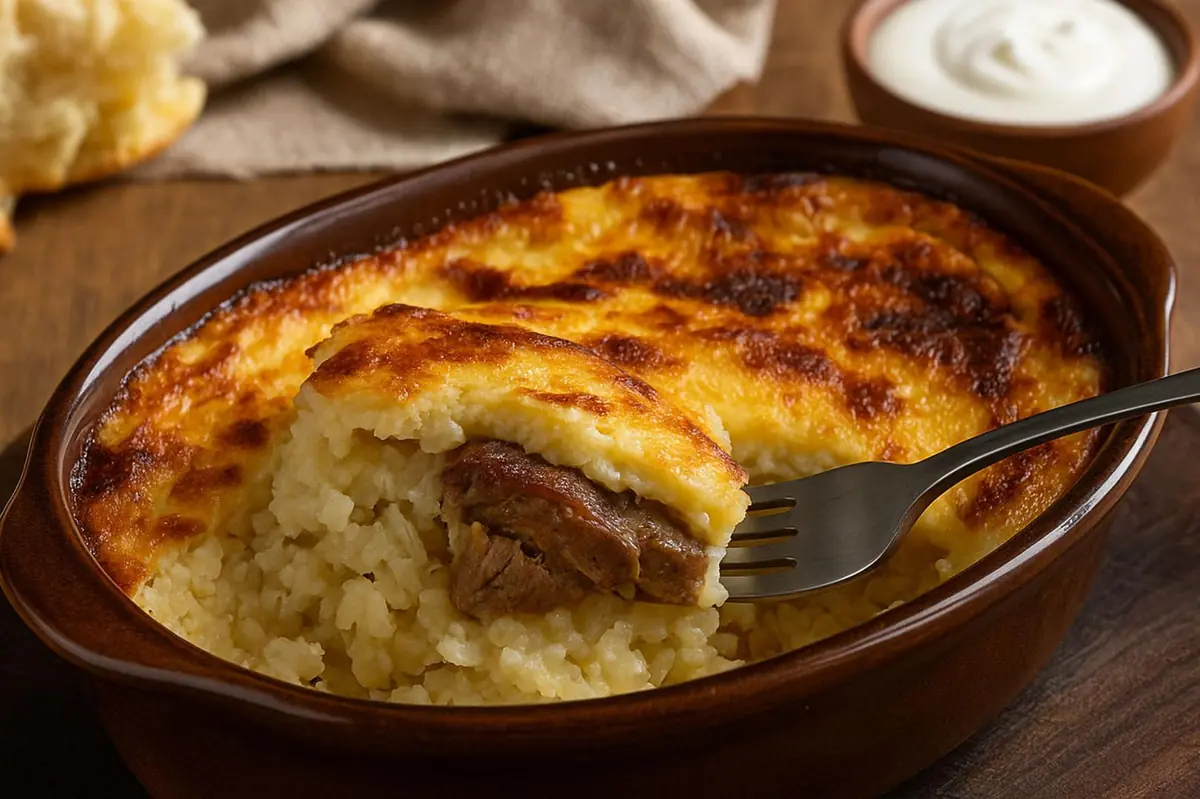
Tavë kosi is Albania’s national dish — chunks of lamb (occasionally chicken) baked over rice in a roux of butter, flour, eggs, and tangy yogurt until the top sets into a golden custard. It originated in Elbasan, where it is also called Tavë Elbasani, and is best ordered in winter at Oda or Era Vila in Tirana.
The dish reportedly traces back to the 15th century, when local cooks marinated lamb in yogurt for an Ottoman occupying garrison under Sultan Mehmed II. The Albanian diaspora carried the recipe into Greece and Turkey, where versions of it still appear under different names.
The technique is the magic. The roux base is built from butter and flour, then beaten with eggs and full-fat yogurt until smooth. That cold mixture is poured over hot, partially-cooked lamb and rice, then baked at 375°F (190°C) for about 80 minutes. The yogurt sets into something between a soufflé and a custard. Skip the chicken version. The lamb is the original, and it’s better.
- Location: Oda, Rruga Luigj Gurakuqi, near Pazari i Ri, Tirana
- Cost: 500-900 ALL ($6-$11) per portion
- Best for: Travelers who want one definitive dinner in Tirana
- Time needed: 90 minutes (kitchens cook it to order)
Is Albanian food spicy, healthy, or basically Greek?
No, Albanian food is not spicy. It leans on oregano, mint, basil, paprika, garlic, and lemon — heat comes from optional pickled chilis on the side. Yes, it is healthy: it is a textbook Mediterranean-diet cuisine, with high olive-oil, vegetable, and fish intake. And no, it is not “just Greek food” — Ottoman, Italian, and uniquely Albanian dishes make it distinct.
The “Albanian paradox” is the term researchers use for the country’s high life expectancy relative to its GDP. Wikipedia classifies Albanian cuisine under the Mediterranean diet umbrella, and Albania ranks fifth in the world in onion consumption per capita — a side-effect of how heavily local cooking leans on raw vegetables in salads, soups, and stews.
What Albania shares with Greece: moussaka, dolma (japrak), baklava, Greek salad, grilled fish with lemon. What Albania has that Greece doesn’t: fërgesë (no equivalent), qifqi (a Gjirokastër-only herbed rice ball), pispili (a cornbread-and-spinach hybrid), lakror (Korçë’s flat layered pie), pastiçe (an Italian-influenced baked pasta), ballokume (an Elbasan butter cookie), and a stronger Ottoman pie tradition.
Saying Albanian food is Greek food is like saying Mexican food is Spanish food. How Albania and Greece actually compare comes down to this: the shared roots are real, the execution isn’t.
The 14 Albanian food classics worth tracking down
These are the dishes you should chase, roughly in this order: byrek for breakfast, fërgesë and tavë kosi for traditional dinners, qofte at a zgara, speca të mbushura and pispili if vegetarian, peshk në zgarë on the coast, tarator on a hot day, fasule for a cheap rib-sticking lunch, and trileçe and baklava for dessert with raki.
1. Byrek — the $0.50 flaky pie that fuels the country
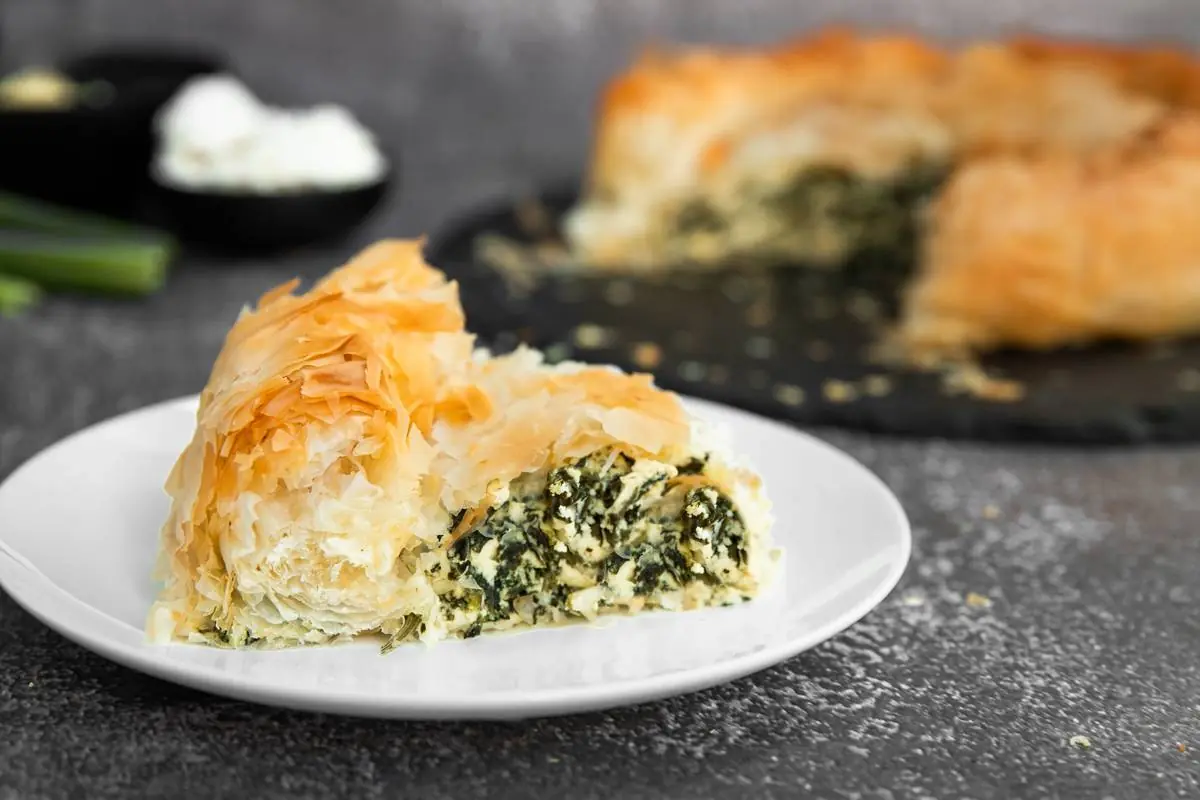
Byrek (BUR-ek) is layered filo pie filled with spinach and feta, cheese, meat, pumpkin, leek, or potato. It is breakfast, lunch, snack, and late-night fuel. The Albanian version is rolled by hand on a marble slab with a thin wooden pin called an okllai, then baked in trays cut into wedges. It costs 30-60 ALL per slice ($0.35-$0.70).
The variants worth knowing: byrek me spinaq (spinach + feta), byrek me gjizë (Albanian ricotta), byrek me mish (minced meat), byrek me kungull (pumpkin), byrek me presh (leek), and byrek me domate dhe qepë (tomato and onion). At Byrektore Albani I arrived at 9 a.m. and only cheese was left — they sell out by mid-morning. I paid 50 ALL, ate it standing up against a parked car, and watched a kid behind me chase his with a 100-ALL macchiato.
The spotting tip: a line of locals plus an older woman behind the counter is your quality signal. Byrek is best with a glass of dhallë (salted yogurt drink) or ayran. Ignore the chains around Skanderbeg Square — the byrek there is reheated.
- Location: Byrektore Albani, Rruga Mihal Duri, Tirana (and any neighborhood byrektore in Pazari i Ri)
- Cost: 30-60 ALL ($0.35-$0.70) per slice
- Best for: Breakfast on the move, late-night hangover food
- Time needed: 5 minutes (eat it standing up)
2. Tavë kosi — the lamb-yogurt casserole
Already covered in detail above. The version every traveler should taste is at Oda in Tirana — clay-baked, served bubbling, with the yogurt crust still trembling. Order it with a Greek salad, fresh bread, and a glass of Kallmet red. The smaller, family-run tavernas in Berat and Gjirokastër also do excellent versions, often with herbier yogurt and a more rustic crust.
3. Fërgesë — peppers, tomato, and gjizë in a clay pot
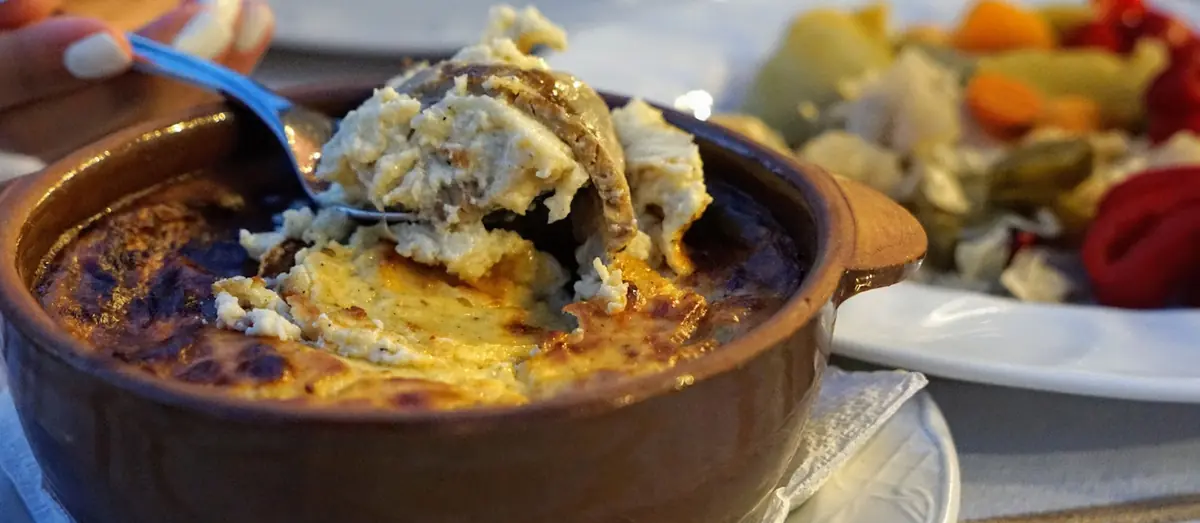
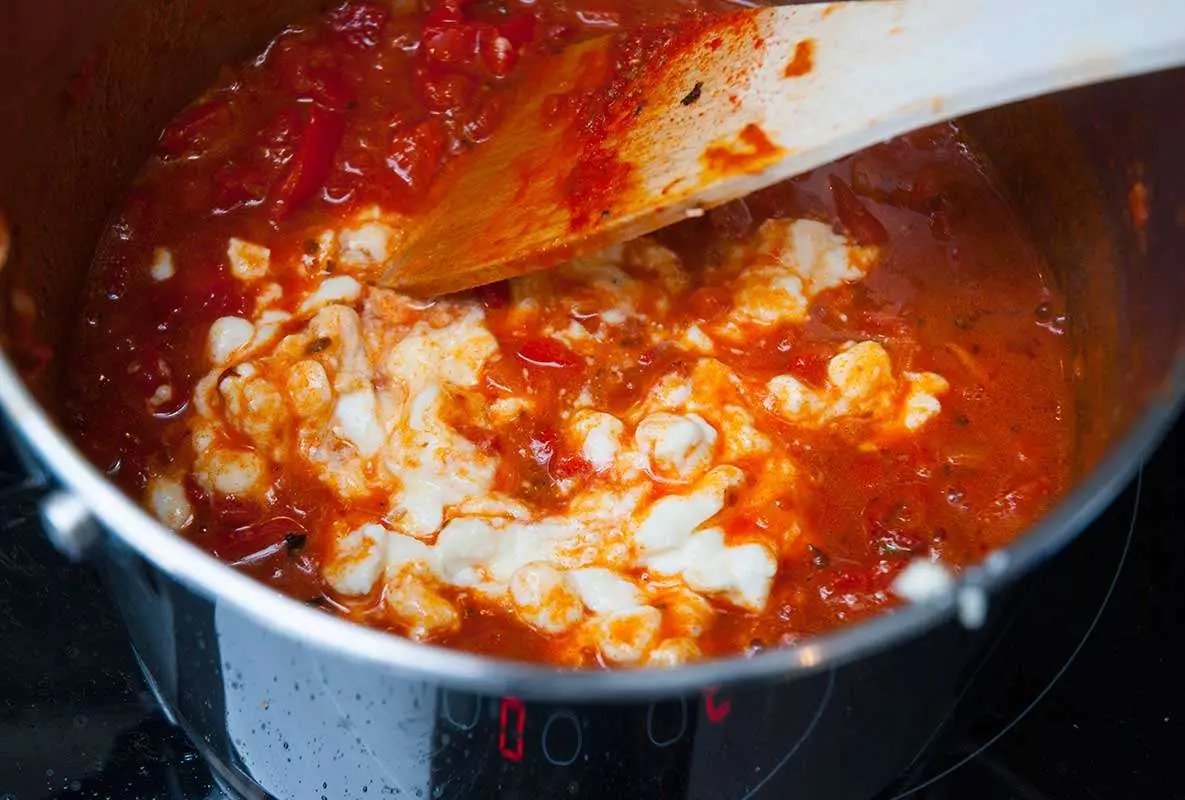
Fërgesë (FER-geh-suh) is the comfort dish of Tirana — bell peppers, tomatoes, onions, and gjizë (Albanian ricotta) baked in a clay pot until thick. Order fërgesë me mëlçi (with chopped liver) at a Tirana taverna, or fërgesë verore (vegetarian) anywhere. Price runs 350-600 ALL ($4.20-$7).
The dish has two main forms. Fërgesë e Tiranës me piperka is the vegetarian version — peppers, tomatoes, onions, and a generous slug of gjizë baked in a clay dish until the cheese melts and the vegetables collapse. Fërgesë me mëlçi is the same base with chopped chicken or veal liver folded in. Both arrive sizzling, with crusty bread for dipping.
The first fërgesë me mëlçi I ate at a tiny Tirana taverna was so hot the gjizë was still bubbling when the waiter put the clay dish on a wooden trivet. By the time I finished the bread basket, the dish had thickened to the texture of polenta. Era Piceri Blloku and Oda both serve excellent versions.
- Location: Era Piceri, Rruga Ismail Qemali, Blloku, Tirana
- Cost: 350-600 ALL ($4.20-$7)
- Best for: First-time fërgesë eaters; anyone who likes baked-cheese dishes
- Time needed: 60 minutes for a full lunch
4. Qofte — the charcoal-grilled meatballs of every street corner
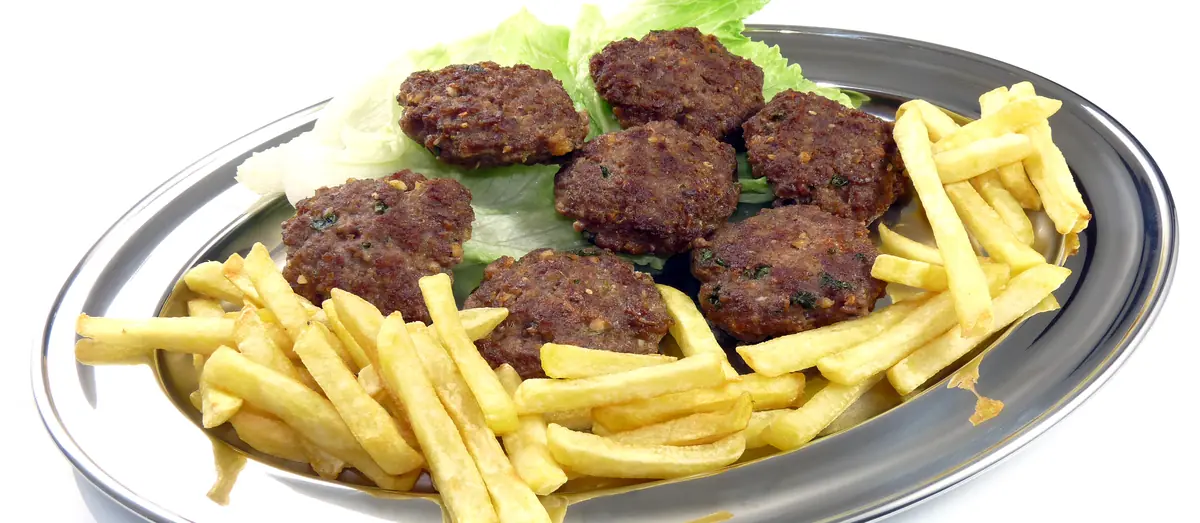
Qofte (CHOF-teh) are charcoal-grilled meatballs of minced beef and lamb, served with raw onion, yogurt, ajvar, and bread for about $5-$7. The most famous shop in Tirana is Te Met Kodra near Pazari i Ri — locals queue at lunch, tourists rarely find it.
Te Met Kodra is unmarked from the street — I walked past it three times before a man eating qofte at the standing counter waved me in. A plate of qofte, bread, salad, raw onion, and yogurt ran 450 ALL ($5.40). They shape the meat thin, almost like flat patties, then sear them over hardwood charcoal until the outside chars and the inside stays pink.
Regional shape variation matters. Korçë qofte are small, round, and seasoned with more cumin. Shkodër qofte stretch into elongated cigars closer to qebapa (the Balkan-wide skinless sausage). Pickled chilis sit on every table. Pork is rare — Albania is roughly 70% Muslim, so beef and lamb dominate.
- Location: Te Met Kodra, Rruga Luigj Gurakuqi, near Pazari i Ri, Tirana
- Cost: 400-600 ALL ($4.80-$7) for a full plate
- Best for: A fast, cheap, very Albanian lunch
- Time needed: 45 minutes (counter-only seating, no reservations)
5. Speca të mbushura, japrak, and tavë dheu — the stuffed-and-baked tier
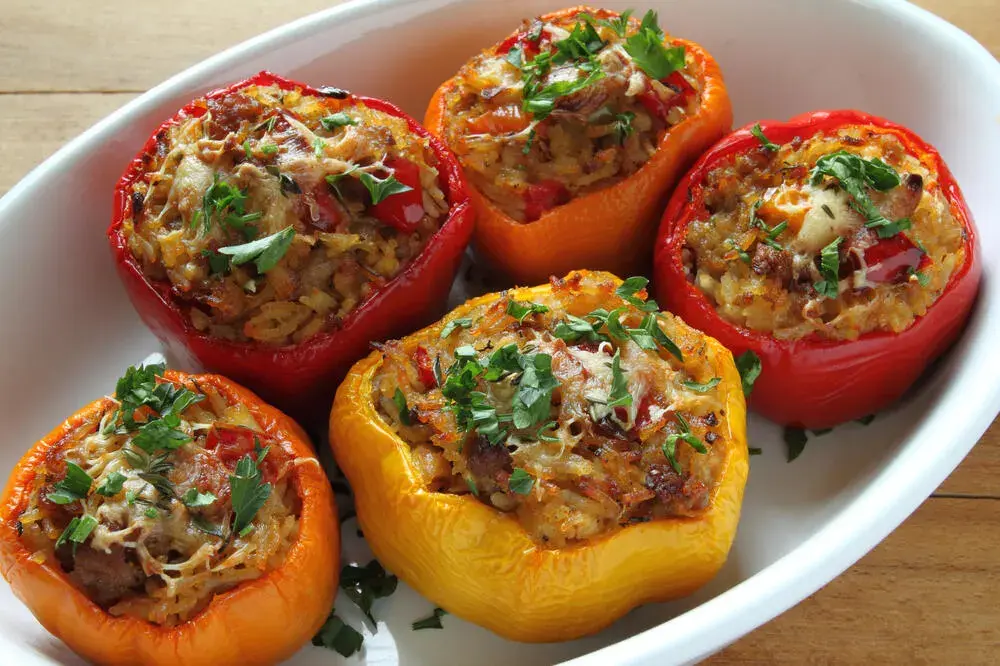
Speca të mbushura are bell peppers stuffed with rice and herbs (vegetarian) or rice and minced meat. Japrak swaps peppers for vine or cabbage leaves. Tavë dheu is the clay-pot lamb-and-feta cousin of fërgesë. All three are baked, all three cost 300-600 ALL ($3.60-$7), all three are best with bread.
The consensus best place for stuffed peppers and stuffed eggplant (patëllxhan të mbushur) is Eni Traditional Food in Berat. The owner watched me try a pickled chili, then refilled my raki without being asked. Japrak in northern Albania (Shkodër, Lezhë) leans on cabbage leaves more than vine leaves — winter food, served warm with yogurt. Tavë dheu, which translates to “earthenware casserole,” is the dish to order if you’ve already had fërgesë and want something heavier.
- Location: Eni Traditional Food, Rruga Antipatrea, Berat
- Cost: 300-600 ALL ($3.60-$7) per portion
- Best for: Vegetarians (peppers and eggplant) and anyone who likes stuffed-and-baked
- Time needed: 60-90 minutes for a full meal
6. Flija and qifqi — the labor-of-love regional specials
Flija is northern Albania’s wedding-day pancake tower — thirty-plus thin layers cooked one-by-one under a saç lid (a bell-shaped iron dome) over hot coals. Qifqi is Gjirokastër‘s herbed rice ball, fried in a special pan. Order flija at Mrizi i Zanave; qifqi only in Gjirokastër (every menu has it).
Flija takes more than three hours to cook. Each layer of crepe-thin batter is poured onto the saç separately, baked under the dome for 90 seconds, then topped with the next layer. The result is a striated tower served with butter, honey, kajmak (clotted cream), and yogurt. It’s mostly served at festivals, weddings, and family events — outside agritourism settings, you won’t find it in a city restaurant.
Qifqi, by contrast, is everywhere in Gjirokastër. Boiled rice gets mixed with eggs, mint, sometimes feta or kashkaval, and shaped into balls the size of golf balls. They get fried in a cast-iron qifqi pan with hemispherical wells. At a family-run place in Gjirokastër, mine arrived ten to a plate. The owner pulled out the qifqi pan from a cabinet to show me — cast iron, polished, clearly older than I am.
- Location: Mrizi i Zanave, Fishtë (75 minutes north of Tirana, between Lezhë and Shkodër)
- Cost: Flija 500-900 ALL ($6-$11); qifqi 300-500 ALL ($3.60-$6)
- Best for: Slow-food travelers and anyone driving north or south of Tirana
- Time needed: Plan a 4-hour lunch at Mrizi i Zanave; qifqi takes 30 minutes
7. Pispili and lakror — the cornbread cousins
Pispili (also called shapkat) is a Korçë and southeast Albanian specialty: cornmeal mixed with chopped spinach, leek, and feta, then baked into a savory cornbread. Lakror is a flat layered pie — filo dough wrapped around fillings like spinach, leek, tomato, or zucchini — also a Korçë specialty. Both are vegetarian, both are best in the southeast.
In Korçë, the lakror at a small bakery near the cathedral came out the size of a bicycle wheel. They cut it into eight wedges and the woman behind the counter wrapped two for me to take on the bus to Tirana. Lakror travels well — it’s the picnic food of the south. Pispili is denser, more like cornbread crossed with spanakopita.
- Location: Cegora Bakery and surrounding bakeries, central Korçë
- Cost: 200-500 ALL ($2.40-$6) per wedge
- Best for: Vegetarians, road-trippers, anyone curious about the cornmeal tradition
- Time needed: 15 minutes at a bakery counter
8. Peshk në zgarë — grilled fish on the Ionian coast
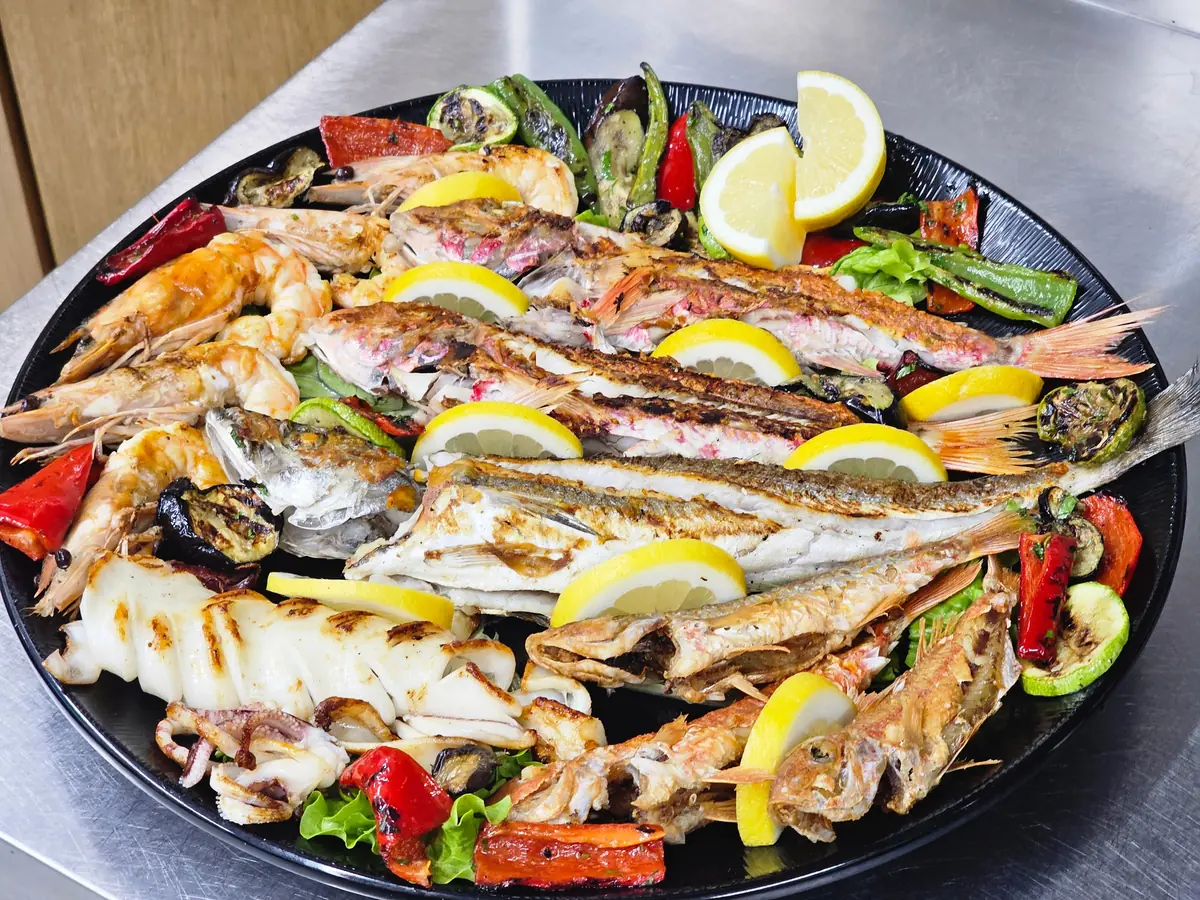
On the coast, peshk në zgarë (grilled fish) is the only thing you should be eating. Sea bass, sea bream, red mullet, and calamari, seasoned with nothing but lemon, olive oil, garlic, and a little oregano, then thrown on a hardwood grill. Whole fish runs 700-1,200 ALL ($8.50-$14) on the Sarandë promenade.
Adriatic versus Ionian matters. The northern coast (Durrës, Vlorë’s northern beaches) gets Adriatic fish — slightly darker meat, more octopus, more squid. The southern coast (Sarandë, Ksamil, Himarë, Dhërmi) gets Ionian fish — lighter, more sea bass and sea bream, cleaner flavor. In Sarandë I watched a waiter walk to the dock at 11 a.m., point at a sea bream still flapping in the boat, and carry it back to the kitchen. It was on my plate by noon for 900 ALL ($11).
- Location: Sarandë promenade tavernas, Bujtina e Peshkarit (Radhime, Vlorë), Marina Seafood 4VM (Shkodër)
- Cost: 700-1,200 ALL ($8.50-$14) for a whole grilled fish
- Best for: Coastal travelers, summer trips, seafood lovers
- Time needed: 90 minutes (Riviera service is unhurried)
9. Tarator and fasule — the everyday safety net
Tarator is cold cucumber-and-yogurt soup with garlic, dill, and walnuts — the Albanian and Balkan answer to summer heat, served in a glass at lunch for 200-400 ALL. Fasule is the thick, slow-cooked white-bean stew that fuels every cheap workers’ restaurant in the country: jani me fasule (lighter, more brothy) or fasule pllaqi (baked, with carrots and tomato), both around 300-500 ALL.
Fasule is what you order when it’s cold, when you’re hungover, or when you don’t want to think. Most lunch places have it on the menu by default. Tarator gets ordered as a starter or sometimes as a stand-alone summer lunch with bread and feta. Both are the everyday safety net behind the more famous dishes.
- Location: Any workers’ restaurant or all-day lunch spot, nationwide
- Cost: Tarator 200-400 ALL ($2.40-$4.80); fasule 300-500 ALL ($3.60-$6)
- Best for: Tarator on a hot day; fasule for a cheap, filling cold-weather lunch
- Time needed: 30-45 minutes
What do Albanians eat for breakfast?
Albanians eat a light breakfast: bread, butter, feta, jam, and olives, with coffee, tea, milk, or sometimes raki. Common additions are byrek (especially with spinach), petulla (fried dough with honey and cheese), suxhuk (spiced sausage), gjizë cheese, and trahana (a wheat-and-fermented-milk soup) in rural areas. The whole spread costs 150-250 ALL ($1.80-$3).
Breakfast is small because lunch is the main meal — usually between 1 and 2:30 p.m., when many businesses close so people can eat with family. A four-stop morning crawl through Tirana works well: a byrek + dhallë at Byrektore Albani, a macchiato at any neighborhood café, a wedge of trileçe or kinder cake for the sugar hit, and a final mountain tea (çaj mali) before noon.
Pro Tip: Coffee culture is central. Order a macchiato or a Turkish-style coffee, never a “regular coffee.” Cafés open around 7 a.m. and most don’t bring a check unless you ask — the writing-on-air gesture works.
My most Albanian breakfast cost 200 ALL: a spinach byrek and a salty dhallë drunk standing up at a counter in Tirana while the baker rolled the next round of dough on a marble slab behind me.
Where should you eat traditional Albanian food in Tirana?
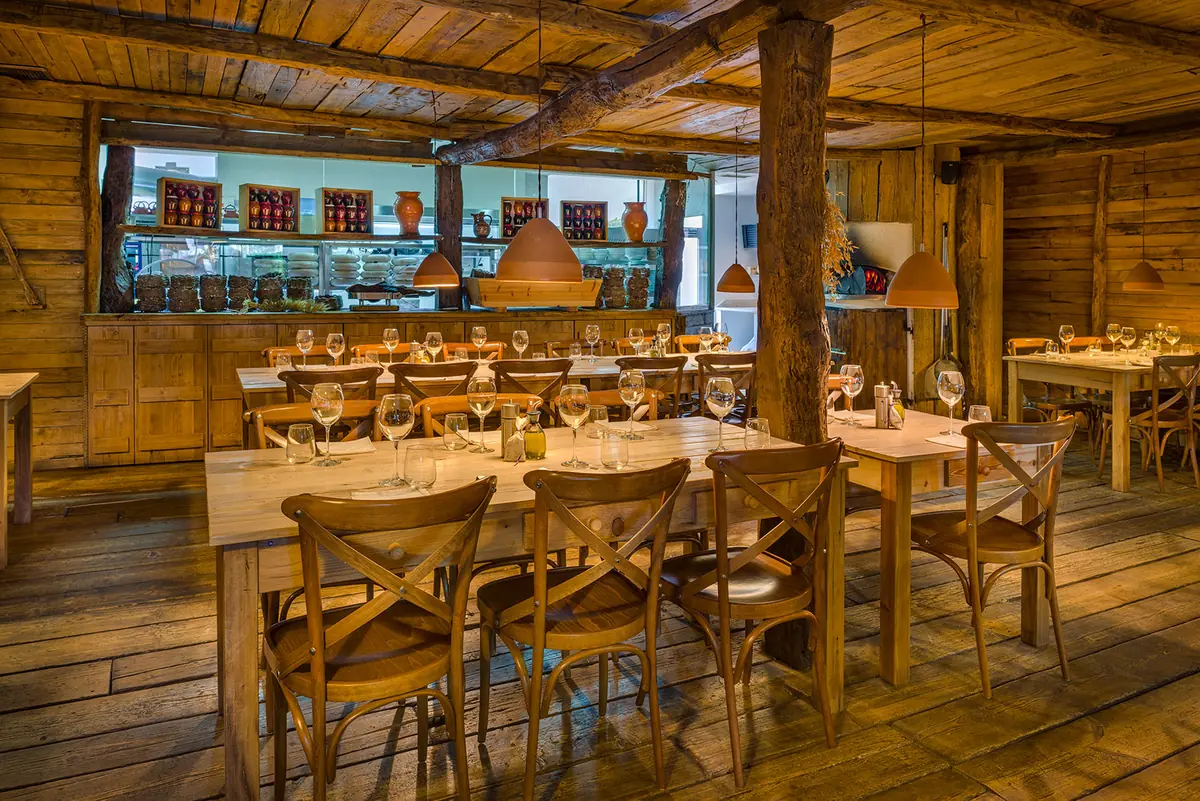
For traditional Albanian food, the best restaurants in Tirana come down to four canonical names: Oda (rustic, live music), Era Vila Blloku (modern but classic), Mullixhiu (modern Albanian by ex-Noma chef Bledar Kola, in Grand Park), and Mrizi i Zanave (slow-food agritourism, 75 minutes north, now also with a Tirana city branch near the Tanners’ Bridge). For a date-night dinner in a restored 1930s villa, Padam Boutique is the move.
Mullixhiu is the one to plan ahead for. Chef Bledar Kola trained at Noma in Copenhagen and Fäviken in Sweden before coming home and opening a restaurant whose stated mission is to “challenge the global dictatorship of French cuisine.” It’s on the World’s 50 Best Discovery list. The “Metamorphosis” tasting menu runs $33 (€30) — for the same money in Rome, you’d eat a mediocre osso buco. The trahana with fermented mulberries was the most interesting thing I ate in the Balkans.
Oda is the opposite end. It’s hidden in an unmarked alley near Pazari i Ri, the dining room is wood-paneled with copper pots hanging from the ceiling, and a man with an çifteli (a two-stringed lute) plays in the corner most nights. Era Vila Blloku is the easy mid-range — modern but rooted, walkable from anywhere central. For a budget local feast, Tek Zgara Tironës 1 is your bet.
For a half-day trip, Mrizi i Zanave in Fishtë is the slow-food destination of the Balkans. Founder Altin Prenga sources almost everything from his own farm or surrounding Lezhë producers. Plan three to four hours.
Where should you eat on the Albanian Riviera and the coast?
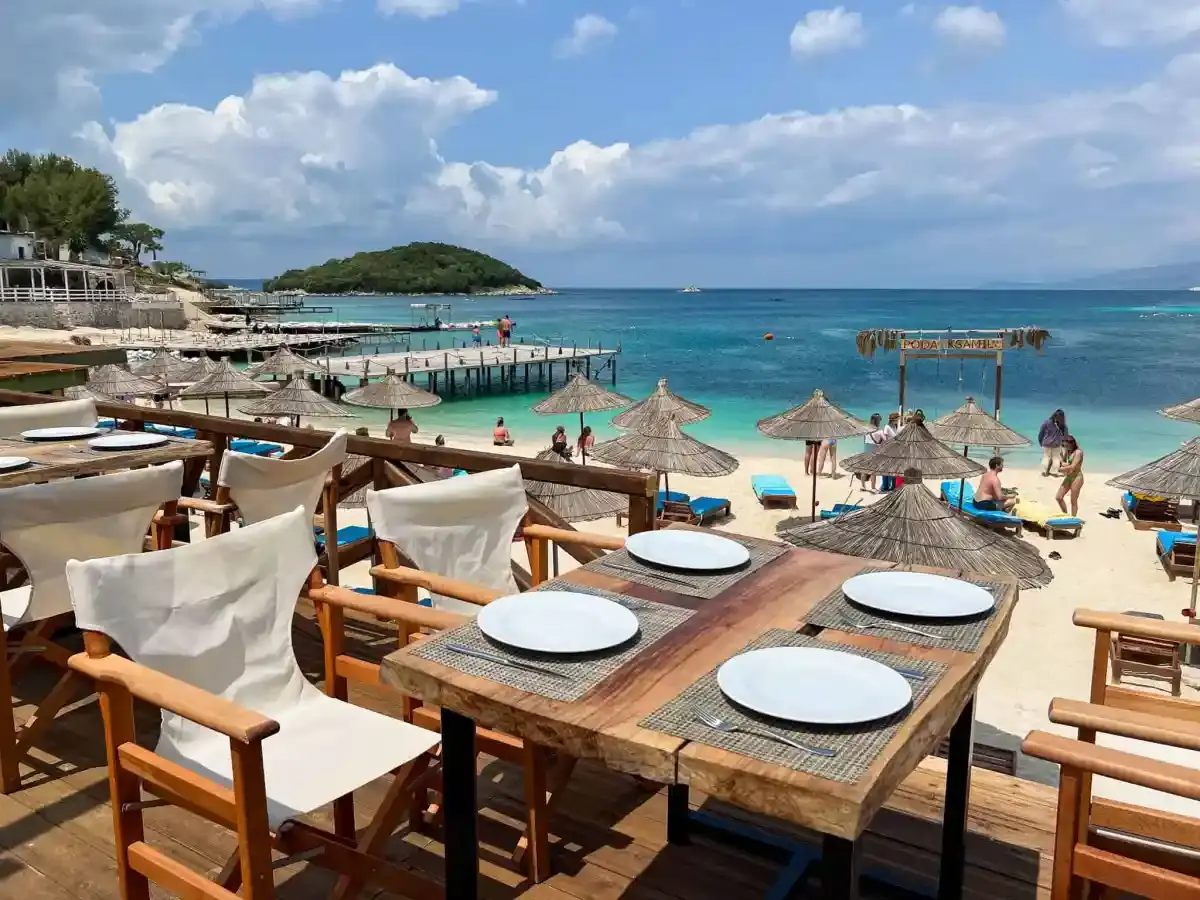
On the Albanian Riviera, eat seafood. In Sarandë, follow the morning fishermen’s catch to the promenade tavernas (grilled sea bass for $8.50-$14). In Radhime near Vlorë, Bujtina e Peshkarit serves the freshest catches. In Himarë and Dhërmi, family-run gardens like Elea cook with goats wandering through the dining room.
The Riviera doubles as a price-arbitrage play. The same Ionian fish that costs 1,200 ALL ($14.50) in Sarandë costs €30-40 ($33-$44) across the strait in Corfu. Ksamil is the most touristy, Himarë and Dhërmi are quieter, and the road between Llogara Pass and Vlorë is the scenic stretch — pull over for grilled fish at any of the small tavernas with a sea view.
Avoid restaurants directly on the main square in Sarandë. Walk one block back from the promenade and prices drop 20-30% for the same fish.
Is Albanian food good for vegetarians?
Albania is more vegetarian-friendly than its grill-house reputation suggests. Order fërgesë verore, qifqi, speca të mbushura me oriz, pispili, tarator, byrek me gjizë or me spinaq, lakror, jani me fasule (white bean stew), perime në zgarë (grilled vegetables), and Greek salad. In Tirana, dedicated vegan options exist at Salt Tirana, Gjelber, and Happy Belly / Eat Smart.
I went vegetarian for three days in Berat by accident — I just kept ordering fërgesë and pispili and never missed the meat. The honest tradeoff: vegan is harder than vegetarian. Most baked dishes use butter, gjizë, or kaçkavall. Ask “pa qumësht, pa djathë” (without milk, without cheese) and they’ll point you to grilled vegetables, beans, or salad. In rural areas, bring a few staples (nuts, energy bars) for travel days.
What do Albanians drink? Raki, beer, mountain tea, and the salty yogurt one
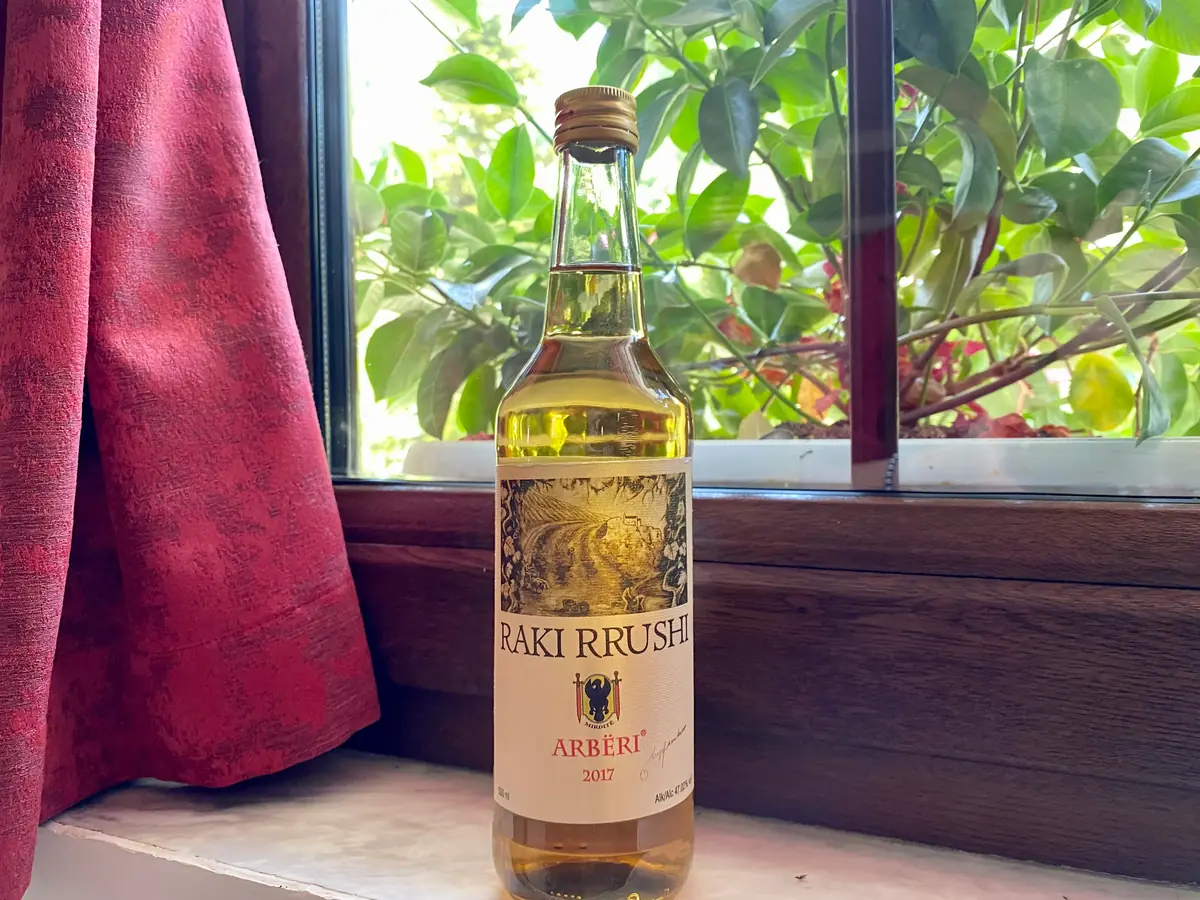
Raki is Albania’s national spirit — a 40-55% ABV fruit brandy, almost always homemade, with grape (Skrapar), plum (Korçë, Pogradec, Dibër), mulberry (Përmet, Leskovik, Erseke), and cherry plum (Shala Valley) all considered serious styles. Beyond raki: Korça beer (brewed since 1928), Birra Tirana, Kallmet red wine, çaj mali (mountain tea), salty dhallë, and boza.
Most Page-1 guides treat raki as one drink. It is not. Skrapari raki (grape) is the most prestigious — clear, clean, 45% ABV, the digestif of choice at every formal Albanian dinner. Përmet mulberry raki (raki mani) is amber-colored, sweeter, and rarer — outside the south, you almost never see it commercially. Korçë and Pogradec do excellent plum raki (raki kumbulle). Shala Valley cherry plum raki is the dark horse — smoky, slightly bitter, almost like a lightly aged grappa.
Refusing the first raki of a meal is considered rude. The toast is “Gëzuar” (geh-ZOO-ar), pronounced with the stress on the second syllable. A guesthouse owner in Theth poured me three rakis from three unmarked bottles before 8 a.m. — grape, plum, and a deep amber mulberry — and walked off without explaining which was which. The mulberry stayed with me long after the lamb did.
For non-spirit drinks: Korça beer is the country’s oldest brewery, operating since 1928. Birra Tirana, Birra Stela, and Birra Kaon round out the local lineup. Albanian wines are improving fast — try Kallmet (a red from the north, around Lezhë), Shesh i Zi, and the Italian-style varietals from Alpeta in Berat. Çaj mali, brewed from Sideritis (mountain tea) flowers, is the country’s daily caffeine alternative. Boza is a fermented corn-and-wheat-flour soft drink, non-alcoholic in the Albanian version, slightly sour, an acquired taste.
What should you eat in each Albanian region?
Each region has a non-negotiable dish. Eat fërgesë in Tirana, lakror and bean-filled byrek in Korçë, sarma and tave krapi (carp) in Shkodër, vienez (cheese-walnut beef rolls) in Berat, qifqi and kukurec in Gjirokastër, peshk në zgarë on the Sarandë promenade, and flija in Theth or Valbona.
| Region | Signature dish | Where to order | Price (ALL) | Pronunciation |
|---|---|---|---|---|
| Korçë | Lakror | Cegora Bakery, central Korçë | 200-500 | lah-KROR |
| Shkodër | Tave krapi (carp) | Marina Seafood 4VM | 400-700 | TAH-veh KRAH-pee |
| Berat | Vienez | Antigoni Restaurant | 600-900 | vee-eh-NEZ |
| Gjirokastër | Qifqi | Taverna Kuka | 300-500 | CHEEF-chee |
| Sarandë | Grilled sea bass | Promenade tavernas | 700-1,200 | — |
| Theth/Valbona | Flija | Mountain guesthouses | 500-900 | FLEE-yah |
Vienez in Berat is the dish nobody mentions outside the country: thin slices of beef rolled around kashkaval cheese and walnuts, baked in a tomato sauce. It tastes like Italian-Albanian comfort food. Antigoni does the canonical version. In Gjirokastër, kukurec (intestine wrapped around organ meat, grilled over coals) is the dish I most wish I’d ordered — it’s an acquired-taste regional specialty, not for first-timers.
How do you eat like a local in Albania?
Lunch (1-2:30 p.m.) is the biggest meal — many businesses close so families can eat together. Dinner starts at 8-9 p.m.; arriving at 6:30 p.m. means eating alone in an empty room. Bread is served free with most meals. Tipping in Albania sits around 10% — appreciated, not mandatory. Refusing food or a first raki is considered rude.
The cultural saying that runs the table is “bukë, kripë e zemër” — “bread, salt, and heart” — the standard Albanian gesture of hospitality. Meals stretch two to three hours. Greet the oldest person first when joining a table. The writing-on-air gesture asks for the bill. Cash is king outside central Tirana. Bolt is cheaper than taxis (about 300 ALL / $3.60 versus 900 ALL / $11 for the same ride). Tap water is generally fine for locals; bottled is recommended for visitors.
Pro Tip: I asked a Berat host how to say “I’m full.” She laughed: “You don’t. You eat the next plate or you say faleminderit four times in a row.” Faleminderit (fah-leh-meen-DEH-reet) means thank you.
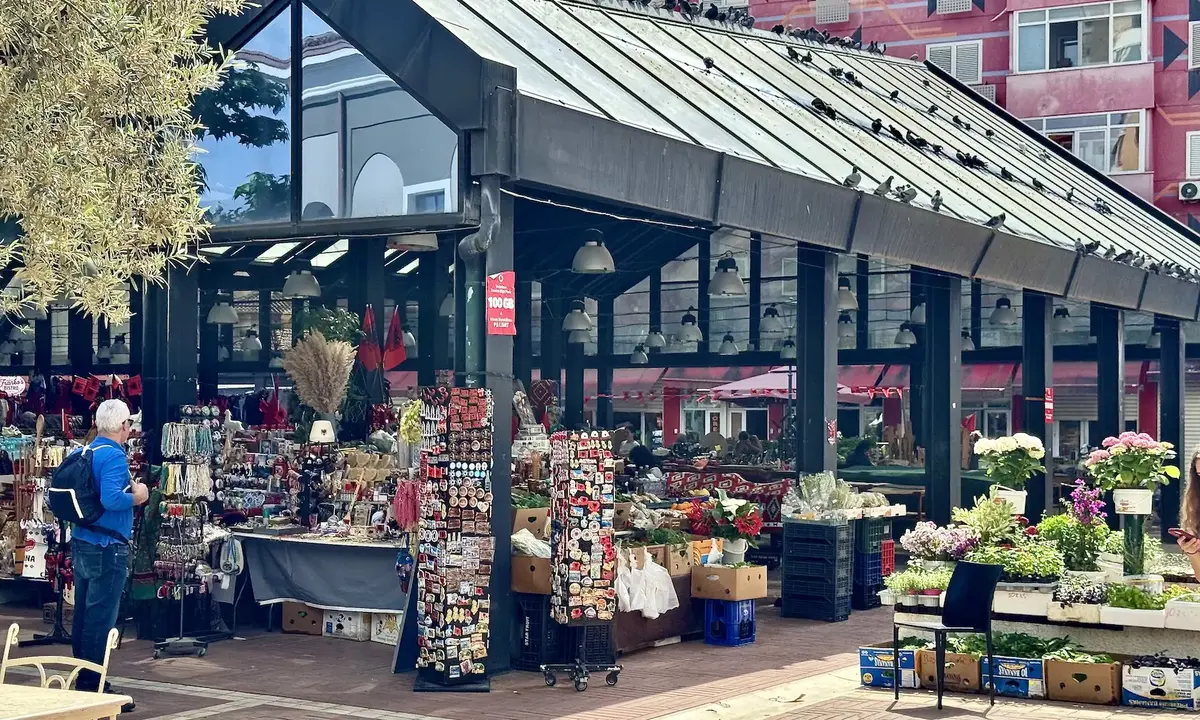
The one underrated Tirana experience: Pazari i Ri at 8 a.m.
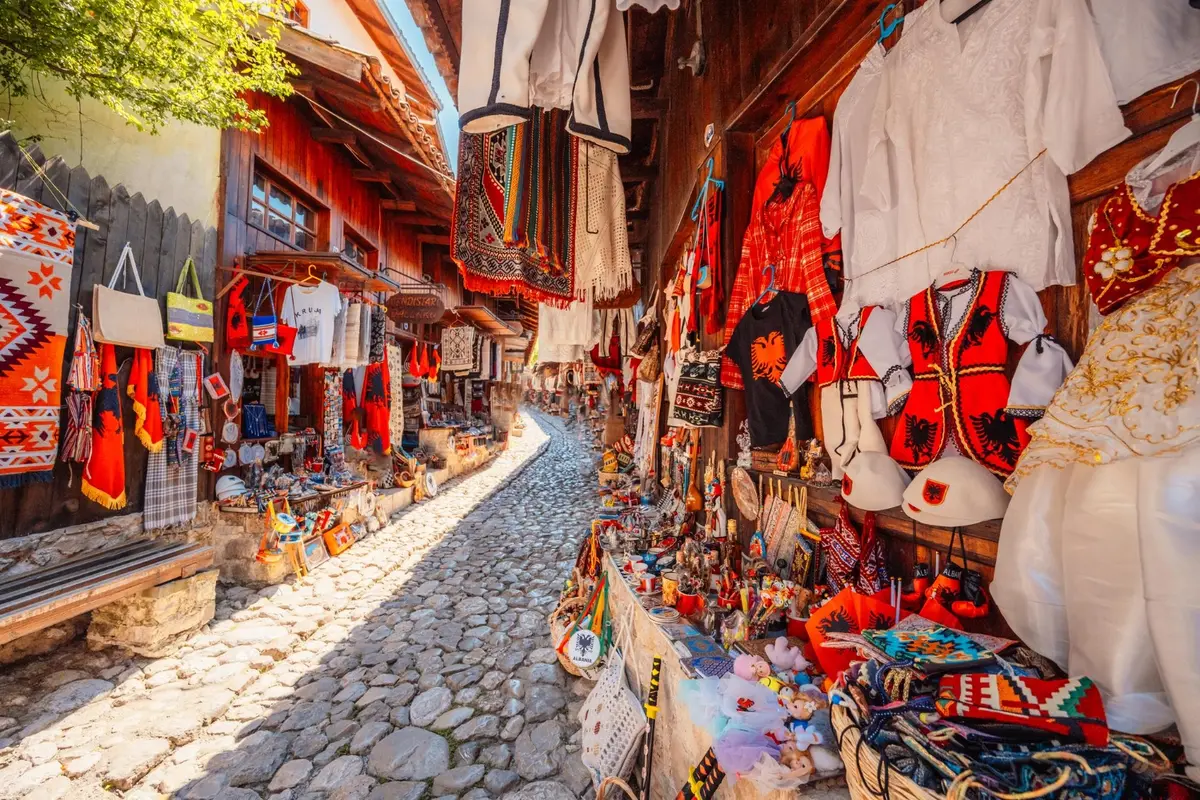
Pazari i Ri (the New Bazaar) at 8 a.m. is Tirana’s best free food experience — and one of the best free things to do in Tirana overall. Stalls overflow with seasonal produce, gjizë, djathë i bardhë (white feta-style cheese), unlabeled olive-oil bottles, and homemade honey. Cafés around the square serve byrek and macchiato for under 250 ALL ($3). Skip the Skanderbeg Square restaurants — eat here.
The bazaar covers about three city blocks. The outer ring is restaurants, the inner ring is produce, dairy, and bakery, and the perimeter has zgaras (charcoal-grill houses) and small byrektore. Walk a slow loop, buy a single piece of fruit at one stall and a wedge of djathë i bardhë at another, then stop at a counter for a 100-ALL macchiato.
The contrarian take: Skanderbeg Square restaurants charge 2x the city average for half the quality. They aim at tourists who don’t know better. Walk two blocks in any direction (especially toward Pazari i Ri) and you’ll eat better for less.
A pronunciation guide so you can actually order
Albanian pronunciation is mostly phonetic, but the diacritics trip travelers up. “ë” is a soft schwa (like the “u” in “bun”). “ç” is “ch.” “xh” is “j” as in “jam.” “q” is “ch” as in “cheese.” Use the table below to order without a dictionary.
| Dish | Spelling | Pronunciation | Translation |
|---|---|---|---|
| Tavë kosi | Tavë kosi | TAH-veh KOH-see | Yogurt-and-lamb casserole |
| Fërgesë | Fërgesë | FER-geh-suh | Clay-baked peppers + cheese |
| Byrek | Byrek | BUR-ek | Filo pie |
| Qofte | Qofte | CHOF-teh | Grilled meatballs |
| Trileçe | Trileçe | tree-LEH-cheh | Three-milks cake |
| Çaj mali | Çaj mali | chai MAH-lee | Mountain tea |
| Gjizë | Gjizë | JEE-zuh | Albanian ricotta |
| Mullixhiu | Mullixhiu | moo-LEED-joo | The mill |
| Pispili | Pispili | pees-PEE-lee | Spinach cornbread |
| Lakror | Lakror | lah-KROR | Korçë layered pie |
| Qifqi | Qifqi | CHEEF-chee | Gjirokastër rice ball |
| Gëzuar | Gëzuar | geh-ZOO-ar | Cheers |
I mispronounced “gjizë” as “GIZE” for three days before a waitress in Berat finally corrected me — she said it “JEE-zuh,” three times, slowly, the way you’d teach a child.
What are the best Albanian desserts (and what to drink with them)?
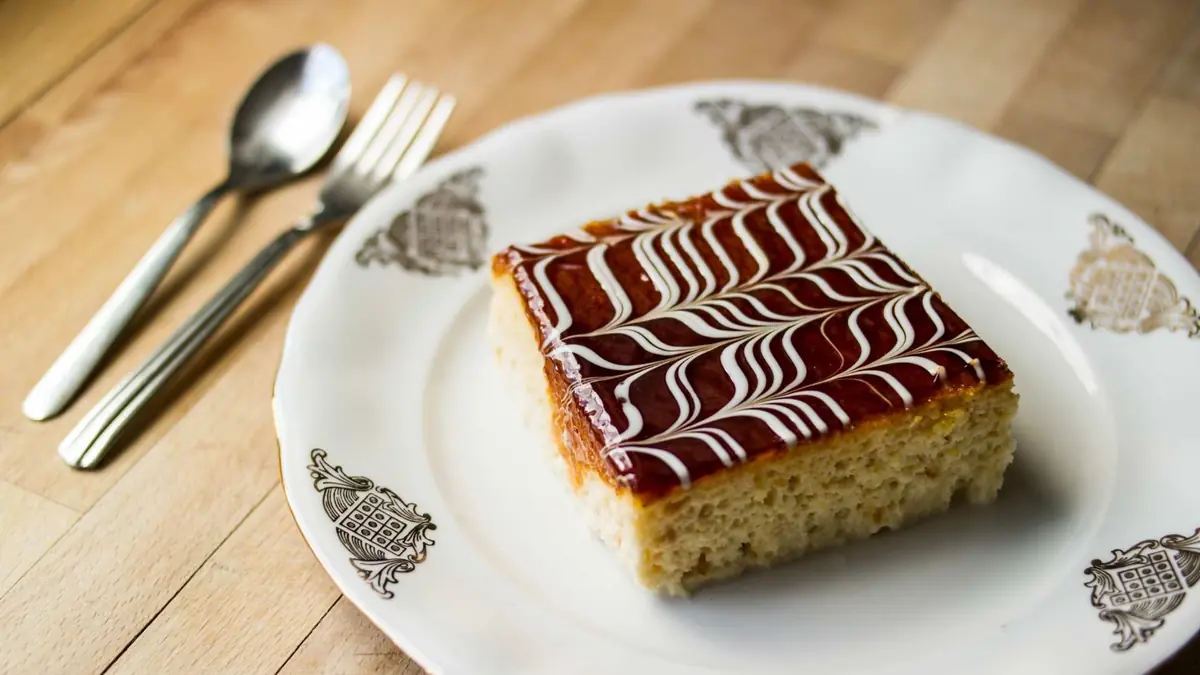
Trileçe is the universal Albanian dessert — sponge cake soaked in three milks (cow, goat, evaporated) with caramel on top. Drink Turkish coffee with it. Baklava is the Albanian-walnut version (less cloying than Turkish). Drink raki. Round out the dessert tour with kadaif (shredded filo with walnuts), sheqerpare (syrup-soaked pastry), ballokume (Elbasan butter cookie), petulla (fried dough), and ashure (cold sweet porridge with grains and dried fruit).
The best slice of trileçe I had was at Elinikon Bakery in Tirana — 220 ALL, eaten with a macchiato, while the wifi password was scrawled in lipstick on a napkin. Just Go Exploring rates a Shkodër café version higher, served cold with cinnamon.
A few notes on the lesser-known sweets. Ballokume is tied to Dita e Verës (Summer Day, March 14), an Albanian holiday from Elbasan. Ashure is traditionally prepared by Bektashi Muslim communities for the Ashura observance. Albanian baklava uses walnuts, not pistachios, and watered-down honey rather than syrup — it’s lighter than the Turkish or Greek versions, easier to eat at the end of a long meal.
A modern Albanian food movement: chefs reinventing the cuisine
A new generation of Albanian chefs is reinterpreting the country’s food. Bledar Kola at Mullixhiu (ex-Noma, ex-Fäviken; on the World’s 50 Best Discovery list) grinds his own flour and sources almost entirely from small local farms. At Mrizi i Zanave, Altin Prenga runs an agritourism slow-food restaurant. Uka Farm, Salt Tirana, and Edua in Gjirokastër follow the same farm-to-table thread.
Mullixhiu’s tasting menu features dishes like trahana with fermented mulberries, quail with plum sauce, and a bread course where they grind flour onstage from heirloom Albanian wheat. The restaurant’s walls are dried sweetcorn husks pressed between glass. The chef walks the dining room himself most nights. At my third course — a single fermented-mulberry-glazed trahana grain — Bledar Kola walked over, tapped the bowl, and said in English, “My grandmother made this. I just made it harder.”
Mrizi i Zanave hosts live bands and dancing on weekends. Uka Farm leads the Tirana farm-to-table movement just outside the city. Edua in Gjirokastër revives near-lost dishes like osa me mish qengji (a hand-rolled pasta with lamb) using a wooden shoshi tool. None of these existed a generation ago.
Why Albania is the most under-the-radar food destination in Europe
Albania welcomed 12.47 million foreign tourists in the most recent reported full year (per INSTAT) — a 6.6% jump — with US arrivals up 45% in the latest reported quarter. Foreign visitors spent an estimated €5.7 billion (about $6 billion), a record. The food scene is still cheap, still authentic, still ahead of the curve.
The math on what a trip to Albania costs is hard to argue with. A full meal in Tirana with wine averages 1,200-1,800 ALL ($14.50-$22). The same meal in Rome runs €40-50 ($44-$55). The same meal in Athens or Barcelona sits in between. Albania is roughly one-third the price for food that’s just as good and often more interesting because it hasn’t been homogenized for international tastes.
The window will close. I asked a Sarandë restaurant owner if prices had gone up. He shrugged and said: “A little. The Americans don’t argue.”
Before you book
TL;DR: Albanian food is a Mediterranean-Balkan-Ottoman cuisine built on byrek (anywhere, $0.50), tavë kosi (Oda in Tirana, $6-$11), and fërgesë (any taverna, $4-$7); it is not spicy, not just Greek, and ranks among Europe’s healthiest. Eat lunch at 1 p.m., dinner at 9 p.m., book Mullixhiu’s $33 tasting menu in advance, and bring cash.
Three things to do as you plan your Albania trip: download Bolt for cheap rides, withdraw 10,000-15,000 ALL in cash on arrival (avoid Euronet), and book Mullixhiu and Mrizi i Zanave at least a week ahead — both fill up. Pack a few stretchy waistband pants. You’ll need them.
What dish are you most excited to try first — the qofte at Te Met Kodra, the tavë kosi at Oda, or the fërgesë in a clay pot? Tell me in the comments which Albanian region you’re heading to and I’ll send back two more spots most guides miss.