Albania’s bunkers outnumber its gas stations. Roughly 173,371 concrete domes still squat in fields, on beaches, and along Tirana sidewalks — the relic of Enver Hoxha’s paranoid bunkerization program. Two of them rank among Tirana’s best museums, a ten-minute drive apart, and this guide covers exactly how to visit both.
Albania built 173,371 concrete bunkers under Communist leader Enver Hoxha. You can walk inside two converted nuclear shelters in Tirana — Bunk’Art 1 near the Dajti cable car and Bunk’Art 2 on Skanderbeg Square — each costing 900 lek (about $11). Step into Bunk’Art 1 in July and the air drops from a sticky 95°F (35°C) to a damp, constant 61°F (16°C). Bring a layer; the cold is the first thing you notice.
Why does Albania have 173,371 bunkers? The Hoxha story in plain English
Albania has 173,371 bunkers because Communist leader Enver Hoxha — who broke with the Soviet Union in 1961, abandoned the Warsaw Pact in 1968, and severed ties with Mao’s China in 1978 — feared invasion from every direction at once. Between 1967 and 1986 his bunkerization program turned the entire country into a fortress.
Hoxha ruled from 1944 to 1985, and the longer he ruled, the fewer allies he had. Albania was the only European country to leave the Warsaw Pact, and it did so after the Soviet invasion of Czechoslovakia spooked an already isolated regime. By the late 1970s the country had no formal allies left — not Moscow, not Belgrade, not Beijing.
The financial damage was real. Per Wikipedia’s “Bunkers in Albania,” the construction of prefabricated bunkers alone cost an estimated two percent of net material product, and the program in total cost more than twice as much as France’s Maginot Line while consuming three times as much concrete. A poor country poured its economy into concrete mushrooms that were never fired in anger.
Pro Tip: You only register the scale when a local treats it as background noise. My taxi driver waved at a roadside bunker the way an American points out a billboard — barely a glance.
One number gets misquoted constantly. The headline figure of 750,000 bunkers was Hoxha’s plan, not the built count. Declassified government papers put the actual number completed by 1983 at 173,371. Most guidebooks still lead with the bigger, wrong figure because it sounds more dramatic.
Bunk’Art 1 vs Bunk’Art 2: which should you visit with one day?
If you have a full day, choose Bunk’Art 1 — at 5 underground floors, 106 rooms, and 32,000 square feet (3,000 m²), it is far larger and tells the broader story from World War II to the regime’s collapse. If you have half a day or are short on time, Bunk’Art 2 next to Skanderbeg Square delivers the secret-police story in 90 focused minutes.
Here is the side-by-side that no other guide bothers to lay out:
| Bunk’Art 1 | Bunk’Art 2 | |
|---|---|---|
| Location | Rruga Fadil Deliu, eastern Tirana, ~3.7 miles (6 km) from center | Rruga Abdi Toptani, on Skanderbeg Square |
| Ticket | 900 lek (~$11) | 900 lek (~$11) |
| Combo ticket | 1,300 lek (~$16), valid 72 hours | 1,300 lek (~$16), valid 72 hours |
| Time needed | 2–3 hours | 1–1.5 hours |
| Subject | 20th-century Albanian history, the regime, daily life | The Sigurimi secret police, surveillance, interrogation |
| Accessibility | Stairs throughout, not wheelchair-friendly | Stairs throughout, not wheelchair-friendly |
| Kids | Heavy themes but manageable | Graphic interrogation content, not for under-12s |
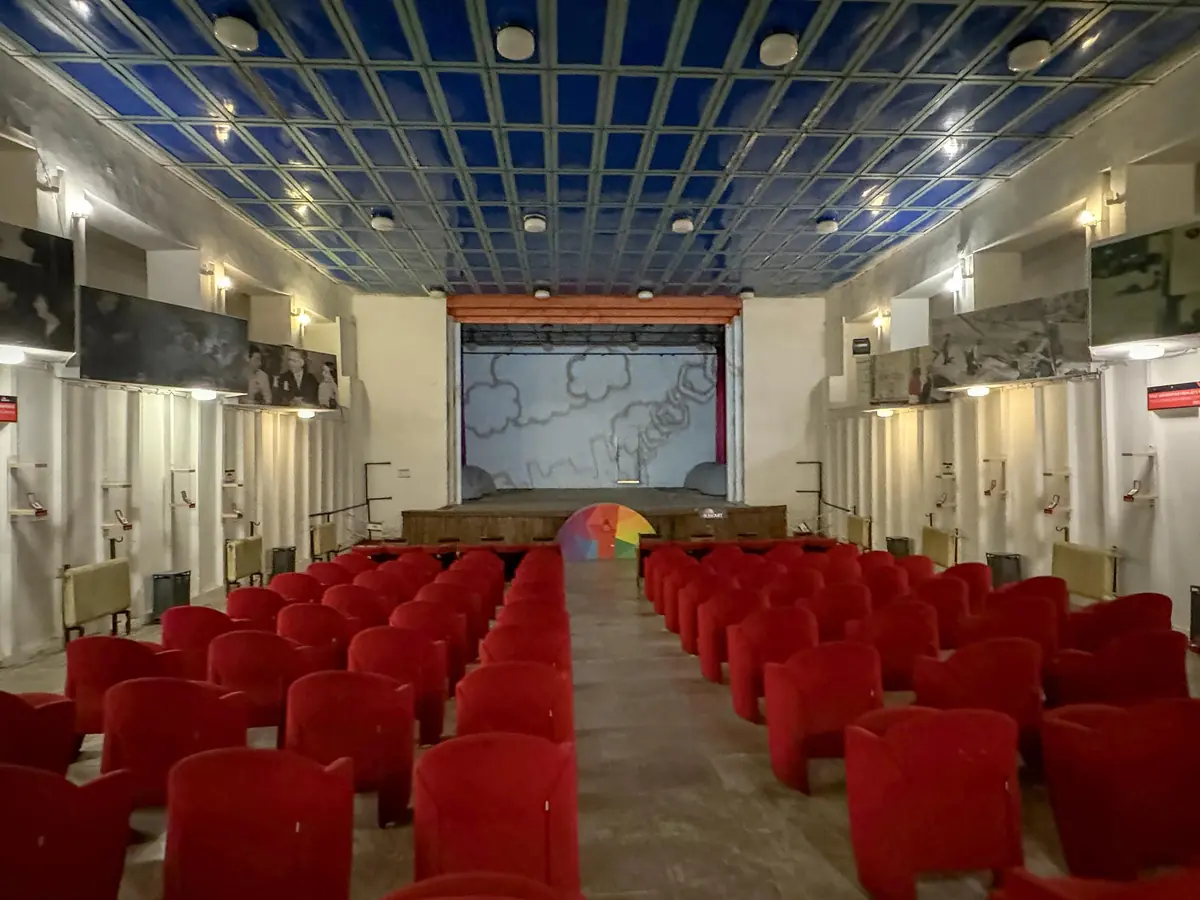
The deciding factor for most people is one room. Bunk’Art 1’s underground assembly hall — two stories tall, rows of seats facing a stage cut into the rock — is the moment that converts skeptics. There is nothing like it at Bunk’Art 2. But Bunk’Art 2’s reconstructed interrogation room does something the bigger museum does not: it makes the regime personal rather than architectural.
How do you get to Bunk’Art 1 from Skanderbeg Square?
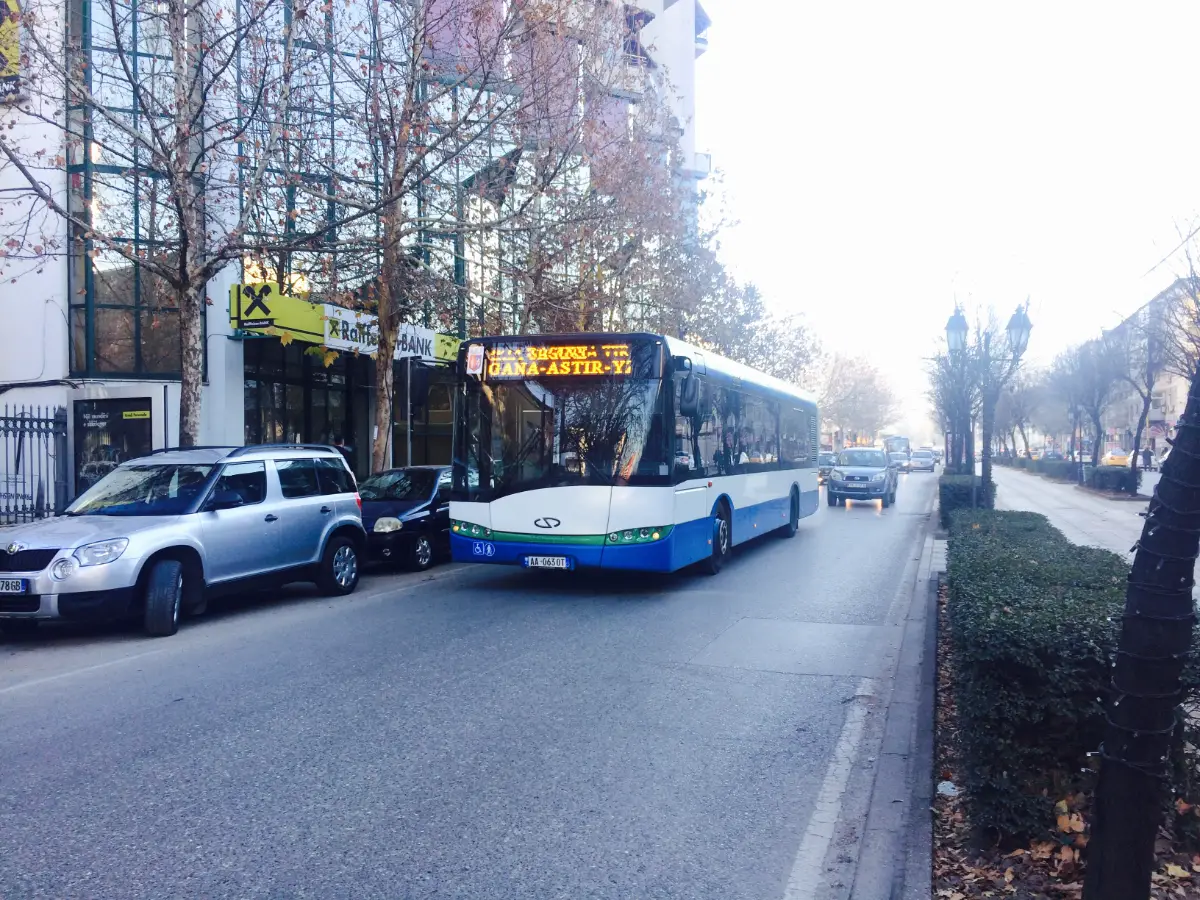
From Skanderbeg Square, take the blue L11 bus to the Porcelan stop — 40 lek (about 49 cents), 25 to 30 minutes, leaving roughly every 15 minutes from behind the Opera. A metered taxi costs 700 to 900 lek (about $8.50 to $11) and takes 15 to 20 minutes. The entrance is a 5-minute walk uphill from the bus stop.
Three ways to reach it, ranked by what you’re optimizing for:
- Cheapest: Bus L11 toward “Porcelan” or “Teleferiku.” Pay the on-board conductor in cash; a 100 or 200 lek note works.
- Fastest: A metered taxi or a rideshare-style app. 15 to 20 minutes door to door.
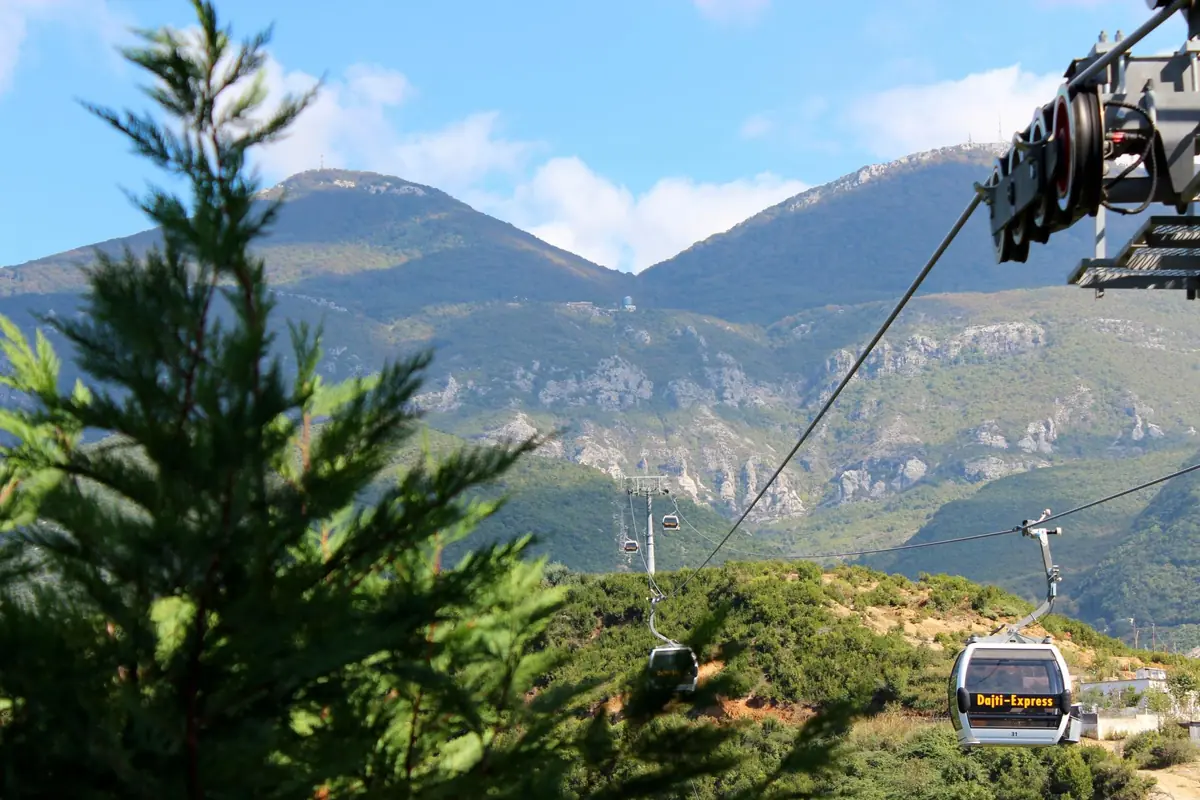
- Best combined plan: Bunk’Art 1 sits about a 10-minute walk from the Dajti Ekspres cable car lower station, so doing both in one trip avoids any backtracking.
Pro Tip: The L11 conductor counts change by feel without looking up. Hand over 100 lek and you’ll get 60 back in five-lek coins — keep small notes for the return.
What does Bunk’Art look like inside? A walk through the 5-floor shelter
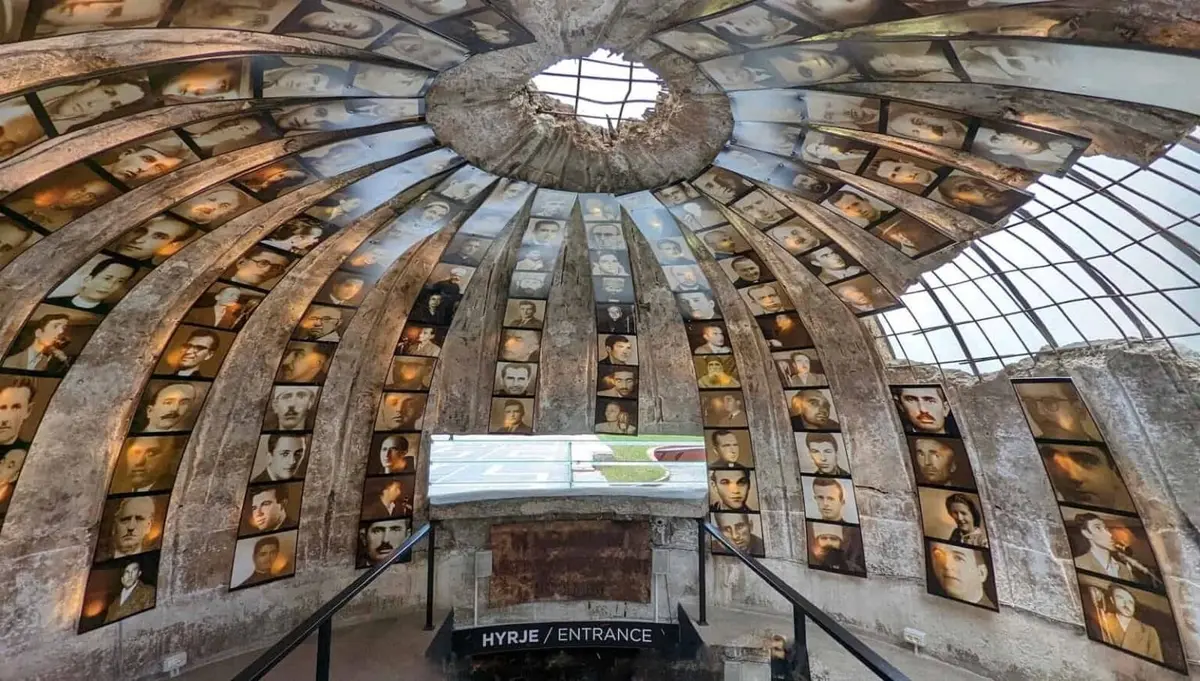
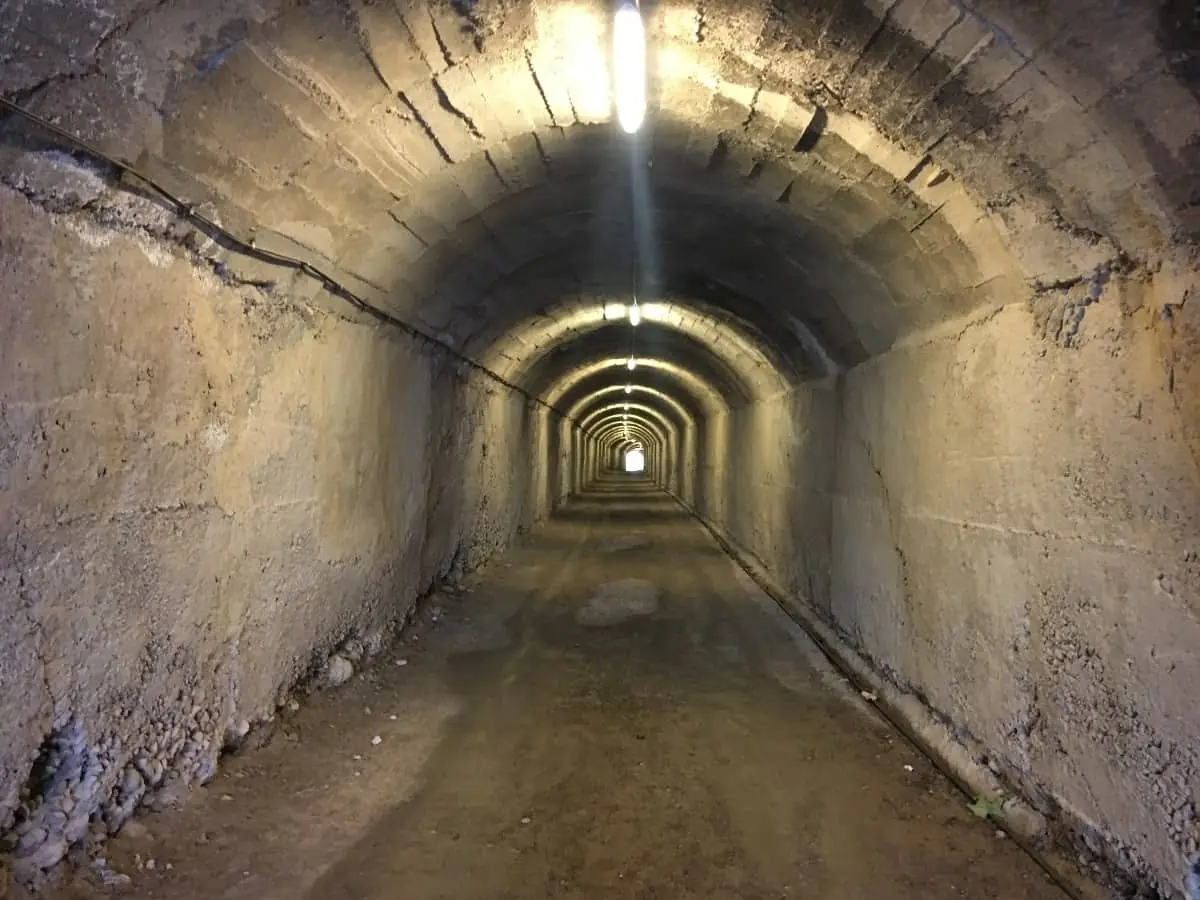
Bunk’Art 1 starts with an open-air approach tunnel — roughly 660 feet (200 m) of curved concrete cut straight through the hillside, wide enough for a single car. It opens onto a wooded path, a ticket booth, and the original blast doors. Inside, 106 rooms unfold across 5 underground floors, including the preserved quarters of Hoxha and Prime Minister Mehmet Shehu.
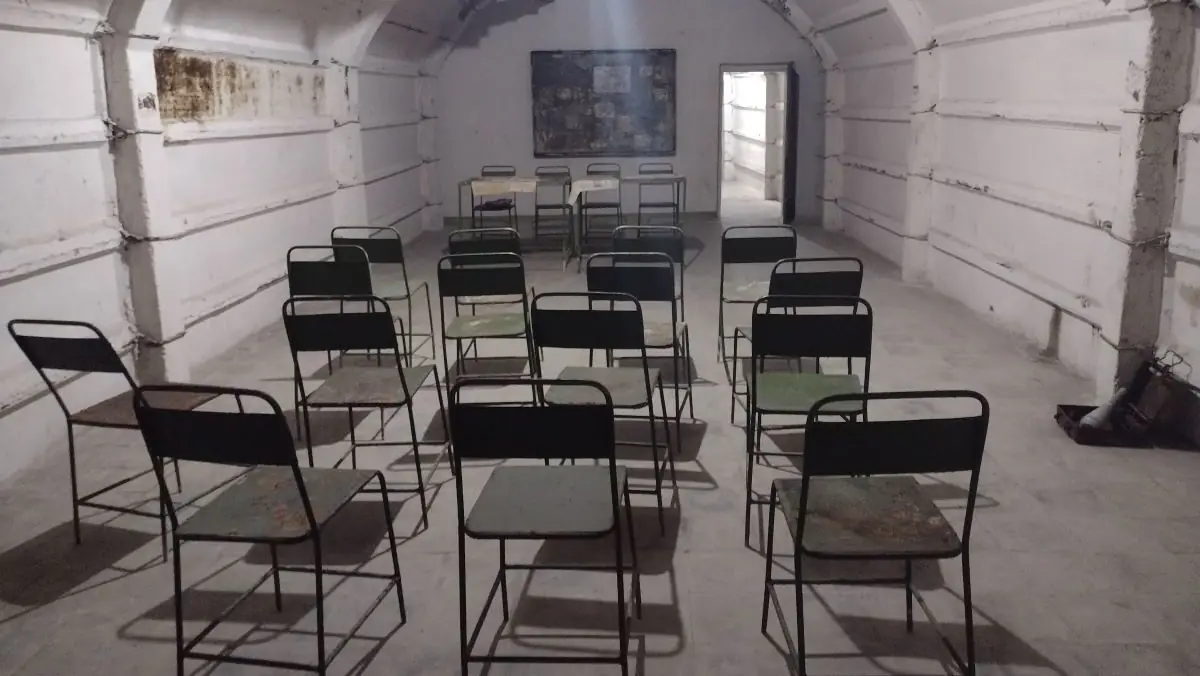
The shelter was built from 1972 to 1978 under the codename Objekti 0774. It was meant to keep the regime’s leadership alive through a nuclear strike that never came. You pass a preserved decontamination shower near the entry, then descend past dormitories, a reconstructed 1980s grocery shop, and the assembly hall that now hosts jazz concerts.
The sensory details are the reason to go in person rather than read about it:
- Temperature holds around 61°F (16°C) year-round, and the walls feel damp to the touch.
- The corridor lights run on a timer. Stop too long at a panel and you can be left briefly in pitch dark while water drips somewhere behind the concrete.
- Photography is allowed without flash, and the long entry tunnel echoes every footstep.
Pro Tip: Arrive at the 9:30 AM opening and you’ll have the first three corridors entirely to yourself. By 11 AM the Italian tour groups fill the assembly hall and the timed lights start working against you.
How much does Bunk’Art cost, and is the combo ticket worth it?
A standard adult ticket to either Bunk’Art 1 or Bunk’Art 2 is 900 lek, about $11. The audio-guide-app version is 1,000 lek (about $12). A combined ticket covering both museums is 1,300 lek (about $16) and stays valid for 72 hours, so you can split the two visits across different days.
The combo is worth it for almost everyone, because the two singles already total 1,800 lek and you save 500 lek (about $6) by buying both at once. The only reason to skip it is a genuinely short layover where you can realistically see one museum and not the other.
A few practical money notes from doing this myself, beyond the broader Albania travel costs:
- Cost (single): 900 lek (~$11) for Bunk’Art 1 or Bunk’Art 2
- Cost (combo): 1,300 lek (~$16), both museums, valid 72 hours
- Audio guide: a downloaded app, +100 lek — bring your own headphones
- Payment: bring cash; only the larger Bunk’Art 1 reliably takes cards
- Nearby add-ons: the House of Leaves surveillance museum is a separate 700 lek (~$8.50) ticket
Pro Tip: The Bunk’Art 2 ticket prints a QR code that you scan on the way in and again on the way out. Lose it and you’ll backtrack a corridor to sort it out.
Bunkers beyond Tirana: Gjirokastër, Porto Palermo, Sazan and Llogara
Beyond Tirana, four bunker sites reward a detour. The Gjirokastër Cold War Tunnel runs about half a mile (800 m) under a UNESCO-listed old town. The Porto Palermo submarine tunnel sits in a still-restricted naval bay near Himarë. Sazan Island, off Vlorë, holds roughly 3,600 bunkers. The Llogara Pass “Big Bunker” overlooks the Ionian from above 2,000 feet (610 m).
Gjirokastër Cold War Tunnel
Cut beneath the stone city of Gjirokastër, this tunnel was built in the early 1970s as a shelter for about 300 people if the bombs fell. The guide walks you through bare command rooms and a long, cold spine of corridor; the temperature holds near 59°F (15°C) even in August. The 20-minute tour is one of the best-value cultural stops in southern Albania.
- Location: Çerçiz Topulli Square, next to the Town Hall, Gjirokastër Old Town
- Cost: 200 to 400 lek (about $2.45 to $5)
- Best for: History travelers doing the southern Albania loop
- Time needed: 20 to 30 minutes including the guided walk
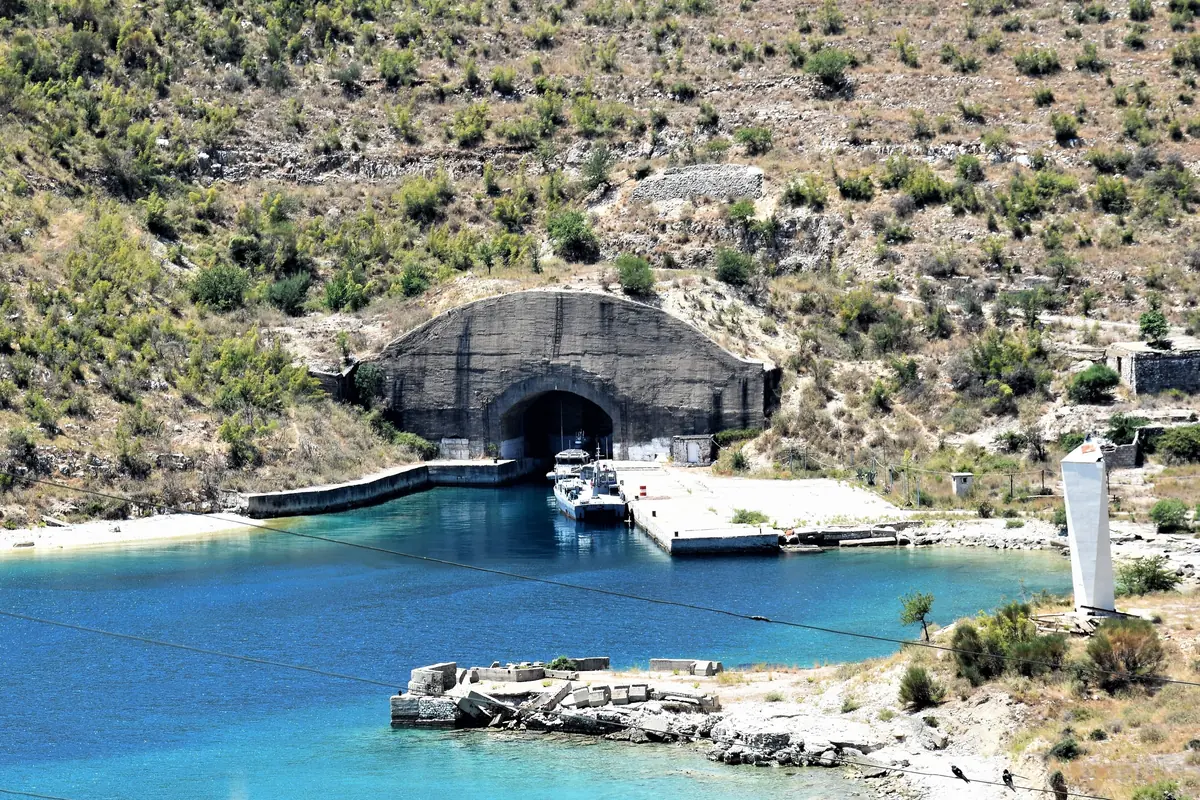
Porto Palermo submarine tunnel
This is a look-but-don’t-enter site. A 2,130-foot (650 m) tunnel was carved into the headland near Himarë to hide four Soviet Whiskey-class submarines, and the interior still sits inside a military restriction zone. You view the entrance from the coastal road above the bay — dramatic from a distance, off-limits up close.
- Location: Porto Palermo bay, off the SH8 coastal road near Himarë
- Cost: Free (exterior viewing only)
- Best for: Road-trippers on the Albanian Riviera, photographers
- Time needed: 15 to 20 minutes from the roadside viewpoint
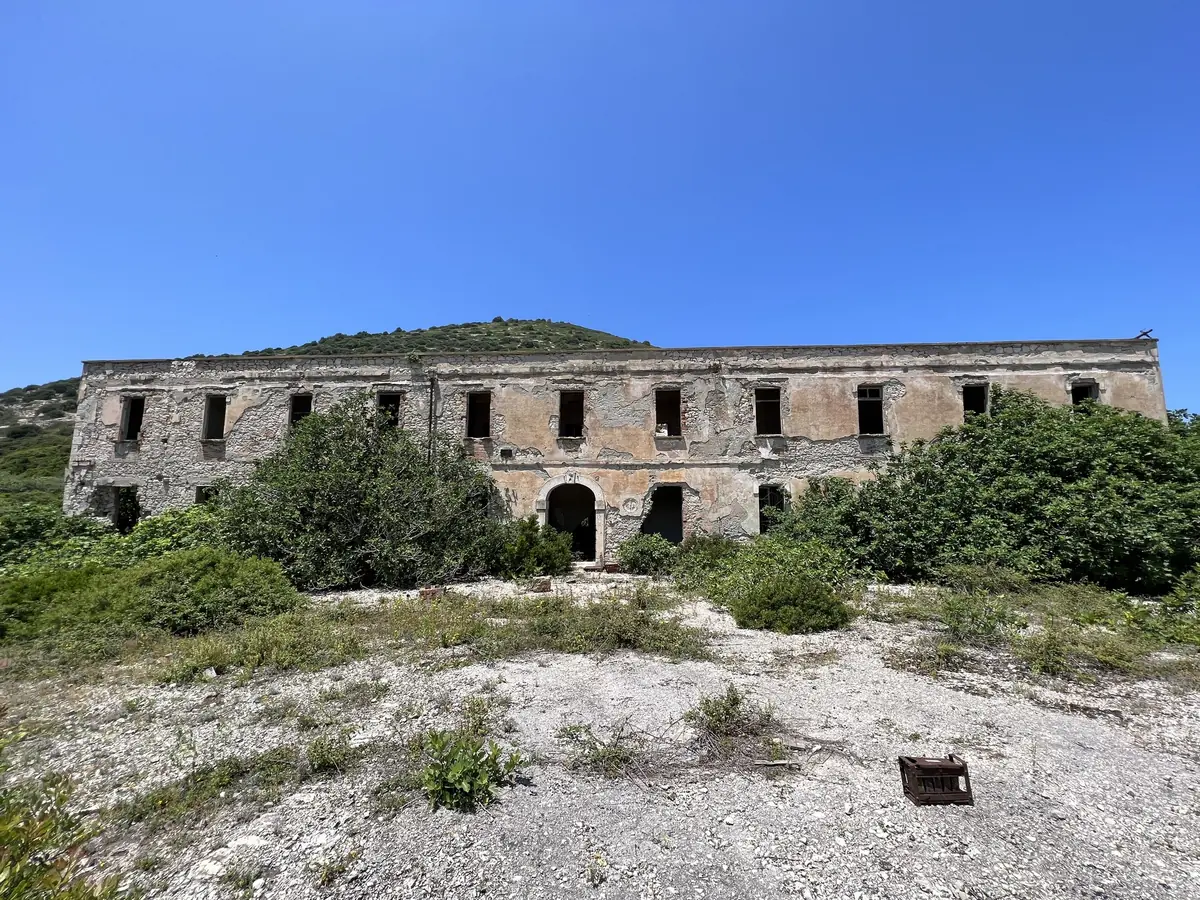
Sazan Island
A short boat ride from Vlorë port lands you on a militarized island of roughly 3,600 mushroom bunkers, abandoned barracks, and a chemical-weapons-era past. Day-trip boats run only in the warmer months — the best time to visit Albania for the coast — and the trip pairs with the Karaburun-Sazan Marine Park. It is the closest thing Albania has to a true ghost-island.
- Location: Sazan Island, Bay of Vlorë (boat from Vlorë port)
- Cost: about $27 to $60 for a day-trip boat tour
- Best for: Dark-tourism and urban-exploration travelers
- Time needed: Half a day including boat transfer
Llogara Pass “Big Bunker”
A three-story bunker complex clings to a hairpin on the Llogara Pass at about 2,000 feet (610 m), with the Ionian dropping away below. There is no ticket and no guide — just stairs of broken glass and rebar leading to upper floors with a long-range view down the coast.
- Location: Llogara Pass, SH8 coastal road, Ceraunian Mountains
- Cost: Free
- Best for: Confident self-drivers and photographers
- Time needed: 20 to 30 minutes
Pro Tip: At the Llogara Big Bunker the stairs to the upper floors are broken glass and rebar. Wear closed-toe shoes and bring a phone flashlight — there is no lighting and no railing.
QZ vs PK: the two bunker designs you’ll see everywhere
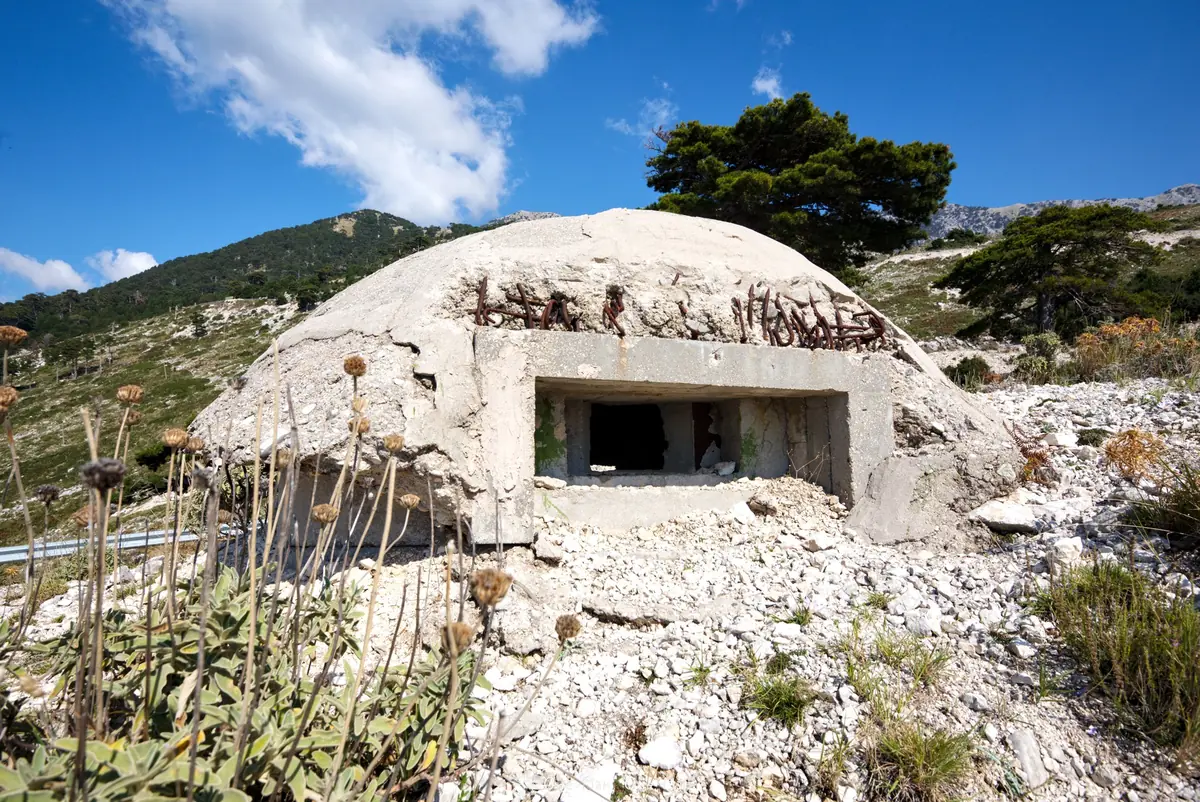
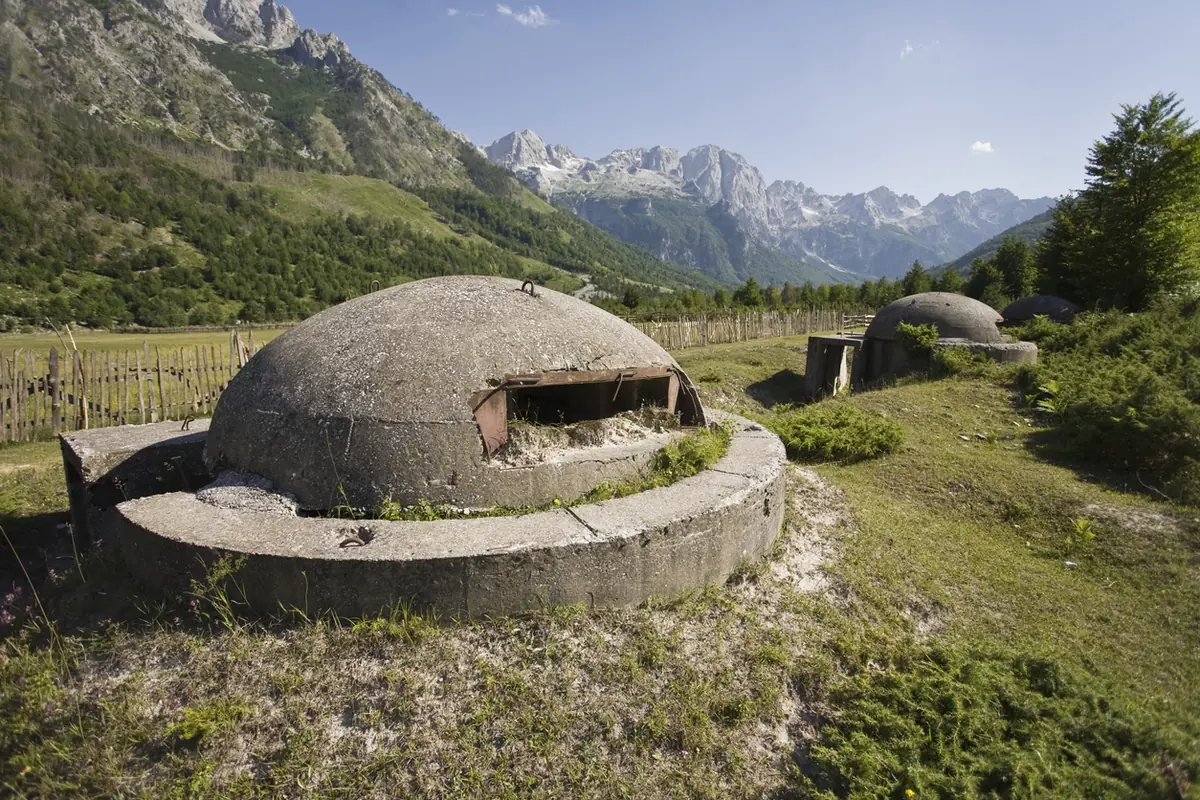
Two designs dominate the countryside. The Qender Zjarri (“firing position,” or QZ) is the small mushroom dome in fields — 6.9 feet (2.1 m) tall, 5.9 feet (1.8 m) wide, with walls roughly 12 inches (30 cm) thick. The Pikë Zjarri (“firing point,” or PK) is the larger command bunker, up to 26 feet (8 m) across with much thicker walls.
The QZ was prefabricated in factories and trucked to its position, designed for one or two riflemen behind a single slit. The PK was cast on site, with walls up to about 39 inches (1 m) thick, built to hold up to ten people plus command equipment. In an average square kilometer you’d find roughly two dozen QZ domes and a single PK.
The engineer behind the dome was Josif Zagali, a World War II partisan who designed the shell to deflect tank fire. Per Wikipedia’s “Bunkers in Albania,” Zagali was purged in 1974 and imprisoned for eight years on false charges of sabotage. The man who armored the regime ended up a prisoner of it.
Pro Tip: Crawl inside a coastal QZ and the firing slit frames the sea like a horizontal letterbox. You understand the boredom of a Cold War lookout in about two seconds.
Can you actually go inside Albania’s roadside bunkers?
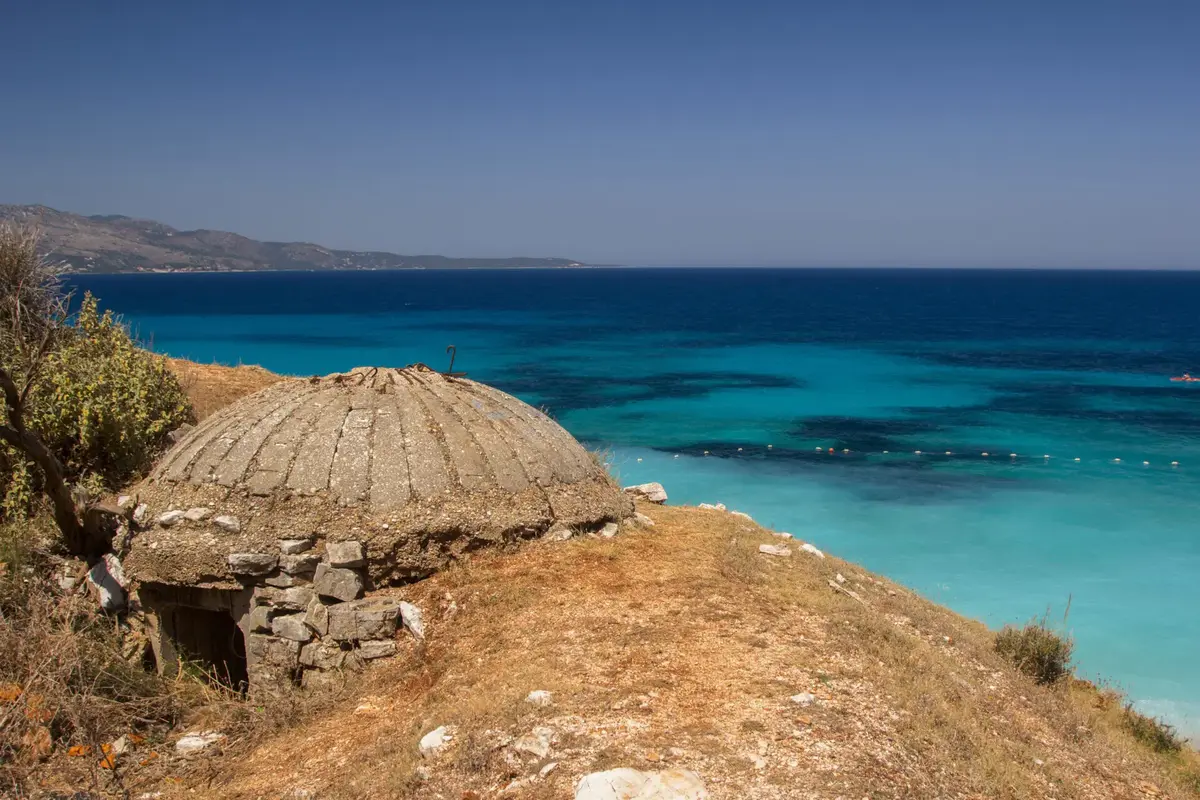
Yes — many roadside QZ pillboxes are unlocked or open, and you can crawl inside. They legally remain Albanian military property, but where a bunker sits on private land the owner uses it freely. Watch for broken glass, snakes in summer heat, and standing water, and bring a flashlight plus closed-toe shoes before climbing in.
In practice, landowners have repurposed thousands of them — chicken coops, tool storage, roadside cafés, even a cheese-aging chamber at the farm-restaurant Mrizi i Zanave. Along the Albanian Riviera near Qeparo and Himarë, some have been painted with murals and bright patterns, which makes for the most photogenic versions of an otherwise grim object.
Pro Tip: The QZ on the Llogara turn near Palasë smells faintly of woodsmoke and is full of empty Birra Korça bottles. Locals use it as a wind shelter — a small, honest detail about what these bunkers became.
What are Bunk’Art’s hours, and what should you bring?
Bunk’Art 1 opens daily at 9:30 AM and closes mid-to-late afternoon, with slightly later closing on weekends. Bunk’Art 2 keeps longer hours, opening at 9 AM and running into the evening, later still toward the weekend. Both close briefly around New Year’s Day. Bring cash in lek, a light layer for the 61°F (16°C) interior, and your own headphones.
A quick pre-visit checklist:
- Cash: bring lek; the smaller Bunk’Art 2 may not take cards
- Layer: the interior holds near 61°F (16°C) and feels damp
- Headphones: the audio guide is an app, not a handset
- Footwear: many stairs, no elevators, not stroller-friendly
- Timing: the 72-hour combo lets you split the two museums across days
Pro Tip: Confirm the day’s exact closing time at the ticket booth on arrival — Bunk’Art adjusts hours seasonally, and the last entry is well before the posted close.
2 bunker myths to kill (and which Bunk’Art wins)
Two myths deserve killing. First, the famous “750,000 bunkers” figure was Hoxha’s plan, not the built count — declassified papers put the real number at 173,371. Second, Bunk’Art 2 is routinely called the “lite” option, but for a US traveler with one free afternoon, its secret-police exhibit hits harder than Bunk’Art 1’s sheer scale.
Here is the unpopular opinion stated plainly: if you only have time for one, and you’re not a completionist, go to Bunk’Art 2. The conventional verdict — repeated by nearly every guidebook — is that Bunk’Art 1 always wins because it’s bigger. Bigger is not the same as more affecting. Bunk’Art 1 fills your camera roll. Bunk’Art 2 sends you out onto Skanderbeg Square quiet for an hour.
The other overstated story is the “every family defended their own bunker” line. Civil-defense drills were frequent and the rifles were real, but the romance of universal armed readiness is thinner than the concrete. Most of these domes were never assigned to anyone in particular.
How do you see Tirana’s bunkers in one day?
Start at 9:30 AM at Bunk’Art 1 and allow about 2.5 hours. Walk 10 minutes to the Dajti Ekspres cable car for a round trip up Mount Dajti around 12:30 PM (allow 1.5 hours with the view). Have lunch on the mountain by 2 PM, ride the L11 bus back, and reach Bunk’Art 2 by around 5 PM for 90 minutes. Total spend lands near $50.
Mapped out with real costs:
- 9:30 AM: Bunk’Art 1, 900 lek (~$11), allow 2.5 hours
- 12:30 PM: Dajti Ekspres cable car, adult return about 1,400 lek (~$17), 2.9 miles each way, ~15 minutes per leg
- 2:00 PM: Lunch on Mount Dajti, roughly 2,000 lek (~$24) per person
- 4:00 PM: Bus L11 back toward the center, 40 lek (~49 cents)
- 5:00 PM: Bunk’Art 2 on Skanderbeg Square, covered by the 1,300 lek combo ticket
The combo ticket is the quiet hero of this plan: bought at Bunk’Art 1 in the morning, it covers Bunk’Art 2 the same evening and saves you 500 lek over two singles.
Pro Tip: The cable car cabins have small scratched windows and no air conditioning, but the view over Tirana’s red roofs near sunset is the photo you’ll actually post. Time the descent for late afternoon.
Who built Albania’s bunkers?
Politically, the bunkers were ordered by Communist leader Enver Hoxha and his Politburo, with Prime Minister Mehmet Shehu overseeing construction. The engineer who designed the mushroom-domed QZ pillbox was Josif Zagali, a World War II partisan veteran. He was later purged and imprisoned by the same regime he had armored.
There is a long-repeated story that Zagali was ordered to sit inside a prototype while a tank fired on it to prove the design held. Whether or not that exact scene happened, the human cost of the program was not abstract. Per Wikipedia’s “Bunkers in Albania,” 70 to 100 people a year died building them, and conscripted labor included political prisoners.
Pro Tip: Inside Bunk’Art 1 there’s a small panel with Zagali’s face. It’s easy to walk past, but he’s the reason the entire country is shaped like concrete mushrooms.
How many bunkers are in Albania today?
Albania built 173,371 bunkers by 1983 according to declassified government papers — an average of 5.7 per square kilometer, or 14.7 per square mile. Many have since been demolished, buried, or absorbed into farms, cafés, and seawalls, but estimates still put the surviving total in the hundreds of thousands.
The destruction is uneven and slow. Demolishing a QZ is expensive because the concrete is dense and the rebar is tangled; one resident reportedly sold the scrap steel from a single bunker for about $325. So most of them simply stay where they are, weathering, while the country builds around them.
Pro Tip: Drive the SH8 from Vlorë toward Sarandë and you’ll count at least 40 bunkers in 90 minutes without trying. The density along the coast tells the story better than any museum panel.
Should Albania’s bunkers be on your trip?
Yes. If you’re planning a trip to Albania, even a single day in Tirana is enough — walking south of Skanderbeg Square to Bunk’Art 2 for 900 lek (about $11) is among the best-value cultural hours anywhere in the Balkans. Add Bunk’Art 1 and the Dajti cable car for a full day, and the Gjirokastër tunnel if you’re driving south.
TL;DR: Albania’s bunkers are worth a deliberate stop, not just a roadside glance. Do Bunk’Art 2 if you have one afternoon, both museums plus the cable car if you have a full day, and buy the 1,300 lek combo ticket the moment you arrive at the first one.
Have you been inside Bunk’Art 1 or Bunk’Art 2 — and which one stayed with you longer? Drop your verdict in the comments.