Solo female travel in Albania has a reputation problem — both ways. Friends back home ask if it’s safe; friends in Tirana laugh at the question. The truth lives in between. After 16 days from the capital to the Alps to the Riviera, here’s the honest version, with US-passport logistics and USD prices — read it as a solo-female companion to the broader Albania travel guide.
Is Albania safe for solo female travelers?
Yes. Albania is safer for solo women than most Western European cities, with one geographic caveat. Violent crime against tourists is rare, the cultural code of besa makes locals protective of guests, and the US State Department keeps the country at Level 2 — the same rating as Italy, France, Germany and the UK, and a useful baseline for whether Albania is safe for tourists more generally. The exception is the Sarandë–Ksamil stretch in peak summer.
The honest version goes deeper than that. Crime data from the Travel Ladies app puts Albania at 4.4 out of 5 for solo female safety, based on 84 first-hand reports. The Institute for Economics and Peace ranks the country 52nd out of 163 on the Global Peace Index — ahead of the United States, which sits far lower on the same list. I walked back to my Tirana hostel at 1 a.m. on Rruga Murat Toptani — quiet, well-lit, two old men playing chess outside a cafe — and felt safer than I do walking from the L train in Brooklyn.
What you should actually exercise caution about:
- Road safety: Albania has one of the highest road-fatality rates in Europe. If you’re renting a car, the danger is the driving, not the destination.
- Pickpocketing: Rare, but present in Tirana’s Skanderbeg Square and on the Tirana–Sarandë bus.
- Persistent attention from men: Concentrated on the Sarandë promenade and around Ksamil beach clubs from July through mid-September. More on this below.
- Currency scams: Avoid Euronet ATMs (10-15% worse than bank rates) and street-corner exchange offices in Sarandë that advertise “no commission.”
Pro Tip: Save the US Embassy in Tirana’s number in your phone before you fly — +355 4 224 7285. Sign up for the State Department’s STEP program online and the embassy pushes security alerts straight to your phone — useful, since they do issue them from time to time.
Where is solo female travel safest in Albania?
The safest regions for solo female travel in Albania are the central cities (Tirana, Berat, Gjirokastër), the northern alpine villages (Theth, Valbona, Shkodër) and the quieter Riviera towns (Himarë, Dhërmi). The friction reports concentrate in two coastal towns: Sarandë and Ksamil. Everywhere else, harassment ranges from rare to nonexistent.
Tirana — easiest landing for a solo woman
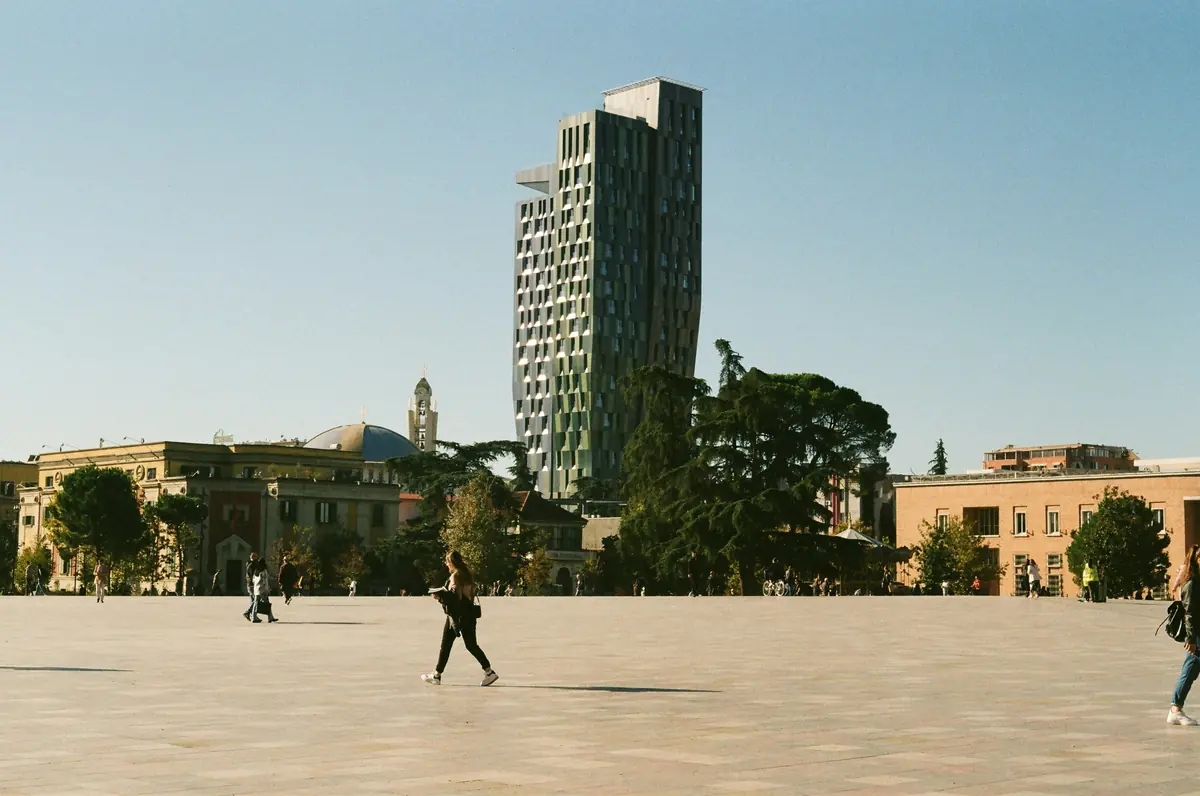
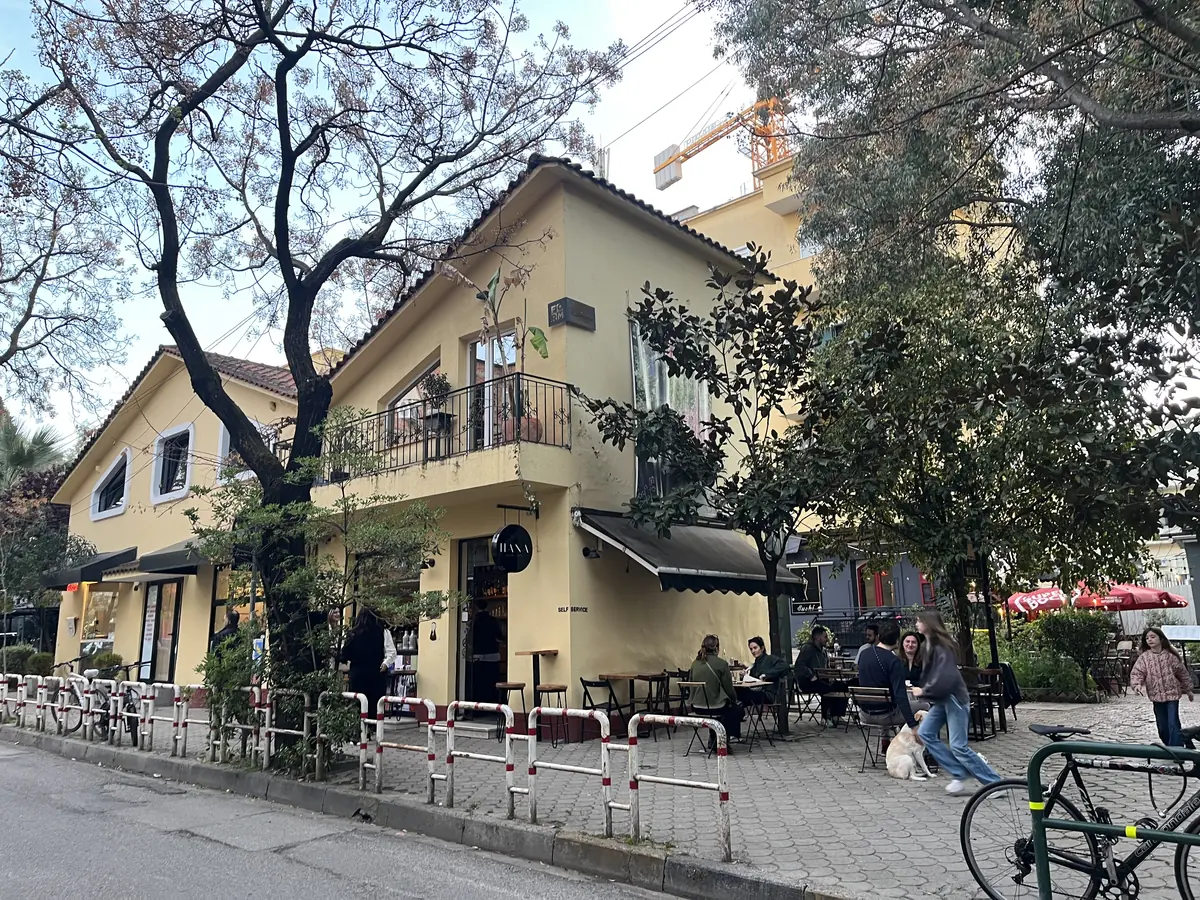
Tirana is the obvious first stop and the easiest urban introduction to Albania. Central Tirana revolves around three walkable zones: Skanderbeg Square (the civic heart), Blloku (the cafe and bar district just south) and the Pazari i Ri food market area. I covered all three on foot in a single day — a slice of the wider list of things to do in Tirana if you give the city a full day.
What surprised me: the cafe culture is intense, the coffee is better than in most of Italy, and women run a meaningful share of the cafes in Blloku. The city is also flat, which matters when you’re hauling a backpack.
- Where to stay: Blloku for nightlife and walkability, around Skanderbeg Square for sightseeing
- Time needed: 2-3 nights minimum
- Walk, city center to Bunk’Art 2: 12 minutes
- Public transport you need: City Bus L5B (40 ALL / $0.50) to the South & North Terminal for onward buses
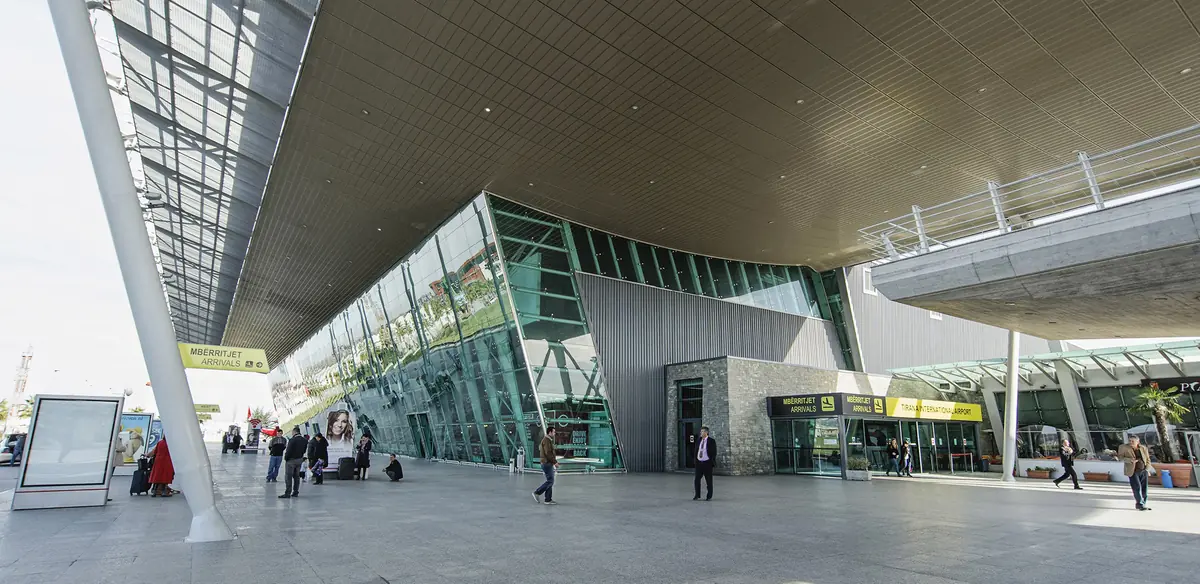
Pro Tip: Skip the official taxis at Rinas Airport. The Rinas Express bus runs hourly, 24/7, costs 400 ALL (about $4.90), and drops you behind the National Theatre of Opera and Ballet — a five-minute walk from the main hostels.
Berat — UNESCO city, family guesthouses
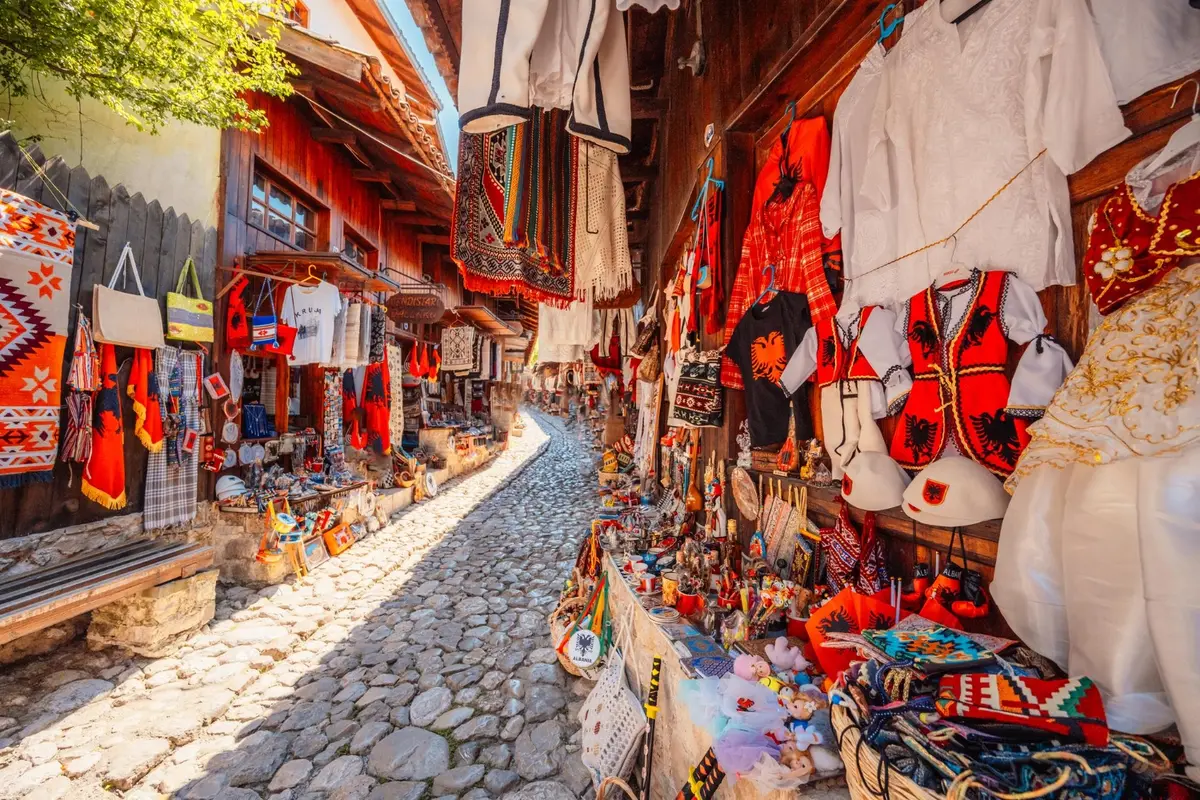
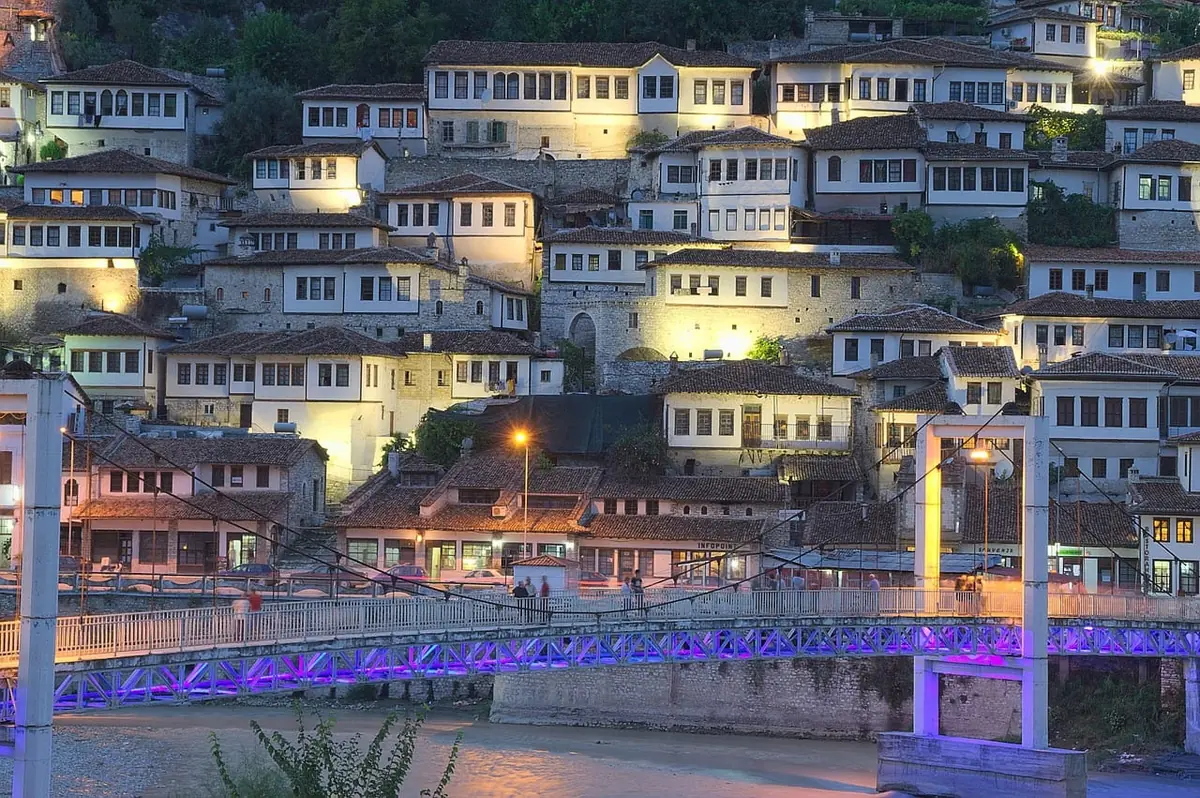
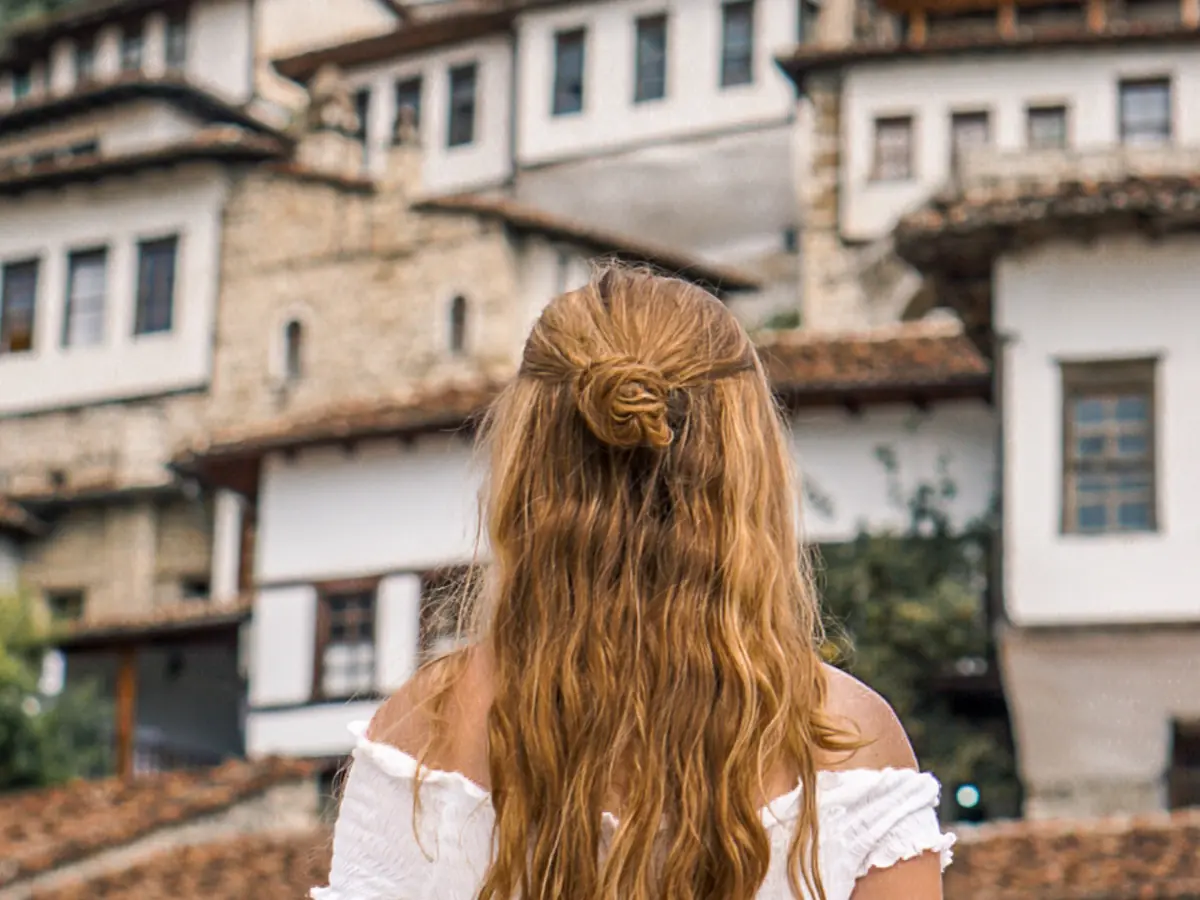
Berat earned its UNESCO listing for the stacked Ottoman houses of the Mangalem and Gorica quarters, separated by the Osum River and connected by a stone footbridge. The whole old town is about 0.6 miles (1 km) end to end. You can walk Berat’s UNESCO old town twice in an afternoon and still spot windows you missed.
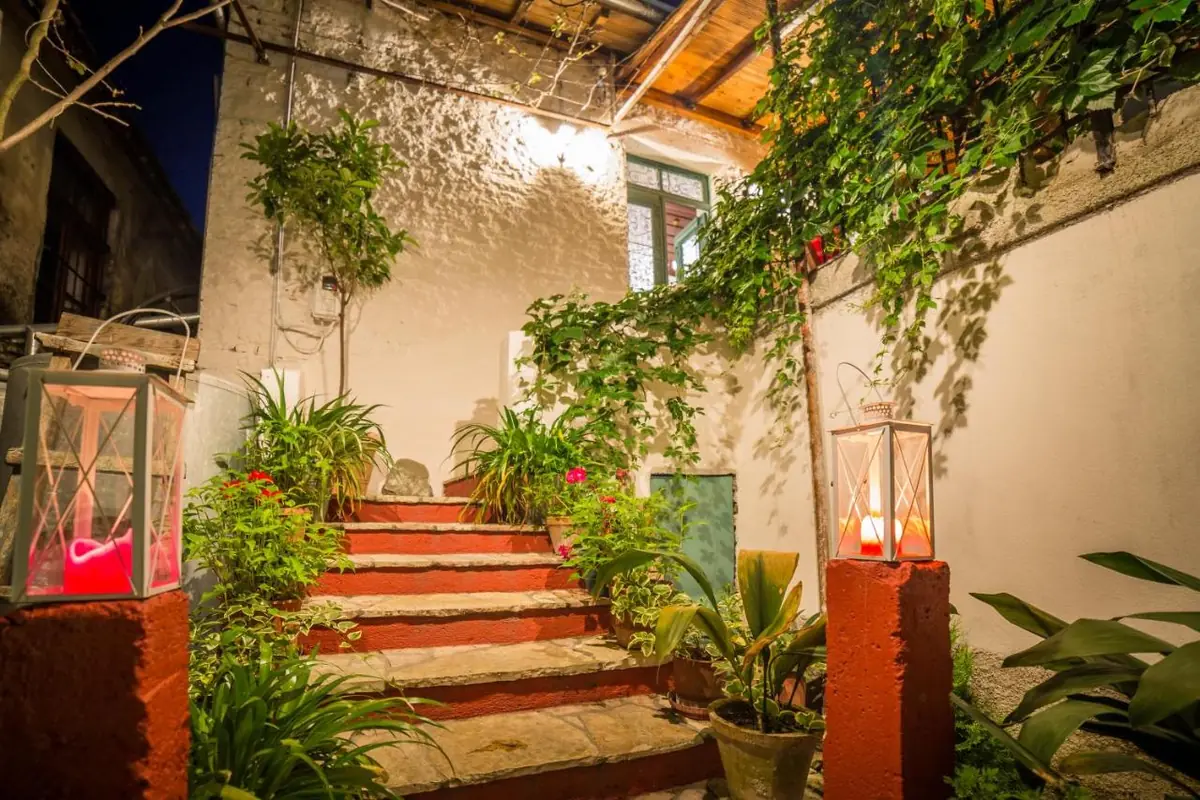
Family-run guesthouses dominate. Most include breakfast on a rooftop or vine-covered terrace. The owners are usually a married couple in their sixties who do not speak much English but communicate everything you need through gestures, photographs of past guests, and an unending supply of homemade raki.
- Castle entry: 400 ALL (about $4.90), open 9 a.m. to dusk
- Walk, old town center to castle: 25 minutes uphill on cobblestones
- Time needed: 2 nights
- Safe to walk alone at night: yes, the Mangalem quarter is lit and busy until at least 11 p.m.
Gjirokastër — the stone city
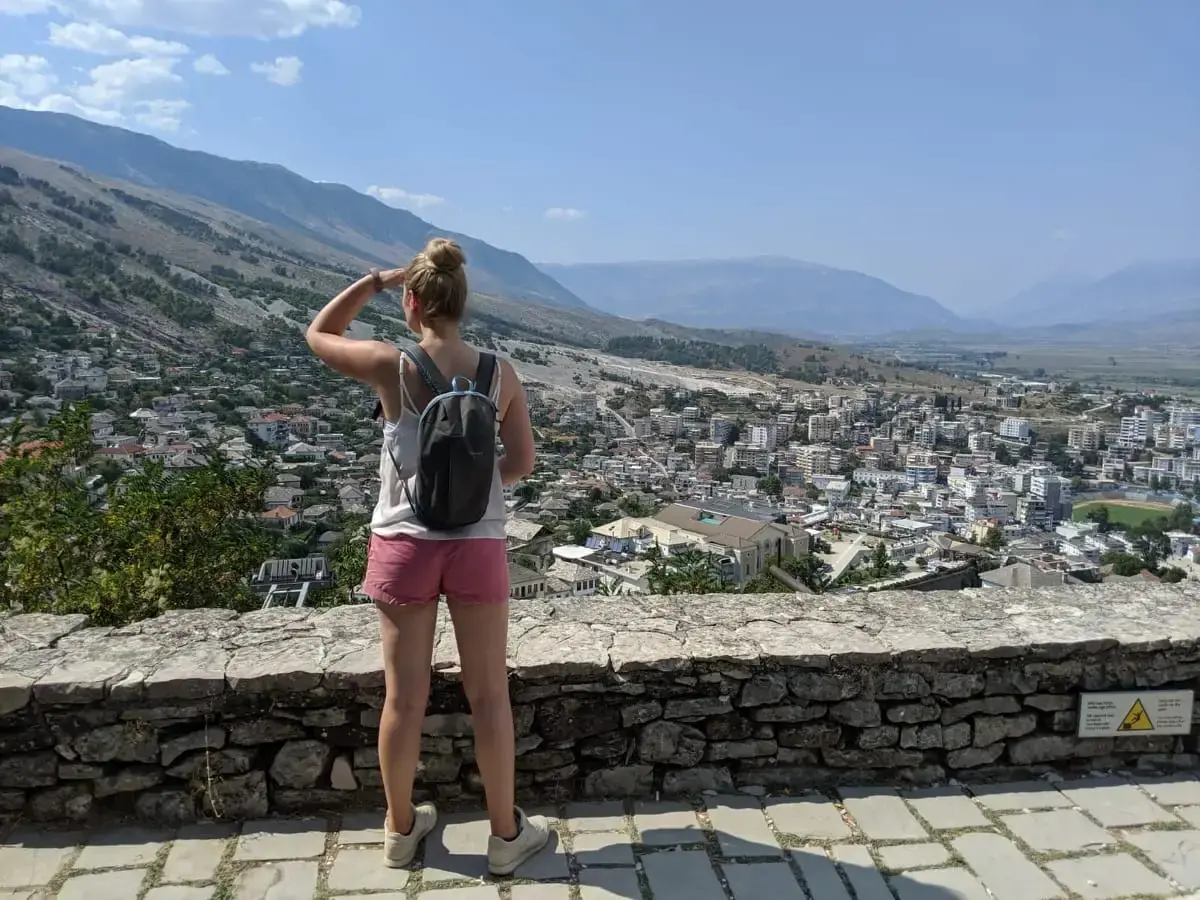
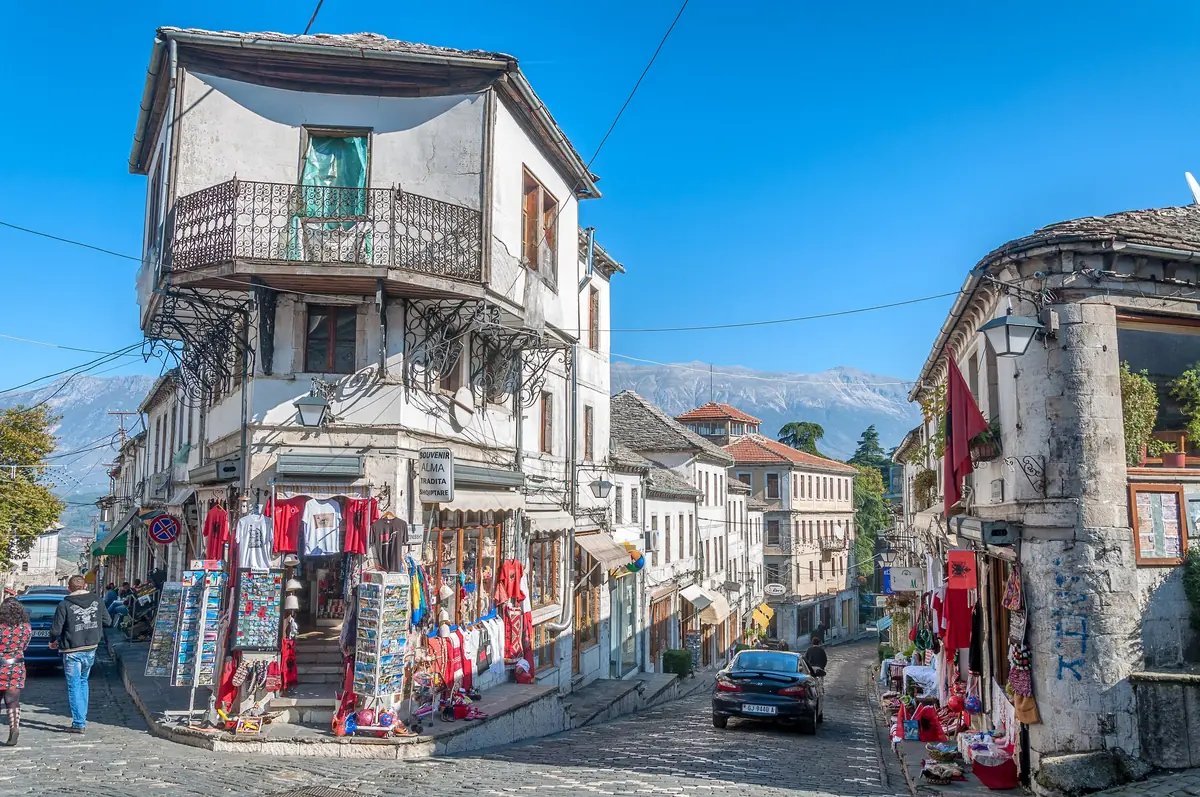
Gjirokastër’s stone old town is the second of Albania’s two UNESCO old towns, and the more atmospheric of the two. The houses are built from gray slate that turns silver in rain and gold at sunset. The cobblestones are the size of bricks and the inclines are punishing — wear shoes with grip.
I stayed at Stone City Hostel, the consistent first pick for solo female travelers across every Albania guide I’ve read. It earns the reputation. The owners (a Dutch-Albanian couple) screen guests, the dorm beds have privacy curtains and individual reading lights, and the included breakfast is a proper sit-down meal at 8:30 a.m.
- Castle entry: 400 ALL ($4.90)
- Walk, main square to Hoxha’s birthplace museum: 8 minutes, mostly downhill
- Time needed: 1-2 nights
- Best dinner spot: Taverna Kuka, $8-12 for qifqi (Gjirokastër’s signature rice-and-egg fritters) and a glass of local wine
Shkodër — gateway to the Albanian Alps
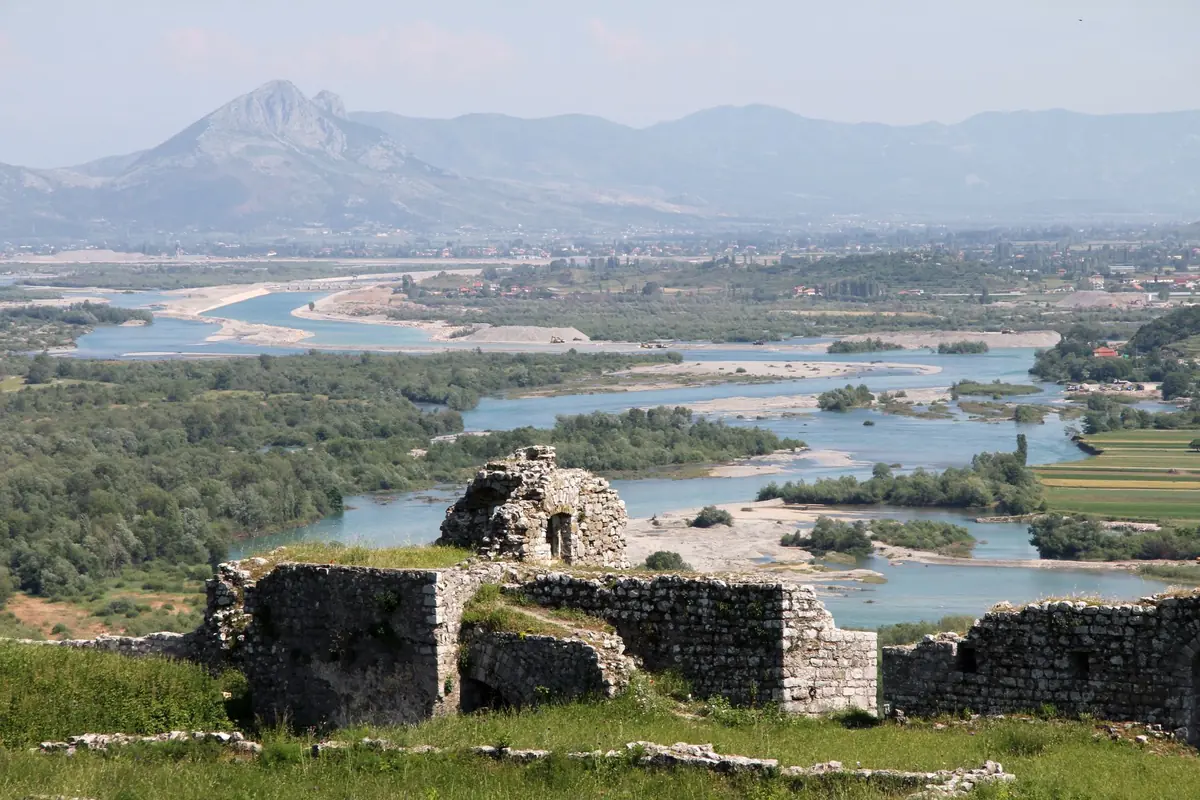
Shkodër is functional more than charming, but it’s the unavoidable pivot point for any northern trip. Every solo female traveler I met heading to Theth had booked her Komani Lake Ferry transfer and minibus through a Shkodër hostel the day before. Wanderers Hostel essentially runs a logistics service for the Theth–Valbona crossing alongside its dorm beds.
- Rozafa Castle entry: 400 ALL ($4.90)
- Walk, city center to castle base: 35 minutes (or take a 200 ALL / $2.45 taxi)
- Bike rental: $5-7/day from most hostels
- Time needed: 1 night before the Alps, 1 more on return if you have it
Theth and Valbona — the Alps
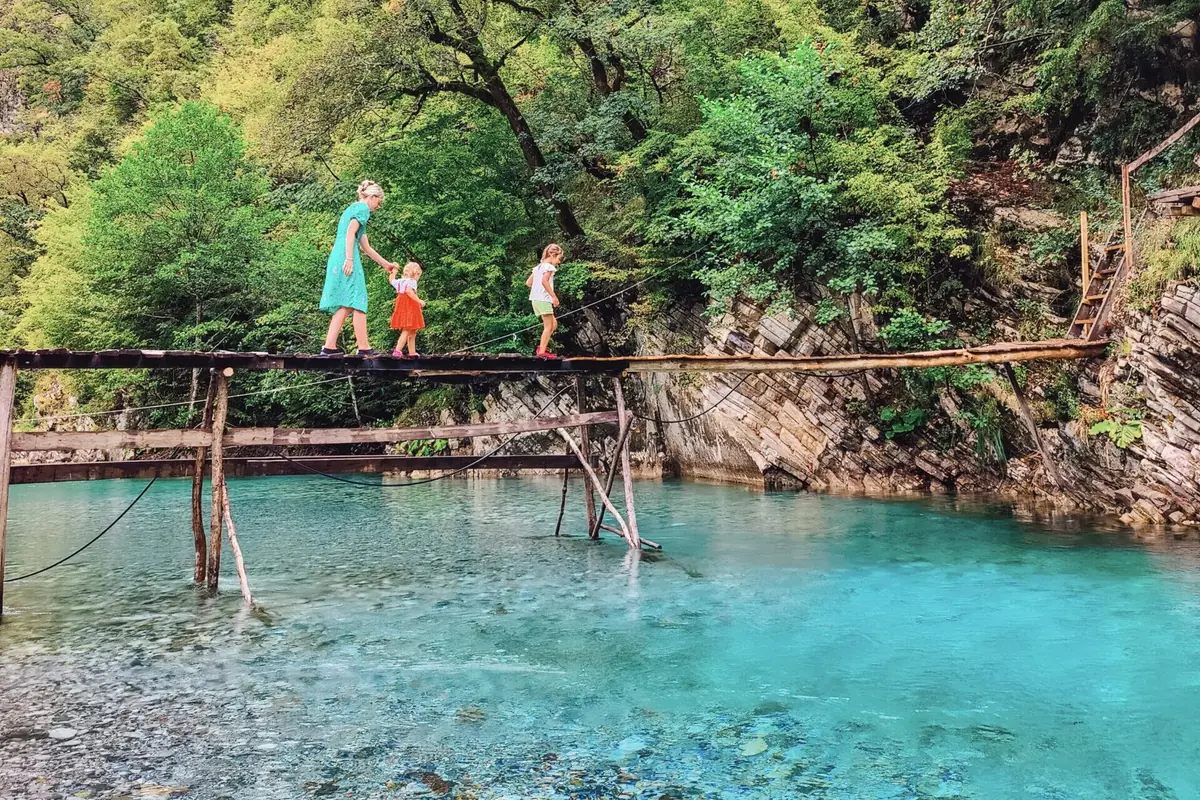
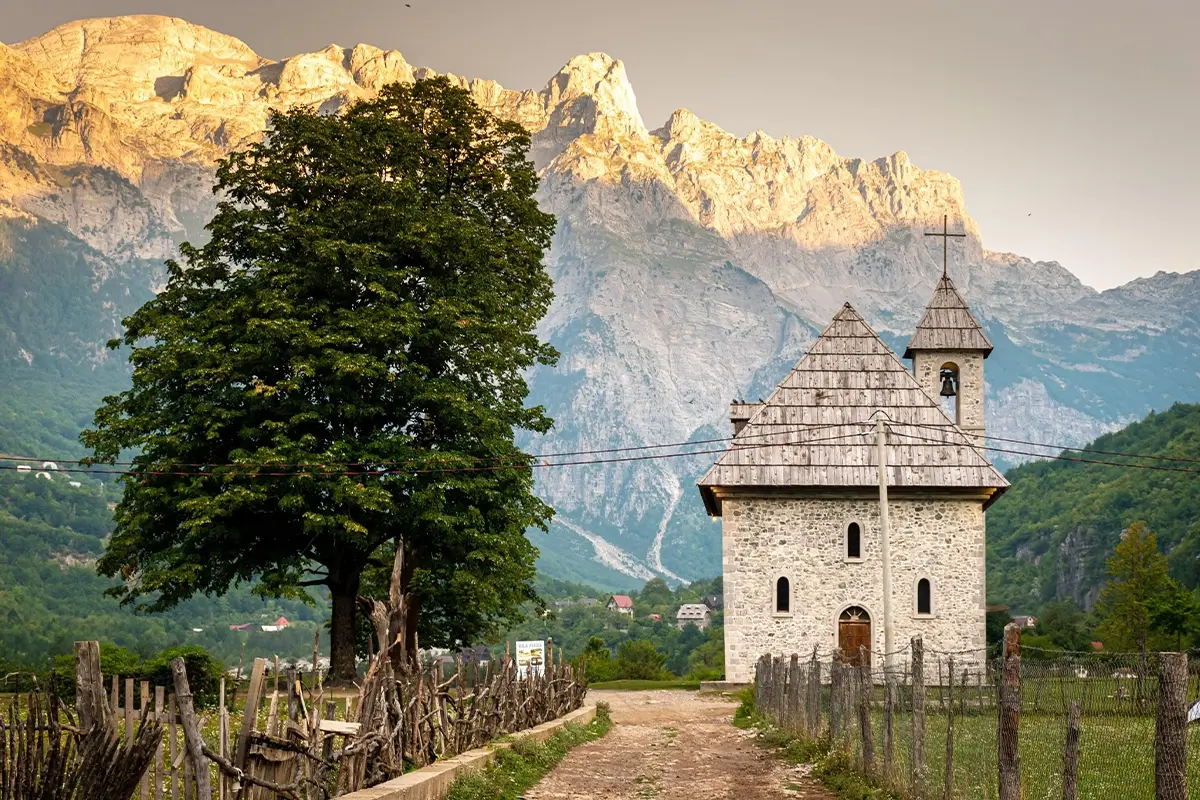
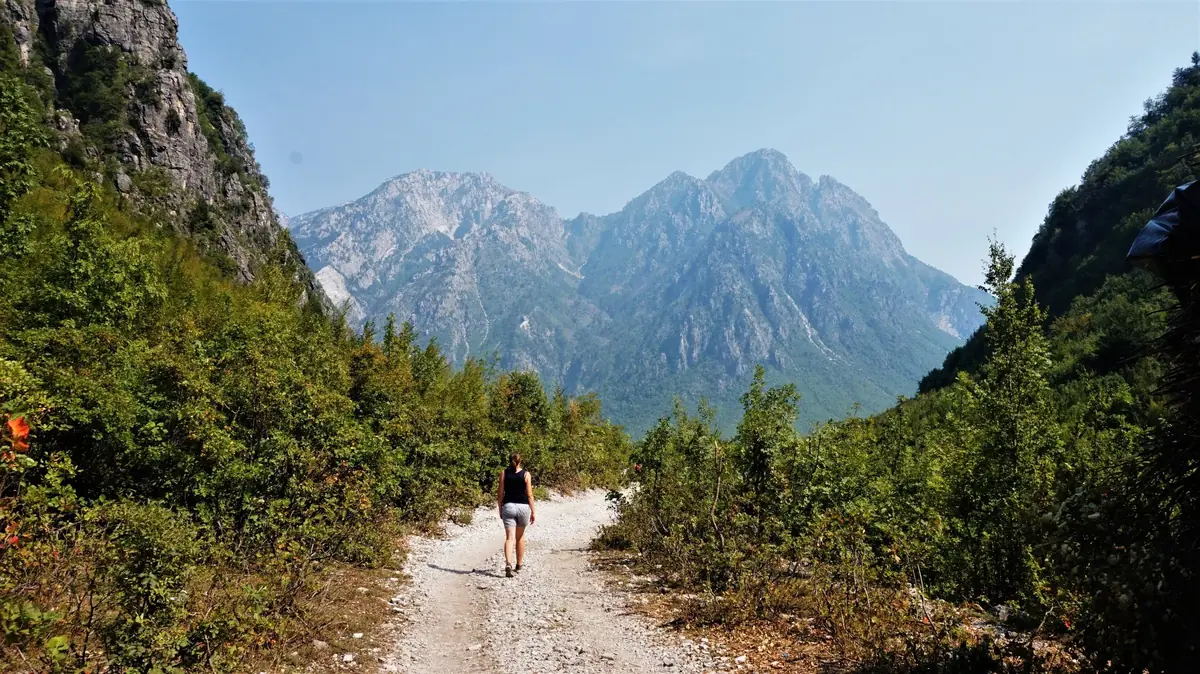
This is the safest section of Albania for solo female travel. Family guesthouses, no nightlife, hikers grouping up by the day to walk the Theth–Valbona pass. I crossed the trail alone in mid-September and was within shouting distance of other hikers the entire way.
The two villages are 10.5 miles (17 km) apart on foot — a 6 to 8-hour hike across a 5,807-foot (1,770 m) pass. The hike itself, the Komani Lake Ferry on either end, and the family-run guesthouses are covered in detail below.
Sarandë and Ksamil — the one stretch to plan around
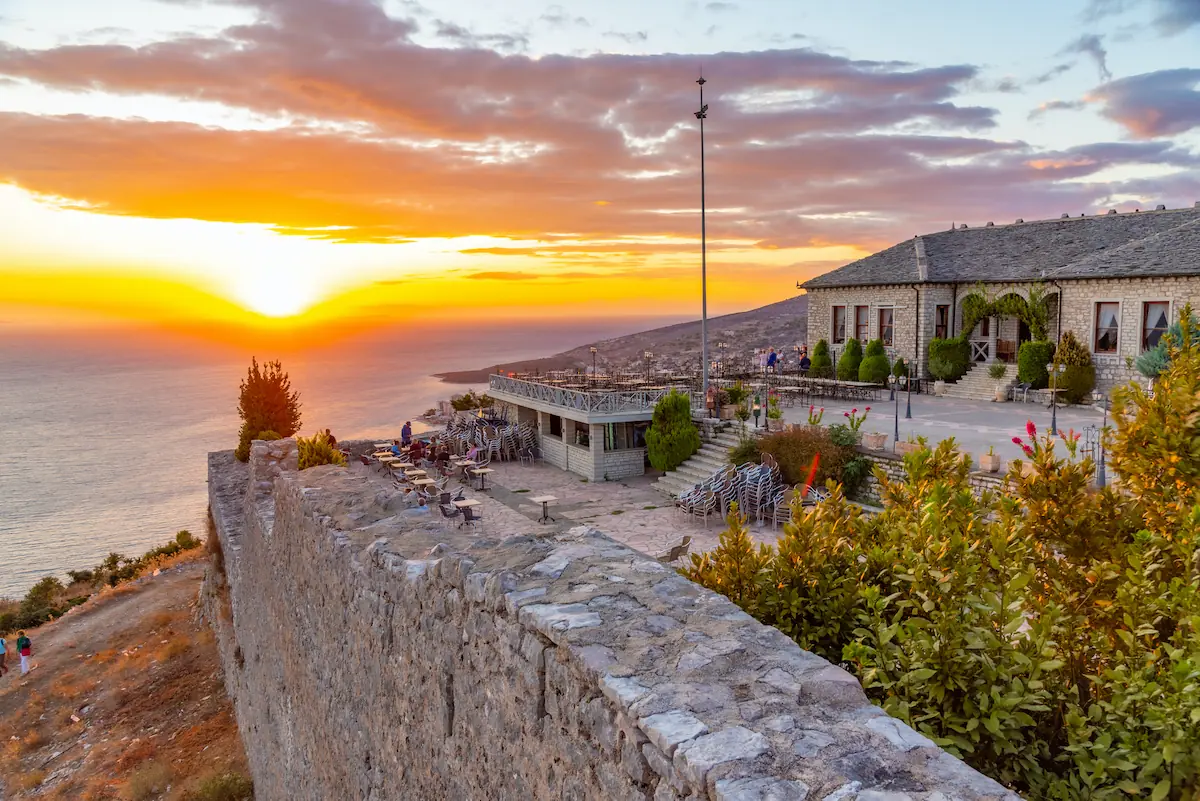
Sarandë and Ksamil are the only places in Albania where multiple solo female travelers report persistent harassment — entitled male attention, refusal to take no for an answer, and beach-club staff treating solo women as obstacles rather than customers. This is not a city-wide safety crisis. It is a peak-season, specific-spots problem that you can mostly engineer your way around.
What I actually experienced over five days in this stretch:
- On the Sarandë promenade at 9 p.m., a man followed me for three blocks insisting on showing me the “best” wine bar. He stopped when I walked into a busy seafood restaurant and sat at the bar.
- At a Ksamil beach club at 2 p.m., the staff ignored me for 25 minutes, then quoted me €60 for a sunbed (the going rate for two beds is $15-25 in shoulder season). I left.
- At my Sarandë guesthouse on the hill above the city, the owner’s family adopted me. They drove me to the bus station the morning I left. Different planet from the promenade.
What separates the friction from the rest of Albania:
- Volume of tourists. Sarandë and Ksamil absorb the largest share of Albania’s coastal visitors, plus day-trippers off the Corfu ferry. The men hassling on the promenade are not a representative cross-section of Albanians — they are working the tourist flow.
- Alcohol density. Both towns have a high concentration of bars and beach clubs operating from late morning until 2 a.m. in summer.
- Anonymity. In Berat or Gjirokastër, an Albanian man hassling a foreigner gets recognized within five minutes. In Ksamil in July, nobody knows anybody.
How to actually manage it:
- Time it for shoulder season. Mid-May, late September and early October are dramatically calmer than July or August. Sunbed prices drop from $50-80 per pair to $10-25, the beach-club staff are friendlier, and the promenade is half as crowded.
- Choose your beach. Ksamil’s main beaches (Beach #4 and #7) are the densest. Lori Beach and Pasqyra (Mirror) Beach are quieter and the staff is noticeably less aggressive.
- Sleep above the town. Sarandë’s hilltop guesthouses (10-15 minutes uphill from the promenade) are quieter, the owners more protective, and you skip the worst of the late-night street traffic.
- Use the Sarandë–Corfu ferry to reset. If a day feels off, the 30-minute high-speed ferry to Corfu ($11-40 / €10-35) is a real option. Several solo women I met used it as a half-day decompression.
- Consider Himarë instead. The town an hour up the coast has the same Riviera beaches, mellower atmosphere, Greek-influenced cooking, and a fraction of the hassle.
Pro Tip: If you book a Ksamil beach club online before you arrive, the staff treats you as a confirmed reservation. Walk-ins get the worst tables and the most negotiation. Bianco Lounge and Poda Boutique Hotel both accept online sunbed bookings with prosecco included for $60-100 per pair.
How much does solo female travel in Albania cost?
Solo female travel in Albania costs $30-50 a day on a backpacker budget, $70-100 mid-range and $150+ at the high end. Hostel dorms run $8-14 a night, sit-down meals $5-12, and intercity bus tickets $5-17 — the everyday Albania travel costs that shape a daily budget. The country is roughly 40-60% cheaper than coastal Croatia or the Greek islands, and a sit-down lunch in Tirana costs less than a coffee in Athens.
What I actually spent over 16 days
- Accommodation (mix of dorms and private guesthouse rooms): $268
- Food and drink (one sit-down meal a day plus market food): $187
- Intercity transport (5 bus rides, 1 ferry, 1 minibus to Theth): $74
- Local taxis and ride-hailing: $43
- Attractions and entry fees (castles, museums, Butrint, Bunk’Art 2): $51
- Phone (Vodafone tourist SIM, 35 GB): $11
- ATM fees (4 withdrawals at $7-8 each): $30
Total: $664. Daily average: $41.50.
Where solo women overspend
- Ksamil sunbeds in peak season. A pair of sunbeds with umbrella runs $50-80 in July and August — VIP cabanas hit $100-120. The same setup is $10-25 in late September.
- Tirana taxis. The city is walkable; use Bolt or UpS Taxi when you don’t want to walk.
- Tour buses. A day trip to Theth from Shkodër runs ~$77 booked through hostels, but the same logistics done independently with a Komani Lake Ferry ticket cost me $35.
- ATM withdrawals. Every non-Albanian card pays a $7-8 fee per transaction across every bank (Raiffeisen, Credins, Alpha, BKT, Intesa, OTP). Withdraw in maximum chunks — most ATMs cap at 40,000 ALL (about $490).
- Euronet ATMs. Avoid these everywhere. The rates are 10-15% worse than the bank ATMs sitting right next to them.
Sample costs you can plan around
- Hostel dorm (Tirana, Sarandë, peak summer): $12-18
- Hostel dorm (everywhere else, shoulder season): $8-14
- Private guesthouse room: $25-40
- Mid-range hotel: $40-90
- Boutique hotel: $100-200
- Byrek (savory pastry, street food): $1-2
- Sit-down lunch with drink: $5-10
- Dinner at a recommended restaurant: $12-20
- Espresso at a Tirana cafe: $0.80-1.20
- Glass of Albanian wine: $2-4
- 1.5L bottled water from a corner shop: $0.50-0.80
- Castle entry (Berat, Gjirokastër, Shkodër): $4.90 each (400 ALL)
- Butrint National Park entry: $11 (€10 / 1,000 ALL)
- Tirana → Berat bus: $5-7, every 30 minutes, 2-hour ride
- Tirana → Gjirokastër bus: $10-14, 4-hour ride
- Tirana → Sarandë bus: $15-17, 4 hours 15 minutes to 6 hours
- Tirana → Shkodër bus: $3-5, 2-hour ride
- Komani Lake Ferry (Berisha): €10 ($11) at the dock, €8.80 ($9.70) online with the 15% discount
- Sarandë → Corfu high-speed ferry: $11-40 (€10-35), 30 minutes
- Day tour to Theth from Shkodër: ~$77
- Theth–Valbona 3-day package via Shkodër hostels: €70-100 ($77-110) all-in
- Car rental: $25-60 a day
- Rinas Express airport bus: $4.90
When is the best time for solo female travel in Albania?
The best time for solo female travel in Albania is June or September — warm but not punishing (high 70s to mid-80s°F / 25-30°C), Riviera open without the July-August crowds, and accommodation prices 30-40% lower than peak. Late May and early October are excellent for the cities and for inland hiking, which tracks closely with the broader best time to visit Albania for any traveler. Avoid July and August on the coast if Sarandë and Ksamil are on your route.
Month by month:
- May: Late month opens the coast. Inland hiking begins. Tirana 65-75°F (18-24°C). Cheapest accommodation outside of winter. Some Theth guesthouses still closed.
- June: My personal pick. Long days, warm but not heavy, Riviera water hits 70°F (21°C), and the Theth–Valbona trail is in full season. Solo female density is high at hostels.
- July and August: Peak prices, peak crowds, peak heat (90-100°F / 32-38°C on the coast). The friction reports in Sarandë and Ksamil cluster here. Tirana stays manageable but empties out — locals take their own holidays.
- September: The other ideal window. The Riviera water is at its warmest (75°F / 24°C), the crowds drop noticeably after the first week, beach clubs open with friendlier staff, and the Albanian Alps are still hikeable.
- October: Early October is excellent for the cities and the Berat–Gjirokastër–Sarandë triangle. Komani Lake Ferry runs until early November. Beach swimming gets cold mid-month.
- November to March: Cities only. Most coastal hotels close. Snow on the Theth pass shuts the trail. Tirana is a fine winter city break — $30 dinners, no crowds at Bunk’Art, espresso bars open by 7 a.m.
- April: Cities and lower-elevation hiking. Komani Lake Ferry resumes mid-April. Riviera still cold for swimming.
Pro Tip: The Komani Lake Ferry runs from roughly mid-April through early November. If you’re flying in outside that window and want to do the Alps, book one of the year-round minibus services from Shkodër to Theth — Wanderers Hostel and Mi Casa es Tu Casa both arrange them.
What do US travelers need for visas, money and connectivity?
US citizens enter Albania visa-free for up to one year — the most generous tourist allowance in Europe and the reason Albania has become a digital-nomad workaround for Americans bumping against the Schengen 90/180 rule. The Albanian Lek is closed-currency, ATM fees are flat per transaction, and Vodafone’s tourist SIMs offer 30+ GB for around $11.
The 365-day US-citizen visa
Albania and the United States have a bilateral agreement that lets American passport holders stay up to 365 days without a residence permit, no application required — the most generous of Albania’s visa requirements for Americans. You get the stamp on entry. Your passport needs at least three months of remaining validity — though some airlines won’t board you with under six months, so check with your carrier before you fly.
Worth knowing if you’re stacking trips: Albania is not in the Schengen Zone and not in the EU. Days spent in Albania do not count against the 90-in-180 Schengen allowance. American travelers regularly use Albania as a buffer when they’ve maxed out Schengen days and need somewhere affordable to wait out the calendar.
Every other Western nationality (UK, Canadian, Australian, EU) is capped at 90 days in 180. Americans get the unique deal.
Money — Albanian Lek (ALL)
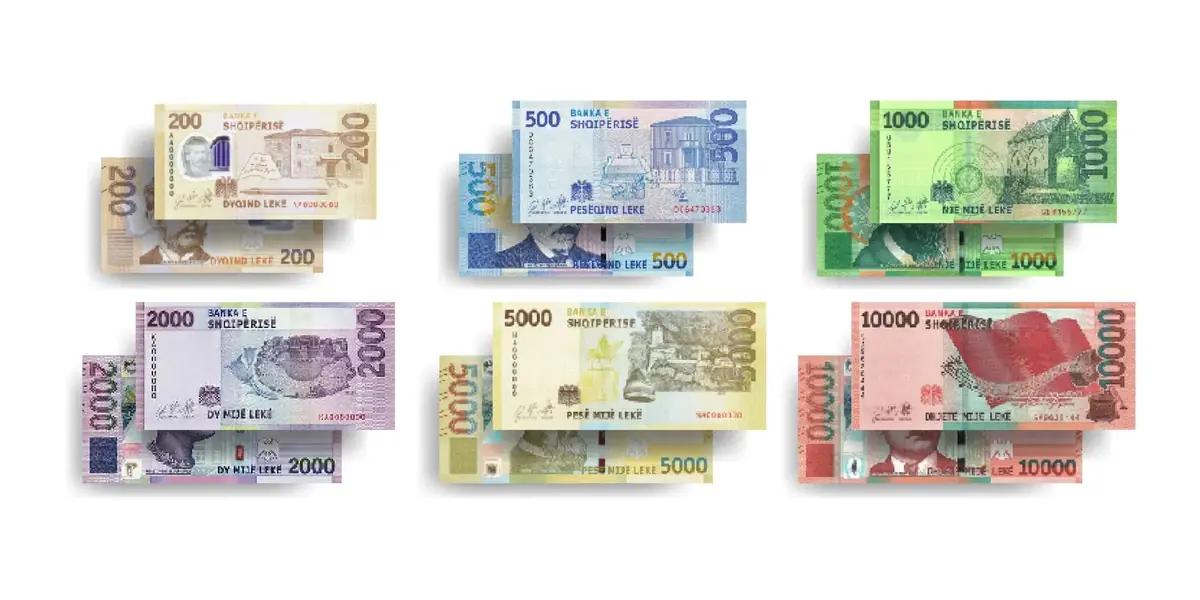
The Albanian Lek (denoted ALL or simply L) is a closed currency. You cannot buy it before you arrive, and you cannot take meaningful amounts out. The mid-market exchange rate hovers around 80-85 ALL per US dollar — verify the day-of rate before you withdraw a large chunk.
How to handle cash without bleeding fees:
- Use Albanian bank ATMs (Raiffeisen, Credins, Alpha, BKT, Intesa, OTP). All charge a flat $7-8 fee per withdrawal.
- Withdraw in maximum amounts. Most cap at 40,000 ALL (~$490). Two withdrawals of 40,000 ALL beat four withdrawals of 20,000 ALL every time.
- Avoid every Euronet ATM. They mark the rate down 10-15%.
- Bring $100-150 in USD or EUR cash as backup. Iliria 98 in Tirana has the best exchange rates in the country.
- Carry small bills. Many small-town vendors cannot break a 5,000 ALL note ($60).
Card acceptance is patchy. Tirana, Sarandë and most hotels take Visa and Mastercard; Theth, Valbona, smaller restaurants and most furgon drivers do not.
Connectivity — SIMs and eSIMs
Albania has two carriers — Vodafone Albania (best coverage including the Alps) and One Albania. A local prepaid SIM costs about $5 base, then $10 for a tourist bundle with 30+ GB of data valid for a month — the simplest of the SIM cards and eSIMs for Albania. You buy at the airport, any city center, or the carrier shops.
eSIM alternatives that route through Vodafone Albania:
- Airalo: $9.50 for 3 GB / 30 days
- Holafly: from $19 for unlimited 7 days
- Saily and Jetpac: similar pricing tiers
- ByteSIM: cheaper on long stays
The Western Balkans roaming agreement means a single Albania SIM works at no extra cost across Albania, Kosovo, North Macedonia, Montenegro, Serbia and Bosnia. If you’re combining Albania with Montenegro or Kosovo, the local SIM is the better play.
Pro Tip: Pick up a Vodafone Albania SIM at the airport before you leave Rinas. The kiosk on the arrivals level is open until midnight and the staff sets it up for you. The city-center Vodafone shops have longer waits and the kiosk at Skanderbeg Square closes by 8 p.m.
How do you get around Albania as a solo woman?
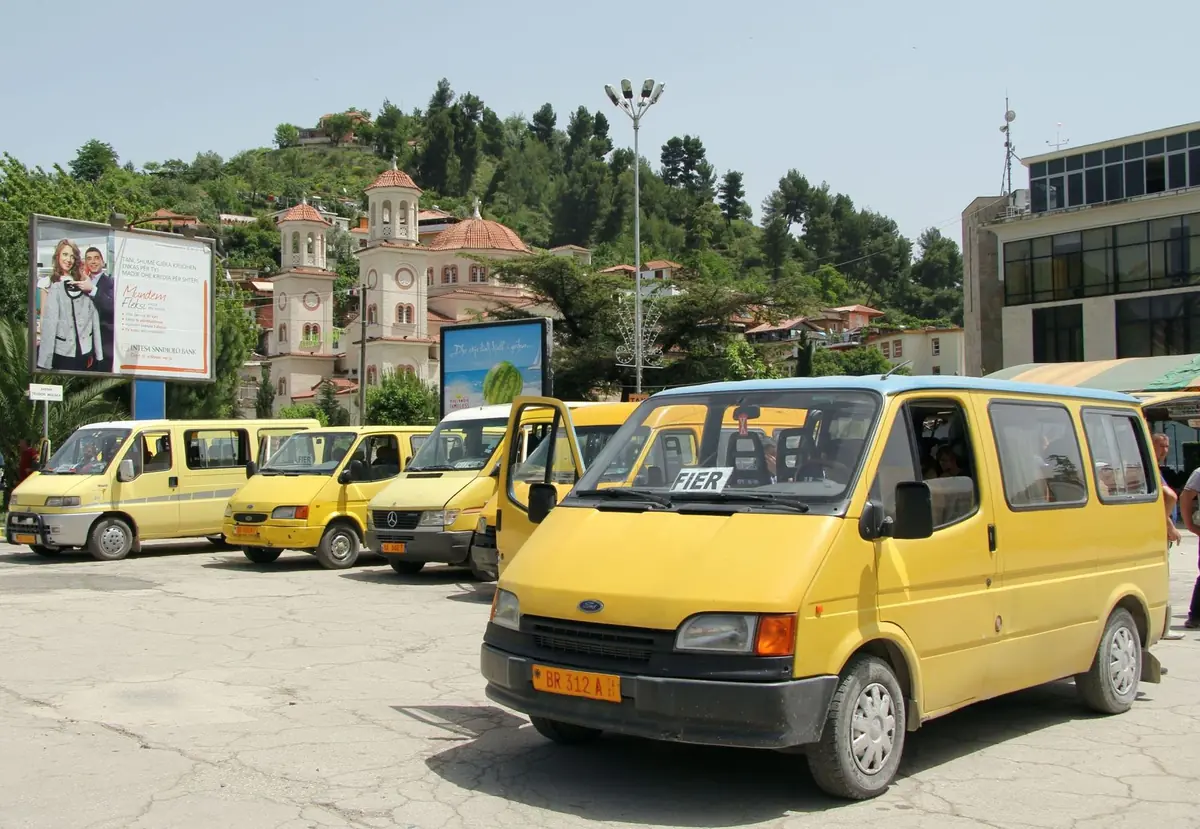
Solo women get around Albania by intercity bus, furgon (shared minivan), occasional rental car, and apps like Bolt within Tirana. Trains are effectively defunct. Furgons leave when full from informal departure points, run cash-only, and cost $2-21 depending on distance. Uber is illegal in Albania. The local ride-hailing equivalents are UpS Taxi, Speed Taxi, Bolt and Patoko.
Intercity buses
Tirana’s bus situation is finally sane. After the bus terminals were consolidated, two terminals handle almost everything for intercity bus travel in Albania:
- South & North Terminal (near Garden Mall, about 4 miles / 6 km northwest of Skanderbeg Square): all major domestic routes — Shkodër, Berat, Sarandë, Vlorë, Durrës. Take the City Bus L5B (40 ALL / $0.50) from behind the National History Museum or a Bolt for about $4.
- TEG East Terminal (TEG shopping center): international routes to Kosovo, Greece, North Macedonia, Montenegro, plus Korçë and Elbasan.
Specific departure board for the Tirana → Sarandë route via Tisa Travel (the most-used operator): 05:30, 07:30, 08:30, 09:45, 12:30, 14:00, 16:00 and 22:00. Tickets bought at the terminal counter. Roughly $15-17 one-way. The inland route via Gjirokastër takes 4 hours 15 minutes; the coastal route via Vlorë takes closer to 6.
Furgons
Furgons are the white minivan shared taxis that move locals between smaller towns. They seat 8-12, take cash directly to the driver, and depart only when full (5 to 20 minutes of waiting). The destination is propped on a cardboard sign in the windshield. There is no national timetable. Gjirafa Travel (travel.gjirafa.com) is the only meaningful online aggregator.
As a solo woman: completely fine in daylight. I took furgons from Berat to Gjirokastër (3 hours, about $9) and from Sarandë to Himarë (1.5 hours, about $6) without any issue. The conductors look out for solo women and will point you to the correct van at the informal departure points.
Ferries
- Sarandë ↔ Corfu (Greece): three operators (Albania Luxury Ferries, Ionian Seaways, Finikas Lines), $11-40 / €10-35, 30 to 60 minutes, up to 10 daily June through September. Note the 1-hour time difference between Albania and Greece.
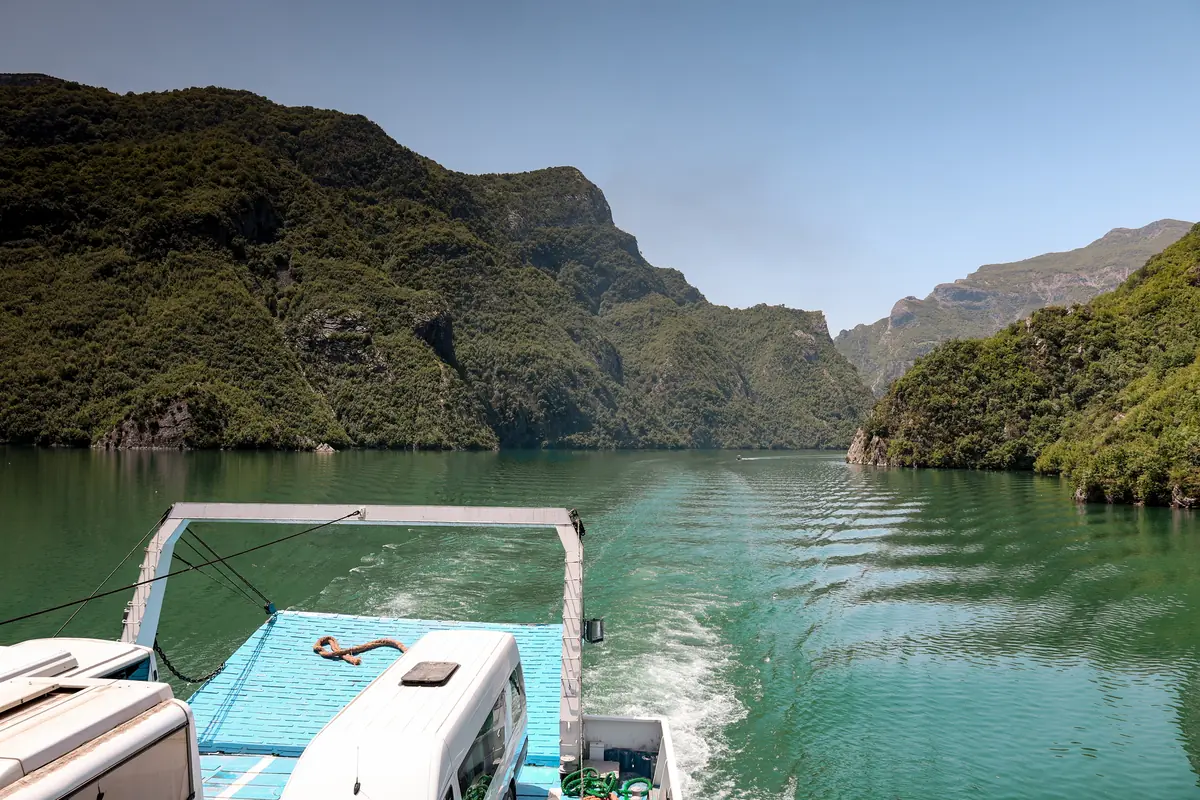
- Komani Lake (Koman ↔ Fierzë): 2.5-3 hours, mid-April through early November, the required leg of the Theth–Valbona crossing. Berisha is the largest operator.
- Vlorë ↔ Brindisi or Bari (Italy): overnight ferries, less common but workable.
Car rental
A solo woman can absolutely rent a car in Albania — and you may want to if you’re focused on the Riviera. Road quality has improved with the Llogara Tunnel cutting 23 minutes off the coastal route. Hazards to plan for:
- Aggressive overtaking on two-lane roads
- Sheep, goats and the occasional cow on rural roads
- Missing or damaged road signs outside major highways
- Headlights required 24/7
- An International Driving Permit is recommended (the 1968 version, not the 1949)
Rental rates: $25-60 a day depending on season and vehicle. Local agencies often beat international brands by 20-30%.
Ride-hailing inside cities
- Tirana: Bolt, UpS Taxi, Speed Taxi, Patoko all work well. Bolt rides across central Tirana run $2-4.
- Sarandë: Bolt has decent coverage. Avoid street-hailing on the promenade — the unregistered taxis there are the most common scam vector.
- Everywhere else: hotel-arranged taxis or your guesthouse owner’s brother-in-law with a car. Negotiate the price before you get in.
Where should solo female travelers stay in Albania?
Solo female travelers should stay in well-rated hostels in the major cities (Trip’n Hostel in Tirana, Stone City Hostel in Gjirokastër, Wanderers Hostel in Shkodër, Funky Guesthouse in Berat, Hairy Lemon in Sarandë) and family-run guesthouses in the alpine villages. Dorm beds run $8-18; private guesthouse rooms $25-40. The hostels below are the consistent first picks across every solo female travel guide to Albania.
Trip’n Hostel — Tirana
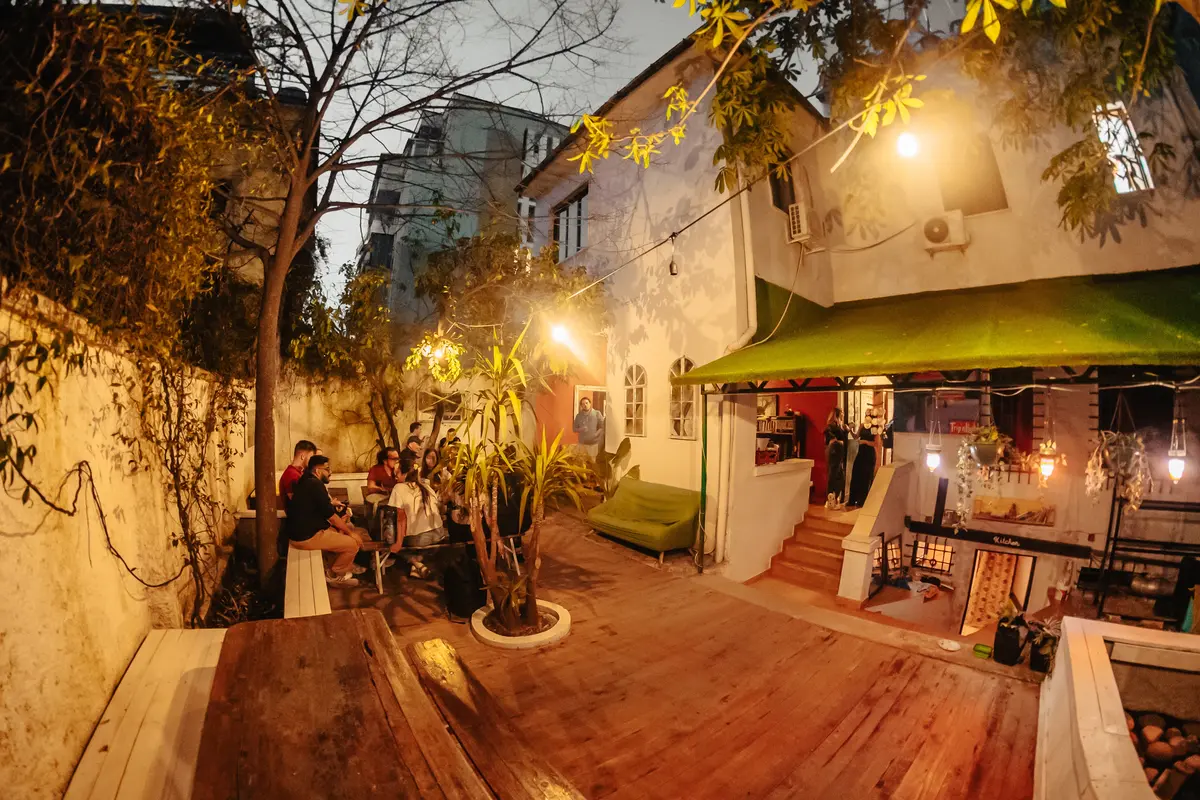
Trip’n Hostel is the default first pick when you’re deciding where to stay in Tirana. The property is an old Italian villa from around 1910, set back from the street with a green garden where the staff serves morning espresso to whoever’s awake. Female-rated 5 out of 5 across the major booking platforms. The dorms have two lockers per guest and the rooms are quiet despite the central location.
- Location: about a 10-minute walk from Skanderbeg Square
- Cost: dorms from $8-14, private rooms from $35
- Best for: first-time Albania visitors, solo women who want a social hostel
- Time needed: minimum 2 nights to use as a Tirana base
- Sister properties: Trip’n Hostel Pink Bubble and Trip’n Hostel Chill Zone (15 beds, digital-nomad lean)
Stone City Hostel — Gjirokastër
This is the only hostel on the list I’d specifically travel to a city to stay at. The Dutch-Albanian owners screen guests, the dorms have privacy curtains and individual reading lights, and the included breakfast is a proper communal meal at 8:30 a.m. They organize group walks to Hoxha’s birthplace museum and give an honest assessment of which restaurants in the old town are worth the splurge.
- Location: in the old town, two minutes’ walk from the main square
- Cost: dorms from $14-18, doubles from $40
- Best for: solo women who want substantive conversation at breakfast
- Time needed: 2 nights minimum
Wanderers Hostel — Shkodër
Wanderers functions as both a hostel and a logistics center for the Albanian Alps. The staff books Komani Lake Ferry tickets, arranges minibus transfers to Theth, and runs an informal matching service between solo hikers looking to walk the Theth–Valbona trail together.
- Location: central Shkodër, walking distance to Lake Shkodër and the castle
- Cost: dorms from $13, doubles from $32
- Best for: solo women heading into the Alps
- Time needed: 1 night before the hike, 1 after if you have it
Funky Guesthouse — Berat
Funky is a small, social hostel in the Mangalem quarter with a rooftop that catches the late sun and the call to prayer from the castle simultaneously. The owner cooks a Sunday-night dinner that’s worth timing your visit around.
- Location: heart of the Mangalem quarter, 4-minute walk to the castle path
- Cost: dorms from $12, doubles from $40
- Best for: solo women who want UNESCO views without resort pricing
- Time needed: 2 nights
Hairy Lemon Hostel — Sarandë
The longtime solo female traveler favorite in Sarandë. Set above the city, away from the promenade noise, with sea views and a small pool. The owners are protective of guests — they’ll tell you which beach clubs to avoid and arrange Butrint day trips for $25.
- Location: about a 12-minute walk uphill from the promenade
- Cost: dorms from $13, doubles from $45
- Best for: solo women who want to sleep above the Sarandë friction
- Time needed: 2 nights as a base for Ksamil and Butrint day trips
Family guesthouses in the Alps
For Theth and Valbona, you’ll book a family guesthouse rather than a hostel. The half-board norm includes a home-cooked dinner (almost always involving local cheese, grilled meat and a vegetable stew) and a sit-down breakfast.
- Theth: Villa Ujevara, Rrashkadoli Guesthouse, Hotel Restaurant Alpet Theth — all $32-50/night half-board
- Valbona: Gurra Family Guesthouse, Hotel Margjeka, Bujtina Valbone — all around €30-45 ($33-50) half-board
Other reliable picks worth knowing
- Tirana Backpacker Hostel (Tirana): the original Tirana hostel, social, dorms from $11
- Milingona City Centre Hostel (Tirana): party-leaning, dorms ~$10
- Vanilla Sky Boutique Hostel (Tirana): quieter, well-rated for solo women
- Berat Backpackers (Berat): traditional Ottoman house, dorms ~$15
- Villa Arben Elezi (Berat): family-run, ~$50 private double with rooftop breakfast
- Hotel Gjirokastra (Gjirokastër): mid-range, ~$60 a night
- Bujtina Babai (Gjirokastër): traditional family guesthouse, ~$40
- Mi Casa es Tu Casa / Shkodra Backpackers Hostel (Shkodër): €11-15 dorms, bike rentals included
- Pupa Hostel (Sarandë): social, harbor-view, dorms from $12
Pro Tip: Don’t pre-book all your nights. I locked in Tirana and Theth on Booking.com before I flew but kept the rest flexible. Twice I extended a city by an extra night based on conversations at the hostel. Albanian hostels rarely sell out except in Sarandë/Ksamil in July and August.
What does a solo female travel itinerary in Albania look like?
A solid solo female travel itinerary in Albania covers Tirana, one UNESCO city (Berat or Gjirokastër), and either the Riviera (Sarandë/Ksamil/Himarë) or the Alps (Shkodër/Theth/Valbona). Seven days is the compressed minimum, 10 days is the sweet spot, and 14 days lets you do both halves of the country without rushing. Bus times and terminals are named below.
7-day itinerary (compressed but doable)
- Day 1 — Arrive Tirana. Rinas Express bus to the city center ($4.90). Check into Trip’n Hostel. Walk Skanderbeg Square at golden hour. Dinner at Oda or Mullixhiu.
- Day 2 — Tirana. Bunk’Art 2 in the morning ($5 entry, opens at 9 a.m.), lunch at Pazari i Ri, Dajti Express cable car in the afternoon ($9 round-trip), Blloku for drinks.
- Day 3 — Tirana → Berat. Morning bus from the South & North Terminal ($5-7, 2 hours, departures every 30 minutes from 6:30 a.m.). Check into Funky Guesthouse. Walk the Mangalem and Gorica quarters before dinner.
- Day 4 — Berat. Castle in the morning ($4.90), Onufri Museum, lunch at Antipatrea, afternoon free for the Gorica side.
- Day 5 — Berat → Gjirokastër. Furgon or bus, about 3 hours, $9-12. Stone City Hostel. Walk down to Hoxha’s birthplace museum before sunset.
- Day 6 — Gjirokastër → Sarandë. Morning bus, ~$9, 2.5 hours. Day trip to Butrint (1,000 ALL / $11 entry, UNESCO site). Sleep above the promenade at Hairy Lemon.
- Day 7 — Day trip to Ksamil (Lori Beach or Pasqyra), then evening bus back to Tirana (~$15-17, 4-6 hours depending on route). Late flight out.
10-day itinerary (most-recommended)
- Days 1-2 — Tirana (same as above).
- Day 3 — Tirana → Shkodër. Morning bus, $3-5, 2 hours. Wanderers Hostel. Rozafa Castle in the afternoon, dinner at the bike-shop-cafe by the lake.
- Day 4 — Shkodër → Theth. Wanderers-arranged minibus transfer ($25-30) over the Theth Pass. Family guesthouse on arrival. Grunas Waterfall hike if you have energy.
- Day 5 — Theth → Valbona hike. 10.5 miles (17 km), 6-8 hours, over the 5,807-foot (1,770 m) pass. Family guesthouse in Valbona.
- Day 6 — Valbona → Komani Lake Ferry → Shkodër. Minibus to Fierzë in the early morning, ferry at 10 a.m., bus from Koman to Shkodër arrives by mid-afternoon. Easy night.
- Day 7 — Shkodër → Berat. Long travel day (5-6 hours by bus via Tirana, ~$15 total). Funky Guesthouse.
- Day 8 — Berat. Castle, Onufri Museum, free afternoon.
- Day 9 — Berat → Gjirokastër. Furgon, ~$9-12, 3 hours. Stone City Hostel. Castle in the late afternoon.
- Day 10 — Gjirokastër → Sarandë → Ksamil → Tirana. Quick Riviera day: morning bus to Sarandë ($9), day trip to Butrint or Ksamil, evening bus to Tirana ($15-17) for an early flight the next morning.
14-day itinerary (everything, no rushing)
The 14-day version expands the 10-day route with: a Krujë day-trip from Tirana ($15 round-trip by furgon, half-day for the Skanderbeg Museum and Old Bazaar), one or two nights at Përmet for the Bënjë thermal baths, a Korçë side-trip if you want the less-touristed east, and Himarë inserted as a Riviera alternative if you’d rather skip Sarandë.
Corfu-entry shortcut
If you’d rather fly into Corfu, ferry to Sarandë ($11-40, 30 minutes, up to 10 daily June through September) and run the route in reverse: Sarandë + Ksamil + Butrint (3 nights) → Gjirokastër (1) → Berat (2) → Tirana (2) → fly out of Rinas.
What’s it like to hike Theth to Valbona solo?
The Theth–Valbona hike is the most popular solo female activity in Albania for a reason: a well-marked 10.5-mile (17 km) trail over a 5,807-foot (1,770 m) pass, family guesthouses on both ends, and a hiking-day density that means you’re rarely more than 20 minutes from another walker. I crossed solo in mid-September and treated it as a social day rather than a solitary one.
The logistics in order
- Start in Shkodër. Book Wanderers Hostel or Mi Casa es Tu Casa one night in advance. Leave large luggage at the hostel — most charge $5-7 a day.
- Minibus from Shkodër to Theth. Departs roughly 6:30-7 a.m., 3 hours over the Theth Pass on a partly paved road. $25-30 one-way. Book through your hostel the day before.
- Optional acclimatization night in Theth. Most solo women do this. The Grunas Waterfall trail and the Blue Eye of Theth are good half-day hikes.
- Hike day: Theth to Valbona. Most groups leave at 7 a.m. and arrive in Valbona between 1 and 3 p.m. The trail is well-marked with red-and-white blazes. The pass is the halfway point.
- Night in Valbona at a family guesthouse (~€30-45 / $33-50 half-board).
- Morning minibus from Valbona to Fierzë (the Komani Lake Ferry dock). ~$10, 1 hour.
- Komani Lake Ferry from Fierzë to Koman. 2.5-3 hours, €8.80 ($9.70) online or €10 ($11) at the dock. Berisha is the main operator.
- Bus from Koman back to Shkodër. ~$5, 1 hour 45 minutes.
What to actually pack
- Trail shoes with grip — the descent on the Valbona side is rocky
- 2 liters of water minimum; refill at the spring at the top of the pass
- Cash for the family guesthouses (cards don’t work)
- Light layers — the pass is 20°F (12°C) colder than the valley floors
- A power bank — there’s no cell signal for stretches and most guesthouses run on generators
What I wish someone had told me
- The trail signage looks confusing for the first 30 minutes out of Theth. Just follow the red-and-white markers.
- The lunchtime qafë (pass) hut sells coffee, raki, cheese sandwiches and Snickers bars. Cash only.
- The Komani Lake Ferry is the highlight, not a transit chore. Sit on the deck.
- Saturday and Sunday hike days are the busiest. Aim for Tuesday or Wednesday if you want quieter.
- Three-day all-in packages through Shkodër hostels run €70-100 (~$77-110) and cover both minibus rides, the ferry, and both guesthouses with half-board. Independent booking saves $20-30 but adds three text-message conversations.
Pro Tip: If you’re worried about hiking solo, post in the Wanderers Hostel WhatsApp group the night before — there are always 6-10 people doing the same crossing on the same day, and you can match pace with whoever you click with at breakfast.
What cultural notes should every solo female traveler know?
Three cultural concepts shape solo female travel in Albania: besa (the sacred code of guest-protection), mikpritja (the principle of hospitality), and Albania’s history of religious tolerance. Once you’ve crossed an Albanian household’s threshold, you are protected. Locals shake their head for “yes” and nod for “no” — the opposite of US convention. Dress code is relaxed in cities and on the coast, modest inside mosques and rural northern villages.
Besa and mikpritja
Besa translates loosely as “promise” or “sworn word” but functions as a sacred pledge. The most-cited articles of the Kanun of Lekë Dukagjini — Albania’s traditional legal code — concern the obligations of a host to a guest. Once a guest has crossed your threshold, the household is obligated to feed and protect that guest, even at the cost of the host’s own safety. During World War II, this principle led Albanians to shelter over 2,000 Jews from Nazi persecution. The country was the only occupied European nation with more Jews at the war’s end than at its start.
For a solo female traveler in modern Albania, besa is not a relic. It shapes the protective behavior of guesthouse owners, taxi drivers and the men sitting at the cafe next to the bus station who will physically walk you to the correct furgon if you ask for directions.
Religion and dress
Albania is officially secular and one of the most religiously mixed countries in Europe. The most recent national census reports roughly 45.9% Sunni Muslim, 4.8% Bektashi (a tolerant Sufi order), 8.4% Catholic and 7.2% Orthodox, with the balance split between non-denominational believers, atheists and a large share who declined to state a religion — the first census in which Muslims fell below half the population. Mixed-faith families are common; in Tirana, you’ll see headscarved grandmothers having coffee with their unveiled granddaughters.
Dress code in practice:
- Tirana, Sarandë, Ksamil, Himarë, Dhërmi: wear whatever you would in any Mediterranean city. Bikinis on the beach, summer dresses in town, shorts and tank tops anywhere.
- Berat, Gjirokastër, Shkodër: still relaxed but slightly more conservative. Locals dress fashionably but not provocatively.
- Inside mosques (Et’hem Bey in Tirana, Namazgah, the mosques in Berat and Krujë): cover shoulders, knees and hair. Scarves are usually available at the entrance.
- Rural northern villages (Theth, Valbona, mountain Shkodër): cover shoulders and knees. The dress code is more about respect than enforcement.
The yes/no head movement
Albanians shake their head for “yes” and nod for “no.” This is genuinely confusing at first. You ask if the bus is going to Berat, the driver shakes his head, you walk away, and discover later you were leaving the right bus. After two days you adjust.
Cafe culture is mildly gendered
Traditional neighborhood bar-kafe — the small smoky bars in older districts — are dominated by older Albanian men playing dominoes. Solo women won’t be harassed in them but will feel out of place. The modern cafes in Blloku, on Berat’s promenade and on Sarandë’s seafront draw a mixed clientele and are entirely comfortable.
Solo dining is unremarkable
Eating alone at restaurants in Tirana, Berat, Gjirokastër, Sarandë and Ksamil is completely normal and unremarkable. Staff are warm without being intrusive. Three places I’d specifically recommend for solo women:
- Mullixhiu (Tirana): Chef Bledar Kola’s modern Albanian fine dining, ~$30-45 per person with wine. Book ahead.
- Restaurant Qilari (Shkodër): traditional shared plates, $15-20, the staff explains every dish.
- Mussel House (outside Ksamil): seafood platters $20-30, the owner’s daughter walks solo women to the parking lot at night.
Pro Tip: Learn five Albanian words and the entire dynamic shifts. Faleminderit (thank you), përshëndetje (hello), ju lutem (please), po and jo (yes and no), sa shumë (how much). Pronunciation is forgiving. Even a botched attempt earns goodwill.
What about flights from the US?
There are no nonstop flights from the US to Tirana — every routing connects through a European hub. The most reliable options from American gateways:
- Turkish Airlines via Istanbul (IST): the most consistent service from JFK, EWR, IAD, IAH, ORD, BOS, LAX, SFO. Round-trips $700-1,100.
- Lufthansa via Frankfurt (FRA) or Munich (MUC): connections from major US gateways. Round-trips $750-1,300.
- ITA Airways via Rome (FCO): often the cheapest in shoulder season. Round-trips $650-1,000.
- Wizz Air via European hubs: ultra-low-cost option with no checked bag included. Tirana is one of their major bases.
Tirana International Airport (Rinas) is where nearly every US traveler lands. Vlora International Airport on the southern coast — often described as the future Riviera gateway — is built but not yet open to commercial passenger flights; its launch has been pushed back repeatedly past summer 2026 on a roughly $150 million (€140 million) project with a 2-million-passenger annual capacity. Until it opens, plan to fly into Tirana (or ferry over from Corfu) and drive south.
Travel insurance is worth the money. Albania’s national healthcare is functional but inconsistent, and US health insurance generally doesn’t extend abroad. SafetyWing Nomad Insurance runs $42-56 a month for travelers under 40 and covers Albania.
More questions solo women ask about Albania
Is Tirana safe for women at night?
Central Tirana — Blloku, Skanderbeg Square, Rruga Murat Toptani — is safe to walk at night. Avoid unlit residential streets in the outer districts and the area around the South & North Terminal after 10 p.m. Use Bolt, UpS Taxi or Speed Taxi rather than street-hailing. Most solo women report Tirana feeling safer than Athens or Rome at night.
What should I wear in Albania as a woman?
Tirana, Sarandë, Ksamil, Himarë and Dhërmi have no functional dress code — wear what you’d wear in any Mediterranean city. Cover shoulders and knees inside mosques and in rural northern villages (Theth, Valbona). Albania is secular but the cultural tradition leans modest in older neighborhoods and small towns. Beachwear is fine on the Riviera.
Do US citizens need a visa for Albania?
No. US citizens enter Albania visa-free for up to 365 days under a bilateral agreement — the most generous tourist allowance in Europe. Your passport must have at least three months remaining validity. The stamp is given on entry; no advance application is required. Albania is not part of the Schengen Zone, so time spent there does not count against the 90-in-180 Schengen limit.
How much money should I budget per day in Albania?
Budget $30-50 a day for backpacker travel, $70-100 mid-range, $150+ for boutique hotels and frequent restaurant meals. Hostel dorms run $8-14, sit-down meals $5-12, intercity buses $5-17, and entry to most major attractions $5-11. The biggest budget drains are Ksamil sunbeds in peak season ($50-80 per pair) and ATM fees ($7-8 per withdrawal).
Can you drink the tap water in Albania?
Tap water in Tirana is officially treated and technically drinkable, but most locals and travelers drink bottled water due to occasional pipe-quality inconsistencies. Outside the capital, stick to bottled. A 1.5-liter bottle costs $0.50-0.80. Use tap water for brushing teeth without concern.
Is hitchhiking safe in Albania?
Hitchhiking is culturally accepted in rural Albania and locals do it routinely. For solo women, the experience is unpredictable and not recommended — particularly after dark or anywhere south of Vlorë. Furgons offer the same flexibility at minimal cost ($2-21 depending on distance) and you’re sharing a van with other passengers rather than getting in with one driver.
What language do Albanians speak?
Albanian (Shqip) is the official language. English is widely spoken in Tirana, Sarandë, Ksamil and among Albanians under 40 across the country. Italian is the most common second foreign language, a legacy of decades of Italian TV reception across the Adriatic. In Theth and Valbona, the older generation speaks limited English; the younger generation in the guesthouses is fluent.
Is Albania cheaper than Greece or Croatia?
Yes, by a significant margin. Albania is roughly 40-60% cheaper than coastal Croatia or the Greek islands. A $20 sunbed in Ksamil costs $80+ on Corfu. A $7 main course in Berat costs $20+ in Mykonos. The exception is peak-summer Ksamil and Sarandë, where prices have climbed sharply with the country’s tourism surge.
Where should I avoid in Albania?
There are no regions to flatly avoid. The friction points are situational rather than geographic: the Sarandë promenade at night in peak summer, Ksamil beach clubs at the main public beaches in July and August, and any “no commission” street-corner currency exchange anywhere in the country. Outside those specific contexts, solo women routinely move through every corner of Albania without incident.
What’s the best time of year for solo female travel in Albania?
June and September are the sweet spots. Late May and early October are excellent shoulder months. July and August are crowded, expensive on the coast, and where the friction reports cluster. Winter (November-March) is fine for the cities — Tirana is a genuine winter break — but most coastal hotels close and the Theth Pass is impassable.
Are there women-only tours in Albania?
Yes, a growing number. Solo Female Travelers Club runs occasional Albania trips. G Adventures lists several Balkans tours with their “Solo Female Friendly” endorsement. Choose Balkans, Albania Holidays and Albanian Trip all offer mixed-gender small-group tours where solo women are well-represented. Most cost $1,500-3,000 for 7-10 days including accommodation.
What is besa and why does it matter?
Besa is the Albanian cultural code of honor — a sacred pledge of hospitality and protection of guests, codified in the Kanun of Lekë Dukagjini. Once you cross an Albanian household’s threshold, the family is obligated to protect you. The principle is so deeply held that during World War II, Albanians sheltered over 2,000 Jews from Nazi persecution. For solo female travelers today, besa explains the protective behavior of guesthouse owners and the warmth of locals everywhere outside the busiest tourist zones.
What if something goes wrong?
Two phone numbers worth saving before you fly:
- US Embassy in Tirana: +355 4 224 7285 (24-hour emergency line)
- Albanian emergency services: 112 (general), 129 (police), 127 (medical)
Enroll in the State Department’s STEP program online before you leave — it pushes security alerts straight to your phone if anything happens nearby. Tell your hostel which day you’re crossing the Theth–Valbona pass; they’ll flag you to local authorities if you don’t check in by 6 p.m.
Solo female travel insurance covering Albania:
- SafetyWing Nomad Insurance: $42-56/month, covers medical and limited evacuation
- World Nomads: $80-120/month, covers adventure activities including hiking
- IMG Global: better for longer stays (3+ months)
Before you book
TL;DR: Solo female travel in Albania is genuinely safer than its reputation suggests — provided you understand that the friction is concentrated in Sarandë and Ksamil in peak summer, and that you have a strategy for that stretch (shoulder season, hilltop accommodation, quieter beaches, or the Himarë alternative). Plan for $30-50 a day, lean on the named hostels above, and use your American passport’s one-year visa as the structural advantage it is.
The country is not a “what Croatia was 15 years ago” destination anymore — it’s already arrived. But it’s still a country where a solo woman can ride a furgon to a UNESCO town she’d never heard of two weeks ago, get adopted by a guesthouse family, hike a 5,807-foot pass with strangers who become friends by lunchtime, and walk back to her hostel at midnight feeling more comfortable than she does in most US cities.
Which part of the route is calling you first — the Alps, the UNESCO triangle, or the Riviera? Drop it in the comments and I’ll tell you which week to book.