Driving in Albania gets you to a coastline that rivals Croatia’s at a fraction of the cost — and renting a car is the only practical way to reach most of it. The roads come with a learning curve: aggressive overtaking, livestock crossings, abrupt speed-limit drops, and confusing insurance. Here’s what American drivers actually need.
The short version: Americans can drive in Albania with a US license plus an International Driving Permit from AAA ($20 for the permit, $30–50 once you add photos). Traffic keeps to the right. Speed limits run 25 mph in town, 50 mph on rural roads, and 68–81 mph on the motorways. Rental cars average $23–47/day, with off-season economy cars from $14. Main highways between cities are in good shape; mountain roads demand attention. The blood-alcohol limit is 0.01% — effectively zero.
Is it safe to drive in Albania?
Yes, driving in Albania is safe for confident, attentive drivers. The US State Department rates Albania Level 2 (“exercise increased caution”) — the same level as France and the UK, and Albania ranks as a safe country for tourists overall. The real challenges are aggressive local driving habits, livestock on rural roads, potholed secondary stretches, and unlit mountain sections after dark. Violent crime and car theft are not serious concerns.
What surprises most Americans isn’t the danger — it’s the rhythm. A Mercedes will overtake you on a blind curve on SH8, then the road clears and you have 20 miles of empty Riviera ahead. Drivers tailgate, flash headlights to signal overtakes, and treat lane markings as suggestions. If you’ve driven in rural southern Italy or the Greek islands, you already know the vibe.
Pro Tip: Avoid night driving outside major cities. Most rural roads have no street lighting, no shoulders, and occasional pedestrians or livestock on the asphalt. Aim to be off mountain roads by sunset.
Keep these numbers on your phone before you pick up the keys:
- General emergency: 112
- Police: 129
- Traffic police: 126
- Ambulance: 127
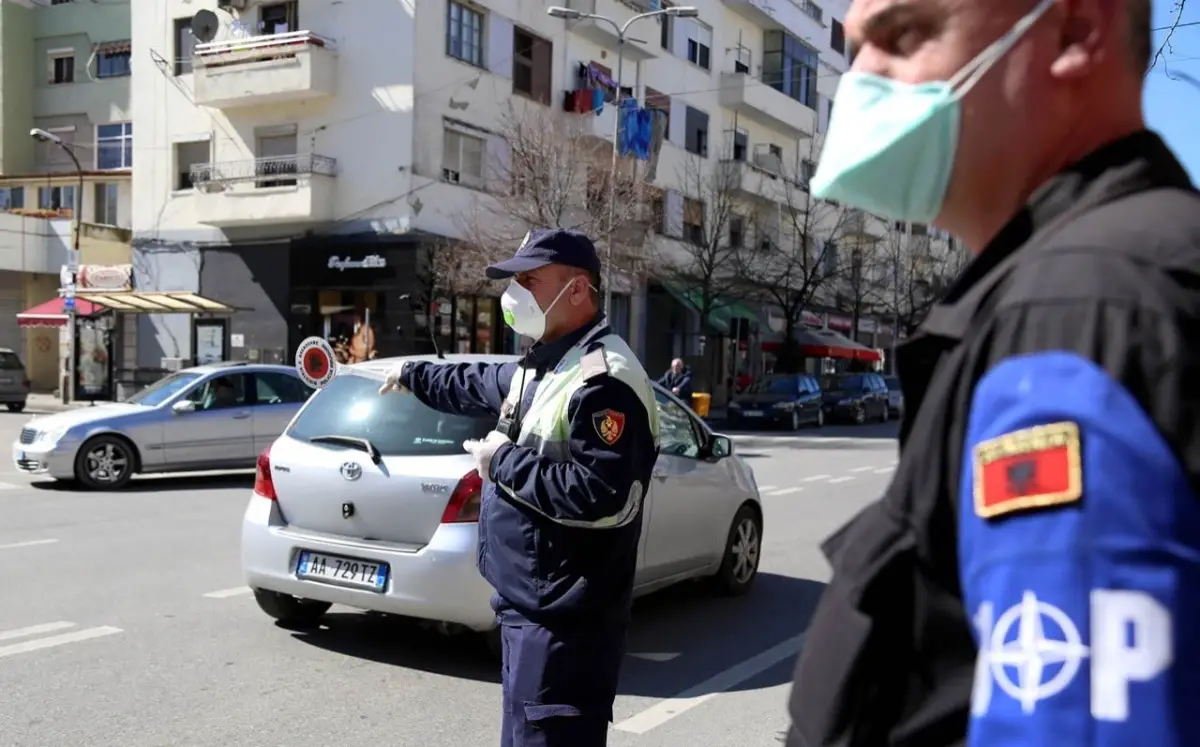
On my last trip, the only moment I felt genuinely rattled was a four-lane roundabout in central Tirana where no one used indicators and a police officer waved cryptically from the middle. Outside the capital, the driving is demanding but rarely scary.
Do Americans need an international driving permit for Albania?
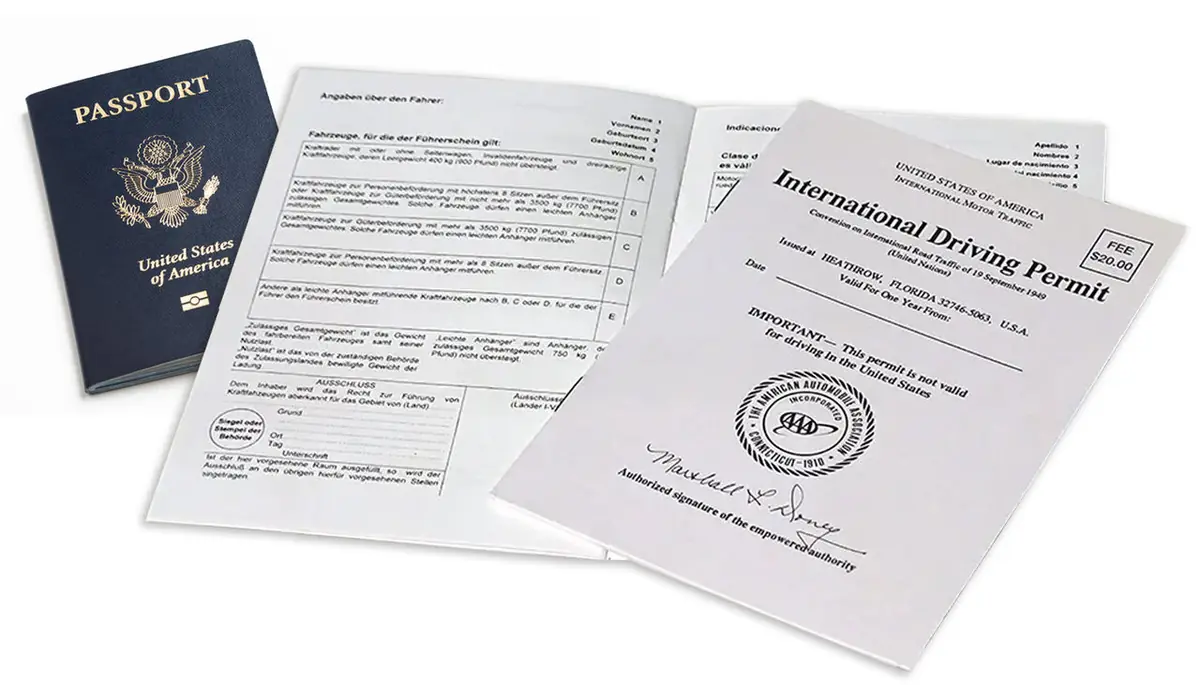
Yes — and it’s worth the $20. The US Embassy in Tirana advises Americans to carry an IDP alongside their state license. While Albanian law doesn’t strictly require one for licenses printed in Latin characters, most rental companies ask for it at the counter. Showing up without an IDP is the fastest way to lose your reservation on the spot.
Getting one is straightforward. Walk into any AAA office with your US driver’s license and the $20 permit fee. The permit itself is $20, but if you need the required passport-style photos taken at AAA, budget another $10–30 — so the realistic out-the-door cost is $30–50. Processing is same-day. The permit is valid for one year from issue. You cannot get an IDP after arriving in Albania — it must be issued in your home country.
Documents to carry in the car at all times:
- US driver’s license (the actual card, not a photo)
- International Driving Permit from AAA
- US passport (or a clear copy)
- Rental agreement
- Insurance certificate (the rental company provides this)
- Green Card insurance (for cross-border trips — see below)
At checkpoints, officers examine the rental agreement more closely than the IDP. Still, rental desks will not hand over keys without seeing the IDP. The fine for driving without required documents runs about $122 (10,000 ALL), and it’s one of the few fines officers sometimes ask foreigners to pay on the spot.
How do you rent a car in Albania as an American?
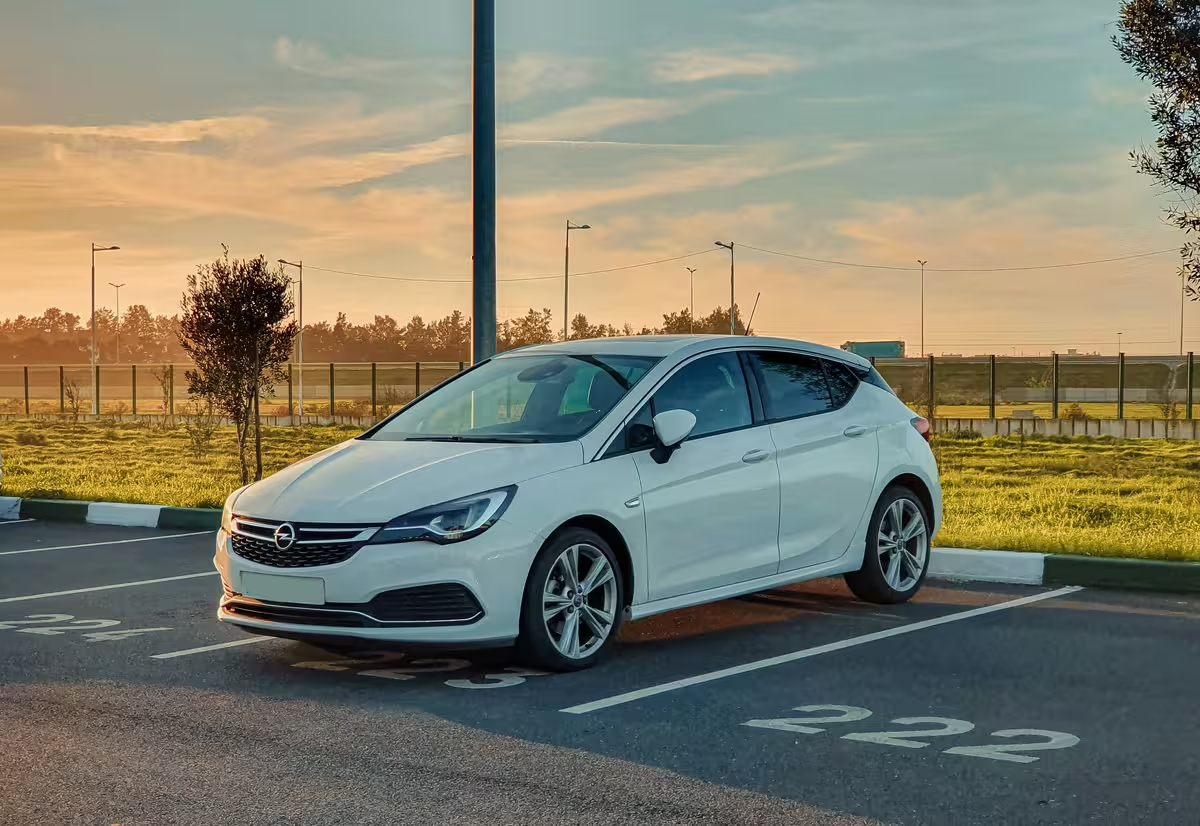
Renting in Albania is cheaper than most of Europe — economy cars run $14–67/day depending on the season. You’ll need a credit card for the deposit (debit cards are refused), an IDP at the counter, and an early booking if you require an automatic. Insurance is bundled but carries a deductible worth buying down. Expect manual transmissions by default.
Renting here comes with quirks Americans don’t always expect — limited automatics, chunky credit card deposits, and fine print on insurance that may or may not overlap with what your travel card already covers.
Automatic vs. manual — book early or lose out
Most rental cars in Albania are manual transmission. Automatics exist but run 20–40% more and sell out fast between June and September. If you can only drive automatic, this is the single most important booking decision of your trip. Reserve at least 4–6 weeks ahead through DiscoverCars or Localrent, both of which let you filter for automatic only.
- Automatic premium: $8–15/day extra
- Best chance of automatic stock: Sixt, Enterprise, Hertz, AbbyCar
- Cheapest automatic sources: aggregators like DiscoverCars and Localrent
- Availability in peak summer for same-week bookings: near zero
Walking up to the Tirana Airport counter in late July expecting an automatic is how Americans end up paying $90/day for the last Toyota Corolla on the lot — or canceling the trip entirely.
What rental car insurance actually covers
Albanian rentals include mandatory third-party liability. Collision Damage Waiver (CDW) is usually bundled but carries a deductible between $275 and $1,300 depending on the company. The full-protection upgrade that zeroes out the deductible costs $8–15/day. That math matters: on a 7-day rental, full protection runs $56–105, versus a $1,300 deductible if you scratch the bumper in a Berat alley.
US travel credit cards can fill the gap, but with caveats:
- Chase Sapphire Preferred/Reserve: secondary coverage abroad; call before you fly to confirm Albania is covered
- Amex Platinum: offers premium car rental protection for a per-rental fee ($12.25–25); worth it for longer trips
- Most other cards: secondary (not primary) coverage, meaning your own auto insurance pays first
Pro Tip: UK-targeted guides recommend insurance4carhire.com. That product is only available to UK and EU residents. Americans cannot buy into it — don’t waste 20 minutes on their site like I did.
Always document existing scratches on video at pickup. Walk around the car with the attendant, narrate the timestamp and location, and film the odometer and fuel gauge. Tire, windshield, and undercarriage damage are often excluded from CDW — ask specifically.
Rental costs by season
Pricing swings hard with the tourist season, so knowing the best time to visit can cut your bill in half. March is the cheap-rental sweet spot; August is brutal.
| Season | Economy | Mid-size | SUV |
|---|---|---|---|
| Winter (Nov–Mar) | $14–20/day | $28–38/day | $35–45/day |
| Shoulder (Apr–May, Oct) | $22–32/day | $40–52/day | $45–58/day |
| Peak (Jun–Sep) | $45–67/day | $58–80/day | $70–95/day |
Additional costs to plan for:
- Security deposit hold: $275–$1,650 (credit card only — debit cards universally rejected)
- Under-25 surcharge: ~$3.50/day
- Minimum rental age: 21 for economy, often 23 for SUV
- One-way drop fees: $50–150 if returning to a different city
- Cross-border authorization: $22–66 (see border section)
Aggregators that consistently beat direct-booking rates:
- DiscoverCars — scans all major and local providers; clearest insurance upgrades
- Localrent — transparent deposits; strong automatic filter
- Rent From Locals (rentfromlocals.al) — highest Google ratings in-country; local marketplace
What are Albania’s speed limits and traffic fines?
Albanian speed limits run 25 mph (40 km/h) in cities, 50–56 mph (80–90 km/h) on rural roads, and 68–81 mph (110–130 km/h) on motorways. The A1 to Kosovo allows the highest limit at 81 mph (130 km/h). Police with radar guns wait at transition zones where limits drop sharply — a 56-to-25 mph change can appear with no warning sign. Fines start at $12 and reach $244 for serious speeding.
Speed limits at a glance:
| Zone | km/h | mph |
|---|---|---|
| Urban areas | 40 | 25 |
| Rural roads | 80 | 50 |
| Expressway | 90 | 56 |
| Highway | 110 | 68 |
| A1 motorway | 130 | 81 |
Many competing guides state the highway limit as 110 km/h across the board — that’s outdated. The A1 (Rruga e Kombit) specifically permits 130 km/h, and it’s signed clearly.
Common fines — pay within 15 days to get a 50% discount:
| Violation | ALL | USD | Notes |
|---|---|---|---|
| Minor speeding (10–20 km/h over) | 1,000–3,000 | $12–37 | Most common ticket |
| Moderate speeding (20–40 km/h over) | 2,000–4,000 | $24–49 | — |
| Major speeding (40+ km/h over) | 5,000–20,000 | $61–244 | License suspension possible |
| Running a red light | 5,000–20,000 | $61–244 | — |
| No seatbelt (any seat) | 5,000–15,000 | $61–183 | All passengers required |
| Handheld phone | 5,000–15,000 | $61–183 | Hands-free allowed |
| DUI (0.01%+ BAC) | Up to 20,000 | Up to $244 | Plus suspension, possible detention |
Night fines (10 PM–7 AM) are increased by two-thirds. Officers sometimes ask foreigners to pay on the spot — always request a written receipt. Albanian police reform has sharply reduced roadside corruption, but do not offer money under any circumstance. If the officer is acting informally, politely insist on a receipt and the police station.
Other rules that trip up Americans:
- Headlights must be on 24/7 (day and night) — rentals have this defaulted, but verify
- Seatbelts mandatory in all seats including the back
- No right turn on red (unlike most of the US)
- Children under 12 not allowed in the front passenger seat
- Warning triangle and reflective vest required in the car — check the trunk at pickup
What are Albanian roads actually like?
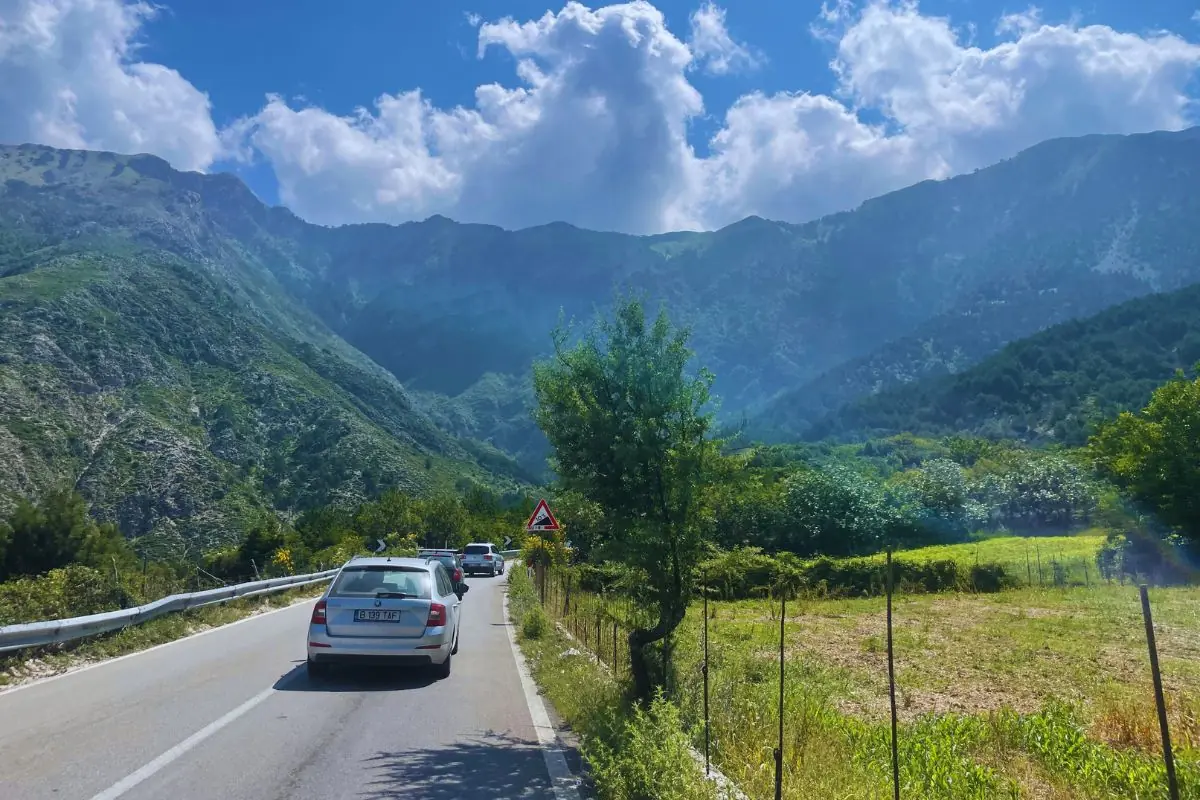
Road quality in Albania splits sharply by road type. The motorways and main national roads between major cities are genuinely good — European-standard asphalt, clear signage, modern tunnels. Secondary roads vary wildly. Mountain roads are where driving gets interesting.
Highways and main roads between cities
Albania’s backbone motorways are modern and fast. The A1 (Rruga e Kombit) runs 80 miles (128 km) from Milot to the Kosovo border at Morinë, including the 3.5-mile (5.65 km) Kalimash Tunnel — one of the longest road tunnels in the country. The A2 between Fier and Vlorë is a smooth dual carriageway. The A3 from Tirana toward Elbasan is the second-longest motorway and mostly complete.
Main national roads rate as follows:
- SH1 (Tirana–Shkodër): good condition, single carriageway, busy
- SH2 (Tirana–Durrës): excellent dual carriageway; fastest road in the country
- SH4 (Elbasan–Pogradec–North Macedonia): variable; some rough stretches
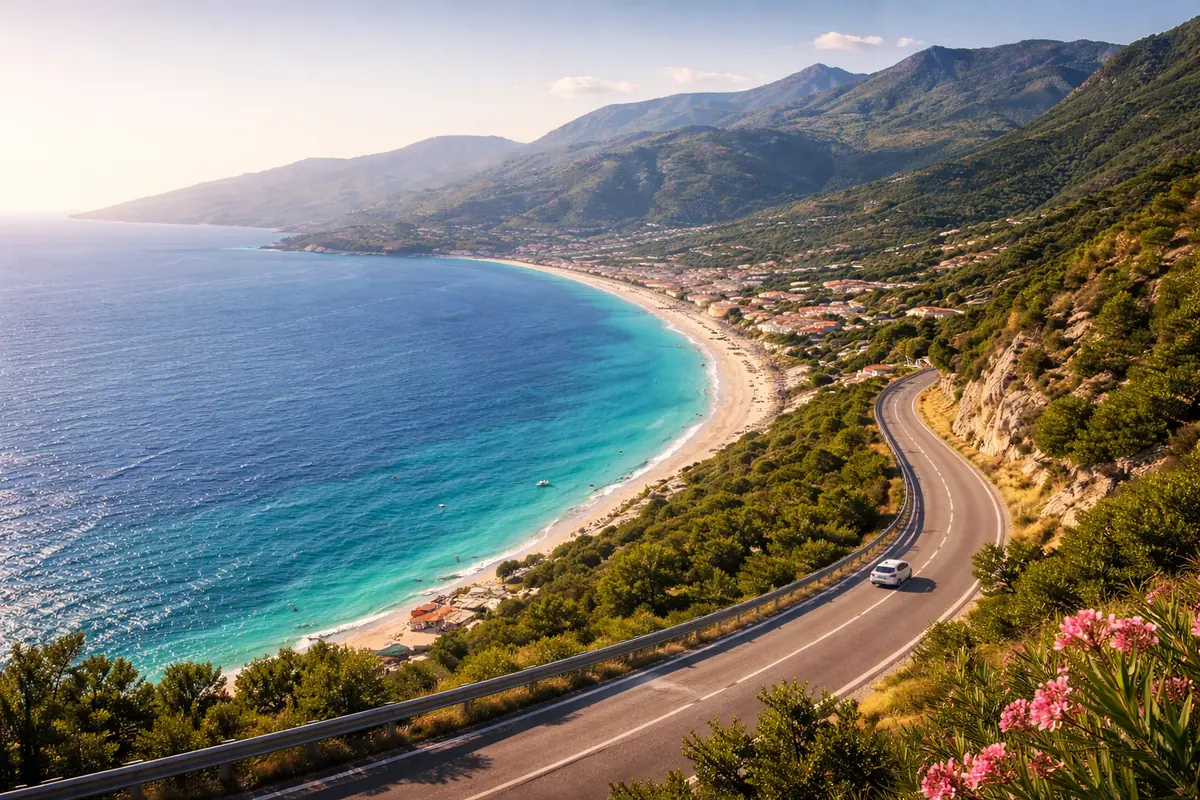
- SH8 (Vlorë–Sarandë, the Riviera): the coastal road along the Albanian Riviera — fully paved, narrow, cliff-hugging
Google Maps underestimates Albanian drive times by 30–50% on secondary and mountain roads. A “2h 15m” estimate to Theth is really closer to 3 hours once you factor in construction, switchbacks, and livestock delays.
Mountain roads and rural stretches
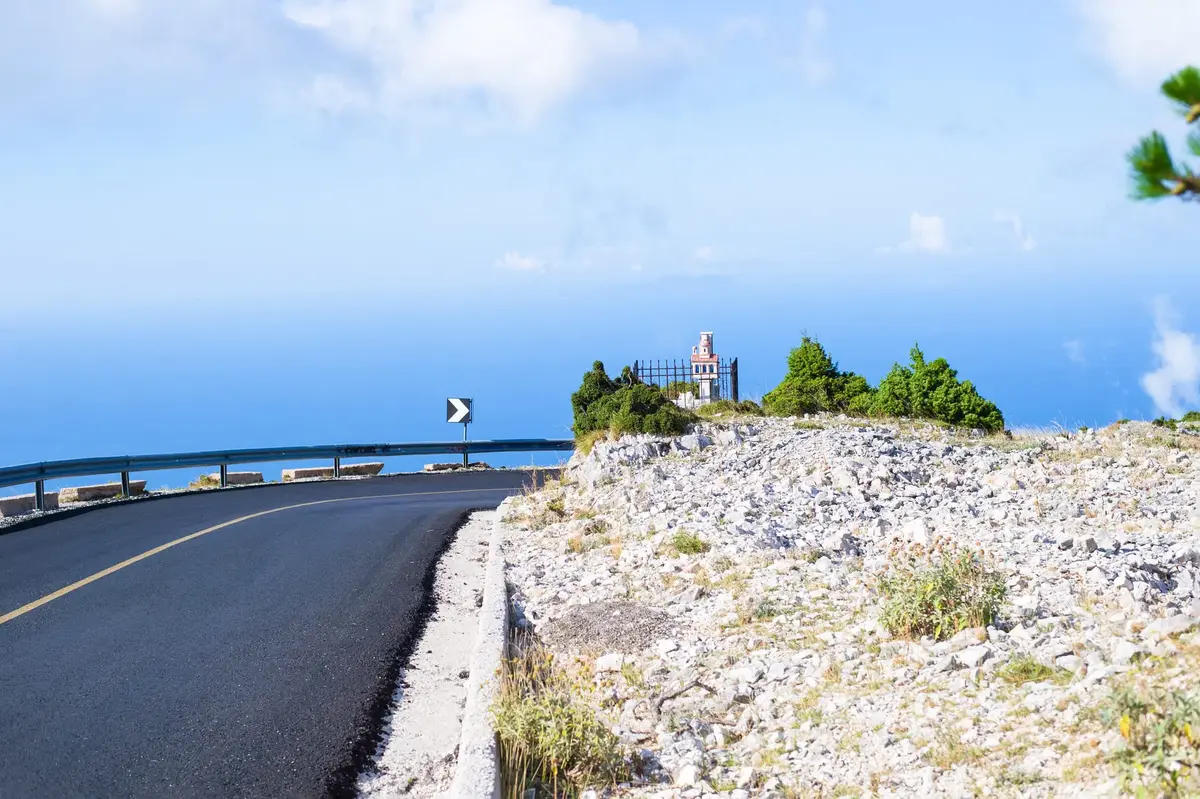
Mountain roads are where Albania earns its reputation. SH8 is fully paved but narrow, with near-vertical cliff drops and gaps in the guardrails. The road to Theth from Shkodër — long infamous as a 4×4-only track — is now fully paved, though still steep with sharp switchbacks; it’s the usual jumping-off point for the Theth-to-Valbona hike. The road to Valbona still has unpaved stretches where an SUV adds real value. The final approach to the Koman Ferry terminal is narrow and slow.
Key mountain roads rated honestly:
- Llogara Pass (SH8): 3,422 ft (1,043 m) elevation, paved, 20+ switchbacks — drive it in clear weather, skip it in fog or at night
- Llogara Bypass Tunnel: 3.7 miles (6 km), 250 ALL (~$3) toll, saves 30 minutes — use in bad weather or after dark
- Shkodër to Theth (SH21): fully paved, steep, narrow, ~2.5 hours for 45 miles (72 km)
- Valbona approach from Fierzë: partly unpaved, 4×4 advised
- Koman terminal access: narrow, slow, limited parking at the dam
The paving of the Theth road is a real shift that most articles haven’t caught up with. I drove it in a compact Skoda Fabia without drama. An SUV adds confidence on the switchbacks but isn’t necessary.
Hazards every driver will encounter
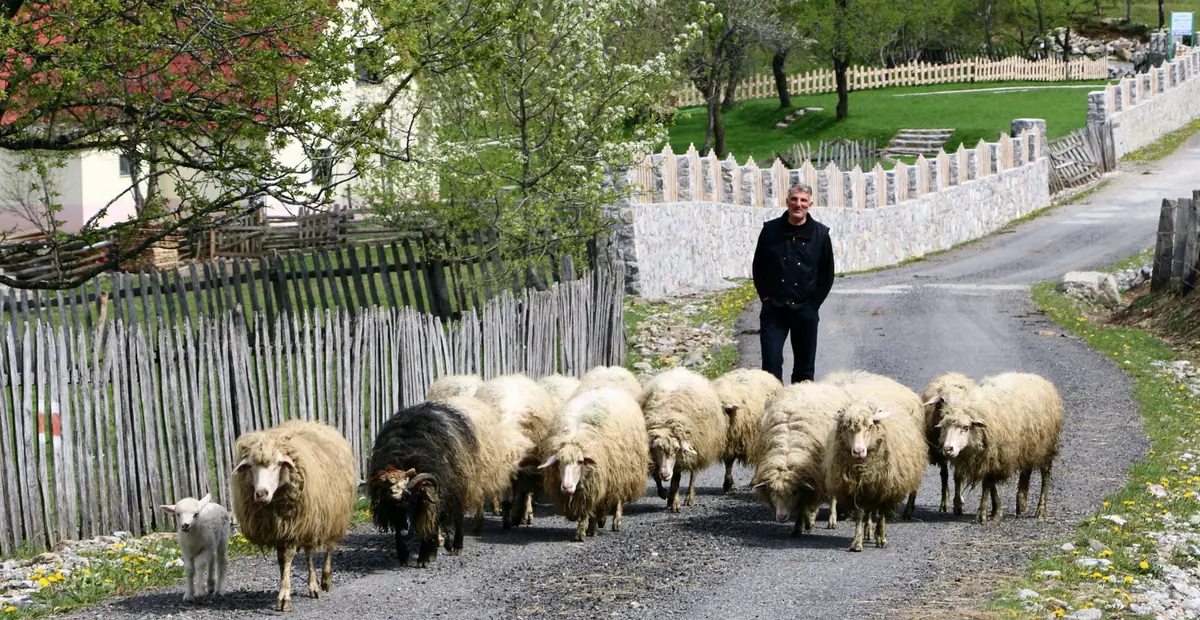
Expect to share the road with livestock. Sheep, goats, and cows graze along rural roads and occasionally block the asphalt entirely. Add potholes on secondary roads, unlit stretches after dark, mopeds riding against traffic, pedestrians walking on highway shoulders, and speed-limit signs that drop from 56 mph to 25 mph with no transition zone.
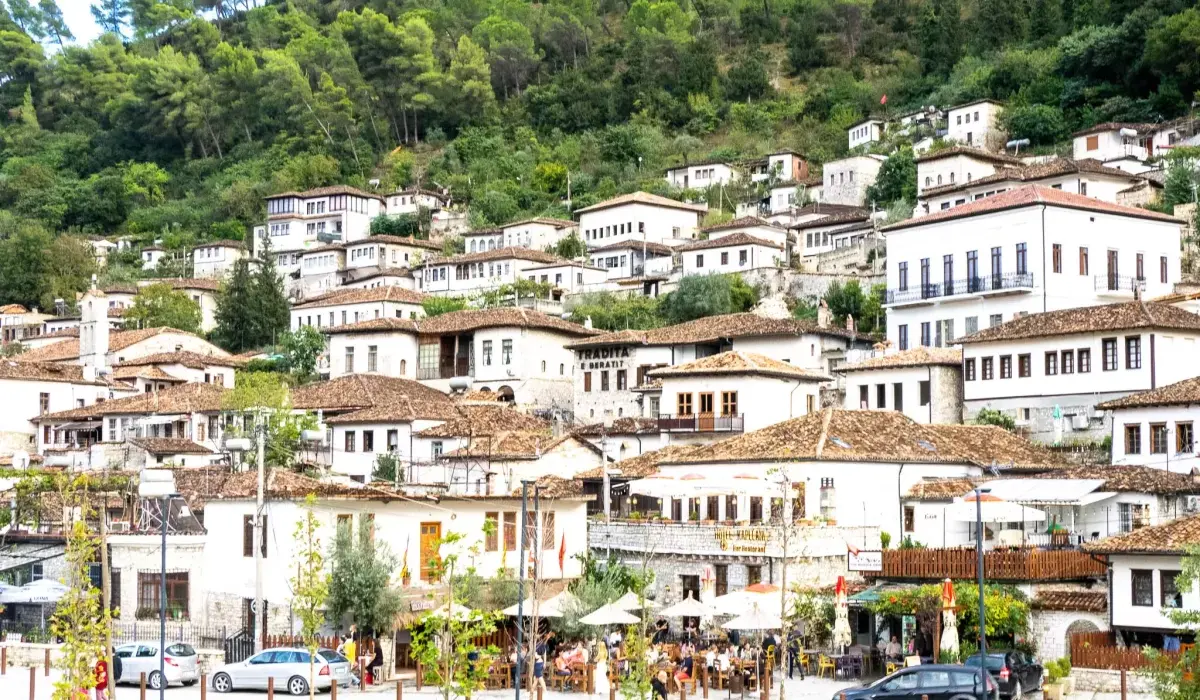
Pro Tip: When Google Maps routes you down what looks like a dirt track or a set of stone stairs in an old town (it happens often in Pogradec, Berat, and Gjirokastër), trust your eyes, not the app. Reverse out and find a main road.
What do fuel, tolls, and parking cost in Albania?
Gasoline costs roughly $8/gallon (~178 ALL/liter), and diesel runs about $9.15/gallon (~198 ALL/liter) — diesel is more expensive than gasoline in Albania, unusual for Europe. There are three toll points: the A1 Kalimash Tunnel (~$5.50), the Thumanë–Kashar stretch near Tirana Airport (~$3), and the Llogara Bypass Tunnel (~$3). City parking runs $1.10–1.65/hour. Fuel stations are common on main roads but scarce in mountain areas.
| Item | Cost (USD) | Notes |
|---|---|---|
| Gasoline | ~$8/gallon | Government-regulated; adjusted ~twice monthly |
| Diesel | ~$9.15/gallon | More expensive than gas |
| A1 Kalimash Tunnel | ~$5.50 (€5) | Cars; motorcycles ~$2.75 |
| Thumanë–Kashar toll | ~$3 (250 ALL) | Near Tirana Airport |
| Llogara Bypass Tunnel | ~$3 (250 ALL) | One-way; 500 ALL round trip; skips the mountain pass |
| Tirana street parking | $1.10–1.65/hour | Metered or paid to attendant |
| Coastal beach parking | $1.20–2.45/day | Higher in Ksamil/Dhërmi in summer |
| Hotel parking | $0–10/night | Often free outside Tirana |
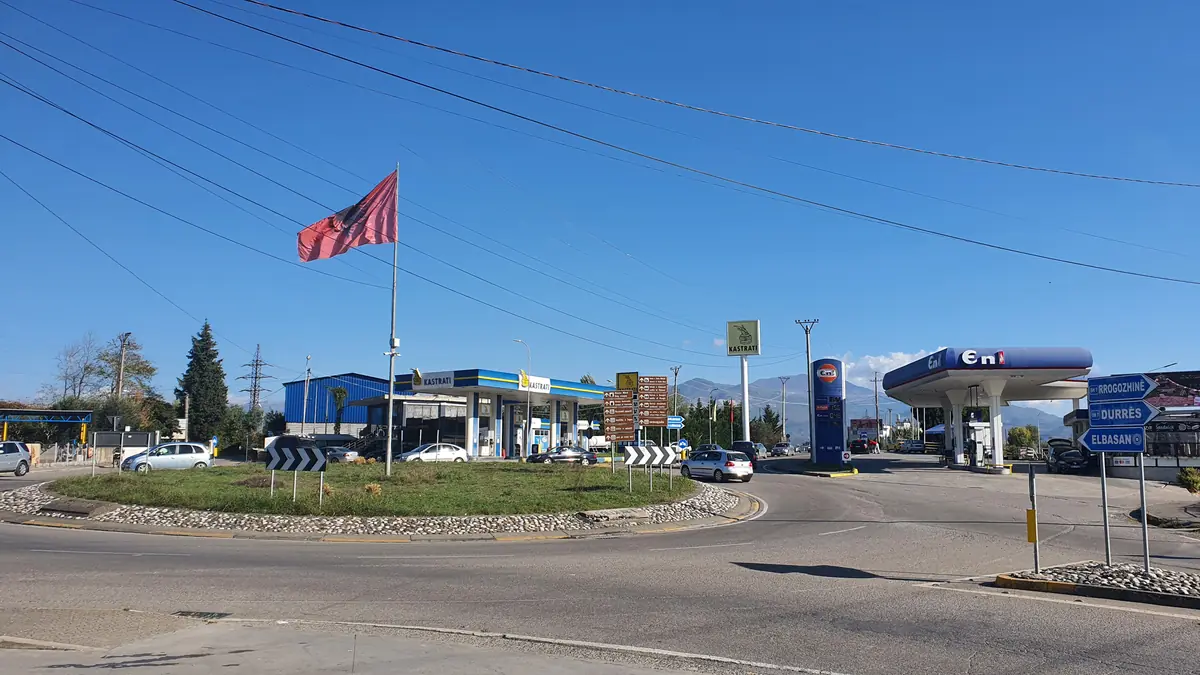
Fill up before you commit to a mountain drive. There are no gas stations between Shkodër and Theth, between Vlorë and Sarandë on the old SH8 coastal route, or on long stretches of the A1. Branded stations (Kastrati, EuroMax) are attended — tell the attendant “plot” (full) and the fuel type (“benzinë” for gasoline, “naftë” for diesel). Payment is at a small booth. Many rural stations only take cash.
The exchange rate hovers around 1 USD ≈ 82 ALL. Withdraw cash from ATMs in cities (Credins, Raiffeisen, and BKT are reliable). Euros are accepted in tourist areas but at unfavorable conversion.
What are the best driving routes in Albania?
The SH8 coastal road from Vlorë to Sarandë is Albania’s signature drive — 80 miles (129 km) of clifftop switchbacks above the Ionian Sea. The A1 motorway north to Kosovo is the country’s fastest and most modern road. The Tirana–Berat–Gjirokastër–Riviera loop is the classic 7–10 day circuit. The Shkodër–Theth road is the most dramatic paved mountain drive in Albania.
| Route | Distance | Drive time | Difficulty (1–5) | Surface | Scenic (1–5) | Key stops |
|---|---|---|---|---|---|---|
| SH8 Vlorë–Sarandë | 80 mi / 129 km | 3h 30m | 3 | Paved | 5 | Llogara, Dhërmi, Himarë |
| A1 Tirana–Kosovo border | 95 mi / 153 km | 1h 45m | 1 | Motorway | 3 | Kalimash Tunnel |
| Tirana–Berat | 76 mi / 122 km | 2h | 1 | Paved | 3 | Berat old town |
| Tirana–Gjirokastër | 139 mi / 224 km | 3h 15m | 2 | Paved | 4 | Tepelenë, Blue Eye nearby |
| Tirana–Shkodër | 62 mi / 99 km | 1h 45m | 1 | Paved | 3 | Lake Shkodër |
| Shkodër–Theth | 45 mi / 72 km | 2h 30m | 4 | Paved, steep | 5 | Theth village, waterfalls |
| Korçë–Përmet | 62 mi / 100 km | 2h 45m | 4 | Mixed | 5 | Mountain villages |
The 10-day classic loop (Tirana → Shkodër → Theth → back to Shkodër → Durrës → Berat → Gjirokastër → Sarandë → Riviera via SH8 → Vlorë → Tirana) covers every major destination in 800–900 miles (1,290–1,450 km) of driving — a complete Albania road trip in itself.
Llogara Pass or the tunnel?
The Llogara Bypass Tunnel costs 250 ALL (about $3) one-way for a car and saves roughly 30 minutes versus the old pass. Both sit on SH8. The decision matrix:
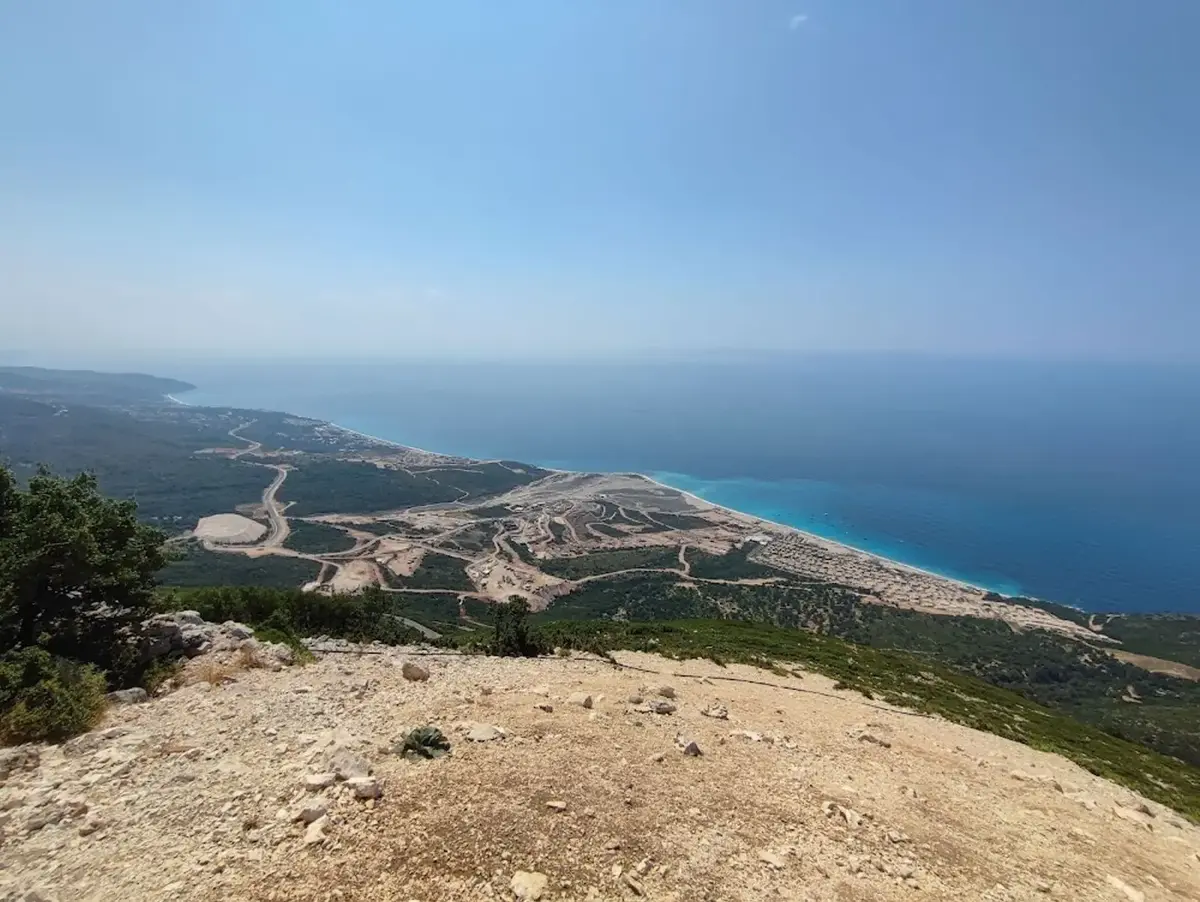
- Clear morning, good weather: drive the pass — the view at the summit, with the Riviera unrolling toward the Ionian, is the kind you pull over for
- Fog, rain, or dark: take the tunnel — the switchbacks are genuinely dangerous in poor conditions
- Tight schedule: take the tunnel
- First visit in summer: split it — drive the pass heading south, take the tunnel on the return
Koman Ferry logistics
If your route includes the Koman Ferry from Koman to Fierzë (the scenic alternative to driving to Valbona via Kukës):
- Ferry departs: 9:00 AM daily (confirm seasonally)
- Passenger fare: ~$12 per person
- Car fare: limited slots — pre-book essential in summer
- Crossing time: 2h 30m
- Scenic rating: 5/5 — fjord-like reservoir between vertical mountains
Can you take a rental car across Albanian borders?
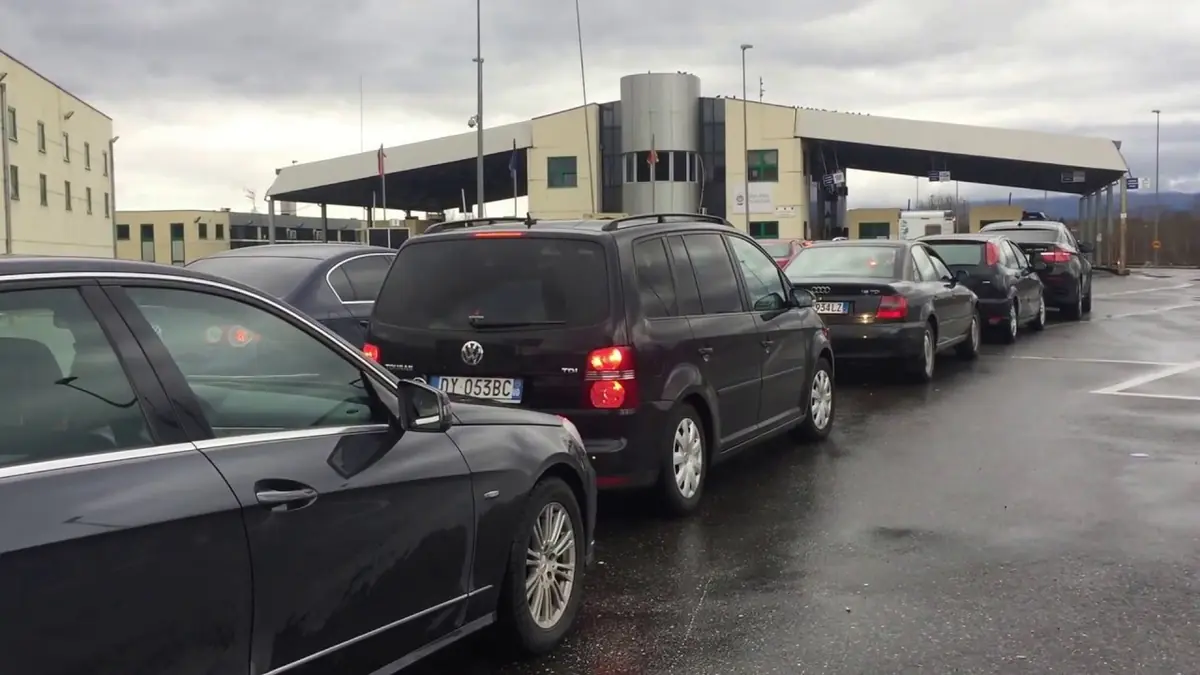
You can drive a rental car from Albania to Montenegro, Greece, North Macedonia, and Kosovo — but you must arrange cross-border authorization and Green Card insurance in advance. Most rental companies charge $22–66 for the authorization and Green Card bundle. Kosovo is the exception: a reciprocal agreement means no Green Card is needed. Always confirm cross-border policies at booking, not at pickup.
| Border | Main crossing | Connects | Hours | Notes |
|---|---|---|---|---|
| Montenegro | Hani i Hotit / Božaj | Shkodër ↔ Podgorica | 24/7 | Busiest; 30–90 min summer waits |
| Montenegro | Muriqan / Sukobin | Shkodër ↔ Ulcinj | 24/7 | Joint checkpoint — faster |
| Kosovo | Morinë / Vërmicë | Kukës ↔ Prizren | 24/7 | Modern; no Green Card required |
| Greece | Kakavijë / Ktismata | Gjirokastër ↔ Ioannina | 24/7 | Very busy July–August |
| Greece | Qafë Botë / Sagiada | Konispol ↔ Filiates | 07:00–23:00 | Quieter; near Sarandë |
| N. Macedonia | Qafë Thanë / Kafasan | Pogradec ↔ Struga | 24/7 | Near Lake Ohrid |
| N. Macedonia | Tushemisht / Sveti Naum | Pogradec ↔ Ohrid | 07:00–19:00 | Lakeside scenic |
Green Card insurance options:
- Rental company bundle: $22–66 (includes cross-border authorization)
- Border insurance booth: $16–54 (€15–49) at most crossings — not available at Grabon/Cijevna
- Online via Albanian insurer: cheaper, requires planning ahead
Pro Tip: The Morinë/Vërmicë crossing on the A1 to Kosovo moves like a modern toll booth — 10 minutes tops. Hani i Hotit in summer can stretch past 75 minutes. If your itinerary includes both, save Kosovo for a weekday and Montenegro for an early morning.
How hard is it to drive in Tirana?
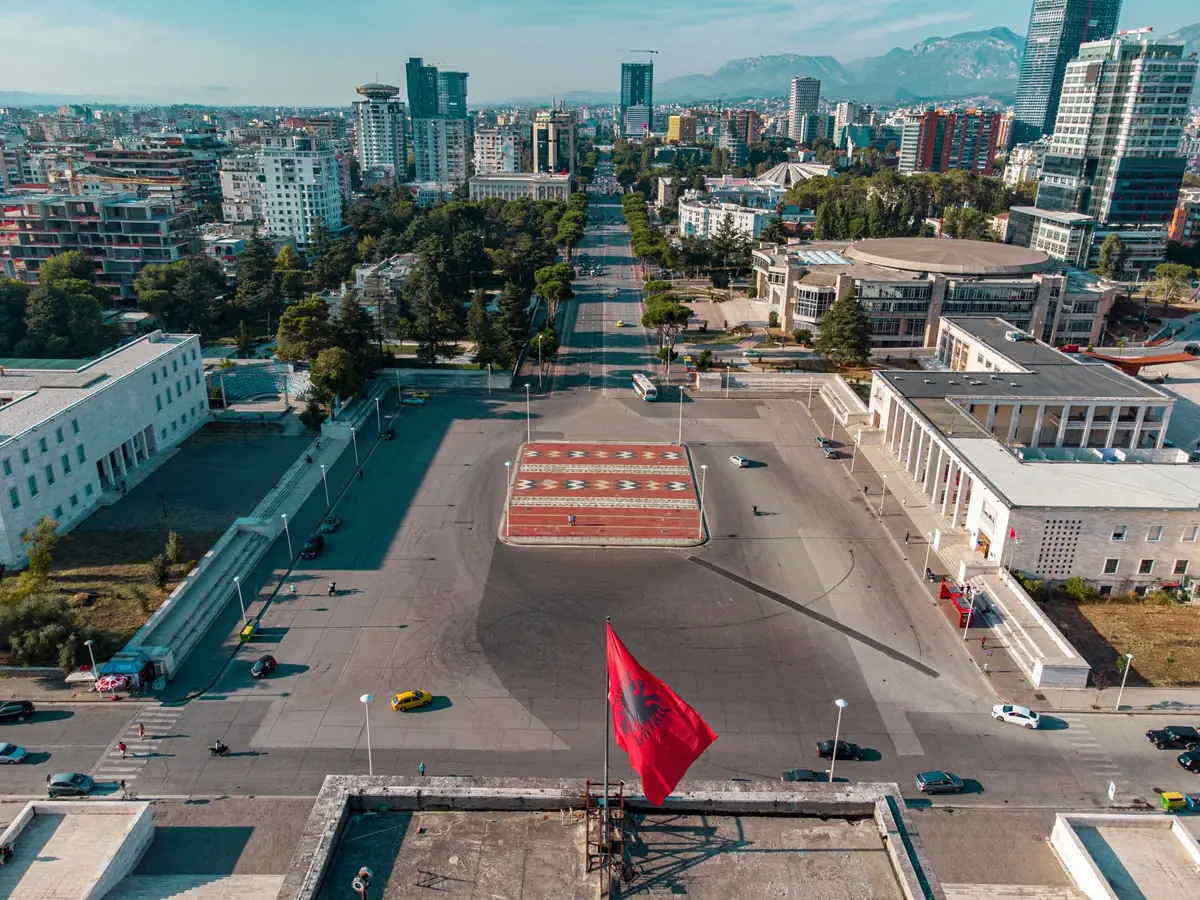
Tirana’s roundabouts are the most stressful driving you’ll do in Albania. Lanes function as suggestions, indicators are decorative, and merging is a contact sport. The best strategy is to save the capital for the end of your trip, once you’ve adapted to the Albanian driving rhythm. Park at your hotel in Tirana and walk or take taxis inside the city center.
Tactical survival notes:
- Skanderbeg Square and the main ring road: avoid between 7:30–9:30 AM and 5–7 PM
- Roundabouts near the airport are police-directed during peaks — watch the officer, not the lane lines
- Google Maps struggles in Tirana due to construction and tall buildings blocking GPS — verify turns visually
- Double-parking is endemic; expect to be blocked in occasionally
- Use official paid lots (signposted with a P) — avoid informal “attendants” who appear near tourist spots
Parking realistic costs:
- Central Tirana street meters: $1.10–1.65/hour
- Blloku paid lots: $2.50–4.00/hour
- Hotel parking: often included or $5–10/night
- Airport long-term lot: ~$8/day
Rush hour can turn a 2-mile trip into a 45-minute slog. Taxis via the Speed Taxi app or a hotel-arranged driver cost $4–8 for most city-center rides — cheaper than parking stress.
Do you actually need a 4×4 in Albania?
No — for the standard southern Albania loop (Tirana–Berat–Gjirokastër–Riviera–Tirana), a compact car handles everything fine. Main highways and the SH8 coastal road are fully paved. You only need a 4×4 for the Valbona road from Fierzë, some unpaved beach access tracks, and the Korçë–Përmet mountain shortcut. The road to Theth from Shkodër is now paved and doable in a sedan, though an SUV adds confidence on the switchbacks.
Where a compact car works fine:
- All motorways (A1, A2, A3)
- All SH national roads (SH1, SH2, SH4, SH8)
- Llogara Pass (paved throughout)
- Shkodër–Theth road (fully paved)
- Main approaches to Berat, Gjirokastër, Sarandë, Vlorë, Korçë
Where a 4×4 genuinely earns its cost:
- Valbona approach from Fierzë (partly unpaved)
- Beach access tracks near Gjipe, Borsh, and some Riviera coves
- Korçë–Përmet via the mountain route (not the main road)
- Any off-piste exploring in the Albanian Alps
The math: economy rental ~$23/day vs. SUV ~$48/day — that’s $25/day, or $175 over a week. For most itineraries, the compact saves enough to cover all tolls, fuel, and parking combined — a real dent in your overall Albania travel costs.
What happens at an Albanian police checkpoint?
Albanian police set up frequent checkpoints on main roads, especially near cities and on the A1 motorway. They wave cars over at random. The officer asks for your license, rental agreement, and insurance documents. The exchange is usually brief and professional — 2–3 minutes if documents are in order. Keep everything in the glove compartment for quick access.
A typical stop goes like this: an officer steps into the road with his palm raised. You pull over to the shoulder, lower the window, keep both hands visible on the wheel. He says “dokumenta.” You hand over the stack (license, IDP, rental agreement). He glances at each for a few seconds, sometimes asks where you’re going in basic English, nods, hands them back, and waves you on. Total elapsed time: 90 seconds to 3 minutes.
What not to do:
- Don’t offer cash, gifts, or anything that resembles a bribe — police reform has been serious and the officer may not be the one you expect to encounter
- Don’t argue — if you get a fine you disagree with, ask for a written receipt and contest it later
- Don’t get out of the car unless asked
- Don’t speed away from a checkpoint — officers radio ahead
If a fine is issued, Albanian law requires a written receipt (fletarreshtim). Pay within 15 days for the 50% discount. Some officers will offer to “settle it here” — politely decline and ask for the official receipt.
What do most Albania driving guides leave out?
A few practical details rarely make the guides: most gas stations are full-service and many rural ones take only cash; mobile coverage vanishes in Theth, Valbona, and Koman; and Google Maps regularly routes you onto stairs or dirt tracks in old towns. Download offline maps, sort out a SIM card or eSIM, and carry small lek notes before you leave the city.
Gas stations and paying for fuel
Most Albanian gas stations are full-service. You pull in, an attendant asks what you want, pumps the fuel, and you pay at a small booth. Tipping isn’t expected, but $1–2 for good service earns a wave-off and a smile. Branded chains (Kastrati, EuroMax, Gega) deliver consistent fuel quality. Many rural stations are cash-only — keep 2,000–5,000 ALL ($24–61) in small notes.
Fill up before:
- The Shkodër–Theth drive (no stations after Shkodër)
- The old SH8 route between Vlorë and Sarandë (one station in Himarë)
- Crossing into North Macedonia (stations thinner near Pogradec)
- Any day exploring the Albanian Alps
Cell service, navigation, and offline maps
Download Google Maps offline for all of Albania before you leave your home Wi-Fi. Google Maps occasionally routes down stairs, dirt tracks, or dead-ends — especially in Pogradec, Berat’s old town, and parts of Gjirokastër. Use Maps.me as backup.
Connectivity options:
- US T-Mobile Magenta or Go5G: includes slow international data in Albania
- eSIM via Airalo: from ~$4 for 1 GB / 7 days, scaling to ~$37 for 20 GB / 30 days
- eSIM via Holafly: unlimited from ~$10/day or ~$37/week (fair-use throttling applies)
- Vodafone Albania tourist SIM at Tirana Airport: ~$12 for 10 GB / 7 days
Coverage drops in the mountains — expect no signal in Theth, Valbona, Koman, and stretches of the SH8 coast.
What to keep in the car
Legally required:
- Warning triangle
- Reflective safety vest
- First-aid kit
Recommended additions:
- Printed screenshots of mountain routes (GPS fails)
- Cash in 500 ALL and 1,000 ALL notes for tolls and rural fuel
- Water and snacks for long mountain drives
- Phone mount (handheld phone use = $61–183 fine)
- Paper copy of rental agreement (in case of theft)
The bottom line
TL;DR: Driving in Albania is the right call for most American travelers — main roads are good, rental costs are low, and a car unlocks the coastline and mountain villages that bus travel can’t reach. Book an automatic 4–6 weeks ahead, get an IDP from AAA, and skip the 4×4 upsell. Save Tirana driving for the end of the trip.
The quick cheat sheet:
- Drive on the right
- Speed limits: 25 mph urban, 50 mph rural, 68–81 mph motorway
- Blood alcohol: 0.01% (effectively zero)
- Headlights on 24/7
- IDP from AAA: $20 permit ($30–50 with photos), same-day
- Average rental: $23–47/day
- Gasoline: ~$8/gallon
- Three tolls: Kalimash (~$5.50), Thumanë–Kashar (~$3), Llogara Tunnel (~$3)
- Emergency: 112 / Police: 129 / Traffic police: 126
- Top 3 tips: fill gas before mountains, book automatic early, save Tirana for last
Driving is just one piece of the puzzle — our full Albania travel guide covers where to stay, what to eat, and when to go. The country rewards drivers who commit. The SH8 Riviera, the Theth switchbacks, the Koman Ferry detour — these aren’t side trips, they’re the reason to come. What part of your Albania route are you second-guessing? Drop it in the comments and I’ll give you a straight answer.