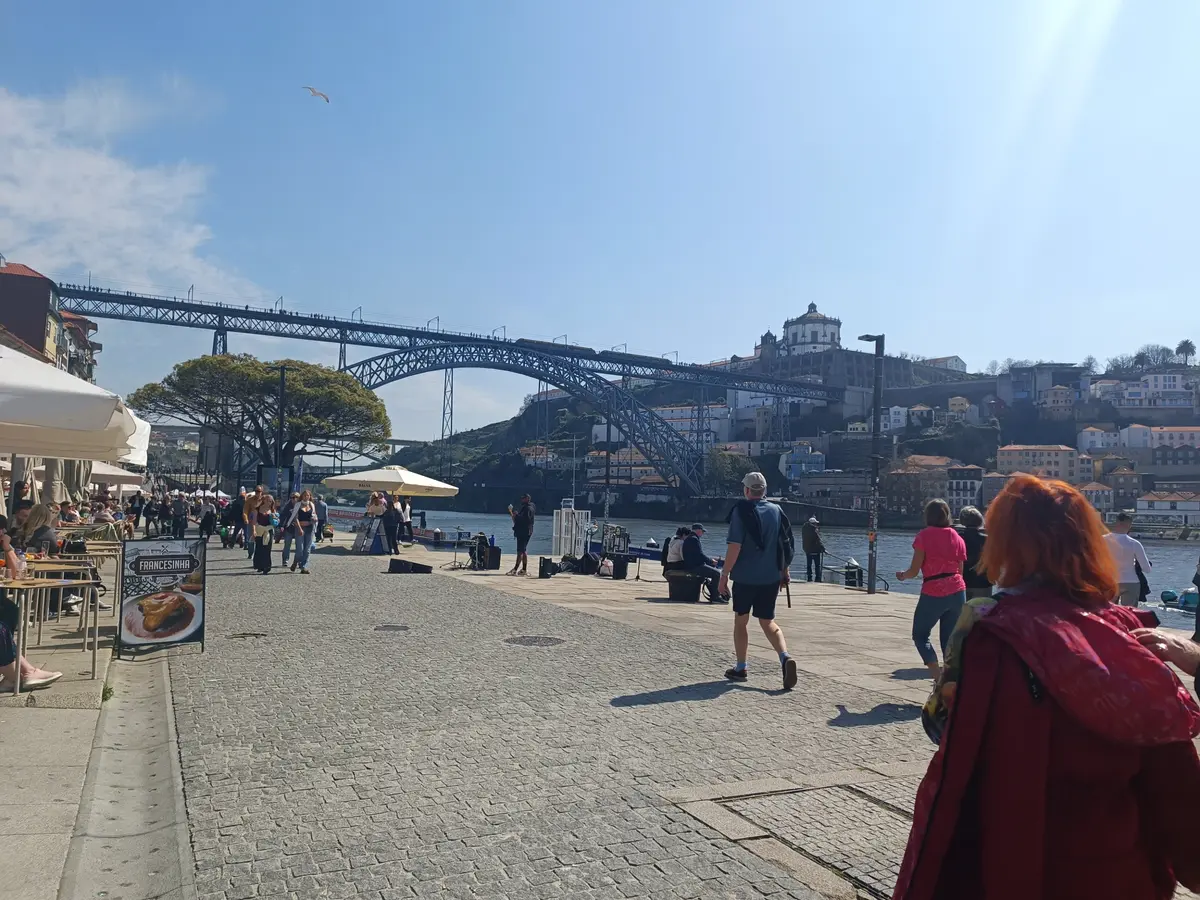
Humberto Delgado Airport sits 7 miles (11 km) from Lisbon’s center, but most published guides about getting from Lisbon airport to city center are quietly wrong: the Aerobus is gone permanently, and Uber pickups at the arrivals curb do not exist. Here is every real option, with current prices and no guesswork. If this is your first visit, the Lisbon travel guide covers the full picture once you are through customs.
Which transport option is right for your trip?
Four real options exist: the Metro (€1.72/$1.85 with Zapping, 35-45 minutes with one transfer), Uber or Bolt (€10-20/$11-$22 from the P2 garage, 20-30 minutes door-to-door), licensed taxis (€12-20/$13-$22, curbside 24/7), and pre-booked private transfers (€25-35/$27-$38, driver waiting in arrivals with your name on a sign). The right choice depends on group size, arrival time, and how much luggage you have.
Here is how to make the call quickly:
- Solo traveler, arriving before 1 AM: Metro. The cost difference adds up fast over a multi-day trip.
- Couple or group of 3-4: Bolt or Uber. Once you split the fare, the Metro’s cost advantage disappears.
- Arrival after 1 AM: Taxi or private transfer. The Metro shuts down at 1 AM with no exceptions.
- Heavy luggage, staying in Alfama or Belém: Ride-hailing or private transfer. The Alameda Metro transfer with two large suitcases is exhausting, and Alfama’s nearest station (Santa Apolónia) deposits you at the bottom of a steep hill.
- Business travel or mobility concerns: Private transfer. The peace of mind costs €25 ($27).
Transport choices are also worth mapping against your overall Portugal travel cost budget before you land — the Metro’s €1.72 fare compounds differently across a 3-day city stop versus a 10-day itinerary.
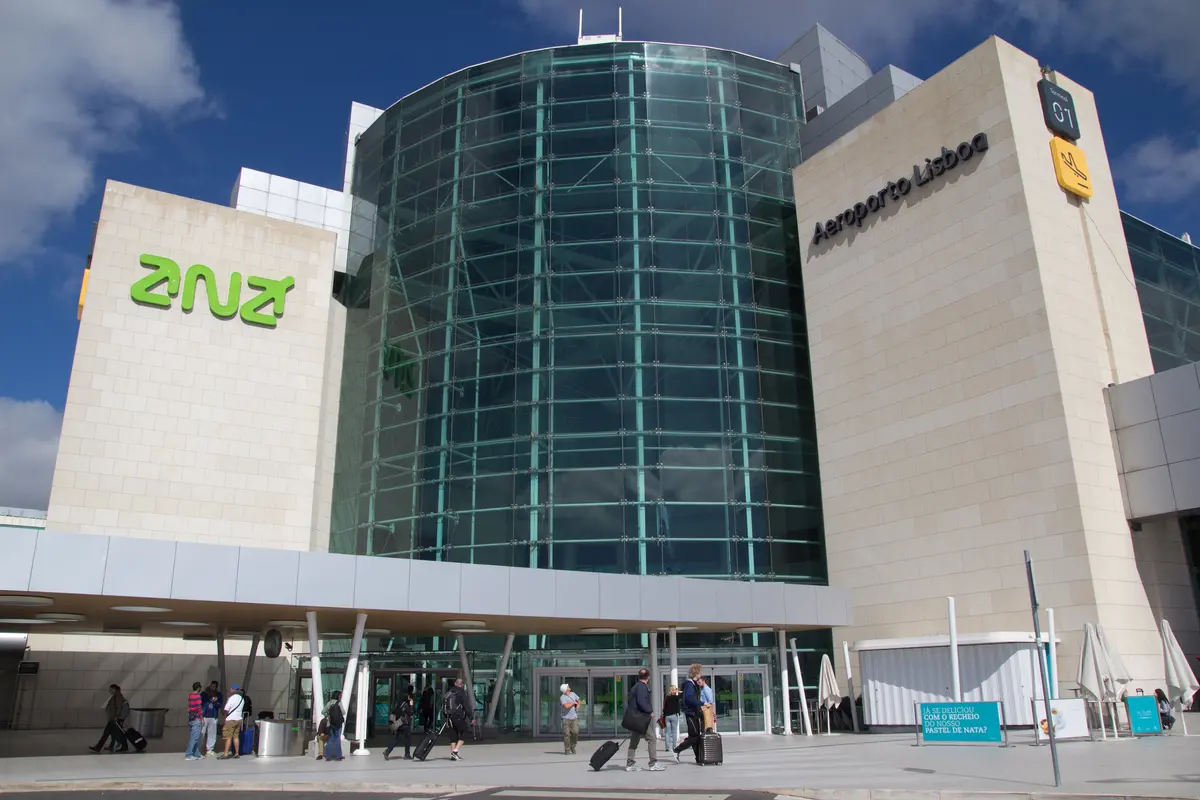
What actually happened to the Aerobus?
The Aerobus — yellow buses that used to stop at hotels along Avenida da Liberdade — has been permanently suspended since the pandemic and shows no sign of returning. Your four real choices are the Metro, ride-hailing apps, licensed taxis, and pre-booked private transfers.
If you see an airport shuttle advertised in a hotel lobby or by a curbside tout, confirm it is a licensed service before paying. The Aerobus name still surfaces in searches, but there is nothing to board. Any guide still listing it as a primary option is outdated.
Is the Metro worth it from Lisbon Airport?
The Metro is the cheapest way from Lisbon Airport to city center at €1.72 ($1.85) per ride with Zapping. The Aeroporto station sits at the end of the Red Line, a 30-second walk from Terminal 1 arrivals. Most central neighborhoods require one transfer — at Alameda for Baixa and Chiado, at São Sebastião for Avenida da Liberdade. Total journey time runs 35-45 minutes.
For most solo travelers arriving during Metro hours, it is the correct answer. If you are planning any train travel in Portugal beyond Lisbon, the Red Line connects directly onward to Oriente and Entrecampos stations — useful context for structuring your journey from the moment you land. The airport station (Aeroporto) sits at the end of the Red Line, about 30 seconds from the Terminal 1 arrivals exit. Turn right after walking out of customs and you will see the entrance.
Trains run every 6-9 minutes from 6:30 AM until 1 AM.
- Location: Metro entrance, 30-second walk right of Terminal 1 arrivals exit
- Cost: €1.72 ($1.85) per ride with Zapping; €1.92 ($2.10) contactless bank card; Navegante card costs €0.50 ($0.55) to purchase
- Best for: Solo travelers and budget arrivals before 1 AM
- Time needed: 35-45 minutes to Baixa or Chiado, including the Alameda transfer
How to pay without queuing at the machines
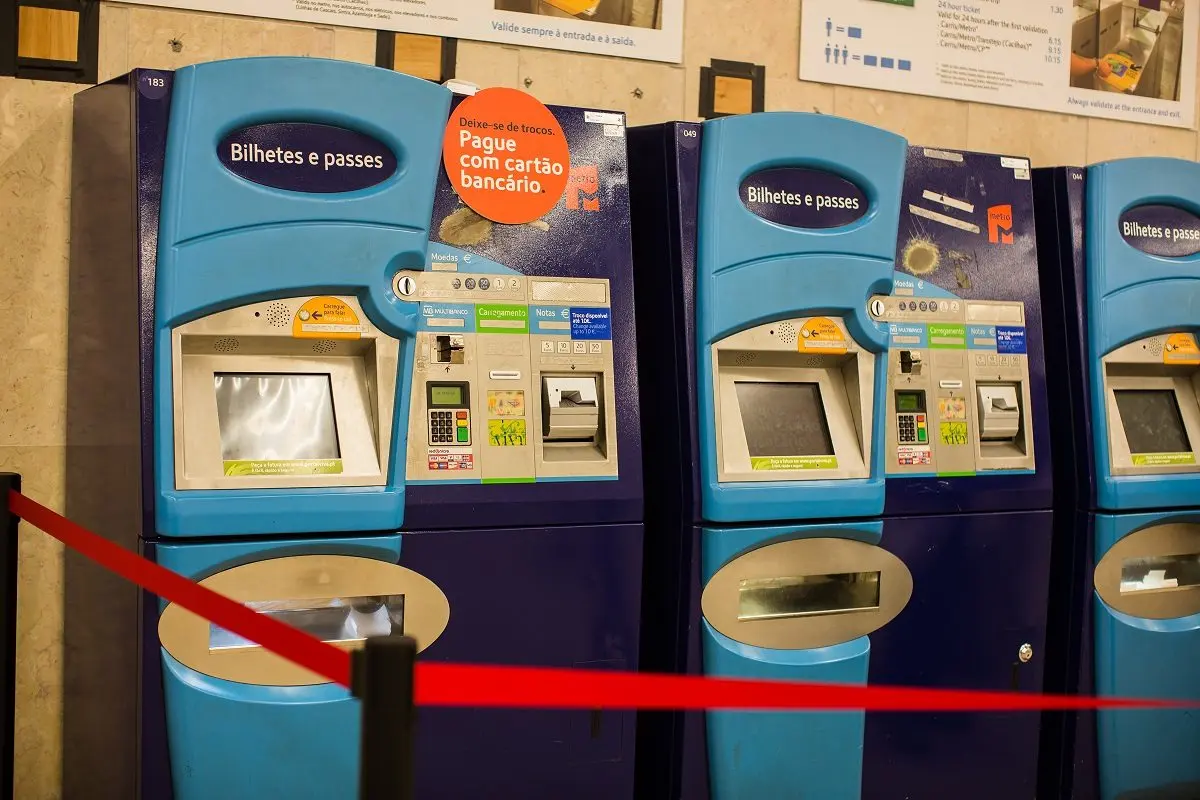
You have two options at the gate. Tap a contactless Visa or Mastercard directly on the validator for €1.92 ($2.10) per ride — fast, no machine required. Or buy a reusable Navegante Occasional card for €0.50 ($0.55) and load it with Zapping credit at €1.72 ($1.85) per Metro ride.
The contactless method is faster and works on arrival with no setup. The Navegante with Zapping is cheaper per trip and covers all buses, trams (including Tram 28), and funiculars — so if you plan to use public transport more than three times during your stay, Zapping saves money. For longer stays, compare that against the Lisbon Card, which bundles unlimited transport with museum and attraction entries across the city.
Pro Tip: Skip the machines directly in front of the Metro entrance. Walk 20 meters (65 feet) further into the station atrium and you will find machines tucked behind the pillars with no queue at all. That is where commuters go.
What the Alameda transfer actually involves
The Red Line does not run directly to the most-visited neighborhoods. For Baixa, Chiado, or Alfama, you transfer at Alameda to the Green Line. For hotels near Avenida da Liberdade or Marquês de Pombal, you transfer at São Sebastião to the Blue Line.
The Alameda transfer involves long underground corridors, multiple escalators, and elevators that break down more often than they should. During rush hours — 8-10 AM and 5-7 PM — you are navigating those passages while commuters move in the opposite direction. On my last visit with a 28-inch suitcase, the uphill elevator at Alameda was out of service and I carried it up three flights of stairs alongside roughly 40 other passengers in the same situation.
If you are traveling with two full suitcases, run the numbers on Bolt before assuming the Metro is the obvious call.
How do Uber and Bolt work from Lisbon Airport?
Uber and Bolt pick up from the P2 parking garage — a 5-minute walk from Terminal 1 arrivals — not from the arrivals curb. Fares run €10-20 ($11-$22) to central Lisbon under normal conditions. Bolt typically undercuts Uber by 10-20% on identical routes. For groups splitting the fare, the cost advantage over the Metro disappears almost entirely.
Ride-hailing apps are often cheaper than taxis for the same route. Bolt typically runs 10-20% lower than Uber on identical trips, with base fares landing around €10-13 ($11-$14) to central neighborhoods in normal traffic.
- Location: P2 short-stay parking garage, 5-minute walk from Terminal 1 arrivals
- Cost: €10-20 ($11-$22) base; surge pricing during rain, rush hour, or after events at Altice Arena can push to €25 ($27)
- Best for: Couples and groups; heavy luggage; anyone staying in Alfama or Belém
- Time needed: 20-30 minutes door-to-door
The P2 parking garage walk, step by step
You cannot request a ride at the arrivals curb. Airport authorities enforce geofencing that limits ride-hailing pickups to the P2 short-stay parking garage. If you request while still at the baggage carousel, the driver arrives, waits the mandatory five minutes, and charges a cancellation fee.
The walk goes like this: exit customs into the arrivals hall, turn left, walk past the Starbucks on your left, follow signs reading “Parque P2” or “Online Reservation Platforms,” exit the terminal building, cross the pedestrian walkway (sometimes covered, sometimes not, depending on ongoing construction), and enter the multi-level parking structure. It takes about five minutes.
Do not request your ride until you are standing in P2. Drivers stage in a nearby buffer zone and arrive within 2-3 minutes. The garage is dim and crowded — check the license plate before getting in.
Pro Tip: Download both Bolt and Uber before you land and price-check in real time. If one app shows surge pricing above 1.5x, the other often does not. Having both open takes ten seconds and has saved a meaningful amount on the same route during a rainy Friday evening.
Bolt vs. Uber: which to book first
Bolt is cheaper on most Lisbon routes and is the local preference. Uber in Lisbon has better car supply during peak hours — Friday afternoons, Sunday evenings, and just after major events. Download both, check both, choose the better price.
Are Lisbon airport taxis reliable — and what does the meter actually say?
Licensed taxis queue at a rank directly outside Terminal 1 arrivals, open 24 hours. All city trips run on the meter by law — the daytime rate is €0.96 per km ($1.05/km) with a €3.32 ($3.60) minimum. A typical run to city center costs €12-20 ($13-$22). Decline any driver who shows a laminated flat-rate zone card instead of starting the meter.
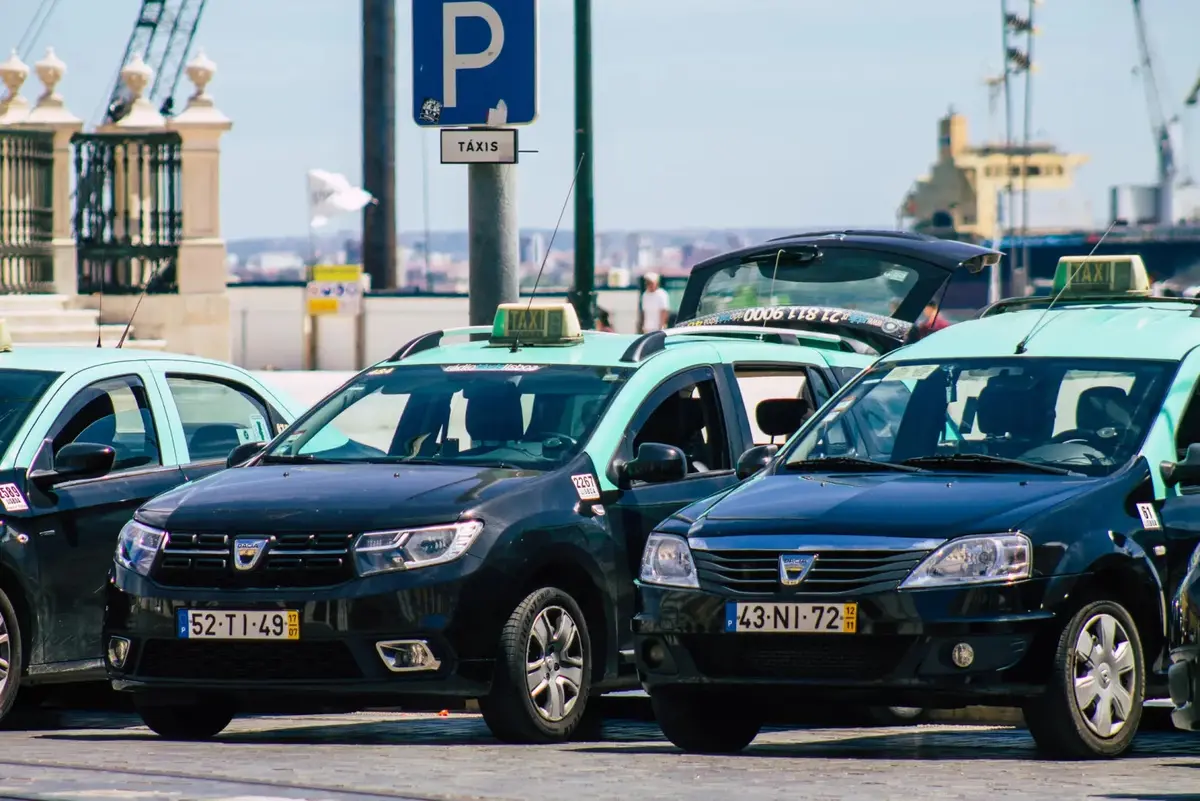
Licensed Lisbon taxis are cream-colored or black with a green roof, metered for all city trips, and the right option when the Metro is closed or you do not want to walk to P2.
- Location: Taxi rank directly outside Terminal 1 arrivals, open 24/7
- Cost: €12-20 ($13-$22) daytime (6 AM-9 PM); up to €25 ($27) nights and weekends; €1.60 ($1.75) luggage surcharge total — not per bag
- Best for: Arrivals after 1 AM; travelers who prefer direct curbside pickup
- Time needed: 20-30 minutes
How the zone pricing scam works
Some drivers at the arrivals rank target tired travelers with a professional-looking laminated card bearing official logos and a price matrix claiming “Official Airport Zones.” It quotes flat rates of €35-45 ($38-$49) to the city center. It looks convincing. It has no legal basis.
Lisbon taxis are required by law to use the meter (taxímetro) for urban trips. The official daytime rate is €0.96 per km ($1.05/km) with a minimum fare of €3.32 ($3.60). At night and on weekends the rate rises to €1.21 per km ($1.32/km). The luggage fee is a flat €1.60 total — any driver asking €5 per bag is inventing a surcharge.
If a driver refuses to run the meter or shows you a rate card, say “Taxímetro, se faz favor” — one of the basic Portuguese phrases for tourists worth memorizing before arrival. If they refuse, close the door and move to the next taxi. This is not a confrontation — it is a policy.
Pro Tip: If the arrivals rank feels chaotic, take the escalator inside the terminal up to the departures (Partidas) level and exit to the street. Taxis dropping off departing passengers can be hailed legally right there. These drivers are not part of the arrivals queue, are not running any zone rate games, and are generally glad for a quick return fare to the city.
What to say to start the meter
Get in, name your hotel or neighborhood, and confirm the meter is running before the car moves. The Portuguese for meter is “taxímetro” (tash-ee-MEH-troo). Most drivers understand “meter, please” in English without further translation.
When does a private transfer from Lisbon Airport make sense?
Pre-booked private transfers place a driver in the Terminal 1 arrivals hall with a sign bearing your name, after customs. You walk out, spot the sign, and follow someone who already knows where your hotel is — no P2 walk, no meter negotiation, no ticket machine. Standard sedans run €25-35 ($27-$38). For three people splitting a €30 ($32) fare, the per-head cost matches the Metro with none of the transfer hassle.
Companies like Welcome Pickups handle most of the English-speaking market. If you have not yet settled on a neighborhood, the guide to where to stay in Lisbon covers the tradeoffs between Alfama, Baixa, Chiado, and beyond — useful to have sorted before you book. Book at least 24 hours in advance and provide your flight number so the driver tracks any delay.
- Location: Terminal 1 arrivals hall, landside (after customs)
- Cost: €25-35 ($27-$38) for a standard sedan; up to €50 ($54) for larger vehicles
- Best for: Business travelers; families; anyone with mobility challenges; late arrivals when the Metro is closed
- Time needed: 20-30 minutes door-to-door
The per-person cost drops sharply for groups. Three people splitting a €30 ($32) transfer pay €10 each — the same as the Metro with none of the transfer hassle. Run that math before assuming the Metro is always the budget play.
What if you’re flying from Terminal 2?
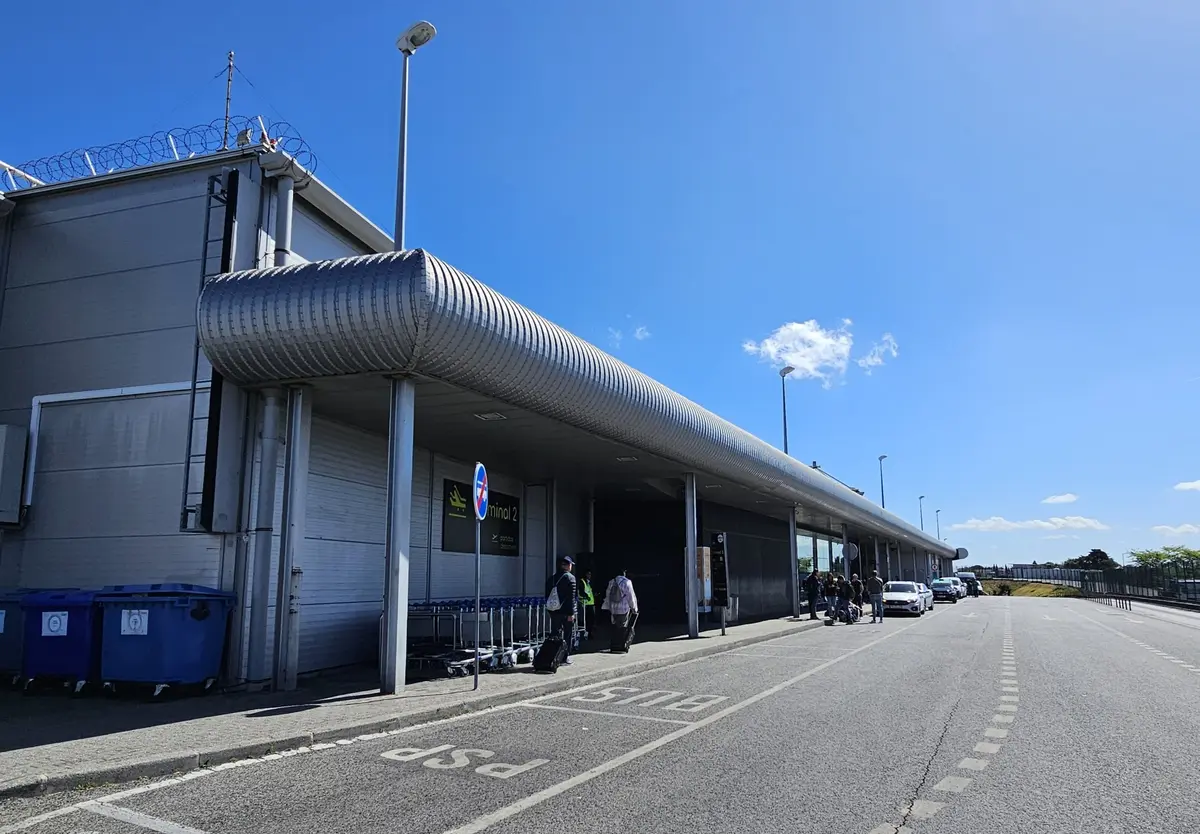
All international arrivals use Terminal 1. Ryanair, Wizz Air, and EasyJet departures, however, use Terminal 2 — a separate building about 1.8 miles (3 km) away with no Metro connection.
To reach Terminal 2, take the free shuttle bus from outside Terminal 1 departures. The bus runs every 10 minutes and the journey takes 3-5 minutes, but if you arrive right after a large inbound flight lands, the queue can be substantial. Add at least 30 minutes to your airport arrival time if you are departing from T2 — a detail especially worth noting if your 3-day Lisbon itinerary ends with an early-morning departure.
Pro Tip: Note which terminal handles your carrier the night before leaving your accommodation — it catches experienced travelers off guard more often than anyone wants to admit.
What to do with bags if check-in isn’t until 3 PM?
You land at 9 AM, your Airbnb does not open until 3 PM, and you are not going to stand in the terminal for six hours. Two practical options exist.
Official airport lockers are on the departures level of Terminal 1, landside (before security), open 24/7. Prices per 24-hour period:
- Small locker: €7 ($7.50)
- Medium locker: €9 ($9.75)
- Large locker: €14 ($15)
- XL locker: €20 ($22)
Card payment accepted. The lockers are coin-free, which most visitors find out only after searching for coins they do not have.
The alternative is LUGGit, a luggage courier service. Book through their app, a driver meets you at the curb, collects your bags, and delivers them to your accommodation at your chosen check-in time. Cost runs around €15 ($16) per bag — more expensive than a locker, but it means you can spend your first morning walking Alfama’s hills without dragging a suitcase up every cobblestone street.
For travelers with reduced mobility, most Metro stations have elevators, but they fail often enough that a pre-booked private transfer is the more reliable choice. The accessible travel in Lisbon guide covers elevator routing, accessible taxi booking, and step-free alternatives across the city.

The bottom line
TL;DR: Solo travelers arriving during Metro hours (6:30 AM – 1 AM) should take the Red Line from Aeroporto, budget for the Alameda transfer, and pay contactless to skip the machines. Couples and groups should default to Bolt or Uber and walk to P2 before opening the app. Late-night arrivals, anyone staying in Alfama or Belém, and travelers with heavy luggage should budget for a taxi or private transfer.
Ignore any guide still listing the Aerobus, and turn down any taxi driver who shows a zone rate card instead of the meter.
Have you made the run from Lisbon airport to city center recently — did the Metro transfer cooperate, or did you bail for Bolt?