Berat rises in two tiers of white stone above the Osum River, its Ottoman windows stacked like sheet music up the hillside beneath a still-lived-in castle. The best things to do in Berat fit into two nights — the Kala at dawn, the Gorica Bridge at golden hour, Puls wine at Çobo. Here’s the honest playbook.
What are the top things to do in Berat?
The top things to do in Berat are walking the inhabited Kala neighborhood inside the 13th-century castle, visiting the Onufri Iconographic Museum, wandering the Mangalem and Gorica quarters on either side of the Osum River, crossing the 18th-century Gorica Bridge, and taking a day trip to Osum Canyon and Bogove Waterfall.
Why is Berat called the city of a thousand windows?
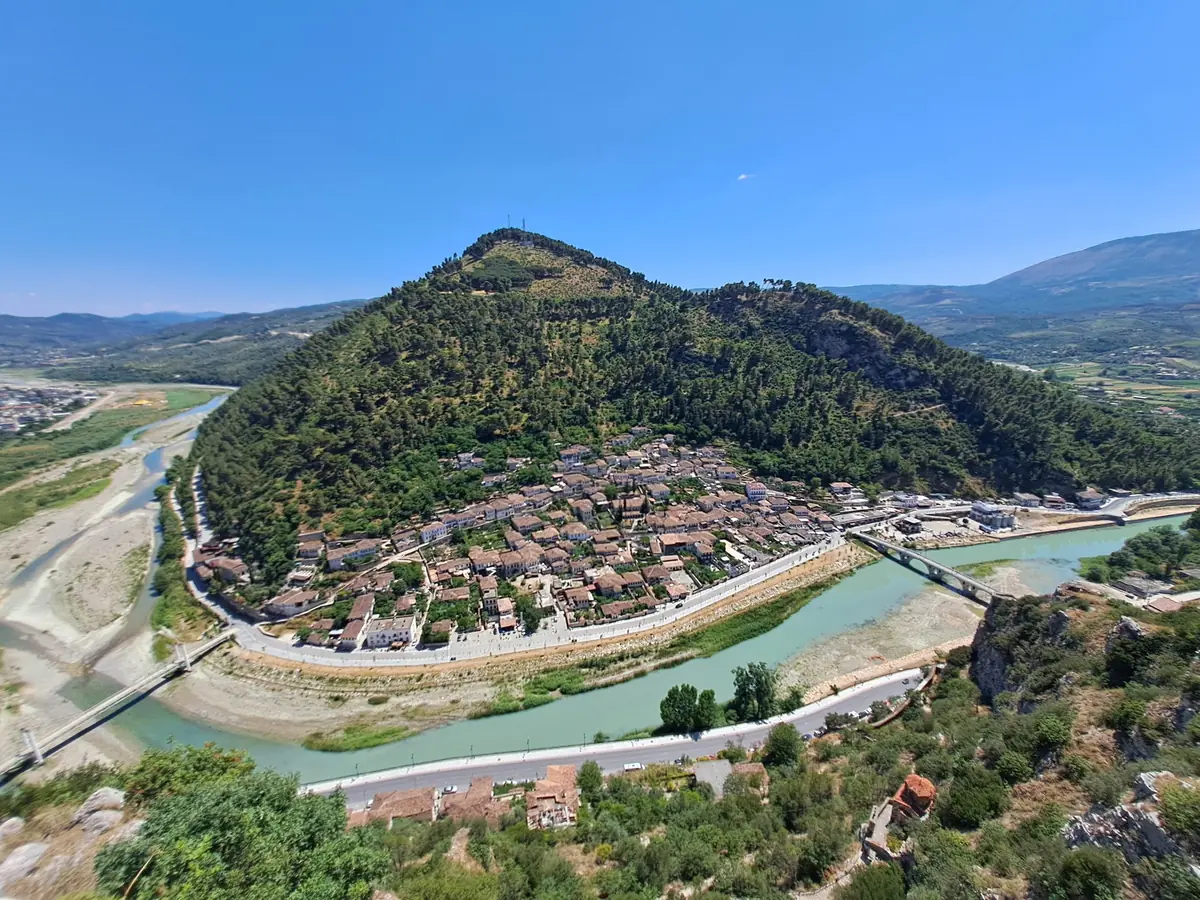
Berat earned its “City of a Thousand Windows” nickname from the stacked rows of evenly spaced, large-paned windows on its white Ottoman houses, which rise in tiers up the Mangalem and Gorica hillsides above the Osum River. Its historic center joined the UNESCO World Heritage List in 2008 as an extension of Gjirokastër‘s 2005 inscription.
The Albanian name is Qyteti i Një Mijë Dritareve. The city itself is over 2,400 years old — founded as Antipatreia in the 4th century BC by Cassander of Macedon, fortified again by Emperor Justinian I in the 6th century, and rebuilt in its current form by Michael I Komnenos Doukas in the 13th century. The population is about 62,000.
The Ottoman houses aren’t just stacked for the view. They’re built using çatma — a timber-reinforced construction that runs horizontal beams every 80 to 120 cm inside the white stone walls, giving the buildings flex. That’s why they survived the 1851 earthquake that leveled half of Albania. Most guides skip this detail; it’s the reason Mangalem still looks like Mangalem and not a pile of rubble.
Pro Tip: The suspension footbridge across the Osum gives the easiest, flattest angle on the windows. From it at dusk, you can watch the interior lights come on one floor at a time — like the houses are blinking awake in sequence.
How do you get to Berat from Tirana?
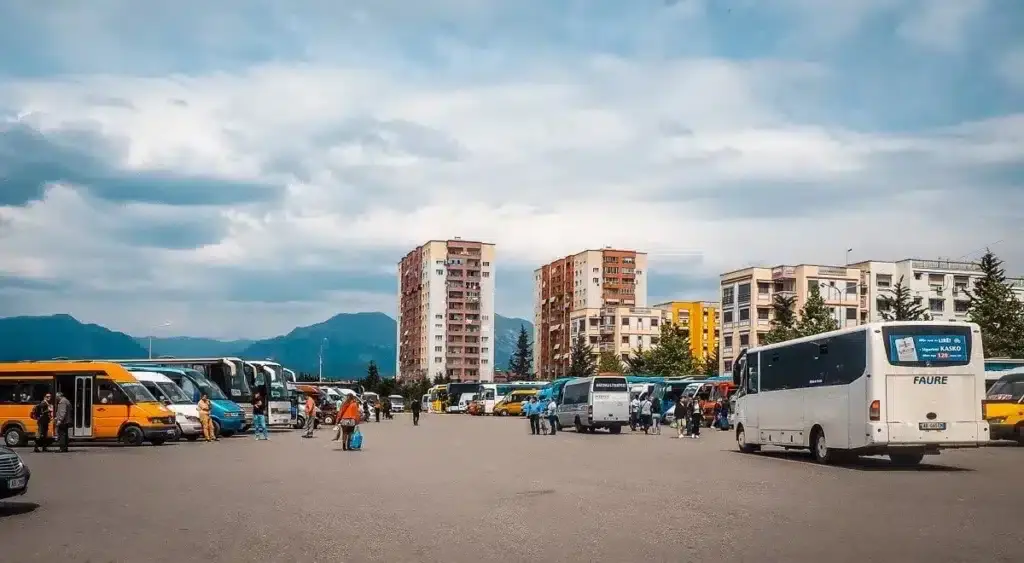
The easiest way to reach Berat is by bus or furgon (shared minibus) from Tirana’s South & North Terminal at Kthesa e Kamzës. Buses depart roughly every 30 minutes from 5:40 a.m. to 5:30 p.m., the ride takes about 2 to 2.5 hours, and tickets cost 400 to 500 ALL (roughly $5 to $6 USD).
Your main options:
- Public bus: 400–500 ALL ($5–6 USD) one-way, 2–2.5 hours, most frequent and most comfortable
- Furgon (shared minibus): same price, slightly faster, runs when full rather than on a schedule
- Rental car: $20–25 USD/day plus ~$30 USD fuel round-trip; 120 km (75 mi) by road, about 2 hours
- Taxi from Tirana: 61–82 EUR ($70–95 USD) one-way, negotiate before you get in
- Guided day tour: $60–120 USD per person including transport and lunch
The road distance is 120 km (75 mi) — longer than the 70 km (43 mi) straight-line distance because the highway curves around the Skrapar mountains. Tirana International Airport (Rinas/TIA) is the only real air gateway; there is no airport in Berat itself.
Berat’s own bus station sits on Rruga Antipatrea, a 15-minute walk or a quick taxi (10–15 EUR, about $12–17 USD) from the old town. On foot it’s flat and well-lit the whole way.
Pro Tip: Men at the Tirana terminal will grab your elbow and try to funnel you into a half-empty furgon that won’t leave for 40 minutes. Walk past them, find the information desk, and get on the actual marked Berat bus with numbered seats.
How many days do you actually need in Berat?
You need two full days and one night in Berat to do it properly — enough time to walk the castle at sunrise, see the Onufri Museum, cross both bridges, eat two long dinners, and catch the lit-up “thousand windows” after dark. Add a third day if you want the Osum Canyon and Bogove Waterfall day trip or the Mount Tomorr and Çobo Winery combo.
Most visitors fit Berat into a broader 3 days in Albania loop; here’s how each length of stay in the city itself actually plays out:
- One day (from Tirana): 7 hours of ground time. You see the castle, the Onufri Museum, and have lunch. You miss the sunset, the lit-up old town at night, and any day trip. Not recommended.
- Two days, one night: The sweet spot. Afternoon arrival, dinner on Mangalem, sunrise at the castle next morning, Onufri and Gorica in the afternoon, bus back in the evening.
- Three days, two nights: Adds Osum Canyon or Çobo Winery on day two. This is the realistic maximum most travelers need.
- Four-plus days: Only if Mount Tomorr, multiple wineries, and Belshi Lake are on your list.
The math: Berat is most beautiful 45 minutes after sundown, when yellow window lights come on against the black silhouette of Mount Tomorr. A Tirana day-tripper never sees this.
Where should you stay — Mangalem, Gorica, or modern Berat?
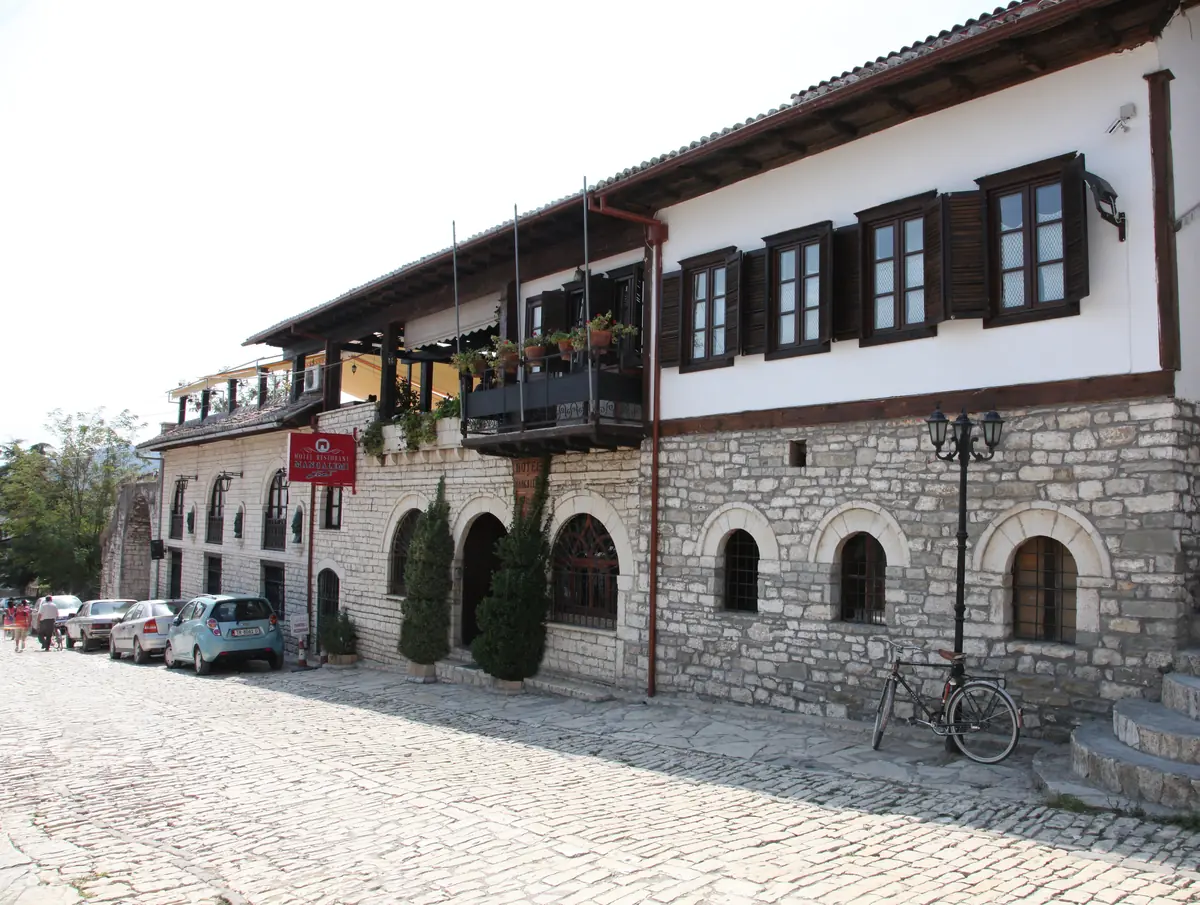
Mangalem puts you at the foot of the castle in a 300-year-old stone guesthouse for about $40 to $70 USD a night. Gorica is quieter and has the head-on “thousand windows” view across the river. The modern town along Bulevardi Republika is flat, cheaper ($25 to $45 USD), and walkable to most restaurants.
Quick breakdown by zone:
- Mangalem: best for first-time visitors. Stone guesthouses, walkable to the castle, loudest for dinner crowds until 11 p.m. Anchors: Hotel Mangalemi (15 rooms, $60–85 USD), Hotel Muzaka, Guva Mangalem.
- Gorica: best for photographers and light sleepers. The view looks directly at the Mangalem houses. Cross the bridge for dinner. Anchors: Hotel Berati, Rezidenca Desaret.
- Modern town (Bulevardi Republika): best for budget travelers. Flat, cheap, close to ATMs and the bus station. Anchors: Castle Park Hotel, mid-range guesthouses from $25–40 USD.
- Inside the Kala (castle walls): for dawn-photo obsessives. B&B Josiph and similar run $35–55 USD. You wake at 6 a.m. to a donkey and a church bell.
Average prices from Booking.com run about $43 USD/night for 3-star, $58 for 4-star, and $67 for the handful of 5-star options. Budget hostels start around $15–20 USD for a dorm bed.
Pro Tip: Staying inside the castle walls is romantic on paper but the reality is 15 minutes of uphill cobblestone with luggage after the evening bus drops you at Rruga Antipatrea. Arrive early, or pay the $8 USD for a taxi to the main gate.
Is Berat Castle worth the climb?
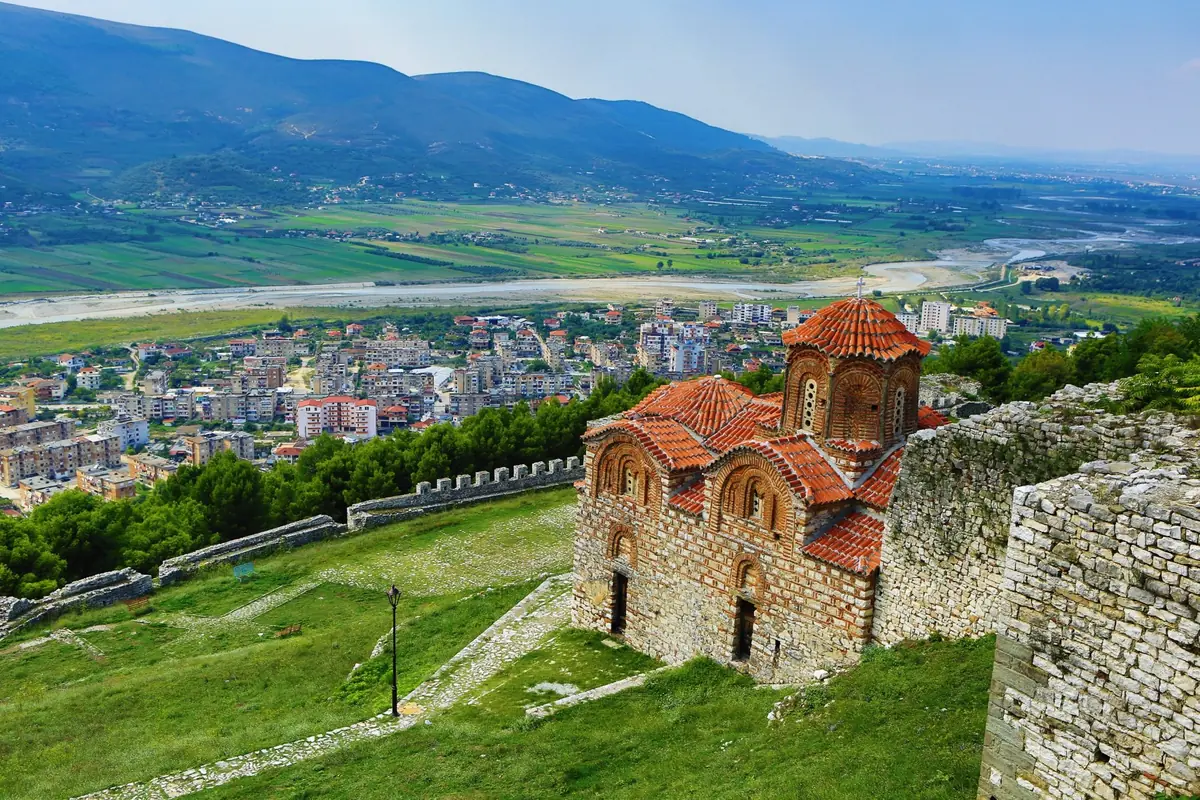
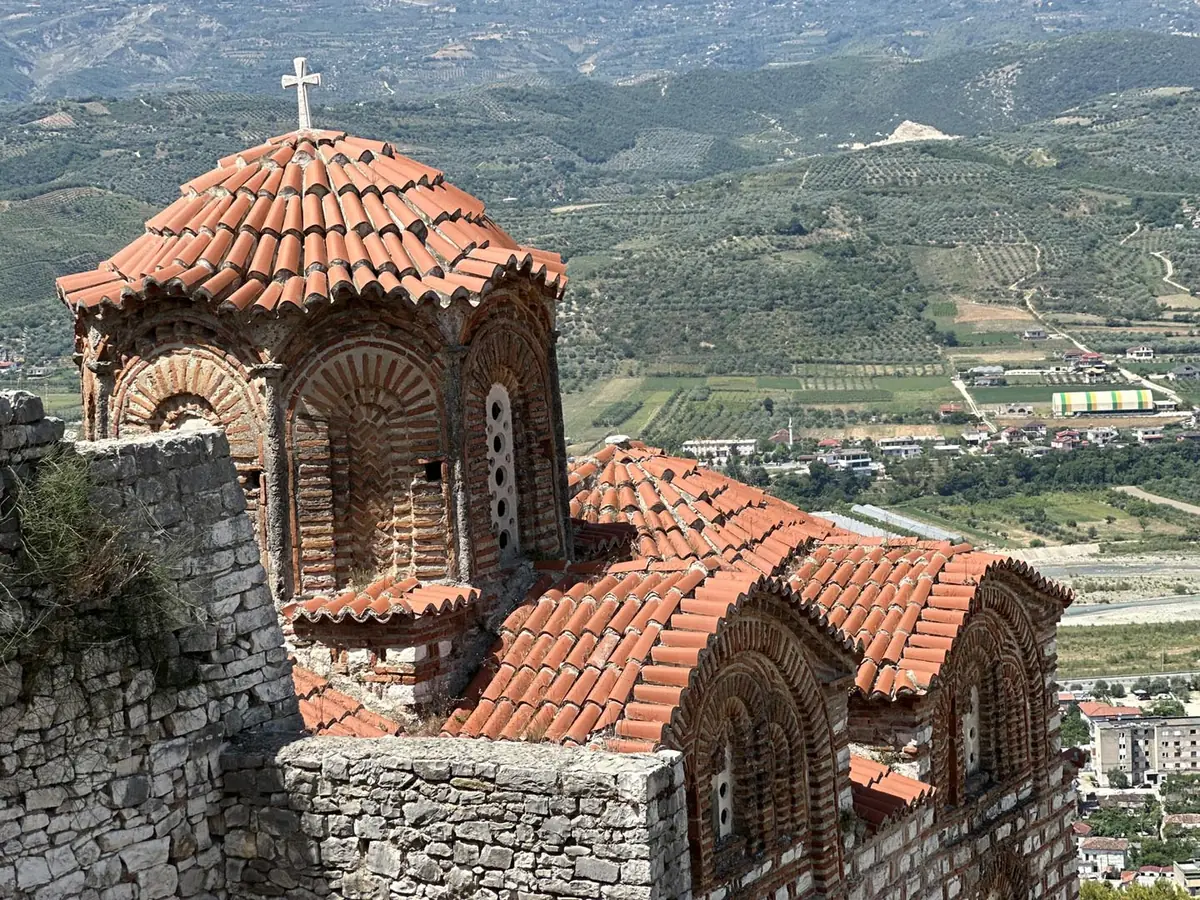
Berat Castle, locally called Kalaja, is a 13th-century fortress still home to about 100 families — you’ll find Byzantine churches, two ruined mosques, cobbled lanes and a viewing platform all inside its walls. Entry is 300 ALL (about $3.50 to $4 USD) at the main gate, cash only, though the walk up is free outside staffed hours. The uphill from Mangalem takes 15 to 20 minutes on steep cobblestones.
The castle sits at 214 m (702 ft) above the Osum, with the main gate on Rruga Mihal Komnena. What’s actually inside:
- Church of the Holy Trinity (Shën Triadha): 14th-century, cross-in-square plan, free to enter
- Red Mosque ruins: 15th-century, minaret only
- White Mosque ruins: visible foundations
- St Mary of Blachernae: small chapel with frescoes
- Cathedral of the Dormition of St Mary: houses the Onufri Museum
- An underground cistern
- A southern viewing platform with the widest angle on Gorica
The castle is technically open 24/7 — the ticket booth is only staffed 9:00 a.m. to 6:00 p.m. Go in at dawn and you’ll have the ramparts to yourself until the first tour groups arrive around 9:30.
Quick stats:
- Location: Rruga Mihal Komnena, above the Mangalem quarter
- Cost: 300 ALL (about $3.50 to $4 USD), cash only; free outside staffed hours
- Best for: History walkers and sunrise photographers
- Time needed: 2 to 3 hours
First-hand note: Walking in at 7 a.m., I passed a woman sweeping her stoop between a Byzantine chapel and the Red Mosque ruins, and a kid kicking a football against a 700-year-old wall. This is not a ruin. It’s a postcode.
Pro Tip: The polished limestone cobbles on the castle road are genuinely slippery after rain. I watched two people go down on Rruga Mihal Komnena within an hour of a drizzle. Wear shoes with lugged soles, not flat sandals.
What’s inside the Onufri Iconographic Museum?
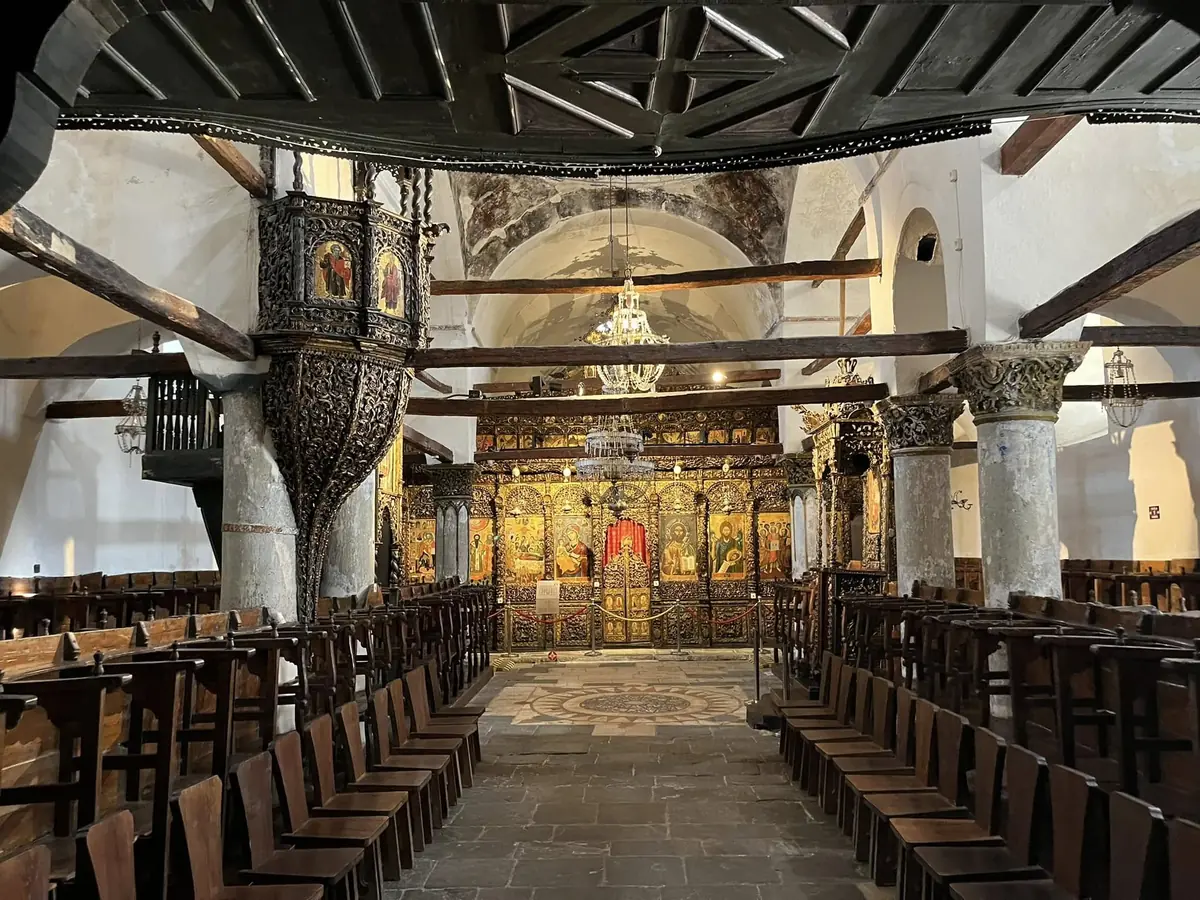
The Onufri Iconographic Museum sits inside the Cathedral of the Dormition of St Mary, the largest church in Berat Castle. It houses about 200 objects spanning the 14th to 20th centuries — icons and liturgical pieces — including works by Onufri, the 16th-century Albanian master famous for a signature red pigment. Entry is about 200 ALL (roughly $2.50 USD).
Who Onufri was matters here. He was a 16th-century Greek Orthodox bishop and iconographer who ran a painting workshop that produced some of the Balkans’ most technically accomplished icons. His signature is a luminous red — a mineral-based pigment whose recipe was lost after his death and has never been fully reproduced. The museum is the largest single collection of his work anywhere.
Quick stats:
- Location: Inside Berat Castle, Cathedral of the Dormition of St Mary
- Cost: about 200 ALL ($2.50 USD)
- Hours, May 1–Sept 30: Daily 9:00 a.m.–6:00 p.m.
- Hours, Nov 1–Apr 30: Tues–Sat 9:00 a.m.–4:00 p.m., Sun 10:00 a.m.–3:00 p.m.
- Best for: Anyone with even passing interest in Byzantine or Orthodox art
- Time needed: 45–60 minutes
Beyond Onufri himself, the collection includes work by his son Nikolla, the Cypriot painter Onufër, David Selenica, Kostandin Shpataraku, and members of the Çetiri family of painters. The iconostasis — the carved wooden wall that separates the nave from the sanctuary — dates to 1807 and shows Italian Baroque influence creeping into Albanian Orthodox design.
What’s worth seeing in Mangalem’s Ottoman quarter?
Mangalem is Berat’s historically Muslim quarter on the right bank of the Osum, a jigsaw of white-walled Ottoman houses, cobbled alleys and three working mosques. Start at the 15th-century King Mosque (Xhamia e Mbretit), built in 1492 under Sultan Bayezid II, pass the lead-domed Lead Mosque on the main square, and end at the riverfront Bachelor’s Mosque built for unmarried guild craftsmen.
The four religious buildings worth your time, in walking order from the bus station:
- King Mosque (Xhamia e Mbretit): 1492, built under Sultan Bayezid II, largest in Berat
- Lead Mosque (Xhamia e Plumbit): 1555, named for the lead-coated dome, still active
- Bachelor’s Mosque (Xhamia e Beqarëve): 19th-century, built for unmarried shop assistants from the bazaar
- Halveti Tekke: 1782, commissioned by Ottoman governor Ahmet Kurt Pasha for the Sufi Khalveti order
The Halveti Tekke is the one most visitors walk past. Inside, the carved wooden ceiling has small acoustic holes drilled into it — clap once and the sound softens noticeably. The guide will point this out if you ask.
Two museums cluster here too:
- Ethnographic Museum of Berat: housed in an 18th-century Ottoman house, 1,300+ exhibits of Berat home life, opened 1979. Entry 200–300 ALL ($2.50–3.50 USD).
- Solomon Museum: small but worth 30 minutes, documents Berat’s role sheltering Albanian and foreign Jews during WWII.
Contrarian take: skip the Ethnographic Museum if you’re tight on time. The castle itself is the ethnographic experience — people actually live in the Ottoman houses up there. If you’re also visiting Gjirokastër, the Zekate House there is the stronger kullë-style museum.
What’s across the Gorica Bridge?
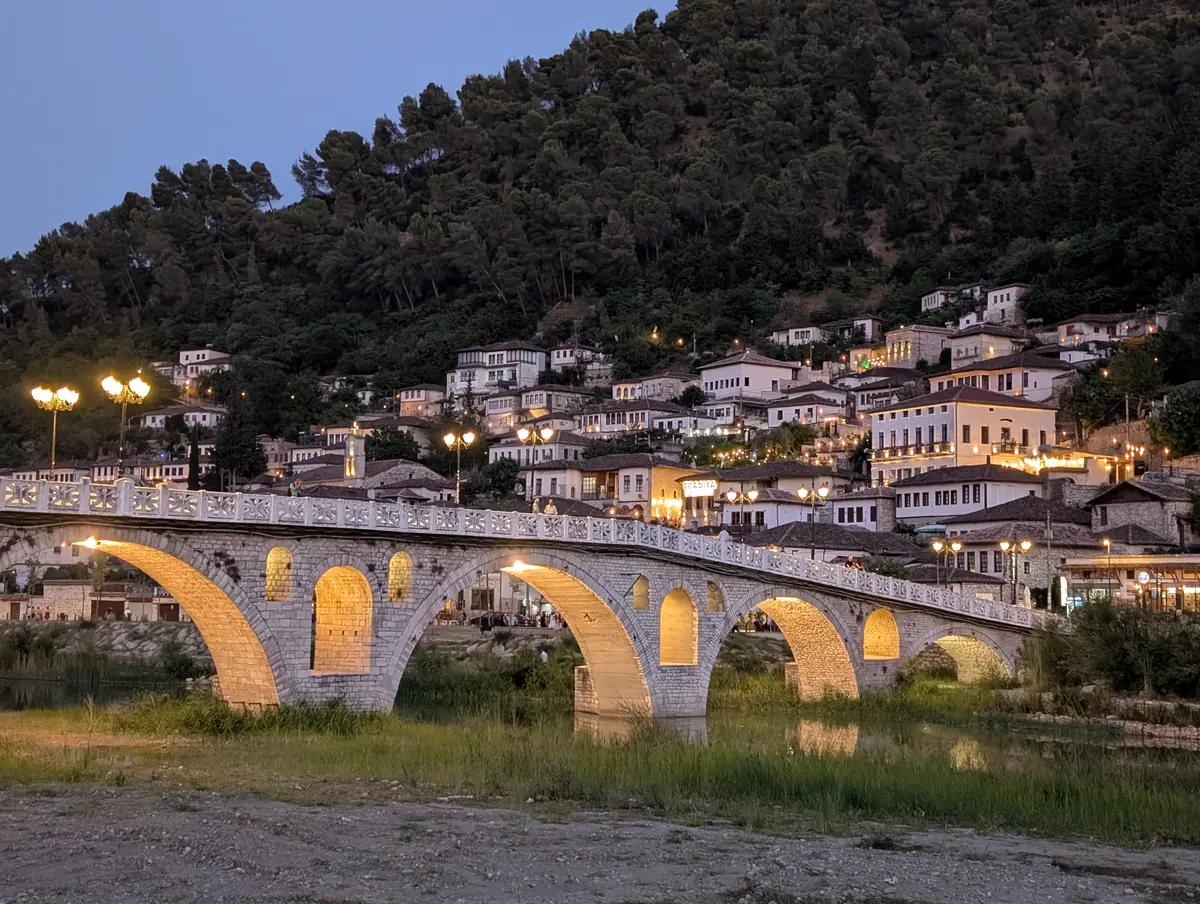
The seven-arched Gorica Bridge (Ura e Goricës) crosses the Osum River between Mangalem and the historically Christian Gorica quarter. Commissioned by Ahmet Kurt Pasha, built in wood in 1780 and rebuilt in stone in the 1920s, it’s 129 m (423 ft) long and about 10 m (33 ft) above the water. Cross it at golden hour for the classic “thousand windows” shot looking back at Mangalem.
Gorica is smaller, quieter, and older-feeling than Mangalem. What to see once you cross:
- Church of Saint Spiridon: 19th-century Orthodox church, open during services
- St Michael’s Church (Shën Mëhill): 14th-century cliff chapel clinging to the rock face above Gorica, accessed by a 15-minute walk up a narrow path
- Saint Demetrius and Saint Thomas churches: small, often locked, ask a neighbor
- Gorica ruins hike: 30 minutes up from behind Hotel Muzaka, rewards you with an empty panoramic viewpoint
The central arch of the Gorica Bridge is tall enough that from mid-bridge you look down on rooftops, not up. It feels more like a viewing platform than a crossing.
Where are the best thousand-windows viewpoints?
The four best “thousand windows” viewpoints in Berat are the new suspension footbridge (fastest and flattest), the Gorica side of the Osum (classic head-on compression shot), Gorica Hill above St Spiridon Church (panoramic, 20–30 minutes uphill), and the castle’s southern viewing platform (wide angle including Gorica and Mount Tomorr). Sunset is the standard recommendation but early morning gives cleaner light and fewer people.
Ranked by effort versus payoff:
- New suspension footbridge: 5-minute walk from Bulevardi Republika. Best for the tight head-on compression shot.
- Gorica riverbank below the bridge: 10-minute walk. Best for the wide shot with the bridge in frame.
- Gorica Hill above St Spiridon: 20–30 minute uphill on a dirt path. Best for the panoramic with the Osum curving through.
- Castle southern viewing platform: 20-minute climb from Mangalem. Best for the full frame including Mount Tomorr in the background.
Contrarian take: the classic Instagram “thousand windows” shot is taken from the Gorica side, not from inside Mangalem. If you walk through Mangalem itself expecting the photo, you’re too close and looking up at the wrong angle.
Pro Tip: Golden hour in Berat is roughly 30 minutes before sunset; blue hour (the deepest saturation) is about 20 minutes after. From the castle platform, Mount Tomorr keeps its snow into May — for the signature “white windows, white peak” frame, shoot before mid-month.
Is the Osum Canyon day trip worth it?
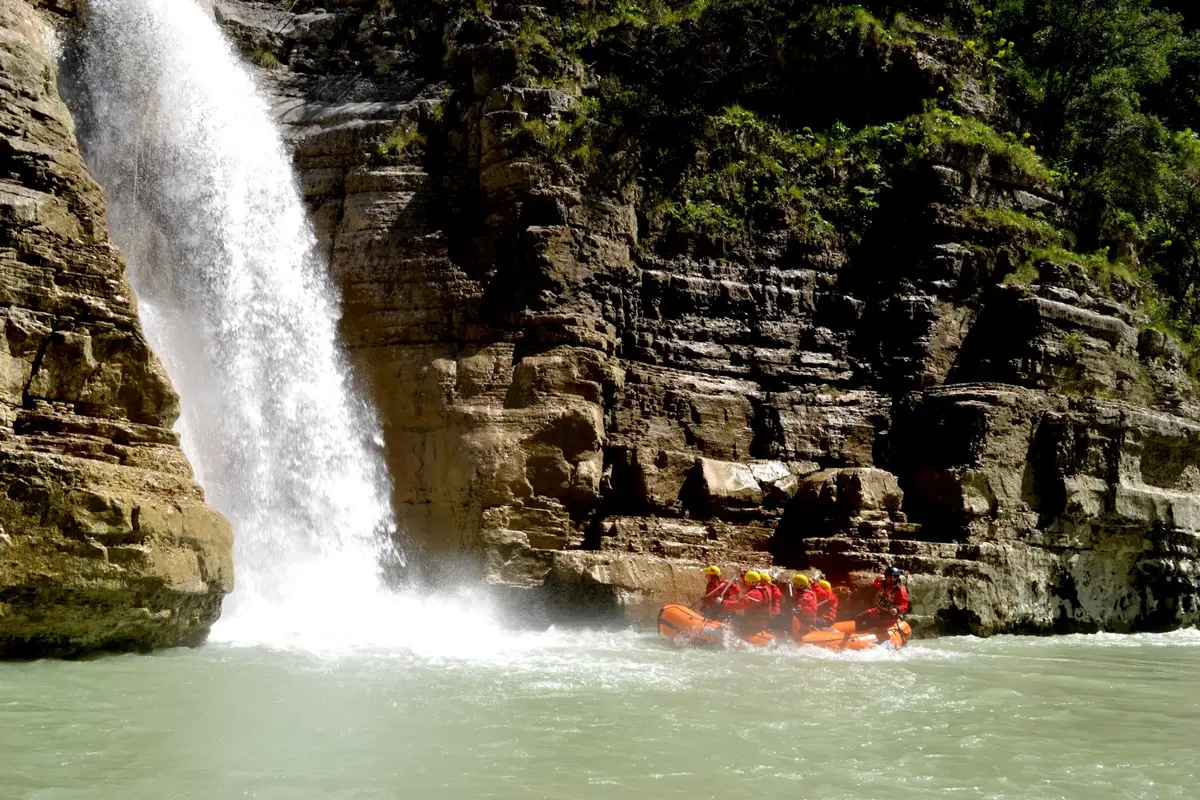
Osum Canyon is Albania’s largest canyon, about 1 to 1.5 hours from Berat by road, and Bogove Waterfall is a short hike inside Bogove National Park on the return leg. Both are best done as a guided day tour ($60 to $100 USD) from July through September, when water levels drop enough to walk or raft inside the canyon. Outside that window it’s sightseeing-only from viewpoints.
The seasonality rule is the thing nobody explains clearly. From October through June, snowmelt and rainfall keep the canyon water too high and fast to enter safely — you can photograph it from above, but the walk-through and the rafting are closed. From July through September, outfitters like Albania Rafting Group and Flow Albania run guided descents through the narrowest section, where the walls close in to about 2 m (6 ft) apart.
Logistics:
- Distance from Berat: ~60 km (37 mi), about 1.5 hours by road
- Drive-through stops en route: Polican (communist-era munitions town), Kasabashi Bridge
- Bogove Waterfall hike: 35–45 minutes each way from the parking area
- Water temperature inside the canyon: 50–54 °F (10–12 °C) even in August
- Typical tour length: 8–10 hours door-to-door
The canyon water goes numb-your-feet cold in about five minutes. That is the point. From the Bogove Waterfall pool, the shock is worse but the recovery is faster because the pool is smaller and sunnier.
Mount Tomorr — Albania’s sacred peak above Berat
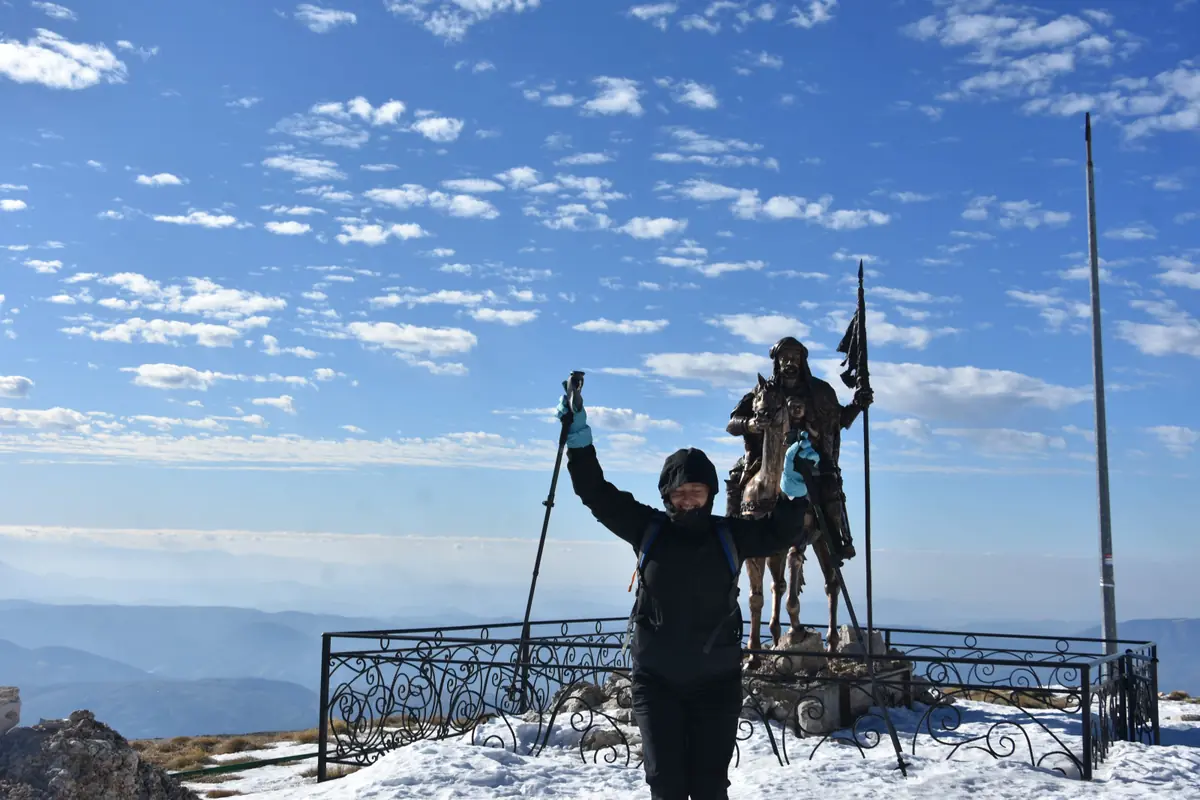
Mount Tomorr rises to 2,417 m (7,927 ft) east of Berat and anchors Tomorr National Park. It is a sacred peak for both Christians (Assumption Day, August 15) and the Bektashi Sufi order, whose annual pilgrimage from August 20 to 25 to the Abaz Ali shrine draws more than 600,000 pilgrims. Most visitors see it on a 4×4 tour combined with a winery stop.
Why it’s more than a mountain:
- Elevation: 2,417 m (7,927 ft) at Çuka e Partizanit, the highest peak
- Religious status: sacred to Bektashi Sufis as the site of Abaz Ali’s shrine; Christians also pilgrimage on Aug 15
- Tekke of Abaz Ali: destroyed in 1967 under the Hoxha regime, rebuilt in 1992; the tyrbe (mausoleum) was rebuilt in 2008
- Fauna: wolves, brown bears, wild goats, golden eagles
- Best access: 4×4 tour from Berat, about 3 hours each way on a rough mountain road
You cannot self-drive the summit road in a regular car — the final 20 km (12 mi) is unpaved and steep. Tours run $80 to $150 USD per person depending on group size and whether Çobo Winery is included.
From the southern ridge on a clear day, you can see across the Adriatic to Italy. That’s not a tourism exaggeration — the visibility math works out at roughly 90 miles (145 km), and several Albanian guides will point out the Italian coast on clear mornings.
Çobo Winery and the wine region outside Berat
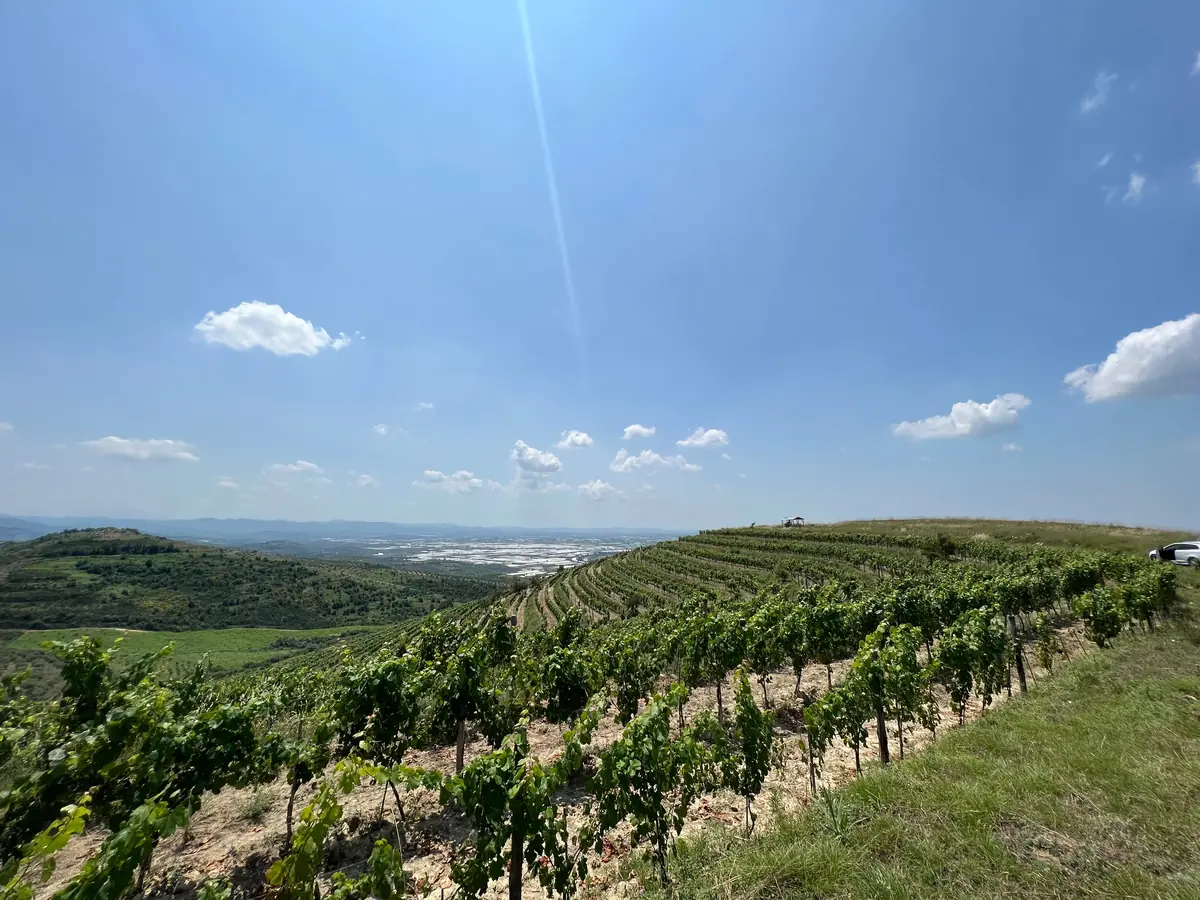
Çobo Winery sits about 15 minutes from Berat in Ura Vajgurore at the foot of Mount Tomorr. Founded in 1998 by brothers Petrit and Muharrem Çobo on land their great-great-grandfather planted, it specializes in native Albanian grapes — Puls, Shesh i Zi and Kashmer — and offers a guided tour and tasting for about $25 USD per person, accompanied by local cheeses, olives and bread.
The three grapes to know:
- Puls: white, native to central Albania, citrus and stone fruit profile
- Shesh i Zi: red, the most-planted native Albanian varietal, medium-bodied
- Kashmer: red, less common, deeper and more tannic
The signature pours:
- Shëndeverë: sparkling, aged 48 months in bottle
- E Kuqja e Beratit (“The Red of Berat”): the flagship red, a Shesh i Zi blend
- Small-batch Kashmer: released only in strong years
Quick stats:
- Location: Ura Vajgurore, about 15 minutes from Berat
- Cost: about $25 USD per person for tour and tasting
- Best for: Wine drinkers and slow afternoons
- Time needed: 2 to 3 hours
Tours are offered in English, Italian and Albanian. Booking a day in advance is wise in July and August. Alpeta Agrotourism and Winery is a good second stop on a half-day circuit — it adds a full farm lunch to the tasting format for about $35 USD per person.
Pro Tip: At Çobo, you sit under a 400-year-old olive tree for the tasting. The family dog stays for the whole thing. If you’re arriving by taxi, negotiate the return — the drive back to Berat is hard to flag from the vineyard gate.
What should you eat in Berat?
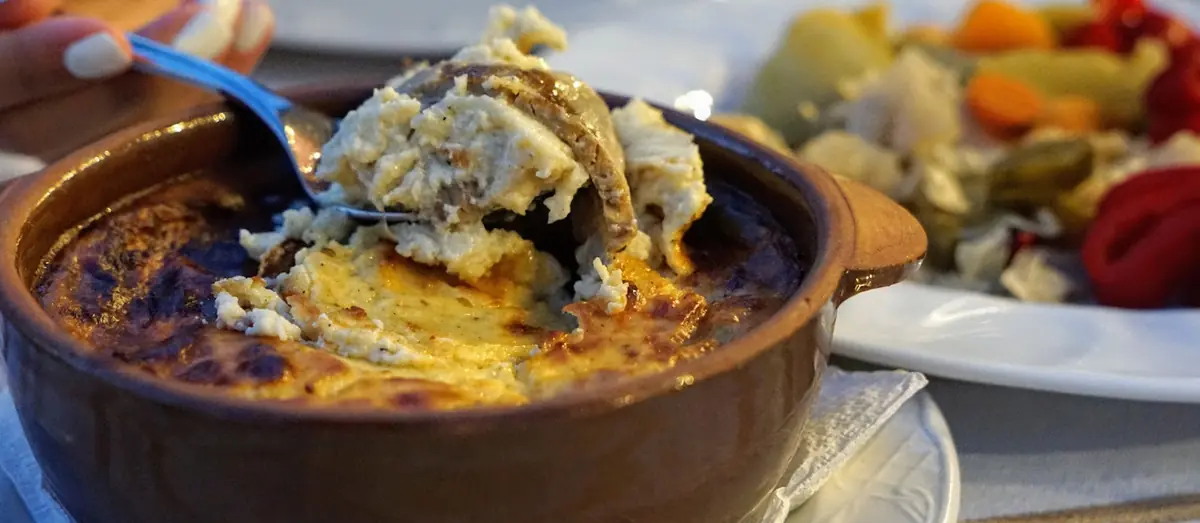
Berat is among the best eating cities in Albania. Order tavë kosi (lamb baked in yogurt and eggs, Albania’s national dish), fërgesë (peppers, tomatoes and white cheese baked to a bubbling gratin) and grilled qofte meatballs, washed down with house raki. A full traditional meal costs $8 to $15 USD per person.
Pairing each dish with the restaurant that does it best:
- Tavë kosi: Hotel Mangalemi Restaurant. The verandah catches the evening breeze and the version here is a touch tangier than the Tirana standard.
- Fërgesë: Homemade Food Lili. There’s no menu. The owner, Lili, tells you what she cooked that morning and you say yes.
- Qofte and grilled meat: Temi Albanian Food. The charcoal grill sits in the window; you can point at what you want.
- Vienezi i Beratit (Berati Beef, a local braised dish): Antigoni Restaurant. Ask specifically for it — it’s not on every menu.
- Byrek (filled pastry): the bakeries along Bulevardi Republika. A slice of cheese or spinach byrek runs 100–150 ALL ($1.20–1.80 USD).
A few other names worth knowing: Onufri Restaurant (inside the castle walls, solid if touristy), Eni Traditional (cheap, good grilled fish), Piccolo Grande Amore (better for pasta than for anything Albanian).
Raki is served in small glasses at the start of the meal. The house version is grape-based and typically 35–45% ABV. One glass is a welcome; three is a mistake.
Berat or Gjirokastër — which UNESCO city wins?
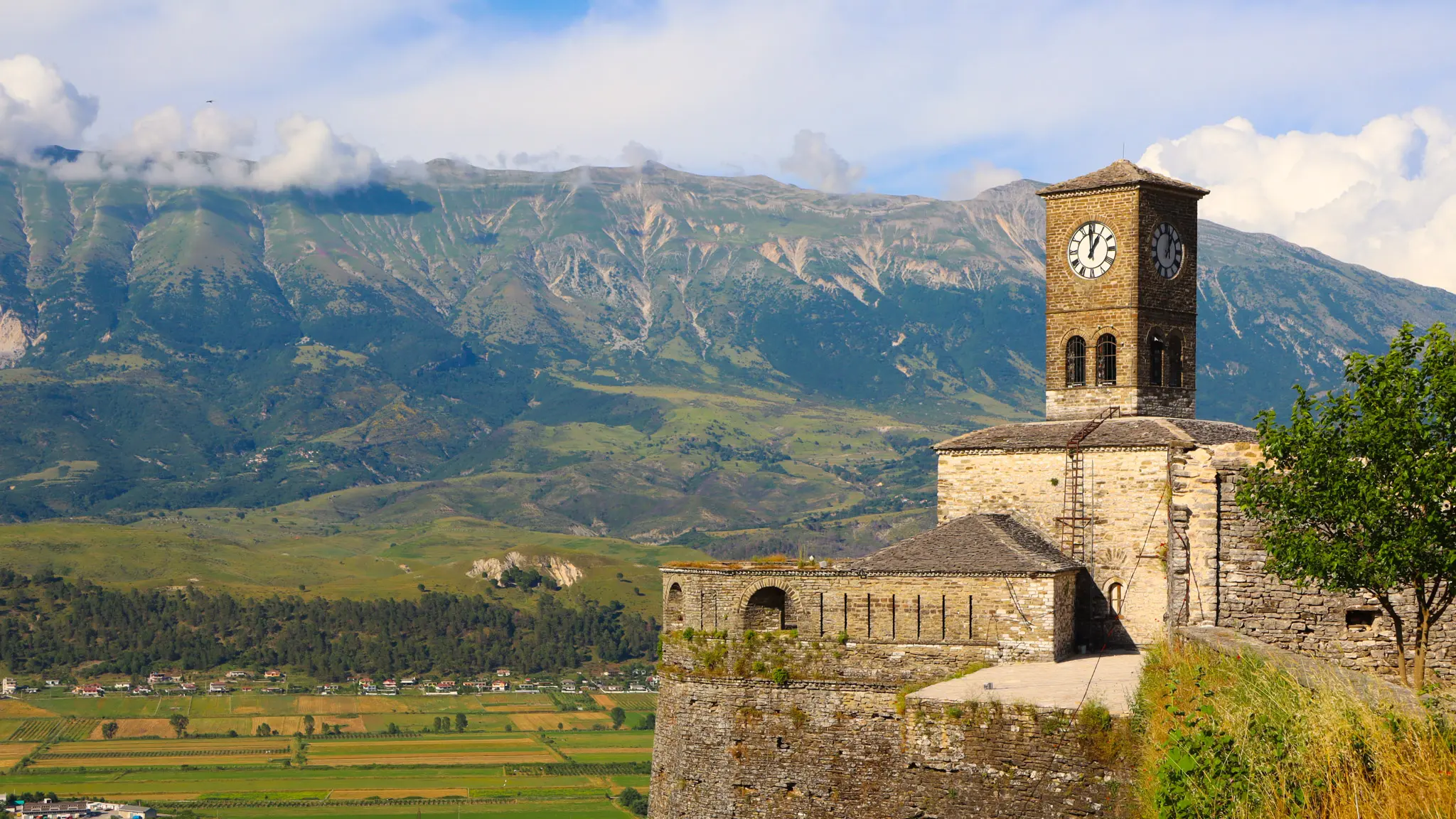
If you have to choose one, pick Berat for the living castle and easier flat-town walking, and pick Gjirokastër for the better-preserved stone tower houses and closer access to the Albanian Riviera. Berat is the stronger overnight stay with more hotels and restaurants; Gjirokastër works better as a day trip on the way south to Sarandë.
The honest comparison:
- UNESCO status: Both. Gjirokastër 2005, Berat added 2008 as a joint property.
- Castle: Berat is inhabited; Gjirokastër’s is a preserved museum fortress. Both charge similar entry.
- Old town walking: Berat is easier and flatter at the base; Gjirokastër is steeper everywhere but with better-preserved individual houses.
- Cobblestones: Berat’s are slipperier when wet; Gjirokastër’s stone-paved streets have better grip.
- Food scene: Berat has more restaurants and more range. Gjirokastër has fewer but equal quality.
- Onward travel: Berat connects best back to Tirana. Gjirokastër is 1.5 hours from Sarandë and the Ionian coast.
- Best for: Berat for a relaxed two-night stop. Gjirokastër for a focused overnight before heading south.
With a full week in Albania, do both. With four days or fewer, do Berat.
Experience signal: in Berat you hear kids playing football inside the castle walls. In Gjirokastër, you hear your own footsteps echo in a museum.
When is the best time to visit Berat?
The best time to visit Berat is May, June, September and early October — daytime highs of 70 to 82 °F (21 to 28 °C), manageable rainfall, and warm evenings for dinner on Mangalem terraces. July and August are genuinely punishing, with highs of 86 to 95 °F (30 to 35 °C) as the Osum valley traps heat. January drops to 35 to 45 °F (2 to 7 °C) with the heaviest rain of the year — a rhythm that closely tracks the best time to visit Albania as a whole.
Monthly breakdown for US travelers:
- March–April: 55–68 °F (13–20 °C), rainy, Mount Tomorr still snow-capped, fewer tourists. Pack layers and a rain shell.
- May–June: 70–82 °F (21–28 °C), dry, long evenings. Peak walking weather. Light jacket for nights.
- July–August: 86–95 °F (30–35 °C), oppressive in the valley. Avoid midday walking. Swimsuit for Osum. Loose cotton only.
- September: 75–85 °F (24–29 °C), still warm, Osum Canyon walkable through mid-month. The best single month overall.
- October: 60–75 °F (16–24 °C), start of fall rain but still comfortable. Great photography light.
- November–February: 35–55 °F (2–13 °C), wet, quiet, cheapest accommodation. Castle is dramatic in fog. Waterproof boots non-negotiable.
Annual rainfall is about 1,024 mm (40 in), heaviest in November and December. The cobblestones of Mangalem are notably slippery from late October through March.
Experience signal: in late July the Mangalem stone walls stay warm to the touch until midnight. The city literally radiates the day back at you.
What should you know before you go?
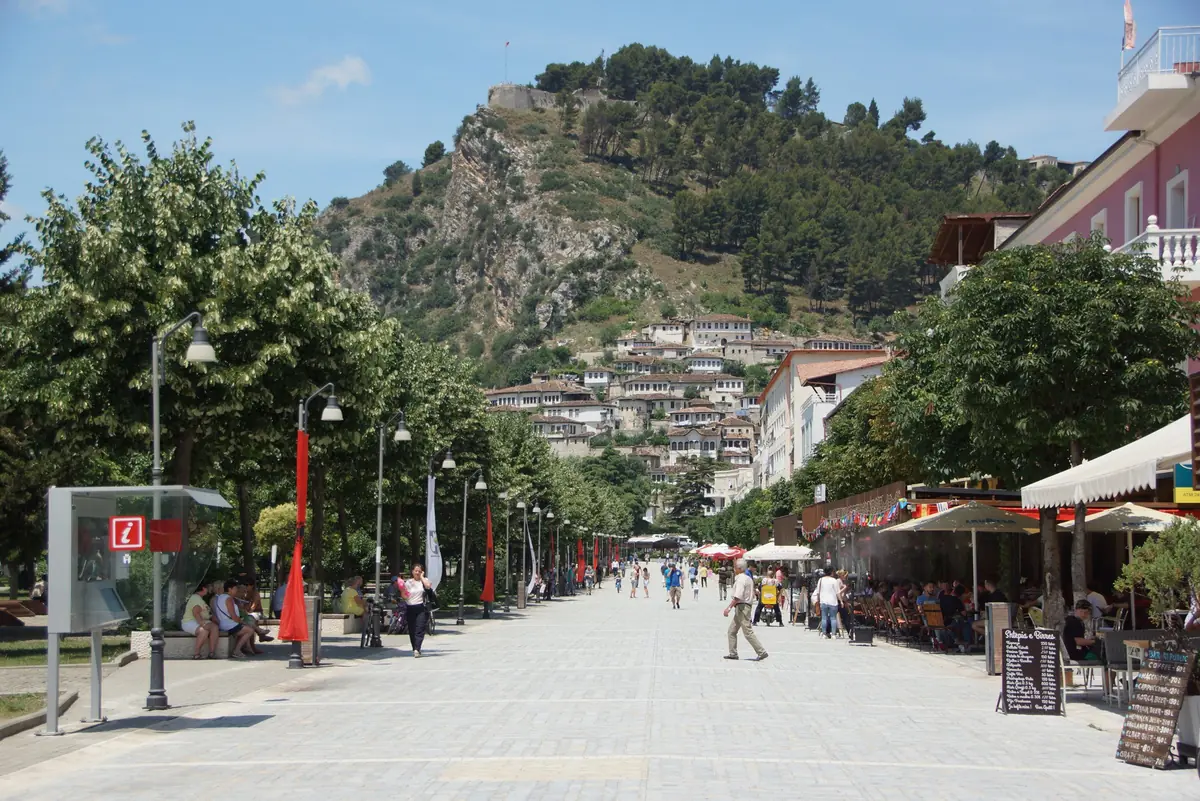
Berat runs mostly on cash — bring Albanian lek (ALL) for small purchases even though euros are accepted at many hotels and restaurants. ATMs are clustered along Bulevardi Republika. Cobblestones in Mangalem and up to the castle are genuinely slippery when wet, so pack shoes with grip. The city is among Albania’s safest destinations, including for solo women.
The quick practical list:
- Currency: Albanian lek (ALL). Rough math: 100 ALL ≈ $1.20 USD, 100 ALL ≈ €1
- Euros accepted: yes at most hotels and tourist restaurants, less so at bakeries and cafes
- ATMs: along Bulevardi Republika, at least five in a 500 m (0.3 mi) stretch. Avoid the sketchier independent machines inside shops.
- Cards: accepted at hotels, half of restaurants, most tour operators. Bring backup cash.
- Tap water: drinkable in town
- Language: Albanian. Younger people speak good English; older generations more likely Italian or Greek.
- Tipping: 10% for sit-down meals, round up for taxis
- Solo female travel: widely considered safe. Harassment levels lower than much of Western Europe.
- Cobblestones: wear lugged soles. Flat sandals and smooth-bottomed sneakers are genuinely risky after rain.
- SIM cards: Vodafone or One Albania at Rinas airport, about $10 USD for 20 GB
One more honest note: Berat’s cobbles on Rruga Mihal Komnena (the castle road) are polished limestone, not rough granite. Dry, they’re fine. Wet, they’re glass. I watched a woman in flat sandals fall twice on the same morning after an overnight rain. Lugged soles are not optional.
The bottom line
Go to Berat for two nights. Spend the first morning in the inhabited Kala castle and the Onufri Museum, the afternoon crossing the Gorica Bridge and climbing Gorica Hill for the thousand-windows shot, and the second day on a guided Osum Canyon and Çobo Winery combo. Budget around $150 to $250 USD per person for two nights including food, entry fees and one day trip — modest next to typical Albania trip costs.
TL;DR — the math on a two-night Berat trip:
- Hotel: $40–70 USD/night (Mangalem guesthouse)
- Three traditional meals: $25–45 USD total
- Castle entry: 300 ALL (about $3.50 USD), cash only
- Onufri Museum: 200 ALL (about $2.50 USD)
- One day trip (Osum or Çobo): $60–100 USD
- Bus from/to Tirana: $10–12 USD round-trip
- Total per person: roughly $200 to $300 USD for two nights
That’s about the cost of a single Tuesday-night dinner for two in Manhattan. Spent here, it buys you a UNESCO city most of your friends can’t place on a map and a wine varietal most of them have never tasted. If Berat is your first stop, build out the rest with a wider Albania travel guide.
What part of the Berat itinerary are you leaning toward — the castle and museum track, or the Osum Canyon and winery add-on? Drop a comment below and I’ll weigh in.