El Salvador plugs and adapters confuse a lot of travelers, but the answer is refreshingly simple: the outlets and voltage are basically identical to the United States. This guide shows US visitors what to pack (often nothing), what European travelers actually need, and how to keep every device charged from San Salvador to Surf City.
El Salvador uses Type A and Type B outlets at 120 volts and 60 Hz — the same standard as the United States and Canada. US and Canadian travelers do not need a plug adapter or voltage converter for dual-voltage devices. Travelers from Europe, the UK, or Australia need a Type A/B adapter.
What plugs and outlets does El Salvador use?
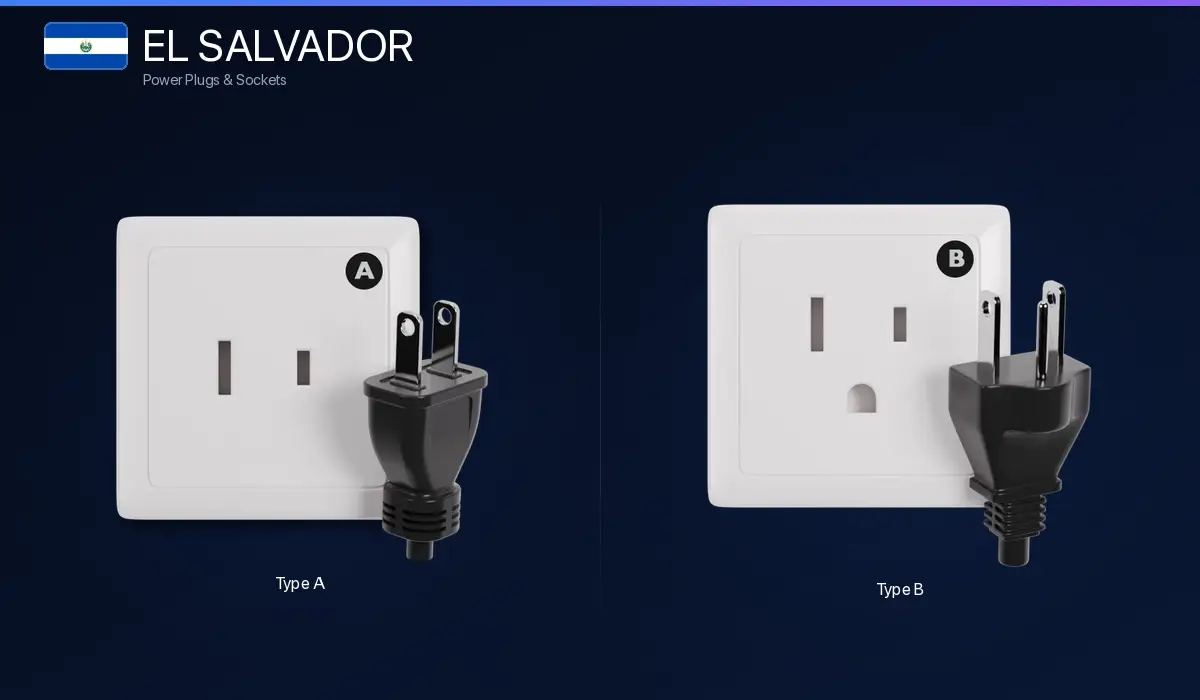
El Salvador uses two outlet types: Type A (NEMA 1-15), with two flat parallel pins and no ground, and Type B (NEMA 5-15), which adds a round grounding pin. These are the identical outlets used across the United States, Canada, and Mexico, so American plugs fit Salvadoran sockets without an adapter.
Type A is the ungrounded version — two flat blades, nothing else. Type B is the same plug with a third round pin for grounding. A Type A plug slides into a Type B socket without any problem, so a two-prong charger works everywhere. The only direction that fails is forcing a three-prong grounded plug into an older two-prong outlet.
One detail most reference pages skip: the pins on these plugs are not insulated, and the sockets often sit flush with the wall rather than recessed into it. That matters because a plug can work its way loose and leave live metal partly exposed — something worth knowing before you leave a laptop charging on a nightstand overnight.
On my last trip, the outlets in mid-range San Salvador hotels looked and felt exactly like the ones at home, down to the familiar snug click when a US plug seats. The surprise came in budget hostels along the coast, where some older sockets were two-prong only — so a grounded three-prong laptop plug wouldn’t seat fully and I had to use a two-prong charger instead.
- Type A: two flat parallel pins, ungrounded
- Type B: two flat pins plus a round grounding pin
- Both rated at: 15 amps
- Type A plug fits: both Type A and Type B sockets
- Pin spacing (Type A): 12.7 mm, roughly 1.5 mm thick
Pro Tip: Pack a charger with a two-prong plug as your backup. It seats in every socket you’ll meet in El Salvador, grounded or not, old or new.
What voltage and frequency does El Salvador run on?
El Salvador runs on 120 volts at 60 hertz, the same as the United States and Canada. Some reference sites list 115 volts; the difference is immaterial because both sit inside the 100-127V band. Any device rated for US power will run normally in El Salvador without a converter.
Here’s the confusion no other page bothers to clear up. The IEC’s World Plugs database lists El Salvador at 115V. Sites like worldstandards.eu and wise.com say 120V. Both are right. Nominal voltage carries a tolerance — utilities target a number but the actual wall voltage drifts within a band, in this case the 100-127V “low-voltage” range. A device built for 120V doesn’t care whether the socket delivers 115 or 120; it’s engineered for the whole band.
The frequency matters more than people think, and here El Salvador and the US match exactly at 60 Hz. That’s why anything with a motor or a clock — a fan, an electric razor, an alarm clock — runs at the correct speed. Travelers coming from 50 Hz countries occasionally find motorized gear runs slightly fast, but that’s not a concern for anyone arriving from North America.
Pro Tip: Wall voltage can sag during peak afternoon demand, especially outside the capital. If you’re traveling with a sensitive laptop or camera battery charger, a small surge protector earns its space in your bag.
Do you need a power adapter or converter for El Salvador?
If you are coming from the US or Canada, you need neither a plug adapter nor a voltage converter — your plugs fit and your voltage matches. Travelers from Europe, the UK, or Australia need a Type A/B plug adapter, plus a voltage converter for any single-voltage 220-240V appliance.
The two devices solve different problems and people constantly mix them up. A plug adapter only changes the shape of the prongs so they physically fit the socket. A voltage converter changes the electricity itself, stepping 220-240V down to 120V. An adapter never touches voltage. Plugging a single-voltage 240V appliance into a Salvadoran socket with only a shape adapter is how people fry their hair dryers.
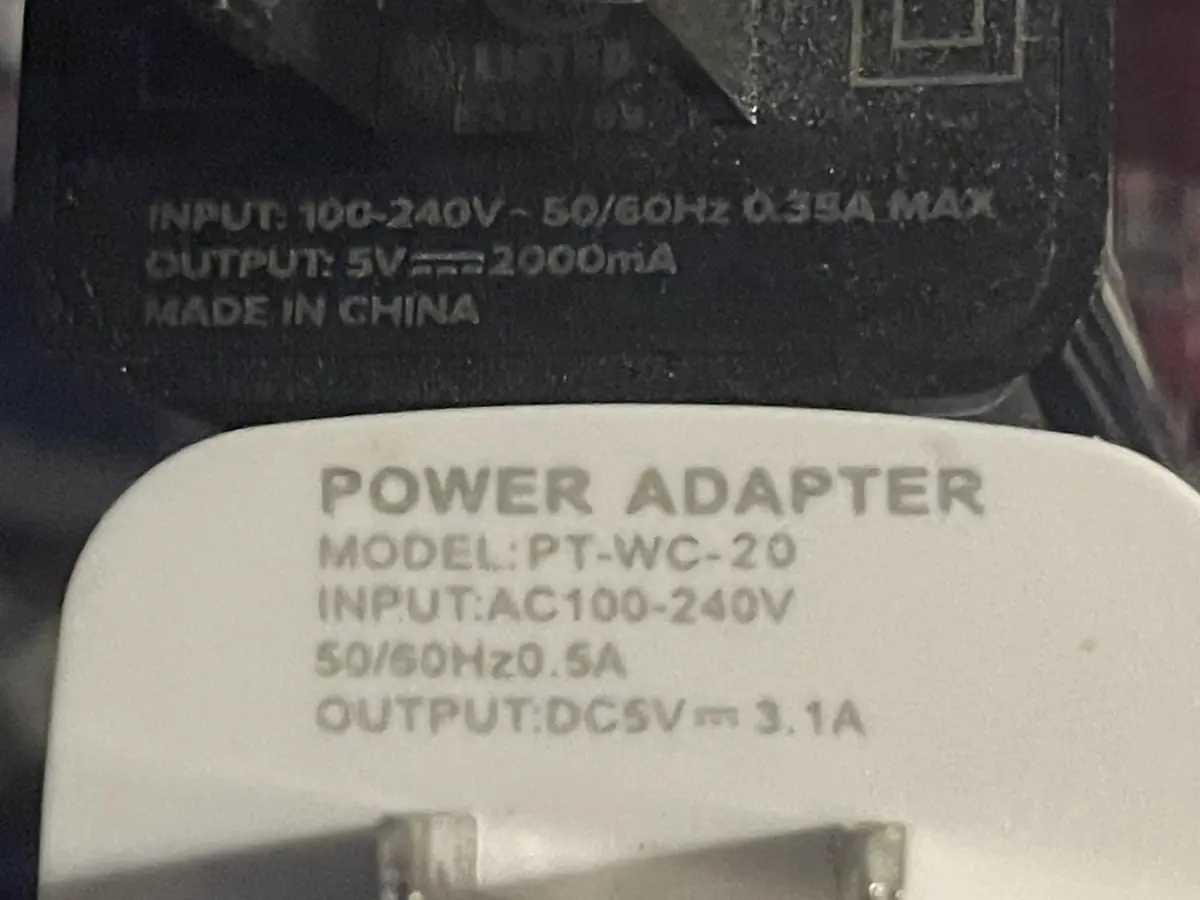
The label rule settles almost every case. Look at the small print on your charger or device — if it reads “INPUT 100-240V,” it’s dual voltage and works anywhere on earth with nothing more than a shape adapter. Most phones, laptops, tablets, and cameras are built this way. The exceptions are high-wattage, single-voltage heat appliances.
Here’s the decision broken down by where you’re flying from:
- From the US or Canada: No adapter, no converter. Plugs fit, voltage matches.
- From the UK, Europe, or Australia: Type A/B plug adapter required. Converter only needed for single-voltage 220-240V appliances.
- Any traveler with a “100-240V” device: Adapter for shape if needed, never a converter.
- Any traveler with a single-voltage heat appliance: Converter required, or better, leave it home.
On my last trip I made a habit of checking the tiny print on each charger brick at the departure gate. Every one read 100-240V, which confirmed I could leave the converter I’d nearly packed at home.
Which of your devices will (and won’t) work in El Salvador
Almost everything a US traveler carries — phone, laptop, tablet, camera, e-reader, electric toothbrush — is dual voltage and works in El Salvador with no adapter. The only real risks are single-voltage, high-wattage heat appliances like some hair dryers, curling irons, and flat irons.
The pattern is consistent: anything with a charger brick or a small power supply is almost always dual voltage, while anything that generates heat directly from the wall is the gamble. Phone and laptop chargers read 100-240V and work without a thought. USB-C Power Delivery and GaN chargers behave identically — they’re just more efficient. CPAP machines are usually dual voltage, but check the wattage; a unit under roughly 200W can pair with a compact travel converter if it happens to be single-voltage.
Here’s the device-by-device breakdown:
- Phone charger (iPhone/Android): No adapter, no converter. Dual voltage.
- Laptop / MacBook brick: No adapter, no converter. Dual voltage.
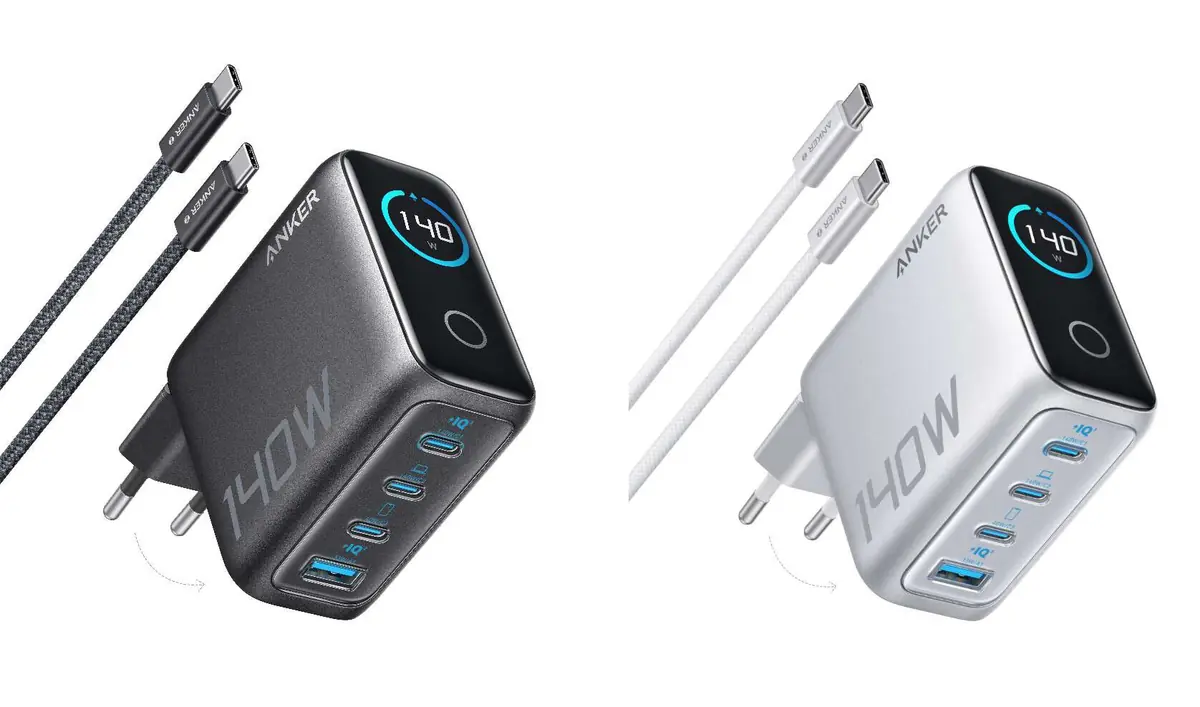
- USB-C GaN multi-port charger: No adapter, no converter. Works identically.
- Camera / GoPro charger: No adapter, no converter. Dual voltage.
- E-reader (Kindle, etc.): No adapter, no converter. Dual voltage.
- Electric toothbrush: No adapter, no converter. Dual voltage.
- CPAP machine: Usually dual voltage — check label; converter only if single-voltage and under ~200W.
- Hair dryer: Works only if dual voltage. Single-voltage 220-240V will not run.
- Curling iron / flat iron: Same as hair dryer — dual voltage only.
A practical note from experience: hostels and surf lodges often have only one or two reachable outlets per room, so the real bottleneck isn’t voltage — it’s outlet count.
Can I use my hair dryer in El Salvador?
You can use a hair dryer in El Salvador only if it is dual voltage (labeled 100-240V) — then you need nothing extra. A single-voltage 220-240V dryer will not work on El Salvador’s 120V power. The simplest fix is a compact dual-voltage travel hair dryer rather than a heavy converter.
Hair dryers draw roughly 1000-2000W, and that’s the problem with converters. A converter that can handle 1875W is bulky, heavy, and expensive — the wrong tool for a carry-on. A single-voltage 240V dryer plugged into 120V through a shape adapter doesn’t burn out dramatically; it usually just blows lukewarm, weak air because it’s getting half the power it expects.
The honest move is to buy a compact dual-voltage travel hair dryer, which costs less than the converter would and weighs a fraction as much. Even simpler: many mid-range Salvadoran hotels now supply in-room dryers, so a lot of travelers can leave theirs at home entirely.
- Hair dryer wattage: roughly 1000-2000W
- Converter needed for that wattage: bulky and heavy — not worth it
- Better option: compact dual-voltage travel dryer
- Free option: check whether your hotel supplies one
Can I use my US phone charger and laptop in El Salvador?
Yes. US phone chargers, laptop bricks, and tablet chargers are dual voltage (100-240V, 50/60 Hz) and plug straight into Salvadoran Type A/B outlets with no adapter or converter. Just confirm the small print on the charger reads “100-240V” and you are ready to charge.
This covers the largest group of visitors, and the answer is genuinely that simple. Apple chargers, the vast majority of Android chargers, and laptop power supplies are all multi-voltage by design. USB-C Power Delivery bricks and modern GaN chargers — the small, powerful ones that charge a laptop and phone at once — work exactly the same way. Template plug pages almost never confirm this, but GaN chargers carry the same 100-240V rating as everything else.
On my last trip I ran a phone, a laptop, and a GoPro off a single US power strip in a San Salvador hotel room, plugged straight into the wall with no adapter in sight.
Do I need a voltage converter for El Salvador?
Usually not. US and Canadian devices already match El Salvador’s 120V power, and any dual-voltage device labeled “100-240V” needs no converter anywhere in the world. The only items that may need a step-down converter are single-voltage 220-240V appliances, such as some hair dryers and styling tools.
It’s worth knowing the converter-versus-transformer distinction, because they’re sold interchangeably and aren’t. Converters are designed for short-use heat appliances — a few minutes of a curling iron. Transformers are built for continuous-use electronics. For the typical US traveler, neither is necessary, and most people who pack one never plug it in. I’ve watched travelers haul heavy converters across Central America that stayed sealed in their bags the entire trip.
Pro Tip: Before buying any converter, flip over the device you’re worried about and read the input range. If it says 100-240V, the converter is money wasted — the device handles the job itself.
What to pack and where to buy it
US travelers need no adapter, but a small USB-C power strip or multi-port GaN charger solves single-outlet hotel rooms. Travelers from abroad should buy a universal adapter before departure — they cost more at airports. Dedicated single-country adapter kits run roughly $4.50-$15; universal adapters typically run $15-$30.
The smartest packing decisions here are about outlet count and outages, not voltage. A multi-port USB-C GaN charger — brands like EPICKA, Anker, and TESSAN make good ones — turns a single wall outlet into four charging slots, which matters far more than any adapter when your hostel room has one accessible socket. A compact travel power strip with surge protection does the same job and protects against voltage sag. For the coast, a power bank is the single most useful item you can pack.
Buy all of it online before you leave. Adapter prices jump noticeably at the SAL airport newsstand and at US airport shops compared to ordering ahead.
- US/Canada travelers: USB-C GaN multi-port charger or travel power strip; a power bank for the coast
- UK/Europe/Australia travelers: universal travel adapter ($15-$30) bought before departure
- Single-country adapter kit: roughly $4.50-$15
- Universal adapter: typically $15-$30
- Everyone heading to the beach: a power bank for outages and long surf days
El Salvador travel context that affects charging
El Salvador uses the US dollar, so there is no currency math on an airport adapter purchase. Most travelers land at SAL and head to San Salvador or the Surf City beaches like El Tunco and El Zonte. Rural and beach areas can see occasional power cuts, so a power bank is worth packing.
A few logistics shape how you’ll actually charge devices on the ground:
- Currency: US dollar (USD), official since 2001 — no conversion needed at the airport shop
- Main airport: SAL (Óscar Arnulfo Romero), in San Luis Talpa
- SAL to El Tunco: about 45 minutes; private taxi roughly $30-$40
- Mobile carriers: Claro and Tigo sell local SIMs and eSIMs
- Emergency number: 911
- Tap water: not potable — pack accordingly
The charging reality changes once you leave the capital. San Salvador hotels are reliable. On the La Libertad coast, surf lodges and hostels run on fewer outlets and occasionally lose power for short stretches. My routine on a San Salvador-to-coast itinerary was to top up the laptop and power bank fully in the city, then live off the power bank during long beach and surf days when an outlet wasn’t reachable.

Common mistakes and safety tips
The biggest mistake travelers make is buying a voltage converter they do not need — US devices already match Salvadoran power. The second is assuming a plug adapter changes voltage; it never does. Use a surge protector for laptops, and never force a grounded three-prong plug into an older two-prong socket.
The mistakes follow a pattern, and they’re all avoidable:
- Buying a converter for dual-voltage devices that never needed one
- Assuming an adapter changes voltage — it only changes plug shape
- Overloading a multi-port adapter with a heat appliance like a flat iron
- Skipping surge protection for laptops during outage-prone coastal stays
- Forcing a three-prong grounded plug into an older two-prong socket
The loose-socket issue deserves a specific warning. Because Salvadoran outlets often aren’t recessed and the plug pins aren’t insulated, a plug can sit half-out while still live. On the coast I had a charger work its way loose in an un-recessed socket and hang half-falling-out overnight — fine in the end, but a reminder to seat plugs firmly and check them before bed.
Pro Tip: A travel power strip with surge protection does triple duty in El Salvador — it multiplies your outlets, protects against voltage sag, and keeps all your plugs seated tightly in one reliable spot.
Bottom line — El Salvador plugs and adapters at a glance
TL;DR: El Salvador uses Type A/B outlets at 120V/60Hz, identical to the US. Americans and Canadians pack nothing special — just chargers and maybe a USB power strip. Europeans, Brits, and Australians need a Type A/B adapter, plus a converter for single-voltage heat appliances. Confirm “100-240V” on each device.
The whole topic comes down to four facts and one rule:
- Plug types: A and B (NEMA 1-15 and NEMA 5-15)
- Voltage and frequency: 120V, 60 Hz
- US/Canada verdict: no adapter, no converter
- UK/Europe/Australia verdict: Type A/B adapter, converter only for single-voltage heat appliances
- The one rule: read each device for “100-240V”
I finished an entire El Salvador trip — capital, mountains, and the Surf City coast — using nothing but the standard US chargers already in my bag. For most American travelers, that’s the real takeaway.
What’s the one device you’re most worried about charging on your trip? Drop it in the comments and I’ll tell you exactly what it needs.