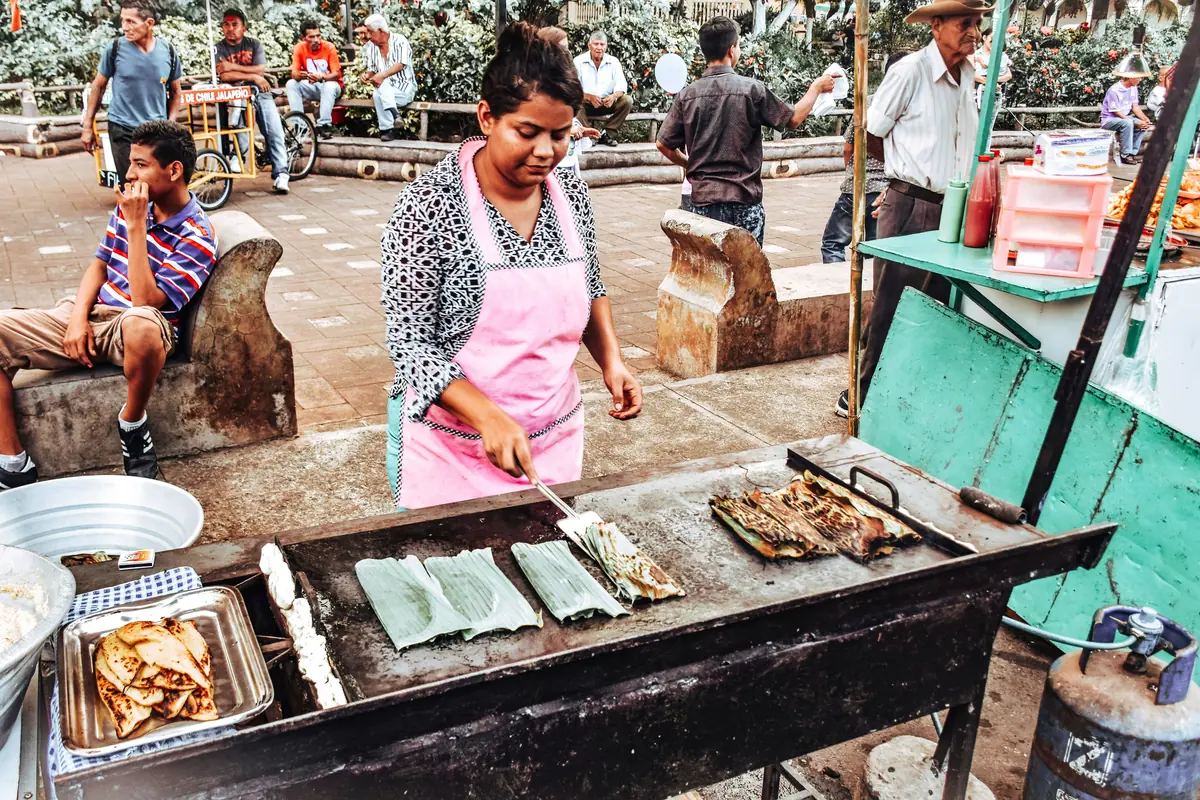
Salvadorans speak Spanish, but three things hit an American ear within the first hour on the ground. They say vos instead of tú. They run almost everything through a slang layer called Caliche. And they soften or drop the s at the end of syllables, so las pupusas lands closer to “lah poo-POO-sah.” Textbook Spanish will get you a plate of food and a bus ride, but it won’t get you the joke the cobrador just made.
English is limited outside hotels, tour operations, and the surf towns on the coast. That’s good news, actually: a handful of memorized phrases goes a long way here, and Salvadorans are famously patient with people who try.
This guide covers the grammar that matters (voseo, conjugated correctly, including the commands), the slang worth knowing, the words that will get you a laugh and the ones that will get you a cold stare, plus scenario-by-scenario phrase tables for pupuserías, chicken buses, surf breaks, pharmacies, and highway checkpoints.
Is Spanish the language of El Salvador?
Yes. Spanish is the official language and effectively universal, spoken by virtually the entire population.
The country’s Indigenous language, Nawat (also written Nahuat, and historically called Pipil), survives only barely. UNESCO classifies it as critically endangered, with a few dozen fluent elderly speakers concentrated in western Sonsonate towns such as Santo Domingo de Guzmán and Cuisnahuat, plus a growing group of younger learners in revitalization programs. You will not need Nawat to travel, but you will hear it every day inside Salvadoran Spanish, embedded in place names and everyday vocabulary.
There’s a third layer worth knowing about: Spanglish salvadoreño, carried home by the enormous Salvadoran diaspora in Los Angeles, Houston, and Washington, D.C. You’ll hear troca for truck, lonche for lunch, marqueta for market, parquear for to park, and chatear for to chat. If someone switches to fluent English on you in a small town, there’s a decent chance they spent years in the States.
How much English is spoken in El Salvador?
Not much, nationally. English is common in mid-range and upscale hotels, with tour operators and surf schools, at the international airport, and among returnees who lived in the United States. Outside those pockets, assume Spanish only.
The practical exception is the coast. In El Tunco, El Zonte, and Sunzal, surf instructors, hostel staff, and restaurant servers often speak workable English because the surf economy runs on foreign visitors. Ten miles inland, that disappears. Bus drivers, market vendors, pharmacists, and police officers will speak Spanish with you, and a translation app with an offline Spanish pack earns its keep.
Voseo: why Salvadorans say “vos” instead of “tú”
In El Salvador, the standard informal pronoun is vos, not tú. It replaces tú in conversation with friends, peers, and anyone younger, and it comes with its own verb endings. This is the single biggest gap between classroom Spanish and street Spanish here, and closing it will change how people respond to you.
How to conjugate vos
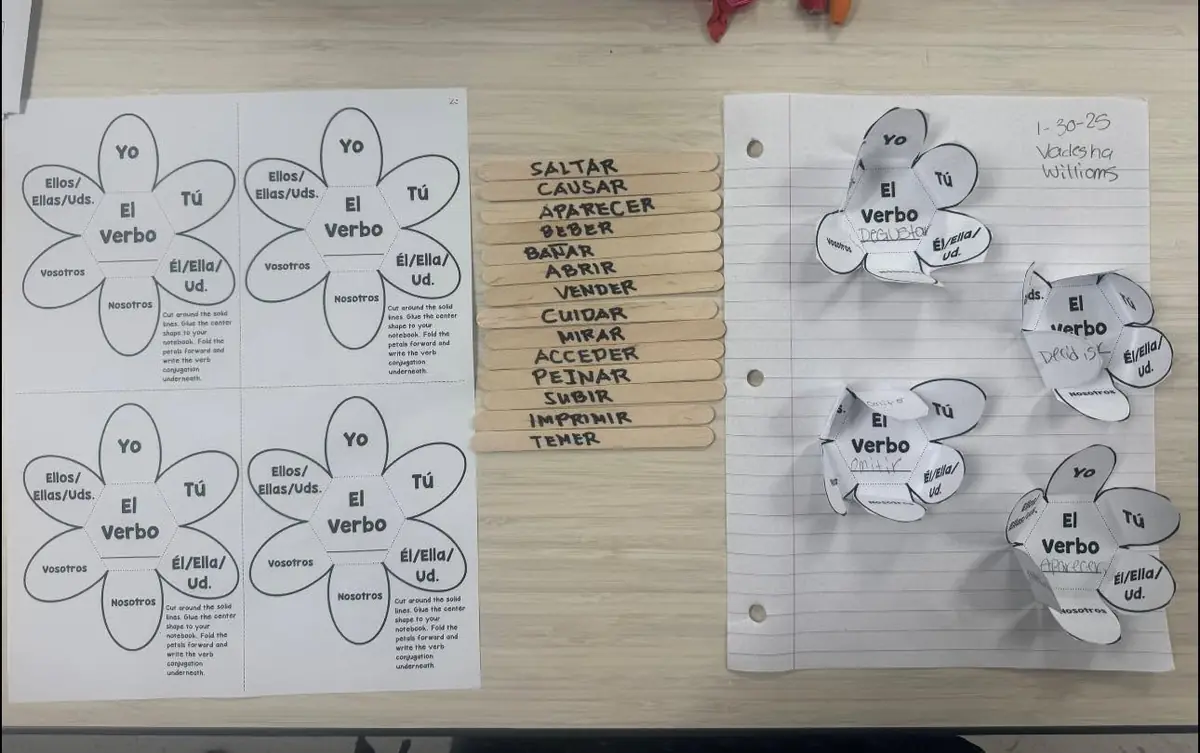
The rule is easier than the tú forms you already learned. Take the infinitive, drop the final -r, add -s, and put the accent on the last vowel. Stems never change, which means no vowel shifts to memorize.
| Infinitive | tú form | vos form (present) | vos command |
|---|---|---|---|
| hablar (to speak) | tú hablas | vos hablás | ¡hablá! |
| comer (to eat) | tú comes | vos comés | ¡comé! |
| vivir (to live) | tú vives | vos vivís | ¡viví! |
| venir (to come) | tú vienes | vos venís | ¡vení! |
| decir (to say) | tú dices | vos decís | ¡decí! |
| tener (to have) | tú tienes | vos tenés | ¡tené! |
| poder (to be able) | tú puedes | vos podés | — |
| querer (to want) | tú quieres | vos querés | — |
| ir (to go) | tú vas | vos vas | ¡andá! |
| ser (to be) | tú eres | vos sos | ¡sé! |
Notice what is missing: the stem changes. Tú puedes becomes vos podés, tú quieres becomes vos querés, tú piensas becomes vos pensás. The o and e stay put.
Commands follow the same shortcut. Drop the -r and accent the final vowel: hablá, comé, mirá, vení, andá, decí, tené, pedí. So a Salvadoran friend waving you over says “¡Vení!” rather than “¡Ven!”
Only three forms are genuinely irregular in the present: vos sos (you are), vos vas (you go), vos has (you have, as an auxiliary). “Vos sos muy simpático” is the everyday equivalent of “Tú eres muy simpático.”
When to use vos, tú, and usted
El Salvador runs a three-way system, which is unusual and worth getting right.
| Pronoun | Use it with | Notes |
|---|---|---|
| usted | Elders, strangers, shop owners, police and soldiers, business contacts, anyone you want to show respect | Children address adults with usted regardless of the adult’s age. This is your safe default. |
| vos | Friends, peers, people your age or younger once things are relaxed | The genuine informal pronoun. Adults also use it with children. |
| tú | An in-between register, and very often what locals use with foreigners | Salvadorans frequently switch to tú with visitors, partly out of courtesy, partly because they assume you learned tú. |
The practical rule for travelers: open with usted every time. Let the other person move you down to vos, then follow their lead. Using vos with a police officer at a checkpoint or with a grandmother selling mangoes reads as presumptuous. Using usted with a surf buddy your own age reads as stiff, but harmlessly so.
How Salvadoran voseo differs from Argentine voseo
The verb forms are nearly identical to what you’d hear in Buenos Aires: hablás, comés, vivís, sos. If you studied Rioplatense Spanish, you already have the grammar.
The difference is social. Argentina uses vos as the only informal pronoun, and Argentines will use it with you on day one. El Salvador keeps tú in play as a middle-ground option and reserves usted for a much wider range of situations. Salvadorans also tend to speak more slowly than Argentines, with none of the Italian-inflected melody, and with far heavier consonant dropping.
What is Caliche? El Salvador’s slang, explained
Caliche is the informal Salvadoran vernacular: a body of slang, expressions, and Nawat-derived vocabulary layered on top of standard Spanish. It is not a separate language or a dialect spoken only by one class. Bankers, bus drivers, university students, and grandmothers all use it, though professionals switch it off in formal settings just as an American executive drops “y’all” in a board meeting.
Two things make Caliche distinctive. The first is the Nawat substrate, documented by Salvadoran linguists including Pedro Geoffroy Rivas of the Academia Salvadoreña de la Lengua, which supplies everyday nouns most other Spanish speakers won’t recognize. The second is its role in national identity. Salvadorans call themselves guanacos, and Caliche is the sound of that self-image: quick, self-deprecating, and heavy on wordplay. Salvadoran comedians, rappers, and cumbia acts trade on it constantly.
For a visitor, understanding Caliche matters more than producing it. You do not need to say maje to anyone. You do need to know that when someone tells you the waves are chivo, they mean excellent.
Essential El Salvador Spanish phrases for travelers
These are organized by situation. Pronunciation respellings are approximate and written for American English speakers. Where the local accent drops an s, the respelling reflects what you’ll actually hear.
Greetings and courtesy
Greeting people is close to mandatory here. Walk into a small shop, a bakery, or a waiting room without saying anything and you’ll be read as rude.
| Spanish | Say it like | English | Usage note |
|---|---|---|---|
| Buenos días | BWEH-noh DEE-ah | Good morning | Until about noon. |
| Buenas tardes | BWEH-nah TAR-deh | Good afternoon | Noon until dark. |
| Buenas | BWEH-nah | Hi there | All-purpose short version, used constantly. |
| ¿Cómo está? | KOH-moh eh-TAH | How are you? | The usted form. Your default with strangers. |
| ¿Qué onda? | keh OHN-dah | What’s up? | Casual, among peers. |
| Quiubo | KYOO-boh | Hey / what’s happening | Contraction of ¿qué hubo? Very informal. |
| Mucho gusto | MOO-choh GOOS-toh | Nice to meet you | Pair with a handshake on first meeting. |
| Con permiso | kohn per-MEE-soh | Excuse me | Squeezing past someone. |
| Disculpe | dees-KOOL-peh | Excuse me / sorry | Getting attention or apologizing. |
| Vaya pues | BAH-yah pweh | All right then | Agreement, goodbye, or conversation-ender. Extremely Salvadoran. |
| Que le vaya bien | keh leh BAH-yah byen | Take care | Said to someone leaving. |
| Salú | sah-LOO | Cheers / bless you | Toasting or after a sneeze. |
Vaya pues deserves its own note. It works as “okay,” “sounds good,” “see you later,” and “well, anyway,” depending on tone. If you learn one Salvadoran expression, learn this one.
Ordering pupusas and food
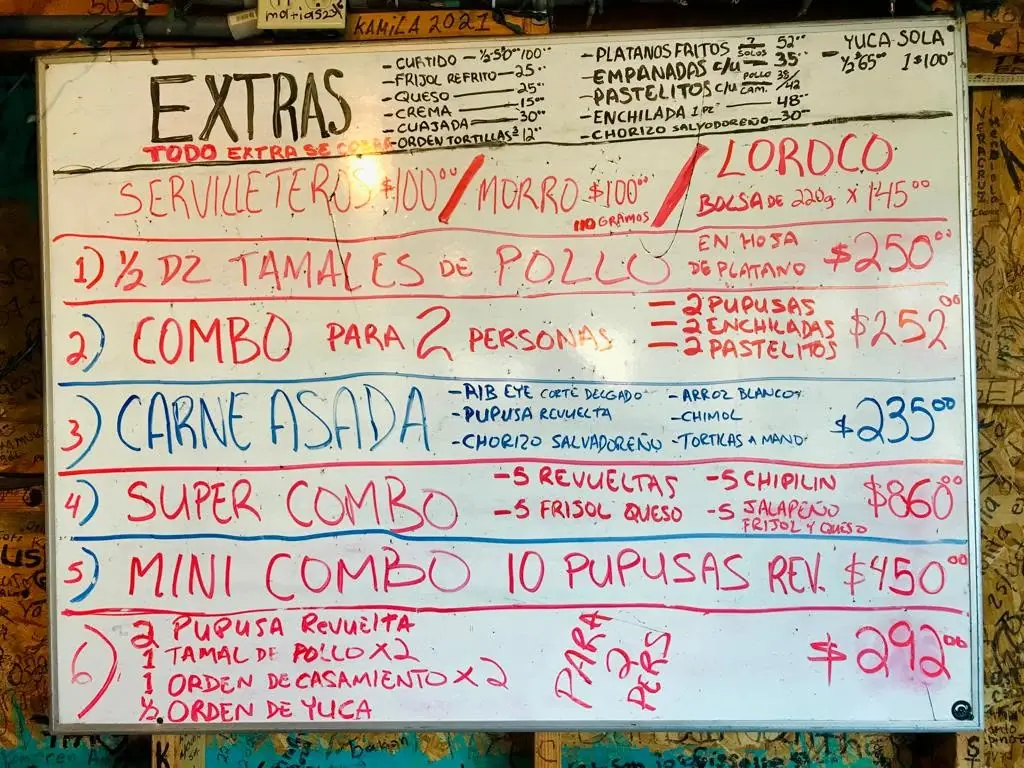
Pupusas are the national dish: thick corn or rice masa cakes stuffed and griddled, served with curtido and salsa. Ordering them well is the fastest way to earn a smile.
| Spanish | Say it like | English | Usage note |
|---|---|---|---|
| ¿Me da una orden de pupusas? | meh dah OO-nah OR-den deh poo-POO-sah | Can I get an order of pupusas? | An “orden” is usually three or four. |
| Dos revueltas, por favor | doh reh-BWEL-tah | Two mixed, please | Beans, cheese, and pork. The classic. |
| Una de queso con loroco | OO-nah deh KEH-soh kohn loh-ROH-koh | One cheese with loroco | Loroco is an edible flower bud. Try it. |
| Una de chicharrón | OO-nah deh chee-chah-ROHN | One with pork | Ground seasoned pork, not fried rind. |
| Una de frijol con queso | OO-nah deh free-HOL kohn KEH-soh | One bean and cheese | Reliably vegetarian-friendly. |
| ¿De arroz o de maíz? | deh ah-ROH oh deh mah-EE | Rice or corn masa? | You’ll be asked this. Rice masa is an Olocuilta specialty. |
| ¿Me da más curtido? | meh dah mah koor-TEE-doh | More curtido, please | The pickled cabbage slaw on the counter. |
| ¿Pica mucho? | PEE-kah MOO-choh | Is it very spicy? | Salvadoran salsa is mild by Mexican standards. |
| Soy vegetariano / vegetariana | soy beh-heh-tah-RYAH-noh | I’m vegetarian | Add “no como carne” for clarity. |
| Para llevar | PAH-rah yeh-BAR | To go | |
| ¿Me trae la cuenta? | meh TRAH-eh lah KWEN-tah | Can I get the check? | |
| Estaba bien rico | eh-TAH-bah byen REE-koh | That was delicious | Genuine compliment, always well received. |
Two dishes worth knowing by name: casamiento (rice and beans cooked together, the standard side) and atol (a warm corn drink, often sold from big pots at markets).
Money and paying
The everyday currency is the US dollar, which removes most of the friction for American travelers. Bitcoin is no longer legal tender: the Legislative Assembly amended the Bitcoin Law in 2025, making acceptance voluntary, a change tied to the country’s Extended Fund Facility agreement with the IMF. A few businesses in El Zonte and El Tunco still take it by choice, but nobody is obligated to.
Carry small bills. Twenties are hard to break at a pupusería, and a fifty may be refused outright.
| Spanish | Say it like | English | Usage note |
|---|---|---|---|
| ¿Cuánto cuesta? | KWAN-toh KWEH-tah | How much is it? | |
| ¿Cuánto le debo? | KWAN-toh leh DEH-boh | What do I owe you? | Warmer than asking the price. |
| ¿Aceptan tarjeta? | ah-SEP-tan tar-HEH-tah | Do you take cards? | Cities and resorts yes, rural no. |
| Solo tengo efectivo | SOH-loh TEN-goh eh-fek-TEE-boh | I only have cash | |
| ¿Tiene cambio de veinte? | TYEH-neh KAM-byoh deh BAYN-teh | Do you have change for a twenty? | |
| ¿Me da el vuelto? | meh dah el BWEL-toh | Can I get my change? | Vuelto, not cambio, for change owed. |
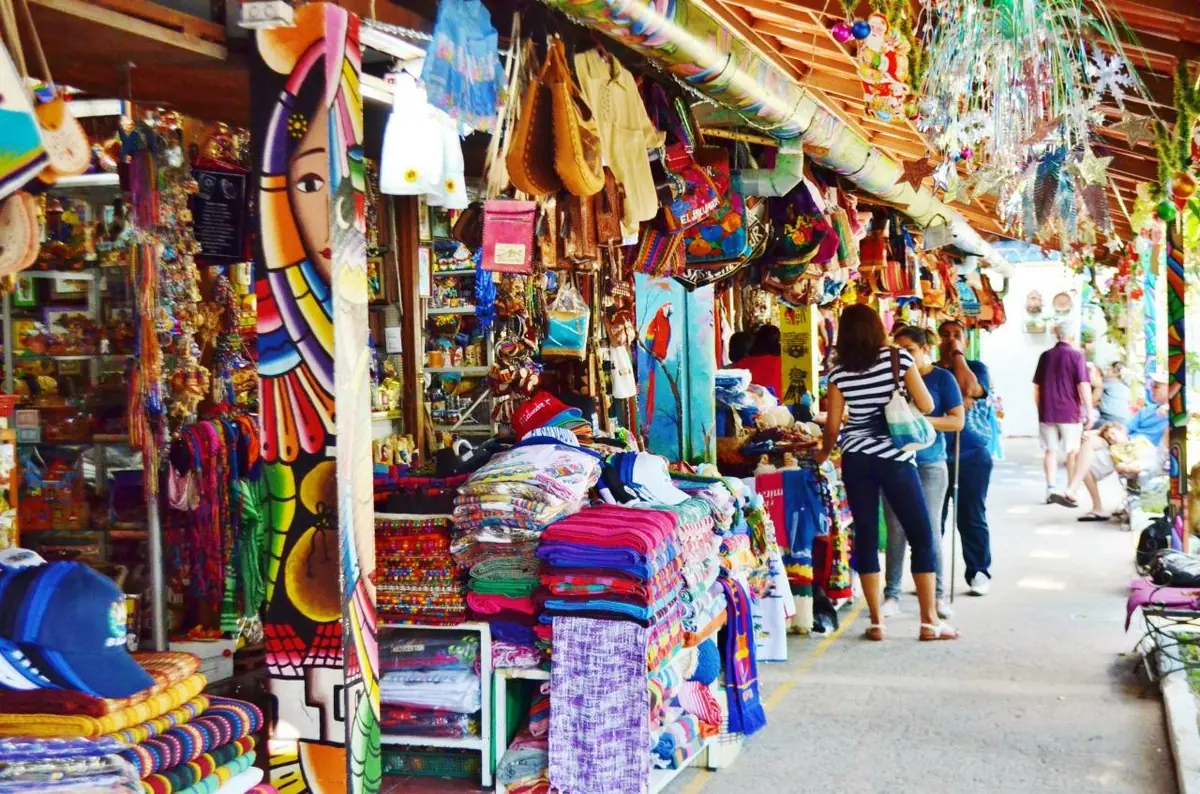
| ¿Me hace precio? | meh AH-seh PREH-syoh | Can you give me a better price? | Markets and crafts only, never restaurants. |
| No tengo pisto | noh TEN-goh PEE-toh | I don’t have money | Pisto is the Caliche word for cash. |
| Una cora | OO-nah KOH-rah | A quarter | Borrowed straight from “quarter.” |
Transportation and chicken buses
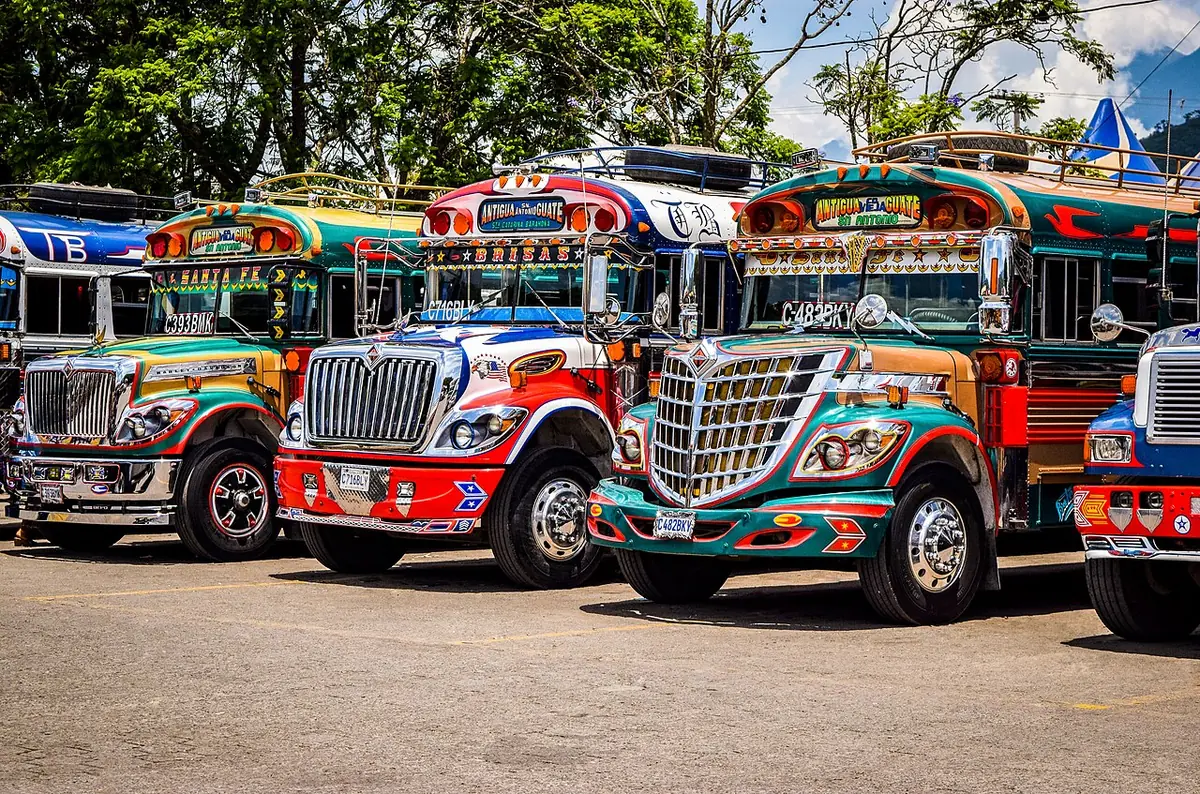
The retired American school buses, repainted in murals and named camionetas locally, run numbered routes across the country for pocket change. They are the cheapest way to move and the single best place to hear real Caliche. They are also crowded, and the US State Department advises its own employees against using public buses, so weigh that against shuttles and ride-hailing in the capital.
| Spanish | Say it like | English | Usage note |
|---|---|---|---|
| ¿Para dónde va? | PAH-rah DOHN-deh bah | Where is this headed? | Ask the cobrador, not the driver. |
| ¿Pasa por La Libertad? | PAH-sah por lah lee-behr-TAH | Does it go through La Libertad? | Swap in your destination. |
| ¿Cuánto es el pasaje? | KWAN-toh eh el pah-SAH-heh | How much is the fare? | Usually well under a dollar. |
| ¡Bajan! | BAH-han | Someone’s getting off! | Shout it so the driver stops. |
| Aquí nomás, por favor | ah-KEE noh-MAH | Right here, please | |
| ¿Me deja en la parada? | meh DEH-hah en lah pah-RAH-dah | Can you drop me at the stop? | |
| ¿Dónde agarro la ruta 102? | DOHN-deh ah-GAH-roh lah ROO-tah | Where do I catch route 102? | Agarrar, not tomar, for catching a bus. |
| ¿Hay microbús para…? | ay mee-kroh-BOO | Is there a minibus to…? | Faster, smaller vans on many routes. |
| Voy para El Tunco | boy PAH-rah el TOON-koh | I’m going to El Tunco |
Route 102 is the long-running San Salvador to La Libertad line that puts you within reach of the surf coast. Route numbers and connections shift, so confirm the current one with your hotel the morning you travel.
Asking for directions
| Spanish | Say it like | English | Usage note |
|---|---|---|---|
| ¿Dónde queda…? | DOHN-deh KEH-dah | Where is…? | Queda is preferred over está for places. |
| ¿Está lejos a pie? | eh-TAH LEH-hoh ah pyeh | Is it far on foot? | |
| Está cerca | eh-TAH SER-kah | It’s close | |
| A la vuelta | ah lah BWEL-tah | Around the corner | |
| Siga derecho | SEE-gah deh-REH-choh | Go straight | Derecho is straight, derecha is right. |
| A la par de la iglesia | ah lah par deh lah ee-GLEH-syah | Next to the church | A la par is the Central American “next to.” |
| Arriba / abajo | ah-REE-bah / ah-BAH-hoh | Up the hill / down the hill | Used constantly for direction in hill towns. |
| ¿Me lo puede mostrar en el mapa? | en el MAH-pah | Can you show me on the map? |
Addresses outside the capital often work by landmark rather than street number, so expect directions built around a church, a park, a gas station, or a former business that closed a decade ago.
Surf and beach Spanish
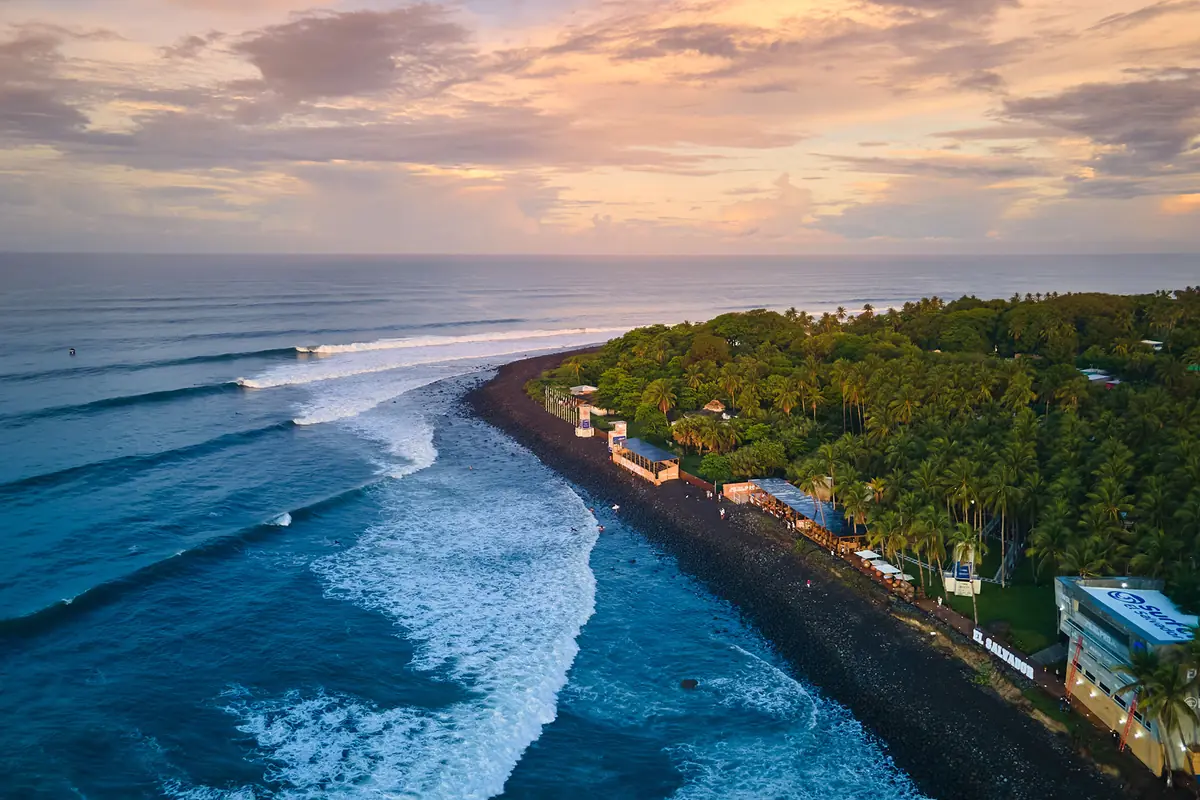
El Tunco, El Zonte, Sunzal, Punta Roca, and the breaks around La Libertad draw surfers year-round to right-hand point breaks over rock and cobblestone.
| Spanish | Say it like | English | Usage note |
|---|---|---|---|
| ¿Cómo está el mar hoy? | KOH-moh eh-TAH el mar oy | How’s the water today? | The standard morning question. |
| ¿Está buena la ola? | eh-TAH BWEH-nah lah OH-lah | Is the wave good? | |
| La marea está alta / baja | lah mah-REH-ah | The tide is high / low | Most points break best on a specific tide. |
| ¿Hay corriente? | ay koh-RYEN-teh | Is there a current? | Ask before paddling out anywhere new. |
| ¿Dónde puedo rentar una tabla? | ren-TAR OO-nah TAH-blah | Where can I rent a board? | Tabla is board, quilla is fin. |
| ¿Es para principiantes? | preen-see-PYAN-teh | Is it beginner-friendly? | El Zonte’s point suits confident intermediates. |
| Hay piedras | ay PYEH-drah | There are rocks | Reef and cobblestone bottoms are the norm. |
| ¿Me da una clase? | meh dah OO-nah KLAH-seh | Can you give me a lesson? | |
| ¿Cuánto por el lanchero? | lan-CHEH-roh | How much for the boat guy? | For boat access to outer breaks. |

Emergencies, health, and the pharmacy
The national emergency number is 911. Pharmacies are widespread, well stocked, and staffed by people who will help you sort out a stomach bug without a doctor’s visit.
| Spanish | Say it like | English | Usage note |
|---|---|---|---|
| Necesito ayuda | neh-seh-SEE-toh ah-YOO-dah | I need help | |
| Llame a la policía | YAH-meh ah lah poh-lee-SEE-ah | Call the police | |
| ¿Dónde está el hospital más cercano? | ser-KAH-noh | Where’s the nearest hospital? | |
| Necesito un médico | neh-seh-SEE-toh oon MEH-dee-koh | I need a doctor | |
| Me duele el estómago | meh DWEH-leh el eh-TOH-mah-goh | My stomach hurts | Swap la cabeza (head), la garganta (throat). |
| Tengo fiebre | TEN-goh FYEH-breh | I have a fever | |
| Soy alérgico a la penicilina | ah-LEHR-hee-koh | I’m allergic to penicillin | Adapt to your own allergy. |
| ¿Hay una farmacia cerca? | far-MAH-syah | Is there a pharmacy nearby? | |
| ¿Tiene algo para la diarrea? | dyah-REH-ah | Do you have something for diarrhea? | No embarrassment here, it’s a common ask. |
| Se me perdió el pasaporte | seh meh per-DYOH | I lost my passport | Then contact the US Embassy in Antiguo Cuscatlán. |
Police and military checkpoints
Random police and military checkpoints, called retenes, are a normal part of driving in El Salvador under the ongoing state of exception, alongside routine DUI stops. They are usually brief and uneventful. Slow down, turn on the interior light at night, keep your hands visible, and speak usted.
| Spanish | Say it like | English | Usage note |
|---|---|---|---|
| Buenas, oficial | BWEH-nah oh-fee-SYAL | Good day, officer | Open with a greeting, always. |
| Aquí están mis documentos | ah-KEE eh-TAHN mee doh-koo-MEN-toh | Here are my documents | Passport or copy, plus license and rental papers. |
| Soy turista | soy too-REE-tah | I’m a tourist | |
| Ando de vacaciones | AHN-doh deh bah-kah-SYOH-neh | I’m on vacation | Andar is used where you’d expect estar. |
| Vengo de San Salvador | BEN-goh deh | I’m coming from San Salvador | |
| Voy para La Libertad | boy PAH-rah | I’m heading to La Libertad | |
| Es un carro rentado | eh oon KAH-roh ren-TAH-doh | It’s a rental car | |
| ¿Puedo seguir? | PWEH-doh seh-GEER | May I go on? | |
| Con gusto | kohn GOO-toh | Of course / happy to | Cooperative, polite closer. |
Two travel notes that pair with this vocabulary: the US State Department has placed El Salvador at Level 1, its lowest advisory tier, while still advising US government personnel to avoid intercity travel at night and public buses. Driving rural highways after dark is discouraged for the ordinary reason that livestock, pedestrians, and unlit vehicles share the road. Check travel.state.gov for the current advisory before your trip.
25 must-know Caliche words
This is the working vocabulary you’ll hear in a week on the ground.
| Word | Say it like | Meaning | Register note |
|---|---|---|---|
| chivo | CHEE-boh | Cool, awesome | Safe and constant. The most Salvadoran adjective there is. |
| cabal | kah-BAL | Exactly, right on | Also means “on the dot” for time. |
| cipote / cipota | see-POH-teh | Kid, child | Neutral and affectionate. |
| bicho / bicha | BEE-choh | Kid, young person | Fine in El Salvador, vulgar in several other countries. |
| chero / chera | CHEH-roh | Friend, buddy | Warm. The safe way to say “my friend.” |
| maje | MAH-heh | Dude, guy | Friendly among peers, insulting with the wrong tone. |
| púchica | POO-chee-kah | Darn! Wow! | Completely safe, even in front of kids. |
| puya | POO-yah | Whoa! No way! | Surprise or disbelief. Also safe. |
| pisto | PEE-toh | Money, cash | Universal in El Salvador. |
| cora | KOH-rah | A quarter, 25 cents | From English “quarter.” |
| bolado | boh-LAH-doh | Thing, deal, situation | The all-purpose noun when you forget a word. |
| buena onda | BWEH-nah OHN-dah | Good vibes, a good person | Works as a compliment about people or places. |
| vaya pues | BAH-yah pweh | All right then | Agreement, farewell, or filler. |
| chuco | CHOO-koh | Dirty, grimy | Also the name of atol chuco, a dark corn drink. |
| bayunco | bah-YOON-koh | Goofy, tacky, immature | Mild tease. |
| goma | GOH-mah | Hangover | “Ando de goma” means you’re hungover. |
| socar | soh-KAR | To tighten; to hurry up | “Socale” means step on it. |
| mara | MAH-rah | Crowd, group of friends | Also the word for gangs. Read the room. |
| guishte | GWEE-teh | Shard of broken glass | Pure Salvadoran. Nobody else uses it. |
| guacal | wah-KAL | Plastic or gourd bowl | Every Salvadoran kitchen has several. |
| tunco | TOON-koh | Pig, pork | Yes, the beach town is named for it. |
| chele / chela | CHEH-leh | Light-skinned or blond person | Descriptive, not an insult. You may be called this. |
| casaca | kah-SAH-kah | A tall tale, a line of BS | “Echar casaca” is to sweet-talk or exaggerate. |
| paja | PAH-hah | A lie, nonsense | “No hablés paja” means quit talking nonsense. Vulgar in Spain and Mexico. |
| achís | ah-CHEE | Yeah, right / who cares | Dismissive, slightly sassy, very common. |
Salvadoran words to use with caution
Caliche has a sharp edge, and several of its best-known words are ones a visitor should recognize but not deploy. Tone and relationship carry the meaning here, and as a foreigner you have neither the accent nor the standing to make the joke land.
| Word | What it means | How careful to be |
|---|---|---|
| cerote | Literally a piece of excrement; used between close young male friends as a rough “dude” | Vulgar. Understand it, don’t say it. |
| culero | A harsh slur | Highly offensive. Avoid entirely. |
| verga | Vulgar term for male anatomy | Vulgar, though vergón commonly means “awesome” and “estar en verga” means to be in a bad spot. Leave all of it alone. |
| maje | Dude, or idiot | Depends completely on delivery. Safe among friends your age, risky with strangers. |
| bicho | Kid in El Salvador | Innocuous locally, obscene in Puerto Rico and elsewhere. Keep that in mind if you travel on. |
| chocho | Can refer to female anatomy in some contexts | Avoid. |
| paja | Nonsense or lies locally | Vulgar in much of the Spanish-speaking world. Understand it, skip it. |
| mara | Your crew, or a criminal gang | Never use it casually about people you don’t know. The gang meaning is not abstract here. |
When you need emphasis, use púchica or puya. Both are genuinely Salvadoran, both are safe in front of a grandmother, and both will make people smile because a foreigner said them.
Salvadoran Spanish vs. Mexican and other dialects
Most Americans arrive with Mexican Spanish in their ear, from school, from television, or from living in a city with a large Mexican community. The grammar transfers cleanly. The vocabulary does not always.
| Concept | El Salvador | Mexico | Note |
|---|---|---|---|
| Friend | chero, maje | cuate, güey | Chero is the friendliest choice. |
| Kid | cipote, bicho | chamaco, escuincle | Bicho is neutral only in El Salvador. |
| Money | pisto | lana, varo | |
| Hangover | goma | cruda | Colombians say guayabo. |
| Cool | chivo | chido, padre | |
| Informal “you” | vos | tú | Different verb endings follow. |
| Plural “you” | ustedes | ustedes | Nobody in Latin America uses vosotros. |
| Bus | camioneta, ruta | camión | |
| Drinking straw | pajilla | popote | |
| Wow / darn | púchica | híjole |
Regionally, Salvadoran Spanish sits closest to Honduran and Nicaraguan speech, sharing voseo and heavy consonant reduction with both. Compared with Mexican Spanish, it’s spoken at a slower clip but with far more sounds swallowed, which is why it can feel harder to follow at first despite the relaxed pace.
Pronunciation guide for English speakers
Salvadoran pronunciation follows a few consistent patterns. Learn these and comprehension improves faster than by memorizing more vocabulary.
The s disappears. At the end of a syllable or word, s softens into a breathy h or vanishes altogether. Los becomes “loh,” las pupusas becomes “lah poo-POO-sah,” estás becomes “eh-TAH.” This is the single biggest listening obstacle for Americans, because plural markers and verb endings evaporate. Context carries the meaning.
The d drops between vowels. Words ending in -ado lose it: pescado becomes “pescao,” cansado becomes “cansao,” ¿Dónde has estado? becomes something like “dónde ha’ e’tao.”
Seseo is universal. There is no Castilian lisp. Cerveza sounds like “ser-BEH-sah,” and gracias like “GRAH-syah.”
The j and g sound gentle. The Spanish j is a soft English h rather than a scraped throat sound, so trabajo lands closer to “trah-BAH-hoh.”
Words run together. Pues sí compresses to “puesí,” para dónde becomes “pa’dónde,” and para nada becomes “pa’nada.” Salvadorans also use pues as a sentence tag the way Americans use “well” or “so.”

Nahuat-Pipil words you’ll hear
Nawat gave Salvadoran Spanish a layer of vocabulary that other Spanish speakers often don’t recognize. Several of these words are ordinary, everyday nouns.
| Word | Meaning | Notes |
|---|---|---|
| guishte | Shard of broken glass | Geoffroy Rivas proposed a link to Nawat witzti, “thorn.” The etymology is a hypothesis, not settled. |
| guacal | Bowl, originally a gourd vessel | Now usually plastic. In every kitchen and every car wash. |
| chumpe / chompipe | Turkey | Origin debated among scholars. |
| ayote | Squash | |
| elote | Corn on the cob | |
| tacuacín | Opossum | |
| tecolote | Owl | |
| zopilote | Vulture | |
| caite | Sandal | Traditional leather or tire-soled footwear. |
| chucho | Dog | Informal, used across Central America. |
| chiche | Breast; also “easy” | “Está chiche” means it’s a piece of cake. Context matters. |
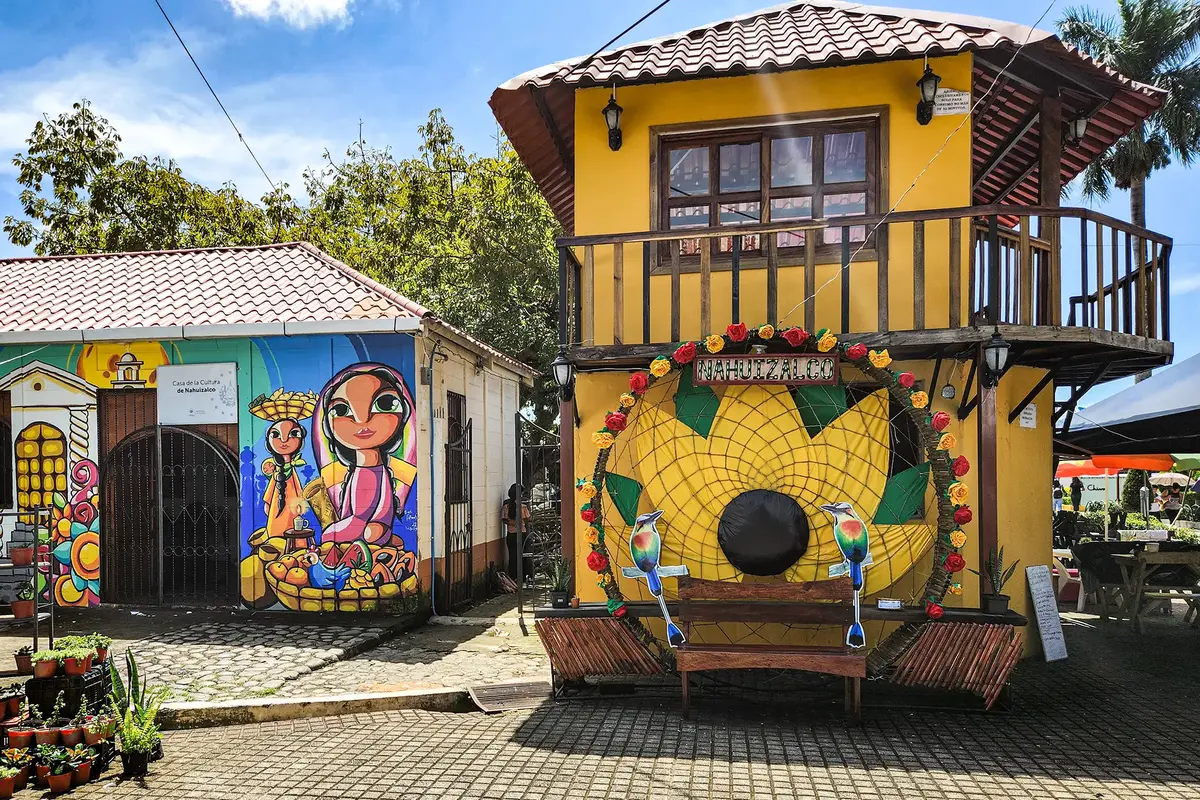
Place names carry the same heritage: Ahuachapán, Izalco, Cuscatlán, Nahuizalco, Sonsonate. Learning to hear the Nawat in the map makes the country’s geography click.
One correction worth making, because travel and language blogs repeat the error: pisto is not a Nawat word. The Spanish Royal Academy traces it to Latin pistus, meaning pounded or crushed, the same root behind the Spanish vegetable dish of that name. It arrived through Spanish, not through Nawat.
Nawat itself is the focus of active revitalization work, including immersion programs for children in Sonsonate and university-backed documentation projects. If you visit the western highlands, you may see bilingual signage as part of that effort.
Regional variation within El Salvador
The country is roughly the size of Massachusetts, but the accent still shifts noticeably as you move across it.
San Salvador and the central departments speak the most neutral variety, with moderate s-dropping and heavy Caliche use. This is what you’ll hear in media and what most visitors encounter first.
The eastern departments, San Miguel, Usulután, and La Unión, take consonant reduction furthest. Aspiration of the s is strongest here, and speech from the east is immediately identifiable to other Salvadorans. Expect pues sí to arrive as something like “pueji.”
The west, around Santa Ana, Ahuachapán, and Sonsonate, has the densest Nawat vocabulary and the strongest connection to Indigenous heritage, including the coffee-country towns of the Ruta de las Flores such as Juayúa and Concepción de Ataco.
The coastal surf towns are the outlier. In El Tunco and El Zonte you’ll hear more English, more borrowed surf vocabulary, and Spanish adjusted for foreign ears. It’s the easiest place in the country to be understood and the hardest place to actually practice.
Language etiquette: what to do and what not to say
Salvadoran social norms are warm but more formal than most Americans expect, and the language reflects it.
Greet on arrival, every time. Entering a shop, a small restaurant, a clinic waiting room, or even a shared van without a buenos días marks you as cold. Many Salvadorans greet the person sitting next to them on the bus.
Use titles. Don and doña before a first name show respect to older adults. Seño works for a shopkeeper, teacher, or any woman whose name you don’t know, and señor for men. Niña plus a first name is a common respectful address for an older woman, and is not condescending.
Default to usted and wait. Let people move you to vos. Following someone else’s shift is the polite move.
Expect diminutives. Ahorita, un ratito, cerquita, and cafecito soften almost everything. Note that ahorita can mean right now or in an hour, and the ambiguity is often intentional.
Read indirect refusals. “Fíjese que…” almost always introduces a no. Salvadorans rarely refuse bluntly, and a soft, roundabout answer is a real answer. Push once, politely, and then let it go.
Keep vulgar Caliche out of formal situations. Not with elders, officials, hotel staff, or in any business context, and not at a checkpoint.
Take the guanaco jokes as an invitation. Self-deprecating humor about the country is a national sport, but it’s theirs to make. Laugh along rather than joining in with your own material.
Putting it into practice before you go
You do not need fluency. You need about twenty phrases that work under pressure and an ear trained for the dropped s.
Start with the ten that carry the most weight: buenos días, buenas, mucho gusto, ¿cuánto cuesta?, ¿me da una orden de pupusas?, ¿dónde queda…?, ¿me da el vuelto?, con permiso, gracias, and vaya pues. Add ¿cómo está? and púchica for warmth, and aquí están mis documentos for the highway.
Then train your listening rather than your speaking. Find Salvadoran YouTube channels, radio stations, or comedy clips and play them while you cook. The vocabulary in this guide will start surfacing within a few sessions, and the s that keeps disappearing will stop throwing you.
Get the vos conjugations into your mouth before you land, even if you plan to answer in tú. Recognizing “¿de dónde venís?” as a question about where you came from is the difference between a conversation and a blank stare.
Finally, use the language even badly. El Salvador receives fewer American visitors than its neighbors, and the reaction to a foreigner attempting Caliche is almost always delight. Say púchica when you burn your mouth on a pupusa and you’ll have made a friend.