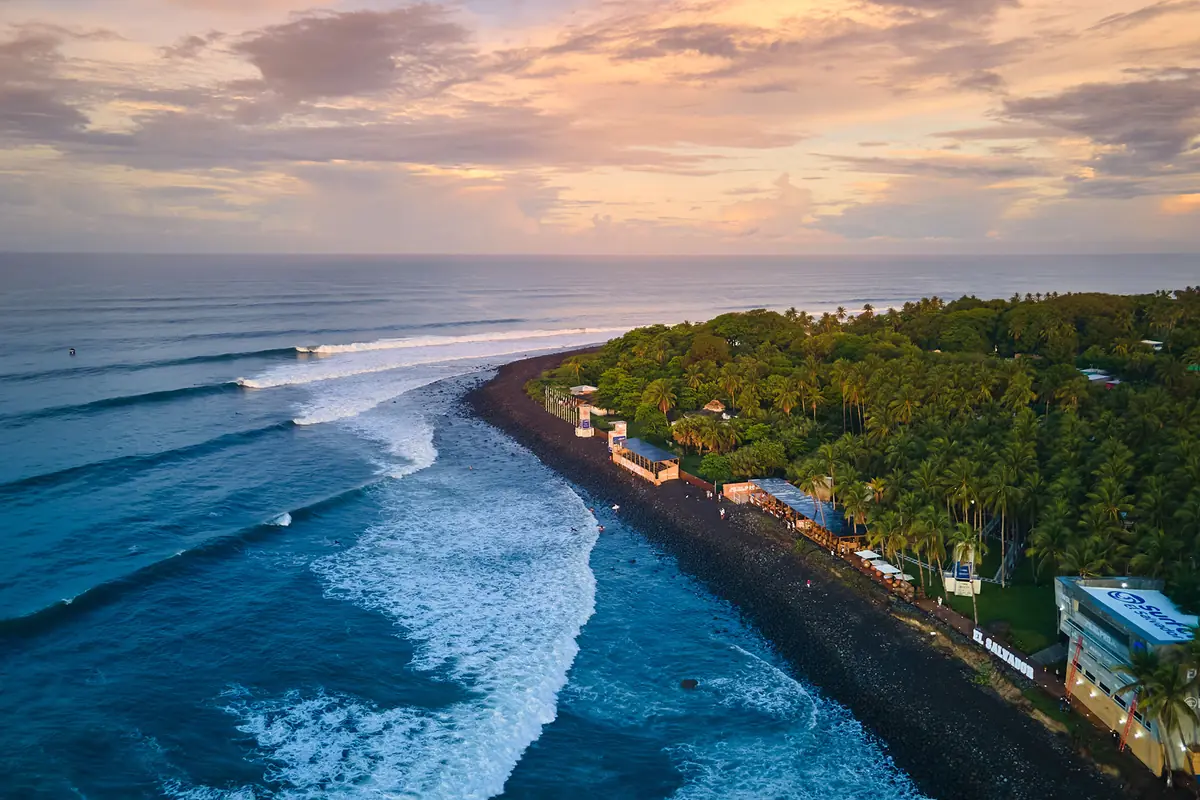
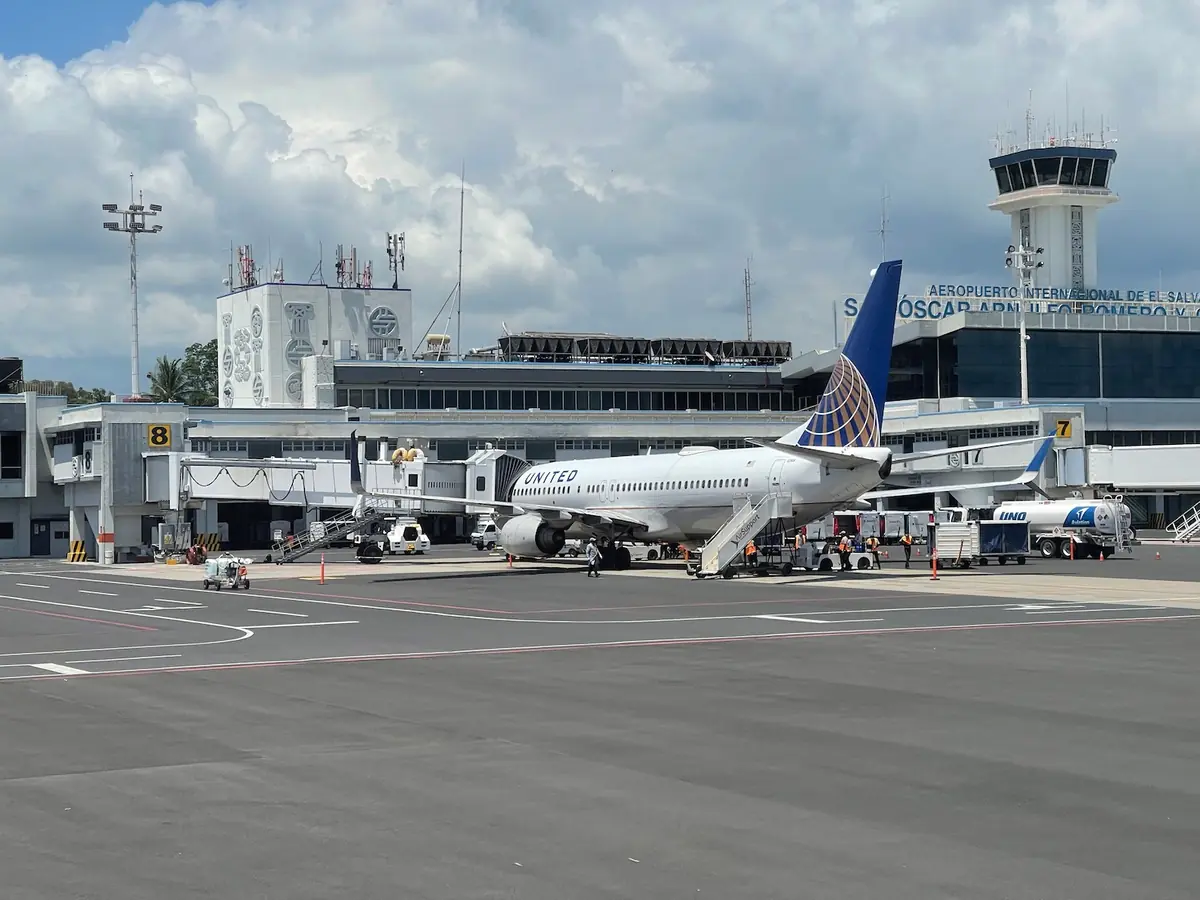
San Salvador Airport, officially El Salvador International Airport San Óscar Arnulfo Romero y Galdámez (IATA: SAL, ICAO: MSLP), is Avianca’s Central American hub and the country’s only commercial airport, sitting in San Luis Talpa about 27 miles southeast of the capital and roughly 25 miles from the surf breaks at El Tunco.
Two things have changed here recently, and most guides still get both wrong. First, the $12 tourist card fee that Americans paid at immigration for years no longer exists. Second, a brand-new arrivals terminal opened in June, and it moved the entire arrivals experience into a bigger, faster building with a dedicated surfboard carousel.
This guide walks the airport in the order you’ll actually experience it: landing, immigration, baggage, customs, ground transport, and then everything you need on the way back out.
San Salvador Airport at a glance (SAL / MSLP)
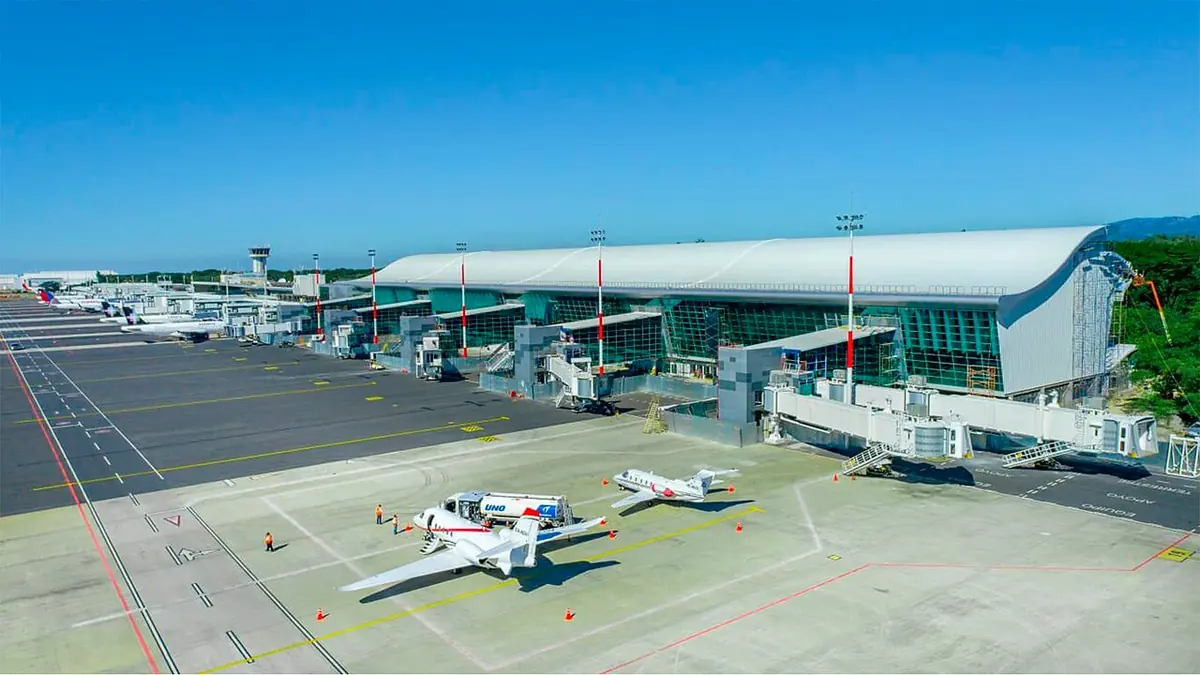
SAL is a single-terminal international airport operated by CEPA (Comisión Ejecutiva Portuaria Autónoma), handling around 6,000 passengers a day with no domestic scheduled service.
| Detail | Information |
|---|---|
| Official name | Aeropuerto Internacional de El Salvador San Óscar Arnulfo Romero y Galdámez |
| Codes | IATA: SAL / ICAO: MSLP |
| Location | San Luis Talpa, La Paz department |
| Distance to San Salvador | About 27 miles (44 km), 40–45 minutes |
| Operator | CEPA |
| Terminals | One passenger terminal, single concourse |
| Main runway | 07/25, 10,499 ft (3,200 m) |
| Elevation | 102 ft |
| Hub for | Avianca El Salvador, Volaris El Salvador |
| Passenger volume | More than 5.2 million passengers in 2025 |
| Currency | US dollar |
A few practical implications of that table. The single-concourse layout means you cannot get badly lost, and connections as short as 40 to 60 minutes are physically doable if you stay airside. The airport is also open 24 hours, which matters if you land on a late Avianca bank or leave on a 5 a.m. departure. And because El Salvador uses the US dollar, there is no currency exchange step at all — the bills in your wallet work the moment you walk out the door.
Note that you may see the airport referred to as Comalapa or Cuscatlán in older booking systems and travel forums. Those are legacy names for the same place.
What’s new: the expanded arrivals terminal
CEPA opened a new arrivals terminal on June 23, a $50 million expansion built in eight months and financed out of the port authority’s own revenues rather than external debt.
The scale is meaningful for a country this size. The new hall covers more than 258,000 square feet (24,000 m²) and is designed to process up to 4,500 passengers per hour. Check-in service points went from 82 to 122. Baggage handling capacity jumped from 6,000 to 16,500 bags per hour, which CEPA president Federico Anliker described as the highest throughput in the region. The first flight processed through the new building was an American Airlines arrival from Miami carrying 172 passengers.
What you’ll notice as a traveler:
- Faster bag screening. Orion dual-view scanners inspect luggage in seconds, and the customs directorate uses a robotic assistant that can confirm or rule out suspicions about substances in minutes rather than pulling you aside for a long manual search.
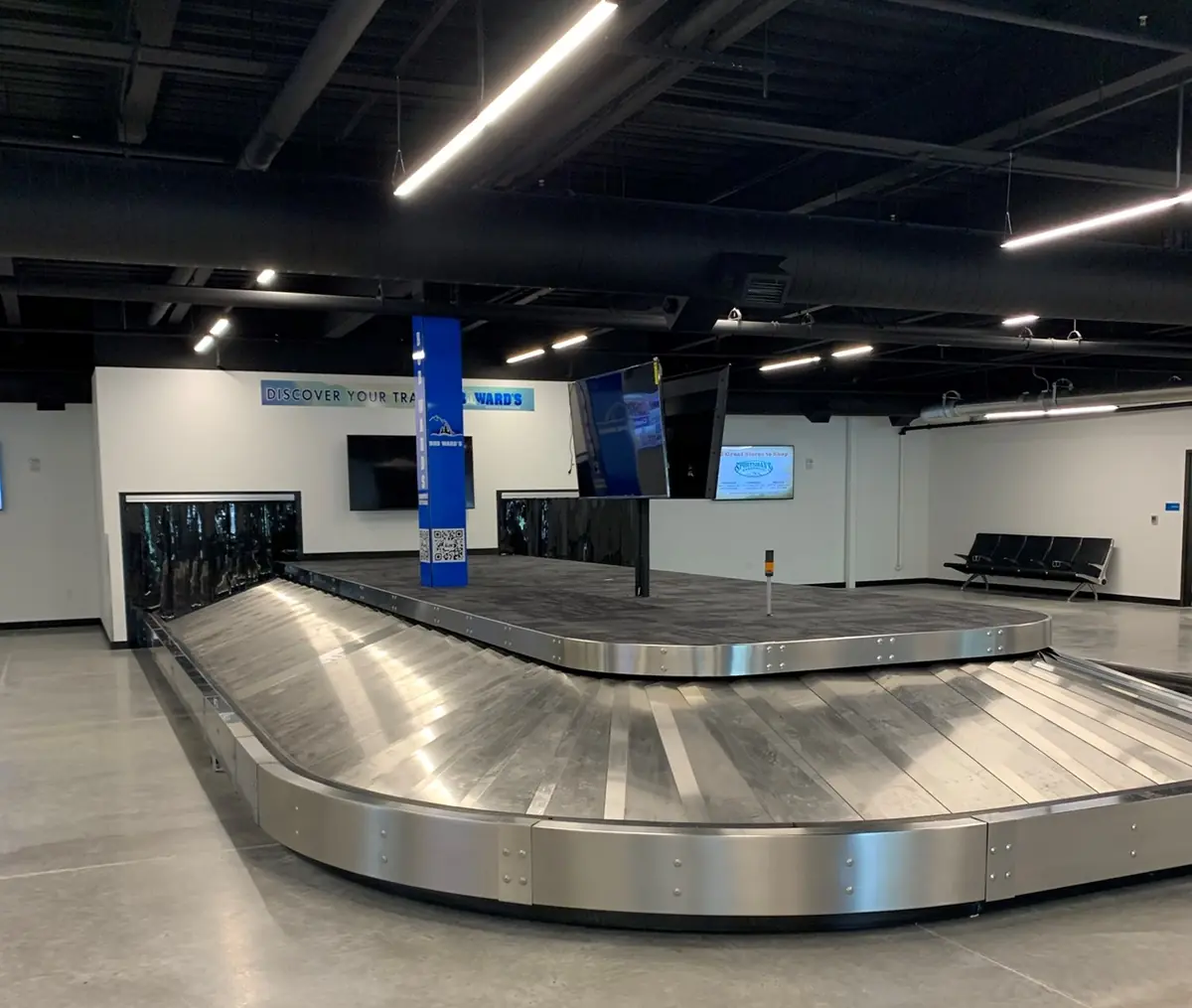
- A dedicated surfboard carousel. This is a first in Central America and a direct nod to Surf City tourism. Boards no longer come out on an oversize belt in a back corner.
- Family and accessibility lanes. Families can complete a single unified check-in instead of registering each traveler separately, and there are dedicated lanes for children, seniors, and passengers with reduced mobility. The terminal is also pet-friendly.
- A stated 30-minute target. International standards average about 45 minutes from disembarkation to exiting the terminal; the new layout is built to cut that to roughly 30.
The expansion is one piece of a portfolio exceeding $320 million. Six new boarding gates, a four-level parking structure, and additional cargo and hangar infrastructure are in progress, backed in part by a $195 million modernization loan from the Inter-American Development Bank approved in November 2025. Expect construction hoarding and occasional signage changes in the terminal for the next several years.
Entry requirements for US citizens
US citizens need a passport book and nothing else for stays up to 90 days. No visa, no advance application, and no tourist card fee.
Do you still pay the $12 tourist card fee?
No. El Salvador’s Legislative Assembly eliminated the $12 Migratory Entry Card fee (Tarjeta de Ingreso Migratorio, or TIM) on April 30, 2025 by a 56-vote margin, derogating Article 328 and striking the charge from Article 325 of the Ley Especial de Migración y Extranjería. The reform was published in the Diario Oficial on May 5, 2025 and took effect on May 13, 2025.
This is the single most outdated fact in circulation about SAL. Visa-service sites, tour operators, and even US government pages have been slow to catch up, and travel.state.gov still described a $12 tourist card at the time of writing. The fee is gone as a matter of Salvadoran law.
One practical caveat: a small number of front-line officers have occasionally applied the old rule out of habit, and the booth where the fee was once collected still exists in some travelers’ memories of the layout. Carry $12 in small bills as cheap insurance. Do not volunteer it, and do not pay anyone who approaches you outside the immigration line. Travelers born in El Salvador were always exempt and can present a DUI or a parent’s Salvadoran passport.
Passport, CA-4, and the 90-day stay
You need a passport book. A passport card is not valid for air travel and will not get you on the plane. El Salvador requires validity at the time of entry rather than the six-month buffer some countries demand, but airlines apply their own rules inconsistently, so aim for at least six months of remaining validity and one blank page.
El Salvador belongs to the Central America-4 Border Control Agreement alongside Guatemala, Honduras, and Nicaragua. The 90 days you receive on arrival are shared across all four countries, not reset at each border. If you plan a longer Central America loop, count your days across the region, not per country. Overstaying triggers fines and paperwork on exit.
What immigration actually asks
Officers are generally brief, but they can ask for proof of onward travel and where you’re staying, and occasionally for proof of sufficient funds. Have a screenshot of your return flight and your first night’s hotel or rental booking on your phone before you land, because the customs and immigration area is a cell dead zone until you exit the building. A printed copy costs nothing and solves the problem entirely.
Immigration and customs, step by step
The arrival sequence at SAL is short: passport control, baggage claim, then a customs button that randomly selects bags for screening.
- Disembark and follow signs for Migración. On wide-body arrivals from Miami, Houston, or Los Angeles, walk briskly — the line grows fast when two flights land together.
- Present your passport at immigration. Expect a question or two about the purpose of your trip and how long you’re staying. There is no fee to pay and no card to fill out.
- Collect your bags. Surfboards now have their own dedicated carousel; check the overhead monitors rather than assuming an oversize door.
- Press the customs button. Green means walk straight through. Red means your bag goes through a scanner. It is random, it is quick, and it is not a signal that anything is wrong.
- Exit into the arrivals hall, where drivers, taxi staff, and rental counters are waiting.
How long does it take? Historically, an hour was normal at SAL during peak arrival banks. Recent traveler reports since the expansion put it closer to 30 minutes or less on off-peak arrivals, and CEPA is explicitly targeting sub-30 minutes. Build 45 to 60 minutes into your plan anyway if you have a driver waiting or a tight onward connection at the coast.
One thing to know before you clear customs: the moment you step out, you’ll be within reach of drivers offering rides. Officially certified taxi staff wear identification and work from a fixed-fare desk. Anyone freelancing inside the hall or in the walkway is not the certified option, and that is where the airport’s very small pool of tourist scams lives.
Getting from SAL to San Salvador, El Tunco, and beyond
You have four realistic options out of SAL: a certified fixed-fare taxi, Uber, a pre-booked private transfer, or a public bus. For most first-time American visitors heading to the coast, a pre-booked transfer or Uber is the sweet spot.
| Destination | Distance | Drive time | Uber | Certified taxi / private transfer | Bus |
|---|---|---|---|---|---|
| San Salvador (city center) | 27 mi | 40–45 min | $20–25 | $30–40 | Under $2 (Route 138) |
| El Tunco / Surf City | 25 mi | 35–45 min | $25–35 | $30–50 | $1–2 with a transfer |
| El Zonte | 32 mi | 50–60 min | $30–40 | $40–55 | Not practical |
| Santa Ana | 62 mi | About 1 hr 35 min | $55–70 | $70–90 | $3–5 with transfers |
| Suchitoto | 44 mi | About 1 hr 20 min | $45–60 | $60–80 | $3–5 with transfers |
Fares move with demand, time of day, and fuel prices. Treat these as planning ranges, and expect a surcharge for arrivals between roughly 8 p.m. and 8 a.m.
Certified taxis vs. Uber at SAL
Certified taxis operate from a fixed-fare booth in arrivals. You pay a set price, there’s no negotiation, and the driver is registered with the airport. Look for the “A” designation on the license plate. This is the lowest-friction option after a red-eye.
Uber works at SAL and is usually 20 to 40 percent cheaper, but the pickup mechanics matter. Drivers do not collect at the curb directly outside the doors; you walk out to the designated pickup area in the parking lot. Order the ride only after you’ve cleared customs and reconnected to cell service or the airport Wi-Fi, and match the plate before getting in. Ignore anyone who approaches you inside the terminal offering to “help with your Uber.”
Here’s the part almost nobody mentions: you can usually Uber to the beach, but not back. Driver density at El Tunco and El Zonte is thin, and travelers regularly wait 30 to 60 minutes for a car that never materializes. Arrange your return to the airport through your hotel or a hired driver the day before you fly.
Private transfers and shuttles
Pre-booked private transfers run roughly $30 to $50 one way to the El Tunco area, with some operators quoting well above that for larger vans, late-night pickups, or longer coastal runs to El Cuco and Las Flores. You’ll see quotes as high as $85 for a full 6- to 8-passenger vehicle. The value is in certainty: a driver holding a sign past the customs doors, a fixed price agreed in advance, and no scrambling at 1 a.m.
Shared shuttles are cheaper at roughly $10 to $20 per person but run on fixed departures and wait to fill.
For groups and families, a hired private driver for a full day (commonly $40 to $50 for a one-way coastal run, or a flat daily rate) often beats stacking individual Ubers between stops, and it solves the coverage dead zones at places like Joya de Cerén and the Ruta de las Flores waterfalls.
Rental cars
Hertz, Avis, Budget, Alamo, Europcar, Sixt, Thrifty, and Fox all operate on or near arrivals. Economy cars advertise at roughly $25 to $40 a day, but the advertised rate is not the rate you’ll pay. Salvadoran law requires third-party liability coverage purchased locally, and it can roughly double the daily total. Your credit card’s collision coverage does not substitute for it.
Driving conditions are better than most Americans expect. The airport highway is modern and well maintained, and the Litoral coastal road is straightforward. Two cautions: livestock and pedestrians on rural shoulders after dark, and a zero-tolerance DUI law introduced in December 2024. Do not have a drink and drive.
Public buses
Route 138 links the airport with San Salvador’s Terminal de Oriente for under a dollar. Route 102A serves the coastal corridor toward La Libertad. Buses are the local reality and perfectly usable in daylight, but they’re crowded, slow, and awkward with large luggage or boards. US government personnel are prohibited from using public buses, which is a reasonable signal for a first-time visitor arriving after dark with everything they own.
Money at the airport: dollars, Bitcoin, ATMs, and tipping
El Salvador uses the US dollar as its official currency, so there is nothing to exchange and no conversion math to do.
Bitcoin is a different story than the headlines suggested. The Legislative Assembly stripped Bitcoin of legal-tender status on January 29, 2025 as part of an agreement with the International Monetary Fund. Acceptance is now entirely voluntary, and in practice it is rare outside a handful of businesses in El Zonte and a few tourist-facing spots. Do not plan to pay for anything at the airport with it.
ATMs are available landside near the customs exit and in the arrivals hall. They dispense dollars, they charge fees on top of your bank’s foreign transaction fee, and they’re occasionally out of service. Withdraw enough to cover a couple of days rather than making repeated small pulls.
Cards work at the airport, hotels, and established restaurants. Cash is king everywhere else: pupuserías, buses, beach parking, market stalls, and small surf shops. Break your bills early, because a $50 note is hard to spend at a roadside stand.
Tipping norms are lighter than in the US. Ten percent is common in sit-down restaurants and often already added as a service charge; check your bill before doubling up. A dollar or two for a bag handled at the airport and rounding up for a taxi driver are both appreciated and neither is expected.
Wi-Fi, SIM cards, and eSIM at SAL
The airport has free Wi-Fi, but buy an eSIM before you fly. No tourist eSIMs are sold at SAL, and the customs hall has no cell signal until you exit.
| Option | Typical cost | Where to get it | Setup time |
|---|---|---|---|
| eSIM (Airalo, Saily, Nomad, Holafly) | $1–15 depending on data | Buy online before departure | Minutes, done at home |
| Airport SIM (Tigo, Claro) | $7–15 with tourist markup | Kiosks in arrivals | 10–15 min, passport required |
| City SIM | $7–10 | Tigo/Claro stores in San Salvador | 10–15 min, passport required |
Physical SIM activation requires registering your passport, which is a legal requirement and not a sales tactic. Kiosk staffing gets patchy after about 10 p.m., so a late arrival can easily mean no local number until the next morning.
Coverage is solid 4G in San Salvador and the main tourist corridor, patchier on volcano approaches and along the far eastern coast. Real 5G is close to nonexistent regardless of what the marketing says.
The practical move: activate an eSIM before you board, keep airplane mode on until you clear customs, and you’ll have working data the second you walk out to the Uber pickup area.
Lounges, food, and amenities
SAL has four lounges, all airside, and the two Aeroconnections locations accept both Priority Pass and Amex Platinum.
Lounges and how to get in
| Lounge | Location | Access | Showers |
|---|---|---|---|
| Aeroconnections VIP Lounge | Airside, past security and immigration, turn left | Priority Pass, Amex Platinum, day pass around $35 | Yes |
| Aeroconnections VIP Lounge 2 | Second floor, toward the far end of the concourse | Priority Pass, Amex Platinum, day pass | Yes |
| Avianca Sala VIP | Airside, mid-concourse | Avianca premium cabins, LifeMiles elite | Yes |
| Ambaar Lounge | Airside near the far gates, plus a landside location | Pay at door, some card programs | Limited |
Gate numbering has shifted with the terminal work, so follow signage rather than a gate number you read in an older review. Two Aeroconnections house rules catch Americans out: complimentary alcohol is capped at three drinks per adult, and shorts are not permitted. Private nap rooms are available for an extra fee at the front desk, which is worth knowing on a long overnight connection.
Food, coffee, and duty-free
The concourse has cafés, a handful of sit-down restaurants, bars, duty-free, and souvenir shops. Prices are airport prices, but the coffee is the exception: El Salvador grows genuinely excellent high-altitude arabica, and a bag from an airport shop is one of the few duty-free purchases that beats what you’d find at home. Buy whole bean, not pre-ground, and check that it’s Salvadoran rather than a regional blend.
If you have an hour before boarding and want one last local meal, look for pupusas rather than a burger. Olocuilta, the pupusa capital, is minutes from the airport on the highway, and its influence reaches the terminal food court.
Showers, sleeping, storage, and accessibility
Showers are available in the Aeroconnections and Avianca lounges. The terminal is open 24 hours and overnight sleepers are confined to the main hall, which is guarded but bright and not especially comfortable — bring an eye mask. Luggage carts are available in arrivals, and an information desk is staffed near the exit. The new arrivals building was designed to universal accessibility standards with dedicated lanes for passengers with reduced mobility, seniors, and families with young children.
Layovers and overnight connections
The rule of thumb at SAL: under four to five hours, stay airside. Five hours or more, it’s worth leaving.
If you’re connecting on a single international ticket, your bags are checked through and you never clear immigration — you stay airside, walk the single concourse, and re-board. Travelers routinely make connections in under an hour this way, though a 90-minute buffer is more comfortable if you’re changing between an Avianca regional flight and a US carrier.
Leaving the airport means clearing immigration and customs on the way in and going back through security on the way out. Budget 45 to 90 minutes of pure process time round trip, then decide what’s left. With five or more hours, three things are genuinely reachable:
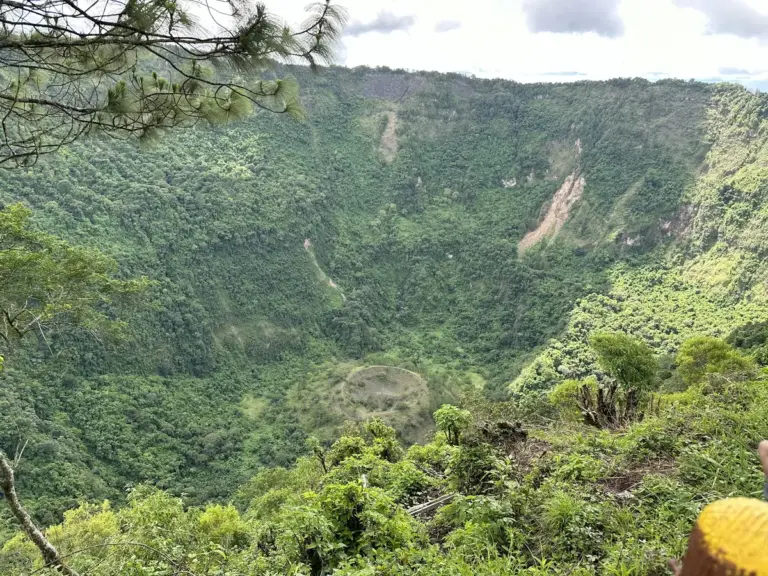
- El Boquerón, the crater of San Salvador volcano, with park entry around $2 and roughly an hour’s drive.
- Olocuilta’s pupusa stands, 10 minutes away, for a legitimately great meal.
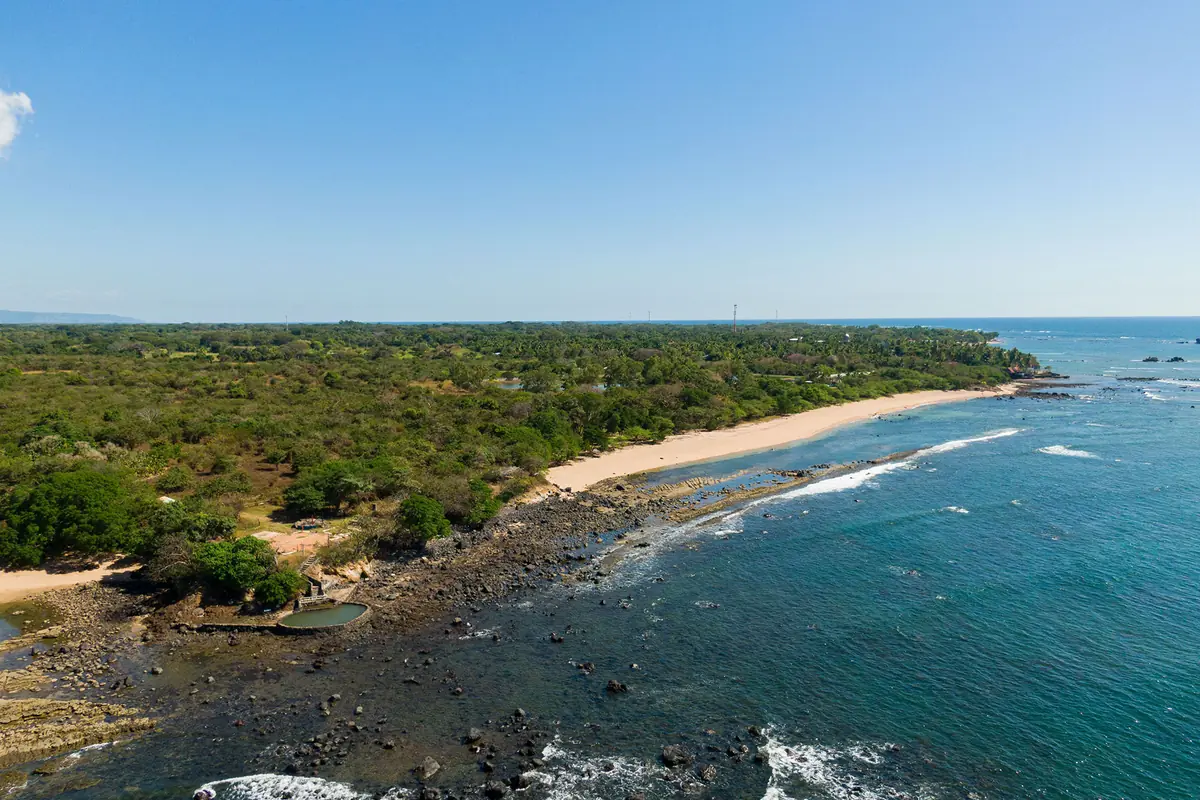
- El Tunco or the closer stretch of La Libertad coast, 35 to 45 minutes out, if you just want to stand on black sand for an hour.
For overnight connections, Quality Hotel Real Aeropuerto sits about two to three miles from the terminal and runs a free shuttle roughly every 30 minutes from early morning to late evening. Confirm the last pickup when you book, because the shuttle does not run all night and a taxi at 2 a.m. costs more than the convenience is worth.
US nonstop routes and airlines serving SAL
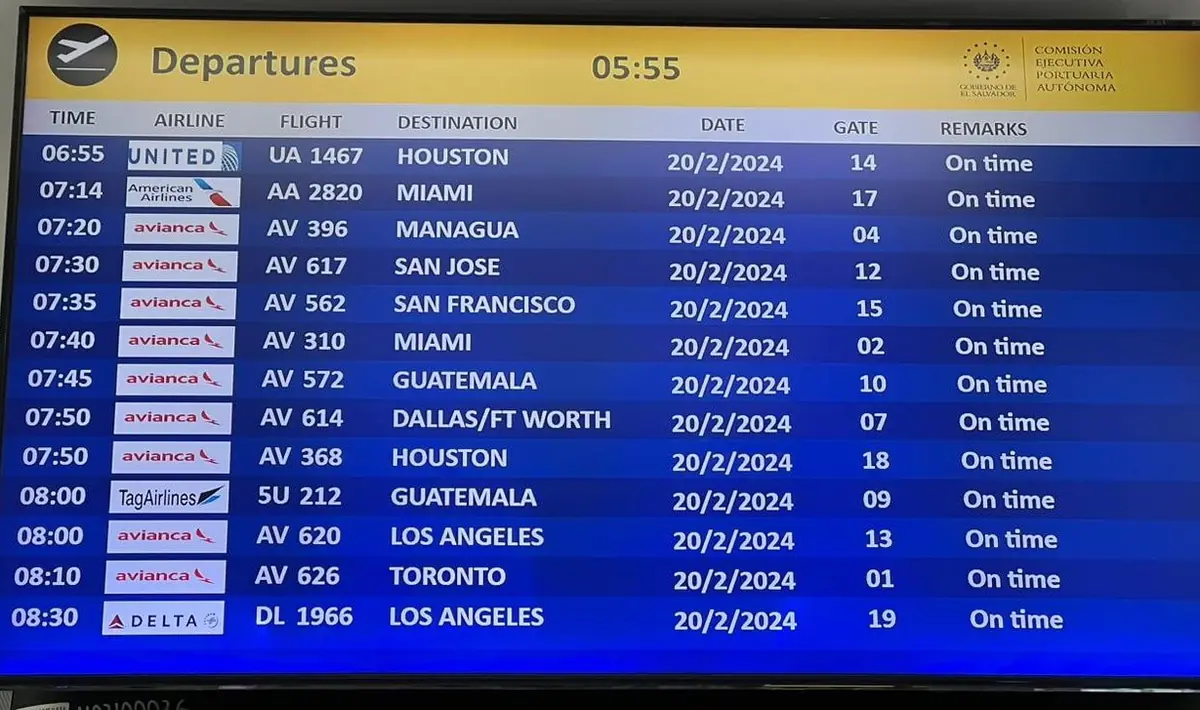
SAL is Avianca’s Central American hub, and it connects nonstop to roughly a dozen US gateways. Los Angeles, Houston, and Washington were the airport’s top US destinations by traffic in 2025.
| US gateway | Airlines | Approx. nonstop time |
|---|---|---|
| Houston (IAH) | United, Avianca | 3h 15m |
| Miami (MIA) | American, Avianca | 2h 40m |
| Los Angeles (LAX) | Avianca, Volaris El Salvador | 5h |
| Atlanta (ATL) | Delta, Avianca | 3h 20m |
| Dallas–Fort Worth (DFW) | American, Avianca | 3h 30m |
| Washington (IAD) | Avianca | 4h 30m |
| New York (JFK/EWR) | Avianca | 4h 45m |
| Fort Lauderdale (FLL) | Spirit, Frontier, Avianca | 2h 50m |
| Boston (BOS) | Avianca | 5h |
| Chicago (ORD) | Avianca | 4h 45m |
Houston is the busiest link, with roughly 38 departures a week between IAH and SAL. Orlando and San Francisco appear seasonally, and Copa connects SAL to the rest of the Americas through Panama City. There are no domestic scheduled flights within El Salvador, so SAL is the arrival point regardless of where you’re headed in the country.
Booking notes worth knowing. Avianca’s basic fares do not include a checked bag or seat selection, and the airline enforces carry-on sizing more strictly than US carriers. Spirit and Frontier are frequently the cheapest way in from Florida, but the fare difference disappears once you add a bag and a board. If you’re bringing surf equipment, compare total cost with equipment fees included before you book on price alone.
Departures: timing, security, exit tax, and the US return
Arrive two hours before a short-haul flight and three hours before a long-haul departure. There is no separate departure tax to pay in cash.
The old $40 exit tax that travelers remember is now bundled into your ticket price, so nothing is collected at the airport. Check-in for US-bound flights opens three hours out, and the morning Avianca bank between roughly 5 a.m. and 8 a.m. is the busiest window of the day. If you’re flying then, the extra half hour is worth it.
Security is a single checkpoint after check-in and immigration, and it’s a standard international screening: liquids in a quart bag, laptops out, shoes generally stay on. Once through, you’re on the single concourse with the lounges, shops, and gates.
Two things Americans frequently assume incorrectly. There is no US Customs and Border Protection preclearance at SAL, so you’ll clear US immigration on arrival in the States, not before you board. And Global Entry, Mobile Passport Control, and TSA PreCheck have no effect at SAL — they matter only when you land back home. Global Entry is still worth having for the return, especially if you’re connecting domestically at Houston or Miami with a tight window.
If you’re departing at dawn, arrange your ride the night before. Uber coverage at 3 a.m. on the coast is unreliable, and hotels near the beach will book a driver for you at a fixed price.
Is San Salvador Airport safe?
Yes. The US State Department placed El Salvador at Level 1, Exercise Normal Precautions, on April 8, 2025 — its safest tier, the same rating held by Japan and Iceland, and a level above France, Germany, and the United Kingdom.
The numbers behind that call: El Salvador recorded 1.9 homicides per 100,000 inhabitants in 2024, down from 2.4 the year before, with 114 homicides nationally. That is one of the lowest rates in the Western Hemisphere and below most large American cities.
The airport corridor specifically is among the safest routes in the country. A useful proxy: US government personnel are restricted from traveling between cities after dark, with the route between San Salvador and the international airport, and between San Salvador and La Libertad, explicitly carved out as permitted. Those are exactly the two roads most visitors use.
Practical precautions are ordinary ones. Use certified taxis or Uber rather than unmarked cars. Don’t accept help from anyone who approaches you inside the terminal. Keep bags in the trunk, not on the back seat, in city traffic. Avoid intercity travel and public buses after dark, mostly for road-safety reasons rather than crime. And use ATMs inside the terminal or a bank branch rather than standalone machines on the street.
Two pieces of context worth understanding. El Salvador has been under a State of Exception since March 2022, which suspends certain constitutional protections and has drawn sustained criticism from human rights organizations; it has essentially no visible effect on tourists but you’ll see a significant military and police presence, including at the airport. And navigation apps occasionally route drivers through neighborhoods you’d rather skip in pursuit of a faster line — stick to the main highways.
Best time to fly into SAL
The dry season runs November through April and delivers the most reliable weather. The wet season, May through October, brings afternoon storms and the biggest surf of the year.
| Period | Weather | Crowds and prices | Best for |
|---|---|---|---|
| November–February | Dry, highs in the mid-80s°F, low humidity | Moderate, spiking at Christmas | Volcano hiking, Ruta de las Flores, first-time visitors |
| March–April | Hot and dry, highs near 90°F | Peak during Semana Santa | Beach time, festivals |
| May–August | Afternoon rain, humid | Lower except early August | Surf, green landscapes, lower rates |
| September–October | Heaviest rain | Lowest of the year | Bargain flights, consistent swell |
Three windows to book early or avoid. Semana Santa (Holy Week, late March or April) is the country’s biggest domestic travel week and the coast fills completely. Fiestas Agostinas in early August is a national holiday period with similar pressure. And mid-December through New Year’s brings the diaspora home in volume, which fills flights from Los Angeles, Houston, and Washington months ahead.
For surfers, the calculus inverts. May through October produces the most consistent south swells, and the rain typically arrives in the late afternoon after the morning session. That’s also when flights and beach hotels are cheapest.
Flying with surfboards, kids, and pets
Board bags are the reason many Americans fly into SAL, and they’re the single biggest variable in your total ticket cost.
Avianca charges roughly $120 when you pay online in advance and about $150 at the airport for a board bag holding up to three boards, with limits around 70 lb and 90 inches. American Airlines treats boards within standard checked-bag dimensions at ordinary bag rates, roughly $40, with a heavier-bag surcharge that can reach $150 in the 51-to-70-lb range. United’s economy surfboard pricing is among the least friendly, though business-class passengers generally carry boards without an equipment fee. Policies change; confirm on the airline’s page the same week you book, and always pre-pay online.
On the ground, boards now come out on their own dedicated carousel in the new arrivals hall, which eliminates the old routine of hunting for an oversize door. Most El Tunco transfer operators have racks or vans that accommodate boards, but say so when you book rather than assuming.
Traveling with kids is easier here than at most Central American airports. The new terminal allows families to complete a single unified check-in and provides a dedicated processing lane, so you’re not shepherding four passports through four separate interactions.
For pets, the terminal is pet-friendly, but the paperwork is the hard part. El Salvador requires a health certificate from a licensed veterinarian and current rabies vaccination, generally issued within a short window before travel and endorsed by the USDA. Start that process at least a month out, and confirm your airline’s live-animal embargo dates, which commonly apply during hot months.
How this guide is maintained
Airport facts in El Salvador move quickly. The tourist card fee changed in 2025, the arrivals terminal opened in June, and further gates, parking, and apron work funded by the IDB will keep changing the layout for several years.
The details here draw on Salvadoran legislative records for the entry-fee reform, CEPA and Inter-American Development Bank announcements for terminal and investment figures, US State Department advisories for safety guidance, airline and lounge program pages for fees and access, and recent first-hand traveler reports for wait times and fares. Prices for taxis, transfers, rentals, and SIM cards are the most volatile figures on this page and are treated as ranges rather than fixed quotes.
Items re-checked on a quarterly basis: entry-fee status against US government wording, ground transport fares, route additions and cuts, terminal construction milestones, the travel advisory level, and lounge hours.