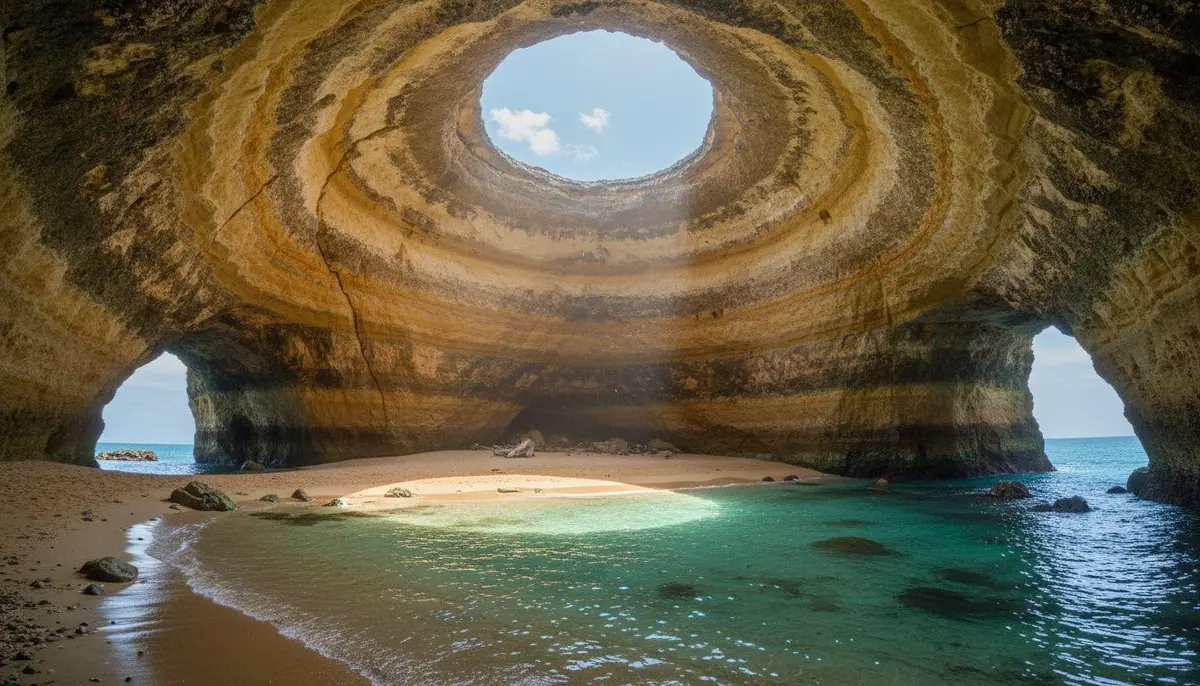
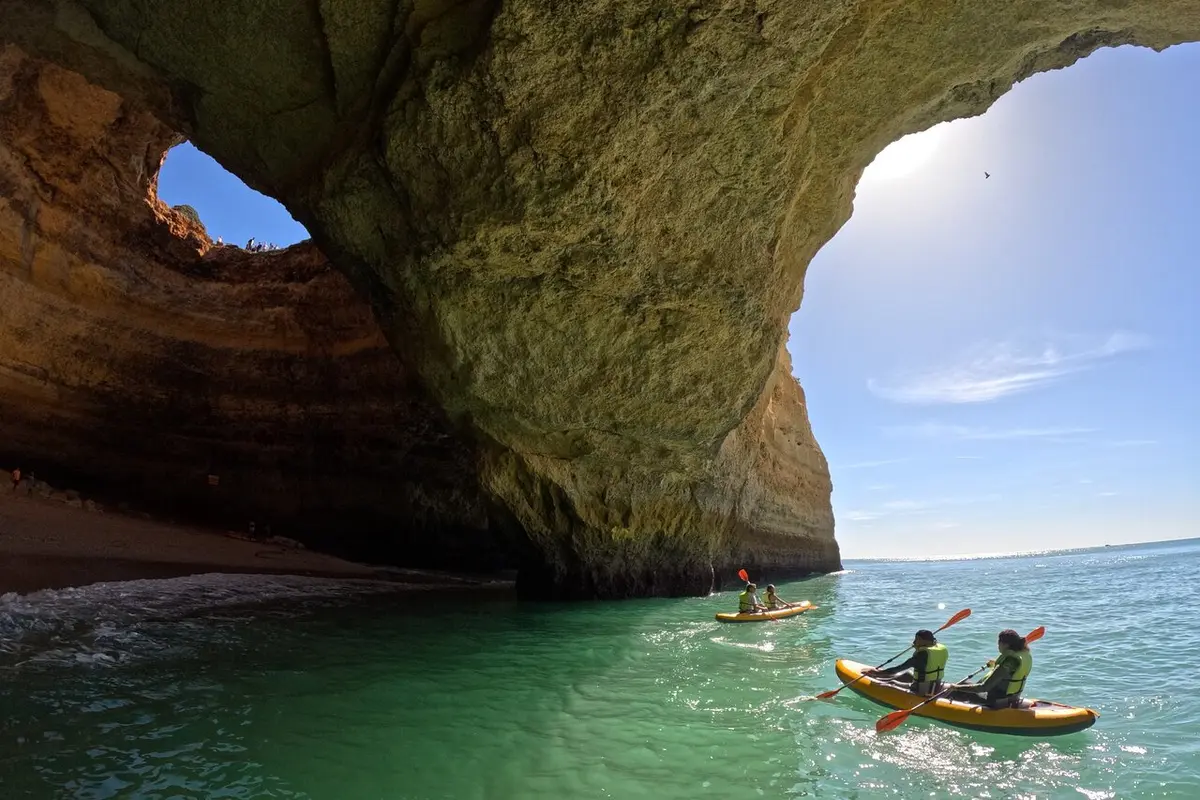
The golden limestone cathedral on Portugal’s Algarve coast — Benagil Cave, the one with sunlight pouring through a hole in its roof onto a tiny interior beach — is real, and it is worth the trip. But how you can visit has changed completely. This guide covers the current access rules, every tour option with honest trade-offs, and a tested day strategy so you spend your time right.
What are the new access rules at Benagil Cave?
You cannot swim, kayak, or paddleboard to Benagil Cave on your own. Portugal’s National Maritime Authority (AMN) implemented strict regulations banning independent water access entirely. Every visit to the cave’s interior now requires a commercial tour with a licensed operator. There is no free way to reach the cave from the water, and enforcement by the Polícia Marítima is active.
Here is what the regulations prohibit:
- Swimming to the cave, with or without flotation devices
- Renting a kayak or SUP and paddling there independently
- Disembarking onto the sandy beach inside the cave — even on authorized tours
- Any maritime activity in the Benagil area from sunset to sunrise
The landing ban is the one that frustrates most visitors. Those viral photos of people standing on the interior beach looking up at the oculus are no longer possible to recreate. The rule protects the fragile limestone from erosion caused by daily foot traffic, and it is not going away — the president of Algarve Tourism confirmed in a review conducted the following summer that the regulations would continue, with only minor adjustments under consideration, such as refining vessel limits inside the cave.
Individual fines for violations can reach up to €2,500 (around $2,700), though authorities have flagged this upper limit as under review. Operator fines run from €300 to €216,000 ($325–$233,000), enforced under Portugal’s Framework Law on Environmental Administrative Offences, since the caves sit within the Parque Natural Marinho do Recife do Algarve.
Pro Tip: Before booking, verify the tour operator’s RNAAT license number — the Turismo de Portugal registration that all legitimate maritime operators must display. Unlicensed sellers in Albufeira and Portimão still push “Benagil tours” that either don’t enter the cave or operate illegally.
How do you get to Benagil Cave?
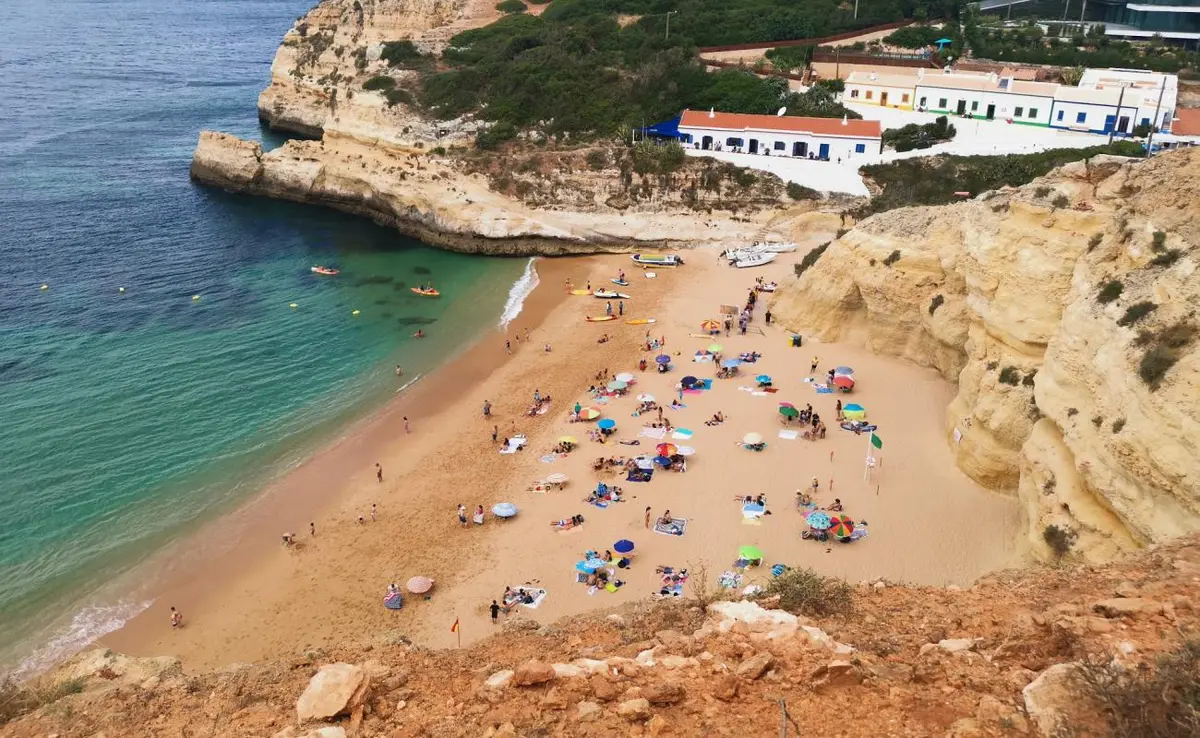
Most visitors reach Benagil by rental car or rideshare, and driving in Portugal for the first time means navigating a few local quirks. The village sits at the bottom of a steep, narrow valley on the Algarve coast near Lagoa, roughly 30 minutes from Portimão and 40 minutes from Albufeira. Public bus Route 77 runs from Lagoa on weekdays only, but its two-departure-per-day schedule leaves little flexibility. Rideshare from Portimão is the practical budget option.
Driving and parking
Benagil village sits at the bottom of a steep valley, and the final approach involves narrow, winding roads that feel genuinely tight if you are used to wide American highways. The village road width is roughly 12 feet (3.7 m) in places — two cars passing requires someone to pull into a lay-by. Most rental cars in Portugal have manual transmissions; if you plan to rent a car in Portugal, book an automatic at least three to four months in advance and expect to pay roughly double the daily rate.
Forget driving all the way to the beach. The few spots near the marina are reserved for residents and fishermen and are typically full by 8:00 AM. The best option is the large, free public parking area on the plateau above the village:
- Walk to beach: 5–7 minutes downhill
- Return trip: 10–15 minutes uphill — strenuous in midday heat
- Mobility note: The terrain involves a significant elevation change; anyone with limited mobility should plan accordingly
The A22 highway across the Algarve uses electronic tolls with no booths. Activate the Via Verde transponder system through your rental agency before driving it, or you will face a convoluted post-trip payment process at Portuguese post offices.
Public transport and ride-sharing
The Vamus Algarve bus system offers Route 77, connecting Lagoa to Benagil and Praia da Marinha. The schedule is sparse — only two morning departures and two afternoon returns on weekdays, with no weekend service — which leaves little flexibility if your tour runs late or you want to linger.
Uber and Bolt are the practical alternative:
- From Albufeira: €30–40 ($32–43), roughly 30 minutes
- From Portimão: €15–20 ($16–22), roughly 20 minutes — best value for rideshare
- From Lagos: €25–35 ($27–38), roughly 40 minutes
Yes, it costs more than the bus. But door-to-door service without schedule constraints makes a real difference when you are juggling tour times and meal plans.
Pro Tip: Book your return Uber from inside the village before you head down to the beach, not after. Cell signal at the bottom of the valley can be poor, and surge pricing kicks in around 5:00 PM when everyone tries to leave at once.
Which Benagil Cave tour is right for you?
For most visitors, a guided kayak tour offers the best balance of access, atmosphere, and value — you enter the cave at water level with no engine noise and more time to hold position inside. If physical effort is a concern, a RIB gets you there faster with less work. Catamarans are the most comfortable option but cannot enter the cave.
All four options below are legal, regularly operated, and allow you to view the cave interior. What differs is how close you get, how much effort is involved, and how much you pay.
Rigid inflatable boat (RIB) tours
These fast, agile speedboats carry 10–12 passengers and navigate directly into the cave. RIB tours typically depart from marinas in Portimão, Albufeira, or nearby Ferragudo.
- Location: Varies by operator — Portimão Marina and Ferragudo are closest to the cave
- Cost: €18–50 ($19–54) per person, depending on departure point and group size
- Best for: Travelers who want quick cave access with minimal effort
- Time needed: 1.5–3 hours depending on departure marina
The ride gets you close visual access to the cave interior, and transit is quick — often 30–45 minutes from departure to cave. Captains are skilled at timing the swell to enter safely, and most tours include additional grottoes and rock formations along the coast.
The trade-off is physical. These boats slam against Atlantic swells, creating a jarring ride that is not suitable for anyone with back problems or pregnancy. Engine noise is constant, ocean spray is guaranteed even on calm days, and the risk of seasickness is real. On a rough day — anything above 3 feet (1 m) of swell — the ride is more about surviving than sightseeing.
Pro Tip: Request a seat at the center-rear of the RIB where pitch and roll are minimized. If you are prone to motion sickness, take medication an hour before departure and skip a heavy meal beforehand.
Guided kayak tours
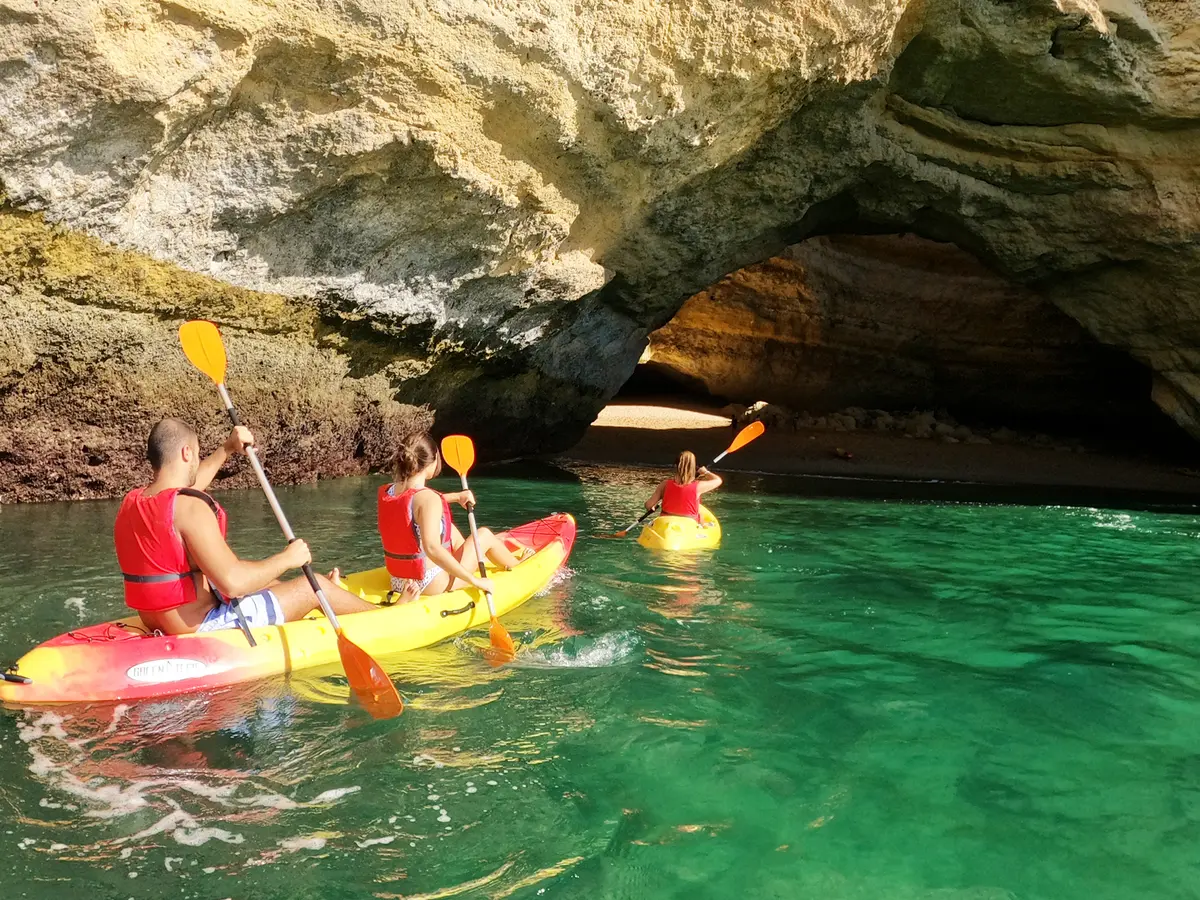
Kayak tours depart from Benagil Beach or nearby Albandeira and Carvalho beaches. Since there are no engines, you can hear the cave’s acoustics — the deep resonance of water against limestone — in a way that no boat tour replicates.
- Location: Departure points vary; Benagil Beach and Albandeira Beach are most common
- Cost: €26–40 ($28–43) per person for a standard 2-hour tour
- Best for: Active travelers, photographers who want to linger, anyone wanting a quieter experience
- Time needed: 1.5–2.5 hours
Guides maintain a ratio of one professional per six vessels under current regulations. Life jackets and tow lines are mandatory. Most operators use stable sit-on-top double kayaks designed for beginners, so you do not need prior kayak experience. The lack of engine noise means you can hold position inside the cave longer than a RIB — better for photos, and genuinely more atmospheric.
The cost is physical effort. You are the engine. Upper body fatigue is real on longer tours, particularly paddling back into a headwind. There is a high likelihood of getting wet. For non-swimmers, the experience can trigger anxiety even with life jackets and professional supervision.
On my last visit, the 7:00 AM departure put us inside Benagil Cave with one other kayak — a completely different experience from the midday scrum of a dozen boats.
Large catamaran cruises
These resort-style vessels offer the most comfortable experience on the water, often including toilets, bars, and shaded seating.
- Location: Departures from Portimão, Albufeira, Vilamoura, and Lagos marinas
- Cost: €25–50 ($27–54) per person, including amenities and sometimes food
- Best for: Families with young children, elderly travelers, anyone with severe motion sensitivity
- Time needed: 3–7 hours for full-day options
The stability dramatically reduces seasickness risk. Many cruises include swim stops at other beaches and food or drink service. You will not get wet unless you choose to during designated swim breaks.
Here is the critical limitation: catamarans are too large to enter Benagil Cave. You will view it from roughly 165 feet (50 m) offshore, not from inside. This is where many travelers feel misled when they do not research vessel type before booking. If getting inside the cave matters to you, a catamaran is not your tour.
Pro Tip: Skip any vendor selling “Benagil Cave catamaran tours” who cannot explain exactly how close the vessel gets. The honest operators will tell you upfront that you view the cave from outside. The ones who dodge the question are selling you a coastal cruise that happens to pass Benagil.
The hiking alternative
Among the most scenic Portugal hiking routes in the Algarve, the Seven Hanging Valleys Trail (Percurso dos Sete Vales Suspensos) offers a view from above rather than from the water — and it is free.
- Location: Trailhead at Praia da Marinha parking lot, or Praia do Vale de Centeanes
- Cost: Free
- Best for: Travelers who want solitude, early risers, photographers working with cliff light
- Time needed: 2–3 hours one way at a comfortable pace
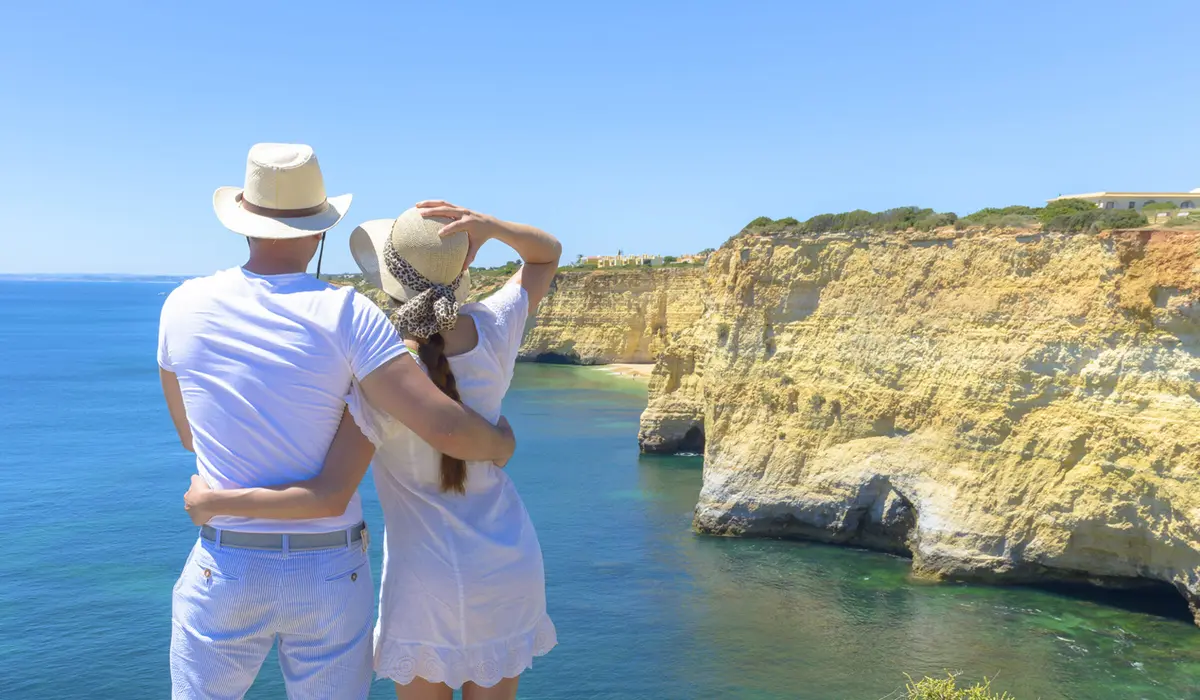
This 3.7-mile (6 km) one-way trail stretches from Praia da Marinha to Praia do Vale de Centeanes, passing directly over the roof of Benagil Cave. A fenced sinkhole — the algar — lets you look down into the cave and watch the boats below. The trail passes through rocky formations, juniper groves, and the limestone cliff edge with a straight drop to the Atlantic.
The terrain demands respect. Rocky and uneven, with several steep staircases descending into and climbing out of ravines, it is rated moderate difficulty. There is minimal shade, making midday summer hiking brutal. Flip-flops are a genuine ankle injury waiting to happen — wear trail shoes. Carry at least 50 oz (1.5 liters) of water per person. The round trip is 7.5 miles (12 km); many hikers walk one direction and take an Uber back. Dedicated walkers seeking a longer coastal challenge can continue west to the Fishermen’s Trail, which follows the Vicentine Coast from Sagres to Vila Nova de Milfontes.
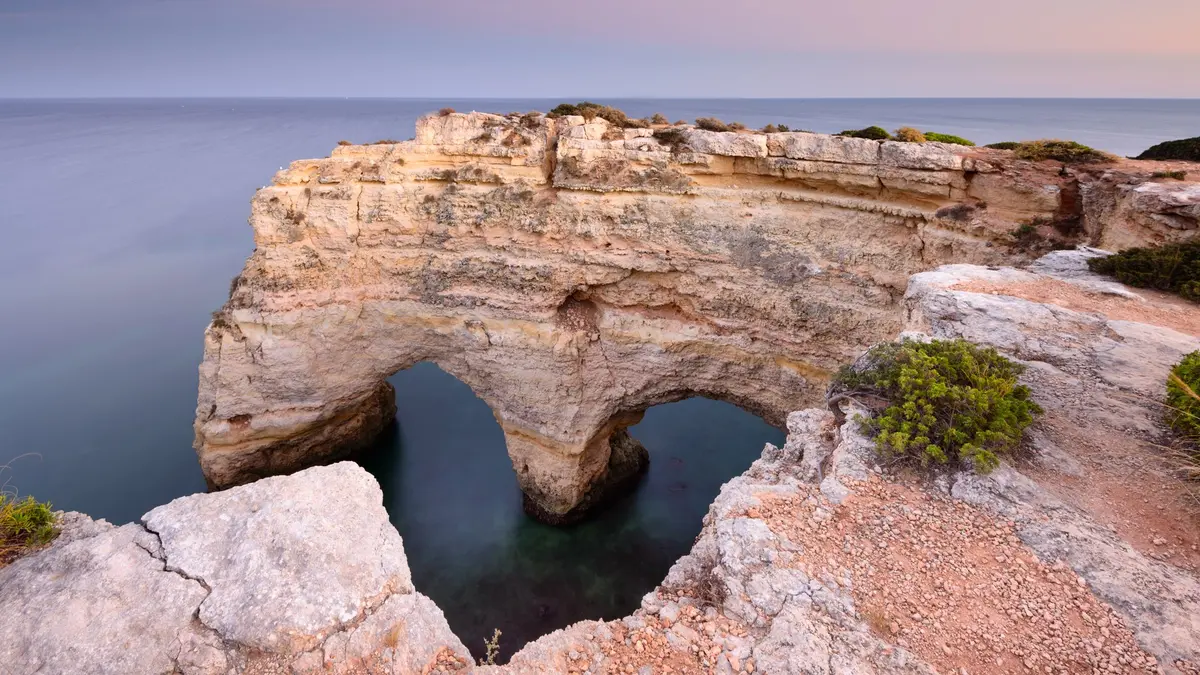
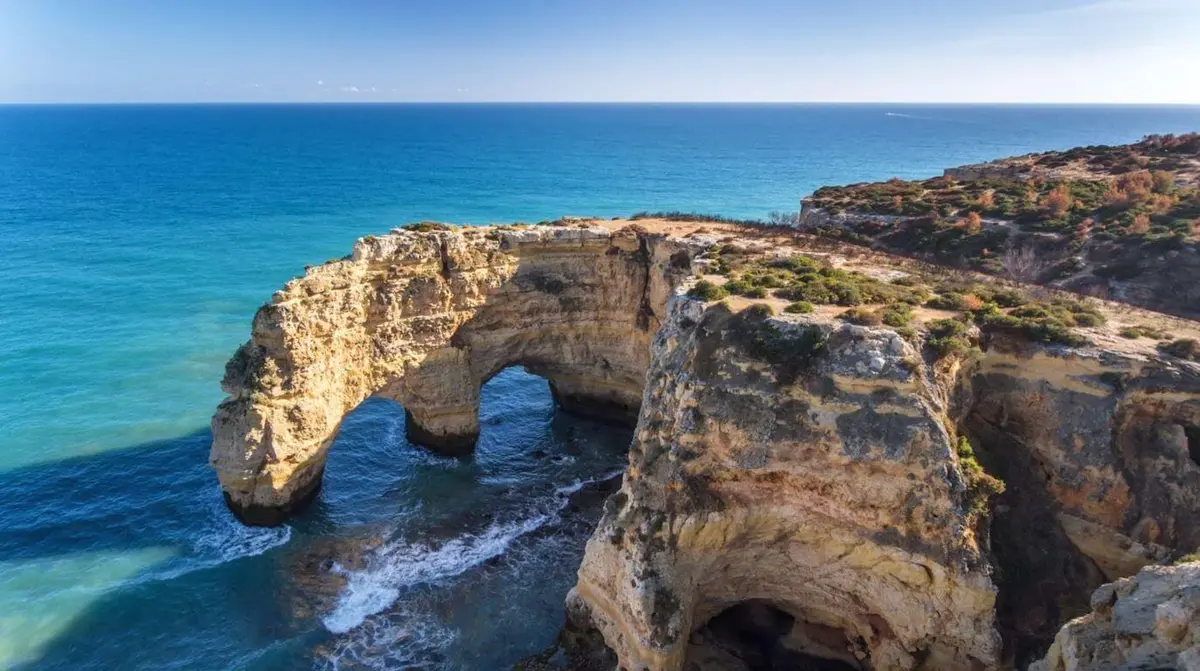
The Heart-Shaped Rock near Praia da Marinha is not actually a single rock. It is an optical illusion created when you align two separate cliff arches to form a perfect heart shape against the ocean. Starting at the Marinha parking lot, walk west staying on the cliff path rather than descending to the beach. The sweet spot is where the path curves inward — position yourself so the near cliff’s V-shape aligns with the inverted arch behind it. Golden hour light, shortly after sunrise or before sunset, makes the limestone glow against deep blue water.
Are there hidden beaches worth visiting nearby?
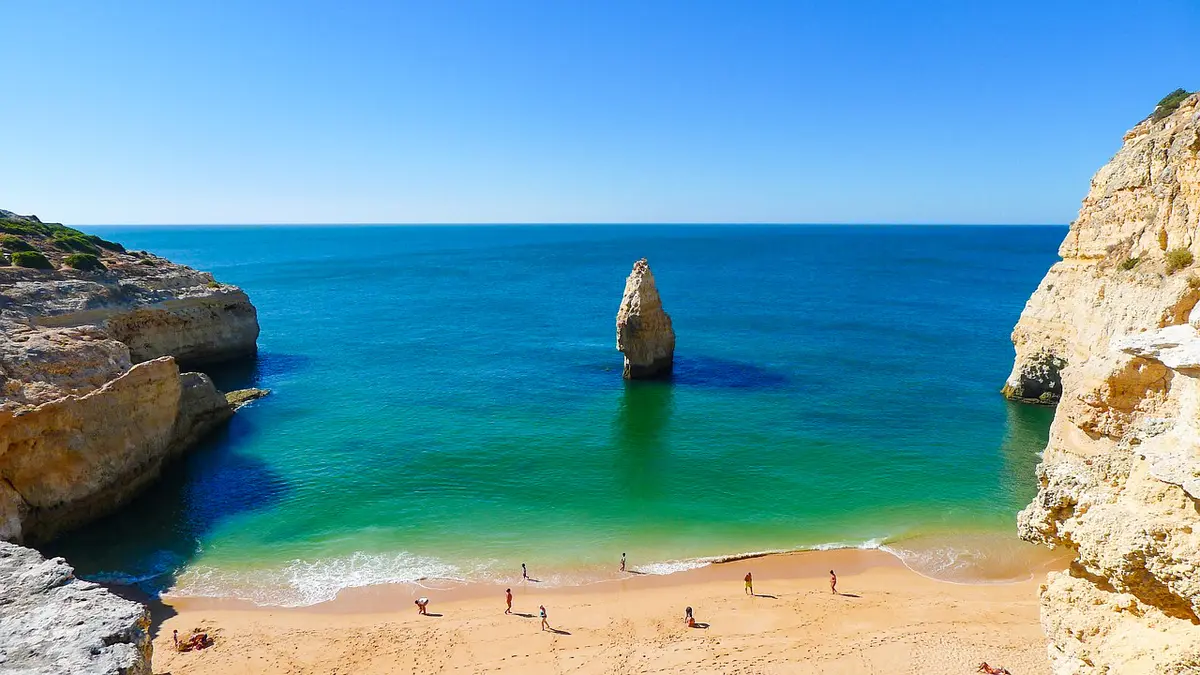
The Benagil coastline has two beaches worth adding to your day. Praia do Carvalho, accessible through a cliff tunnel, gets a fraction of Benagil’s crowds despite being a 10-minute drive away, and delivers calmer swimming conditions. Praia da Marinha anchors the Seven Hanging Valleys Trail and is worth the stop on the way out.
Praia do Carvalho
One of the quieter Portugal beaches along this stretch, Praia do Carvalho sits between Benagil and the Alfanzina Lighthouse and gets passed over by tourists rushing between major sites. The access is what makes it unique: you reach the beach through a man-made tunnel carved directly through the limestone cliff, featuring steep, uneven steps. Local stories connect the hidden cove to pirates and smugglers, and the isolation still feels earned.
- Location: Between Benagil village and Alfanzina Lighthouse, Lagoa municipality
- Cost: Free
- Best for: Curious travelers willing to detour, swimmers wanting calmer water, anyone avoiding peak crowds
- Time needed: 1–2 hours including the beach visit
The sheltered position means calmer water for swimming and a fraction of the crowds found at Benagil or Marinha. The novelty of entering through a cliff tunnel adds to the experience in a way that straightforward beach access never does.
The tunnel descent is challenging for anyone with mobility limitations or claustrophobia, and there are no facilities on the beach itself. During peak summer afternoons the small size limits usable space, so arrive before 11:00 AM or after 4:00 PM.
When is the best time to visit Benagil Cave?
June through August offers the calmest Atlantic conditions, the highest tour reliability, and the dramatic midday light beam — at the cost of maximum crowding. The 7:00 AM to 9:00 AM window in any season gives you the best combination of manageable crowds, softer light, and calmer water. Avoid midday arrivals from June to August unless the light beam is specifically your priority.
Timing for the light beam effect
The sunlight-through-the-oculus effect requires high solar elevation, which happens between 10:00 AM and 4:00 PM. This window coincides exactly with peak crowding. The water inside the cave during those hours can hold a dozen boats and kayaks at once, which eliminates any sense of intimacy.
The strategic compromise: if photography is your priority and you specifically want the dramatic light beam, the midday slot is unavoidable despite the crowds. If atmosphere matters more than the sun-ray effect, book the earliest available tour — 7:00 AM to 9:00 AM delivers soft, diffuse light and near-empty waters.
Tidal considerations
While Benagil Cave is large enough for small boats at most tide levels, exploring adjacent smaller caves often requires low tide. Low tide reveals more sandy areas inside grottoes and allows deeper exploration of rock formations without risking head strikes against ceiling rocks in tight passages. High tide can make entering smaller caves genuinely dangerous.
Download a global tide app like My Tide Times or Nautide before your trip. Coordinate your booking with favorable conditions — your kayak guide will notice, and you will access areas that high-tide tours simply cannot reach.
Seasonal ocean conditions
The Atlantic behaves very differently from the Mediterranean — a factor that shapes the best time to visit Portugal and plan any coastal trip.
Summer (June through August) brings small swells, daily tour reliability, and lower seasickness risk. The trade-off is maximum crowds and summer premium pricing across all services.
Shoulder and winter months (October through April) bring the Atlantic’s raw power. Swells can be significant, leading to frequent tour cancellations and rebookings on short notice. Seasickness becomes a genuine risk on RIBs. If you are prone to motion sickness and visiting during this window, request the center-rear seat on any motorized vessel and take medication an hour before departure.
Where should you eat near Benagil Cave?
The best post-tour meal in the immediate area is at O Pescador Benagil — uphill from the beach, with fresh Algarvian seafood and a direct view of the coastline. For a more casual, budget-friendly option, O Algar delivers traditional Portuguese cooking at half the price. If you are hiking the Seven Hanging Valleys Trail, Casa Lamy mid-trail is your only realistic food stop.
O Pescador Benagil
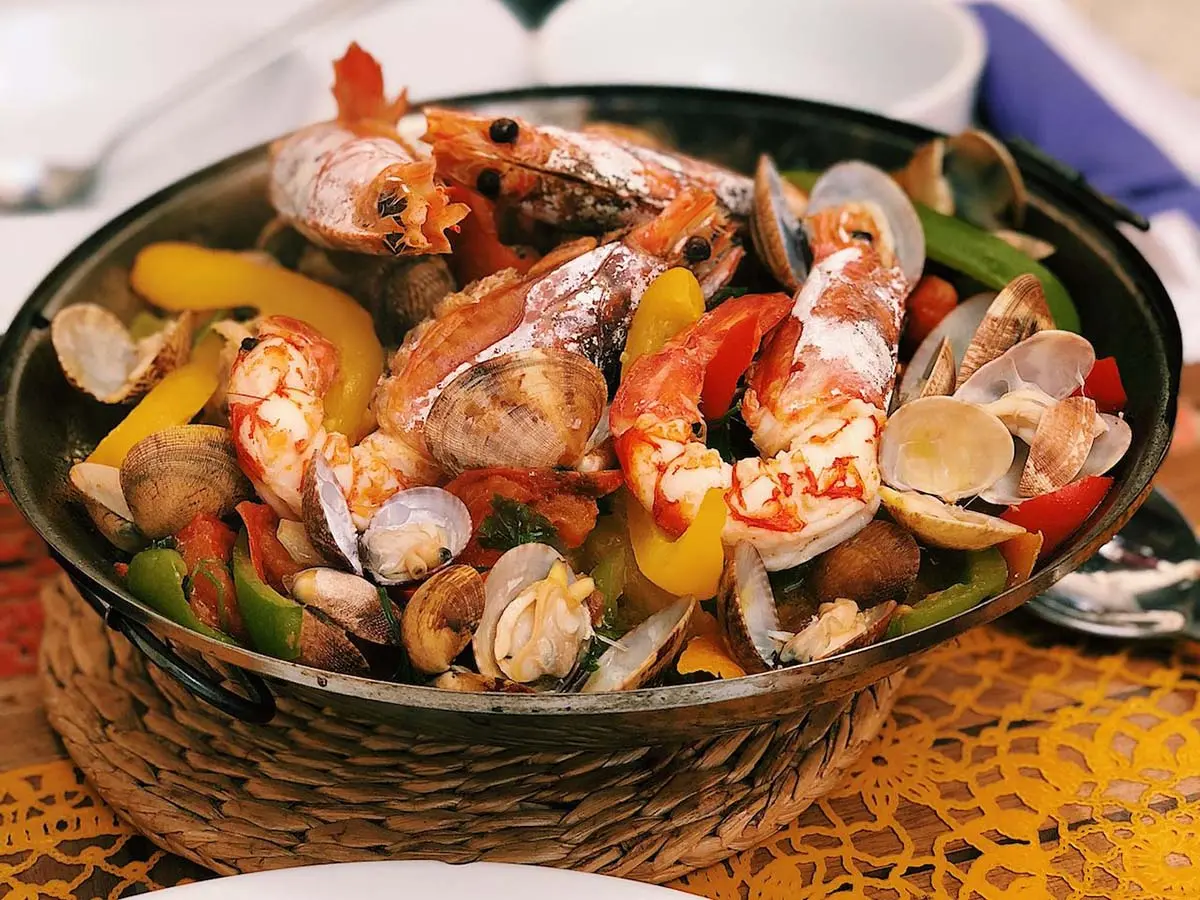
Perched on the hill overlooking the cove, O Pescador offers refined Algarvian cooking — the kind of Portuguese food built around the region’s daily catch — in an upscale setting. Their Cataplana de Marisco — monkfish, prawns, clams, and chorizo steamed in a copper clam-shaped vessel with tomato and wine broth — sources fresh catch directly from the local fishing fleet. The difference in freshness is noticeable from the first bite.
The terrace has a clear view down to the coastline, and the kitchen handles non-seafood options well too, particularly the Trofie Portobello and the Grilled Squid with Lemon Risotto.
- Location: Rua Nossa Senhora do Mar, Benagil village, above the beach
- Cost: €25–45 ($27–49) per person for a main course meal
- Best for: Post-tour celebratory lunch, couples, anyone who wants genuine quality
- Time needed: 1.5–2 hours
Reservations are strongly recommended during summer. The uphill walk from the beach is 10 minutes and feels longer after a morning in a kayak.
O Algar
For a more rustic family-run atmosphere, O Algar delivers warmth and solid traditional Portuguese food in a setting that feels genuinely local. The vibe is friendly and slightly chaotic in an endearing way — tables fill up, voices rise, and the terrace fills with sunset light.
Their Camarão à Guilho — garlic prawns sautéed in olive oil and piri-piri — makes a strong opener. The fresh grilled bream (Dourada) over charcoal is beautifully simple and consistently good.
- Location: Benagil village, above Benagil Beach
- Cost: €15–30 ($16–32) per person
- Best for: Families, budget-conscious travelers, anyone who wants authenticity over polish
- Time needed: 1–1.5 hours
Service slows noticeably during dinner rush, and the menu stays traditional, so picky eaters will find fewer options. The casual setting is not designed for special occasions — but for a long, relaxed Algarvian lunch, it earns its reputation.
Casa Lamy
Situated directly on the Seven Hanging Valleys trail, Casa Lamy exists for hikers. It does not pretend to be a full restaurant.
- Location: On the cliff trail between Marinha and Benagil
- Cost: €5–12 ($5.40–13) for snacks and drinks
- Best for: Mid-hike refueling, post-trail cold drinks, anyone walking from Marinha to Benagil
- Time needed: 30 minutes
Cold Sagres beer, Torrada (thick buttered toast), and a place to sit with a cliff view are what this spot does well. Hours can be irregular outside peak season — do not count on it as your only food plan. But as a trail stop, nothing else comes close to its location.
How much does a Benagil Cave visit really cost?
A Benagil-focused day runs roughly €30–40 ($32–43) per person on a tight budget, or €70–105 ($75–113) at mid-range comfort. A private tour with a sit-down lunch at O Pescador pushes toward €130–200+ ($140–216+). Prices rise noticeably from June through August across all categories, consistent with overall Portugal travel costs during peak season.
Budget approach:
- Vamus bus: €2–3 ($2.15–3.25)
- Guided kayak tour: €26–35 ($28–38)
- Packed lunch at the beach
- Self-guided cliff hike
- Total: roughly €30–40 ($32–43) per person
Comfort approach:
- Uber from your hotel: €20–30 ($22–32)
- RIB tour: €30–45 ($32–49)
- Lunch at O Algar: €15–25 ($16–27)
- Uber return
- Total: roughly €70–105 ($75–113) per person
Premium approach:
- Private car service or rental
- Private boat charter or small-group RIB: €60+ ($65+)
- Upscale lunch at O Pescador: €30–50 ($32–54)
- Guided coastal hike
- Total: €130–200+ ($140–216+) per person
What should you pack for a Benagil Cave day trip?
Your standard Portugal packing list covers the basics, but a Benagil day adds specific demands depending on whether you are on the water or the trail. For kayak and boat tours, a waterproof phone pouch is non-negotiable. For the cliff hike, trail shoes and at least 50 oz (1.5 liters) of water per person are essential.
For boat and kayak tours:
- Waterproof phone pouch: essential — you will get splashed on every kayak tour
- Motion sickness medication: take it an hour before departure if you are prone
- Windbreaker: ocean spray and wind are constant, even in summer
- Polarized sunglasses: reduces glare off the water significantly
- Reef-safe sunscreen: required in the marine protected area
For cliff hiking:
- Trail runners or hiking shoes: no sandals — the terrain will punish you
- Water: 50 oz (1.5 liters) per person minimum
- Hat with retention strap: cliff winds send baseball caps into the ocean
- High SPF sunscreen: virtually no shade exists on the trail
- Lightweight layers: microclimates shift rapidly on the exposed cliff edge
How do you spot a Benagil Cave tour scam?
Aggressive ticket vendors in Albufeira and Portimão sell “Benagil Tours” without specifying the vessel type. Many sell tickets for large cruisers that physically cannot enter the cave, leaving you with a distant view after paying full price. Before booking, confirm the specific boat type and verify the operator’s RNAAT license number. Any legitimate operator will show it without hesitation.
The bottom line
Arrive at Praia da Marinha parking lot around 7:00 AM. Walk the first 1.2 miles (2 km) of the Seven Hanging Valleys trail toward Benagil — this gets you the Heart-Shaped Rock and double arches in golden morning light. By 9:00 AM, meet your pre-booked kayak guide at Benagil Beach. Paddle into the cave before the mid-morning rush. Finish around 11:30 AM and grab brunch at Casa Lamy on the trail or an early lunch at O Algar in the village. At 1:00 PM, visit Praia do Carvalho through the smuggler’s tunnel for a quiet afternoon swim. Head out by 4:00 PM to avoid the peak exit traffic that builds after 5:00 PM.
The new access regulations have changed what a visit to Benagil Cave looks like — no standing on the interior beach, no solo paddling out at dawn. But the cave itself has not changed. That shaft of light hitting golden limestone and turquoise water from a kayak, with no engine noise and a knowledgeable guide, is one of the better things Portugal offers.
TL;DR: Book a guided kayak tour for the earliest available slot. Walk the Seven Hanging Valleys Trail in one direction and Uber back. Add Praia do Carvalho in the afternoon. Skip the large catamaran unless mobility is a genuine constraint — it cannot enter the cave.
What’s your plan — early kayak tour, RIB from Portimão, or the cliff trail? Drop a question below if you need help choosing.