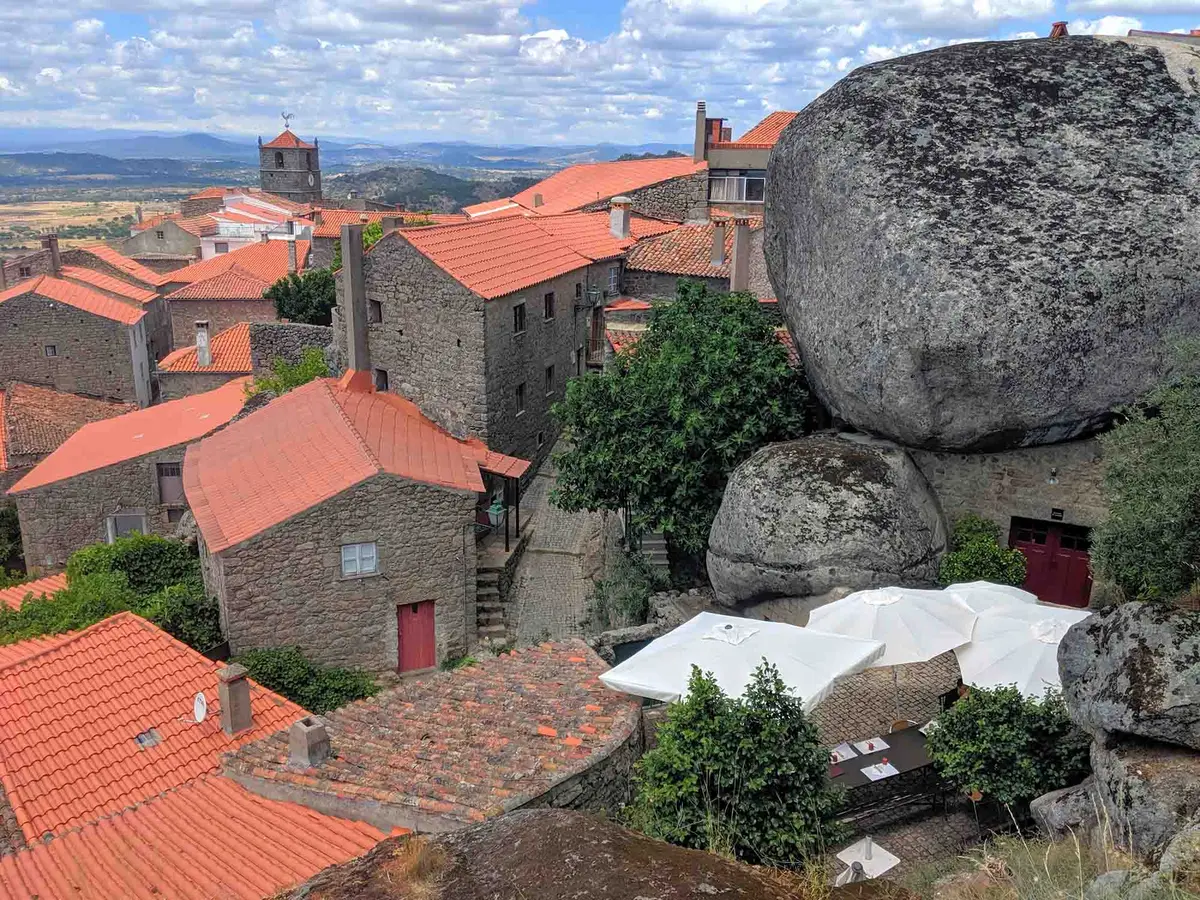
Monsanto Portugal earned the “Most Portuguese Village” title in 1938 by being unlike any other settlement in the country — houses built into 200-ton boulders, a free Templar castle at 763 meters (2,503 ft), silence that returns the minute the day-trippers leave. This guide covers where to park, what to eat, and what House of the Dragon tourism doesn’t mention.
How do you get to Monsanto, Portugal?
Monsanto sits in the Beira Baixa region of central Portugal, roughly 3 hours by car from both Lisbon and Porto. A train to Castelo Branco followed by a Transdev regional bus is technically possible, but the bus runs only on weekdays with very limited service. For most visitors, driving is the only realistic option.
A public transport attempt is brutal in practice: if you miss the morning departure back to Castelo Branco, you’re looking at a €40–50 (~$44–55) taxi back. The bus schedule is not reliably posted online — you find out at the station.
On the positive side, the N239 approach road is in excellent condition and the drive rewards you. Flat plains give way to a sudden granite peak rising from nowhere. If you plan on renting a car in Portugal with a Via Verde transponder, highway tolls are automatic and hassle-free.
Be ready for aggressive local drivers — tailgating on the winding final approach is common. If you’re not comfortable with hill starts or tight European streets, the last few kilometers will test you.
- From Lisbon: ~3 hours by car
- From Porto: ~3 hours by car
- Nearest train station: Castelo Branco (then Transdev bus or taxi, ~50 minutes to Monsanto)
- Best approach road: N239 from Castelo Branco
Pro Tip: Download offline maps before leaving Castelo Branco. Mobile signal drops for long stretches on the final approach.
Where should you park in Monsanto?
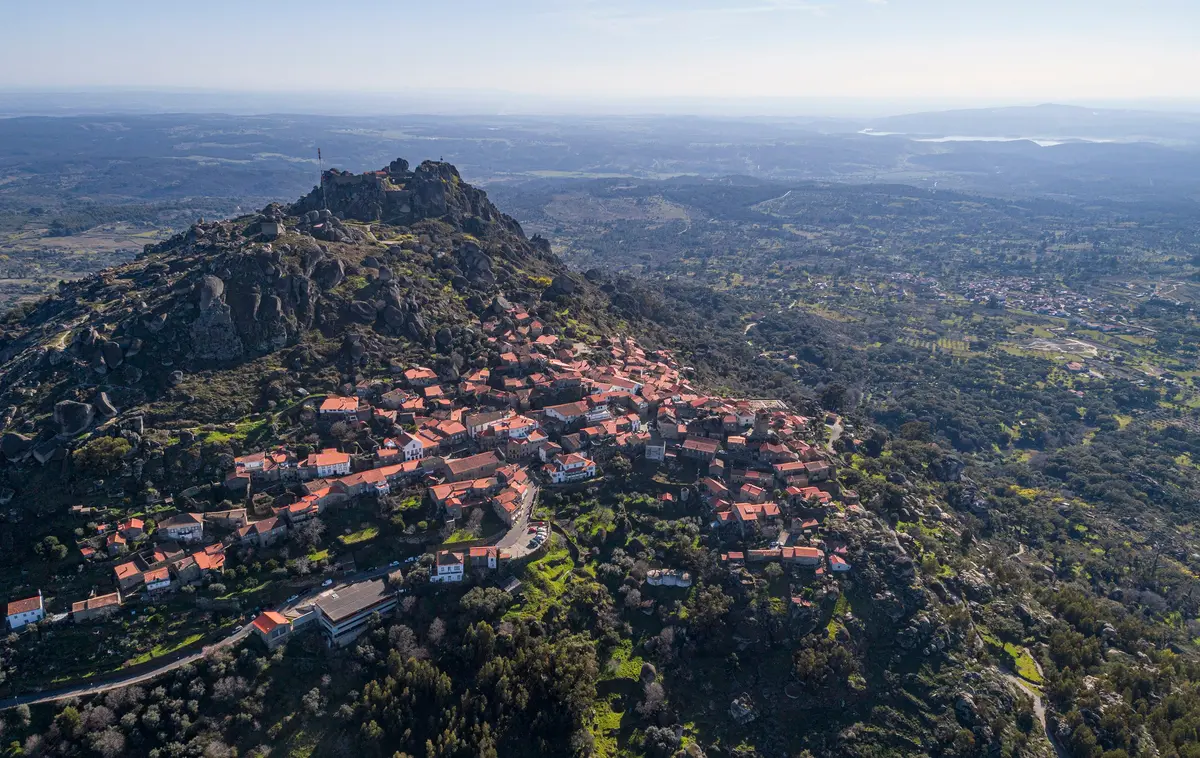
Park in Relva, the lower village at the base of the mountain. Public lots there have real space and no size limits. The Miradouro de Monsanto parking area higher up holds just nine cars and fills by mid-morning on weekends. Driving into the historic center isn’t an option — the streets are medieval defensive paths carved into living rock, too narrow to turn around.
The streets above the Miradouro are pathways, not roads. People have gotten genuinely stuck trying. The solution is parking in Relva (coordinates: N 40° 2′ 25.08″ W 7° 6′ 36.612″) and walking up. The climb turns what could have been a stressful mistake into a proper approach to the village, passing granite formations and architectural details you’d miss entirely from inside a car.
The climb from Relva is steep. Wear sturdy shoes, bring water, and in summer start before 9 a.m. before the heat peaks.
Pro Tip: Monsanto draws Spanish day-trippers in large numbers. The nine-car miradouro lot fills by mid-morning on weekends and Spanish public holidays. Weekday mornings before 9 a.m. are a different village entirely.
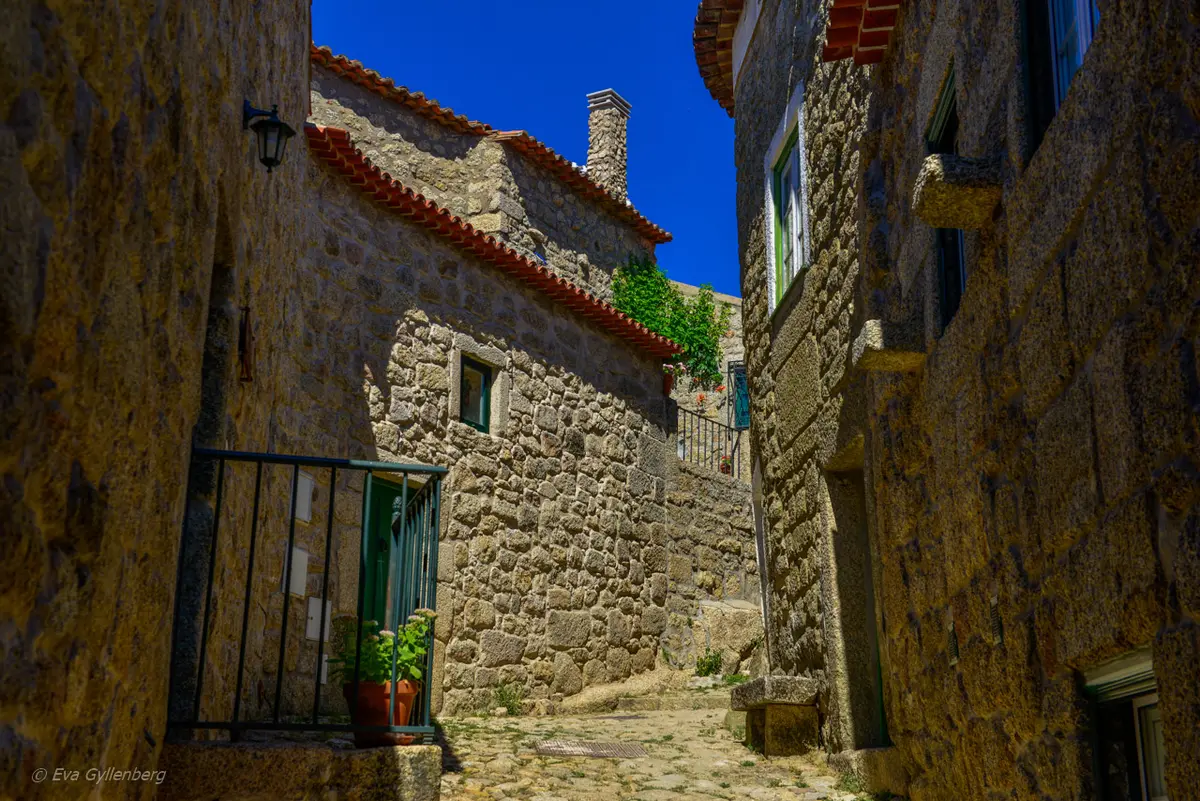
1. Castelo de Monsanto — free Templar fortress with views to Spain
Among Portugal’s medieval castles, the ruins at Monsanto stand apart for the depth of their layered history — and they are the reason you make the climb. Built in 1165 under orders from Gualdim Pais, the legendary Knights Templar Grand Master, this fortress survived sieges from Romans, Moors, and Spanish armies over nine centuries. Parts of the original keep were destroyed in an 1815 gunpowder explosion — those are the most dramatic ruins near the summit. Entry is free, open every day of the year.
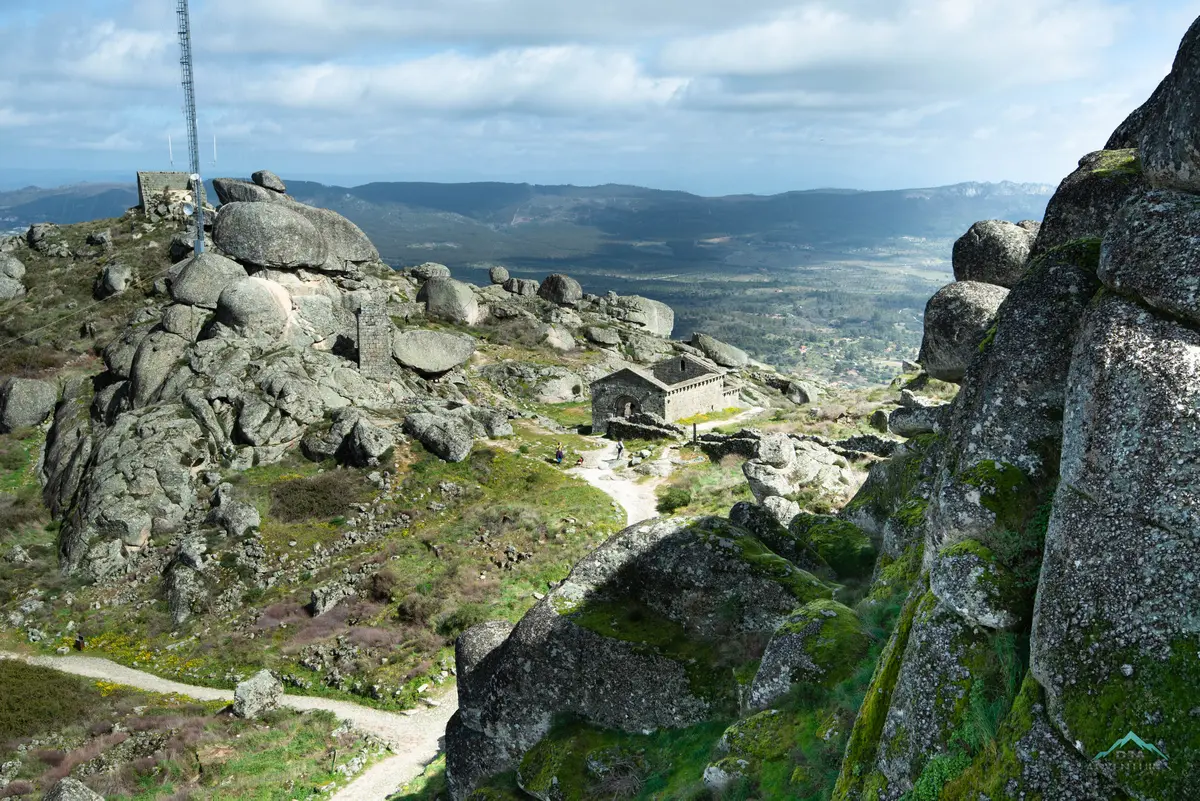
From the ramparts at 763 meters (2,503 ft), the view runs straight from the granite village below to the plains stretching east to Spain. The 12th-century Chapel of São Miguel still stands inside the walls — look for the sarcophagi in the surrounding necropolis, which most visitors walk straight past.
On my last visit, I reached the castle before 9 a.m. on a Tuesday and had the entire ruin to myself for nearly an hour. A bus group arrived at 10:30 and every angle was blocked within minutes. Time accordingly.
This is authentic rubble where the wind whistles through granite crevices and you can touch Templar stonework that predates the Magna Carta. The Templar connection links Monsanto to Portugal’s broader medieval network at Tomar and Almourol — the knights who built fortresses here were the same order that founded both.
The climb to the castle from the village is exposed, hot in summer, and physically demanding with no shade on the final approach. If you’re visiting in July, plan the ascent for early morning.
- Location: Summit of the hill, via the Boulder Route trail (PR5 Rota dos Barrocais)
- Cost: Free
- Best for: History enthusiasts, photographers, House of the Dragon fans
- Time needed: 1.5–2 hours round trip including the climb
Pro Tip: The walk to the castle from the village takes 20–30 minutes one way. Bring more water than you think you need, especially May through September.
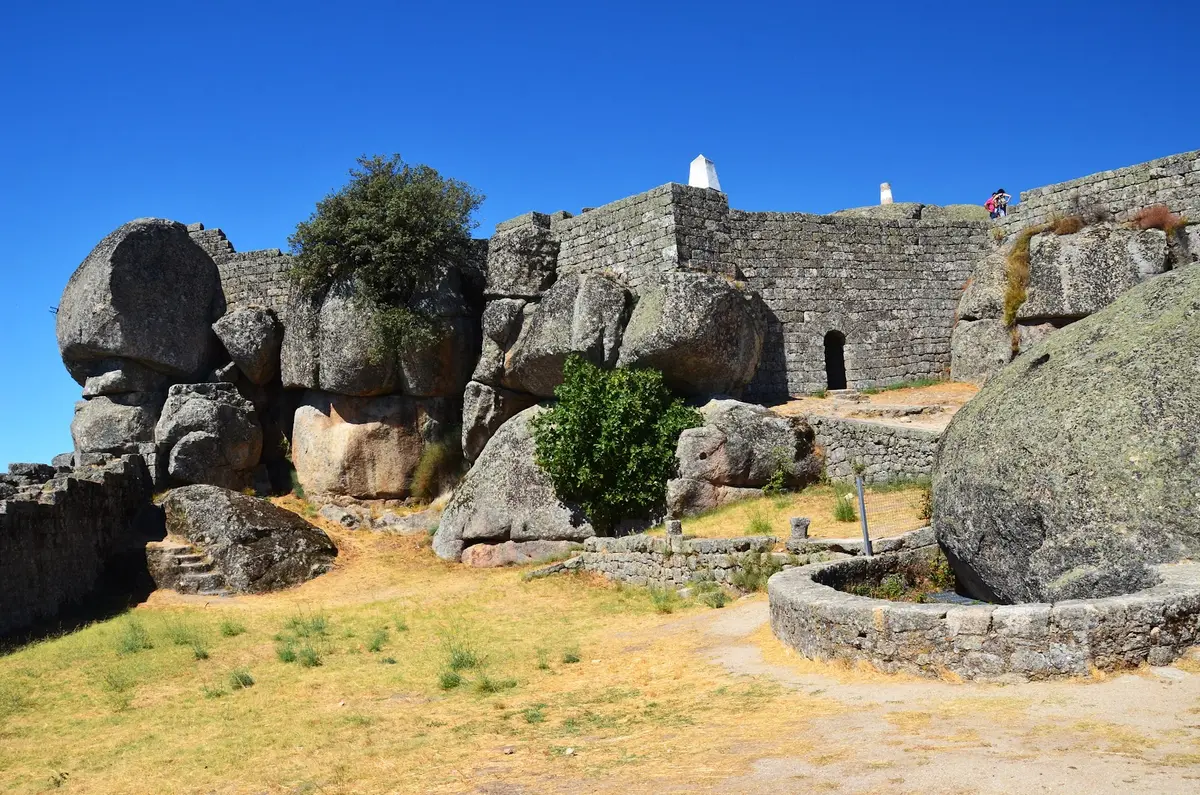
2. The Furdas (pig pens) — medieval survival architecture in stone
Halfway up the Boulder Route, circular stone structures built directly under massive boulders line both sides of the path. These are Furdas — medieval pigsties that show what Monsanto’s builders actually were: people who refused to move a single rock they didn’t have to.
In a village where every square meter mattered and every boulder weighed several tons, livestock shelters were excavated from the mountain itself rather than constructed alongside it. The engineering logic is obvious once you stand inside one: a natural roof that took no labor to raise, walls that required no mortar because the boulder did the work.
Most tourists rush past the Furdas in their push toward the castle. The best examples are lower on the path, closer to the village, and are often completely empty. They’re also the most useful rest stop on the climb — flat ground, some shade, and a view back down over the rooftops.
You won’t find anything like this in Portugal’s whitewashed coastal villages. This is what it looks like when people adapt to an extreme landscape rather than flatten it.
- Location: Boulder Route (PR5 Rota dos Barrocais), lower to mid-section
- Cost: Free
- Best for: Architecture and history enthusiasts, photographers
- Time needed: 15–20 minutes
3. Torre de Lucano — the Silver Rooster
The clock tower in the village center still displays the replica of the Silver Rooster Monsanto received in 1938 for winning the “Most Portuguese Village” contest. It’s a five-minute stop, but the symbolism is worth understanding: Monsanto wasn’t chosen for being typical. It was chosen for representing what a dictatorial Estado Novo government considered the Portuguese soul — rural, stubborn, rooted in stone.
The award was never given out again. Monsanto still holds the title, with building regulations written into law as a direct result. The village’s appearance has barely changed since 1938, and that legal protection is why a place this visually extreme has survived without becoming a resort town.
- Location: Village center
- Cost: Free
- Best for: Context for the village’s identity; quick stop between the Boulder Route and the lower village
- Time needed: 5–10 minutes
Where should you eat in Monsanto?
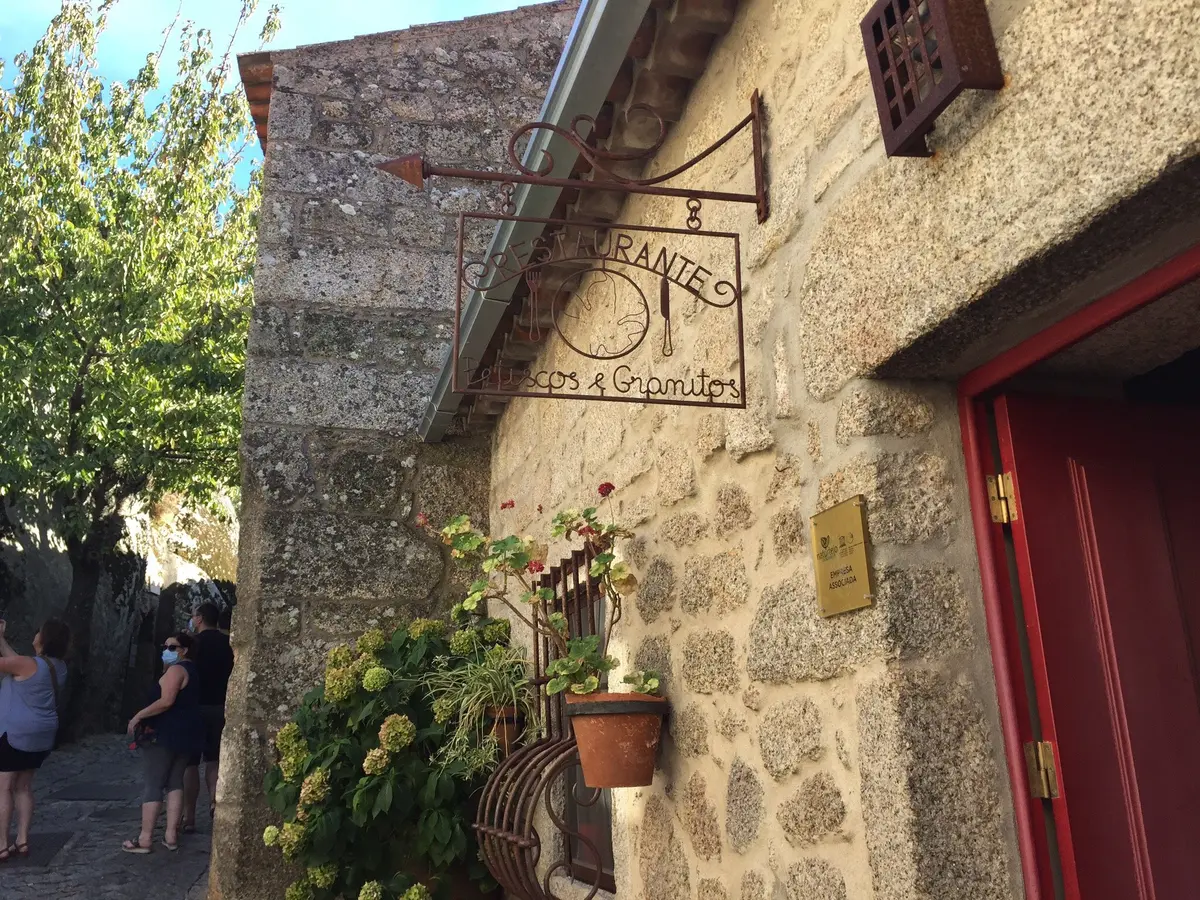
Monsanto’s dining scene is small — around eight places to eat, with a significant gap between the best and the rest. Casa Da Velha Fonte is the clear top pick for food. Petiscos & Granitos earns its place for the setting alone: you eat under an actual boulder. For anything else, Taverna Lusitana and Monsanto Café e Bistro are solid fallback options.
Petiscos & Granitos
The building’s kitchen roof is a genuine giant granite rock — you are eating under a boulder. Request the back terrace for valley views; from there you look out over the rooftops of the village and the plains beyond. Order the octopus gratinated with Serra da Estrela cheese, or the Maranho — a goat stomach dish stuffed with rice, mint, and meat, and one of the most distinctive examples of traditional Portuguese food from the Beira Baixa interior. The fresh mint cuts through the richness better than you’d expect from a dish that sounds like haggis.
Recent visitor reviews have been mixed — it currently ranks in the bottom half of Monsanto’s restaurants. The setting is the reason to go, not the meal itself. Prices run slightly above regional averages, the interior feels cramped, and the kitchen is inconsistent. Reservations are essential in summer.
- Location: R. do Castelo 16, Monsanto (also listed as Rua da Pracinha 16 on some platforms)
- Cost: €15–20 (~$17–22) per person
- Best for: Atmospheric dining under a boulder; regional Beira Baixa food
- Hours: Daily 10:30 a.m.–10 p.m. (hours vary; confirm ahead)
Pro Tip: Skip Petiscos & Granitos if you want a reliable meal. Casa Da Velha Fonte is the top-rated restaurant in Monsanto and a short walk away. Go to Petiscos & Granitos for a drink on the terrace and let the view do the work.
Casa Da Velha Fonte
The #1 restaurant in Monsanto by a significant margin — 4.8 stars on TripAdvisor — and a fundamentally different experience from everything else on the hill. Chef Maria runs a reservation-only kitchen rooted in Beira Baixa and Roman-era culinary traditions. There’s no walk-in, no standard menu, and no rushing through courses. The meal is the event.
Visitors who go in expecting a restaurant come out describing an experience. That’s not marketing language — it’s the recurring observation across dozens of reviews, from solo travelers to group tours. The trade-off: this is not cheap by Portuguese standards, and you need to plan ahead.
- Location: Monsanto village (call ahead to confirm current location and booking)
- Cost: From ~€35 (~$38) per person; reservation required
- Best for: Couples, food-focused travelers, groups who want something memorable
- Time needed: 2–3 hours
What are the Marafonas sold on Monsanto’s streets?
Marafonas are faceless rag dolls mounted on wooden crosses, sold by elderly village women from doorways throughout Monsanto. Faceless by design — no eyes, ears, or mouth — they were traditionally placed under newlywed beds for fertility and hung in homes against thunderstorms. The tradition traces back to pre-Christian worship of the goddess Maia, making these older than the village’s Christianity by several centuries.
Throughout the village, you find the dolls for sale outside private homes and along shaded walls. This is a direct transaction with someone who has lived this tradition her entire life. The Marafonas rank among the most distinctive pieces of Portugal’s traditional crafts — not mass-produced, not sold in shops, and priced honestly. Cash only.
Some visitors find the faceless design unsettling. That reaction means you’re looking at them correctly.

Was Monsanto Portugal really used in House of the Dragon?
Monsanto Portugal served as Dragonstone’s exterior for Season 1 only. Production used the castle ruins and the Boulder Route for scenes involving Rhaenyra and Daemon Targaryen. The Igreja de São Miguel inside the castle grounds is the most recognizable location from the show. Production did not return for Season 2 — the mountain is only reachable by helicopter, and the logistics became too complex to repeat.
The dramatic winding stone bridge that defines Dragonstone in the series was filmed at Gaztelugatxe, a hermitage on a small islet off Spain’s Basque coast. Anyone building a Spain and Portugal itinerary around filming locations can combine Monsanto with a Basque Country detour for the full picture. Penha Garcia Castle, 9 miles (15 km) east of Monsanto, was also used during Season 1 production, according to the Portugal Film Commission.
No official plaques or guided film tours exist. The promotional banners in the village are weathered and often torn. This is a functioning medieval village where people actually live, and the residents are not uniformly enthusiastic about being treated as a backdrop.
Is the Penha Garcia fossil trail worth the detour from Monsanto?
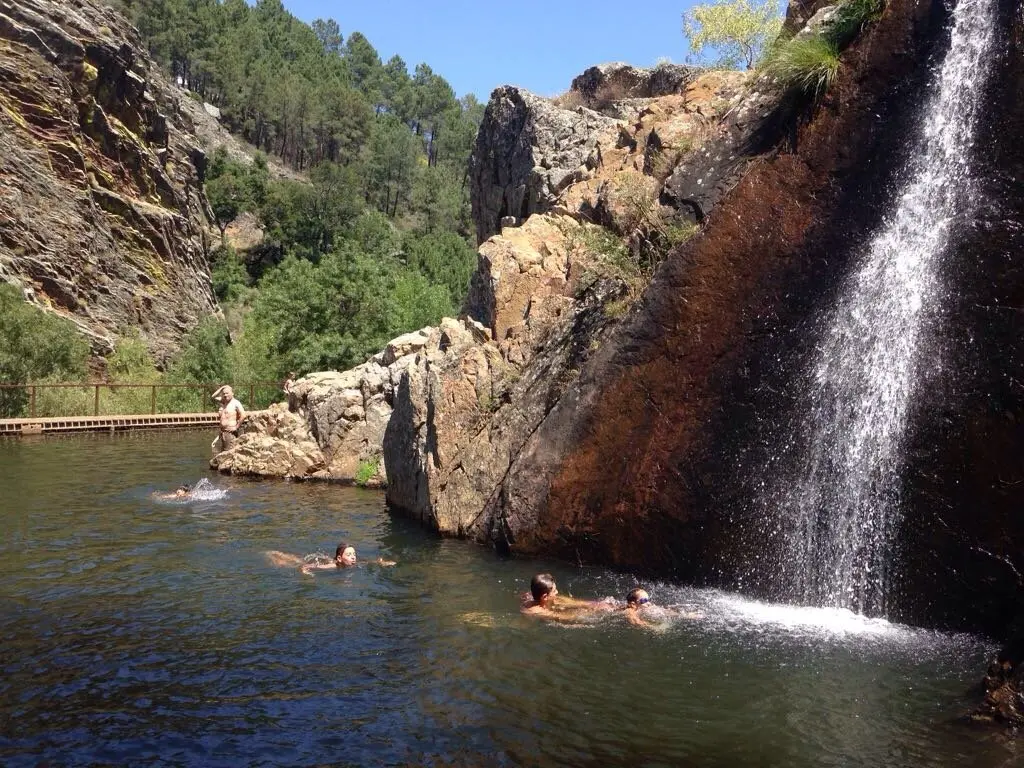
Yes — and it pairs naturally with a morning in Monsanto. The quartzite canyon walls at Penha Garcia contain 480-million-year-old trilobite fossils at eye level, and the trail ends at a river swimming hole. It’s 9 miles (15 km) east of Monsanto, a 15-minute drive, and free to access.
The contrast with Monsanto is deliberate if you do both in one day: heights and granite in the morning, canyon and water in the afternoon. Penha Garcia Castle was also used during House of the Dragon Season 1 production, which makes it relevant beyond the geology.
- Distance from Monsanto: 9 miles (15 km), about a 15-minute drive
- Cost: Free
- Best for: Geology, families, summer cooling off, House of the Dragon film location hunting
- Time needed: 1.5–2 hours
Pro Tip: Do Penha Garcia in the afternoon. The fossil trail is easier walking than Monsanto’s climb, and arriving mid-afternoon means the canyon pool is cooler and day-trippers have thinned out.
Is Monsanto Portugal accessible?
Monsanto is not accessible for wheelchair users or anyone with significant mobility challenges. The terrain involves steep cobblestones, stairs cut directly into rock, and uneven paths that get slippery when wet or covered in loose granite grit.
For mixed-mobility groups, the lower village of Relva has views of the mountain without the climb — but it is a consolation prize, not the real experience. The actual village begins where the gradients get serious.
Monsanto vs. Sortelha — which medieval village should you choose?
Monsanto wins for geological drama and the strange spectacle of houses built into boulders — nothing in Portugal looks like it. Sortelha, 37 miles (60 km) northwest, is a purer medieval walled village: easier walking, better-preserved fortifications, and more conventional by comparison. Two days gives you both, and the drive between them takes under an hour.
If you have two days, both villages fit naturally into a Portugal road trip itinerary through the interior — the drive between them passes through landscape that earns the detour. Sortelha is better for a pure medieval atmosphere without the exertion — a time machine rather than a geological puzzle.
The real trade-off: you can save a night’s accommodation by staying in Castelo Branco (~$60–90/night) and doing Monsanto as a day trip, but you’ll miss the sunset and the silence that follows.
Should you stay overnight in Monsanto?
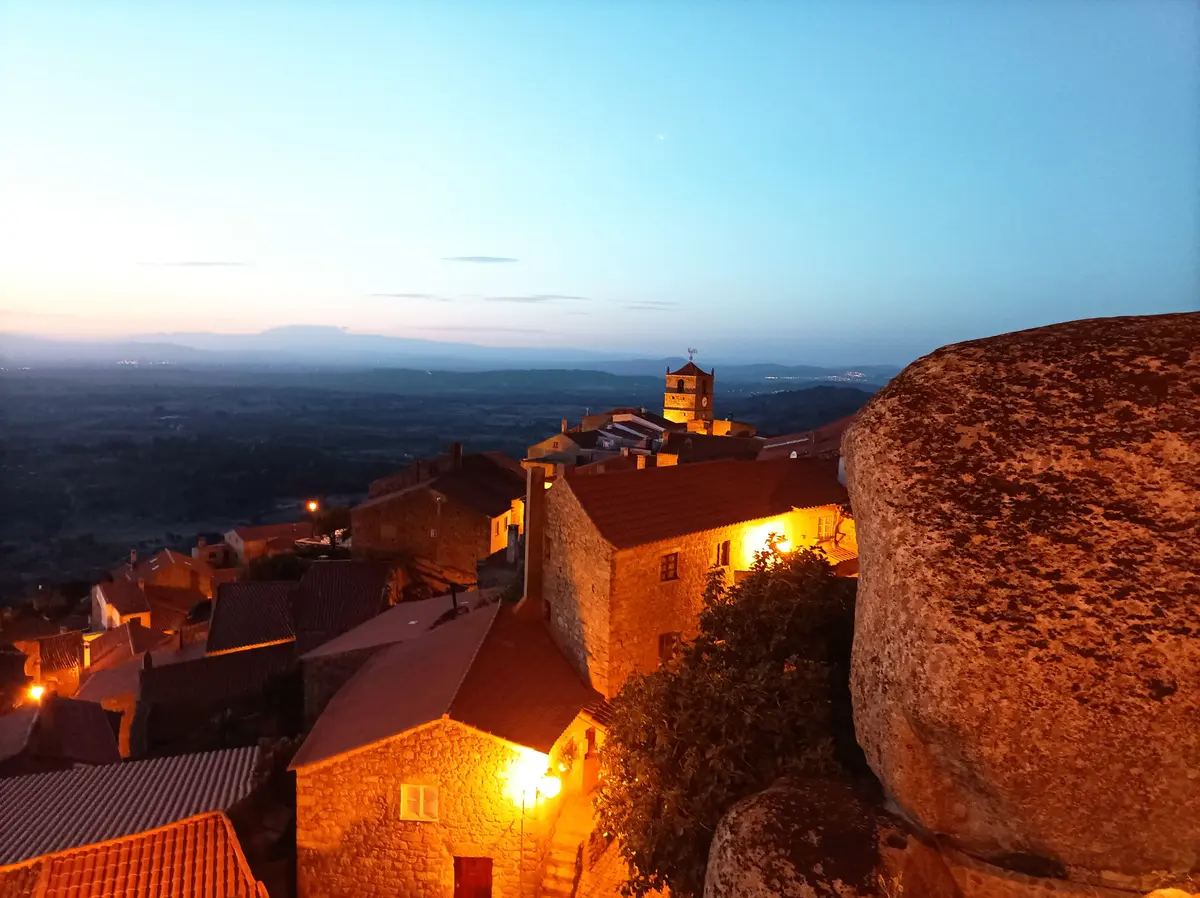
Staying overnight transforms the trip. Most visitors arrive around 10:30 a.m. and leave before sunset — they miss the best part.
After the day-trippers leave, Monsanto goes quiet in a way that most Portuguese villages never do: too remote for casual evening visitors, too small for nightlife. The golden hour light turns the granite amber. Waking up in what genuinely feels like the Stone Age is worth hauling luggage up cobblestones.
Boulder-house accommodation like Casa da Gruta and Sun Set House sleeps two people in rooms built directly into or under the rock. Casa da Gruta starts at around $115 per night on Airbnb. Sun Set House is named accurately — book it for the terrace.
Book at least six months ahead for any visit between May and October. If you’re still working out timing, the best time to visit Portugal guide breaks down regional differences — for Monsanto specifically, May and October hit the sweet spot between warmth and manageable crowds. The village has very limited accommodation and every property sells out for peak season.
Pro Tip: The village parking ban means no cars on the upper streets after a certain point. Pack light for the overnight. A rolling suitcase on Monsanto’s cobblestones is a test of character.
he bottom line
Park in Relva, start the castle climb before 9 a.m., have a drink on the terrace at Petiscos & Granitos but eat at Casa Da Velha Fonte, and stay overnight if the budget allows. The House of the Dragon connection is real but limited to Season 1.
Monsanto isn’t for everyone — it’s remote, physically demanding, and logistically unforgiving. But the Templar history, the Marafona dolls, and that sunset over the plains to Spain are what you’ll actually remember. For the full regional context, the Portugal travel guide covers everything from the coast to the interior. The film connection might get you here. The mountain keeps you coming back.
Which part of Monsanto are you planning to prioritize — the castle, the overnight experience, or the fossil trail at Penha Garcia?