Travelers who bothered to count came back from this day trip with seven stamps in their passports. Not two. Seven. That number is the quickest way to understand what you are actually booking when you plan the Copán ruins from El Salvador: the route does not go where the map suggests, the entry fee is not the one most guides print, and the rental car you were planning to drive probably cannot legally make the crossing.
None of that makes the trip a bad idea. Copán holds the best stone carving in the Maya world and you can see it properly in half a day. But the trip is the hard part, and the trip is the part the listings are vaguest about.
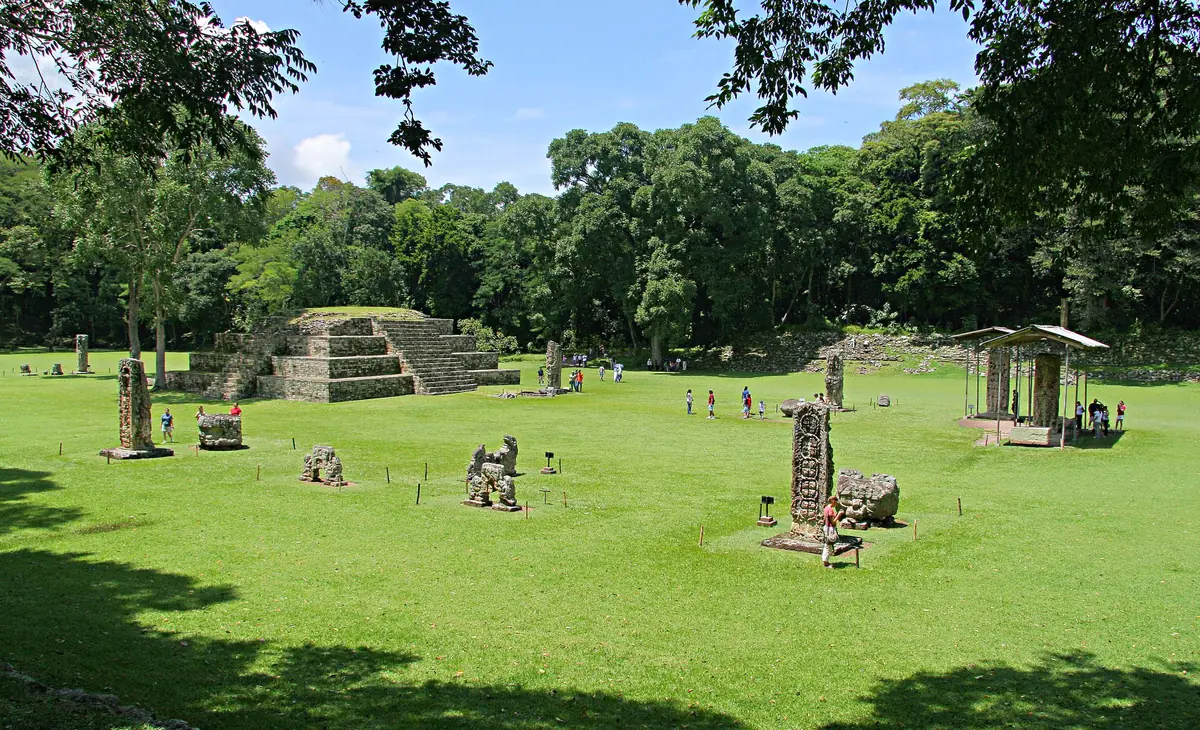
The Border You Actually Cross
Copán sits about 9 miles (14 km) inside Honduras from El Florido — and El Florido is the Guatemala–Honduras border, not the Salvadoran one. El Poy, the direct El Salvador–Honduras crossing, drops you at the wrong end of a long loop through the Honduran mountains: Ocotepeque, then Santa Rosa de Copán, then La Entrada, then west. Travelers who have run that route on public buses put it at roughly 11 hours one way.
Put those two facts side by side and you get the conclusion this article is built on, which is mine rather than any operator’s: the nearest border is the wrong border. Every same-day itinerary sold out of San Salvador goes west into Guatemala at Anguiatú, down through Chiquimula and Vado Hondo, and crosses at El Florido. If somebody runs a same-day trip through El Poy, they are not advertising it, and the bus timetable says it could not work anyway.
So the trip you booked as bilateral isn’t. You transit Guatemala twice in one day, once in each direction, on top of entering and leaving Honduras. Reviewers describe discovering this on the morning it happens, which is a paperwork problem, not a scenic one. One Spanish-language reviewer’s whole complaint was that the operator should say up front that the route crosses Guatemala, because for some nationalities that changes what you need at the window. If your passport is not American, check the Guatemala transit as carefully as the Honduras entry — UK passport holders, for instance, now need a visa for Honduras, a requirement that shows up in tour reviews constantly and whose current process I could not pin to an authoritative source. Leave time for it.
Four Ways In, and Only Two Work as a Day Trip
It is about 110 miles from San Salvador to Copán. By car that is three and a half hours at best, because the route is a two-lane mountain road with truck traffic and two border stops, not an interstate with the same mileage. Every option below inherits that road.
The Tour: 15 Hours for $120 to $175
Shared group tours from San Salvador commonly run $120 to $175 per person, with private and premium versions climbing to about $430. Most include hotel pickup, transport, a guide and site entry; most exclude lunch, tips, and sometimes the Honduran border fee. Pickup is 4:30 to 5:00 a.m. from San Salvador hotels and around 5:15 from Santa Ana; pickups from the beach hotels usually cost extra. You are back between 7:00 and 8:00 p.m. Operators advertise 12 to 16 hours. Reviewers keep reaching for the same phrase: a 15-hour day.
That buys you about three hours at the site. Three hours covers the Great Plaza, the stelae and the Hieroglyphic Stairway at a walking pace. It does not cover the museums, the tunnels and Las Sepulturas as well. One tour arrived at 3 p.m. and got two hours before closing.
The clause that catches solo travelers is the two-passenger minimum: below it, the tour cancels. Travelers have reported cancellations the day before and the morning of, including one who had flown in specifically for it. Book something with free cancellation — 24 hours is the usual cutoff — confirm the day before, and take it as read that paying is not the same as the tour running.
The 4:30 a.m. pickup is 4:30 a.m. the whole way, incidentally. El Salvador, Guatemala and Honduras all sit on UTC-6 and none of them use daylight saving, so nothing on your phone shifts and there is no hour to gain or lose at either border.
The day-trip version is wrong for specific people, and it is worth knowing which before you pay: anyone who cannot sleep sitting up in a van, anyone traveling with small children, anyone with a flight out the following morning, and anyone whose real reason for going is the tunnels and the museums instead of the plazas. For everyone else it works. It is just genuinely long.
The Shuttle: Half the Price, Less Certainty
Shuttles run about $50 to $65 per person. Gekko Trails Explorer (formerly Ecotours) is the established name, leaving San Salvador and Santa Ana on selected days, with a two-person minimum and the same Guatemala routing. Booking and confirmation happen over WhatsApp, which matters before you buy data: a Honduras-only eSIM will not cover a route that crosses Guatemala, so you want a regional Central America plan. Honduras runs on Tigo and Claro; coverage is fine in Copán town, patchy between towns, and present at the ruins.
Reliability is where the shuttle reviews turn. One passenger reported arriving three hours late, at noon against a promised 9 a.m. Separate accounts describe an overfull van and a driver who looked too tired to be driving. Three reports are not a pattern, but they are the risk you are buying at half the tour price. Schedules and prices move; confirm the specific day directly instead of trusting a page.
And ignore the “about five hours each way” figure that route-planning sites give for this trip. Operator itineraries and travelers both land between six and eight.
The Public Bus: Cheap, and Not a Day Trip
From Santa Ana via Guatemala it is five or six buses, six to eight hours, and roughly $8 to $10 all in — Metapán, Anguiatú, Chiquimula or Vado Hondo, El Florido, then 25 lempiras for the last hop into Copán Ruinas. From San Salvador, add a bus and about two hours, so call it 12 hours one way.
The direct route through El Poy is cheaper and slower. Buses 119 and 112 leave San Salvador’s Terminal de Oriente for $1.50 to $2.50 and take three to four hours to the border; then you are changing at Ocotepeque, Santa Rosa de Copán and La Entrada, for something like 11 hours door to door. You have to make the first bus at around 5 a.m. or give the day up, and the last bus back from El Poy to San Salvador leaves around 4 p.m.
Either way, on buses this is an overnight trip. Anyone presenting it as a day trip has not timed it.
Your Rental Car Probably Can’t Come
Three rental desks at San Salvador airport publish their cross-border terms, and they do not agree.
- Alamo permits cross-border travel to Guatemala only, at a $100 surcharge plus a $50 cross-border permit bought from the station 72 hours in advance, on a minimum seven-day rental. Read plainly: an Alamo car from SAL cannot legally enter Honduras at all.
- National permits travel anywhere in Central America on the same shape of terms — $100 surcharge, $50 permit, 72 hours’ notice, seven-day minimum.
- Enterprise charges $50 for the permit, also 72 hours ahead, also on a seven-day minimum.
The third condition is the one that quietly ends the plan, and no rental page states it outright, because it only appears when you read the three clauses together. A seven-day minimum kills a self-drive day trip even at the companies that allow the crossing. That inference is mine; the terms are on each company’s San Salvador page if you want to check it. If you already have a car booked for a long trip, this is workable with three days’ notice and two fees. If you rented for the weekend, it isn’t, and no amount of paperwork at the counter will change it.
Smaller local agencies may write different terms, and I have only seen these three. Ask before you book, and ask about Honduras by name — in these contracts “cross-border” often means Guatemala and nothing else.
Your US license is valid in El Salvador for up to 30 days and an International Driving Permit is not strictly required there. That is El Salvador’s rule about you, and it says nothing about the vehicle’s paperwork at the borders, which is the entire subject of the permit conversation. Travelers crossing at El Poy in their own vehicles describe a Honduran import permit costing about $30 in lempira, plus photocopies and a stop at a bank, and eating close to two hours.
The Case for Sleeping in Copán
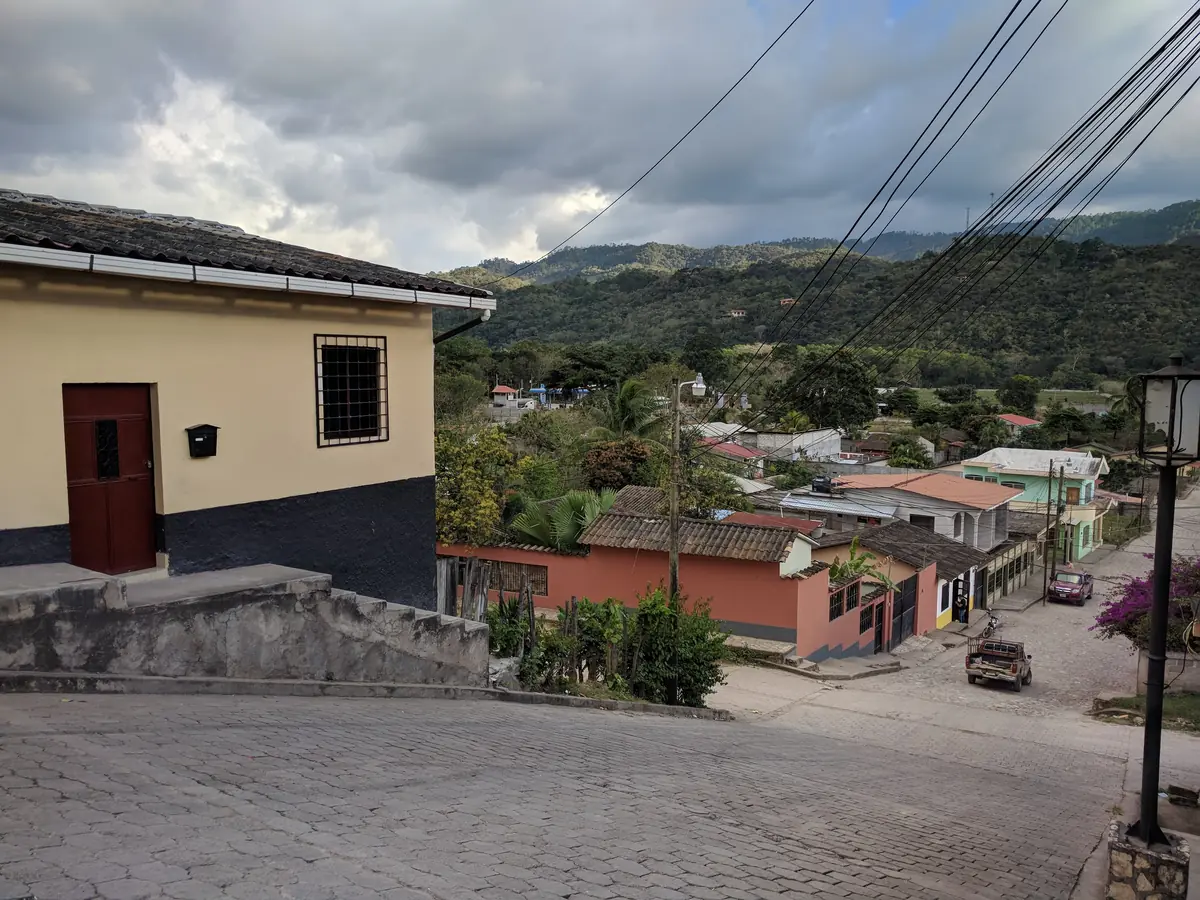
Copán Ruinas is small — roughly a 15-minute walk from town to the site entrance — and it is set up for people who arrive tired. A dorm bed runs $7 to $12 at places like Iguana Azul, Stella, ViaVia and Berakah. Budget private rooms sit between about $22 and $53, with Hotel Marjenny at the top of that band and La Posada and Brisas de Copán below it. The mid-tier is where you start paying for air conditioning, hot water and Wi-Fi that works: Casa de Café B&B, Terramaya, Hotel Marina Copán. Upscale, including Hacienda San Lucas and Ancestral Copán, runs $131 to $146. Rates swing hard by season — KAYAK’s own figures put the cheapest month near $27 and the most expensive near $166 — and December and Semana Santa need booking well ahead.
One lived warning that never makes the listings: the town is built on a hill, and a cheap room uphill is a climb at the end of a long day. Ask where the property actually sits. Many places take cash only.
This is the point where readers balk, so here are the numbers. Honduras carries a Level 3 “Reconsider Travel” advisory from the State Department, with Gracias a Dios at Level 4, while El Salvador now sits at Level 1. Advisory levels move, so check both before you commit. On homicide, InSight Crime put Honduras at 25.3 per 100,000 in 2024, against about 5.0 in the United States on FBI figures and 1.9 in El Salvador. You are leaving a country that is statistically safer than home.
The national figure is also hiding a great deal. In the same year, Tegucigalpa came in at 17.4 and San Pedro Sula at 18.1 — both below the national average, which tells you the violence sits somewhere other than where the reputation points. The State Department’s own country information notes that Copán has lower crime and a heavier police presence than the Honduran average. What nobody publishes is a rate for the department you are actually visiting. Pages that quote precise recent incident counts for this specific highway do not trace back to any primary source, and I would not plan around them.
What travelers do report, repeatedly and independently, is that Copán town is walkable day and night. The one bad outlier attaches to an add-on activity, not to the town: a reviewer’s son and a zip-line guide were robbed by armed men on a tour outside it.
The likelier problem is not crime anyway. Dengue is a live risk in Honduras and the mosquito that carries it bites during the day, so repellent belongs in the bag. Most Honduran providers work in cash, which is the real argument for travel insurance with medical evacuation cover — not the advisory headline.
If you are carrying on into Honduras instead of turning back, Hedman Alas runs Copán to San Pedro Sula in about three hours for roughly $19 to $26 depending on class, on limited days; Casasola Express does the same run for about $6 in about four hours, more often. Check Hedman Alas for current days before you count on it.
Two days on public buses is the cheapest honest version of this trip. Fares round trip come to about $16 to $20, entry is $20, a dorm bed is $7 to $12, and meals are a few dollars each. That arithmetic is mine, not a quoted package price, but it lands near $60 — against $120 to $175 for the tour that gives you three hours and takes your whole day.
The Hour at the Border
Bring a US passport with six months’ validity and at least two blank pages; onward-travel proof gets asked for occasionally. You do not need a visa. The CA-4 agreement covers El Salvador, Guatemala, Honduras and Nicaragua, and its catch is the same clause that saves you the visa: your 90 days is a shared total across all four countries, and the Honduras stamp does not restart it. That matters mainly if you are chaining countries; extensions go through El Salvador’s DGME, once.
Honduras dropped its mandatory pre-check for land arrivals at the end of 2023 — it is now required only of Nicaraguan citizens, and the immigration authority has said so. At least one operator was still asking travelers to file it five days ahead. It is free, so complying costs nothing but the ten minutes.
Then there is the $3. The UK government’s travel advice tells its citizens that land arrivals are charged a $3 fee and to keep the receipt until leaving Honduras. Mexico’s foreign ministry says the same, and specifies cash. Honduras’s own immigration authority publishes its visa fees — $30, $60, $100 — and says nothing whatsoever about a $3 tourist charge at a land border. So the fee is real: two foreign governments and a great many travelers document it, and you will be handed a small white slip marked $3. It is simply undocumented by the country collecting it. That is not the same thing as a scam, and it is exactly why the receipt matters. Keep it.
Whether the window takes dollars or insists on lempira is genuinely disputed in traveler reports, some saying one and some the other. Carry both. At roughly 25 lempiras to the dollar, $3 is about 75 lempiras.
That exchange happens at the border because it more or less has to. Lempira is close to impossible to buy inside El Salvador, which runs on US dollars; travelers who tried report getting theirs from changers at the crossing. Which brings up the part of this trip that produces the most complaints. There are independent reports of short-changing at El Florido — a changer offering fewer lempiras than the rate — and of a guide shorting change on tunnel tickets later the same day. Change small amounts, and count them at the window before you walk away.
In town, dollars get accepted but your change comes back in lempira at a rate that is not doing you any favors. Copán’s ATMs have been out of service on multiple independent visits, and the banks close on Sunday. The reliable changers work next to Banco del País and Banco Atlántida. Cards are fine at the ruins — one traveler used a foreign Visa without trouble — and at the larger hotels. Much of the rest of the town is cash.
What $20 Buys at the Gate
Page one of the search results still prints $15 for entry to Copán. The price list published by IHAH, the Honduran institute that runs the site, says $20 for the archaeological park plus Las Sepulturas for visitors from outside Central America. The page was last modified in November 2025. Central Americans, Salvadorans included, pay $10. The $15 figure was accurate a few years ago and has been copied forward ever since.
Watch that number carefully, because it is still on the price list attached to something else: $15 is the cost of the tunnels, which are a separate ticket from park entry. Two different things, one number, and most guides have it on the wrong one.
The separation is where people lose money. The tunnel ticket is sold at the main entrance, and travelers report the specific mistake of assuming otherwise — you cannot buy it at the tunnels themselves, so a decision you meant to make later has to be made at the gate.
Make it a no unless you are there for the archaeology in particular. Travelers split hard on the tunnels: some are glad they paid, others describe the price as absurd for how little you see. There is no consensus to report, so that is a judgment, and it is the direction I would push a first-time visitor. Skip them outright if enclosed spaces are a problem — one of the tunnels runs about 130 yards (120 m) and is narrow.
The site is open every day of the year. Its closing time is another matter: some sources say 4 p.m. and others 5 p.m., and no source anywhere — including the site’s own — publishes a last-entry time. That gap is unresolvable from here, so treat a late arrival as a real risk and go in the morning. You want the cool hours anyway. Midday runs about 90°F (32°C).
There is no authoritative accessibility statement either, and at least one booking listing calls the site wheelchair accessible. Be skeptical of that. The ground is elevated stone and grass with stairs throughout, the Hieroglyphic Stairway is steep, and the tunnels are narrow. If someone in your group struggles with steps or heat, take the morning, take it slowly, and drop the tunnels from the plan.
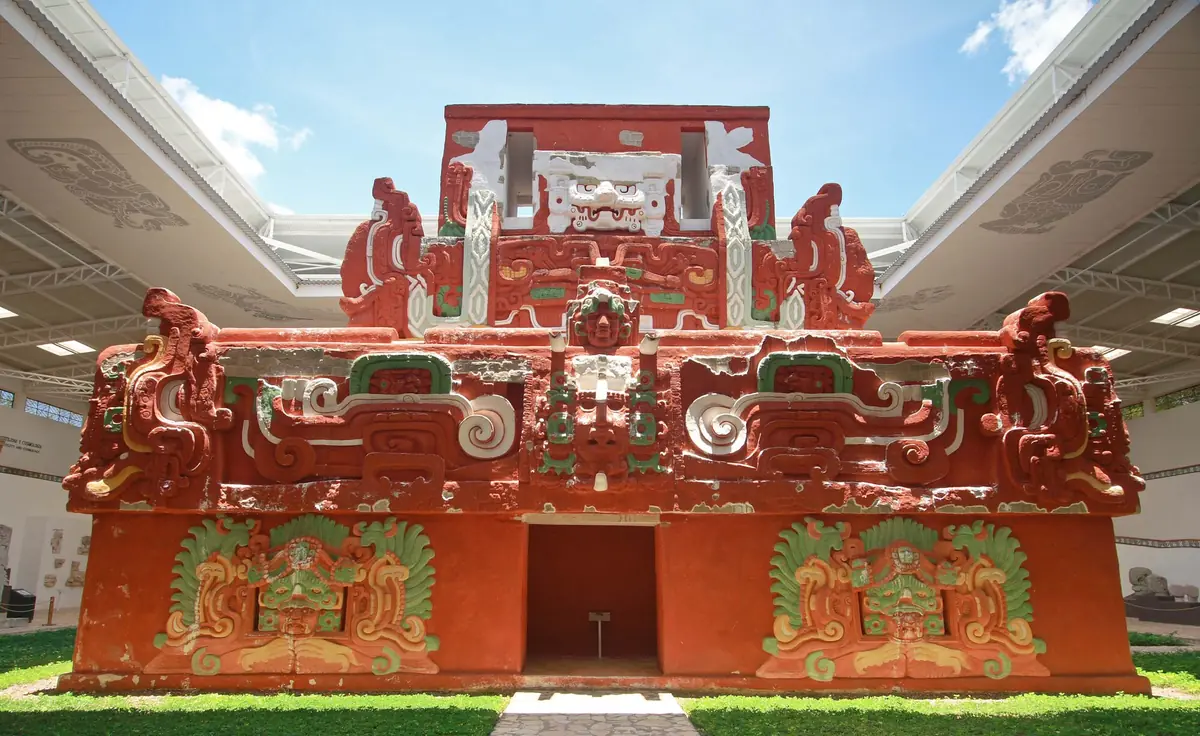
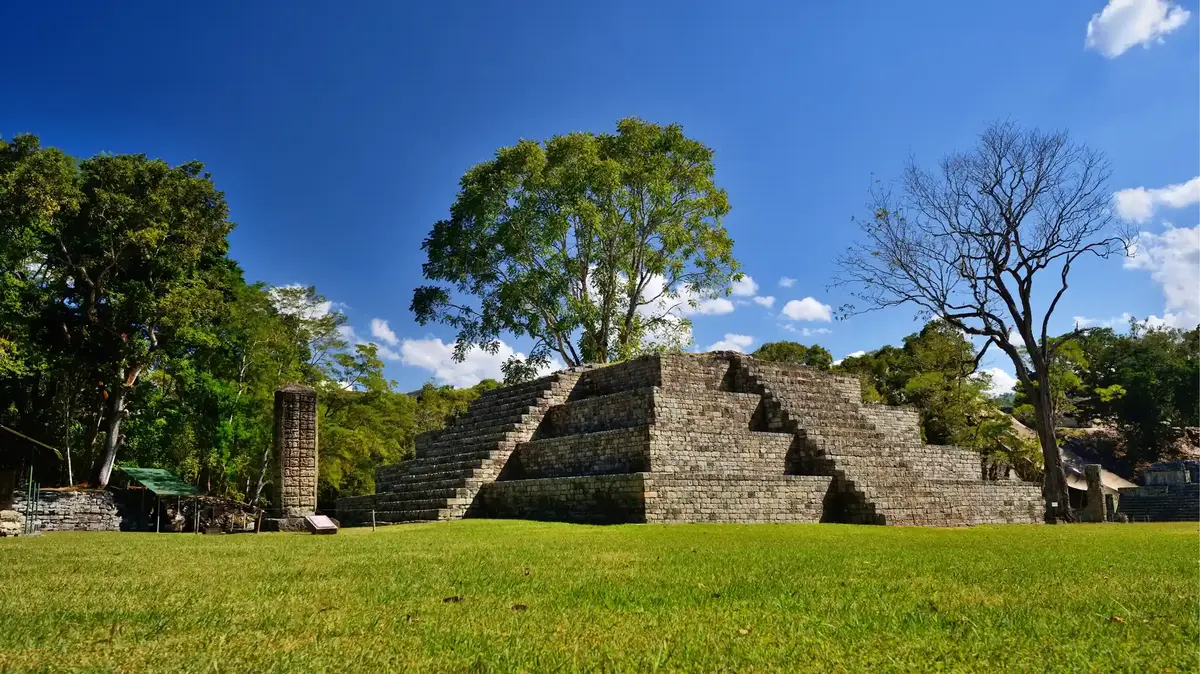
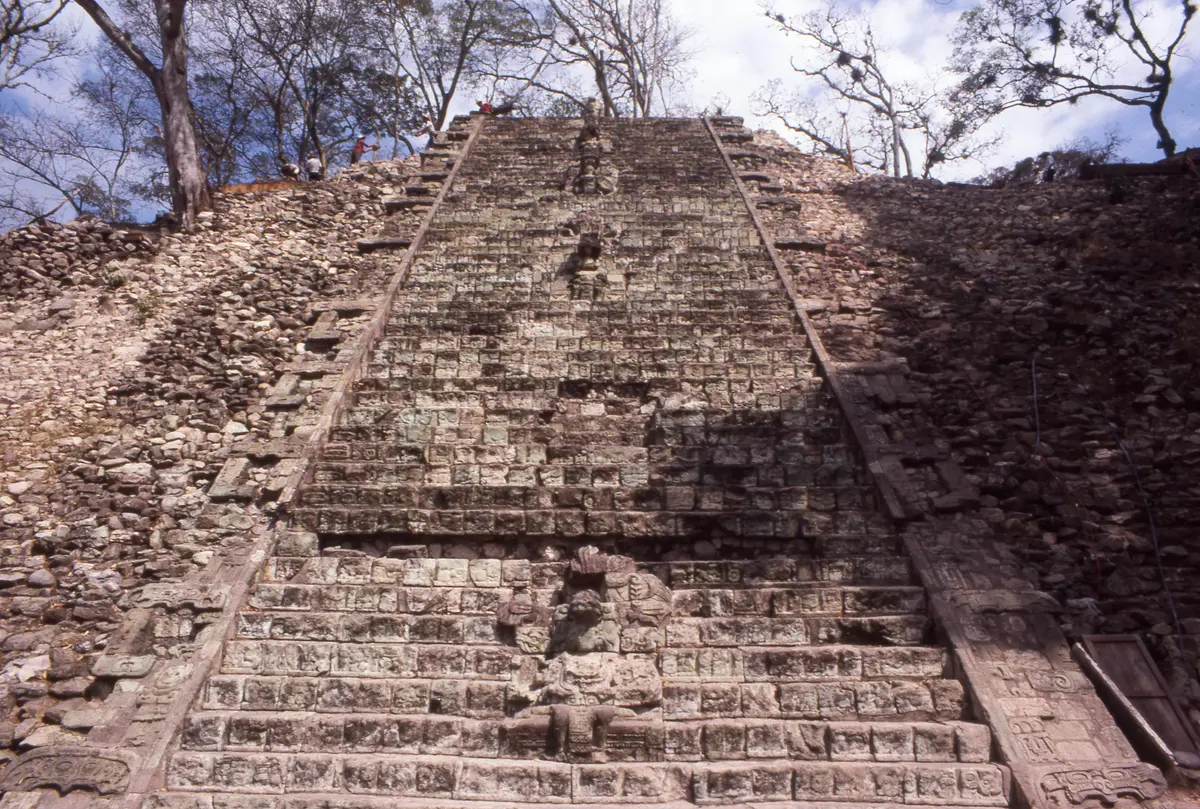
Hire a guide at the entrance. Official IHAH guides charge $30 to $40 per group and wear badges; unofficial ones will approach you in the same place, and only the badge-holders are legitimate. It is worth the money because the carvings, not the scale, are the entire reason this site matters — the Hieroglyphic Stairway carries 2,200 glyphs, the longest known Maya text. On tipping, Honduran restaurants often add around 10% as servicio; travelers give guides something like 100 to 200 lempiras a person for a half day, and reviews describe tips as appreciated rather than expected.
Tickets are bought at the park itself, in lempira, dollars or by card — a tour that includes entry is buying yours at the same window. The ticket is good for one entry within eight days. Nobody selling a fifteen-hour day trip is going to mention that.