An El Salvador SIM card or travel eSIM keeps you on Google Maps, Uber, and WhatsApp from the moment you land — without brutal roaming bills. This guide compares Tigo, Claro, Movistar, and Digicel, names the cheapest plans in USD, shows exactly where to buy, and settles the passport-registration confusion that trips up most travelers.
For most US travelers, a travel eSIM is the smartest choice for El Salvador: install it before you fly and you have data on landing, with no shop visit. For long, budget trips, buy a Tigo or Claro prepaid SIM in the city (not the airport), where a starter SIM costs about $1 and data bundles start near $1.25.
Quick verdict — eSIM or local SIM for El Salvador?
An eSIM wins for short trips, convenience, and keeping your US number live for two-factor codes; a local Tigo or Claro SIM wins for long stays and the lowest cost per gigabyte. Roaming is the worst value. Choose an eSIM if your trip is under two weeks; choose a local SIM if you’re staying a month or backpacking the region.
Here’s the rough math that drives the decision:
- eSIM data: 1 GB starts around $6-8
- Local starter SIM: about $1 before you add a data bundle
- US carrier roaming: often several dollars per small data block, billed daily
There’s a real difference in how the trip starts. Step off the jet bridge with an eSIM already running and you’re ordering an Uber before you reach baggage claim. Skip it, and you’re hunting for the single airport kiosk while everyone else walks past you to the taxis.
Match your traveler type to the right option:
| Traveler type | Best option | Suggested data |
|---|---|---|
| Short-trip vacationer (3-7 days) | eSIM | 3-5 GB |
| Surf/backpacker (El Tunco, El Zonte) | Local Tigo or Claro SIM | 10 GB+ or unlimited social |
| Digital nomad / remote worker | Local SIM with large bundle, or unlimited eSIM | 10 GB+ |
| Crypto-curious / business traveler | eSIM (instant + keeps 2FA) | 5 GB |
| Multi-country Central America | Regional eSIM | 5-10 GB |
Pro Tip: If your phone supports dual SIM, run a data eSIM alongside your home SIM. You get cheap local data and still receive bank verification texts on your US number.
Can tourists buy a SIM card in El Salvador?
Yes. Any visitor can buy a prepaid SIM in El Salvador, and it’s cheap and quick. Your phone must be carrier-unlocked for a local SIM or eSIM to work. El Salvador uses the US dollar, so prices are easy to read, and a basic SIM costs around $1 before you add a data bundle.
The unlocked-phone requirement is the one thing that catches people out. A phone still tied to a US carrier’s payment plan will reject a foreign SIM, and you won’t find that out until you’re standing at the counter in San Salvador with a useless chip.
- Currency: US dollar (official since 2001, so no conversion math)
- Phone requirement: must be carrier-unlocked
- Starter SIM cost: around $1
Pro Tip: Check that your phone is unlocked before you leave home. Most US carriers will unlock a fully paid-off phone on request, but it can take a day or two to process.
Do you need a passport to buy a SIM card in El Salvador?
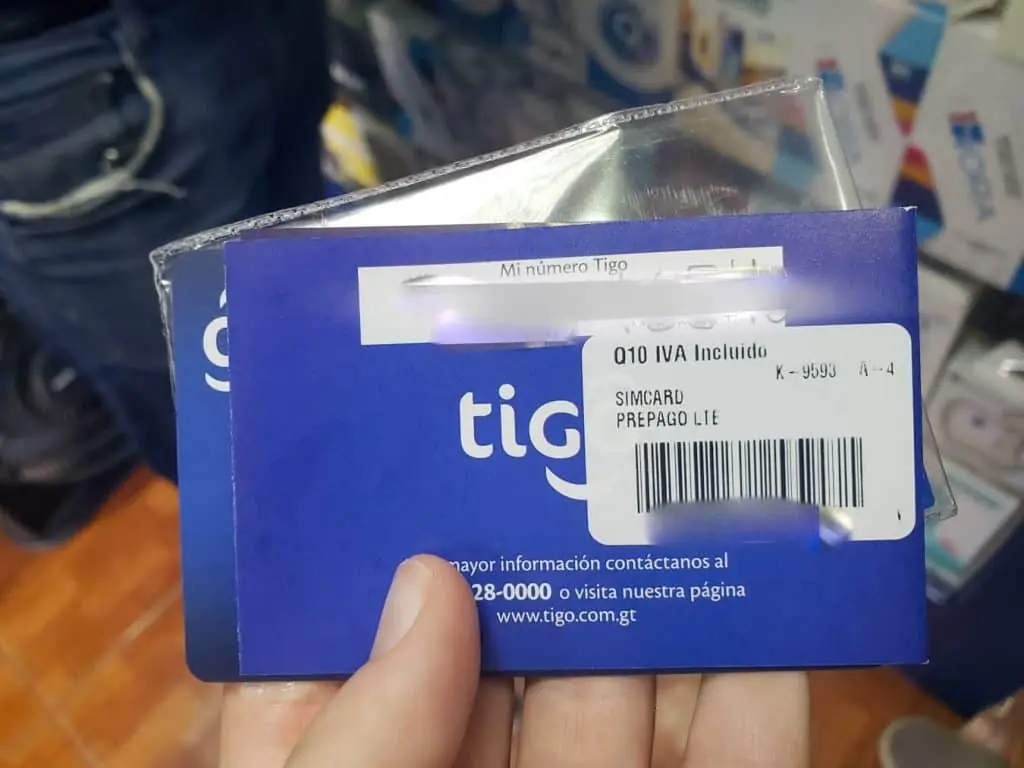
For tourists, SIM registration is generally not required in El Salvador — most travelers buy a prepaid SIM and have it activated on the spot without showing ID. Some operator stores may still ask to see your passport, so carry it. There’s no biometric registration, and an eSIM never requires ID.
This is the single most contradicted point in other guides, and the confusion is worth clearing up. Page 1 of Google is split: some posts insist a passport is mandatory, others say it’s never needed. The on-the-ground reality is in between.
- Street vendors and convenience stores: typically activate on the spot, no ID
- Official carrier stores in malls: may ask for a passport
- eSIM: no ID required, ever
On my last visit, a street vendor in the historic center of San Salvador popped a Claro SIM in and had the data bundle live in about two or three minutes, no paperwork, while I waited at the stall.
Which network is best in El Salvador — Tigo, Claro, Movistar, or Digicel?
Tigo and Claro are the best networks for tourists. Tigo has the broadest coverage and launched the country’s first 5G; Claro consistently posts the fastest download speeds and strong rural reach. Movistar is a solid third, while Digicel has the weakest footprint outside cities — avoid it if you leave San Salvador.
A quick note on a myth you’ll see repeated: Movistar was not absorbed by Claro. The proposed takeover was abandoned, and Movistar El Salvador still operates as an independent carrier, running a “5G Ready” service over its 4G LTE network on the 850 MHz and 1,900 MHz bands.
Here’s how the four stack up:
| Carrier | Owner | Coverage | Speed | 5G | Best for |
|---|---|---|---|---|---|
| Tigo | Millicom | Broadest | Strong | Yes (first in country) | Most travelers, widest reach |
| Claro | América Móvil | Strong + rural | Fastest measured | No (4G/4.5G) | Speed and rural roads |
| Movistar | Telefónica | Good | Good | “5G Ready” 4G LTE | Backup / eSIM host network |
| Digicel | Digicel | Weakest | Weak outside cities | No | City-only, low priority |
The difference shows up the moment you leave a main highway. On back roads in the interior, I’ve watched bars drop to nothing on three phones while a single Tigo handset held one stubborn bar of signal.
How much does a SIM card and data cost in El Salvador?
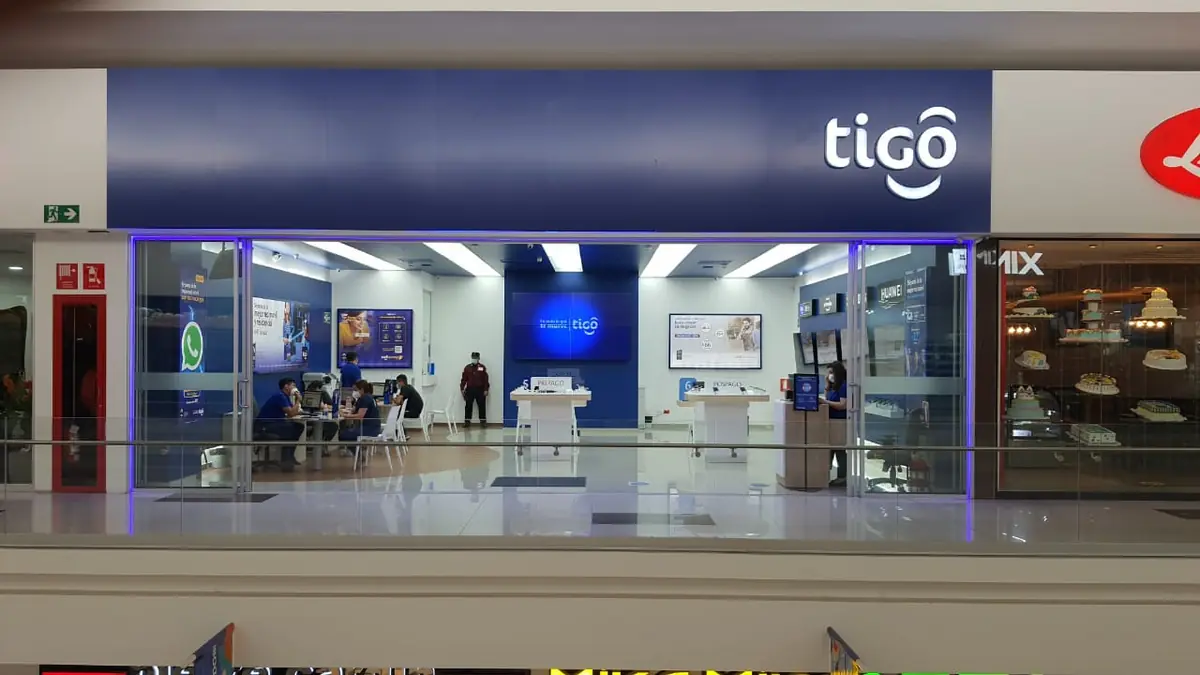
A prepaid SIM in El Salvador costs around $1, and data bundles are among the cheapest in Central America. Tigo’s all-inclusive prepaid packs start near $1.25 and unlock unlimited social apps from $4; Claro sells short unlimited-browsing blocks from about $1.50. Expect to pay only a few dollars for enough data for a week of maps and messaging.
The carrier package structures are worth knowing before you walk into a store, because the labels make no sense until someone explains them:
- Tigo “PaqueTigo Todo Incluido”: packs from $1.25; social apps plus YouTube and TikTok become unlimited from the $4 pack
- Claro “Navegación Ilimitada” blocks: from about $1.50 (a $1.50 block carries 10 GB for one day; a $2.00 block carries 20 GB for two days)
- Starter SIM: around $1
- Airport prices: inflated above city rates
Topping up is almost too easy. At a corner shop you hand over a few dollars and your phone number, and the credit lands before you’ve put your wallet away.
Pro Tip: Claro’s short unlimited blocks are built for heavy single-day use — a $2 block with 20 GB over two days is ideal for a coastal road trip with constant navigation, not for stretching across a whole week.
Where can you buy a SIM card in El Salvador?
Buy a SIM at official carrier stores in malls like Centro Comercial Galerías, at convenience stores and gas stations countrywide, or from street vendors in San Salvador’s historic center who activate cards on the spot. At the airport you’ll usually find only a Digicel kiosk, so most travelers either buy in the city or arrive with an eSIM.
Your realistic buying points, ranked by how good a deal you’ll get:
- Carrier stores in malls (Centro Comercial Galerías and similar): full plan options, may ask for passport
- Convenience stores and gas stations: quick, countrywide, basic packs
- Street vendors in the historic center: cheapest, activated on the spot, no ID
- Airport: Digicel kiosk only, higher prices
The airport Digicel counter is small and tucked near the arrivals exit. It’s tempting because you’re tired and want to be connected, but you’re paying a premium for the weakest network — the city is a better deal in every direction.
Can you buy a SIM card at San Salvador airport?
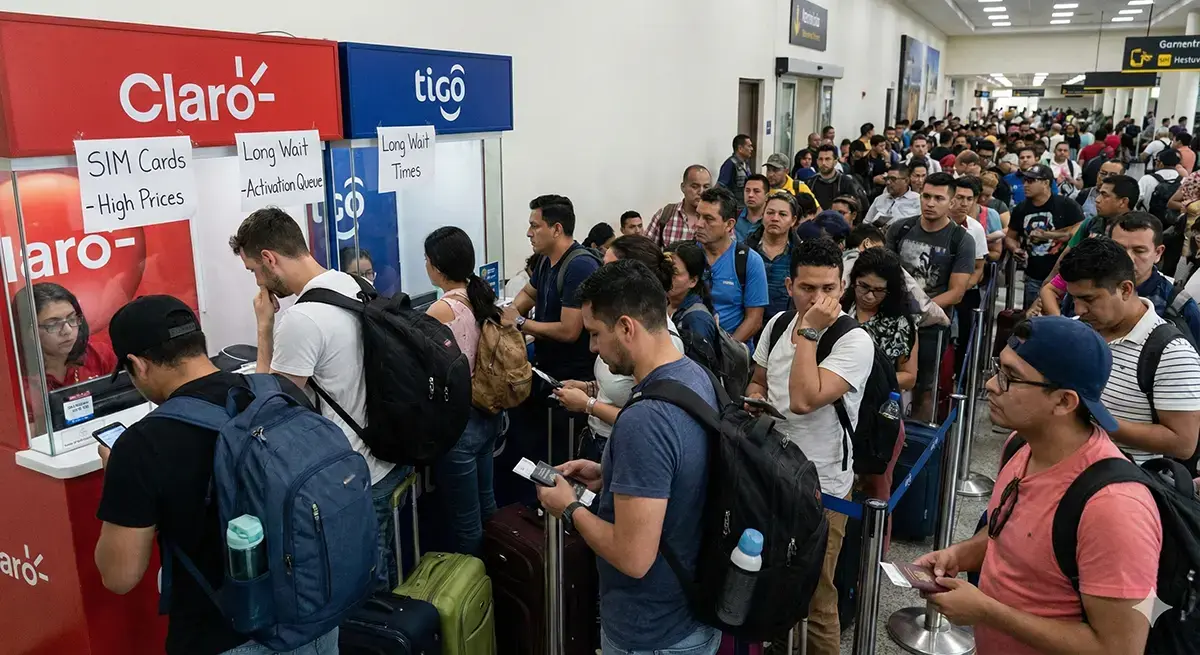
Yes, but options are limited. San Salvador’s Monseñor Óscar Arnulfo Romero International Airport (SAL) typically has only a Digicel kiosk in the terminal, and Digicel has the weakest nationwide coverage. Prices there run higher than in the city. If you want strong data the moment you land, install an eSIM before departure instead.
- Airport carrier: Digicel kiosk only
- Coverage: weakest of the four networks
- Price: higher than city shops
- Distance to San Salvador: about 31 miles (50 km), a 30-45 minute drive
That drive is exactly long enough to make you wish you already had data — no Uber, no offline-free maps, just a ride you arranged at the counter. An eSIM scanned in the departure lounge before you flew solves the whole problem.
Is an eSIM better than a SIM card for El Salvador?
An eSIM is more convenient: you install it before flying, skip the shop, keep your US number for texts and 2FA, and you’re online on arrival. A local SIM is cheaper per gigabyte and gives you a local number. The trade-off is convenience versus cost, plus your phone must support eSIM.
Weigh them honestly — the eSIM blogs that dominate search results have a clear incentive to push their own product:
- eSIM advantages: instant activation, no ID, dual-SIM keeps your US number, online on landing
- Local SIM advantages: cheaper per gigabyte, gives you a local number, easy cash top-ups
- eSIM requirement: a compatible phone (iPhone XR/XS or newer, Galaxy S20 or newer, Pixel 3 or newer)
I scanned a QR code in the departure lounge at home, landed in San Salvador, and the line connected itself before I’d cleared immigration. For a short trip, that’s worth the slightly higher per-gigabyte cost.
Best eSIMs for El Salvador compared
The leading eSIMs for El Salvador are Airalo, Saily, Nomad, Holafly, and Jetpac. Airalo and Nomad run on Movistar’s 4G; Saily offers strong value; Holafly sells unlimited data with a fair-use cap; Jetpac often discounts a first 1 GB. Prices for 1 GB start around $6-8, with 5 GB plans roughly $28-32 for 30 days.
Here’s how the major providers compare on real numbers:
- Airalo (Movistar network, data-only, no 5G): 1 GB / 7 days for $8.00; 5 GB / 30 days for $32.50
- Saily: 1 GB / 7 days for $6.99; 3 GB for $17.99; 5 GB for $27.99; 10 GB for $45.99 (all 30-day validity)
- Nomad (Movistar 4G/4G+): 1 GB / 7 days for $11; 3 GB for $20; 5 GB for $28; 10 GB for $45 (all 30 days)
- Holafly: unlimited data with fair-use throttling; data-only, no phone number
- Jetpac: frequently discounts a first 1 GB
One honest caveat on the “unlimited” plans: they slow down noticeably once you cross the fair-use threshold. After a couple of heavy streaming days, the speed drop is obvious — fine for maps and messaging, frustrating for video.
Pro Tip: Since Airalo and Nomad both ride Movistar’s network, an eSIM gives you Movistar-level coverage, not Tigo’s. If you’re heading to remote areas, a physical Tigo SIM will hold signal where a Movistar-based eSIM won’t.
Does El Salvador have 5G and good coverage?
El Salvador now has 5G: Tigo switched on the country’s first commercial 5G network, initially around the San Salvador metro area and Puerto de La Libertad. Most of the country still runs on solid 4G LTE. Coverage is excellent in cities and good in towns, but it weakens on remote roads, mountain trails, and parts of the surf coast.
Tigo (Millicom) activated El Salvador’s first commercial 5G network with roughly 70 antennas reaching more than 600,000 people. CEO Carolina Vallejo called it “un paso histórico.” The initial 5G footprint covers:
- San Salvador’s Centro Histórico
- Soyapango and Mejicanos
- Antiguo and Nuevo Cuscatlán
- Santa Tecla and Lourdes
- Puerto de La Libertad
Prepaid tourist SIMs with an active data package can use 5G where coverage exists and your handset supports it. Claro and Movistar mostly run 4G/4.5G, and signal on rural roads and volcano trails is patchy. I had full 5G bars in San Salvador that faded to a single bar of 4G while climbing toward the Santa Ana crater.
Mobile coverage in El Salvador’s top tourist areas
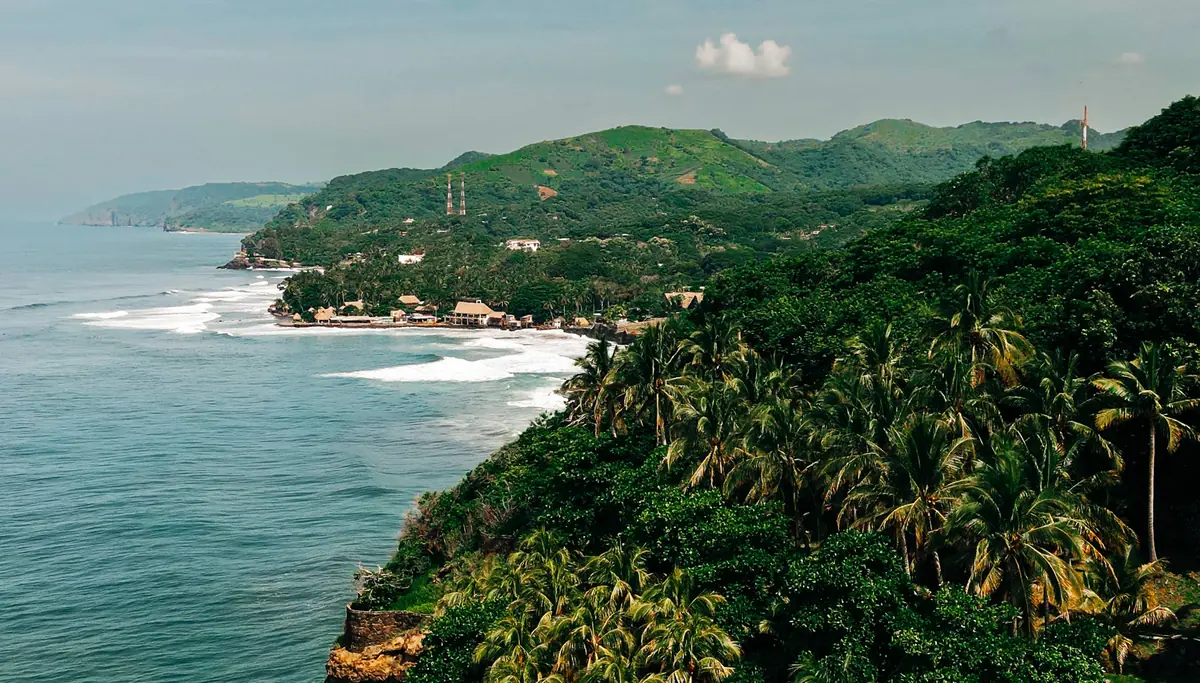
In San Salvador, El Tunco, and Santa Ana city, expect strong, fast data on Tigo or Claro. El Zonte (Bitcoin Beach), the Ruta de las Flores towns, El Boquerón, and the Santa Ana Volcano trail have weaker or patchy signal — download offline maps first. Suchitoto and Joya de Cerén sit in between, with reliable data in town centers.
Coverage by destination:
- Strong, fast signal: San Salvador, El Tunco, Santa Ana, La Libertad
- Patchy or weak: El Zonte, Ruta de las Flores (Juayúa, Ataco), El Boquerón, Santa Ana Volcano summit (7,812 ft / 2,381 m)
- In between (reliable in town centers): Suchitoto, Joya de Cerén
A few distances that shape your data planning:
- El Zonte (Bitcoin Beach): about 26 miles (42 km) from San Salvador
- Santa Ana Volcano summit: 7,812 ft (2,381 m)
The dirt approach into El Zonte is where I lost signal completely. Down at the beach, café Wi-Fi becomes your real connection, which is part of why offline maps matter on this stretch of coast.
Pro Tip: Download offline Google Maps for the whole coastal and volcano region before you leave a strong-signal area. It turns a dead zone from a navigation crisis into a non-event.
How much mobile data do you actually need in El Salvador?
Most travelers need only modest data in El Salvador. Light use — maps, WhatsApp, and social — runs about 0.5-1 GB per day; moderate use with streaming and frequent navigation is 1-2 GB per day; heavy use with video calls is 3-5 GB per day. A 5 GB plan comfortably covers a one-week trip for the average tourist.
Right-size your plan with these daily benchmarks:
- Light (maps, WhatsApp, social): 0.5-1 GB per day
- Moderate (streaming, frequent navigation): 1-2 GB per day
- Heavy (video calls, hotspot): 3-5 GB per day
- Typical one-week trip: 5 GB total is plenty
Downloading offline maps before a road trip slashes daily data use more than any other single habit — your navigation stops pulling map tiles over the network all day.
Should you just use roaming or your US carrier?
Standard US carrier roaming is the most expensive way to get data in El Salvador and is rarely worth it for more than a day. Several US “international day pass” plans charge a daily fee that quickly exceeds the price of a whole eSIM. Unless your plan includes free Latin America roaming, use an eSIM or local SIM instead.
- Day-pass roaming: a flat daily fee that adds up fast over a week
- Standard pay-per-use roaming: costly per megabyte, easy to rack up bills
- The fix: check whether your plan includes free regional data before relying on it; if not, use an eSIM or local SIM
On one trip, a companion who left roaming on watched a day-pass fee multiply across the week until it dwarfed the $30 eSIM the rest of us were using.
Does bitcoin matter when buying a SIM in El Salvador?
El Salvador made headlines as the first country to adopt bitcoin as legal tender, but that status was rolled back, so bitcoin acceptance is now voluntary and the US dollar runs daily life. You can pay for nearly everything, including SIM cards and top-ups, in dollars. A few merchants still accept bitcoin, but you never need it to get connected.
El Salvador’s Legislative Assembly voted 55–2 to amend the Bitcoin Law, stripping bitcoin’s “currency” designation and making private-sector acceptance voluntary — a condition of a $1.4 billion IMF Extended Fund Facility. The IMF’s own country report confirms the reforms made acceptance of bitcoin by the private sector voluntary.
- Everyday currency: the US dollar, dominant since 2001
- Bitcoin status: voluntary acceptance, not legal tender
- Buying a SIM: pay in cash dollars everywhere; bitcoin is never required
I paid for a SIM in cash dollars at a stall while the café next door still had a bitcoin QR sticker in the window — a neat snapshot of where the country actually landed.
How to set up and activate your SIM or eSIM
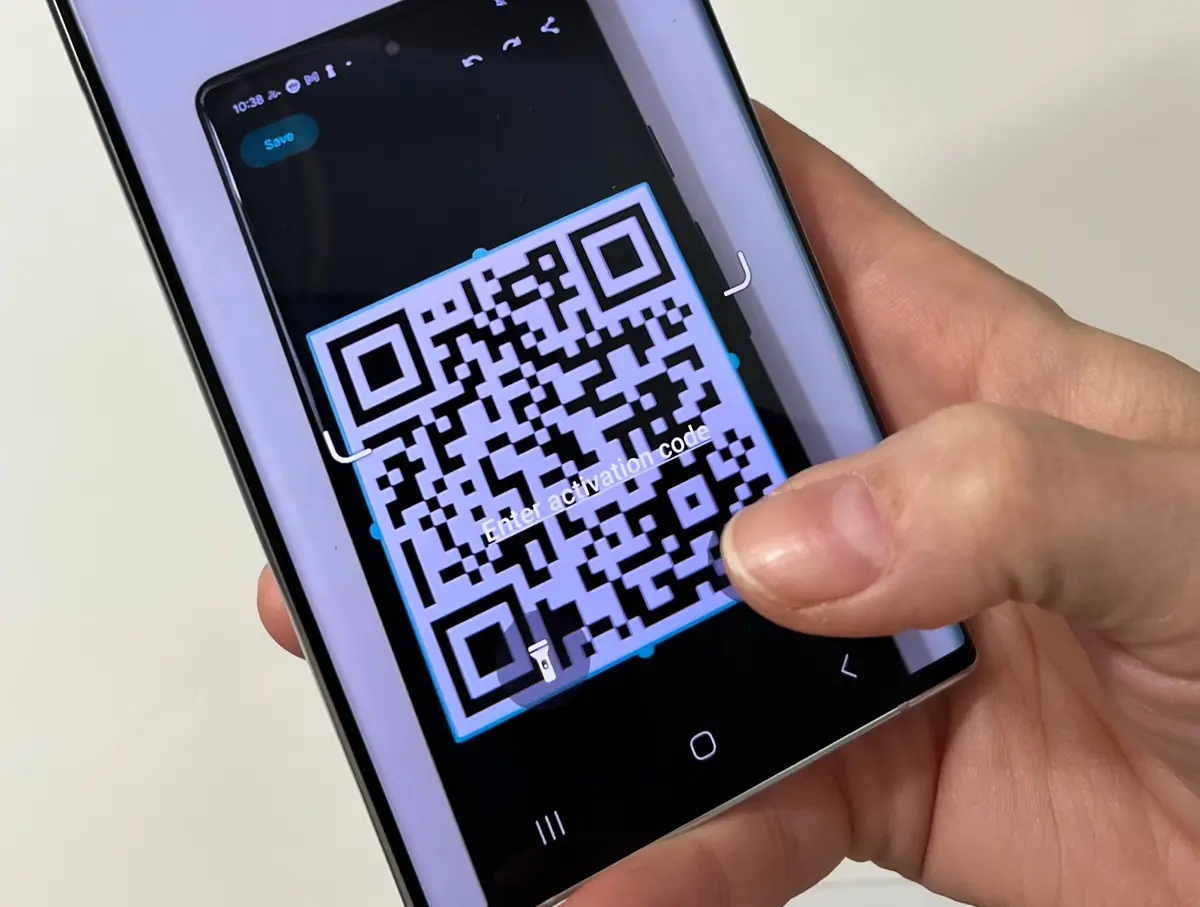
For a local SIM, insert it, ask the vendor to activate the bundle, and confirm data works before you leave the counter. For an eSIM, buy online, scan the QR code, enable the line and data roaming, and it activates when you connect in El Salvador. Either way, keep your home SIM available for texts and bank codes.
Local SIM steps:
- Insert the SIM and ask the vendor to activate your chosen data bundle
- Confirm working data before you pay or walk away
- Keep your home SIM safe for 2FA texts
eSIM steps:
- Buy online and scan the QR code to install the line
- Enable the eSIM line and turn on data roaming for it
- It activates when you connect to a network in El Salvador
- Use dual-SIM so your US number stays live for bank codes
Pro Tip: Insist the vendor shows you working data — open a webpage or load a map — before you leave the counter. Once you walk away, sorting out an activation problem is far harder.
The bottom line on getting connected in El Salvador
TL;DR: Get a travel eSIM if your trip is short or you value convenience, and install it before you fly. Buy a Tigo or Claro prepaid SIM in the city for long, budget trips, where a SIM is about $1 and bundles cost a few dollars. Skip the airport Digicel kiosk and skip US roaming. Download offline maps for the coast and volcano trails.
The single best feeling on this trip is stepping off the plane already connected — no kiosk hunt, no taxi-counter negotiation, just an Uber ordered from the jet bridge. Whichever option you pick, set it up before signal becomes a problem, not after.
Which kind of traveler are you — the short-trip eSIM type, or the long-stay local-SIM type? Tell me your itinerary in the comments and I’ll point you to the right plan.