Nazaré Portugal is one of Europe’s most misunderstood travel destinations. Most visitors arrive in summer expecting the building-sized waves that have defined Portugal’s surfing reputation globally, and leave confused. This guide explains exactly what Nazaré delivers — by season, by zone, and by the details most travel articles skip.
What makes Nazaré’s waves so massive?
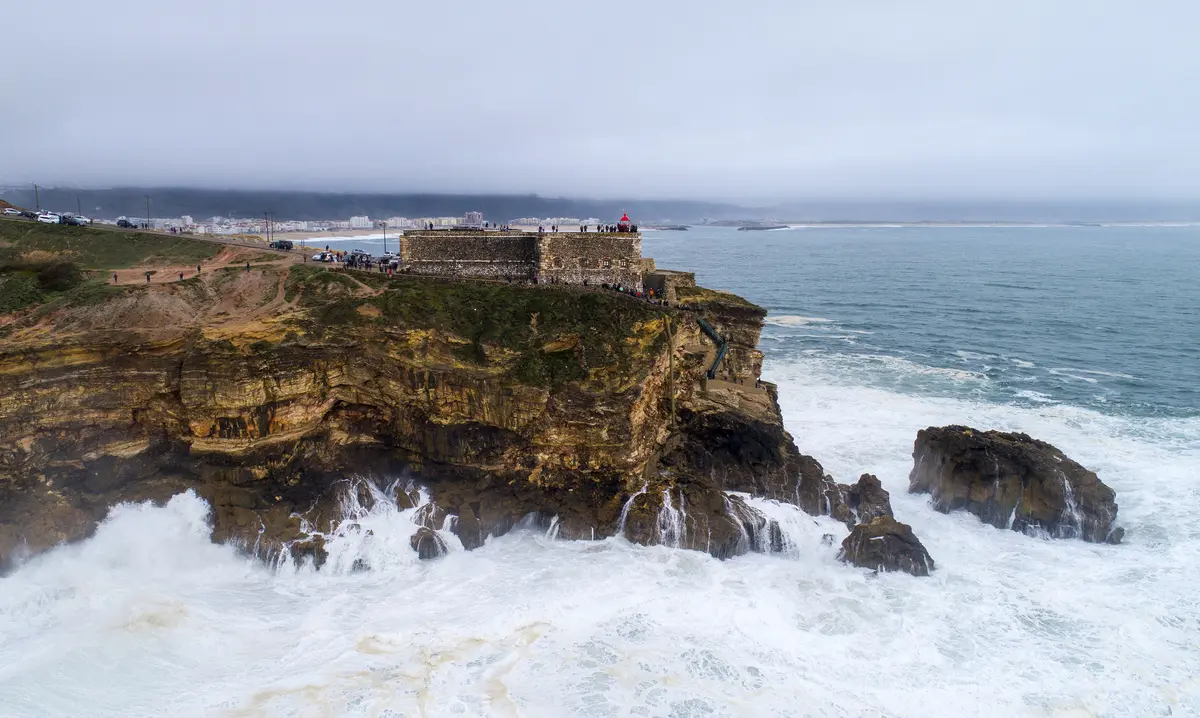
Nazaré’s monster waves come from the Nazaré North Canyon, the largest underwater canyon in Europe. Its head terminates less than 1,000m (0.6 miles) from shore, acting as a deep-sea expressway that delivers the full force of an Atlantic swell directly to the cliff face — creating wave heights that would be impossible at any other Atlantic coastal town.
Understanding the Nazaré North Canyon
The canyon stretches roughly 230km (143 miles) westward into the Atlantic and plunges to depths of 5,000m (16,400 feet). That scale is nearly impossible to comprehend from shore. It’s what separates Nazaré from other famous big wave spots like Jaws in Hawaii or Mavericks in California.
The critical detail is where the canyon ends. In a typical coastal setup, ocean swells lose energy as they drag across the shallow continental shelf. The canyon bypasses all of that friction entirely.
It acts like a deep-sea expressway, preserving the full force of an Atlantic swell right up to the cliff face.
How two waves become one monster
The wave traveling at full speed through the canyon eventually meets the slower wave rolling over the shallow shelf beside it. These two waves don’t cancel each other out — they combine. The resulting peak is roughly the sum of both individual waves in height.
Surfers call this a “mutant” or “pyramidal” peak. Add in the backwash from previous waves pushing hard against the incoming swell, and you have an unpredictable mountain of water. It’s the kind of wave that draws the bravest athletes on earth to Nazaré every winter.
When is the best time to visit Nazaré Portugal?
Nazaré operates on a completely different calendar from the rest of the country. Come between November and February for monster waves and surf history. Plan for June through September for swimming, sunshine, and seafood on the promenade. Getting the season wrong means missing the entire point of your trip.
Many visitors make the mistake of showing up in July expecting the footage they’ve seen in HBO’s 100 Foot Wave. Those waves are a winter in Portugal phenomenon, driven by low-pressure systems churning across the North Atlantic. By summer, the ocean is essentially flat.
What to expect across the seasons
Here’s what to realistically expect across the year:
- January: Extreme wave potential, very low crowds, cold and wet weather.
- May: Low wave potential, medium crowds, warm and pleasant weather.
- July: No big waves, peak crowds, hot weather suited for swimming.
- October: Moderate waves, medium crowds, mixed weather.
December and January are historically the most consistent months for enormous swells — the deep heart of winter when Atlantic storm systems are at their most sustained.
How to track a swell before you go
If you’re timing your trip around big wave events in Nazaré, use dedicated surf forecasting apps. Surfline and Windguru are the tools serious wave-chasers rely on.
The key metrics to watch are a swell height above 3.5m (11.5 feet) and a swell period over 14 seconds. Those two numbers together signal that something remarkable may be on its way.
Pro Tip: The WSL Nazaré Big Wave Challenge runs on an alert system rather than a fixed date. When conditions align, the WSL issues a 72-hour Yellow Alert, then a 24-hour Green Alert. Sign up for WSL notifications if you want any realistic chance of watching competition from the fort rooftop.
Where is the best place to watch waves in Nazaré Portugal?
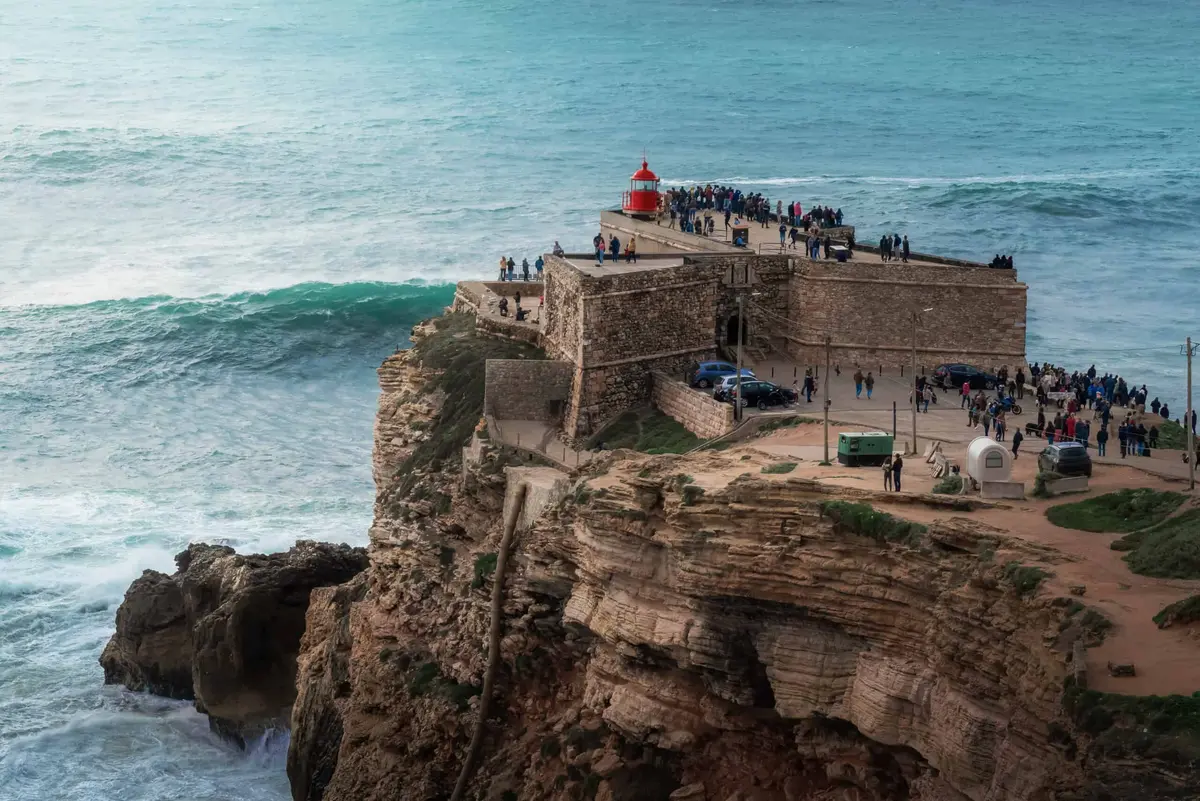
The best place to watch waves in Nazaré Portugal is the rooftop of Forte de São Miguel Arcanjo. This 16th-century fort puts you almost directly above the break at Praia do Norte. The waves crash toward the cliff, so you’re looking almost straight down at the action — you feel the roar through the stone and get hit with mist. Entry costs €2 ($2.20).
Inside Forte de São Miguel Arcanjo
The fort is open daily from 10am to 6pm, with last entry at 5:30pm. Inside, the surf museum displays boards used by big wave surfers including Garrett McNamara and Maya Gabeira. Seeing the actual tow-boards up close — understanding their weight and size relative to the waves they rode — puts the scale of these waves into a perspective that no video quite captures.
- Location: Estrada do Farol, Sítio da Nazaré (15–20 minute uphill walk from the funicular exit)
- Cost: €2 ($2.20) per person; children under 10 free
- Best for: First-time visitors, wave photography, surfing history
- Time needed: 45–60 minutes
Pro Tip: The rooftop fills fast when there’s a significant swell in the forecast. Arrive by 8:30am if you want a spot at the railing. By 10am on a good swell day, it’s shoulder-to-shoulder at the wall.
Alternative viewpoints around Sítio
When the lighthouse rooftop gets crowded, head to Miradouro do Suberco. This is the main balcony in Sítio and offers a side-angle view of the break. It’s also a better option for visitors with mobility concerns.
Miradouro da Pederneira gives you something entirely different: a distant panoramic perspective where you can watch entire wave sets approaching from miles out. The sense of scale against the open Atlantic horizon is worth the short detour on its own.
Is Nazaré safe for tourists?
Most of the town is safe and straightforward for tourists. The one real exception is Praia do Norte, where rogue waves have swept visitors off the sand without warning, surging 50 to 100m (165 to 330 feet) up the beach. Never turn your back on the ocean here, and maintain a real distance from the waterline at all times.
The cliff edges around the lighthouse are fenced for good reason. Further north along the exposed dirt trails, there are no barriers at all. The Nortada wind can gust up to 80 km/h (50 mph), which makes cliff-edge photography a real hazard.
Respect the warning signs. The ocean here does not make exceptions for anyone.
What is the cultural history of Nazaré?
Nazaré is one of Portugal’s most traditionally intact fishing villages, where centuries-old customs survive not as tourist performance but as lived daily practice. Strip away the wave footage and what remains is a community whose cultural identity — from the clothes women wear to how fish is preserved — is unlike anywhere else in Portuguese culture.

The Legend of the Seven Skirts
The most striking visual in Nazaré is women wearing seven layers of skirts, a tradition known as As Sete Saias. It was born from pure necessity, not fashion.
Fishermen’s wives spent hours waiting on the beach for their husbands to return from sea. The seven layers provided thermal insulation against brutal Atlantic winds, and the upper skirts could be pulled over the head for protection from rain.
Local history offers multiple explanations for the number seven. Some say the sea calms after the seventh wave. Others connect it to the seven virtues or the seven days of the week.
Fish drying at Seca do Peixe
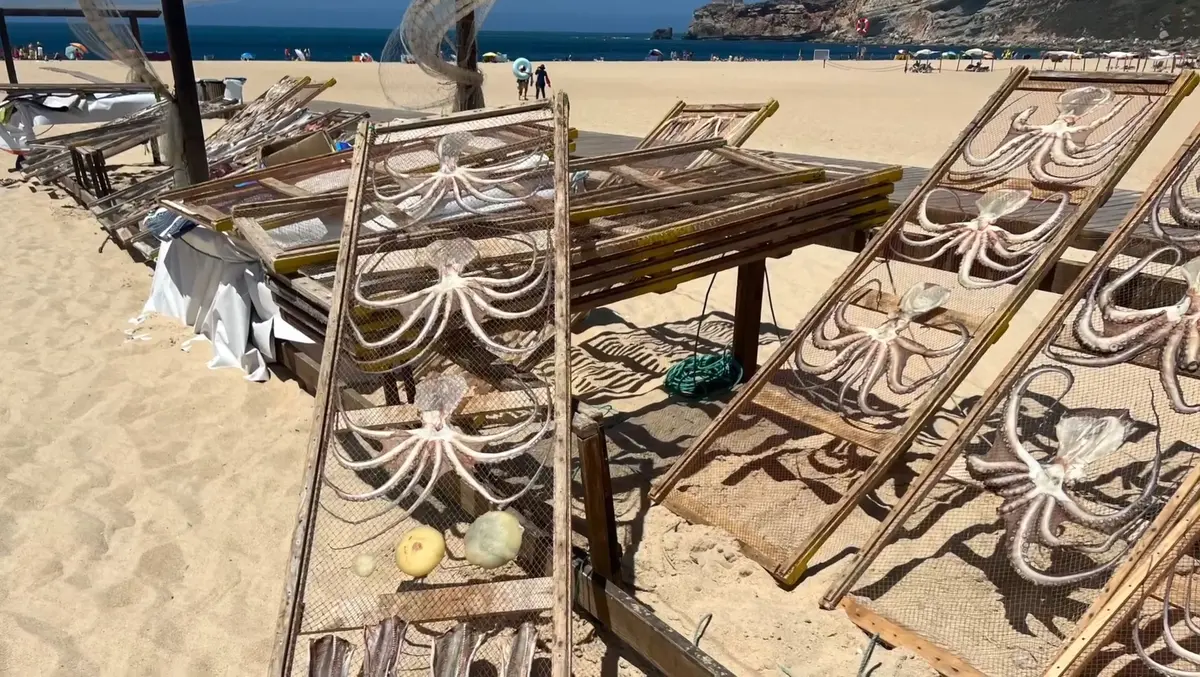
At the southern end of the promenade, you’ll find Seca do Peixe, the traditional fish-drying area. Mackerel, sardines, and octopus are gutted, washed in saltwater, and laid out on wooden racks under the sun.
This method predates refrigeration entirely. It was the primary way fishing communities preserved protein through rough winter months.
The smell is intense. It is also completely essential to understanding the soul of this place — don’t let anyone steer you away from it.
The legend of Dom Fuas and the town’s founding
The town’s founding story reaches back into the country’s medieval past. In 1182, a knight named Dom Fuas Roupinho was hunting a deer in heavy fog near the cliffs. The deer leaped into the void. The knight, realizing his peril, cried out to “Our Lady of Nazareth.” His horse stopped at the very edge of the precipice.
The hoofprint is said to be visible in the stone to this day. The Santuário de Nossa Senhora da Nazaré remains an active pilgrimage site and is worth a visit for its history alone.
How is Nazaré divided into three distinct zones?
Nazaré Portugal is split into three distinct zones: A Praia (the lively lower beach town), O Sítio (the quieter cliff top where the fort and sanctuary sit), and Pederneira (the inland residential hill). Understanding this geography on arrival saves real confusion — most first-time visitors don’t realize they’re dealing with three separate neighborhoods, each with a different character.
The funicular connecting A Praia and O Sítio
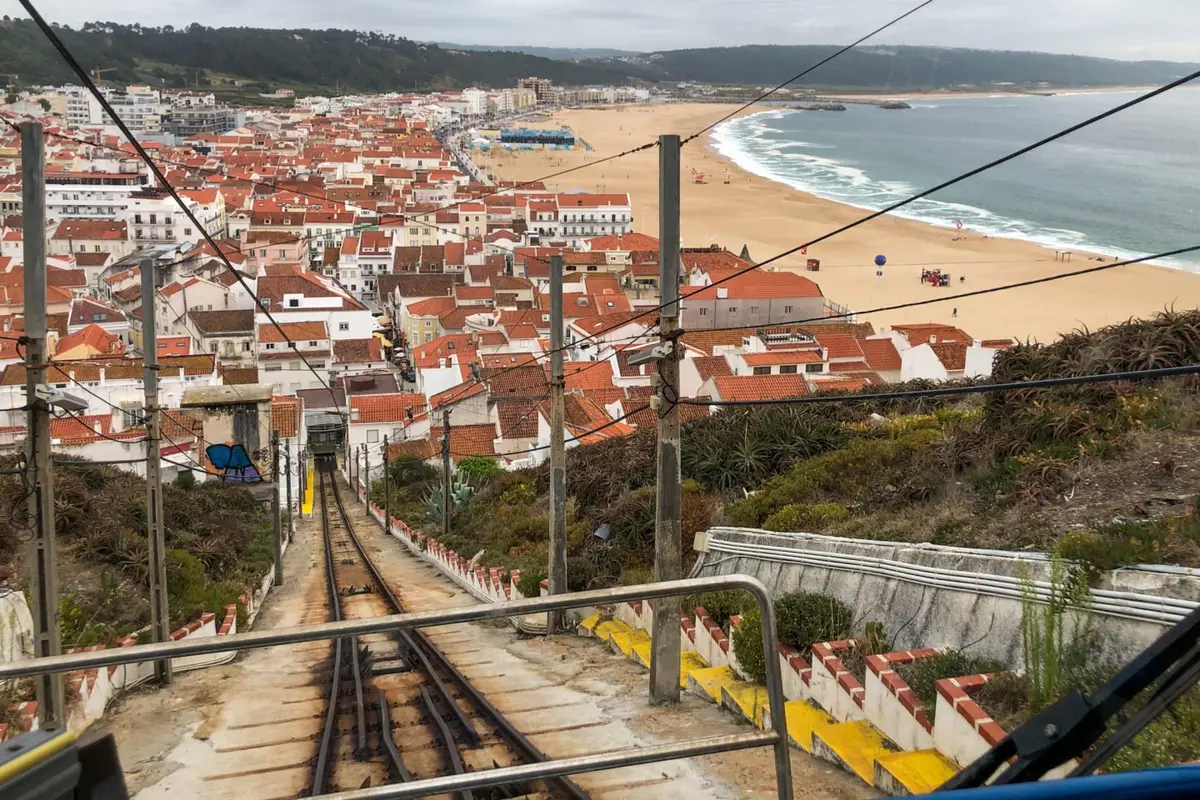
The funicular was built in 1889 by a disciple of Gustave Eiffel and remains one of the most charming details in Nazaré. It connects A Praia to O Sítio, where the fort, the best views, and the sanctuary are all located.
A Praia is the lively lower town packed with seafood restaurants and the main beach scene. O Sítio is calmer, higher, and historically far richer. On my last visit, the wait for the funicular in peak summer ran close to 20 minutes — if you’re heading up in the morning, the uphill path is faster and skips the queue entirely.
Pederneira — the zone most visitors skip
Pederneira is the inland hill that most day-trippers skip entirely. It was originally the seat of the municipality and today is an almost entirely residential area.
When the crowds in A Praia become overwhelming — and in peak summer, they do — Pederneira is your escape route. Few tourists make it there, which is exactly the point.
What are the best lesser-known spots in Nazaré?
Most visitors stick to the fort and the beach promenade. The town has three spots worth tracking down beyond the obvious circuit: the Baloiço da Ladeira swing with its clifftop view, the Barcos Salva Vidas historical lifeboat display, and the Forno de Orca sea cave at Praia do Norte — all coverable in under two hours combined.
The Baloiço da Ladeira is a swing set positioned along the zigzag dirt path connecting Sítio to the beach. The view it frames of the coastline is one of the better ones in Nazaré and feels entirely removed from the tourist circuit below.
Down on the beach, look for the Barcos Salva Vidas. This outdoor exhibition displays historical lifeboats that were once rowed by hand directly into winter storms. The craftsmanship — and the sheer audacity of those rescues — is remarkable up close.
One more spot worth knowing is the Forno de Orca Cave, a natural limestone sea cave at Praia do Norte. It frames the ocean through a dramatic arch. Access requires a slippery trail, and the cave is tidal — only visit at low tide on calm days. It is not forgiving if you misjudge the conditions.
Where should you stay in Nazaré?
Accommodation here ranges from waterfront hotels in A Praia to boutique guesthouses in O Sítio, with character-rich fishermen’s cottage rentals scattered across both neighborhoods. The best choice depends entirely on which version of Nazaré you’re visiting — O Sítio puts you closer to the waves and the fort, while A Praia keeps you near the summer beach scene and the promenade.
For solo travelers, Zulla Nazaré’s Surf Village offers a communal atmosphere popular with the surf crowd. Many short-term rentals are converted fishermen’s cottages, and from personal experience, these tend to deliver the most authentic feel for the town’s character.
Hotel Mar Bravo
Located in Sítio with panoramic ocean views directly over Praia do Norte. The strongest choice if you’re here for the waves — you can watch the sets roll in from your window on a big swell morning.
- Location: Sítio da Nazaré
- Cost: Check current rates
- Best for: Wave-watchers, couples, winter visits
- Time needed: 2+ nights minimum to catch a significant swell
Hotel Praia
Central and modern in A Praia, featuring a rooftop pool. The practical choice for summer beach visitors who want immediate access to the promenade.
- Location: A Praia, central Nazaré
- Cost: Check current rates
- Best for: Summer visitors, families
- Time needed: 2–3 nights
Villamar Style Maison
A boutique guesthouse with high-design aesthetics and a quieter atmosphere than the main beach strip.
- Location: A Praia
- Cost: Check current rates
- Best for: Couples, design-conscious travelers
- Time needed: 2 nights
Hotel Oceano
Budget-friendly and directly on the waterfront. No frills, good location.
- Location: Waterfront, A Praia
- Cost: Check current rates
- Best for: Budget travelers, solo visitors
- Time needed: 1–2 nights
Where should you eat in Nazaré?
Nazaré’s food scene is built on freshness. Expect to pay around €10–€15 ($11–$17) at a local tasca, or €40–€60 ($44–$66) and up for a more formal dining experience. The short distance between the tourist-facing promenade strip and the places locals actually return to is easy to navigate once you know the names.
Seafood specialties you have to try
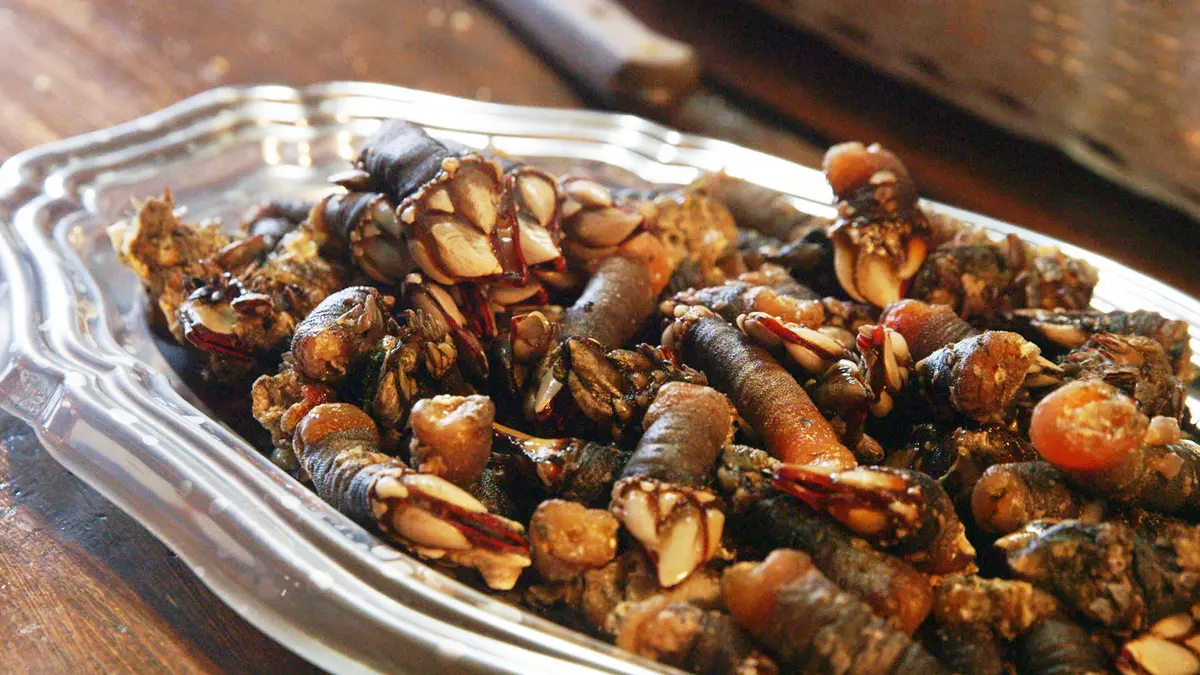
The dish you must order is percebes, or goose barnacles — one of the defining entries in traditional Portuguese food along the Silver Coast. They look like dragon claws and are harvested from dangerously exposed coastal rocks. The flavor is pure, concentrated ocean — unlike anything else you’ll eat in Portugal.
Also look for Caldeirada à Nazarena, a fish stew specific to this town. It uses a particular layering technique with potatoes, onions, and mixed fish, and the result is deeply savory in a way that no other version of fish stew quite replicates.
Restaurante A Celeste
The most reliable option near the beach for an authentic meal. Owner-chef Celeste has been running the kitchen for decades, and big wave surfers including Garrett McNamara treat it as their regular table during winter season. Order the caldeirada, the clams (amêijoas à Bulhão Pato), or whatever grilled fish is chalked on the board that day — the menu shifts with what came off the boats.
- Location: Avenida da República 54, A Praia
- Cost: ~€20 ($22) per person average
- Best for: Authentic local seafood, lunches and dinners
- Time needed: 1–1.5 hours
Taberna d’Adélia
A Michelin-listed restaurant on Rua das Traineiras where the catch is brought to your table before preparation — one of the more theatrical dining experiences in Nazaré. The ceiling is covered in paper “devotions” left by customers since 1989. If the oven-roasted redfish with açorda is available, order it without hesitation. One important local custom to know before you sit down: waiters will automatically bring bread, butter, and olives to your table. These are not complimentary — this is the couvert culture in Portugal. Send them back before you touch anything if you don’t want to pay for them.
- Location: Rua das Traineiras 12, A Praia
- Cost: ~€30 ($33) per person average
- Best for: Dinner, seafood lovers, special occasions
- Time needed: 1.5–2 hours
How do you get to Nazaré from Lisbon?
The drive from Lisbon takes roughly 90 minutes and the bus takes around 1 hour 45 minutes — both are straightforward options. There is one logistical issue that catches many international drivers completely off guard: many Portuguese highways have no physical toll booths, and rental cars without a Via Verde transponder create a billing headache after you return the vehicle. Request one when renting a car in Portugal at pickup.
Getting there by bus
The bus is the most efficient public transport option. Rede Expressos runs direct coaches from Lisbon’s Sete Rios station to the center of Nazaré, with tickets starting from around $4–$18 depending on how far in advance you book.
For travelers curious about train travel in Portugal more broadly, the national rail network is generally reliable — but Nazaré is an exception. There is no train station in the town itself. The nearest station is 5km (3 miles) away and served by infrequent connections, making the bus a far more practical choice.
Where to park if you drive
Parking in A Praia during summer is essentially impossible. Spaces disappear early and the sheer volume of foot traffic makes the lower town difficult to move through by car.
The smarter approach is to park in the large free lots in Sítio and take the funicular down to the beach. It costs less, takes less time, and the descent gives you one of the better views of the coastline in either direction.
Pro Tip: If you’re heading to Praia do Norte specifically to watch big waves, there’s a small unpaved lot directly off the access road. It fills fast on forecast days — arrive before 8am or park in Sítio and walk the 15 minutes down the dirt path.
What day trips can you take from Nazaré?
Nazaré Portugal’s position on the Silver Coast puts several UNESCO World Heritage Sites within easy reach, making it an ideal base for a multi-day exploration of central Portugal rather than a single-day stop.
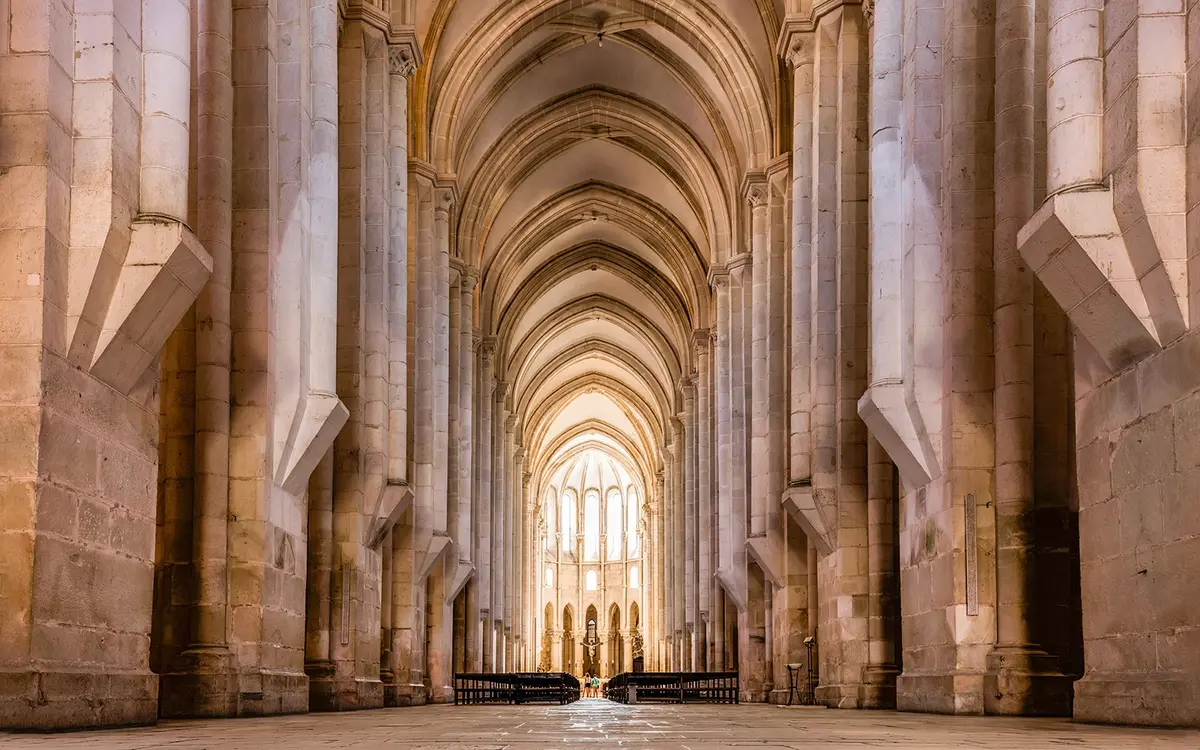
- Monastery of Alcobaça: 20 minutes away, home to one of the great tragic royal love stories in Portuguese history.
- Monastery of Batalha: A masterpiece of Portuguese Gothic architecture, roughly 30 minutes from Nazaré Portugal.
- Óbidos: A medieval walled town best visited in the late afternoon or evening to avoid the packed day-tour crowds.
- São Martinho do Porto: A calm, shell-shaped bay about 15 minutes south, ideal for swimming with children.
The bottom line
Nazaré Portugal delivers on two completely different promises, and the key to enjoying it fully is knowing which version you’re there for. In winter, you witness the raw power of nature on a scale that humbles you. In summer, you find a sun-baked village with a history and cultural depth unlike anywhere else on the Silver Coast.
TL;DR: Come in winter for the waves (November–February is peak season) and summer for the beach and seafood. Take the funicular, find the cave, order the percebes, and spend at least one evening in O Sítio after the day crowds have gone. Skip the promenade tourist traps and eat at A Celeste.
What’s drawing you to Nazaré — the big waves, the history, or both? Drop it in the comments and we’ll point you toward what to prioritize. For the full picture on planning a trip, our Portugal travel guide covers everything from itineraries to practical logistics.