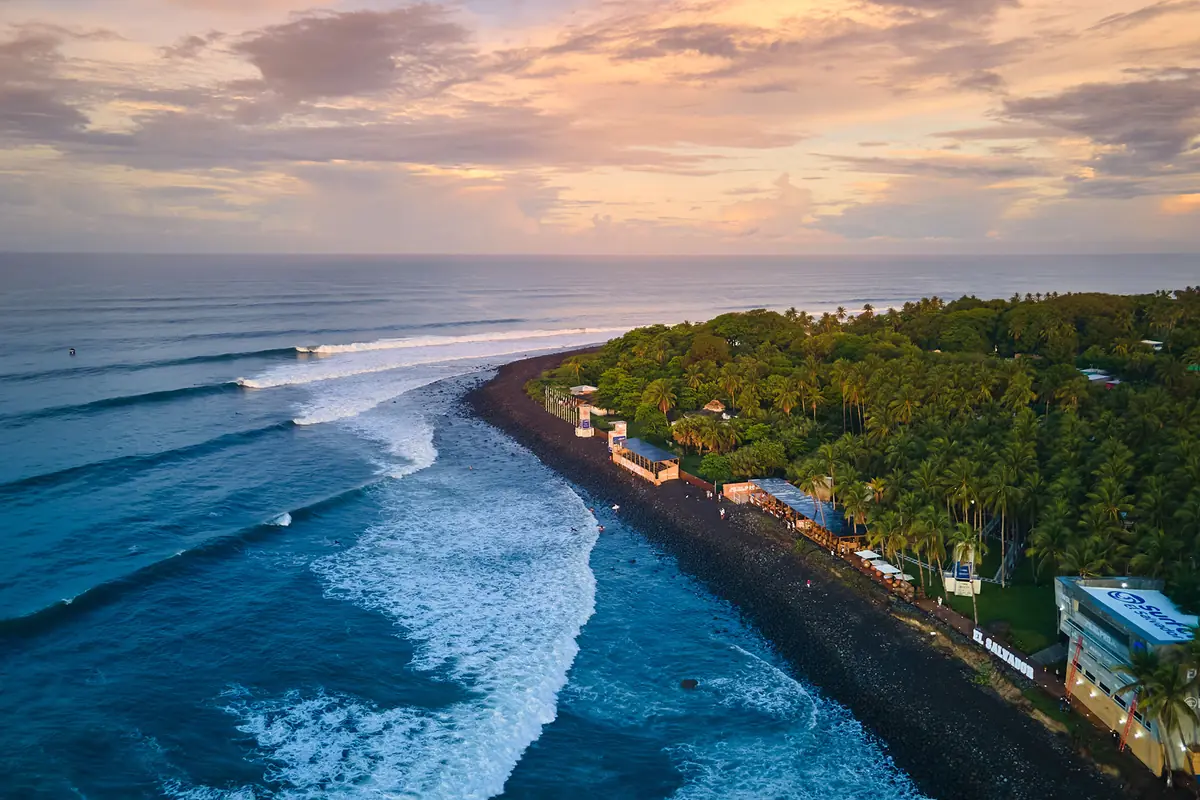
Punta Roca is a world-class right-hand cobblestone point break in La Libertad, El Salvador, widely regarded as one of the best right-hand points in the Americas and the home of the World Surf League’s Surf City El Salvador Pro. On a clean south swell, it peels for the better part of a quarter mile in bathwater-warm conditions, roughly 45 minutes from an international airport with nonstop flights from Houston, Miami, and Los Angeles.
Here is the short version: Punta Roca is an intermediate-to-advanced wave that works best from April through October, sits about 22 miles from San Salvador’s airport, costs most travelers $60 to $130 a day, and can be surfed year-round in boardshorts. El Salvador uses the US dollar, and the country currently carries a Level 1 travel advisory from the US State Department.
What and Where Is Punta Roca?
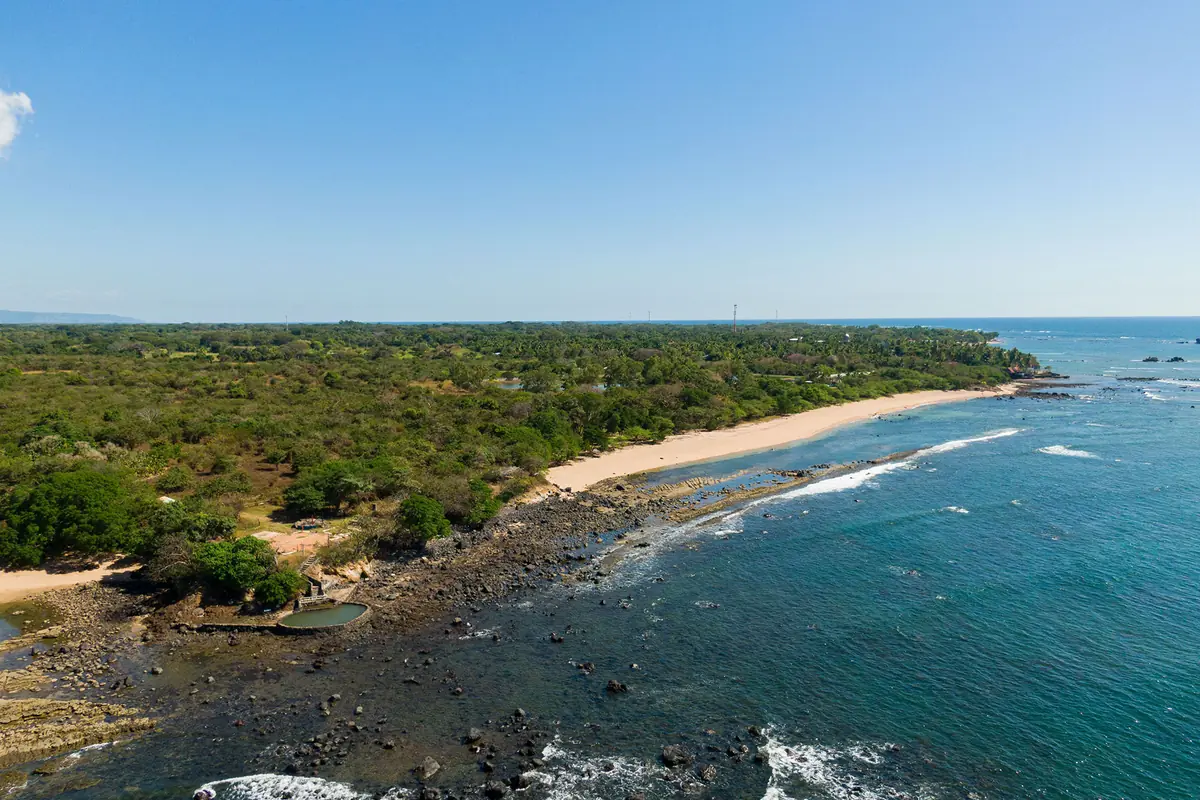
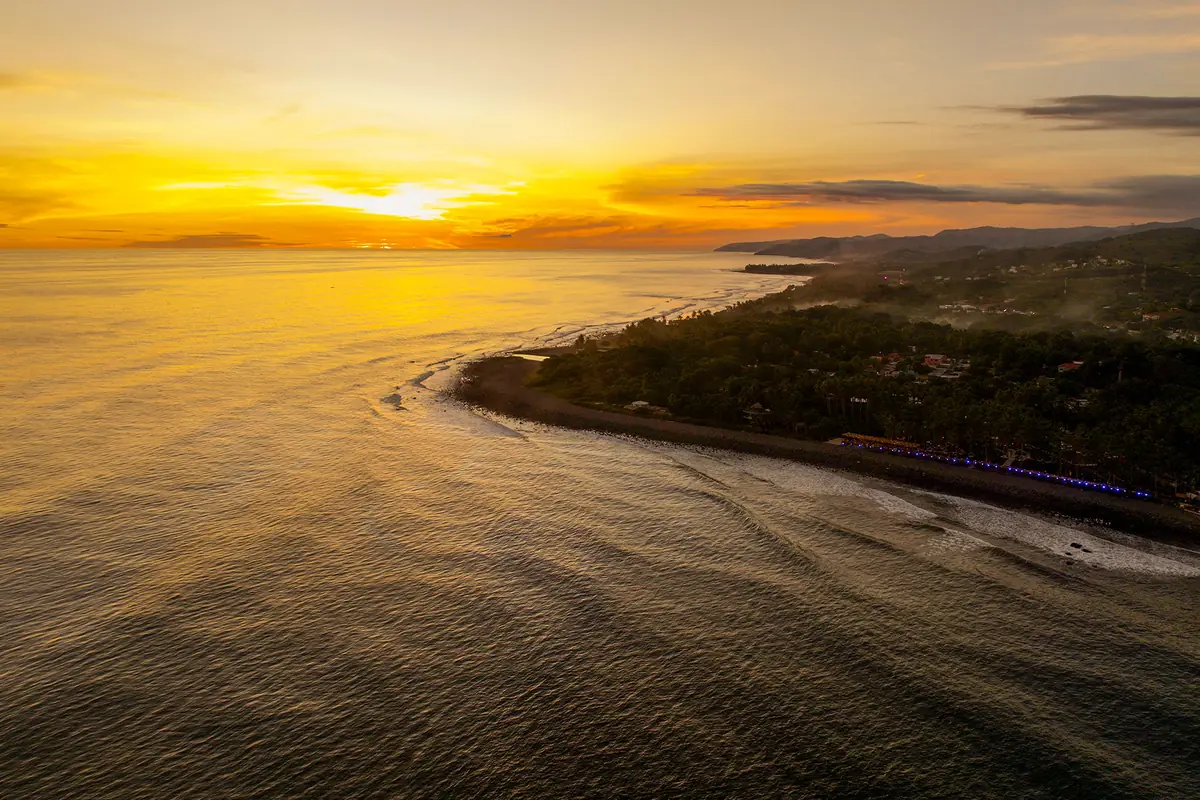
Punta Roca is located in the town of La Libertad, in the department of La Libertad on El Salvador’s Pacific coast, about 22 miles (35 km) southwest of San Salvador’s international airport. The point sits at the eastern end of town, just past the fishing pier and the cemetery, and faces roughly south-southwest into open Pacific swell.
The wave gave rise to the “Surf City” branding you’ll see on highway signs, hotel windows, and government tourism campaigns up and down this stretch of coast. Surf City refers to the whole corridor of breaks running west from La Libertad through El Sunzal, El Tunco, and El Zonte, but Punta Roca is the crown jewel and the reason the World Surf League brings the Championship Tour here.
Surfers have called it the J-Bay of Central America for decades, a nod to Jeffreys Bay in South Africa. The comparison is generous but not unearned: both are long, fast, cobblestone right-handers that reward high-speed rail work and give you time to link three or four sections together on a single wave.
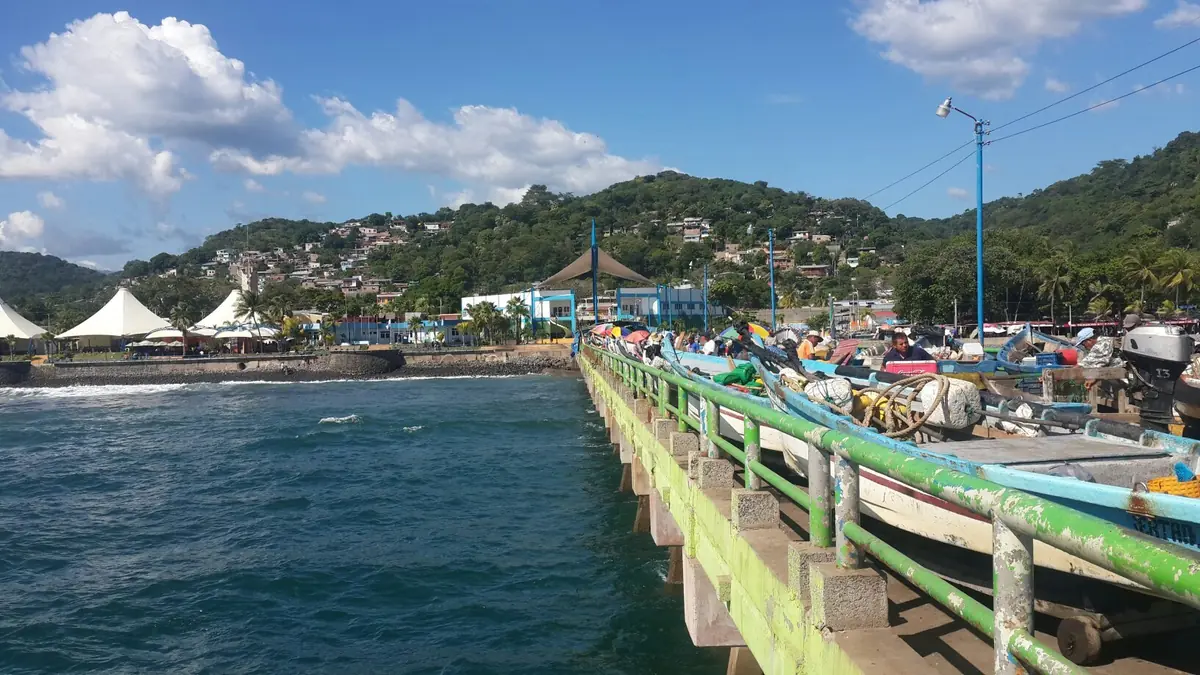
The town itself is a working fishing port, not a resort strip. Boats get winched up onto the pier, the market smells like the ocean, and the walk to the lineup takes you past concrete-block houses and pupusa stands. That texture is part of the appeal. If you want polished, El Tunco is 15 minutes west.
Punta Roca vs. Punta Rocas, Peru
Don’t confuse the two. Punta Rocas, with an “s,” is a right-hand reef break in Punta Negra, roughly 25 miles (40 km) south of Lima, Peru. It hosted the World Surfing Championship in 1965 and has staged multiple Pan American Surf Games. It’s cold, it’s Peruvian, and it requires a wetsuit. Punta Roca, singular, is the warm-water Salvadoran point covered in this guide.
The Wave: Mechanics, Sections, and How It Rides
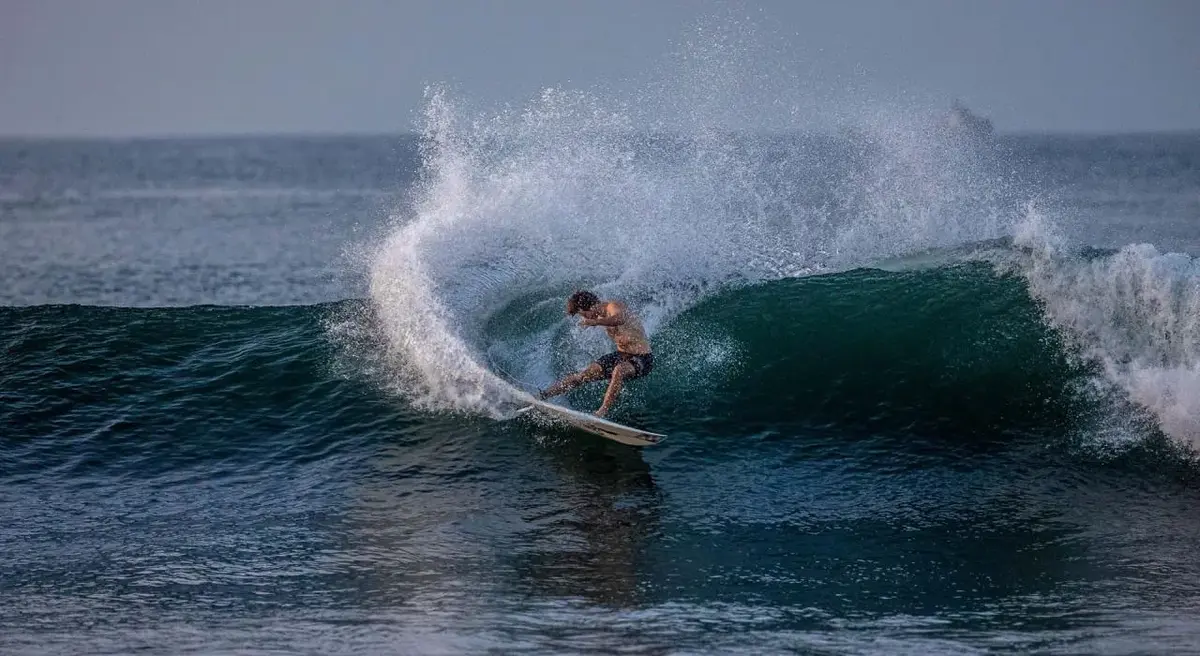
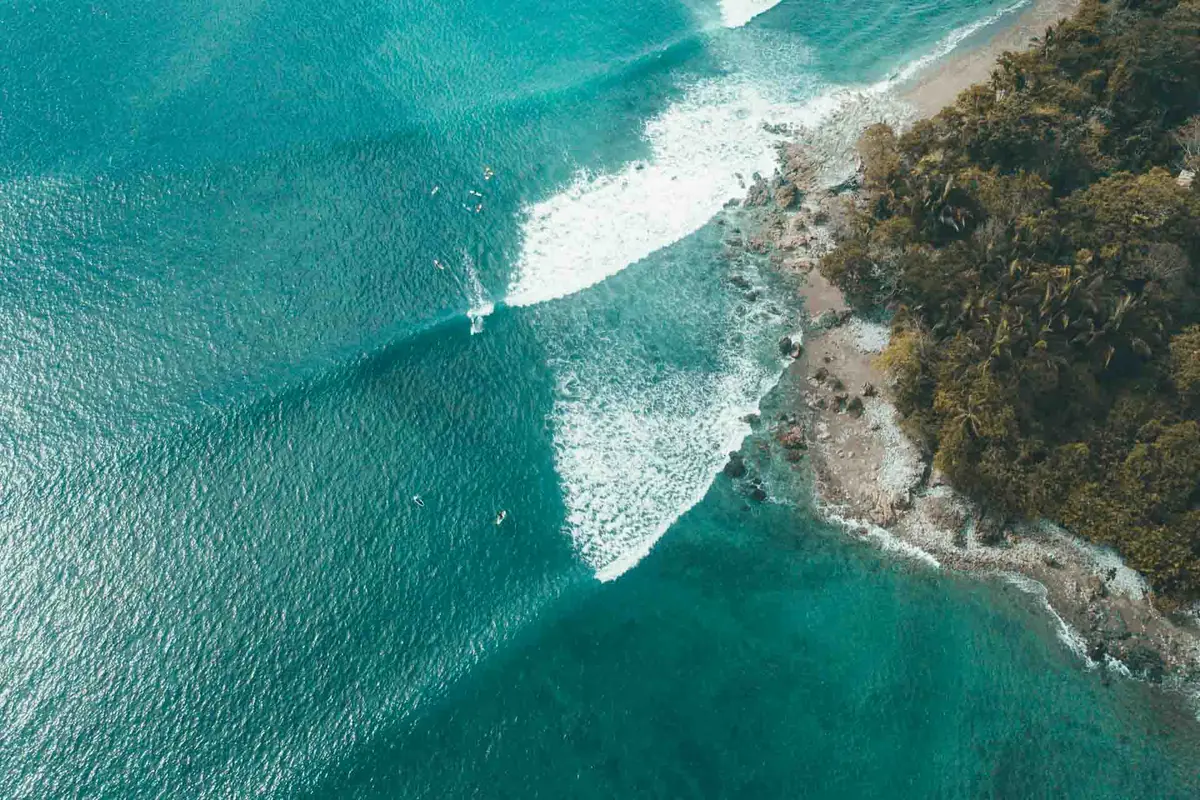
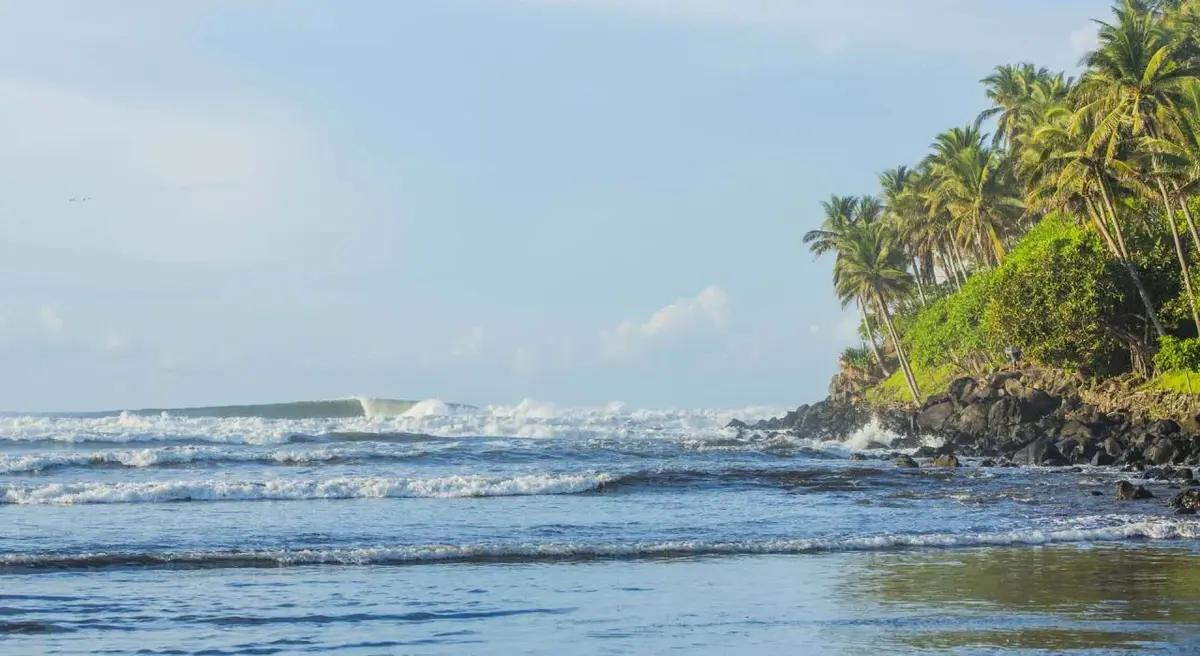
Punta Roca is a right-hand point break over cobblestone and lava reef. It handles swell from about waist-high to double overhead and beyond, roughly 3 to 12 feet, and comes alive on south to southwest groundswell with north or northwest offshore wind. On the best days, rides of 250 to 300 yards are possible from the top of the point through to the inside.
The wave breaks along a headland rather than a sandbar, which means it holds its shape as it grows. Where a beach break gets disorganized above head high, Punta Roca gets better. It also means the takeoff zone is small and well defined, so everyone in the water is sitting in roughly the same place.
The Sections, From the Cemetery to La Paz
The top of the point sits directly out from the cemetery at the eastern edge of town. This is where the wave first stands up, and it’s the steepest, most consequential takeoff. Sit here and you’ll get the longest rides, but you’ll also be sitting closest to the shallow rock and deepest in the local pecking order.
From there the wave runs into a long wall, the workhorse section, where most of the turns happen. On a solid swell with the tide filling in, this section throws and offers short, makeable barrel sections rather than deep tubes. It’s a high-performance canvas more than a slab.
The inside section, known locally as La Paz, is where the wave loses some of its bite and reforms over deeper, more forgiving bottom. Confident intermediates who don’t want to sit at the top of the point can post up here and pick off the runners that make it through. It’s the sensible place to start on your first session.
The Bottom, the Tides, and Mama Roca
The bottom is cobblestone and volcanic reef. It isn’t razor coral, but it’s hard, uneven, and covered in enough growth to open up a shin or a knee if you land wrong. Booties are optional for most surfers and genuinely useful for the walk out over the rocks.
Low tide is the danger window. The point gets shallow, the takeoff gets steeper, and the exposed rock becomes an actual hazard rather than a theoretical one. Mid to high tide is more forgiving and more common in local session planning.
Then there’s Mama Roca. This is the submerged rock sitting just below the surface near the main takeoff zone, and it’s the single most-discussed hazard at the break. It’s not visible on most tides, it doesn’t move, and it has collected fins, boards, and body parts from visiting surfers for as long as people have surfed here. Watch where the locals sit, and note that they’re all sitting slightly off it. That’s not an accident.
How It Compares to Waves You Already Know
If you’ve surfed Rincon in Santa Barbara, you have the closest mental model: a long cobblestone right that connects sections and rewards speed. Punta Roca has more power, more consistency, and water in the low 80s.
If Lower Trestles is your benchmark, imagine that same performance-friendly wall with real consequences under it and a lineup that doesn’t tolerate hesitation. The wave is not hard to read. The takeoff, the crowd, and the rock are what make it demanding.
Skill Level: Can Beginners Surf Punta Roca?
No. Punta Roca is an intermediate-to-advanced wave and it’s the wrong place to learn. The takeoff is steep, the bottom is rock, the paddle-out is long, and the lineup is tight and competitive. Beginners in El Salvador should learn at El Sunzal, a soft, forgiving point 15 minutes west.
Who Should Paddle Out
You’re ready for Punta Roca if you can consistently paddle into an overhead wave, make a late steep drop, and execute a controlled bottom turn without thinking about it. You should also be comfortable surfing over shallow reef and confident enough in your paddle fitness to hold position in a current for an hour or more.
Just as important: you need to be able to read a crowded lineup. This is a one-peak wave with a strong local crew, and the ability to sit patiently, take your turn, and not burn anyone matters more here than any maneuver you can do.
If any of that gave you pause, spend a few days at El Sunzal first. Nobody is keeping score, and the point isn’t going anywhere.
Where Beginners Should Go Instead
El Sunzal is the answer for most first-timers. It’s a long, mellow point with a sandy-bottomed inside section, plenty of whitewater to practice on, and a dense cluster of surf schools that run daily group lessons.
El Tunco’s beach break offers punchier, shorter waves and is best for beginners on smaller days with an instructor. La Bocana, the river-mouth left at El Tunco, is decidedly not a beginner wave and gets serious on a swell.
The La Paz inside section at Punta Roca itself is the natural stepping stone once you’re catching unbroken waves and turning reliably. Surf it on a mid tide, on a modest swell, ideally with a guide.
The Best Time to Surf Punta Roca
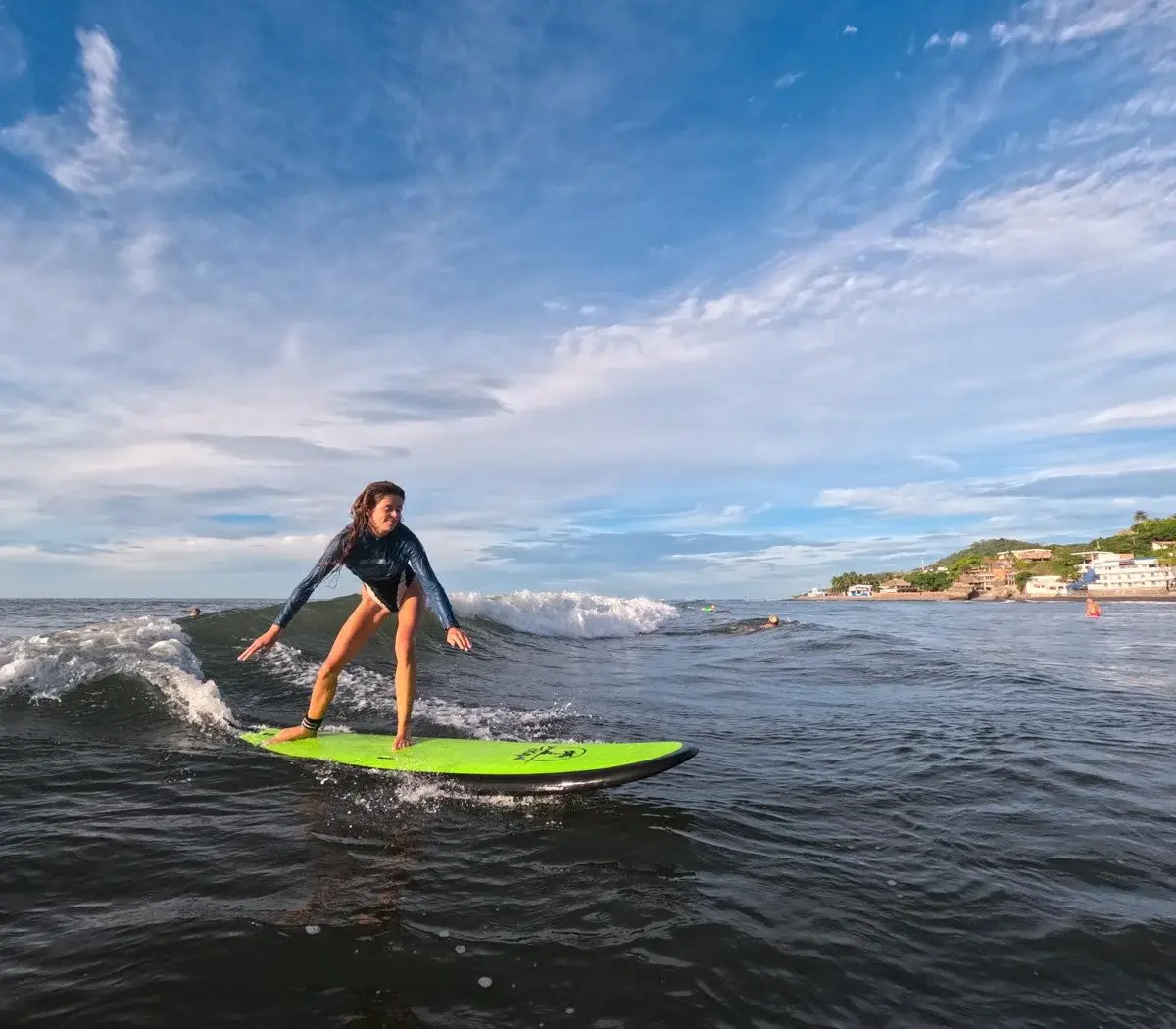
The prime season at Punta Roca runs from April through October, with the most consistent swell arriving between May and September. This is when Southern Hemisphere groundswell reaches Central America, delivering long-period, well-organized lines to a point break that’s built to use them. November through March is smaller, less consistent, and better suited to intermediates and longboards.
Month by Month
| Month | Typical size | Consistency | Crowds | Rain |
|---|---|---|---|---|
| January – March | Waist to head high | Moderate | Light to moderate | Dry, minimal |
| April | Head high to overhead | Building | Moderate | Dry, warming |
| May – June | Overhead and up | High | Heavy | Wet season begins |
| July – August | Overhead to double overhead | Highest | Moderate to heavy | Wettest months |
| September – October | Overhead and up | High | Lighter | Wet, storm season |
| November – December | Waist to head high | Moderate | Light | Drying out |
Wet Season vs. Dry Season
The trade-off is straightforward. The best waves come during the wet season, and the most pleasant weather comes when the surf is smallest.
Wet season, roughly May through October, brings the swell. Rain typically falls as intense afternoon and overnight downpours rather than all-day drizzle, so mornings are often clear, glassy, and offshore. The downsides are humidity, muddy river runoff after heavy rain, occasional road washouts, and the tail end of hurricane season affecting the region from June through November.
Dry season, November through April, gives you blue skies, cleaner water, and quieter lineups, at the cost of smaller and less frequent swell. It’s a great window for a mixed trip with non-surfing companions, or for an intermediate who wants Punta Roca at a manageable size.
Water Temperature and the Wetsuit Question
You don’t need a wetsuit in El Salvador. Water temperatures sit around 81 to 84 °F (27 to 29 °C) year-round, which is boardshorts and bikini territory in every month.
What you actually want is sun protection. A long-sleeve UPF rash guard is close to essential given the equatorial sun and the length of a typical session, and a thin neoprene or Lycra top adds a layer of protection against the reef. Some surfers wear reef booties for the rocky entry and exit, especially at lower tides.
When the WSL Comes to Town
Punta Roca has been a fixture on the WSL Championship Tour since 2022, hosting the Surf City El Salvador Pro. The competition window has landed anywhere from early April to mid-June depending on the season’s calendar, so check the World Surf League schedule before you book if the event matters to you either way.
If you want to watch, it’s one of the more accessible pro events in surfing: you can stand on the rocks and the seawall and be genuinely close to the action, and the town takes on a festival atmosphere. If you want to surf, avoid the window entirely. The point is closed to the public during the waiting period, accommodation books out months ahead, and prices climb.
Is El Salvador Safe? What Travelers Need to Know
The US State Department currently rates El Salvador Level 1, “exercise normal precautions,” its lowest and safest advisory tier. That places it, at the time of writing, in the same category as Japan and a step below several Western European countries. Because advisories change, check travel.state.gov directly before you book.
The context behind that rating: El Salvador’s homicide rate has fallen dramatically over the past decade, from a peak above 100 per 100,000 residents in the mid-2010s to among the lowest in the Western Hemisphere. The State Department attributes the drop to sustained government action against gangs since 2022.
The State of Exception
This is the part most travel guides skip, and you should know it. In March 2022, the Salvadoran government declared a State of Exception in response to a spike in gang homicides. It remains in effect.
Under it, authorities can arrest anyone they suspect of gang involvement, and several constitutional protections are suspended, including the right to a speedy trial and access to counsel. Tens of thousands of people are currently imprisoned awaiting trial. The State Department notes that several US citizens have been detained under these measures and have not yet faced trial.
For a surf traveler, the practical effect is close to zero, and the improved security situation is real and visible. But it’s worth understanding the legal environment you’re entering, and worth being scrupulous about local law. Penalties are severe and enforcement is not lenient. El Salvador has a zero-tolerance drunk-driving law where any measurable blood alcohol level is a criminal offense carrying a prison sentence, and THC products, including most CBD, are illegal.
The Real Risks for Surfers
The risks you’ll actually encounter are ordinary travel risks, not headline ones.
Petty theft is the main one, and it’s concentrated exactly where you’d expect: the parking area and rocks near the cemetery end of the point, where surfers leave bags while they paddle out. Don’t leave anything there. Leave valuables at your accommodation, bring only your keys and a leash, or pay someone at a nearby restaurant to watch your gear.
Road conditions are the second. Intercity driving after dark is genuinely hazardous, with unlit roads, potholes, livestock, and landslide risk during the rainy season. US Embassy staff are barred from traveling between cities at night for this reason, with a specific exception for the San Salvador–airport and San Salvador–La Libertad routes.
The third is the ocean itself. Rip currents and undertows along this coast are strong, and the State Department singles out Salvadoran beaches as dangerous for swimming even for capable swimmers. Respect flag warnings where they exist and assume there’s no lifeguard where they don’t.
Habits That Keep Trips Uneventful
Use rideshare apps in San Salvador rather than street taxis, and verify the plate and driver before getting in. Travel between towns during daylight. Skip public buses. Don’t display expensive watches, cameras, or jewelry, and be alert at ATMs. Enroll in the Smart Traveler Enrollment Program before you go so the embassy can reach you. Buy travel insurance that covers surfing and medical evacuation, because local first-response and hospital resources are limited outside major cities and private hospitals typically require payment upfront.
How to Get to Punta Roca from the US
Fly into San Salvador’s international airport (airport code SAL), then drive about 22 miles (35 km) southwest to La Libertad. The transfer takes roughly 45 minutes, occasionally closer to an hour with weekend traffic. There is no closer airport and no need for a domestic connection.
Flights from Major US Hubs
El Salvador is one of the most convenient international surf destinations for American travelers, largely because Avianca operates a hub at SAL with the widest nonstop network from the US. American, United, Delta, Spirit, Frontier, and Volaris also serve the airport.
Approximate nonstop flight times:
- Houston: about 2 hours 55 minutes
- Miami: about 2 hours 35 minutes
- Washington Dulles: about 4 hours 30 minutes
- Los Angeles: about 5 hours
- New York JFK: about 5 hours
Other nonstop origins include Dallas–Fort Worth, San Francisco, and Boston, depending on season and carrier. Round-trip fares commonly land in the $220 to $430 range, with the lower end available from Texas and Florida hubs outside peak periods.
Book boards as checked baggage in advance. Surfboard fees vary widely by airline and change often, so confirm the current policy and dimensions at the time of booking rather than relying on what a friend paid last season.
From the Airport to La Libertad
Prearranged private transfers are the standard choice and cost roughly $30 to $50 for the run to La Libertad or El Tunco. Most hotels and surf camps will arrange one, and the driver will handle boards without drama. Rideshare apps also operate from the airport and can be cheaper, though availability at odd hours is less reliable.
Public buses run the route and cost a few dollars, but with board bags and jet lag it’s a false economy, and the State Department advises against public buses generally.
Renting a car makes sense if you plan to chase swell up and down the coast or drive east to Las Flores. Expect to need a credit card with a meaningful hold for the deposit, and note that a foreign license is valid for 30 days. Drive during daylight only.
Getting Around the Coast
Once you’re based on the coast, everything in the Surf City corridor is within a 25-minute drive. Rideshare coverage is decent between La Libertad, El Tunco, and El Sunzal. Hotels and surf camps run shuttles to breaks, and local drivers can be hired by the day for around $50 to $80, which is often the most practical way to surf multiple spots on one swell.
Costs and Money: Budgeting in Dollars and Bitcoin
El Salvador uses the US dollar as its official currency, so there’s no exchange rate to track and no conversion fee to eat. Bitcoin is also legal tender, though in practice its use is concentrated in a few places. Most surf travelers spend between $60 and $130 per day including lodging, food, and transport, which makes El Salvador meaningfully cheaper than a comparable trip to Costa Rica.
Sample Daily Budgets
| Category | Budget | Mid-range | Comfort |
|---|---|---|---|
| Lodging | $15 – $30 hostel or basic room | $50 – $90 surf hotel | $120+ boutique or camp package |
| Food | $10 – $15 pupusas and comedores | $25 – $40 mixed | $50+ restaurants and drinks |
| Transport | $5 – $10 shared shuttles | $15 – $25 rideshare | $50 – $80 private driver |
| Surf costs | $10 board rental | $15 – $25 rental and guide share | $40+ guided sessions |
| Daily total | $40 – $65 | $105 – $180 | $260+ |
Real line items for scale: a pupusa runs about $1, a local beer $1 to $3, a plate at a comedor $5 to $8, a sit-down seafood dinner $12 to $20, a day’s board rental $10 to $15, and a group surf lesson roughly $20 to $35.
Bitcoin, Cards, and Cash
Bring cash and small bills. Many smaller businesses along the coast don’t take cards or add a surcharge, and ATMs are frequently out of service or charge high fees. Break large bills when you can; nobody at a pupusa stand wants a fifty.
Bitcoin acceptance is real but uneven. El Zonte, the village known as Bitcoin Beach, is where it’s most established, and you’ll find businesses in El Tunco and San Salvador that accept it. Don’t plan a trip around paying in crypto. Plan around cash, and treat Bitcoin as a novelty that occasionally works.
On entry requirements: US citizens do not currently need a visa for stays of 90 days or less, and the passport must be valid at the time of entry rather than for six additional months. Entry fees for visitors have changed in recent years, so verify current requirements on the State Department country page shortly before you fly.
Tipping
A 10 percent service charge is often already added at restaurants; check the bill before adding more. Where it isn’t included, 10 to 15 percent is generous and appreciated. Tip surf guides and instructors $5 to $10 for a good session, and a few dollars for drivers and hotel staff.
Where to Stay Near Punta Roca
Stay in La Libertad if the wave is the priority and you want to walk to the lineup. Stay in El Tunco or El Sunzal if you want restaurants, nightlife, and a wider range of surf options, accepting a 10 to 20 minute drive to the point. Stay in El Zonte if you want quiet.
La Libertad: Steps from the Point
Basing yourself in La Libertad means you can check the point on foot at dawn and be in the water within minutes, which matters enormously at a wave where the best conditions often last two or three hours.
Punta Roca Surf Resort is the best-known option, a small beachfront property with fewer than a dozen rooms, an on-site restaurant, and rates commonly in the $70 to $85 range. La Terraza AST Surf Hotel is another established choice with direct access. Both book out during the WSL window and peak swell season.
The trade-off is that La Libertad is a working town, not a tourist strip. Dining options are more limited, evenings are quieter, and the surrounding streets warrant the same awareness you’d use in any port city.
El Tunco and El Sunzal
El Tunco is the social center of the coast: hostels, mid-range hotels, bars, restaurants, and a nightly crowd. It’s a 10 to 15 minute drive to Punta Roca and walking distance to both El Tunco’s beach break and La Bocana.
El Sunzal, immediately adjacent, is calmer and home to several established surf camps and surf-focused hotels that run structured packages with lessons, board use, video review, and transport to other breaks. This is the smartest base for anyone traveling with a partner who’s learning, since the beginner wave is directly out front and Punta Roca is a short drive away.
El Zonte
About 25 minutes west, El Zonte is quieter, greener, and more family-friendly, with a rocky point and beach break of its own. It’s also the heart of the Bitcoin Beach experiment. Choose it if you want to read a book between sessions rather than find a bar.
How to Choose by Traveler Type
Hardcore surfer chasing the point: La Libertad, no question. Proximity beats amenities when the swell is on.
Couple with mixed interests: El Tunco or El Sunzal. Enough to do on land, easy access to lessons, short drive to the point.
Family or anyone prioritizing calm: El Zonte or a quieter El Sunzal property.
Beginner or improver: an El Sunzal surf camp package, which removes the logistics from the equation entirely.
Guides, Surf Schools, Board Rental, and Lineup Etiquette
Hire a local guide for your first session at Punta Roca. Board rental and instruction are widely available in La Libertad, El Tunco, and El Sunzal, with shortboards renting for $10 to $15 a day.
Why a Local Guide Is Worth It
A guide isn’t about instruction at this level. It’s about information you cannot get from a forecast: where to enter and exit over the rocks, where Mama Roca actually sits on today’s tide, which section is working, and where a visitor can reasonably sit without stepping on anyone.
There’s also a social dimension. Arriving in the lineup alongside someone the local crew knows changes your reception meaningfully. It’s the difference between being a stranger and being someone’s guest, and in a tight, competitive lineup that’s worth far more than the fee.
Book guides through your hotel or a surf camp rather than the beach if you want reliability. Rates typically run $30 to $60 for a session.
What Boards to Bring or Rent
Bring your regular shortboard, usually in the 5’10” to 6’4″ range for most surfers, plus something with a bit more length and volume if you’re visiting in shoulder season when the point can be waist to chest high. On a big south swell, a step-up in the 6’6″ to 7’0″ range earns its place in the bag.
Pack a spare leash and spare fins. Leashes fail on long point waves, and replacing gear locally is possible but limited in selection. Bring tropical wax, which is harder to find than you’d expect and worth the ounce.
Rental quality is decent at established shops and inconsistent at beach-side operators. If you’re renting, inspect the board and the leash before you pay.
Localism and Lineup Etiquette
Punta Roca has a real local crew, and they surf it well. This is not aggressive localism by the standards of, say, certain California points, but it is a lineup with a clear hierarchy that has been earned over decades.
The rules are the ordinary ones, applied strictly. Don’t drop in. Don’t paddle around people who’ve been waiting. Don’t sit at the very top of the point on your first morning. Take your turn, and when someone deeper calls you off, go.
Practical advice: surf at dawn. The crowd is thinnest, the wind is offshore, and the wave is at its best. Learn a few words of Spanish, say good morning, and let a couple of waves go by to people who live here. Goodwill in this lineup compounds across a week-long trip in a way that aggressive paddling never does.
Hazards, Health, and Water Quality
The main hazards at Punta Roca are shallow reef at low tide, the submerged Mama Roca rock, degraded water quality after heavy rain, strong currents, and intense equatorial sun. None of them are exotic, and all of them are manageable with planning.
Reef, Rocks, and Cuts
The entry and exit over cobblestone is the most common source of injury, not the wave itself. Time your entry with a lull, watch where locals go in, and consider booties.
Reef cuts here are shallow but prone to infection in warm water. Clean anything that breaks the skin immediately and thoroughly. A basic surf first-aid kit belongs in your bag: antiseptic solution, waterproof adhesive bandages, antibiotic ointment, and tweezers for grit.
Water Quality After Rain
This matters more than most guides admit. During the wet season, heavy rain flushes runoff from rivers and drainage into the surf zone, and the water can turn visibly brown. Surfing in it is associated with throat, ear, and stomach infections.
The simple rule: if the water is brown and the river mouths are pumping after a big storm, take a rest day or drive to a break away from the outflow. It typically clears within a day or two.
Lightning, Sun, and Heat
Wet-season storms in Central America produce serious lightning. This is not a hypothetical risk here. In March 2021, Katherine Díaz Hernández, one of El Salvador’s top competitive surfers, was killed by a lightning strike while training at El Tunco at the age of 22. If a storm is building, get out of the water and off the beach.
Sun exposure is the other daily concern. Use a reef-safe zinc-based sunscreen, wear a long-sleeve UPF rash guard, and drink far more water than feels necessary. Heat exhaustion after a long dawn session in tropical humidity is common and preventable.
Water, Food, and Vaccinations
Tap water is generally unsafe to drink. Stick to sealed bottled water, skip ice where you’re unsure of the source, and be cautious with raw vegetables and unpeeled fruit outside established restaurants.
The CDC recommends hepatitis A and typhoid vaccination for travelers to El Salvador and advises being current on routine vaccines including measles, mumps, rubella, tetanus, and chickenpox. Check the CDC’s El Salvador destination page four to six weeks before departure, since recommendations are updated periodically.
Carry prescription medication in original packaging with the prescription. Emergency numbers are 911 for police and 132 for medical services.
Staying Connected: eSIM and Wi-Fi
Buy an eSIM before you leave the US and activate it on landing. International roaming from a US carrier typically runs $10 to $15 per day, which over a week costs more than a month of local data.
Coverage along the Surf City corridor is solid, with reliable 4G in La Libertad, El Tunco, El Sunzal, and El Zonte, and reasonable service on the coastal highway. Data-only eSIM plans commonly cost $5 to $20 for a week’s worth of data, depending on the provider and allowance.
The reason to sort this before you land rather than after: you want maps and rideshare working the moment you clear customs, not after negotiating with an airport kiosk. Wi-Fi at hotels and surf camps is generally fine for messaging and forecasts, less so for uploading video.
Nearby Surf Breaks and Day Trips
The Surf City corridor puts El Sunzal, El Tunco, La Bocana, El Zonte, and the K59 and K61 breaks within a 25-minute drive of Punta Roca. Farther east, Las Flores and Punta Mango offer world-class waves for those willing to make the three-hour drive.
Within 25 Minutes
El Sunzal is a long, gentle point about 15 minutes west, the region’s designated learning wave and a genuinely fun longboard break for everyone else. Best on a mid tide, small to moderate swell.
El Tunco is a beach break with rocks, punchier and shorter than the points, right in front of the region’s best cluster of restaurants and bars.
La Bocana is the river-mouth left at the eastern edge of El Tunco. It’s a serious wave that gets fast, hollow, and heavy on a swell, and it’s the best left-hander in the immediate area.
El Zonte, 25 minutes west, has a rocky right point and a beach break in a quieter setting, plus the Bitcoin Beach story if that interests you.
K59 and K61, named for their kilometer markers on the coastal highway, are less-crowded points worth checking when the main breaks are packed.
Which Break on Which Day
| Break | Skill level | Best conditions | Drive from Punta Roca |
|---|---|---|---|
| Punta Roca | Intermediate to advanced | S–SW swell, N offshore, mid to high tide | On site |
| El Sunzal | Beginner to intermediate | Small to moderate swell, mid tide | 15 minutes |
| El Tunco | Beginner to intermediate | Small swell, low to mid tide | 15 minutes |
| La Bocana | Advanced | Solid swell, mid tide | 15 minutes |
| El Zonte | Intermediate | Moderate swell, mid tide | 25 minutes |
Worth the Drive East
Las Flores and Punta Mango, in the eastern department of Usulután, are the country’s other marquee waves: long, warm, and dramatically less crowded than the Surf City points. Access has improved substantially with the Surf City 2 development, including a new coastal road of roughly 8 miles (13 km) connecting nearly a dozen beaches, backed by a state investment in the tens of millions of dollars.
It’s a three-hour drive each way, so treat it as a two- or three-night side trip rather than a day trip. Boat access to Punta Mango is standard and typically arranged through lodges in the area.
What to Do If You’re Not Surfing
Waterfalls, volcanoes, colonial towns, and one of the best food scenes in Central America are all within a day’s reach of La Libertad, which makes this a workable trip even if only one person in your party surfs.
Along the Coast
The Tamanique Waterfalls sit about 30 minutes inland from El Tunco, a series of pools and jumps reached via a steep guided hike. Go with a local guide; the trail is unmarked and the jumps require someone who knows the water depth.
Atami and similar coastal clubs offer natural ocean pools carved into the rock with day-pass access, which is a genuinely lovely way to spend a morning while someone else is surfing.
La Libertad’s fish market on the pier is worth an early visit, both for the spectacle and because it’s the cheapest fresh seafood on the coast. Sunset from the cliffs above El Tunco is the other reliable non-surf ritual, and most towns have yoga studios and massage available on short notice.
Inland Day Trips
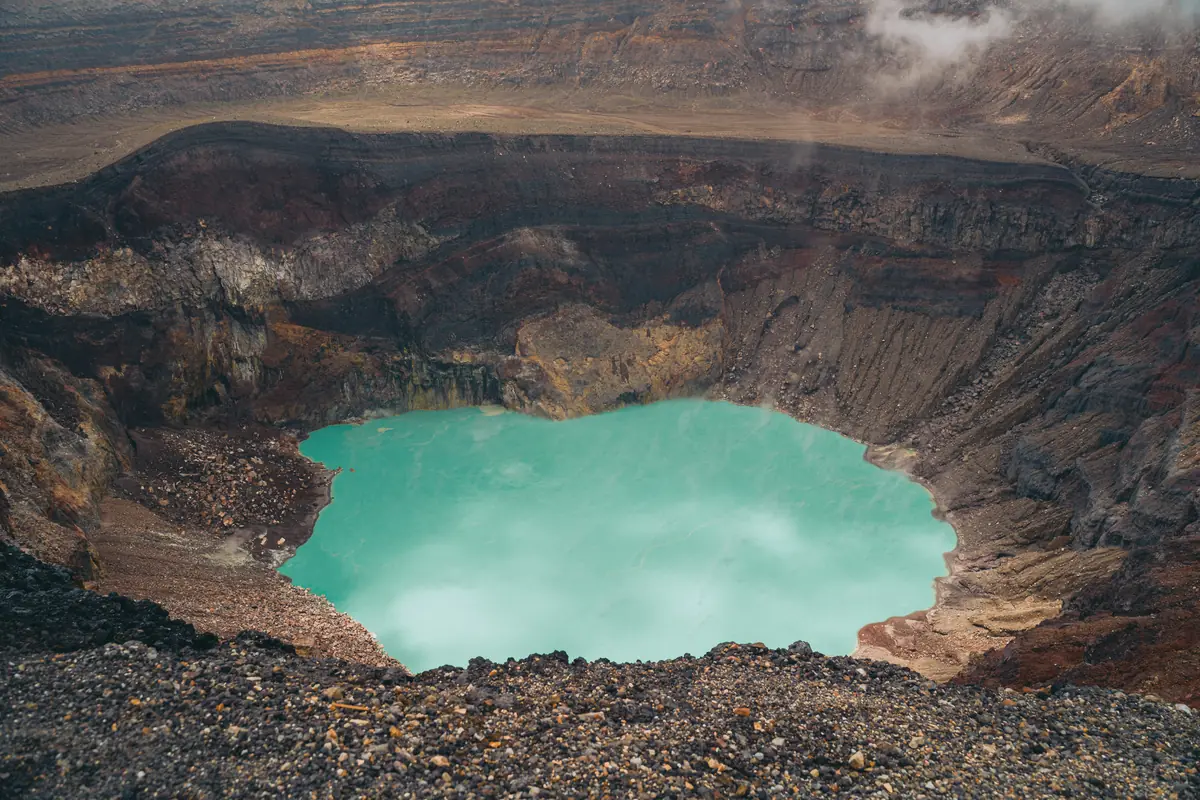
Santa Ana Volcano is the standout: a guided hike of two to three hours each way to a turquoise crater lake, roughly two hours from the coast. Hikes depart in a guided group at a set morning time, so check current departure requirements.
Ruta de las Flores is a string of colorful mountain towns strung along a highland route, known for weekend food festivals, coffee farms, and cooler air. Suchitoto is a preserved colonial town on a lake, and Joya de Cerén, a UNESCO World Heritage site sometimes called the Pompeii of the Americas, preserves a Maya farming village buried by volcanic ash.
Where to Eat and Drink
The coastal food scene runs on seafood, pupusas, and an increasingly good craft beer culture, and it’s inexpensive by any American standard.
In La Libertad, Punta Roca Restaurante sits right by the point and has been feeding surfers for decades. The fish market and the surrounding comedores serve ceviche, whole fried fish, and shrimp for a fraction of what you’d pay 15 minutes west.
Pupusas are the national dish and the best value in the country: thick corn masa griddled with cheese, beans, or chicharrón, served with curtido and salsa for around a dollar apiece. Two or three make a meal. Look for pupuserías that are busy in the evening, which is when Salvadorans actually eat them.
In El Tunco, Cadejo Brewing occupies a cliffside spot with ocean views and is the reliable choice for a cold craft beer after a session. The town also has a dense concentration of small restaurants covering everything from Salvadoran plates to sushi and pizza, which is either welcome or beside the point depending on your priorities.

What to Pack for a Punta Roca Surf Trip
- Shortboard plus a higher-volume board or step-up depending on season
- Two spare leashes and spare fins with the correct key
- Tropical wax, more than you think you need
- Reef booties for the rocky entry
- Long-sleeve UPF rash guard and reef-safe zinc sunscreen
- Surf first-aid kit: antiseptic, waterproof bandages, antibiotic ointment, tweezers
- Dry bag for phone, cash, and passport copy
- Reusable water bottle with a filter
- Small US bills, ideally fives and tens
- Unlocked phone for an eSIM
- Travel insurance policy that explicitly covers surfing and medical evacuation
- Light rain shell if traveling May through October
What people consistently overpack: clothing, multiple boards for a short trip, and electronics. What they underpack: leashes, wax, sun protection, and cash in small denominations.
A Sample Seven-Day Surf City Itinerary
Day 1: Land at SAL, transfer to La Libertad or El Sunzal, check the point, and get an easy surf at El Sunzal to shake off the flight. Early dinner, early night.
Day 2: Dawn session at Punta Roca with a local guide, sitting in the La Paz inside section. Afternoon off. Learn the tide chart and the entry.
Day 3: Dawn at Punta Roca, this time closer to the top of the point if the first session went well. Afternoon at the La Libertad fish market and pier.
Day 4: Non-surf day. Santa Ana Volcano hike or the Tamanique Waterfalls, back to the coast for sunset.
Day 5: Dawn at Punta Roca, then a second session at El Tunco or La Bocana in the afternoon depending on tide and swell. Craft beer on the cliffs afterward.
Day 6: Drive west to El Zonte and K61 for a change of scenery and thinner crowds, or stay put if the point is firing. On a good swell, ignore this itinerary entirely and surf Punta Roca twice.
Day 7: Final dawn session, breakfast, transfer to SAL. Build in a two-hour buffer for the drive and check-in with boards.
The Bottom Line
Punta Roca is one of the best right-hand point breaks in the Americas, and it’s astonishingly easy for American surfers to reach: a three-hour flight from Texas or Florida, a 45-minute drive, no currency to exchange, no wetsuit, and a country that now carries the State Department’s lowest travel advisory.
Go between April and October if you want it at full strength. Go between November and March if you want it manageable. Skip the WSL window unless you’re coming to watch.
The one piece of advice that matters most: hire a local guide for your first session and sit in the inside section until you’ve learned where the rock is and where you fit in the lineup. Punta Roca gives up long, fast, beautiful waves to surfers who arrive with patience and humility, and it takes fins and skin from the ones who don’t.