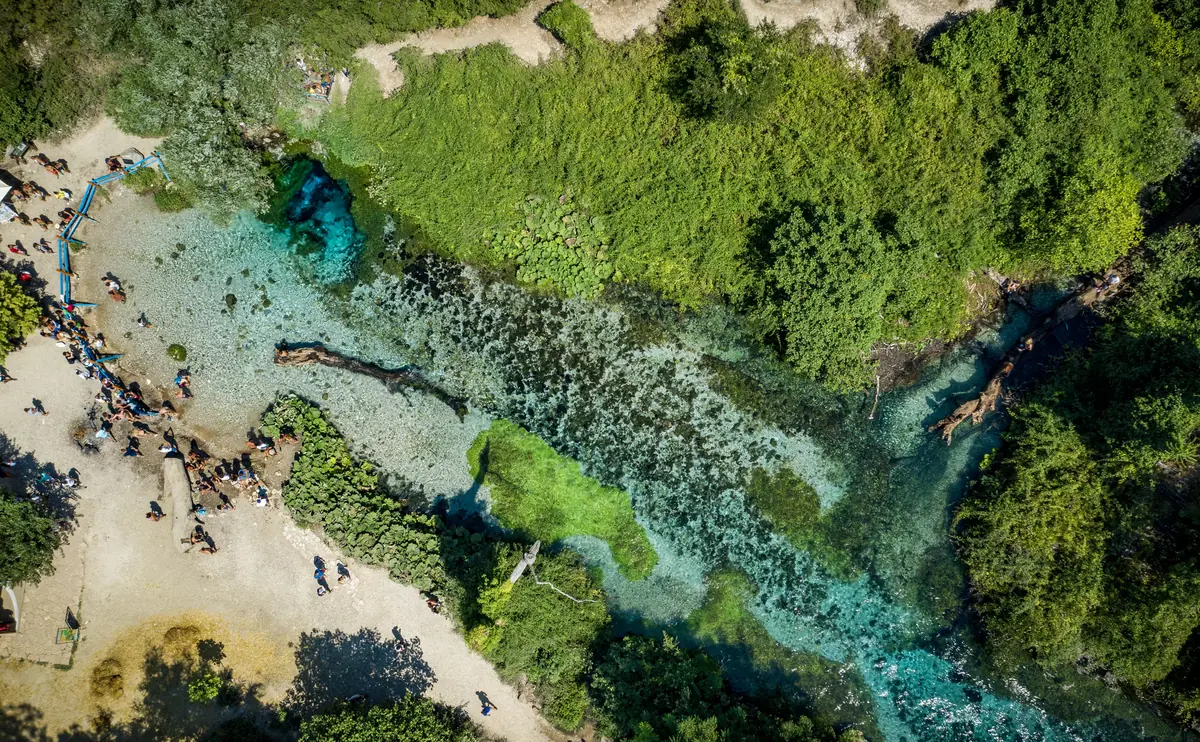
The Blue Eye Albania, known locally as Syri i Kaltër, is a 164-foot-deep karst spring 14 miles east of Saranda, where ice-cold water shoots up from a cave no one has reached the bottom of. This guide covers costs in dollars, real drive times, the swim ban, and whether it earns a detour from your southern Albania route.
The quick version, before you read on:
- Location: Parku Natyror Syri i Kaltër, a 725-acre Natural Park in Vlorë County, 14 miles east of Saranda
- Entry: 50 lek per person (about $0.60), plus 100–200 lek per car
- Hours: Daily, 7 AM–7 PM
- Swimming: Banned
- Time needed: 2–3 hours, including the 1.4-mile (2.2 km) walk in
What is the Blue Eye Albania, and is it worth visiting?
Yes — the Blue Eye Albania is one of southern Albania’s most photographed natural sights, a vertical karst spring whose center looks exactly like a human pupil. It is worth a 2–3 hour stop if you are already in Saranda, Ksamil, or Gjirokastër. It is not worth a 4-hour drive from Tirana on its own.
The Blue Eye is a Vauclusian karst spring, fed by underground water from the Mali i Gjerë and Dhëmbel mountain ranges. The spring is the source of the 16-mile (25 km) Bistricë River, which drains into the Ionian Sea south of Saranda. The protected area was reclassified from Nature Monument to Natural Park (IUCN Category IV) under Albanian Council of Ministers Decision VKM No. 60, expanding the protected zone to 725 acres (293.30 hectares).
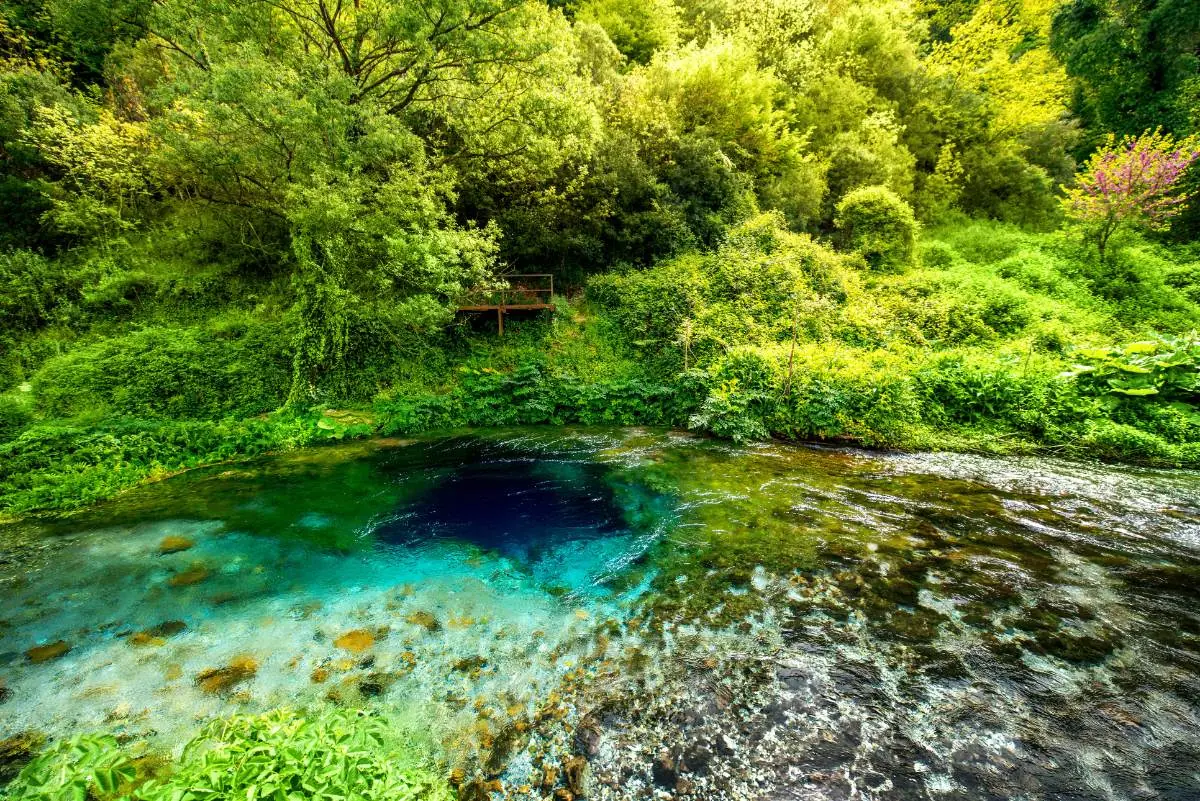
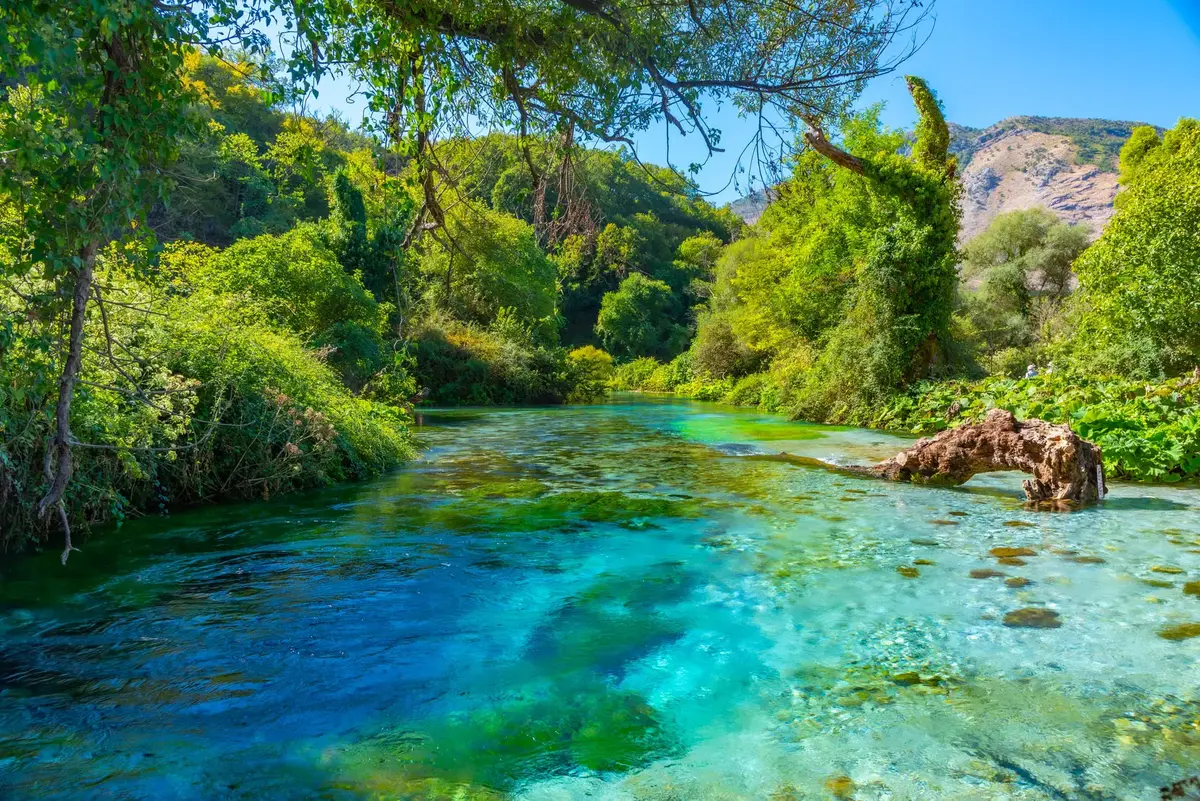
When I leaned over the wooden viewing platform, I could feel the temperature drop a full 10 degrees on my face — the spring exhales cold air. That sensory hit is the moment most travelers say “OK, I get it now.”
Pro Tip: If your itinerary already includes Gjirokastër or Ksamil, you’ll pass within 15 miles of the spring. Hitting it as a roadside stop, not a destination, is how you avoid disappointment.
How do you get to the Blue Eye from Saranda or Tirana?
The Blue Eye is 14 miles from Saranda (40 minutes), 21 miles from Ksamil (1 hour), 23 miles from Gjirokastër (1 hour), and 152 miles from Tirana (4–4.5 hours). The smartest options are a rental car for flexibility, the KMG SUN LINE shuttle from Saranda for €16 round-trip (about $18), or a guided tour for $30–60 per person.
Here is how the main options compare from Saranda:
| Method | Time (one way) | Cost (USD, round trip) | Best for |
|---|---|---|---|
| Rental car | 35–45 min | $30–60 (incl. fuel + parking) | Flexibility, photographers, families |
| KMG SUN LINE shuttle | 50 min | ~$18 per person | Couples, solo travelers without a car |
| Trans Butrinti public bus | 60 min | $4–5 per person | Budget travelers willing to wait |
| Guided tour | varies | $30–60 per person | First-timers wanting context |
| Round-trip taxi (2-hr wait) | 35 min | $60–75 total | Small groups, time-constrained visitors |
A few real-world details that matter:
- The KMG SUN LINE shuttle picks up outside Hotel Mallara in Saranda from 8:30 AM, runs roughly hourly in summer, and books out fast on weekends.
- Many Saranda–Gjirokastër buses use the Kardhiq bypass and skip the spring entirely. Confirm with the driver before boarding: “does this stop at Syri i Kaltër?”
- The turnoff from SH99 is marked but easy to miss. Google Maps tried to send us 4 kilometers past it on our first visit.
Is a day trip from Tirana realistic?
Driving from Tirana to the Blue Eye and back in one day means more than 9 hours behind the wheel. It is technically possible but a poor use of vacation time. Far better: spend a night in Berat or Gjirokastër en route and visit the spring on the way through to Saranda.
A few logistics for US drivers planning the route:
- Distance: 152 miles each way via Durrës, Lushnjë, Fier, Tepelenë and Gjirokastër.
- Fuel: about $2.20 per liter (roughly $8.30 per gallon); budget about $80 round trip in a small rental.
- Roads: SH4 is highway-quality south to Fier, then becomes a slower two-lane mountain road through Tepelenë.
- Documents: Most rental agencies require an International Driving Permit (IDP). US travelers can buy one for $20 from any AAA office before flying out.
We tried the Tirana day-trip on a previous visit. By hour seven of driving we were too tired to actually look at the water. Don’t repeat our mistake.
How much does it cost to visit the Blue Eye Albania?
Entry is 50 lek (~$0.60) per person, paid cash only at the gate. Cars pay an additional 100–200 lek (~$1.20–2.50). Parking ranges from 200 to 800 lek ($2.50–10) depending on duration; campervans pay a flat 800 lek ($10) for 24 hours. Budget about $15–25 per couple total, including a snack at the on-site restaurant — modest against a typical Albania travel budget.
Detailed pricing for the most common visitor types:
- Person: 50 lek ($0.60)
- Motorcycle: 50 lek ($0.60)
- Car: 100 lek ($1.20)
- Minibus: 150 lek ($1.85)
- Bus: 250 lek ($3.05)
- Electric scooter rental (car park to spring): ~1,000 lek ($12)
- Tourist road-train (round trip): ~600 lek ($7.30)
- Restaurant lunch (grilled meat plus salad): ~1,000–1,500 lek ($12–18)
The kiosk attendant waved off my €5 note on a recent visit — only Albanian lek work, and they prefer exact change. Break a 1,000-lek note in Saranda before driving up. The nearest reliable ATM is in Saranda; there is none at the spring or in Muzinë village.
Pro Tip: The on-site restaurant gets unfair flak online. The grilled lamb chops with a cold Birra Korça were one of our better meals in southern Albania, at about $14 a plate.
What’s the walk in to the Blue Eye like?
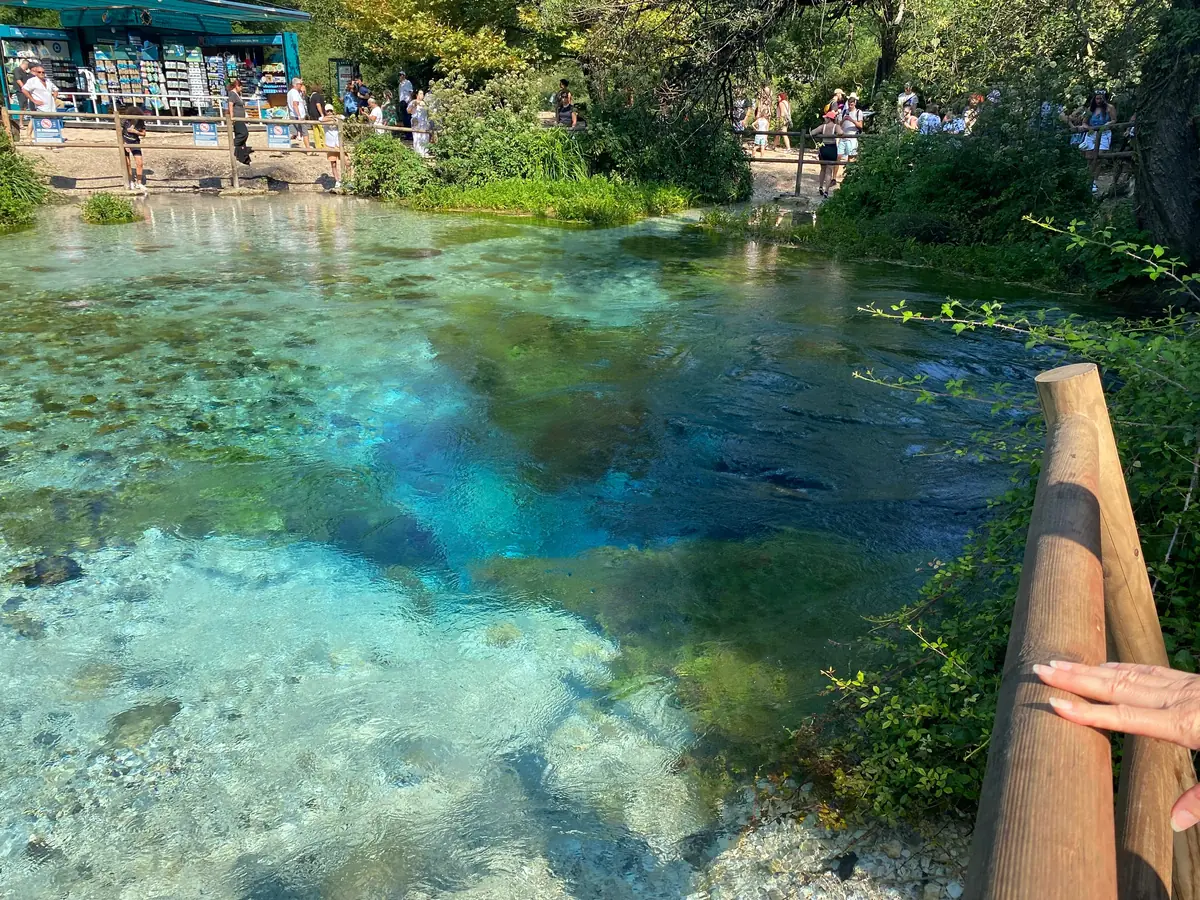
From the paid car park, it is a 1.4-mile (2.2 km) gently uphill walk on a paved, lamplit path to the spring — about 25–35 minutes. Electric scooters and a road-train shuttle are available if you would rather skip the walk. The viewing platform sits directly above the spring, with a separate trail looping into the surrounding oak and sycamore forest.
What the walk-in actually feels like:
- Surface: New concrete pavement the entire way, suitable for strollers and sandals — part of why the Blue Eye suits families traveling Albania with kids.
- Shade: Patchy. The first half-mile from the car park is mostly exposed; the section closest to the spring runs under tree cover.
- Signage: Bilingual Albanian and English at decision points; trail markers are sparse mid-path.
- Restrooms: One block near the entrance, one mid-trail near the restaurant.
- Drinking water: A small fountain near the spring is fed by spring water. Refill bottles here.
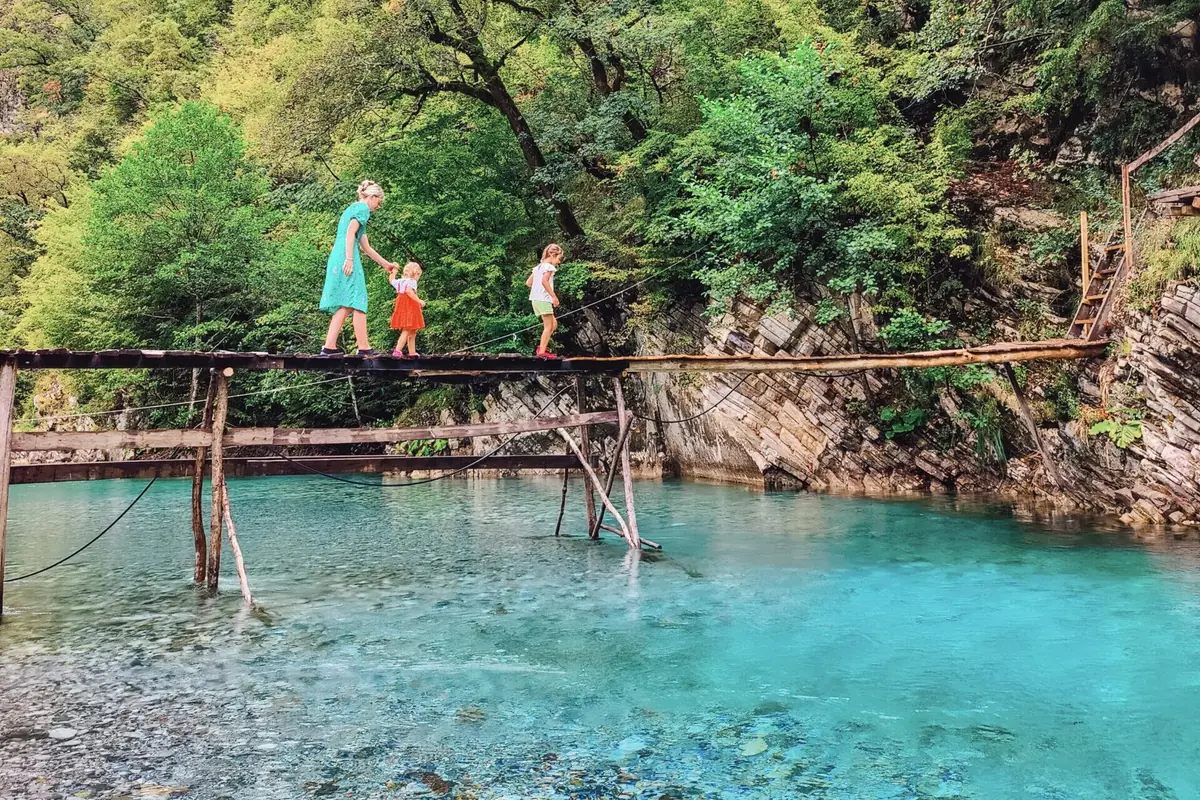
The viewing platform is a wooden deck with railings, perched directly over the deepest visible point. A second short trail extends about 15 minutes deeper into the reserve before the surface gets overgrown. The water at the spring’s edge was so clear we watched a leaf drift 3 feet down as if suspended in glass.
Can you swim in the Blue Eye?
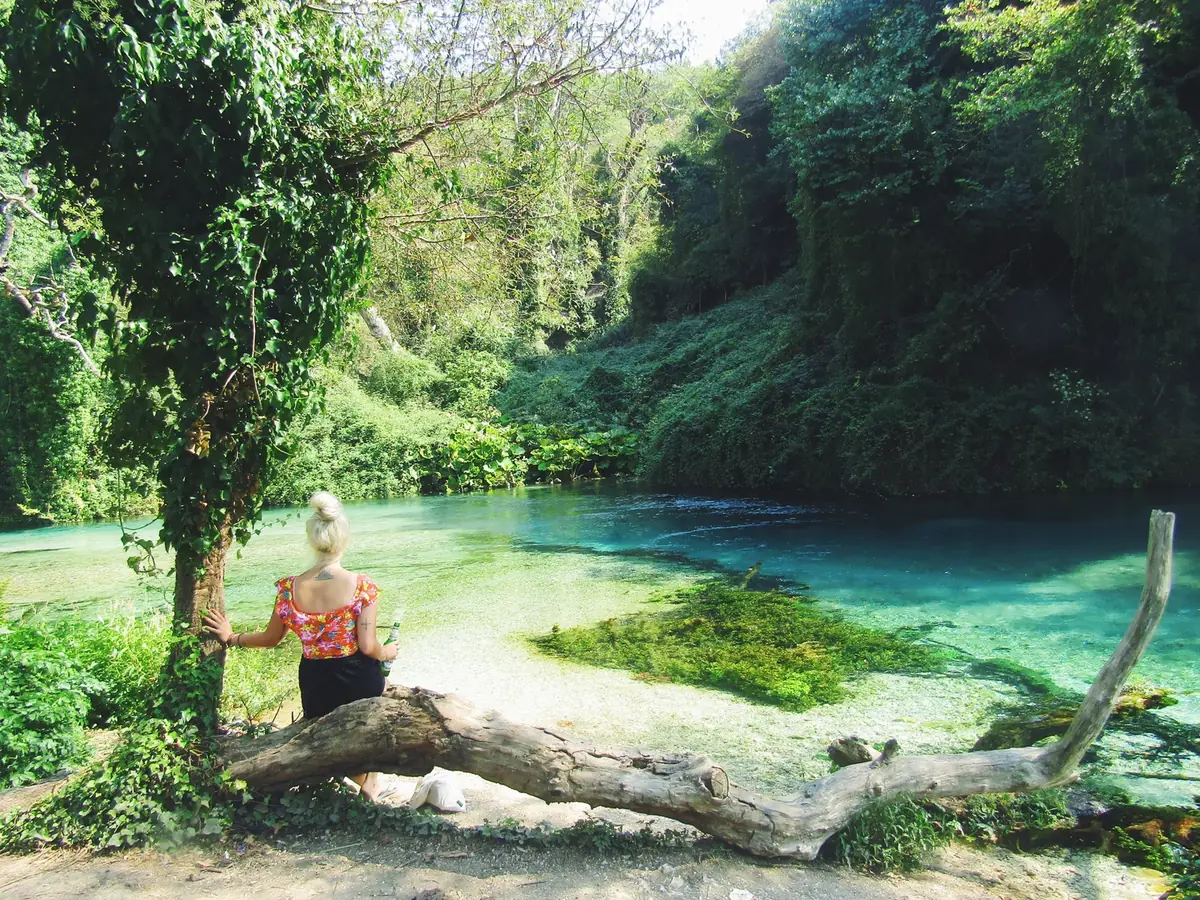
No. Swimming is prohibited following the Albanian Council of Ministers reclassification of the area to Natural Park status under Decision VKM No. 60. Signs are posted at every approach. Some visitors still ignore the rule, but enforcement has tightened. You may dip your feet in the Bistricë River downstream; the spring itself is off-limits.
Why the ban exists, in plain terms:
- The site was upgraded from Nature Monument (445 acres / 180 hectares) to Natural Park (725 acres / 293.30 hectares) under IUCN Category IV protection.
- The Albanian Minister of Tourism and Environment, Mirela Kumbaro, announced a parallel diving ban to protect the cave’s biological column.
- Surface water temperature sits at roughly 50°F (10°C) year-round; published scientific readings put it at 55°F (12.75°C) at depth (Baldassare et al., Water Resources, vol. 38).
- The upward water pressure pushes any swimmer downstream within seconds — even before the ban, “swimming” mostly meant a 15-second dunk before instinct took over.
Two French tourists climbed the railing while we watched on a recent visit; a uniformed ranger appeared within 90 seconds and asked them to leave the water. Don’t budget on getting away with it.
How deep is the Blue Eye, really?
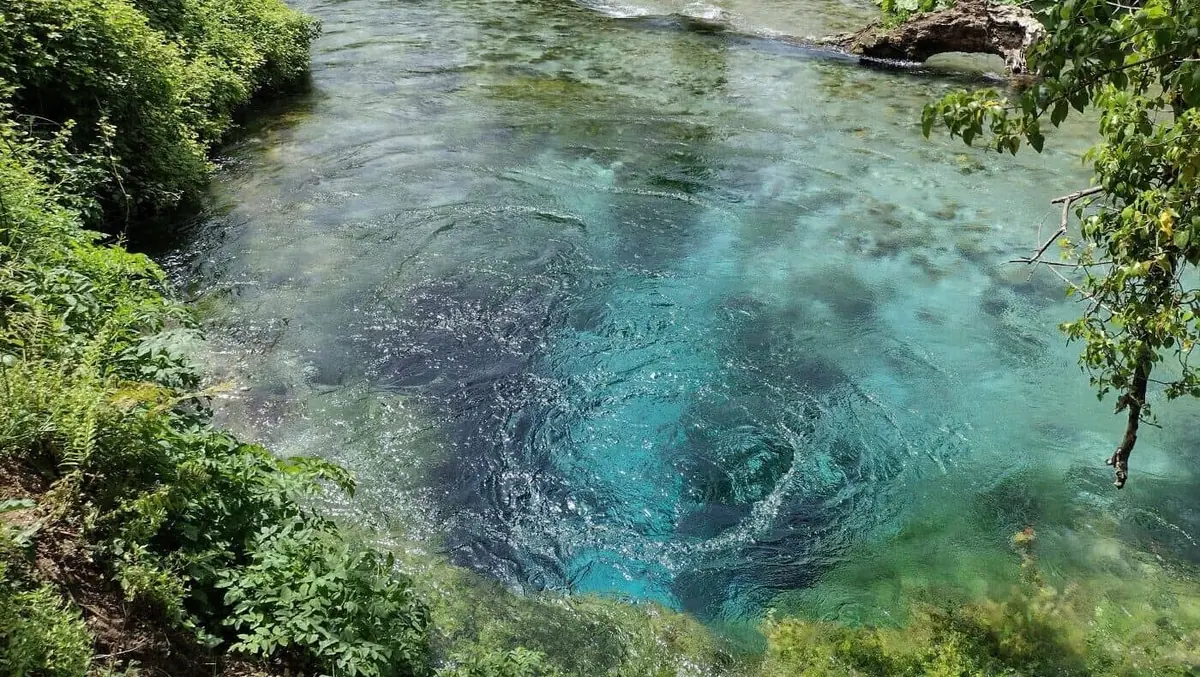
The deepest any diver has reached is 164 feet (50 m) — beyond that, the upward water pressure pushes them back to the surface. The true depth is unknown and may exceed 328 feet (100 m). It is one of the deepest karst springs in Europe.
The geology, briefly:
- Type: Vauclusian karst spring (vertical cave outflow), sitting at 499 feet (152 m) above sea level.
- Discharge: Average 1,585 gallons per second (6 m³/s) at the main spring; 2,900 gallons per second (11 m³/s) for the whole spring group; peaks at 4,862 gallons per second (18,400 liters per second).
- Source rock: Triassic evaporites and Mesozoic carbonate sequence in the Ionian tectonic zone.
- Water chemistry: Calcium-sulphate-bicarbonate, per published analysis in Water Resources (vol. 38).
Looking straight down through the water, I could see the cave throat narrow into pure black — like staring into a well that has no bottom. Most travel guides repeat “50 meters” as if that is the depth. It isn’t. It is the deepest a human has reached, which is not the same thing.
When is the best time to visit the Blue Eye Albania?
Visit in May, early June, or September — widely cited as the best time to visit Albania — for the best mix of warm weather and manageable crowds. Avoid mid-July through August: per Euronews Albania, Minister of Tourism Mirela Kumbaro reported the Blue Eye Natural Park hosted more than 78,000 visitors in a single August. Mornings before 9 AM are dramatically quieter year-round.
Seasonal grid for US travelers:
| Months | Avg high | Crowd level (1–5) | Verdict |
|---|---|---|---|
| Mar–Apr | 64–73°F | 2 | Quiet but cooler; spring-water shock more intense |
| May | 74–82°F | 3 | Best overall — warm, green, manageable crowds |
| Jun (early) | 82–87°F | 3 | Long daylight, before the school-holiday surge |
| Jul–Aug | 90–104°F | 5 | Peak crowds; expect 30+ minute waits at the platform |
| Sep | 80–86°F | 3 | Excellent — warm water, tour buses thin out |
| Oct | 73–80°F | 2 | Lower crowds, occasional rain |
| Nov–Feb | 52–63°F | 1 | Quietest; no swimming pressure since the ban anyway |
At 8:15 AM in late May we had the viewing platform to ourselves for almost ten minutes. By 10 AM, it was three-deep with day-trippers from Saranda. The first hour after opening is the entire game.
What should you pack for a Blue Eye day trip?
Pack cash in Albanian lek (about $25 per person), a refillable water bottle, a sun hat and SPF 50, comfortable walking shoes, a swim towel and waterproof bag for foot-dipping in the river, a portable battery pack, and a printed copy of your tour or accommodation booking, a short version of the broader Albania packing list. Cell coverage drops on SH99.
The full kit:
- Cash: 2,000–3,000 lek ($25–37) per person, in small notes; no card readers at the gate or restaurant.
- Footwear: Sandals or sneakers fine; the path is fully paved. Skip flip-flops for the forest trail.
- Sun protection: SPF 50, wide-brim hat, sunglasses. The first half-mile of the path has no shade.
- Insect repellent: Mosquitoes appear at dusk along the river.
- Camera kit: Polarizing filter, ND filter for summer, drone if you have one (see photography section).
- Maps: Download offline Google Maps or Maps.me for the Saranda–Muzinë section before leaving Wi-Fi.
- Documents: Passport copy plus IDP if you are driving.
Pro Tip: Halfway up the path I burned through my water bottle — and was glad I’d packed a second one. Two 500ml bottles per person, minimum, in summer.
Where should you stay near the Blue Eye?
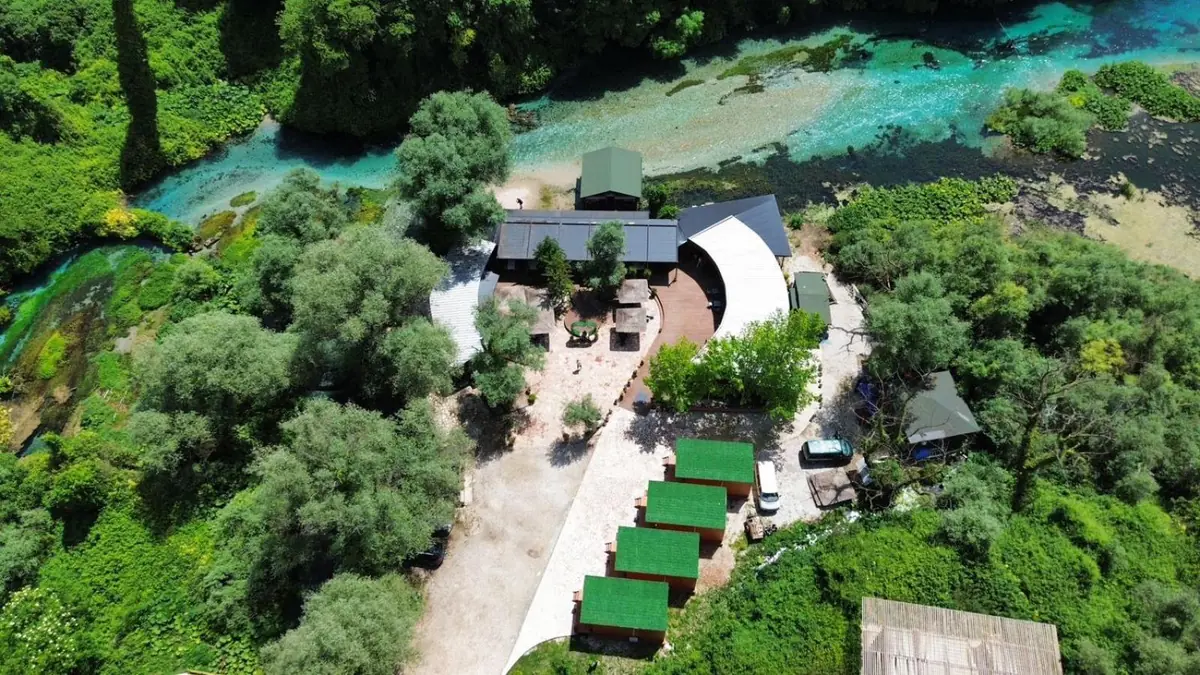
New wooden cabins right at the spring (Blue Eye Saranda Hotel) let you experience the site before and after the day-trippers arrive. For a quieter base 10 minutes away, try Mesopotam Agrotourism Resort, one of a growing crop of agrotourism stays across Albania. Most US travelers should base in Saranda or Ksamil for beach access, or in Gjirokastër for UNESCO Ottoman architecture.
Three lodging tiers, with realistic costs:
- On-site cabins (Blue Eye Saranda Hotel): $90–160 per night in shoulder season; books 6–8 weeks ahead in summer. The cabins are charming but expect daytime foot traffic 12 feet from your terrace.
- Mesopotam Agrotourism Resort (10 minutes away): $70–120 per night with pool, garden setting, family-friendly.
- Saranda hotels (40 minutes away): from $51 per night per Rome2Rio data, plenty of mid-range options on the Lungomare promenade.
- Ksamil resorts (1 hour away): $120–250 per night in summer; closer to the beaches, busier.
- Gjirokastër guesthouses (1 hour away): $40–90 per night; stone-house properties with character.
Day-trip combinations: Butrint, Gjirokastër, Ksamil and Lëkursi
From Saranda you can pair the Blue Eye with Lëkursi Castle for sunset (3–4 hour combo), with Gjirokastër for an Ottoman-stone-city full day, or with Butrint National Park and Ksamil’s beaches for a southern-Albania highlight loop. Each combination works as a single day; pick based on whether you prefer history, nature, or beaches.
Three concrete same-day plans, in order of difficulty:
- The half-day (3–4 hours total): Blue Eye in the morning, Lëkursi Castle for lunch or sunset. The castle sits 15 minutes above Saranda with panoramic views over the Ionian and across to Corfu.
- The history day (8–9 hours): Blue Eye at 8 AM, drive 1 hour to Gjirokastër, walk the UNESCO old bazaar and stone-roof quarter, lunch at a local qifqi spot, tour Gjirokastër Castle, return to Saranda by 7 PM.
- The southern highlights loop (10 hours): Blue Eye at opening, drive to Butrint National Park (UNESCO archaeological site, 1,000 lek / ~$11 entry), continue to Ksamil for an afternoon swim and seafood lunch, return to Saranda for sunset on the Lungomare.
Total day-trip costs from Saranda for a couple: $60–120 self-driven, $80–180 on a guided tour. We did Blue Eye at 8 AM, Gjirokastër castle at noon, and watched the sun drop into the Ionian from Lëkursi at 7 PM. Long, but you cover the highlights of the south in a single day.
How do you photograph the Blue Eye?
Arrive between 9 and 11 AM, when the sun hits the spring directly and the iris-blue saturates. Shoot from the wooden viewing platform looking straight down with a polarizing filter to cut surface glare. Drones are tolerated in practice but technically require a national-park permit; flying low over the spring is discouraged.
Specific gear and timing notes:
- Polarizing filter: Mandatory. Without one, the surface mirrors the trees and you lose the cave throat entirely.
- ND filter (variable, 4–8 stops): Useful in summer for slowing the shutter to capture water motion at the river edge.
- Lens: 24–35mm wide-angle for the platform view; a 70–200mm if you want compressed shots from the upper trail.
- Drone: A DJI Mini works well at the legal under-250g class; fly above tree canopy, not directly over the water.
- Best frame: Wooden footbridge mid-path, shot on the walk back as the light angles into the gorge.
- Avoid: Cloudy days flatten the blue; the iris effect needs direct overhead sun.
Pro Tip: Without a polarizer I got reflections of the trees in every shot. With one, the cave throat showed up clearly 30 feet down. Don’t leave it at the hotel.
Is the Blue Eye area safe, and what should US visitors know?
Albania is generally safe for US travelers, and the Blue Eye area sees no specific safety issues. Watch your footing on the wet platform, respect the swim ban, and don’t litter — the spring feeds drinking water for the region. Cell coverage is patchy on SH99; download offline maps before leaving Saranda.
Practical safety details US visitors actually need:
- Emergency number: 112 (works on any cell, English operators usually available).
- Nearest hospital: Saranda Regional Hospital, 14 miles west.
- Lifeguards: None on site; rangers patrol but are not first-aid trained.
- Pickpocketing: Extremely rare at the spring; standard caution in Saranda’s old town.
- Driving: Albanian drivers can be aggressive, especially on mountain stretches of SH99, so read up on driving in Albania before you go; defensive driving advised. Police speed-trap rental cars on the descent into Saranda.
- Currency: Lek or euros accepted at the on-site restaurant; US dollars are not. The gate kiosk is lek-only.
- Visa: US passport holders enter Albania visa-free for up to 1 year.
- Power: Type C/F European plugs, 230V — bring a converter for US devices.
Our cell signal cut out 4 miles before the SH99 turnoff. The offline map saved us a wrong turn that would have cost 30 minutes round-trip.
The legend and geology behind the Blue Eye
Local legend says the Blue Eye is the crying eye of a giant child-eating snake (or dragon, depending on the teller) that was killed by a clever old man who fed it a flaming straw-stuffed donkey. Geologically, it is a Vauclusian karst spring rising through Triassic evaporites in the Ionian tectonic zone of southwestern Albania.
The legend, in the version most often told:
A giant serpent terrorized villages around Delvinë, demanding a child each year. An old man, tired of losing children, killed a donkey, stuffed its hide with burning straw, and offered it to the serpent. The animal swallowed the bait, the straw caught its insides on fire, and the serpent thrashed itself to death. Where its eye fell to the ground, water gushed up and never stopped flowing — Syri i Kaltër, the Blue Eye.
Albanologist Robert Elsie recorded this legend in A Dictionary of Albanian Religion, Mythology, and Folk Culture. The serpent symbolism is Illyrian in origin and recurs across the western Balkans.
The geology, in plain terms:
- Spring type: Vauclusian (vertical karst), where pressurized groundwater rises through a near-vertical conduit.
- Source: Snowmelt and rainfall infiltrating the Mali i Gjerë and Dhëmbel ranges.
- Travel time underground: Estimated weeks to months from infiltration to outflow, per Water Resources (vol. 38).
- Water chemistry: Calcium-sulphate-bicarbonate; clean enough to drink straight from the spring fountain.
An older man at the on-site restaurant told us a slightly different version — the dragon, not a snake, and the eye fell upward into the sky before dropping back to form the spring. Locals embellish freely. That is part of the experience.
Quick answers to your top Blue Eye questions
Is the Blue Eye Albania worth visiting?
Yes, if you are already traveling in southern Albania. It is one of the deepest karst springs in Europe and one of the country’s most photographed natural sights. Plan 2–3 hours total. It is not worth a stand-alone day trip from Tirana, which is more than 4 hours each way.
How long should I spend at the Blue Eye?
Most visitors are done in 2–3 hours: 25–35 minutes walking in, 30–45 minutes at the spring and viewing platform, 30 minutes for lunch or a drink at the on-site restaurant, and 25–35 minutes walking back. Photographers will want closer to 4 hours.
Is the Blue Eye crowded?
In July and August, very. Minister of Tourism Mirela Kumbaro reported the park hosted more than 78,000 visitors in a single August per Euronews Albania. May, June and September are far calmer. Arrive before 9 AM in any season for a near-empty platform.
Are kids and strollers OK on the trail?
Yes. The 1.4-mile path is fully paved, gently uphill, and stroller-friendly. Restrooms sit near the entrance and at the restaurant. The viewing platform has railings, but supervise small children — there is no barrier between the platform and the water below.
Are there ATMs or card readers at the Blue Eye?
No. The gate kiosk is cash-only and only accepts Albanian lek. The on-site restaurant takes lek and euros but no cards. The nearest reliable ATMs are in Saranda, 14 miles away. Bring 2,000–3,000 lek per person in small notes.
Before you book
The Blue Eye Albania rewards travelers who frame it correctly: not as a destination, but as a 2-to-3-hour roadside detour between Saranda, Ksamil and Gjirokastër — one well-judged stop on a broader Albania travel guide. Treat it that way, arrive early, bring lek in small notes, and accept that swimming is no longer part of the package.
TL;DR:
- What it is: A 164-foot-deep turquoise karst spring 14 miles east of Saranda.
- When to go: May, early June, or September. Arrive before 9 AM.
- What it costs: $0.60 per person plus $1.20–2.50 per car. Total per couple: $15–25.
- How to get there: Rental car for flexibility, KMG SUN LINE shuttle for ~$18 round-trip, or a guided tour for $30–60.
- The catch: No swimming since the Natural Park reclassification; expect a 1.4-mile walk in.
- The verdict: Worth a 2–3 hour stop if you are already in southern Albania; not worth a day-long detour from Tirana alone.
Have you been to the Blue Eye, or are you weighing it against another southern Albania stop? Tell me what you would skip to fit it in — and which combination day you would build around it.