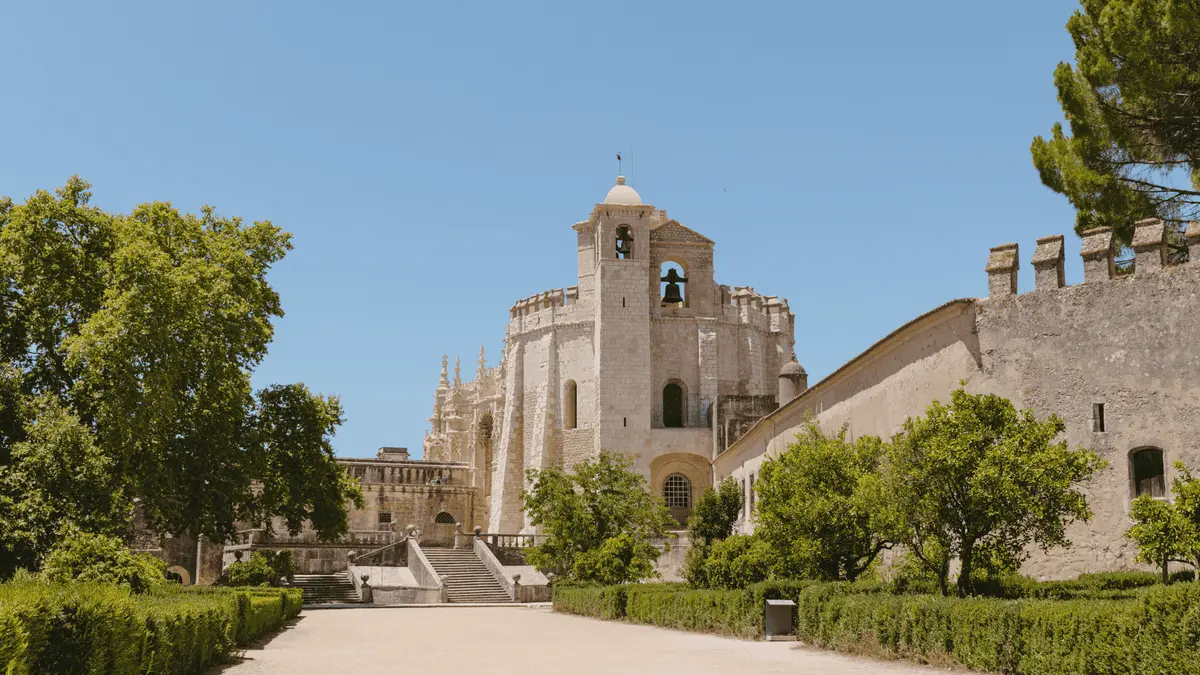
Sintra gets the queues; Tomar Portugal gets the history. This compact riverside city, 90 minutes north of Lisbon by car, holds the only unbroken Knights Templar legacy in the world — housed in the Convento de Cristo, an architectural record of five centuries that most visitors to Portugal never see. This guide tells you exactly what to do, where to eat and how to get there without wasting time.
What makes Tomar Portugal worth a day trip from Lisbon?
Tomar is the only place on earth where the Knights Templar legacy continued without interruption after the order’s suppression in 1312. King Dinis converted Templar assets into the Order of Christ, which then financed the entire Age of Discovery. What you walk through today — castle, convent, cloisters, medieval street grid — is the physical record of that unbroken chain.
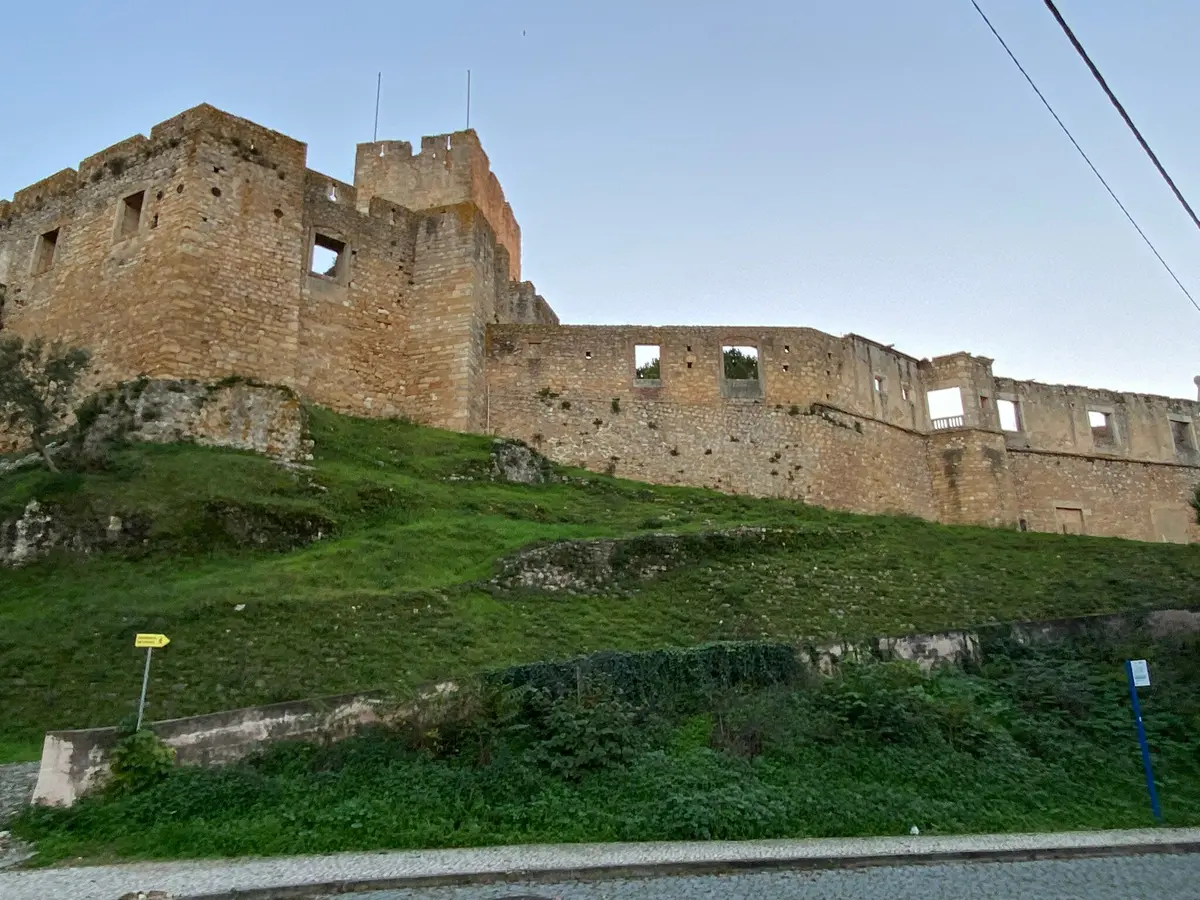
Founded to hold a line: the siege of 1190
The city was engineered, not settled. Gualdim Pais, Grand Master of the Portuguese Templars, founded it in 1160 on a strategic hilltop above the Nabão River, forming part of the Tagus defensive line alongside fortresses like Almourol Castle — among the most strategically positioned of Portugal’s castles. Pais brought military innovations directly from the Crusader states: the castle’s alambor, or sloped embankment walls, prevented battering rams from gaining purchase. That design held in 1190 when Almohad Caliph Yaqub al-Mansur besieged the city with a large army and failed to take it. That defense was not a local skirmish. It held a critical line in the formation of the Portuguese nation.
From Templars to the Order of Christ
When Pope Clement V dissolved the Knights Templar in 1312, assets across Europe were seized or scattered. Portugal’s King Dinis negotiated a different outcome. In 1319, he founded the Order of Christ and transferred all Templar holdings — including Tomar — to the new organization. While other countries lost their Templar heritage, this city preserved and transformed it. The Convent of Christ you walk through today is the direct continuation of that survival.
Henry the Navigator and the Age of Discovery
Prince Henry the Navigator, governor of the Order of Christ, turned the order into the funding vehicle for Portuguese exploration. The cross on the sails of caravels reaching Brazil and India was the Cross of the Order of Christ. Tomar is not just a religious monument — it is the planning office from which European maritime globalization launched, which is why Portugal’s history makes considerably more sense once you’ve walked this complex. Spice trade wealth flowing back financed the elaborate Manueline additions to the convent that remain its most spectacular feature.
How do you get to Tomar from Lisbon?
The best option is the direct Regional train (marked “R” on the CP website) from Lisbon Santa Apolónia or Oriente stations. Journey time is roughly two hours, a one-way ticket costs around €10.55, and no seat reservation is required — which matters for a day trip where you don’t want to fix a return time. The Intercidades service requires a transfer at Entroncamento, costs more and saves very little time.
- From Lisbon: Santa Apolónia station (city center) or Oriente station (northeast Lisbon)
- Train type: Regional (R) — direct, no reservation required
- One-way fare: approximately €10.55; return ticket earns a 10% discount on the second leg
- Journey time: approximately 2 hours
- By car: approximately 90 minutes via A1 motorway connecting to A13; electronic tolls apply
- Station to convent: 1.3 miles (2 km) from the train station to the Convento de Cristo; mostly flat with a steep final approach
Pro Tip: Skip the Intercidades train to Entroncamento. The connection eats up any time saved, and the Regional train lets you buy a return ticket without fixing a departure time — which matters when exploring a complex this large.
How to visit the Convento de Cristo
The Convento de Cristo sits at the top of a steep hill above the city. Getting there on foot from Praça da República takes 15 minutes on a sharp incline — plan the walk up before your knees are tired from the complex. Tuk-tuks run from the town center for a few euros. Budget at least three hours inside — longer than most visits to monasteries in Portugal — because a rushed visit misses half of what makes this worth the trip.
- Location: Estrada do Convento, 2300-000 Tomar
- Hours: 9 a.m.–5:30 p.m. (Oct–May); 9 a.m.–6:30 p.m. (Jun–Sep); last entry one hour before closing
- Cost: €6 adults; €3 students, youth card holders and seniors 65+; free on Sundays for Portuguese residents
- Best for: History and architecture travelers, adults, families with older children
- Time needed: 3–4 hours minimum
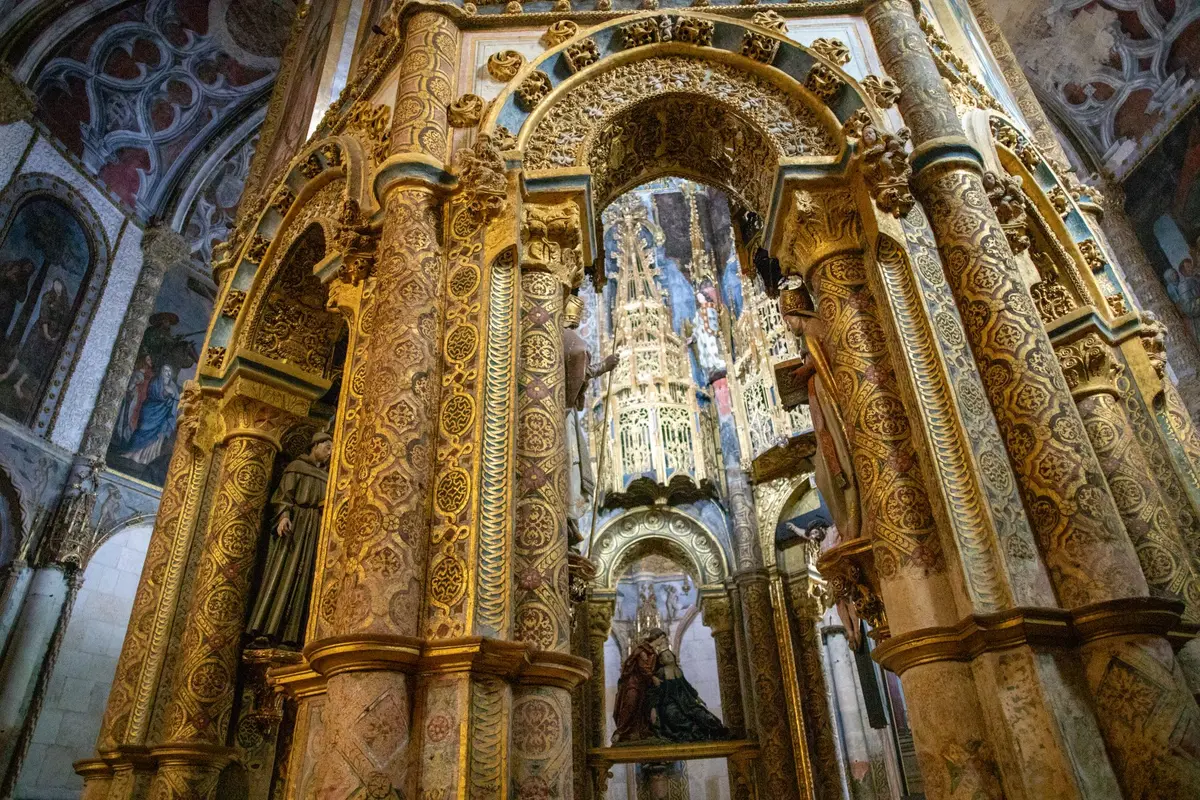
The Charola: inside the round church
The Charola is the visual centerpiece of the entire visit. This 16-sided polygon — modeled on the Church of the Holy Sepulchre in Jerusalem — stands two stories tall, with the central altar circled by a narrow ambulatory. The space is deliberately dim, which makes the restored 16th-century frescoes and gold leaf on the walls glow in a way that rewards arriving before the first tour groups at 10 a.m. The altar was designed so knights could receive mass on horseback, which tells you everything about the order’s priorities. On my last visit, the difference in atmosphere between arriving at 9 a.m. and returning past noon was significant — the morning light through the east windows hits the painted panels directly.
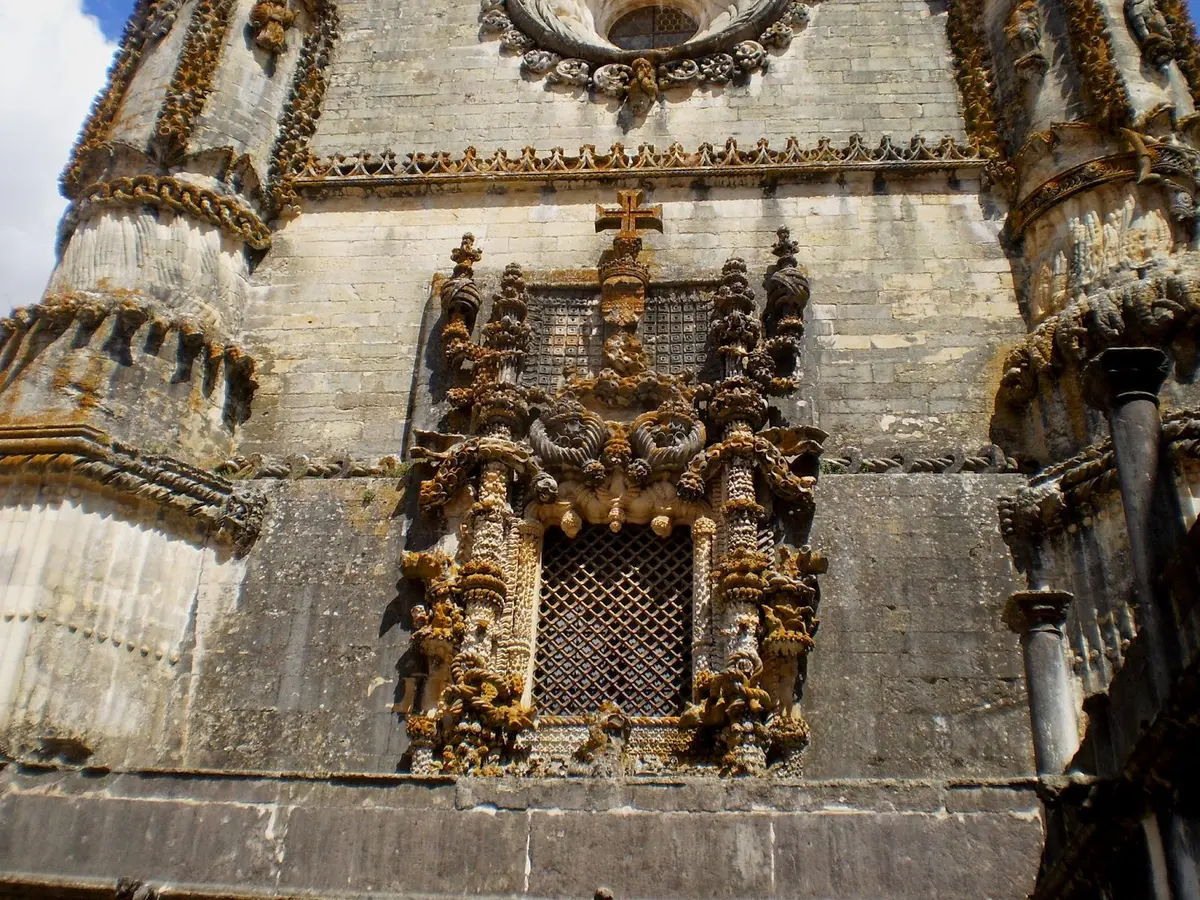
The Manueline Window — myth vs. reality
The Janela do Capítulo, designed by Diogo de Arruda in the early 16th century, is the most recognizable piece of architecture in Portugal. The window frame is entirely covered in carved stone: ropes, cables, armillary spheres, coral forms, oak branches — every element a reference to maritime dominion. The persistent legend that Britain once offered to write off the Portuguese national debt in exchange for this window is historically dubious, but the story survives because nothing else in the country generates that kind of possessiveness.
Navigating the cloisters
The convent contains several interconnected cloisters, and they disorient even people who have studied architecture. The Claustro de D. João III is Renaissance: symmetrical, monumental and sharply different in mood from everything around it — use it as a landmark to orient yourself. The Claustro da Lavagem is a two-story Gothic structure where monks washed their habits; the stone cistern is still intact at ground level. The Claustro dos Corvos and Claustro da Micha were working areas where daily monastery operations took place. Slow movement rewards here more than anywhere else in the complex.
Pro Tip: Take a tuk-tuk up to the convent, then walk back down through the Mata Nacional dos Sete Montes. The forest path is shaded, the descent is gentle on your knees, and you arrive at the town center without retracing a single step.
What else is worth seeing in Tomar’s city center?
The monuments tend to overshadow the town itself, which is a mistake. Tomar’s historic center sits at the heart of central Portugal and is compact and easy on foot, holding three stops worth your time beyond the hill.
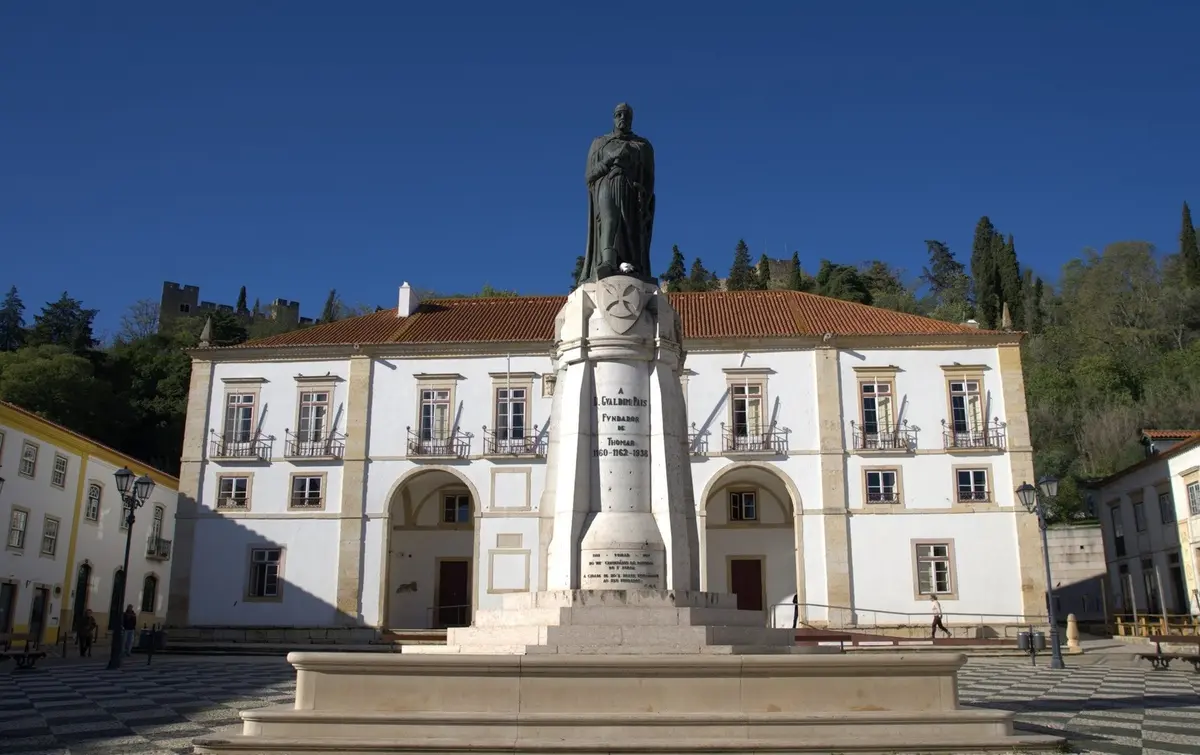
Praça da República
The square is where daily life actually happens — locals take their morning espresso here at 8 a.m. while most visitors are still at breakfast. The Igreja de São João Baptista anchors one side with an octagonal Manueline Gothic spire, and a statue of Gualdim Pais stands at the center. Spend 20 minutes here before hiking up to the convent and you’ll have the context for everything you’re about to see.
The Synagogue and Jewish Museum
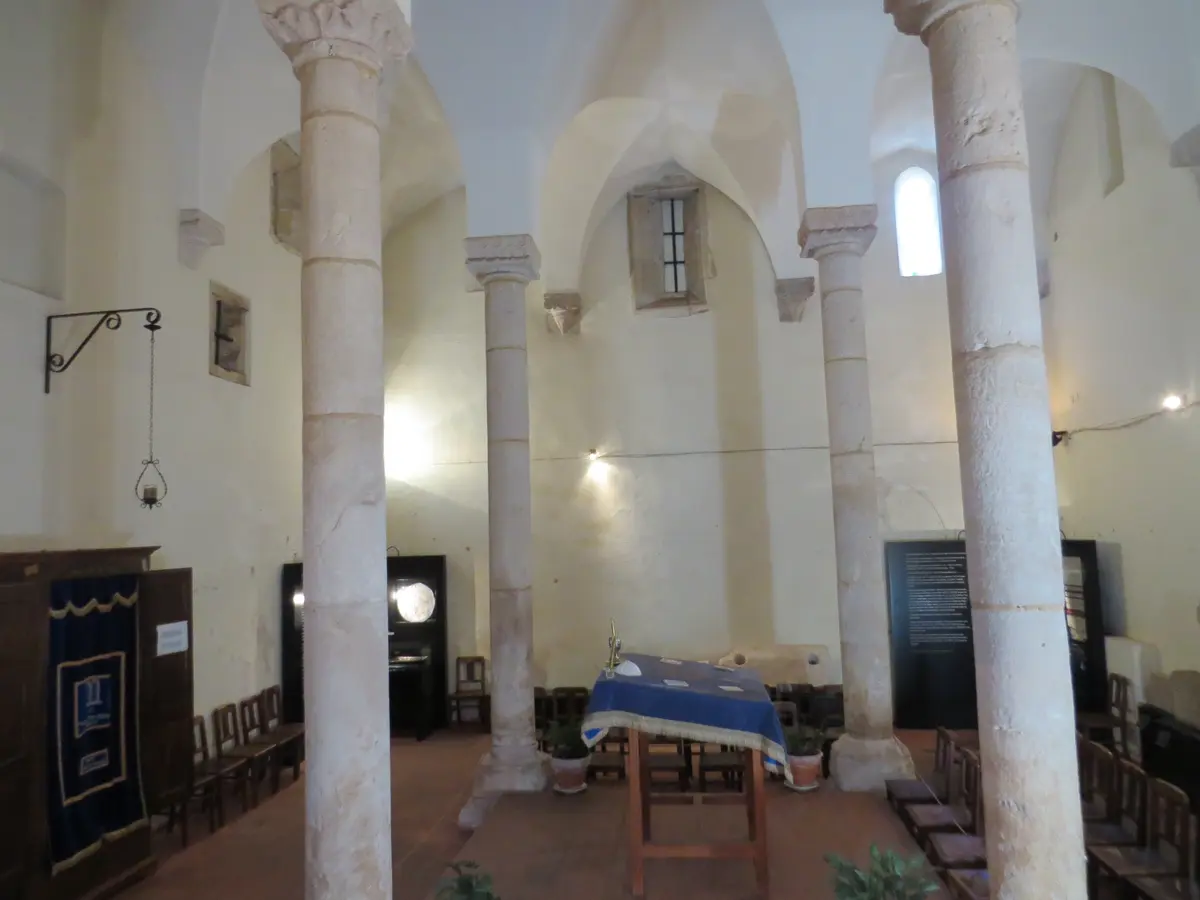
The Museu Luso-Hebraico Abraão Zacuto on Rua Dr. Joaquim Jacinto is the best-preserved medieval synagogue in Portugal, and admission is free. The interior is small — four columns supporting a vaulted ceiling, with inverted clay jars embedded in the walls for acoustic enhancement. What makes it worth the stop is the historical connection: it was built during Henry the Navigator’s governorship, when the Jewish community was close to the Order of Christ’s leadership. It closed in 1496 when Jews were expelled from Portugal; it served as a prison, a chapel and a grocery warehouse before being recognized as a national monument in 1921.
- Location: Rua Dr. Joaquim Jacinto 73, 2300-577 Tomar
- Cost: Free
- Hours: Tuesday–Sunday, 10 a.m.–1 p.m. and 2 p.m.–6 p.m.; closed Mondays
- Best for: History travelers, Jewish heritage travelers
- Time needed: 30–45 minutes
Mata Nacional dos Sete Montes
This 96-acre (39-hectare) public park runs between the town and the convent. The tree canopy is dense enough that temperatures inside drop noticeably compared to the square — a significant advantage when summer temperatures climb above 95°F (35°C). The pedestrian path through the park connects directly to the Convento de Cristo on the hill above, making it the practical alternative to the exposed street route.
Where to eat in Tomar — the honest shortlist
The city has more dining range than its size suggests, from a serious meat restaurant outside the center to a petiscos bar that feels like a different city entirely.
Chico Elias
This is where locals go for roast kid, not where they take tourists to impress them. The dining room feels like a large family house that someone never got around to converting, and the Cabrito Assado (slow-roasted kid goat) is the reason people book tables a week ahead for Sunday lunch. The flavors are intense, the portions are large, and the menu is a faithful cross-section of traditional Portuguese food — nothing here needs translating. You need a taxi or rideshare to get here; it is not walking distance from the center.
- Location: Outside the town center; requires taxi or rideshare
- Cost: €20–30 per person with wine
- Best for: Meat lovers, anyone serious about Portuguese traditional food
- Time needed: 90 minutes
Taverna Antiqua
Medieval theme, period costumes, a menu drawn from 15th-century recipes. This sounds like a tourist trap — the food is actually taken seriously. The lamb dishes are good and portions are filling, perhaps overfilling. It works well for families or anyone who wants atmosphere and food in the same package without having to choose between them. It sits directly on Praça da República, which means prime location with corresponding noise on busy evenings.
- Location: Praça da República, Tomar
- Cost: €18–28 per person
- Best for: Families, history-themed dining, groups
- Time needed: 90 minutes
Clandestino
Skip it if you want tradition. Go if you’ve reached your limit of heavy stews. The menu is petiscos-style — small plates, creative interpretations of Portuguese classics — and the craft cocktails are among the better ones in this part of central Portugal. The clientele skews younger than everywhere else in town. It’s the right call after two days of rich meat dishes and before one more morning at the convent.
- Location: Tomar town center
- Cost: €15–25 per person
- Best for: Lighter eaters, younger travelers, solo diners at the bar
- Time needed: 60–90 minutes
Bela Vista
Riverside dining with views of the historic bridge and the Nabão below. The food is honest and simple — grilled fish, soups, straightforward Portuguese plates. Nothing here needs a superlative. Service slows significantly when the terrace fills at sunset, but the light hitting the river at 7 p.m. makes the wait easier to absorb than it would be anywhere else.
- Location: Riverside, Tomar
- Cost: €14–22 per person
- Best for: Couples, sunset dinners
- Time needed: 60–90 minutes
Where to stay in Tomar: four options for every budget
The accommodation range here is wider than the city’s size suggests, from a boutique hotel with rooftop views of the convent to one of the most respected hostels in Portugal.
Thomar Boutique Hotel
If you want to see the Convento de Cristo illuminated at night from your own rooftop terrace, this is the only property in town that delivers it. The rooms are contemporary, the location puts you within walking distance of the square and the synagogue, and the view at night — the convent’s pale stone lit against a dark sky — is the single best reason to stay an extra night, making it one of the more memorable Portugal hotels for architecture enthusiasts.
- Location: Tomar historic center; walkable to everything
- Cost: From approximately €90/night
- Best for: Couples, architecture enthusiasts, anyone staying more than one night
- Time needed: 1–2 nights
Quinta da Anunciada Velha
A working estate with peacocks on the grounds and genuine antique furniture throughout. The atmosphere is exactly what “rural Portuguese manor” promises and rarely delivers. The trade-off is absolute: you need a car. The property is isolated from the city center, which is a significant problem if you arrived by train.
- Location: Outside Tomar town center; car required
- Cost: From approximately €70/night
- Best for: Travelers with cars, anyone seeking quiet and rural atmosphere
- Time needed: 1–2 nights
Hostel 2300 Thomar
This place consistently appears on lists of the best hostels in Portugal and earns the designation. The design is considered rather than improvised — artwork on the walls, good natural light, clean dorms. The crowd leans toward experienced backpackers and Camino pilgrims passing through, not party travelers. At around €20/night for a dorm bed in a town this historically rich, the value is hard to argue with.
- Location: Tomar town center
- Cost: From approximately €20/night (dorm bed)
- Best for: Solo budget travelers, pilgrims, backpackers
- Time needed: 1–2 nights
Vila Galé Collection Tomar
This property occupies the restored Convent of Santa Iria, which gives it architectural credentials that chain hotels rarely carry. Large breakfast buffet, pool, reliable service — the profile of a resort hotel inside a 15th-century convent. The right call for families or travelers who want a known quantity without sacrificing the historical setting.
- Location: Rua Santa Iria, Tomar
- Cost: From approximately €130/night
- Best for: Families, travelers who prefer chain reliability
- Time needed: 1–2 nights
What are the best day trips from Tomar?
Three excursions are worth building around a Tomar Portugal base: an engineering feat with no guardrails, a Templar island fortress, and a cold-water river swimming hole that locals treat as their summer headquarters.
The Aqueduct of Pegões
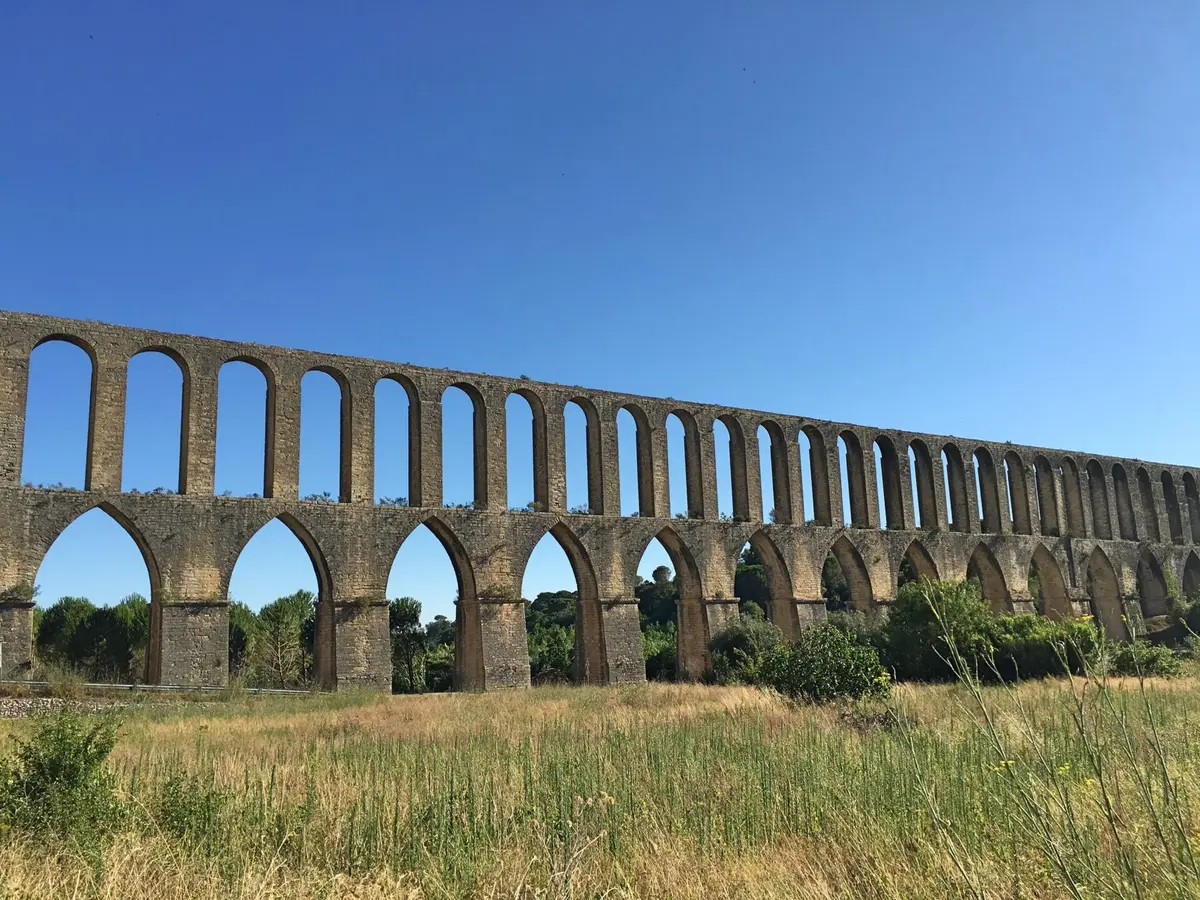
The Aqueduto dos Pegões Altos stretches 3.7 miles (6 km) with 180 arches, originally built to carry water up to the convent above. You can walk along the top. In many sections there are no guardrails and the drop reaches 98 feet (30 meters). If heights are a problem, find out in the first 100 yards rather than halfway across. Access without a car is genuinely difficult; the walk rewards the logistical effort with panoramic views across surrounding farmland.
Almourol Castle: the island fortress
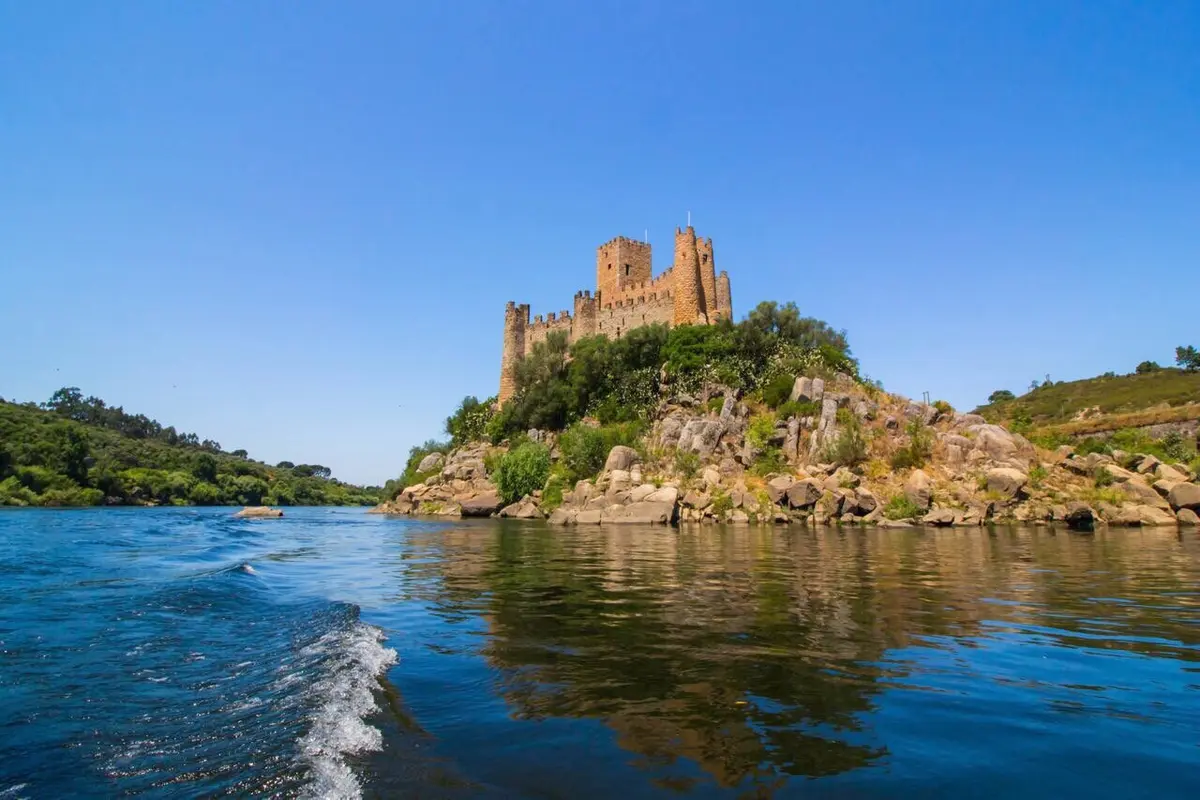
Castelo de Almourol sits on a small rocky island in the middle of the Tagus River, 25 minutes from Tomar by car, and accessible only by a short boat crossing. The castle is purely defensive — no residential rooms, no decoration, no complexity — which means a visit takes 45 minutes and is extremely photogenic at any hour. It is the clearest visual demonstration of Templar strategic thinking: the island itself is the fortification. Add it as a half-day excursion before heading back to Lisbon.
Agroal River Beach
Praia Fluvial do Agroal is a natural spring-fed river pool that the region’s locals treat as their summer headquarters. The water is cold in a way that is immediately noticeable even after the short walk from the parking area — the kind of cold that earns local legends about therapeutic properties. Wooden decks, a cafe and consistent facilities make it a practical counterpart to a morning at the convent. Arrive before 10 a.m. on summer weekends or parking becomes a real problem.
When is the best time to visit Tomar Portugal?
The shoulder seasons — May, June, September and October — represent the best time to visit Portugal broadly, and Tomar is no exception — temperatures stay between 65°F and 80°F (18°C and 27°C), the convent is unhurried before 11 a.m., and the riverside restaurants are open without being overwhelmed. Summer brings heat regularly above 95°F (35°C), which makes the Convento de Cristo — a mostly outdoor complex with significant distances between buildings — genuinely draining by midday. Winter is rainy but delivers the monuments essentially to yourself, which has its own appeal. If you visit in summer, arrive at the convent when it opens at 9 a.m. and plan to finish by noon.
The Festa dos Tabuleiros — Tomar’s once-every-four-years spectacle
The Festa dos Tabuleiros is one of the most visually specific events in Portugal and takes place in Tomar every four years in July. The last edition, in July 2023, drew an estimated 600,000 visitors to a city of fewer than 20,000 residents. The next is scheduled for July 2027. Hundreds of women parade through the streets carrying towering trays on their heads — each one holding 30 loaves of bread and paper flowers, reaching the height of the woman carrying it. The festival has pre-Christian agricultural roots that were absorbed by the Brotherhood of the Holy Spirit in the 14th century; the tray structure was meant to symbolize an offering for the Temple of Jerusalem. If you plan to attend in 2027, book accommodation the moment official dates are confirmed — rooms across the entire region fill within days of announcement.
The bottom line
TL;DR: Tomar Portugal holds a coherent, self-contained history — Templar castle, unbroken Order of Christ legacy, medieval Jewish quarter and the most architecturally layered convent on the Iberian Peninsula — with a fraction of the crowds Sintra absorbs on the same day. Two hours by Regional train from Lisbon, one full day minimum to do it justice, two nights if you want the day trips and a proper dinner at Chico Elias. Pair it with our Portugal travel guide to build the full itinerary around it.
Are you planning Tomar Portugal as a day trip or staying overnight — and what part of the Templar history pulled you in?