BINAES Library is the most talked-about building in San Salvador, and most of what circulates about it online is only half right. China paid for it — about $54 million, given outright. It runs 24 hours a day, entry is free, and the architecture lives up to the videos. What’s actually inside is more complicated.
What Is BINAES?
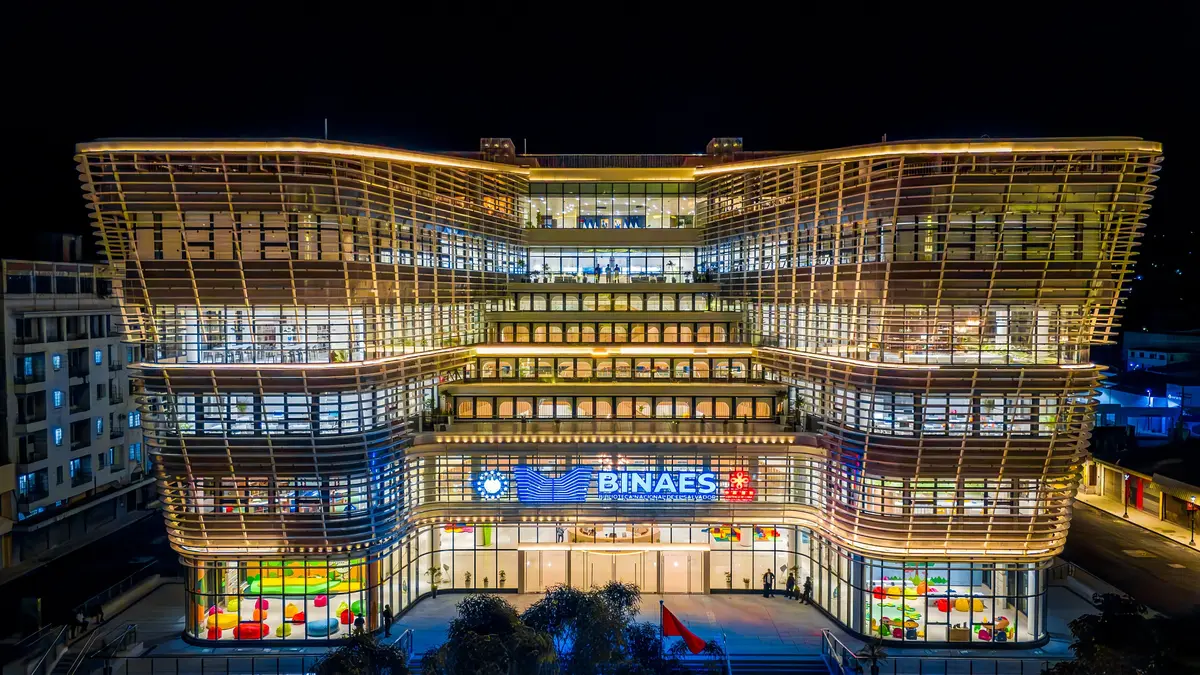
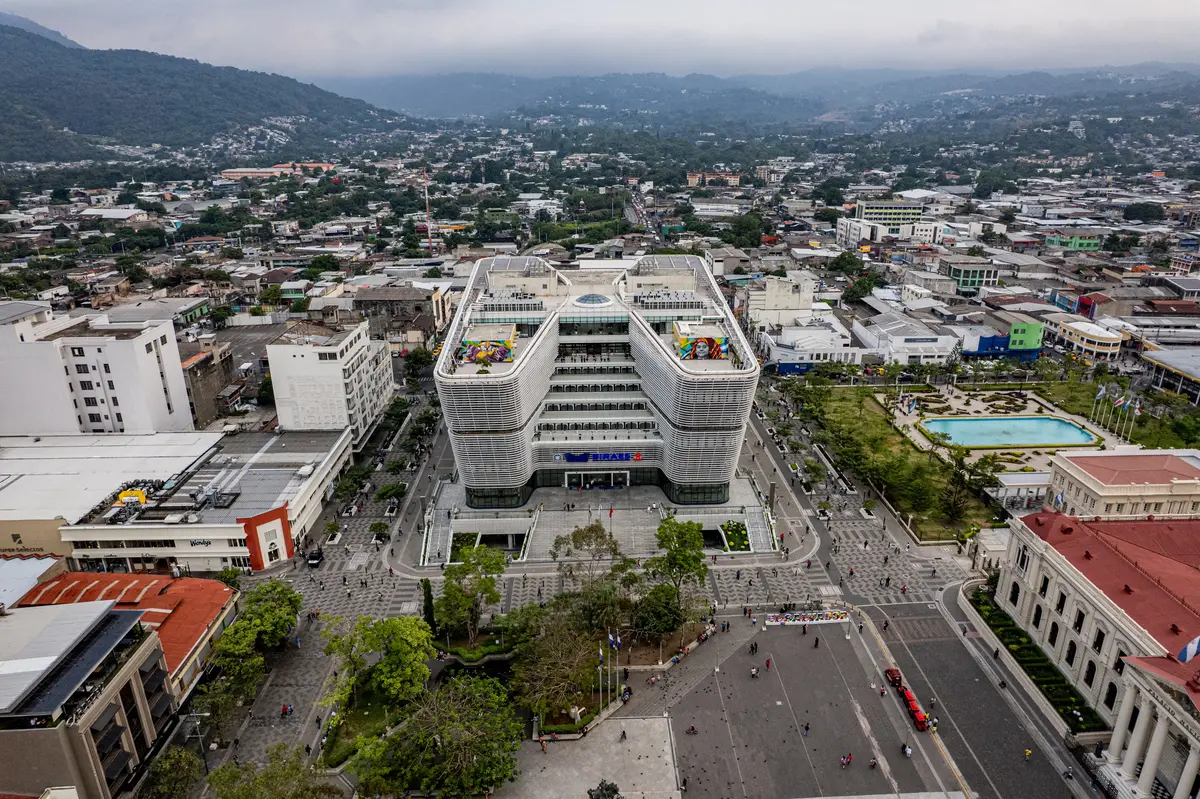
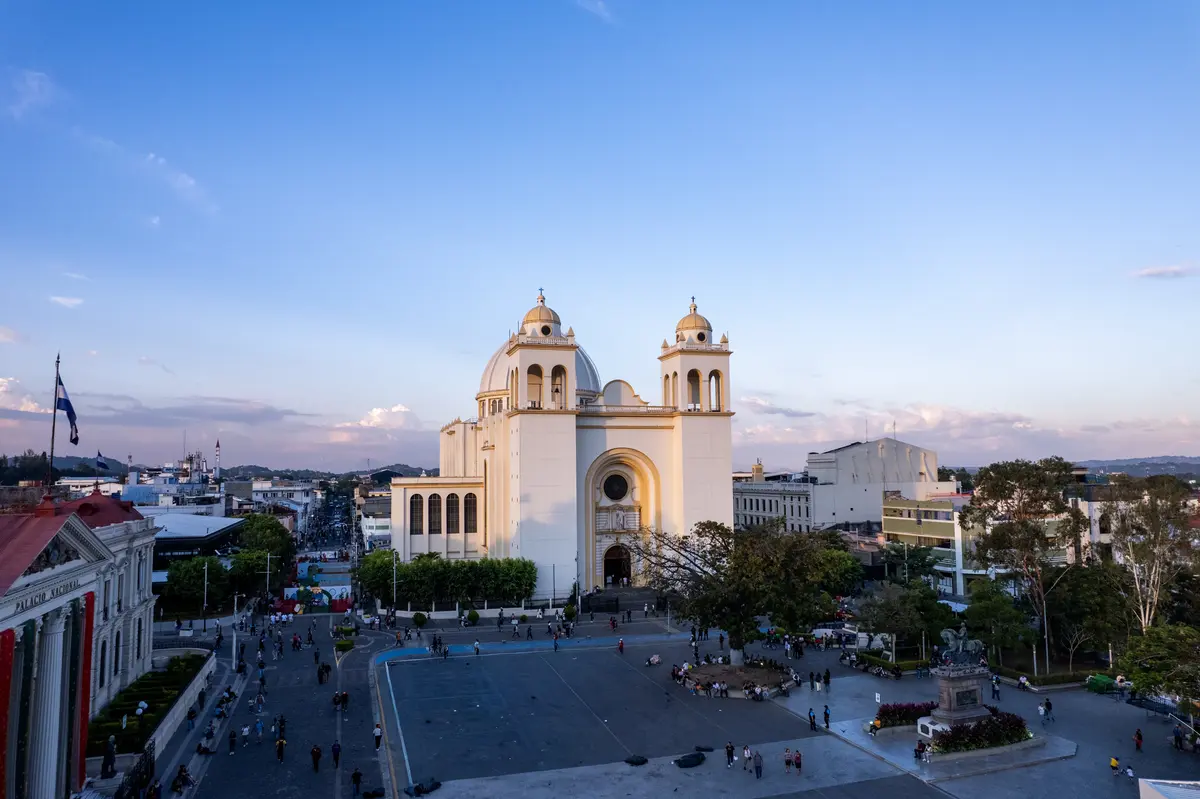
BINAES (Biblioteca Nacional de El Salvador) is El Salvador’s national library, in the historic center of San Salvador facing the Metropolitan Cathedral. It opened on November 14, 2023, built with a roughly $54 million donation from China. The seven-floor building is free, open 24 hours a day, and holds far more tech and pop culture than books.
The full legal name is the Biblioteca Nacional Francisco Gavidia, after the Salvadoran writer whose 1870-founded library it replaced. In English you’ll see it as the National Library of El Salvador. Locals and short-form videos just call it BINAES.
BINAES at a Glance
- Official name: Biblioteca Nacional de El Salvador (BINAES), formerly Biblioteca Nacional Francisco Gavidia
- Location: Historic center of San Salvador, on Plaza Gerardo Barrios, across from the Metropolitan Cathedral
- Opened: November 14, 2023
- Cost to build: About $54 million — a non-reimbursable donation from China
- Admission: Free
- Hours: Open 24 hours a day, 7 days a week
- Size: Roughly 256,000 sq ft (about 24,000 m²)
- Floors: 7 (official count; some visitors count 6)
- Architect: Lei Wei, Central-South China Architectural Design Institute (CSADI)
- Contractor: Yanjian Group
- Digital access: More than 9 million titles (self-reported by the Ministry of Culture)
Pro Tip: There’s no ticket and no queue to get past the entrance, but there is a security bag scan, so travel light if you’re coming from a day of walking the center.
Why Did China Build El Salvador a National Library?
China funded BINAES as non-reimbursable aid — about $54 million covering the building, equipment and initial books — after El Salvador switched diplomatic recognition from Taiwan to Beijing in 2018. The library was the first Chinese-aid project delivered under the new relationship, and it doubles as a piece of soft-power diplomacy in Central America.
From the 1870 Gavidia Library to a Chinese-Built Replacement
The original Biblioteca Nacional Francisco Gavidia dated to July 5, 1870. To make room for the new structure, the old library building was demolished around 2021 and 2022. That demolition is part of why the project draws criticism: it removed a heritage building on the site to put up the replacement. Keep this in mind later — the “new library” story and the “lost old library” story are the same story.
The 2018 Break With Taiwan and the Turn Toward Beijing
El Salvador established formal ties with the People’s Republic of China in August 2018, ending recognition of Taiwan. BINAES became the visible payoff: a landmark in the capital’s center, paid for by Beijing, opened by President Nayib Bukele. Trilingual signage inside — Spanish, Náhuat and English — signals both national identity and an audience beyond the country.
What Else China Is Funding in El Salvador
BINAES isn’t a one-off. Chinese cooperation has been tied to a new national stadium, a tourist pier at La Libertad, and a water-treatment plant at Ilopango, among other projects. The library is the flagship because it’s finished, free, central, and photogenic — a single building that carries the whole diplomatic message.
The Architecture: Waves, Reefs and an Open Book
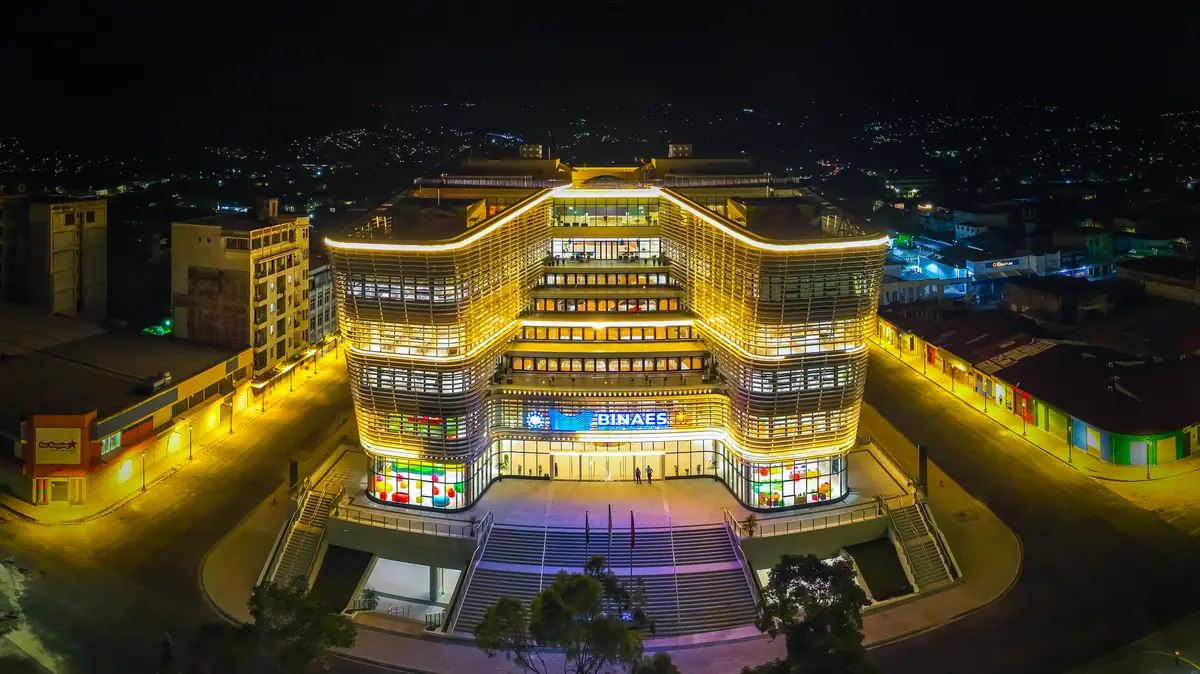
The shape is the whole point. Depending on the angle and who’s describing it, the building reads as waves, coral reefs, volcanoes, an open book, or a butterfly mid-flight. That ambiguity is deliberate — the exterior is meant to look different as you circle it.
Who Designed BINAES and the Idea Behind the Shape
The lead architect was Lei Wei, working with the Central-South China Architectural Design Institute (CSADI). The design language leans on the “open book” metaphor you’d expect from a library, layered with references to El Salvador’s coastline and volcanic terrain. The structure runs seven floors above ground plus one below, according to the Chinese ambassador’s account at the opening.
The 201-Pendant Chandelier and the Seven-Story Atrium
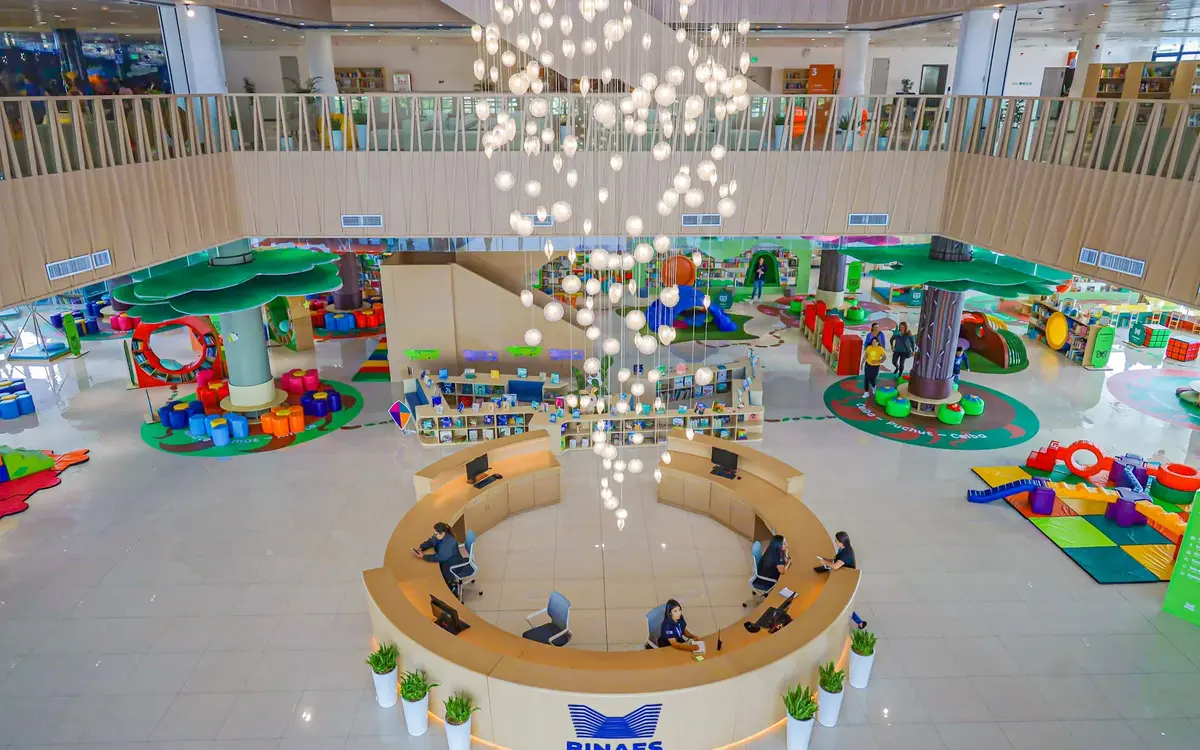
The centerpiece inside is a chandelier that drops through the central atrium. It was made by the studio Shakúff with urban-planning specialist Santiago Caprio of the firm ufficiis, and it’s built from 201 crystal-shell pendants that hang almost 25 feet from the ceiling. Standing at the bottom of the atrium and looking straight up through all seven levels is the shot everyone comes for.
Built to Survive Earthquakes
San Salvador sits in an active seismic zone, and the building was engineered for it. That’s less visible than the chandelier but more consequential — a public building open around the clock in an earthquake-prone capital has to hold up. It’s one of the specs that rarely makes the viral videos and matters more than most of them.
Floor by Floor: What’s Actually Inside
Here’s the honest headline: BINAES is organized more like a modern activity center than a stack-and-study library. Books share the building with gaming rooms, VR rigs and themed pop-culture zones. This table is the quick map; the sections below add what the specs don’t tell you.
| Zone | What’s there | Who it’s for |
|---|---|---|
| Lower floors | Children’s and early-childhood areas | Families with young kids |
| Pop-culture floor | Star Wars, Harry Potter, Game of Thrones, manga, LEGO | Teens, casual visitors |
| Mid floors | General collection, national archive, reading rooms | Readers, researchers |
| Tech floor | VR, robotics, 3D printing, simulators, Bitcoin bookshelf | Students, tech-curious |
| Rooftop | Art gallery, terraces, Italian restaurant, city views | Everyone (best at sunset) |
Children and Early-Childhood Floors
The lower levels are built for kids, with early-childhood spaces tied into the First Lady’s “Nacer con Cariño” programming. On a weekend afternoon these are the busiest, loudest floors in the building — worth knowing if you’re picturing a quiet library.
The Pop-Culture Floor: Star Wars, Manga and LEGO
This is the floor that made BINAES go viral. Themed corners lean into franchises — Star Wars, Harry Potter, Game of Thrones — alongside manga shelves and LEGO builds. It’s the part of the library that reads least like a library and most like a very well-funded fan space, which is exactly why it photographs so well and why critics have questions (more below).
The General Collection and National Archive
The actual books and the national archive sit in the middle of the building. One detailed visitor account notes that nonfiction really only takes over from around the fifth floor up — meaning you climb past a lot of screens and displays before you hit the collection most people picture when they hear “national library.” The physical collection is also for in-library use only; nothing goes home with you.
The Tech Floor: VR, Robotics and a Bitcoin Bookshelf
The technology floor is where BINAES flexes: virtual-reality stations, robotics, 3D printing and simulators. It also holds a Bitcoin-shaped bookshelf, curated by Alejandra Guajardo, known publicly as “Miss Bitcoin” — a nod to El Salvador’s Bitcoin policy that visitors either find charming or on-the-nose, depending on their politics.
The Rooftop: Gallery, Terraces and an Italian Restaurant
The top floor pays off the climb. There’s an art gallery, open terraces, and an Italian restaurant (reported by visitors as Basílico) with a straight view over the historic center. The line of sight takes in the Metropolitan Cathedral and the National Palace, and it’s the single best reason to time a visit for late afternoon.
Pro Tip: Do the building bottom-to-top and save the rooftop for last — you’ll want the terrace at golden hour, not at noon when the glare flattens the view of the Cathedral.
Visiting BINAES: Hours, Entry and the Key to Knowledge Card
BINAES is open 24 hours a day, 7 days a week, and admission is completely free. To use the computers, gaming rooms, tech floor or borrow-in-place materials, you register a free “Key to Knowledge” (Llave del Saber) card at the desk. Just walking the floors and using the rooftop requires nothing but passing the security scan at the door.
The Ministry of Culture describes BINAES as the first national library in the world to run 24 hours — a claim worth attributing rather than repeating as settled fact, since it’s the government’s own framing.
Getting There and the Historic-Center Location
- Location: Plaza Gerardo Barrios, historic center of San Salvador
- Landmark: Directly across from the Metropolitan Cathedral
- Nearby: National Palace, Jardín Centroamérica, and the rest of the revitalized center
- Getting there: Easiest by rideshare into the center; it’s a short walk from the main historic-center sights
Rules That Catch Visitors Off Guard
A few rules trip people up because they don’t match what a “library” usually means:
- Read before you play: On the gaming floor, kids are expected to read for about 30 minutes before they get game time. It’s the quirk every viral clip mentions.
- Books stay put: The physical collection is for in-library use only — no checking books out.
- Security scan on entry: Bags go through a scan at the door, so budget a minute or two at busy times.
Accessibility and Visiting With Kids
BINAES is family-friendly by design — the lower floors exist for children. The honest friction point is vertical movement: reviewers regularly flag slow elevator waits and note that getting a stroller or wheelchair between floors can be a test of patience during peak hours. If you’re visiting with a stroller, go early, before the weekend crowds.
Is BINAES Safe and Worth Visiting?
Yes on both, with caveats. The revitalized historic center around BINAES is one of the safer, more visited parts of San Salvador, and the library itself is guarded, free, air-conditioned and open at all hours. It’s worth visiting if you’re in the capital — but it’s a stop on a trip, not a reason to fly to El Salvador on its own.
Set expectations before you go. If you arrive wanting a great national book collection, you may leave underwhelmed; the building leads with tech and pop culture, and the deepest holdings take a back seat. If you arrive wanting striking architecture, rooftop views and a free place to escape the heat for an hour, it delivers cleanly.
What Visitors Actually Report Inside
A quick note on honesty: this section draws on documented visitor accounts rather than manufactured personal claims, and it’s the place to add your own verified first-hand observations and photos.
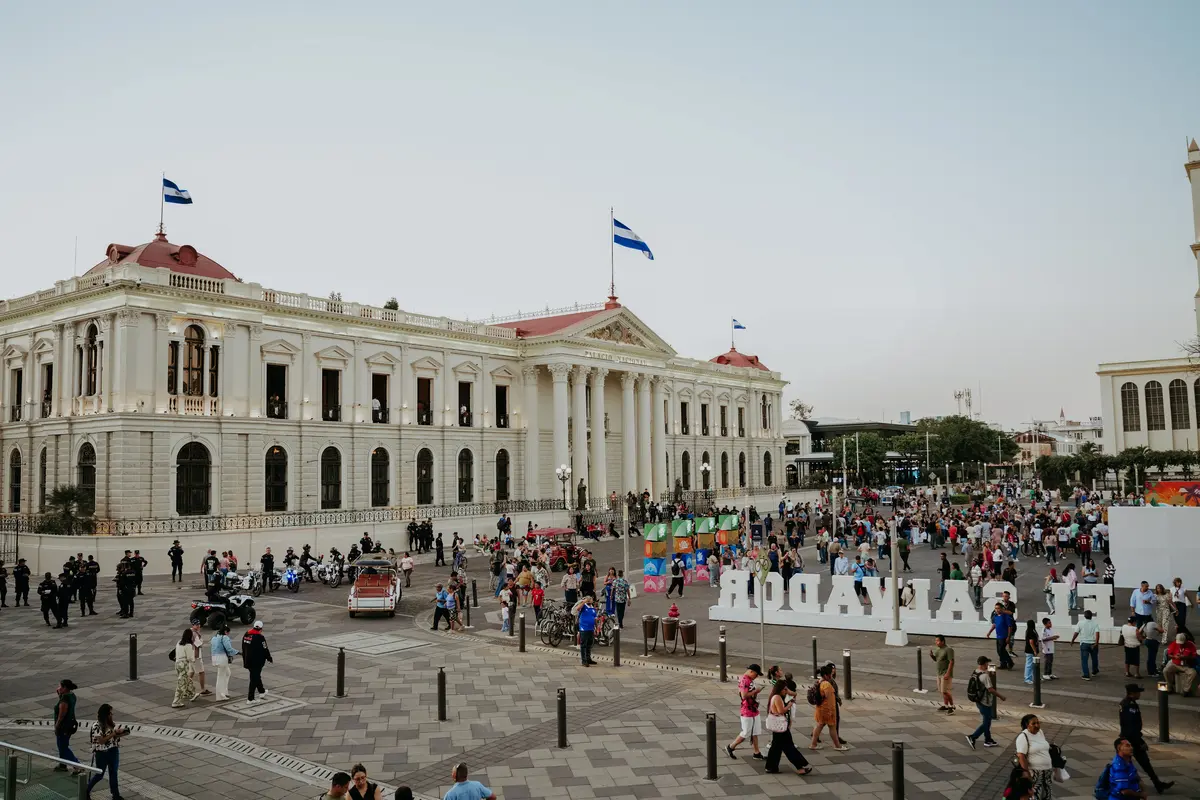
The consistent picture from detailed visitor write-ups: the atrium and chandelier land as advertised, the rooftop view of the Cathedral at sunset is the highlight, and the themed floors are genuinely fun. The recurring complaints are elevator waits and the gap between the “world’s most beautiful library” billing and how few traditional books are actually front-and-center. One Salvadoran writer’s on-site account describes the historic holdings sitting behind a locked door while pop-culture displays get prime space — a tension you won’t feel until you’re inside.
There’s also an access footnote worth knowing: after the crush of the first weeks, the round-the-block queue eased, and getting in became a walk-up rather than an hours-long wait. Come on a weekday morning and you’ll likely have the quieter floors to yourself.
The Controversy: Secrecy, Symbolism and “A Library With Few Books”
This is the part travel guides skip, and it’s the reason to trust the rest. A gift this size, this visible, and this political comes with real disputes attached.
The Seven-Year Secrecy Clause
According to a report by the watchdog group Acción Ciudadana, relayed by Diálogo Américas, information about the BINAES project was classified for seven years starting in August 2021, under an agreement between China’s international-cooperation agency and El Salvador’s Ministry of Culture. Officials reportedly justified the secrecy by arguing that disclosure could endanger national defense and public safety. For balance: Diálogo Américas is sponsored by U.S. Southern Command, so treat its framing with that context, while noting the underlying documents are attributed to a Salvadoran watchdog.
The Borrowed-Shelves Episode
Part of the transparency criticism centers on how the collection was assembled and presented, including a reported episode of borrowed shelving used to fill out the space around opening. It feeds the broader question critics keep raising: whether the library was ready as a library, or ready as a photo op.
Pop Culture Over Books, and a Locked Historic Archive
The sharpest critique is cultural, not political. A detailed first-hand account from a Salvadoran analyst argues that books play a minor role until the upper floors, that the historic holdings are locked away, and that the building prioritizes spectacle over collection. Independent reporting has also noted that much of what’s on display skews toward Western pop culture. None of this makes BINAES a bad place to spend an hour — but it complicates the “greatest library” headline.
Closed Casas de la Cultura and the Soft-Power Critique
Set against BINAES, some observers point to closures of neighborhood Casas de la Cultura — small, local cultural centers — as evidence of uneven priorities: one flagship megaproject in the capital while grassroots access thins elsewhere. Layered on top is the geopolitics: a foreign power’s most visible gift sitting across from the country’s main cathedral is, by design, a message as much as a building.
BINAES by the Numbers
The visitor figures are big, official, and worth reading with a note attached: they’re self-reported by El Salvador’s Ministry of Culture and aren’t independently audited.
- First three weeks: more than 100,000 visitors, with some reportedly queuing past midnight to get in (per the Chinese ambassador at the time)
- Running total, per Diario El Salvador: above 2.5 million visitors since opening
- Culture Minister Raúl Castillo has since reported roughly 2.1 million visits in a single year and a cumulative total near 4.67 million
- Digital access: more than 9 million titles (Ministry figure)
- Auditorium capacity: reported as 350 in most sources, though one account cites 150 — flag the discrepancy
A few headline specs also disagree across sources, which is itself telling:
- Book count: Minister Castillo has cited more than 150,000 physical books, with a plan to grow the collection past 300,000; earlier sources cited 360,000+. The collection is still being built, so treat this as a moving range.
- Floors: 7 is the official count; some reviewers insist it reads as 6.
- Size: the Ministry gives a precise total construction area of 23,764.08 m² (about 256,000 sq ft), of which roughly 19,498.49 m² is above ground — the widely repeated “24,000 m²” is a rounding.
Frequently Asked Questions
Q: What is BINAES? BINAES (Biblioteca Nacional de El Salvador) is El Salvador’s national library in central San Salvador. It opened on November 14, 2023, built with a roughly $54 million donation from China. The seven-floor, roughly 24,000 m² building is free and open 24 hours a day, seven days a week.
Q: Is the National Library of El Salvador free to visit? Yes. Entry is completely free and the library is open 24/7. To borrow materials or use the computers, gaming rooms and tech floor, you register a free “Key to Knowledge” (Llave del Saber) card. Books are for in-library use only.
Q: Who paid for and built BINAES? China funded it as non-reimbursable aid — about $54 million — and the Chinese state-owned firm Yanjian Group built it. It was the first Chinese-aid project delivered after El Salvador switched recognition from Taiwan to Beijing in 2018.
Q: What’s inside BINAES? Seven floors hold children’s areas, pop-culture zones (Star Wars, Harry Potter, manga, LEGO), a general collection and national archive, a technology floor with VR, robotics and 3D printing, plus a café, auditorium, rooftop art gallery, Italian restaurant and city-view terraces.
Q: Is BINAES worth visiting? For anyone in San Salvador, yes — it’s a striking, free, air-conditioned landmark in the historic center with rooftop views of the Cathedral. Just know that books take a back seat to tech and pop culture, and it isn’t a reason to visit the capital on its own.
Before You Go
BINAES Library is two things at once, and the honest read is holding both. It’s a genuinely impressive, free, 24/7 building with a rooftop view worth the climb — and it’s a $54 million diplomatic gift that leads with screens over shelves and came wrapped in a seven-year secrecy clause. Go for the architecture and the terrace at sunset; don’t go expecting the country’s deepest book collection on open display.
TL;DR: BINAES is a free, always-open national library in central San Salvador, built with a ~$54M donation from China. Come for the architecture, chandelier atrium and rooftop Cathedral views — not for a traditional book collection, and with the funding controversy in mind.
Have you been, or is BINAES on your San Salvador list? If you’ve visited, what surprised you most — the building, the crowds, or how few books you actually saw?