Tazumal is El Salvador’s tallest pre-Hispanic pyramid and its most-visited Maya site — and one of its most argued-over. The ruins are small, heavily restored, and famously coated in gray concrete. Here’s what you’ll actually see, how to reach Chalchuapa from Santa Ana or San Salvador, what a ticket costs, and whether it’s worth your time.
Is Tazumal Worth Visiting?
Yes, for a focused visit of about 45 to 60 minutes. Tazumal is El Salvador’s tallest Maya pyramid, sits beside a small artifact museum, and costs around $5 for foreign visitors. The site is compact and heavily restored, so it works best paired with the adjacent Casa Blanca ruins and a stop in nearby Santa Ana.
Set your expectations before you go. The whole compound is smaller than a soccer pitch, which is why nearly every visitor is back at the gate within an hour. The main pyramid is impressive for its height, but it wears a 1940s cement skin that many travelers find jarring up close. The on-site museum is small, its labels are in Spanish only, and it sometimes sits closed with no notice. None of that makes the trip a mistake — it just means you should treat Tazumal as a sharp 45-minute stop, not a half-day of ruins.
Who it’s for, honestly:
- Worth it if: you want to stand at the foot of the country’s tallest pyramid, you’re already in Santa Ana or on the Ruta de las Flores, or you like combining a quick ruin with the crafts demo next door at Casa Blanca.
- Skip it if: you’re chasing sprawling, un-restored jungle ruins — the concrete restoration will disappoint you.
- Go elsewhere first if: you care more about everyday Maya life than monuments. Joya de Cerén, an hour east, preserves an entire buried village and tends to move people more than Tazumal does.
Pro Tip: Buy one ticket and see two sites. Casa Blanca sits a short walk away and is jointly managed, so pairing them turns a 45-minute stop into a satisfying half-day without backtracking.
What You’ll See When You Walk In
Past the ticket window you’ll pass a small statue of Che Guevara, who visited the ruins in April 1954, and a cluster of stalls selling pupusas, yuca frita, and souvenirs. There’s no restaurant inside, so this is your only food. From there the grounds open onto trimmed lawns and the pale bulk of the main pyramid straight ahead. Everything is flat and easy to walk.
The Main Pyramid and the Great Platform
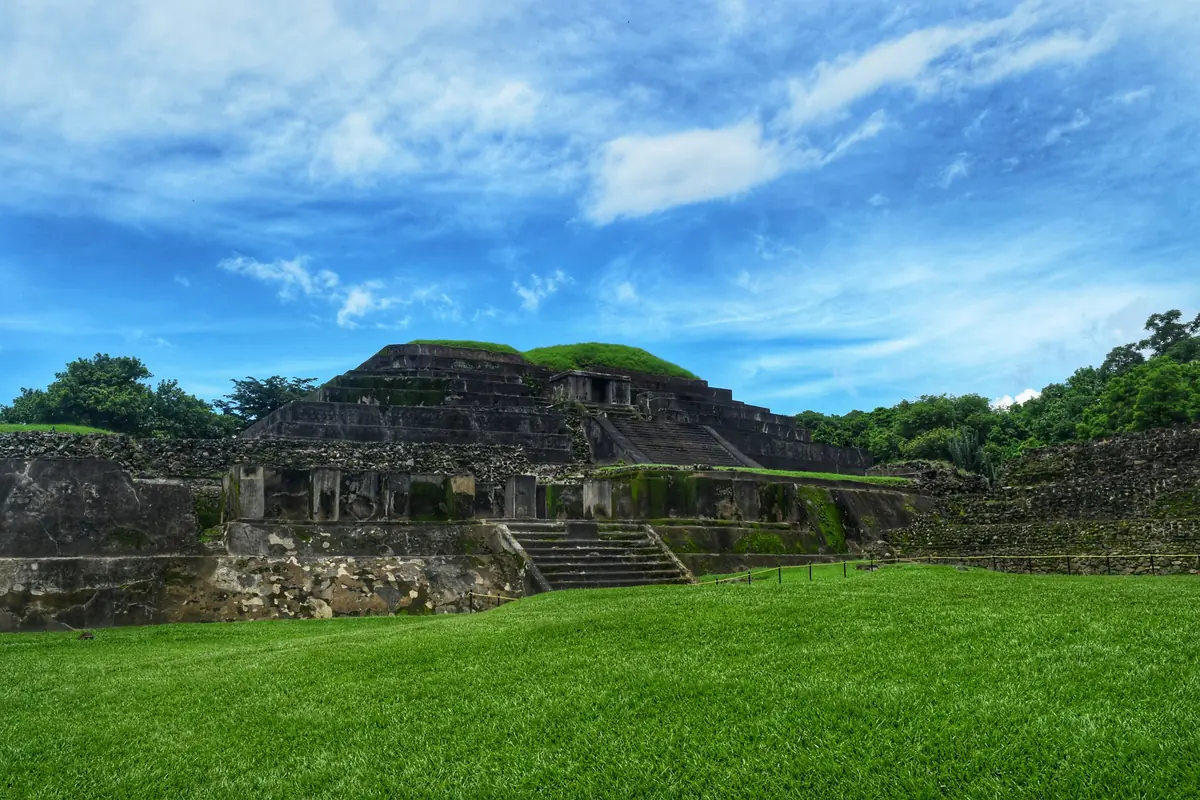
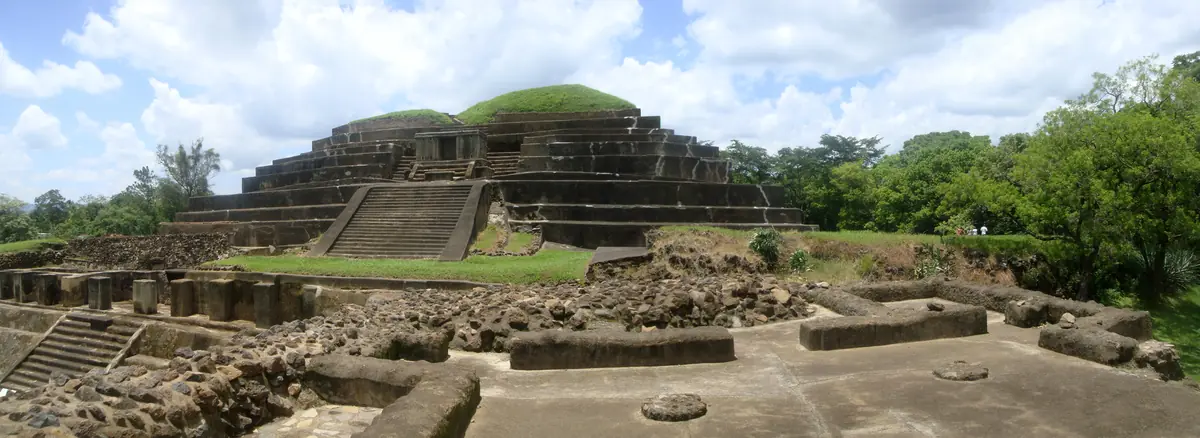
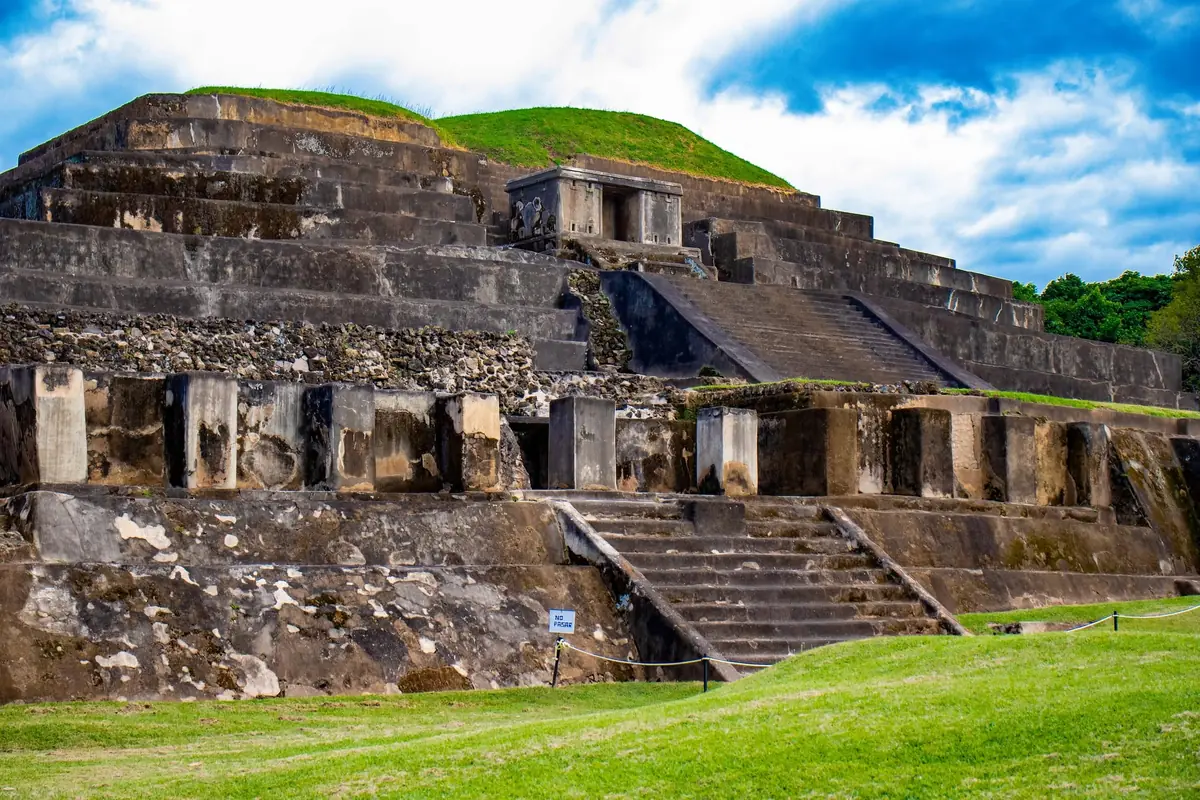
Structure B1-1 is the headliner: roughly 79 feet (24 m) tall, the tallest pre-Hispanic structure in the country. It rises from the Great Platform, a raised base measuring about 240 by 285 feet (73 by 87 m). Like every building on the site, it faces west. Archaeologists have traced roughly 13 separate construction phases inside it, each generation raising the mound a little higher over the last.
The Ballcourt and the Temple of the Columns
To the side sits a Mesoamerican ballcourt (Structures B1-3 and B1-4), set into what was once an adjoining cemetery. The western facade carries the so-called Temple of the Columns. Nearby, Structure B1-2 was built in the talud-tablero style borrowed from Teotihuacan in central Mexico — a sloped-and-paneled profile that marks Tazumal’s long-distance trade ties. Its south flank collapsed after heavy rains, which is a story in itself (see the concrete section below).
The Stanley Boggs Museum
The Museo de Sitio Stanley H. Boggs holds artifacts pulled from across the Chalchuapa zone. Expect a modest room rather than a national collection. The marquee pieces — the Virgin of Tazumal stela and a ceramic Xipe Totec figure — live in the national anthropology museum in San Salvador, not here.
Pro Tip: The labels are Spanish-only and English-speaking guides are scarce, so most foreign visitors leave without the story behind the ruins. Read up before you arrive, or hire one of the local guides at the entrance and accept that the tour may be in Spanish.
Why Does the Pyramid Look Like Concrete?
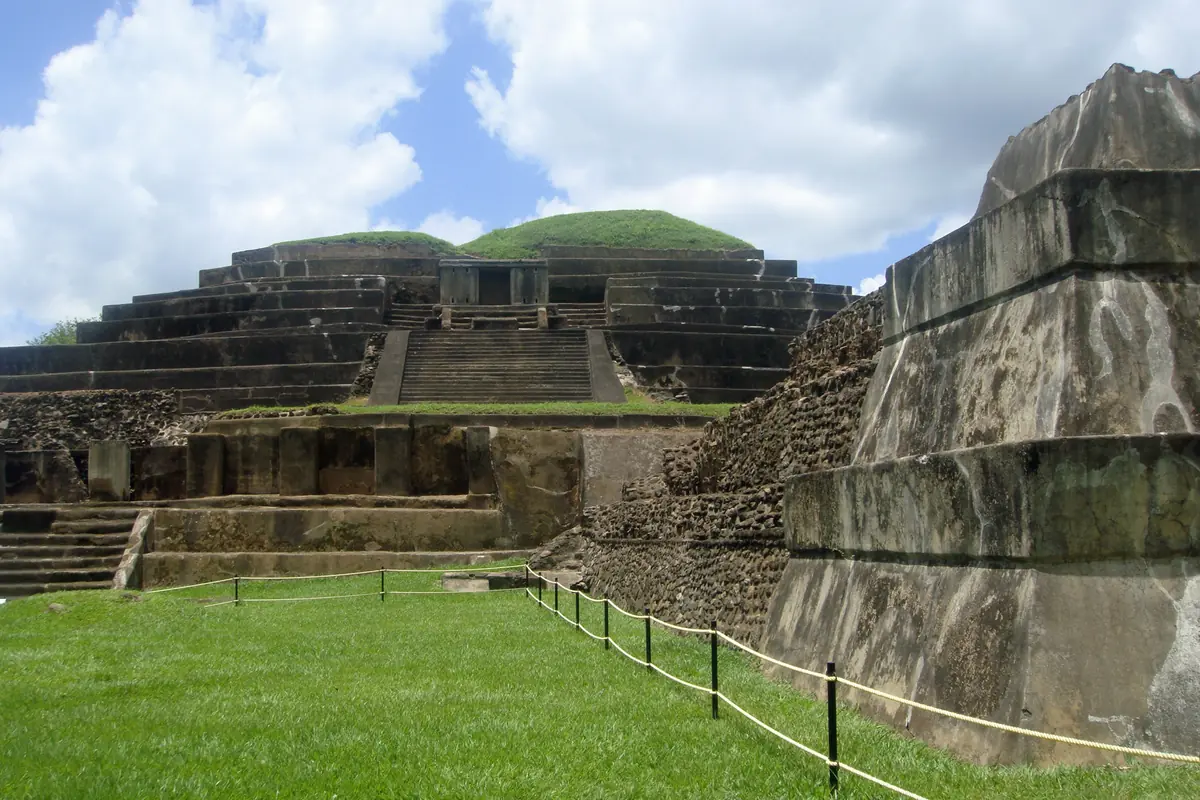
Because it literally is coated in it. In the 1940s, archaeologist Stanley Boggs sealed the main structures in Portland cement to imitate the original stucco surface. Critics have panned the result ever since — the smooth gray finish reads more like a mid-century municipal building than a Maya temple, and it’s the single most common complaint in visitor reviews.
The cement did more than offend purists. Being waterproof, it trapped rainwater and tree-root moisture inside the mound. After a season of heavy rain, the south side of Structure B1-2 gave way and collapsed. Salvadoran archaeologists treated the failure as an opening: they stripped away sections of the old concrete and re-excavated, which turned up fresh burials and new detail about how the pyramid was built up in stages. So the ugly cement patchwork you’re looking at is also, indirectly, why researchers learned more about the site.
How Old Is Tazumal, and Who Built It?
Tazumal was built by the Maya. The area was first settled around 1000 BC, hit its peak during the Classic period between roughly AD 250 and 900, and stayed occupied until about AD 1200, with later Pipil (Nahua) influence layered on top. By the time the Spanish arrived, Poqomam Maya lived in the region.
The site sat inside a trade web that reached far beyond the valley. Its ceramics and building styles show links to Teotihuacan in central Mexico, Copán in Honduras, and Kaminaljuyu in Guatemala. Excavations here have produced green obsidian from central Mexico, jade, iron-pyrite mirrors, over 116 ceramic vessels, and three gold ornaments made by lost-wax casting in the 8th century AD — among the earliest metalwork known in Mesoamerica.
One event interrupted everything: the Ilopango volcano’s “Tierra Blanca Joven” eruption, which blanketed the region in ash and dropped roughly 8 inches (20 cm) of it on Chalchuapa. You’ll see this eruption dated all over the map — 260 AD, 450 AD, 540 AD. Ice-core researchers have since pinned it to around AD 431, give or take a couple of years, by matching the ash to a well-dated layer in Greenland ice; an older study argued for closer to AD 540. The AD 431 figure is the current leading date, and it was a massive event — large enough to make land within about 50 miles (80 km) uninhabitable for years.
A few more markers of the site’s standing: Tazumal was declared a national historic monument, appeared on the 100-colón banknote until the country switched to the US dollar, and its on-site museum opened in the early 1950s.
What Does the Name Tazumal Mean?
You’ll read almost everywhere that Tazumal means “the place where the victims were burned,” a translation credited variously to Nahuatl, Nawat, or K’iche’. Treat that claim with caution — it’s repeated far more confidently online than the evidence supports.
El Salvador’s own heritage foundation, FUNDAR, states plainly that the meaning is unclear, and that scholars don’t even agree on which indigenous language the word comes from. The likeliest explanation is more mundane than the grisly one: the site took its name from a colonial-era farm, the finca Tazumal, that once occupied the land. So if a guide or a plaque tells you Tazumal means “where victims were burned,” you can nod politely and know the honest answer is “nobody’s actually sure.”
How Do You Get to Tazumal, and What Does It Cost?
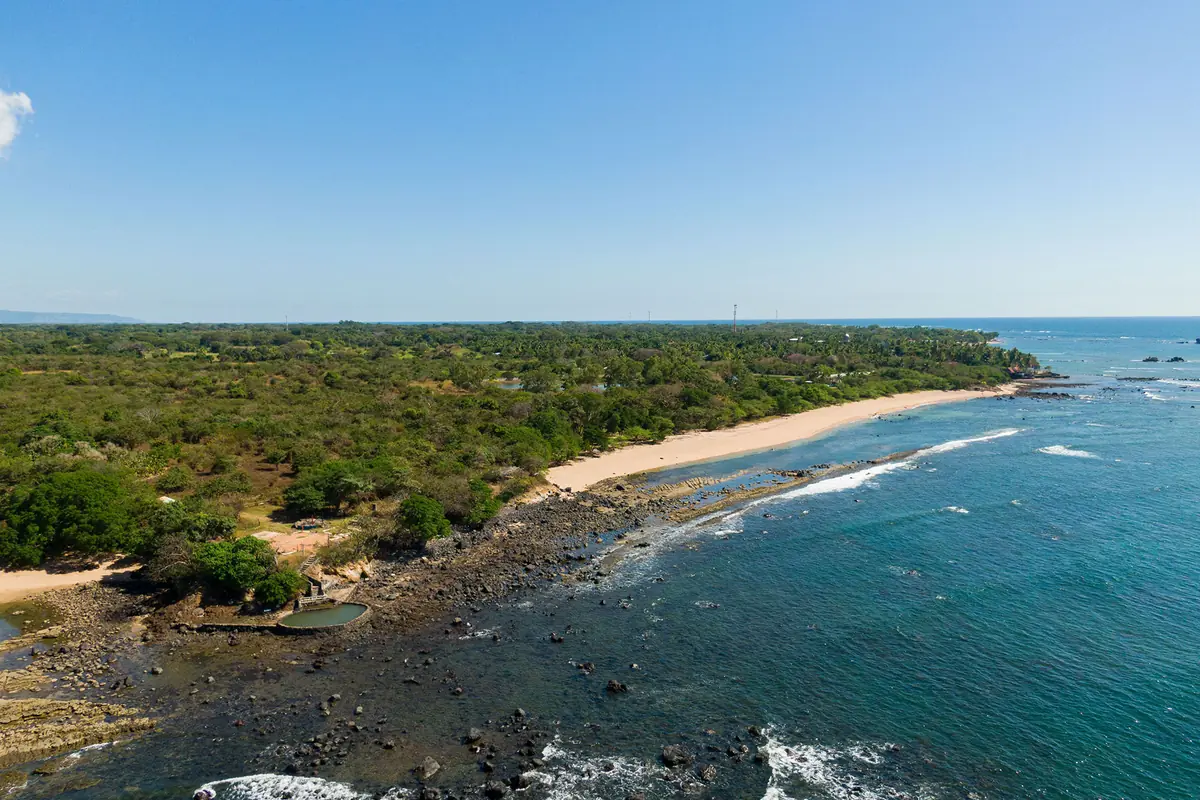
Tazumal is in Chalchuapa, in the Santa Ana department of western El Salvador, at about 2,360 feet (720 m) of elevation. It’s roughly 47 miles (75 km) northwest of San Salvador and only 8 to 11 miles (13–18 km) from the city of Santa Ana, which makes Santa Ana the far easier launch point.
Getting There From Santa Ana
- Bus: Route 218 or 202 to Chalchuapa, about 30 minutes, under $1
- Uber or taxi: about 15 minutes, roughly $10 each way
- Distance: 8 to 11 miles (13–18 km)
From the Chalchuapa drop-off it’s a short walk to the entrance. This is the cheapest and most reliable approach.
Getting There From San Salvador
- Drive: 47 miles (75 km), about 1 to 1.5 hours
- Guided full-day tour: roughly $95–125, usually bundling Casa Blanca, Santa Ana, or Lake Coatepeque
- By bus: possible, but it requires a transfer in Santa Ana — plan on a half-day of travel round trip
There’s no on-site parking lot, so drivers use street parking nearby.
Fees and Opening Hours
El Salvador uses the US dollar, so no conversion is needed. Prices drift over time, so confirm the current figure at the ticket window.
- Non-residents (foreign tourists): around $5
- Central Americans and foreign residents: around $3
- Salvadoran nationals: around $1
- Free entry: children under 12, students with a valid ID, seniors, visitors with disabilities, and local residents
- Vehicles: about $1 (light) to $3 (heavy)
Opening hours:
- Open: Tuesday through Sunday
- Times: 9:00 a.m. to 4:00 p.m.
- Closed: Mondays
Pro Tip: Double-check the day before you go. Some online listings wrongly show Monday as open or list a 5 p.m. close. On the ground, the gate shuts at 4 p.m. and Monday is dark — showing up then means a wasted trip.
Tazumal vs. Nearby Maya Sites
Tazumal is the tallest pyramid, but it isn’t the only ruin worth your time in this part of the country, and it may not be the best fit for what you want. Here’s an honest side-by-side.
| Site | What sets it apart | Distance from Tazumal | Time needed | Best for |
|---|---|---|---|---|
| Tazumal | Country’s tallest pyramid (79 ft); heavily restored in concrete; small museum | — | 45–60 min | First-timers; anyone who wants the tallest pyramid |
| Casa Blanca | Adjacent and jointly ticketed; open grounds with a working indigo-dyeing and ceramics demo | Short walk | 45 min | Hands-on crafts; a natural pairing with Tazumal |
| Joya de Cerén | UNESCO site; a farming village buried by ash, “the Pompeii of the Americas”; everyday Maya life | ~40 mi (65 km) east | 1 hr | Daily-life archaeology over monuments |
| San Andrés | Ceremonial capital of the Zapotitán valley; larger open plazas and platforms | ~40 mi (65 km) east | 1 hr | Pairing with Joya de Cerén on the way to San Salvador |
| Cihuatán | Largest site by area (~740 acres / 300 ha); a Postclassic Pipil city, less restored and more overgrown | ~50 mi (80 km) east | 1.5–2 hr | Travelers who want scale and a wilder, rawer feel |
The clean logic: Tazumal and Casa Blanca sit steps apart in Chalchuapa, so do them together. Joya de Cerén and San Andrés are a pair in the Zapotitán valley, closer to San Salvador. If you only have time for one western ruin and you love monuments, Tazumal wins on the pyramid; if you want to feel how people actually lived, drive to Joya de Cerén instead.
<!– IMAGE 5 – Search: Joya de Ceren archaeological site El Salvador – Source: Wikimedia Commons (verify license) – Alt: Protected earthen structures at Joya de Ceren, a UNESCO Maya site in El Salvador – File: joya-de-ceren-unesco-site – Caption: Joya de Cerén, a farming village frozen by ash, is the region’s UNESCO draw and a common counterpoint to Tazumal. –> <!– IMAGE 6 – Search: Casa Blanca archaeological park Chalchuapa El Salvador – Source: Wikimedia Commons (verify license) | ORIGINAL/OWNED PHOTO if no free match – Alt: Grass-covered pyramid mounds at Casa Blanca archaeological park near Tazumal – File: casa-blanca-chalchuapa-mounds – Caption: Casa Blanca is a short walk from Tazumal and runs a live indigo-dyeing demonstration on the grounds. –>
Quick Answers Before You Go
Where is Tazumal? In Chalchuapa, Santa Ana department, western El Salvador — about 47 miles (75 km) northwest of San Salvador and 8 to 11 miles (13–18 km) from the city of Santa Ana.
How old is Tazumal, and who built it? The Maya built it. The area was settled around 1000 BC, peaked between AD 250 and 900, and stayed occupied until roughly AD 1200, with later Pipil influence. The main pyramid was raised in about 13 construction phases.
What does “Tazumal” mean? The popular translation, “the place where the victims were burned,” is disputed. FUNDAR says the meaning and even the source language are unclear, and that the name most likely came from a colonial farm, the finca Tazumal.
Is Tazumal worth visiting? Yes, for a 45- to 60-minute stop. It’s the country’s tallest pyramid and most-visited Maya site, but it’s small and heavily restored, so pair it with Casa Blanca and Santa Ana.
How do you get there and what does it cost? Take bus 218 or 202 from Santa Ana (about 30 minutes, under $1) or an Uber (around $10). Full-day tours from San Salvador run about $95–125. Foreign entry is around $5, and it’s open Tuesday to Sunday, 9 a.m. to 4 p.m., closed Mondays.
Before You Book
TL;DR: Tazumal is El Salvador’s tallest Maya pyramid but a small, heavily restored site worth about 45 to 60 minutes — not a half-day on its own. Go for the pyramid and the history, brace for the mid-century concrete, and pair it with Casa Blanca next door and a stop in Santa Ana. Foreign entry runs about $5, and it’s closed Mondays.
Are you routing Tazumal into a Ruta de las Flores trip, or squeezing it into a quick Santa Ana day? Drop your itinerary in the comments and I’ll tell you whether the timing actually works.