Albania’s currency and ATMs cost American travelers real money — from ATM fees that swing 60% between banks, to a Dynamic Currency Conversion trap that can silently add up to 13% to every withdrawal. Money is one of the first things to nail down when budgeting your Albania travel costs, and this guide cuts through the noise with tested, bank-by-bank data and a cash strategy built for US cardholders.
The Albanian lek (ALL) is the official currency. One US dollar equals roughly 82-83 ALL. Cash dominates daily life. ATM fees range from 500 ALL (about $6) at Union Bank to 800 ALL (about $10) at Raiffeisen. Always choose “charge in ALL” at ATMs to dodge DCC markups of 4-13%. Bring a Visa or Mastercard; leave Amex at home.
What is the Albanian lek (and what is it worth)?
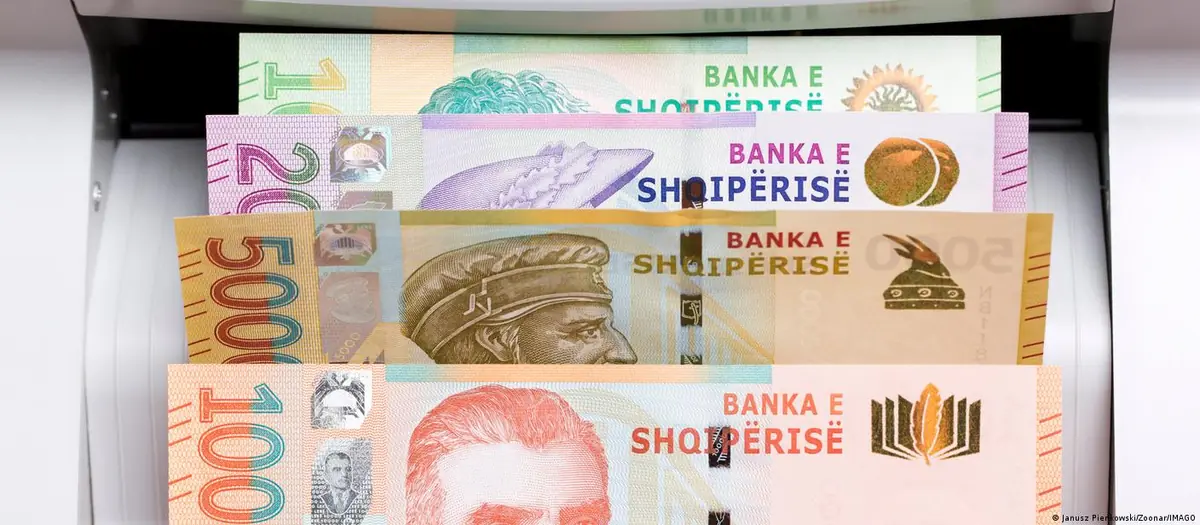
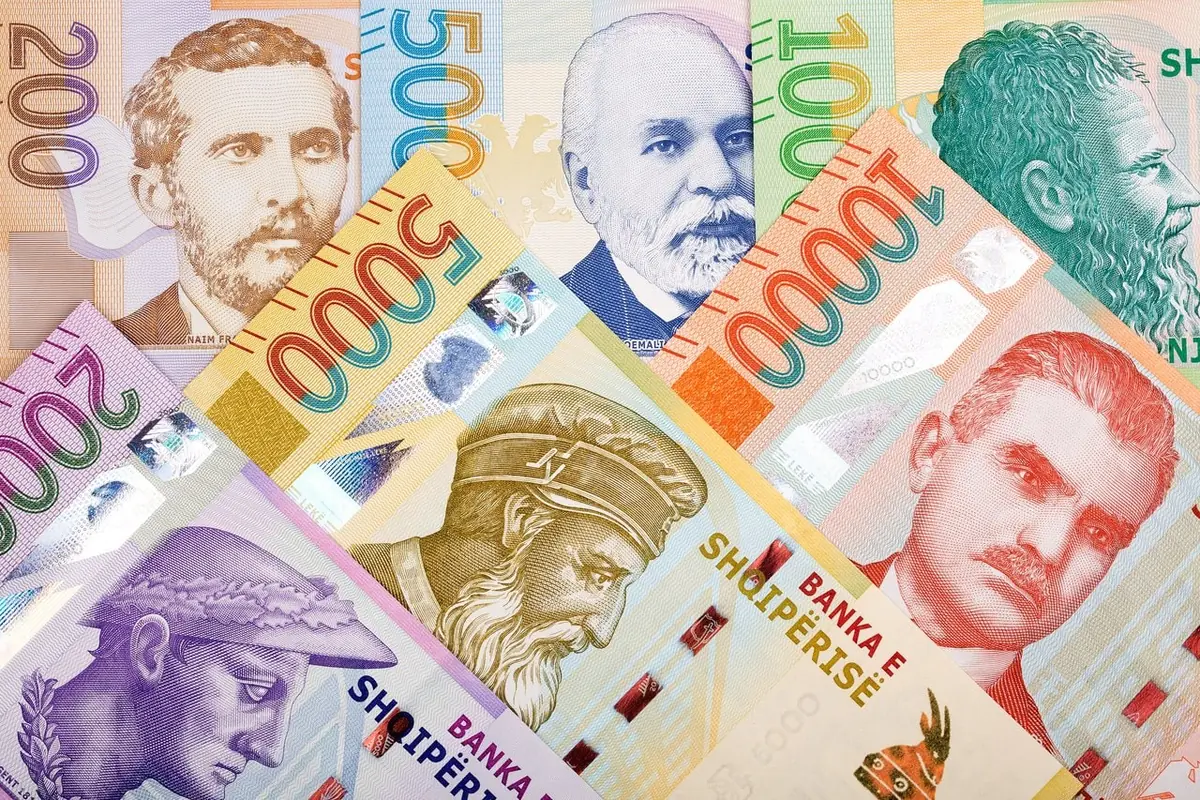
Albania’s official currency is the Albanian lek, currency code ALL. Banknotes come in six denominations: 200 (polymer), 500, 1,000, 2,000, 5,000 and 10,000 lek. Coins run from 1 to 100 lek. The subdivision qindarka (100 per lek) hasn’t circulated since 1992. At roughly 82 ALL per dollar, a 1,000-lek note is worth about $12.
Rough mental math: divide any lek price by 80 for a quick dollar estimate. A 400 ALL coffee is $5, a 1,600 ALL meal is $20.
- 200 ALL (~$2.45) — polymer, Albania’s first plastic note
- 500 ALL (~$6.10) — most common small bill
- 1,000 ALL (~$12.20) — the workhorse banknote
- 2,000 ALL (~$24.40) — accepted everywhere
- 5,000 ALL (~$61) — carry for hotels only
- 10,000 ALL (~$122) — rarely seen; smaller shops may not have change
The 200 ALL note feels slick and plasticky between your fingers — more like a credit card than currency. Counterfeit risk is negligible: the Bank of Albania reports roughly 1 counterfeit per million banknotes in circulation. You’re more likely to encounter a fake euro than a fake lek.
One formatting quirk: Albanians write 1.200 for one thousand two hundred (dot for thousands, comma for decimals). A menu showing “1.200 lek” means 1,200 ALL, not 1.2 lek.
What is the “old lek” trap, and how do you avoid it?
Albania redenominated its currency in 1965 at a 10:1 ratio, but many Albanians — especially older vendors and market sellers outside Tirana — still quote prices in “old lek.” A coffee quoted as “300 lek” actually costs 30 new lek (about $0.37). Written prices on menus and receipts always show new lek. When confused, ask: “Lekë të reja apo të vjetra?” (new lek or old lek?)
This isn’t a scam. It’s a linguistic habit older than most tourists, and since you can’t always count on how much English locals speak outside Tirana, the menu is your safest translator. If a village cafe owner says “treqind” (three hundred) for your espresso, check it — the print probably reads 30 lek. Always trust the printed price.
Pro Tip: When a vendor says a number out loud and it sounds ten times too high, it usually is. Just hand over one-tenth of the quoted amount and watch their reaction — they’ll nod if you were right.
Can you use euros in Albania (and should you)?
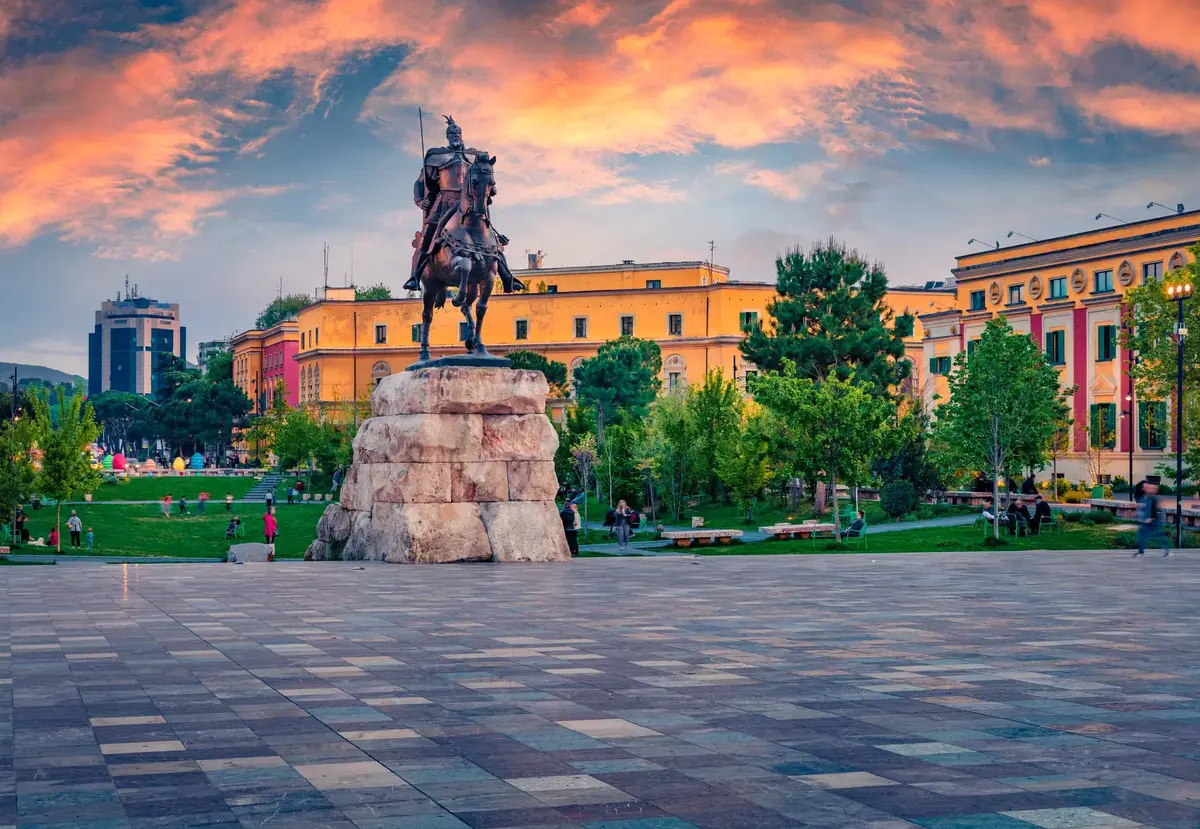
Euros are informally accepted at many Albanian hotels, organized tours, airport taxis and Albanian Riviera restaurants. However, merchants typically apply a 5-15% markup over the official rate. A meal priced at 1,000 ALL (~$12.20) might cost you 12 EUR (~$13.20) — a quiet surcharge. Change always comes back in lek. Pay in lek whenever possible.
Where euros actually work:
- Hotels (most quote prices in EUR, but accept lek at fair rate)
- Airport taxis (20-25 EUR to Tirana center)
- Organized tours and day trips
- Upscale restaurants in Tirana, Sarandë and Ksamil
- Ferry ticket counters
Where euros get you blank stares:
- Local buses and furgons (minibuses)
- Bakeries, street food, markets
- Museum entrance fees
- Rural guesthouses
- Taxis outside Tirana
The official rate hovers around 95 ALL per EUR. If a restaurant charges 10 EUR for a bill that would be 900 ALL in lek, you just paid roughly a 6% premium for the privilege. Pay in lek when you can and save euros for true emergencies.
Which Albanian ATMs charge the lowest fees?
Albanian ATM fees for foreign cards range from 500 ALL (~$6) to 800 ALL (~$10) per withdrawal, but the real cost depends on which bank’s machine you use and whether you fall for Dynamic Currency Conversion. Union Bank and ABI Bank charge the lowest flat fee at 500 ALL. Raiffeisen and BKT are the most expensive. Here’s every bank compared.
| Bank | Fee (foreign card) | DCC prompt? | Network size | Verdict |
|---|---|---|---|---|
| Union Bank | 500 ALL (Visa) | No DCC | Small | Cheapest |
| ABI Bank | 500 ALL flat | No DCC | Small | Cheapest (tied) |
| OTP Bank | 500-700 ALL | No DCC | 188 ATMs | Best coverage-to-fee ratio |
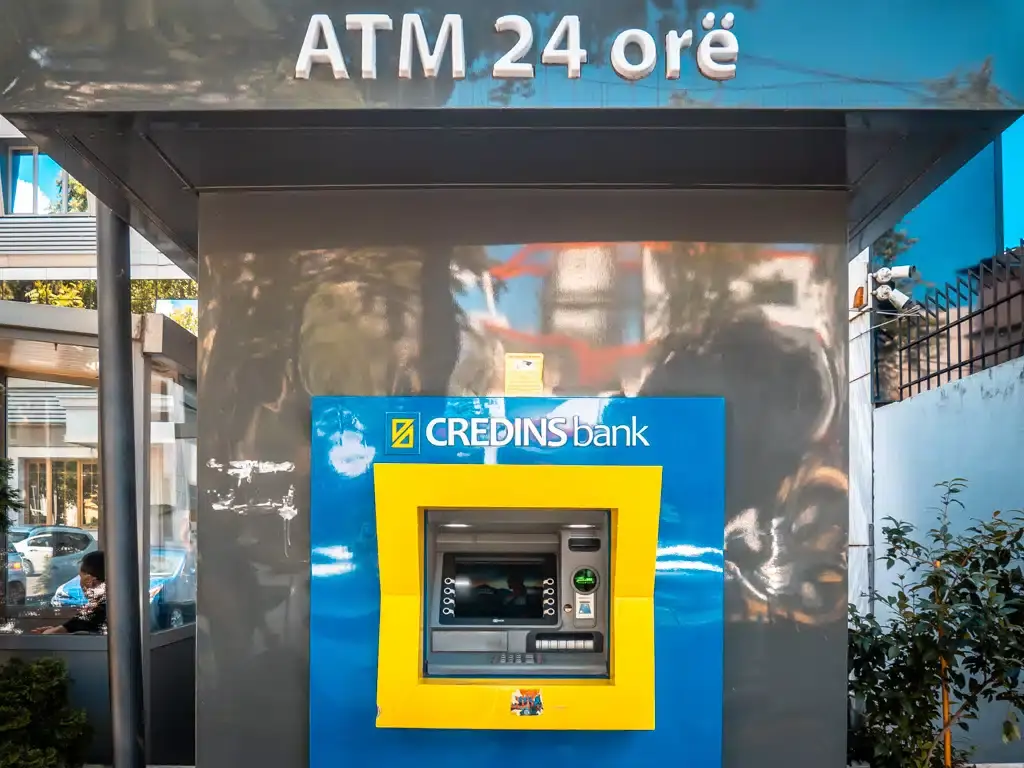
| Credins Bank | 600 ALL | Sometimes | Large | Mid-range (no longer free) |
| Tirana Bank | 700 ALL | No DCC | Medium | Mid-range |
| Intesa Sanpaolo | 700 ALL | Yes — decline it | Medium | OK if you decline conversion |
| ProCredit Bank | 700 ALL | No decline option | Medium | Use with caution |
| Fibank | 690 ALL + up to 9.75% DCC | Aggressive DCC | Small | Avoid |
| Raiffeisen Bank | 800 ALL | No DCC selection | 180+ ATMs | Most expensive flat fee |
| BKT | 6-7 EUR (~700-800 ALL) | No decline option | 114 ATMs | Expensive; red machines |
Two notes on outdated advice you’ll see elsewhere. First, Alpha Bank no longer exists — it merged into OTP Bank, so any guide that still lists it separately is stale. Second, Credins Bank is no longer free; it now charges 600 ALL. Multiple travel blogs still recommend Credins as “fee-free,” which will cost you money.
Remember that the Albanian bank’s fee is layered on top of whatever your US bank charges. A Chase debit withdrawal at a Raiffeisen ATM can cost $10 (Raiffeisen) + $5 (Chase international fee) + 3% FX markup — about $20 on a $300 withdrawal.
What are the ATM withdrawal limits in Albania?
Most Albanian ATMs cap foreign-card withdrawals at 40,000-75,000 ALL per transaction (~$490-$915). BKT allows the highest single pull at 75,000 ALL. Credins caps at 50,000 ALL. Strategy: always withdraw the maximum allowed to minimize the per-lek cost of the flat fee.
- BKT: up to 75,000 ALL (~$915)
- Raiffeisen / OTP: up to 70,000 ALL (~$855)
- Credins: 50,000 ALL (~$610)
- Union Bank / ABI: 40,000-50,000 ALL (~$490-$610)
The math matters: a 500 ALL fee on a 10,000 ALL withdrawal is a 5% cost. The same fee on a 70,000 ALL withdrawal is 0.7%. Pull more, pay less per dollar.
What is the Dynamic Currency Conversion (DCC) trap, and how do you dodge it?
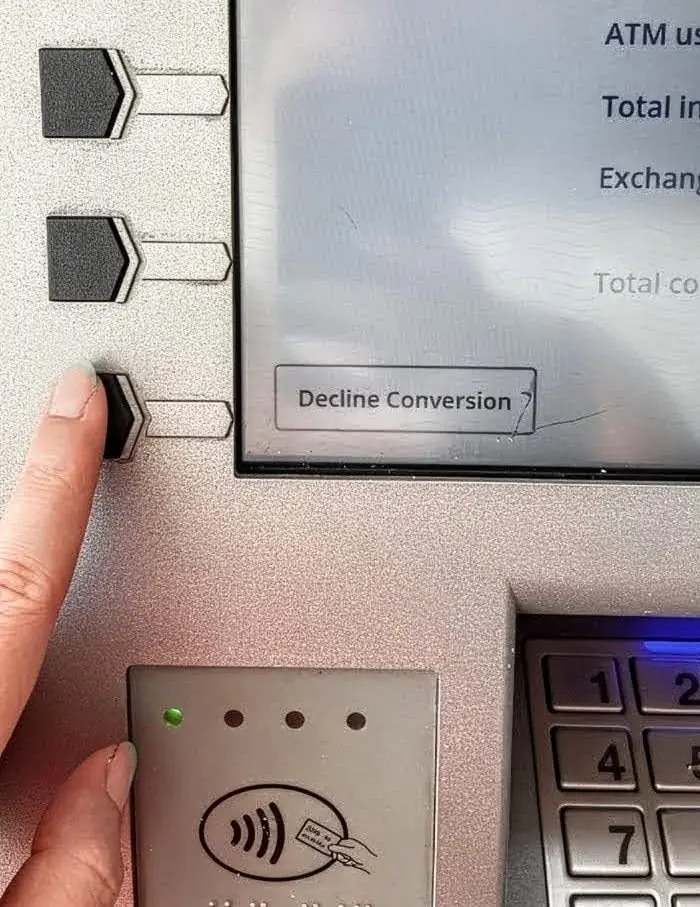
Dynamic Currency Conversion lets the ATM convert your withdrawal to US dollars on the spot — at a markup of 4-13% over the real exchange rate. On a 50,000 ALL withdrawal (~$610), that’s $24-$79 in hidden fees. Always press “Decline Conversion,” “Without Conversion,” or “Charge in ALL.” Let Visa or Mastercard handle the conversion at their wholesale rate instead.
ATM operators earn commissions from pushing DCC, which is why the dollar option is usually presented as the “convenient” choice. Visa’s daily wholesale rate is typically 0.5-1% over mid-market. DCC is 4-13% over mid-market. The gap is pure profit for the ATM operator.
At a Fibank ATM near Blloku in Tirana, the withdrawal screen displays your amount in bold US dollars with a prominent green button. The option to pay in lek sits in smaller text below, framed as “Decline conversion.” The design nudges you toward dollars. Press the small button.
Per-bank DCC behavior:
- Aggressive DCC push: Fibank (worst, ~9.75% markup)
- Shows DCC screen but lets you decline: Intesa Sanpaolo, Credins (sometimes)
- No option to decline (conversion may be automatic): BKT, ProCredit
- No DCC at all (cleanest experience): Union Bank, ABI Bank, OTP Bank, Tirana Bank
The same rule applies at card terminals in shops and restaurants. If the machine asks “USD or ALL?”, always tap ALL.
What’s the best way for Americans to pay in Albania?
For US travelers, the optimal Albania money stack is a Charles Schwab debit card for ATM withdrawals (refunds all fees worldwide), a no-foreign-transaction-fee credit card like Chase Sapphire for hotels and restaurants, and a Wise or Revolut card as backup for mid-market conversions. Carry $200-300 in euros as emergency cash. Leave Amex and Discover at home.
Best debit cards for ATM withdrawals
- Charles Schwab High Yield Investor Checking: Refunds all ATM fees worldwide, including the Albanian bank’s 500-800 ALL charge. The single best US debit card for Albania.
- Standard Chase debit cards: 3% FTF + $5 international ATM fee + $2.50 inquiry fee. Poor choice for Albania.
Best credit cards for purchases
- Chase Sapphire Preferred / Reserve: 0% foreign transaction fee on credit purchases. Use for hotels, car rentals, upscale meals.
Fintech cards as backup
- Wise card: Mid-market exchange rate, free ATM withdrawals up to the monthly limit, works across Albania on Visa/Mastercard rails.
- Revolut card: Mid-market on weekdays, 1% weekend surcharge, free ATM withdrawals up to plan limit.
Cards to leave at home
- American Express: Accepted at a handful of top-tier Tirana hotels and nowhere else reliably.
- Discover / Diners Club: Effectively useless.
Pro Tip: Get a Charles Schwab checking account at least two weeks before departure. The fee refunds post at the end of each month and genuinely cover every ATM fee in Albania — no caps, no categories, no gotchas.
Card acceptance reality on the ground: Visa and Mastercard work at most Tirana hotels, malls, gas stations and car rental desks. In Gjirokastër, three restaurants in a row told me their card machine was broken. The fourth had a working terminal. Albania isn’t anti-card — it’s cash-first. The machines exist but often conveniently malfunction. The contactless tap limit is 2,000 ALL (~$24), and Apple Pay acceptance is spotty outside Tirana.
Where should you exchange money in Albania?
Licensed exchange offices (kambio) in Albanian city centers offer the best rates — margins under 1% from the mid-market rate with zero commission. ATMs are convenient but cost $6-10 in fees per withdrawal. Banks give significantly worse rates (4-5% spread). Airport exchange counters underperform by 2-4%. Never exchange money at a hotel front desk.
Ranked from best to worst value:
- City-center kambio offices: Sub-1% margin, zero commission. Iliria’98 is a reputable chain with branches across Tirana and at the airport.
- ATMs: Convenient and fair if you use Union Bank or ABI Bank and decline DCC.
- Airport exchange counters: 2-4% worse than city rates. One counter at Tirana Airport reportedly closes at 8 PM.
- Banks: The worst option. Banks buy EUR around 120 ALL and sell at 130 vs kambio booths at 125.5/126.4 — a 4-5% penalty.
- Hotel front desk: Tourist-trap territory. Avoid entirely.
Exchange offices in Tirana are glass-fronted kiosks on nearly every commercial block, with digital rate boards visible from the sidewalk. You slide euros under the glass, the attendant counts lek back in seconds, no form, no ID, no receipt. It’s the fastest currency exchange process in Europe.
Bring EUR as your primary backup cash and USD as secondary — both are accepted at kambio booths but EUR gets slightly better rates. One critical warning: the lek is a closed currency. You cannot exchange it outside Albania. Convert any leftover lek before you fly home, or you’ll be stuck blowing it on overpriced airport stalls — better to choose souvenirs worth bringing home earlier in your trip.
How should you handle money at Tirana Airport?
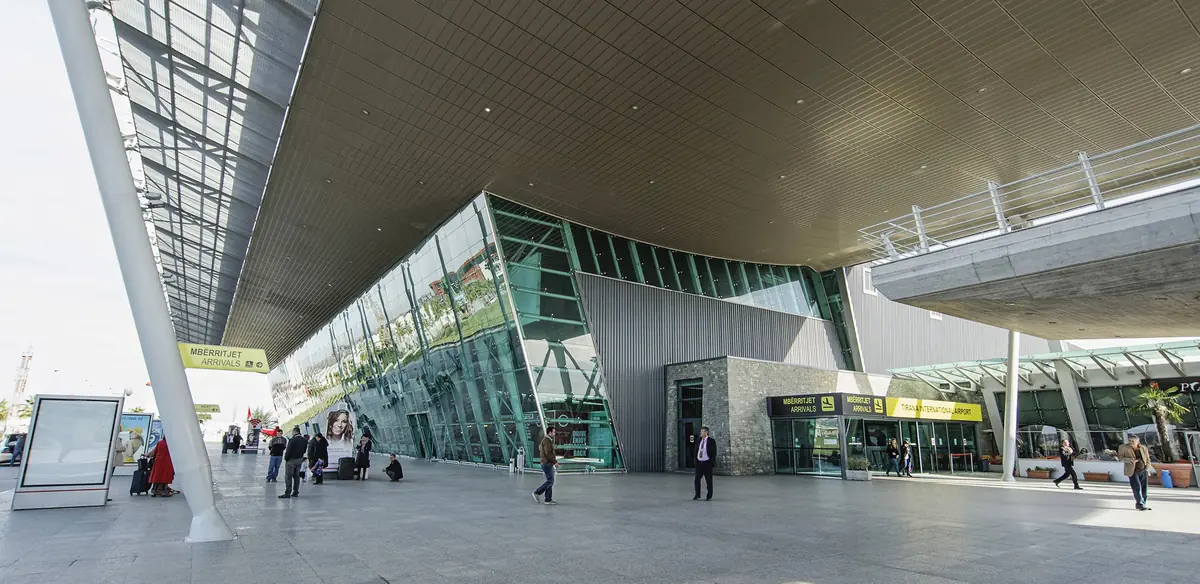
Tirana International Airport (Mother Teresa / Rinas, code TIA) has ATMs from Tirana Bank and Raiffeisen in the check-in hall, and from ProCredit and Raiffeisen in the arrivals area. BKT runs a Forex counter in arrivals. Skip the exchange counter’s poor rate. Use the Raiffeisen or ProCredit ATM for a first withdrawal of 5,000-10,000 ALL, then switch to cheaper Union Bank or ABI Bank ATMs once downtown.
Your first 30 minutes, step by step:
- Clear passport control and head into arrivals
- Use the Raiffeisen or ProCredit ATM for 5,000-10,000 ALL (enough for taxi + first day)
- Decline any DCC prompt; choose ALL
- Skip the BKT Forex counter — its rates are 2-4% worse than a city kambio
- Take the LU-NA airport bus (400 ALL / ~$5, runs 24/7, hourly on the hour; cash, sometimes card) or negotiate a taxi at 2,000-2,500 ALL / 20-25 EUR to central Tirana
- Once in the city, withdraw larger amounts from Union Bank or ABI Bank
The airport is about 11 miles (17 km) from central Tirana, and your Tirana airport transfer by taxi takes 20-30 minutes depending on traffic. Agree on the fare before you get in the car — drivers sometimes quote 40 EUR to tourists and drop to 20 EUR the moment you push back.
Where do ATMs disappear in Albania?
Tirana has 586+ ATMs. The Riviera towns of Sarandë and Vlorë have reliable coverage. But step into the Albanian Alps — Theth and Valbonë, plus Koman Lake — and ATMs vanish entirely. Ksamil has limited machines that can run dry during peak summer weekends. Rule: always top up cash in the nearest city before heading to any rural or mountain destination.
| Destination | ATM status | Last reliable stop | Cash-only warning |
|---|---|---|---|
| Tirana | 586+ ATMs | N/A | Cards widely accepted |
| Durrës | Good coverage | N/A | Cards at hotels/malls |
| Shkodër | Good coverage | N/A | Gateway to Alps — withdraw here |
| Sarandë | Good coverage | N/A | Summer: machines may run dry |
| Vlorë | Good coverage | N/A | Cards at larger venues |
| Berat | Available | N/A | Old town shops: cash only |
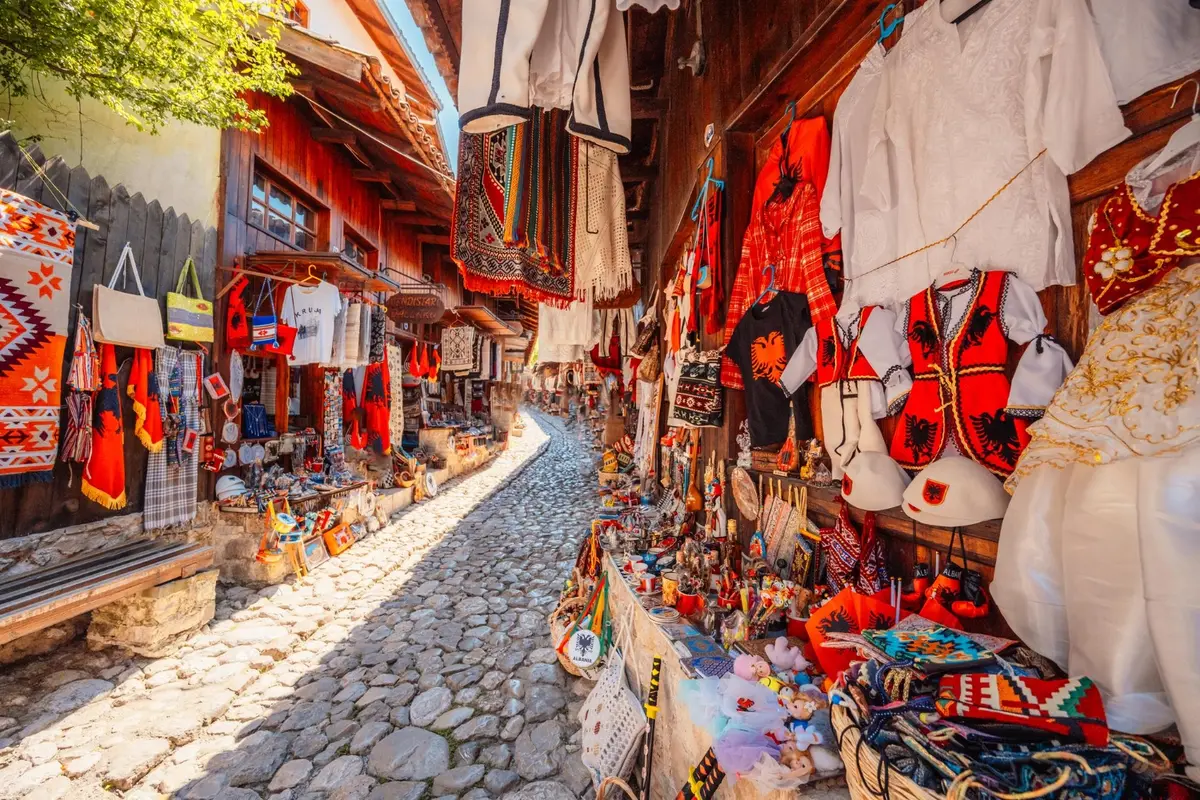
| Gjirokastër | Available | N/A | Bazaar: cash only |
| Ksamil | Limited | Sarandë (12 mi / 19 km) | Beach chairs, restaurants: cash |
| Theth | ZERO ATMs | Shkodër (44 mi / 70 km) | Entirely cash-only |
| Valbonë | ZERO ATMs | Shkodër or Bajzë border | Entirely cash-only |
| Koman Lake | ZERO ATMs | Shkodër | Ferry ticket: cash only |
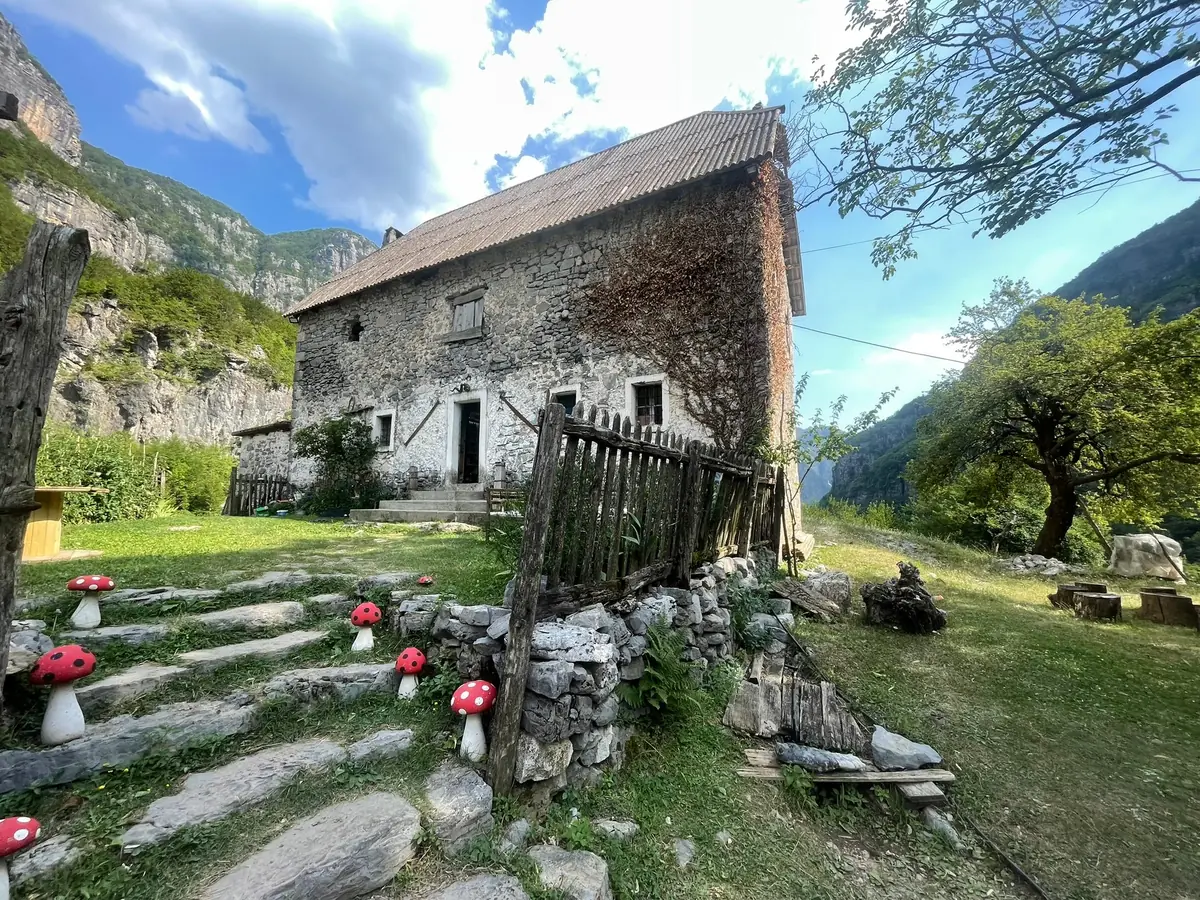
In Theth there is no ATM, no card terminal, and no exchange office. The guesthouse owner takes cash only, the mountain guide takes cash only, and the cafe in the village square takes cash only. Budget 3,000-5,000 ALL per person per day (~$37-$61) for accommodation and meals.
A summer-specific warning for Sarandë and Ksamil: ATMs along the Riviera can literally run out of cash on peak-season Saturday afternoons. If you’re arriving for a beach weekend in July or August, withdraw on Thursday or Friday.
How much should you tip in Albania?
Tipping in Albania is appreciated but never mandatory. Leave 5-10% at sit-down restaurants, or round up to the nearest 100-200 ALL. Taxi drivers expect you to round up. Hotel housekeeping: 100-200 ALL per day. Always tip in cash, even if you pay the bill by card — this ensures staff receive it directly. Service charges are almost never included.
| Scenario | Recommended tip | Notes |
|---|---|---|
| Sit-down restaurant | 5-10% or round up | Service charge rarely included |
| Cafe / bar | Round 180 ALL up to 200 ALL | Leave coins on the table |
| Taxi | Round 470 ALL up to 500 ALL | Not strictly expected |
| Hotel housekeeping | 100-200 ALL/day (~$1.20-$2.45) | Leave on pillow |
| Hotel porter | 100-200 ALL per bag | Hand directly |
| Tour guide | 5-10% of tour cost | More for multi-day private tours |
| Family guesthouse | Small gift often better than cash | Coffee, chocolate, home-country souvenir |
Tip in lek when possible. Albanians value humility, so flashing large tips is considered gauche, not generous. Cash matters because many Albanian card terminals don’t have a tip-add function — if you pay by card, the waiter never sees your gratuity unless you leave it in cash.
What money scams should you watch for in Albania?
The good news first: Albania is safe for tourists by almost any European standard, and violent crime targeting foreigners is near-nonexistent. Money-related issues are minor but avoidable: the old-lek confusion, Dynamic Currency Conversion at ATMs, inflated taxi quotes at the airport, and the ubiquitous “card machine is broken” deflection that nudges you toward cash. None are dangerous — all are solved with preparation.
What to watch for:
- ATM skimming: Use machines inside bank branches when possible. Cover your PIN. Inspect the card slot for stuck-on attachments.
- Bar entrapment: A local invites you to a “great” bar, the bill is inflated. Prevention: choose venues yourself and confirm menu prices upfront.
- Taxi overcharging: Agree on the fare before entering. Airport to Tirana is 2,000-2,500 ALL or 20-25 EUR. Rideshare apps include VrapOn, SpeedTaxi and UPsTaxi.
- “Card machine is broken”: Cultural cash preference, not a scam. Just carry lek.
- Counterfeit risk: Near zero. Focus your skepticism on counterfeit euros, not lek.
Pro Tip: If a Tirana airport taxi driver quotes you 40 EUR, smile and say “Njëzet euro” (twenty euros). Most will accept immediately. The quoted-then-halved price is a well-worn ritual, not an insult.
What’s the step-by-step Albania cash strategy?
As you plan your Albania trip, sort the money basics first: before you leave, get a no-foreign-transaction-fee card and pack 200-300 EUR in cash as backup. On arrival at Tirana Airport: use any arrivals ATM, decline DCC, withdraw 5,000-10,000 ALL. In cities: seek Union Bank or ABI Bank ATMs for lowest fees. Before mountains or coast: withdraw maximum cash. Everywhere: pay in lek, not euros. Keep this checklist on your phone.
- Before departure: Apply for a Charles Schwab debit card or similar fee-rebate card (allow 1-2 weeks). Set up Wise or Revolut as backup. Pack 200-300 EUR cash.
- Notify your bank of Albania travel to prevent card blocks.
- At Tirana Airport: Use the arrivals Raiffeisen or ProCredit ATM. Decline DCC. Withdraw 5,000-10,000 ALL for taxi and first day.
- In Tirana: Find a Union Bank or ABI Bank ATM (500 ALL fee). Withdraw the maximum per transaction.
- Before rural trips: Top up 2-3 days’ cash in Shkodër (before the Alps) or Sarandë (before Ksamil).
- At every ATM and card terminal: Choose “charge in ALL.” Never USD or EUR.
- Daily spending: Cash at restaurants, markets, transport. Card at hotels and upscale dining.
- Before flying home: Convert leftover lek at a kambio — lek cannot be exchanged abroad.
The bottom line
TL;DR: Albania runs on cash — cards are a bonus, not a plan. Your biggest money lever is which ATM you use and whether you dodge DCC: the spread between the cheapest and most expensive option exceeds 15% per withdrawal. Stick to Union Bank or ABI Bank at 500 ALL, always press “charge in ALL,” and withdraw your Alps cash in Shkodër before you leave pavement behind.
Bring a Charles Schwab debit card, keep a few hundred euros in your pack for emergencies, and learn to say “lekë të reja.” Everything else is details.
What’s your biggest question about handling money in Albania — is it the ATM fees, the DCC screens, or figuring out how much cash to carry into the mountains? Drop it in the comments.