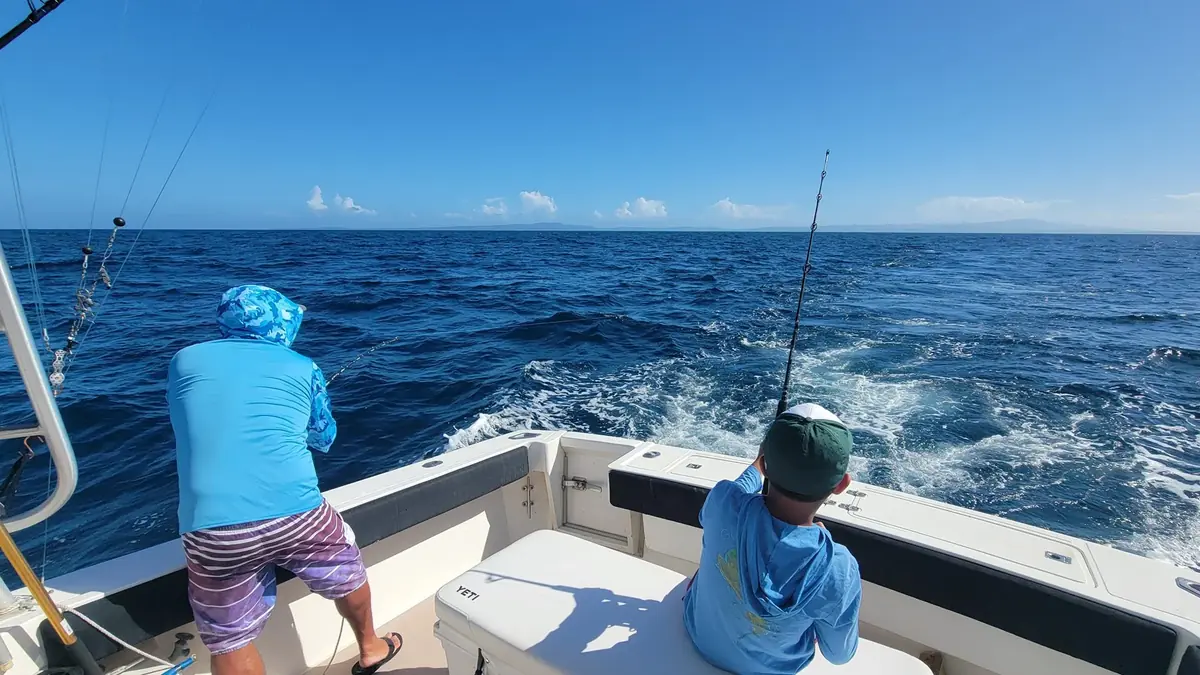
You’re looking at one of the most productive billfish grounds in the Western Hemisphere, and also one of the most confusing to book. Deep sea fishing in Puerto Rico delivers trophy Blue Marlin, Wahoo and Mahi-Mahi, but opaque pricing and conflicting licensing rules trip up most first-timers. This guide cuts through the noise so you don’t get ripped off at the dock.
How much does a Puerto Rico fishing charter actually cost?
A full-day offshore charter in Puerto Rico runs $1,200 to $1,400 per boat, depending on vessel type and season. That number climbs before you ever leave the slip, and most charter websites bury the real math in the fine print.
- Half-day inshore: $550–$620 per boat
- Full-day offshore (power catamaran): $1,200–$1,400 per boat
- High-season surcharge (December through May): +$100 on most operators
- Realistic all-in full-day high season: $1,500–$1,600 with gratuity
Budget for the total before you fall in love with a specific captain’s boat.
Pro Tip: Always confirm whether “full-day” means 8 hours from the marina or 8 hours on the water. Travel time to offshore grounds from Fajardo or San Juan can eat 45 to 90 minutes each way.
Do you need a fishing license in Puerto Rico?
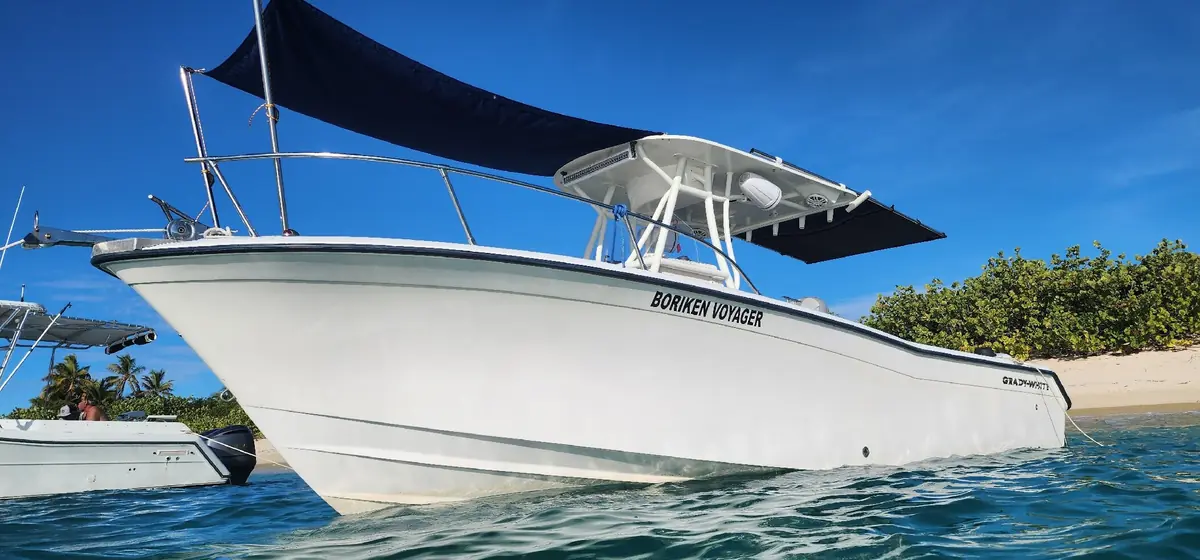
No. Passengers on a licensed commercial charter do not need a personal fishing license in Puerto Rico. The operator’s licensing umbrella automatically covers every angler on board, but that umbrella is far more substantial than a single piece of paper.
A compliant captain must hold all of the following simultaneously:
- Commercial Fishing License: Issued by the Puerto Rico Department of Natural Resources
- Law 430 Navigation Permit: Required for local operation
- Tourism Company Endorsement: Ensures basic hospitality standards
- NOAA Highly Migratory Species (HMS) Permit: Federally required for targeting billfish offshore
Once the vessel crosses into federal waters (generally beyond 3 nautical miles / 5.5 km), U.S. federal maritime law governs entirely. The NOAA HMS permit becomes the operative document while the state licensing covers everything closer to shore.
Pro Tip: Before booking, ask the operator for their USCG documentation number and NOAA HMS permit number. Any professional captain provides these without hesitation. If they deflect, find another boat.
How much should you tip your fishing crew?
The standard charter gratuity in Puerto Rico is 15 to 20 percent of the total charter cost, handed directly to the first mate at the dock after the trip. On a $1,000 full-day trip, that is $150 to $200 in cash. Scale to 20–25 percent if the mate cleans and fillets your catch dockside.
The first mate’s income works differently from the captain’s. The captain typically owns the vessel and earns on the charter fee, while the mate’s livelihood depends heavily on tips. They are rigging ballyhoo at 5 a.m., fighting fish alongside you for eight hours, and often cleaning your catch when you hit the dock.
If the mate handles that dockside cleaning, the higher end of the range is the right move. It also eliminates a separate filleting fee you’d otherwise pay at a local market.
Pro Tip: Bring crisp bills the night before your trip. ATMs near marinas in Fajardo and San Juan regularly run dry on busy weekend mornings.
How can you audit your charter’s safety before leaving the dock?
You can audit your charter’s safety by verifying that all U.S. Coast Guard-mandated equipment is visible and accessible before departure. If you cannot confirm the following gear at the dock, do not board. This takes five minutes and tells you everything about how the operator runs their boat.
- EPIRB (Emergency Position Indicating Radio Beacon): Mounted in an accessible location, not buried in a storage hatch
- Type I Personal Flotation Devices: One correctly sized unit per passenger, stored within reach
- Visual Distress Signals: Flares within their printed expiration date
- High-water bilge alarm: Functional, particularly critical on extended offshore runs
Demand a pre-departure safety briefing from the captain or mate before the vessel clears the harbor. A professional operator does this automatically, without prompting. The briefing should cover assembly points, life raft deployment and wildlife safety.
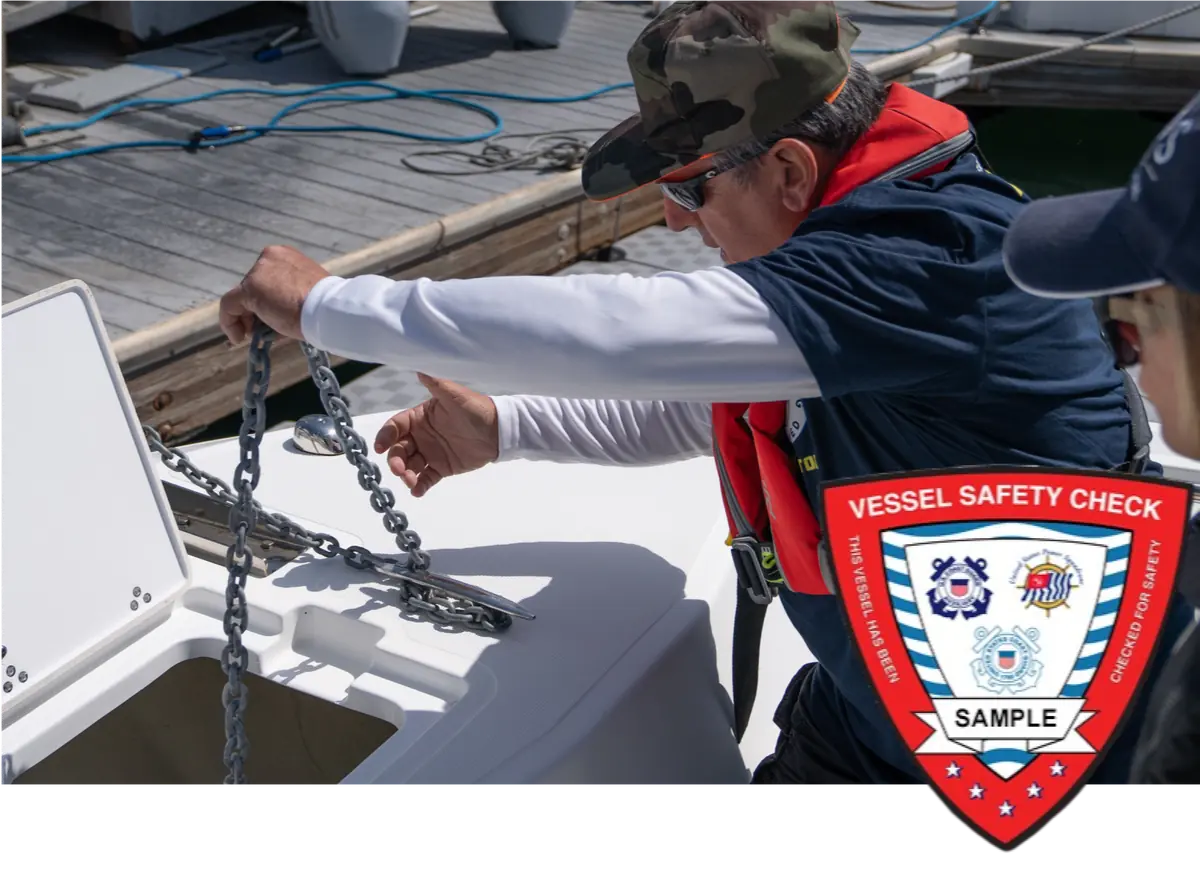
Pro Tip: The USCG’s free Vessel Safety Check program certifies compliant boats with a visible decal. Operators who pursue this voluntarily are generally the right operators to book.
Which Puerto Rico fishing trip fits your group: offshore or inshore?
The right choice depends on your group’s tolerance for open-ocean swells and the species you want to target. Offshore and inshore fishing are fundamentally different experiences, and picking the wrong one can ruin the trip for everyone on board.
Offshore — Blue Marlin, Wahoo, Yellowfin Tuna
Offshore fishing begins 10 to 15 miles (16 to 24 km) from shore, where depths rapidly exceed 100 feet (30 meters). This is the territory of Blue Marlin, Sailfish, Wahoo and Yellowfin Tuna. The Atlantic swells out here can be substantial, and motion sickness is common for children and first-timers on their first open-ocean passage.
Inshore — Tarpon, Snook, flats and mangroves
Inshore fishing targets the calm coastal flats, mangrove estuaries and reef systems hugging the shoreline. Tarpon and Snook are the primary species in these protected waters. The water is calmer, trips run shorter, and the learning curve is far more forgiving. For families with young kids or anyone who suspects seasickness might be an issue, inshore is almost always the correct call.
Pro Tip: Take seasickness medication the evening before and again the morning of an offshore trip. Dramamine and Bonine lose most of their effectiveness when taken reactively after symptoms begin.
Why do Fajardo and San Juan produce trophy fish?
Fajardo and San Juan produce trophy fish because their underwater topography forces concentrations of baitfish and pelagic predators to the surface. The northeastern corner of Puerto Rico is the epicenter of Caribbean sportfishing, and the oceanography tells you exactly why.
Off Fajardo, the Atlantic Ocean’s dominant currents collide directly with the Caribbean Sea. Captains call this stretch Marlin Alley. The collision generates powerful upwellings of cold, nutrient-rich water that attract baitfish and pull migrating predators in on a near-clockwork seasonal schedule.
San Juan delivers a different but equally compelling advantage through its extreme bathymetry. The ocean floor drops to 600 feet (183 meters) within a single mile (1.6 km) of shore. That vertical wall compresses deep-water species toward the surface and sharply increases contact rates for trolling spreads positioned correctly along the shelf edge.
The Puerto Rico Trench sits approximately 75 miles (120 km) north of the island and drops to some of the deepest points in the entire Atlantic. It acts as a biological engine, feeding cold, nutrient-dense currents directly into these nearshore fisheries. It is an oceanographic setup local captains have been reading for generations.

When should you target each species on the Puerto Rico fishing calendar?
You should target species by their specific migration windows to dramatically improve your odds of landing a trophy fish. While you can book deep sea fishing in Puerto Rico year-round, certain months yield far better results depending on what you’re after.
- Blue Marlin: June through November, peak August–October, tied to lunar phases starting at the June full moon
- Wahoo: November through April, driven by colder north-coast current systems
- Mahi-Mahi (Dorado): Year-round, exceptional November and December along weedlines and current edges
- Yellowfin Tuna: Year-round along the northern shelf drop-offs
Captains running out of Fajardo and San Juan consistently log their highest billfish numbers in the late-summer and early-fall window. Wahoo hit with jarring violence during the winter months, making them equally prized as a sport fish and on the dinner table.
Pro Tip: Call your shortlisted captains directly and ask exactly what they’ve been catching. A captain who answers with specific species, recent depths and current bite patterns was actually on the water last week. A captain who gives a generic seasonal summary probably was not.
What bait and tackle do Puerto Rico’s top captains use?
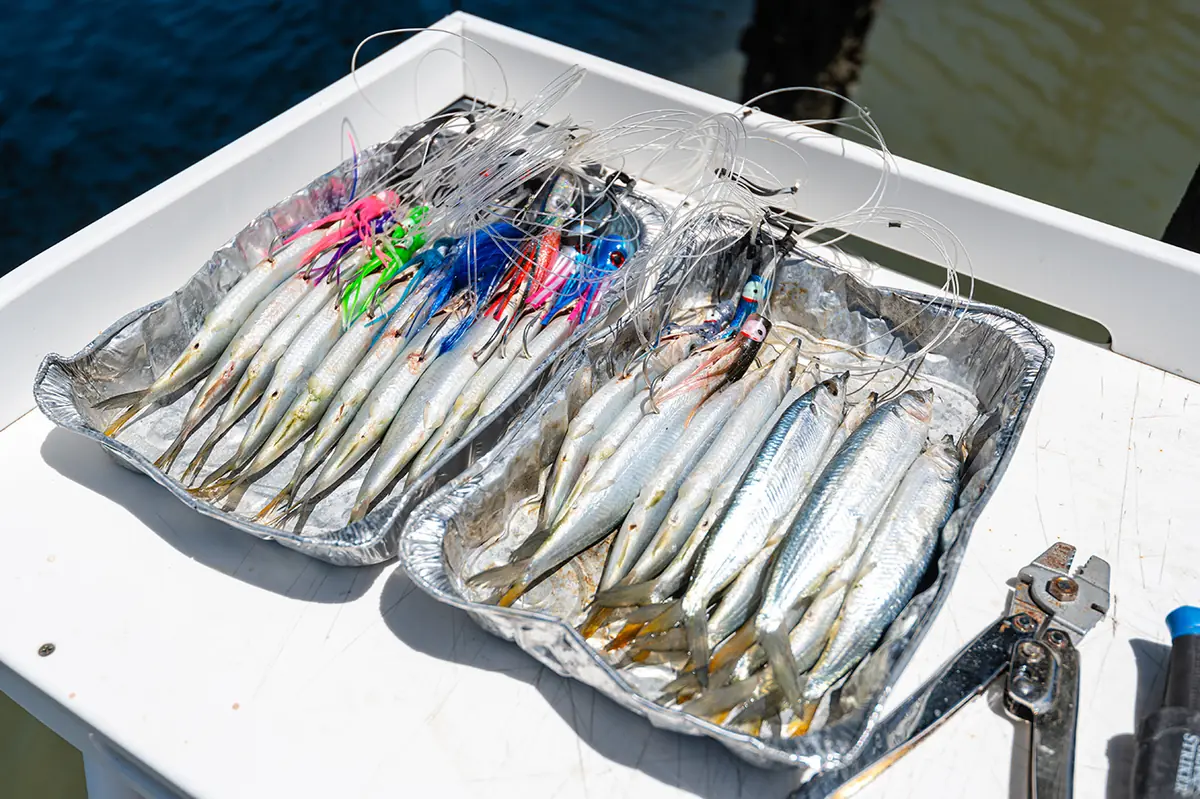
Top captains running deep sea fishing in Puerto Rico rely heavily on rigged ballyhoo paired with a mixed spread of natural baits and high-speed artificial lures. Ballyhoo is the dominant natural bait in this offshore fishery, rigged fresh, vacuum-sealed, or sourced from commercial packs built for high-speed trolling presentations.
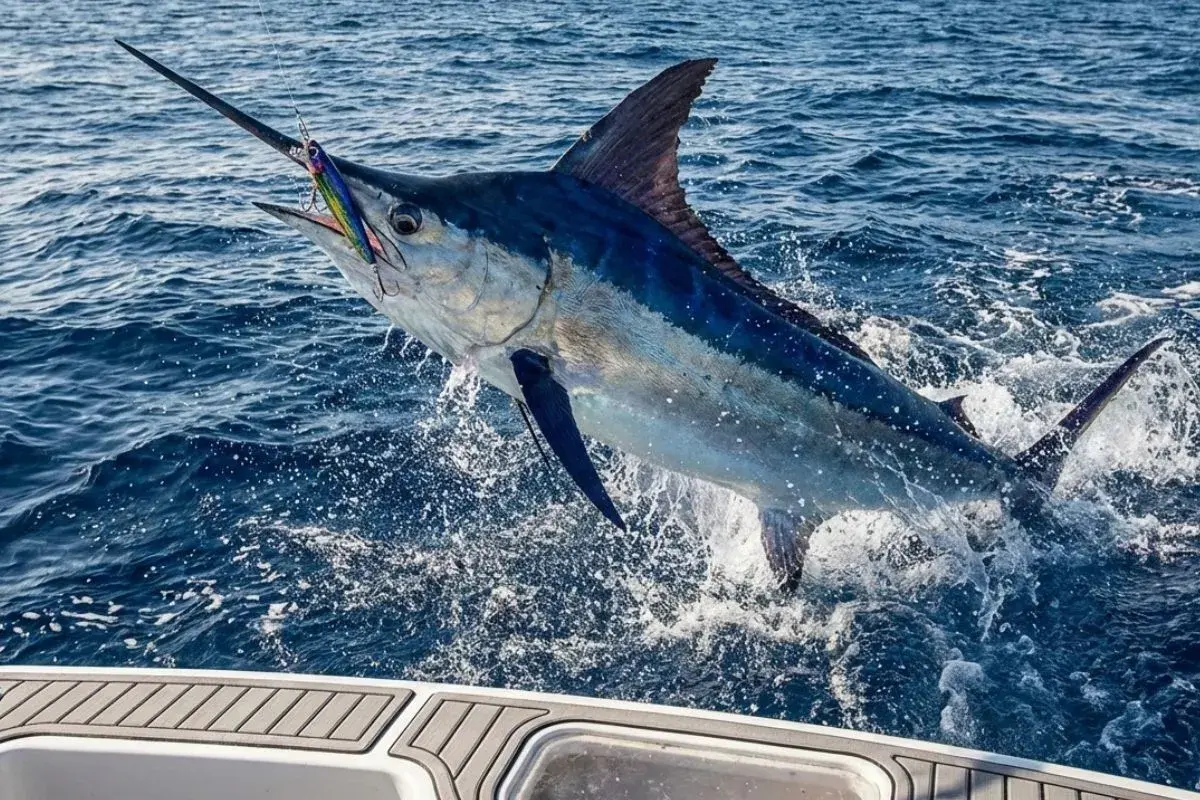
Elite local crews run natural rigged ballyhoo at the short riggers and high-speed artificial skirted lures at the long riggers. They also keep a pitch bait (typically a large flying fish or cut bluefish) ready to drop in front of a free-jumping billfish the instant it appears in the wake. In dock slang, that free-jumper is called a Flopper or Jumper, and timing the pitch bait when one shows up separates experienced crews from everyone else.
One technique that distinguishes the best captains is hangover bait prep. Leftover ballyhoo from a previous charter is treated with a salt-and-baking-soda cure, then vacuum-sealed and stored. The process preserves a supple, natural texture that trolls more convincingly than fresh-frozen commercial bait at any speed. It is economical, tactically superior, and something no charter brochure ever mentions.
Pro Tip: If a fish follows the spread but won’t commit, ask your captain to slow the boat and drop back a pitch bait. Captains call this frustrating behavior a Window Shopper. That sudden change in presentation triggers violent strikes a standard trolling retrieve never will.
Where are the best restaurants near Fajardo to eat your catch?
The best restaurants near Fajardo to eat your catch are Pasión Por El Fogón, El Varadero Seaside Grill and El Bohío. You just pulled in from a full day offshore with 40 pounds (18 kg) of fresh tuna and no kitchen at your resort. These three places solve that problem.
1. Pasión Por El Fogón
This is the benchmark for catch-and-cook dining in the Fajardo area. Chef Myrta’s kitchen operates as a certified mesón gastronómico, a government designation reserved for restaurants championing authentic local culinary traditions. Bring your cleaned catch and the kitchen transforms it into the meal that justifies the entire trip.
The house move pairs fresh tuna with garlic-infused mamposteao rice and stuffed mofongo — a collision of textures the salt-heavy ocean breeze makes considerably better.
- Location: Fajardo area
- Cost: Market price for catch preparation plus standard menu pricing
- Best for: Couples, serious food travelers, anyone wanting the full hook-to-plate arc
- Time needed: 1.5–2 hours
2. El Varadero Seaside Grill
Located directly at Villa Marina Yacht Harbour, this is the logical first stop when pulling in from an offshore run. You barely need to leave the dock to get your fish cooked. The open deck overlooks the marina and the kitchen specializes in custom preparations, including arepas rellenas that pair exceptionally well with fresh Wahoo or Mahi-Mahi.
The setting carries as much weight as the food. Watching the sun drop over the marina while eating fish you caught six hours ago is the entire point of deep sea fishing in Puerto Rico.
- Location: Villa Marina Yacht Harbour, Fajardo
- Cost: $20–$40 per person for food, not including catch preparation
- Best for: Groups, families, post-charter celebrations with a full crew
- Time needed: 1.5–2 hours
3. El Bohío
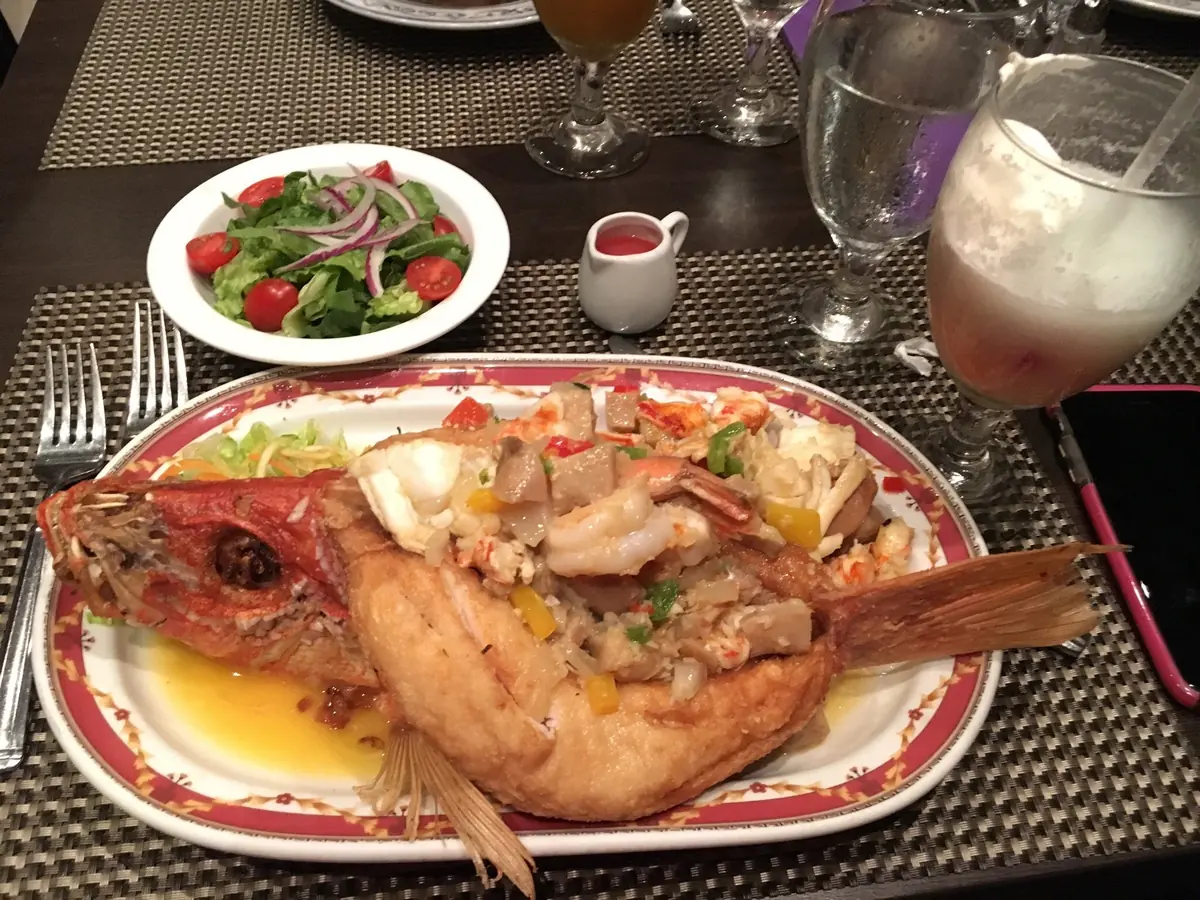
The old-school option and the most authentic on this list. El Bohío is known for whole fried snapper where the fish arrives at the table intact and fried crisp. Straightforward, unadorned cooking that lets the fish speak without interference.
There are no theatrics here, which is entirely the point. You get pure Boricua coastal cooking without the tourist markup you’ll find at the resort restaurants 10 minutes away.
- Location: Fajardo area
- Cost: $15–$25 per person
- Best for: Traditionalists, families, anyone seeking genuine local flavor
- Time needed: 1–1.5 hours
Why does the banana rule matter so much on fishing boats?
The banana rule matters because it is viewed as a serious maritime superstition, and bringing one aboard will instantly damage your relationship with the crew. Never bring a banana in any form onto a Puerto Rico fishing charter. This is not a regional quirk — it is enforced, and I’ve watched a captain throw an entire bunch overboard before the lines were even cast off.
The prohibition runs deep in global maritime culture and traces back to the 18th century. Three theories explain the origin:
- Capsizing risk: Top-heavy fruit transport vessels were statistically prone to capsizing, and salvage crews often found floating bananas among the wreckage.
- Lost fishing days: Perishable bananas meant cargo ships had to run at speeds too fast to troll effectively, linking the fruit with days when no fish were caught.
- Venomous stowaways: Tropical shipments regularly harbored funnel-web spiders and coral snakes, creating genuinely dangerous situations aboard wooden vessels with no means of containment.
Modern captains enforce the rule regardless of which theory they favor. A captain who discovers bananas aboard will throw them overboard or turn the vessel around entirely. This extends to banana bread, banana-flavored energy gels and any snack that resembles the fruit.
Pro Tip: Check your sunscreen ingredients label before the trip. Several widely sold SPF formulations contain banana extract. Swap brands before you pack your boat bag.
What is the essential dock slang for deep sea fishing in Puerto Rico?
Arriving at the marina with basic Spanish fishing vocabulary and a passing knowledge of local tournament history earns immediate respect from Puerto Rican crews. Here is the primer that will help you communicate and signal you’re serious about the trip.
Core angling vocabulary
- Caña: Rod
- Carrete: Reel
- Carnada: Bait
- Nevera: Cooler
Dock slang worth knowing
- Flopper / Jumper: A free-jumping billfish visible near the boat
- Window Shopper: A fish following the spread but refusing to commit
- Boricua: The local term for a Puerto Rican
Using Boricua correctly signals genuine cultural awareness rather than tourist phrasebook copy-paste. You should also understand the tournament that shaped the sport locally. The San Juan International Billfish Tournament carries a seven-decade history and stands as one of the most significant competitions in the Western Hemisphere. Held annually from San Juan Bay Marina, it pioneered the Tag & Release format in 1987 — predating most mainland U.S. federal conservation mandates by years.
Fishing these waters means fishing in a place that helped define modern billfish conservation ethics before it became policy elsewhere.
Pro Tip: Ask your captain which past tournaments they’ve fished. It is a genuine conversation starter that signals you’re there for the full Puerto Rico experience, not just a quick photo at the dock.
Before you book
Deep sea fishing in Puerto Rico rewards the angler who prepares for the reality of the ocean. The ones who land the fish, eat well afterward and leave with a real story are the ones who showed up knowing what the water asks of them.
TL;DR: Book a charter with verified USCG and NOAA HMS credentials, budget $1,500–$1,600 all-in for a full-day high-season offshore trip, tip the first mate 15–20 percent in cash at the dock, and match your species to the month (Marlin August–October, Wahoo November–April). And leave the bananas at the hotel.
What species is at the top of your target list — and are you planning to go offshore for the billfish, or keep it closer to the coast for Tarpon and Snook?