An east coast lighthouse tour can string together more than 40 climbable and photo-worthy beacons, from Maine’s granite headlands to the shallows of Key West. Drive it all in one 1,600-mile push and it collapses into a windshield blur. This guide splits the coast into three regional loops — with the climb fees, step counts, ferry times, and the towers worth skipping.
The move that saves the trip is picking one region instead of the full 1,600-mile (2,575 km) Maine-to-Florida route. Most towers charge under $17 to climb, a few are reachable only by boat, and three anchors — Portland Head Light, Cape Hatteras, and Cape May — define the three best regional loops. Chaining all 14 coastal states in one go turns a dream trip into a slog; below is how to break it into trips you’ll actually enjoy, with the fees, steps, ferry times, and crowd patterns that decide your day.
How Do You Plan an East Coast Lighthouse Tour?
Plan an east coast lighthouse tour by committing to one region: Maine and Massachusetts for a week, the Mid-Atlantic and Outer Banks for a long weekend, or Georgia-to-Key West as a southern finale. Book boat tours and keeper’s-house stays months ahead, and check each tower’s climbing season before you drive.
The full route runs more than 1,600 miles (2,575 km) and needs two weeks minimum just to drive — before you’ve climbed a single tower. Splitting it into regional loops is the difference between a trip and an endurance test.
Two roads shape the drive:
- US Route 1: slower, hugs the coast, drops you near the lighthouses themselves. Take it for the scenic stretches in Maine and along Florida’s A1A.
- I-95: the faster interstate for covering distance between regions. Use it to connect loops, not to sightsee.
A few logistics that catch first-timers off guard:
- Climb fees: free to about $17 at most towers; several of the best photo spots are free from public parks.
- Boat tours: roughly $30–$90 per person, and the popular ones sell out in summer.
- National seashores: an America the Beautiful pass ($80) covers entry to the Cape Cod and Cape Hatteras seashores if you’re hitting several federal sites.
- Outer Banks climbs: Bodie Island tickets are sold same-day only on recreation.gov, released at 7 a.m. — there’s no advance booking, so set an alarm on busy summer mornings.
- Overnight stays: keeper’s-house rentals book months out and are run by small nonprofits, not hotel chains.
Pro Tip: A 68°F (20°C) coastal Maine afternoon can drop about 15°F (8°C) the moment a fog bank rolls in off the water. Pack a real layer even in July — the cliff-top wind at Pemaquid and Bass Harbor is no joke.
Which New England Lighthouses Anchor the Trip? (Maine to Cape Cod)
Maine has 65 lighthouses — more than any other East Coast state — and the southern stretch from Cape Elizabeth to Mount Desert Island is the natural anchor. Portland Head Light, Nubble Light, Pemaquid Point, and Bass Harbor Head are the four worth building a week around, all within a few hours’ drive of each other.
Portland Head Light — Cape Elizabeth
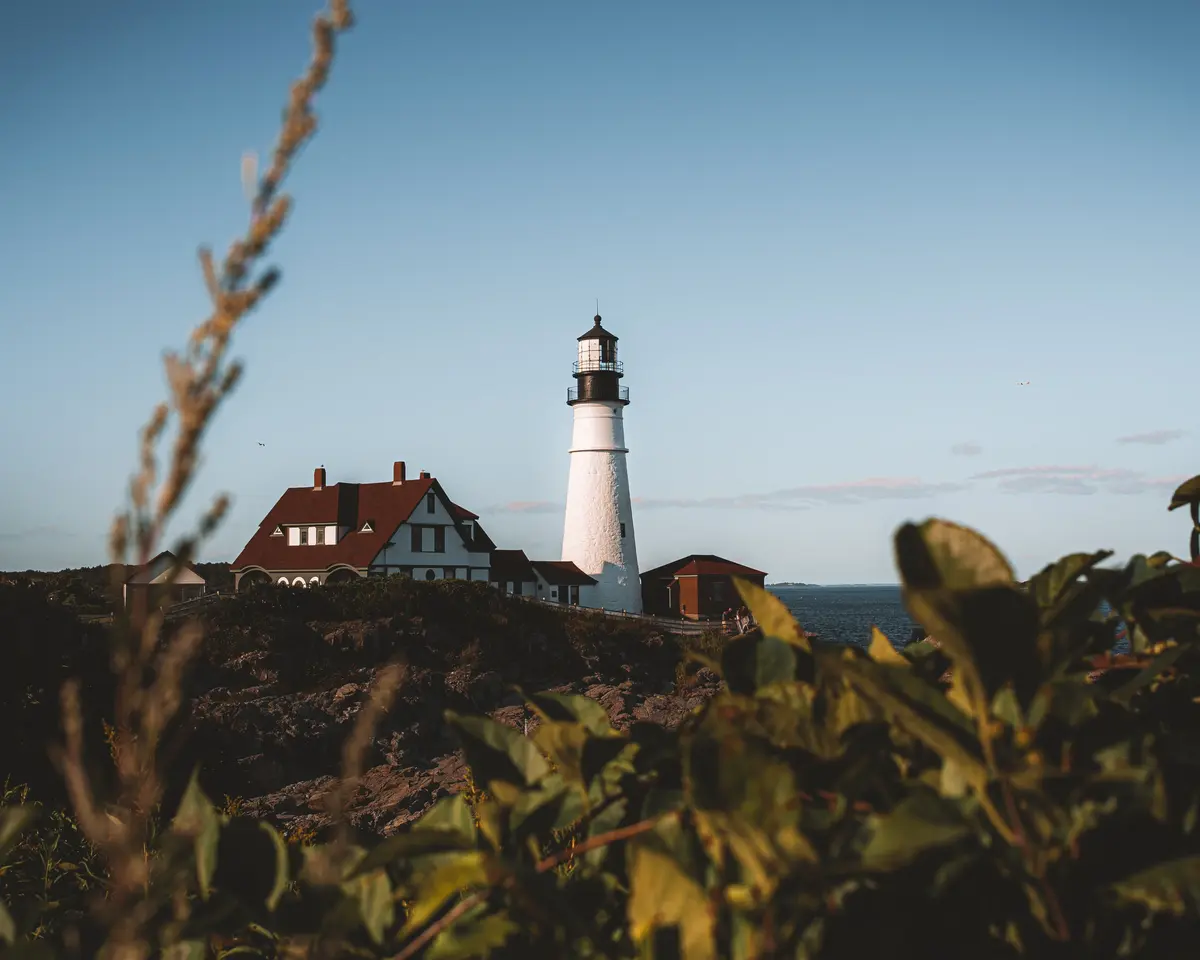
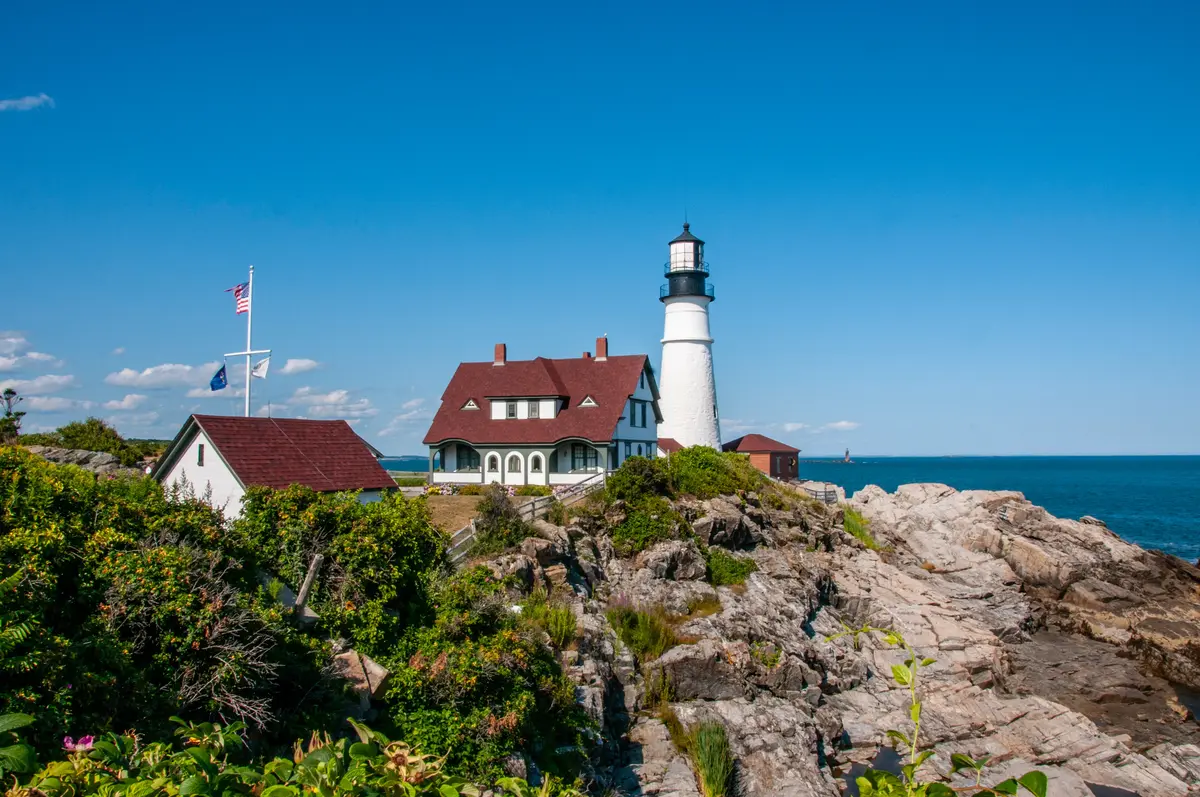
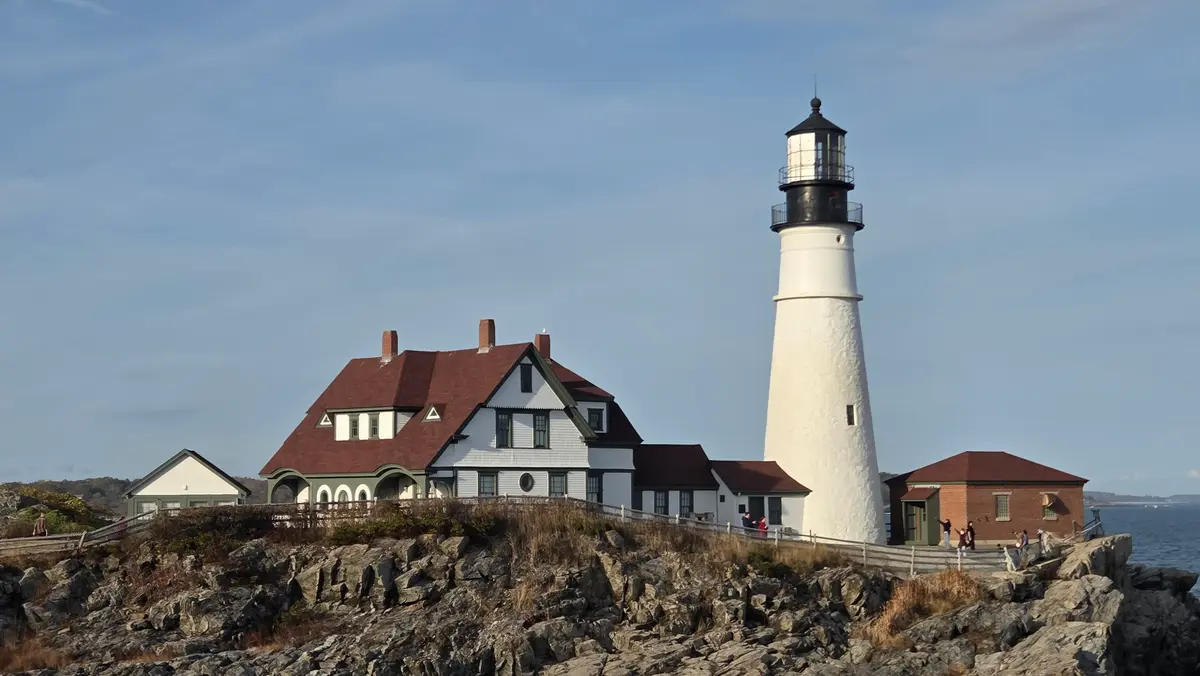
The cliff path at Fort Williams smells of salt rose and gulls before 9 a.m., when the light is nearly deserted and the white tower reads sharp against the water. Edward Hopper painted this view, and the angle still holds up. The tower itself isn’t open to climb, but the park around it is the real draw — free, walkable, and rarely crowded at opening.
- Location: Fort Williams Park, Cape Elizabeth, ME
- Cost: Free entry; seasonal parking fee charged roughly April through mid-November
- Best for: Photographers and first-timers who want the postcard shot without paying for it
- Time needed: 1–2 hours with a walk along the cliffs
Portland Head was first lit in 1791, making it Maine’s oldest lighthouse. The tower stands 80 feet (24 m) tall and 101 feet (31 m) above the water, and it’s widely considered the most photographed lighthouse in America. George Washington commissioned it; Alexander Hamilton authorized its completion with a $1,500 federal appropriation.
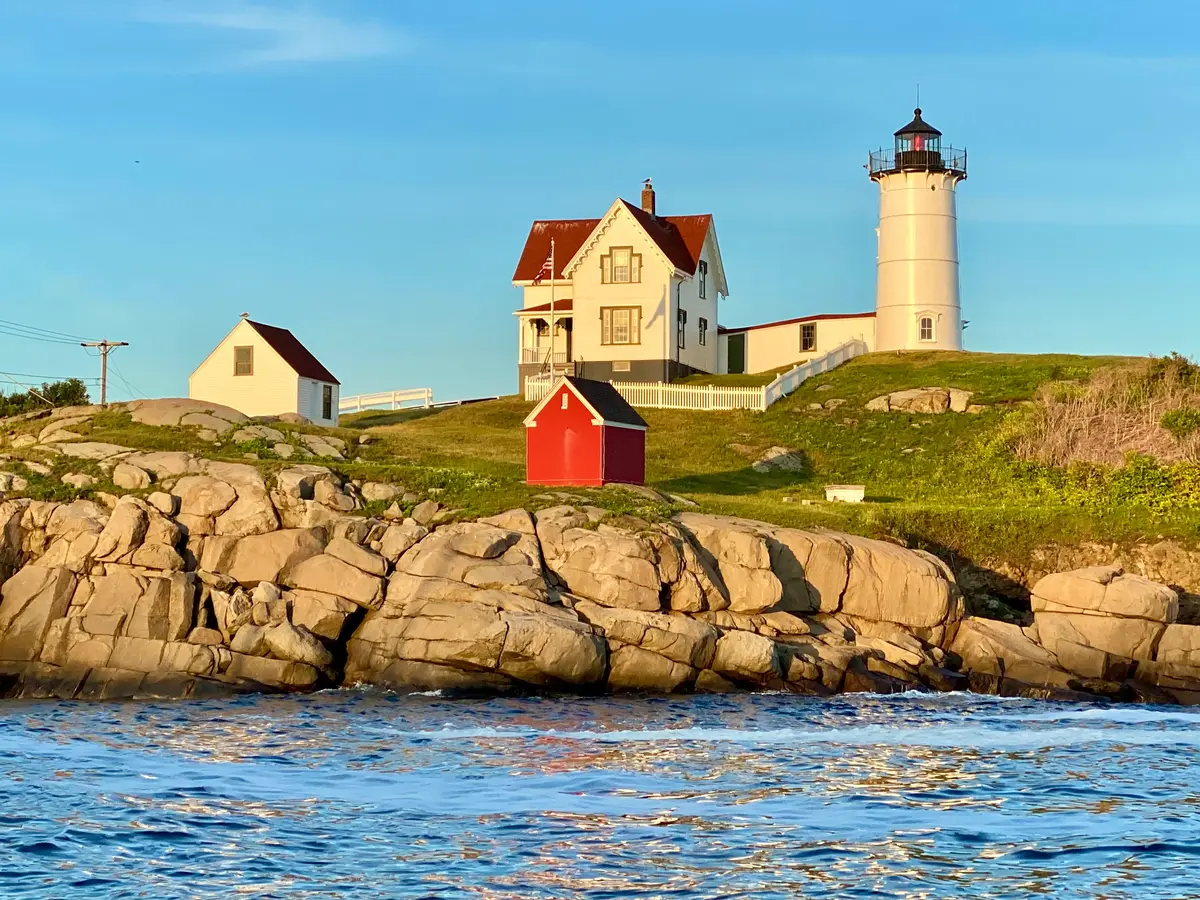
Cape Neddick “Nubble” Light — York
Nubble sits on a small rock island just offshore, so you photograph it from across a narrow channel rather than walking up to it. That distance is the point — the gap of churning water between the parking lot and the light is what makes the shot.
- Location: Sohier Park, York, ME
- Cost: Free
- Best for: Quick stops and golden-hour photography
- Time needed: 30–45 minutes
The tower stands 41 feet (12 m) tall and sits 88 feet (27 m) above sea level. Sohier Park has about 60 free parking spaces, and there’s no public access to the island itself.
Pemaquid Point Light — Bristol
Pemaquid is the one on the Maine state quarter, and the rock does half the work — bands of gneiss and schist tilt down to the surf in what look like gentle natural steps.
- Location: Pemaquid Point, Bristol, ME
- Cost: Small park admission; keeper’s-house museum on site
- Best for: Geology and a quieter, less-trafficked stop
- Time needed: 1 hour
Pro Tip: Those tilted ledges look like an easy staircase down to the water until wave spray hits them. Wet, the gneiss turns slick enough that trail shoes skate out from under you — stay above the spray line and watch where the rock darkens.
Bass Harbor Head Light — Acadia
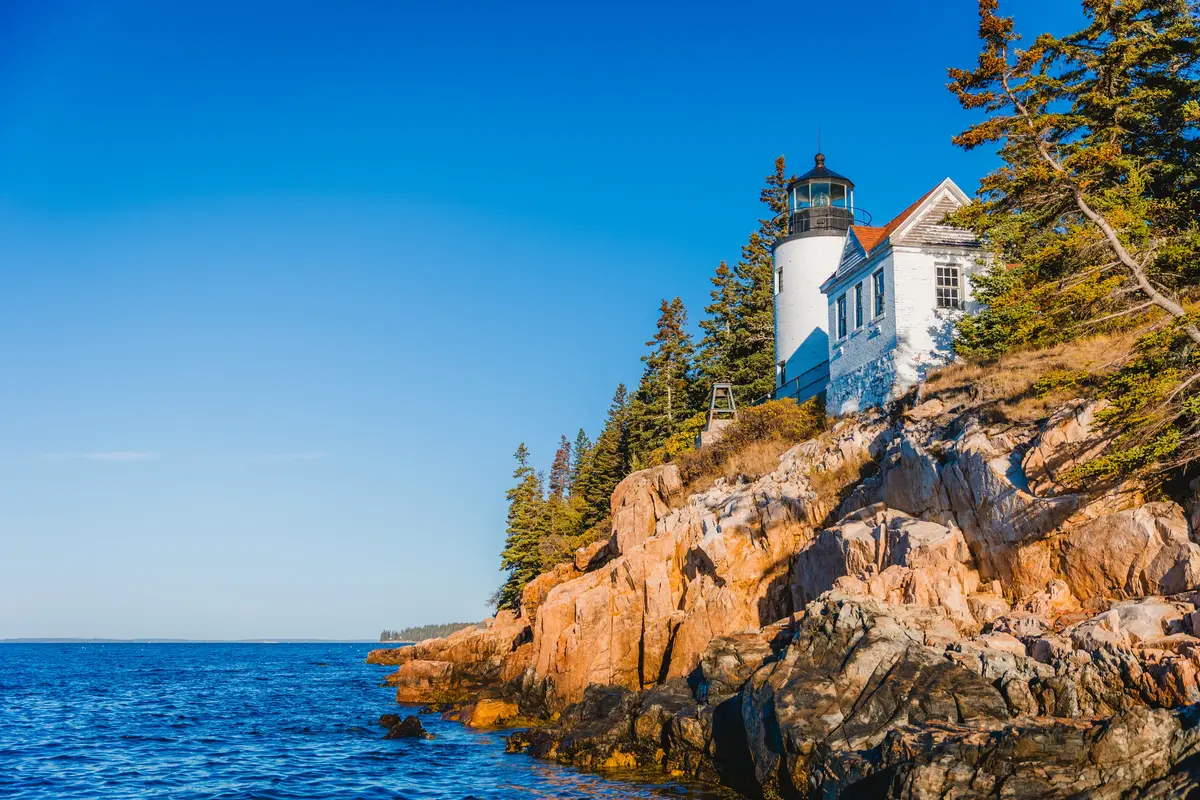
Bass Harbor is the southern tip of Acadia, and the classic shot comes from the rock ledge below and left of the tower, down a short staircase. It’s a small spot with a big crowd problem.
- Location: Mount Desert Island, Acadia National Park, ME
- Cost: Acadia entry $35 per vehicle (seven-day pass); non-US residents pay an extra $100 per person
- Best for: Acadia visitors and sunset photographers
- Time needed: 45 minutes once you’ve parked
The light dates to 1858. The catch is the lot: it holds 27 cars and fills by 9 a.m. on summer weekends. Arrive before 7:30 or accept a half-mile (0.8 km) walk in from overflow parking. Acadia’s $35 vehicle pass is good for seven days, and the park gate is now cashless — card or mobile payment only.
Which Lighthouses Can You Climb, and How Many Steps? (Comparison)
Many East Coast towers are open for self-guided climbs, from Key West’s 88 steps to Cape Hatteras’s 257. Most charge $7–$17, enforce a 42-to-44-inch minimum height, and have no elevator. Cape Hatteras is closed for a major restoration — the grounds stay open and free, but there’s no confirmed reopening date, so check before you build a day around the climb.
Here’s the master climb comparison no single guide on page one puts in one place:
| Lighthouse | State | Steps | Adult Fee | Climbable? | Boat/Ferry? |
|---|---|---|---|---|---|
| Cape Hatteras | NC | 257 | Free grounds | Closed (restoration) | No |
| Bodie Island | NC | 219 | ~$10 | Seasonal | No |
| Currituck Beach | NC | 220 | ~$12 | Yes | No |
| Cape Lookout | NC | 207 | — | Seasonal | Yes (ferry) |
| Tybee Island | GA | 178 | ~$12 | Yes | No |
| St. Augustine | FL | 219 | ~$15–$18 | Yes | No |
| Ponce de Leon Inlet | FL | 203 | ~$7 | Yes | No |
| Cape May | NJ | 199 | ~$12 | Yes | No |
| Fire Island | NY | 182 | ~$8 | Yes | No |
| Montauk Point | NY | — | ~$15 | Yes | No |
| Key West | FL | 88 | ~$17 | Yes | No |
A few rules apply almost everywhere:
- Height minimum: 42–44 inches, strictly enforced — measure your kids before the drive.
- Weight limit: 260 pounds at Bodie Island and Cape Hatteras.
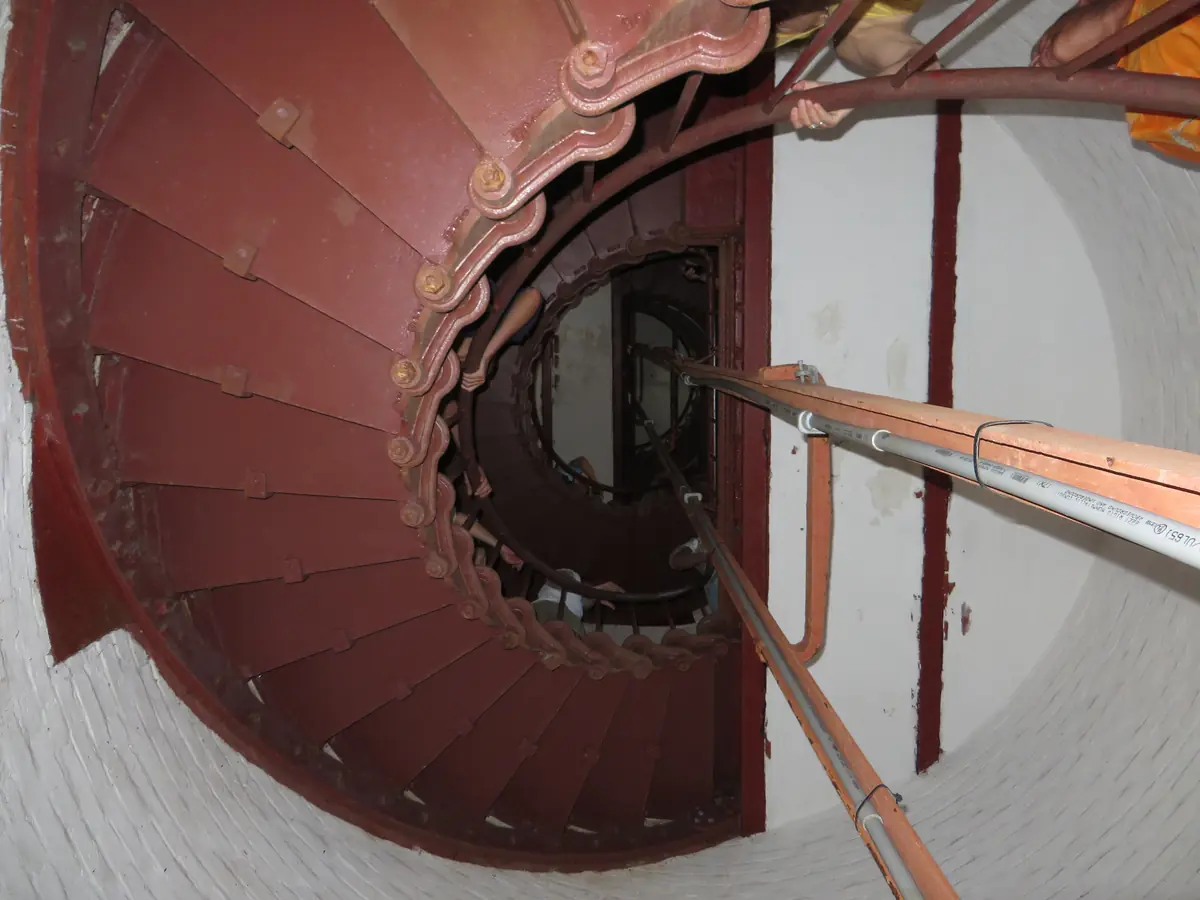
- No elevators: every climb is on foot, up a tight cast-iron spiral.
- One climber per flight: at Bodie Island, only one person is allowed on each flight of stairs at a time, and no one may be carried — expect a slow-moving line on busy days.
Pro Tip: Cape Hatteras normally has a landing every 31 steps, which sounds like a rest stop but works as a traffic feature. Two-way traffic on the narrow stairs means stepping onto a landing to let descenders squeeze past — it’s part climb, part dance, and it’s why the line moves slower than the step count suggests.
Which Lighthouses Need a Boat Tour or Ferry? (Logistics)
Several star lighthouses are only reachable — or best seen — by water. Boston Light requires a narrated harbor cruise, Block Island Southeast Light needs the Point Judith ferry, and Thomas Point Shoal in the Chesapeake is boat-access only. Budget roughly $30–$90 per person for tours.
The water-access stops, with what they cost and how long they take:
- Boston Harbor lighthouse cruise: about 2 hours; roughly $41 adult, $36 senior/student/military, $30 kids (4–11). The narrated route passes Boston Light, Long Island Head Light, and Graves Light. Little Brewster Island is closed to landings, so you see Boston Light from the water, not up close. Book through Boston Harbor Islands.
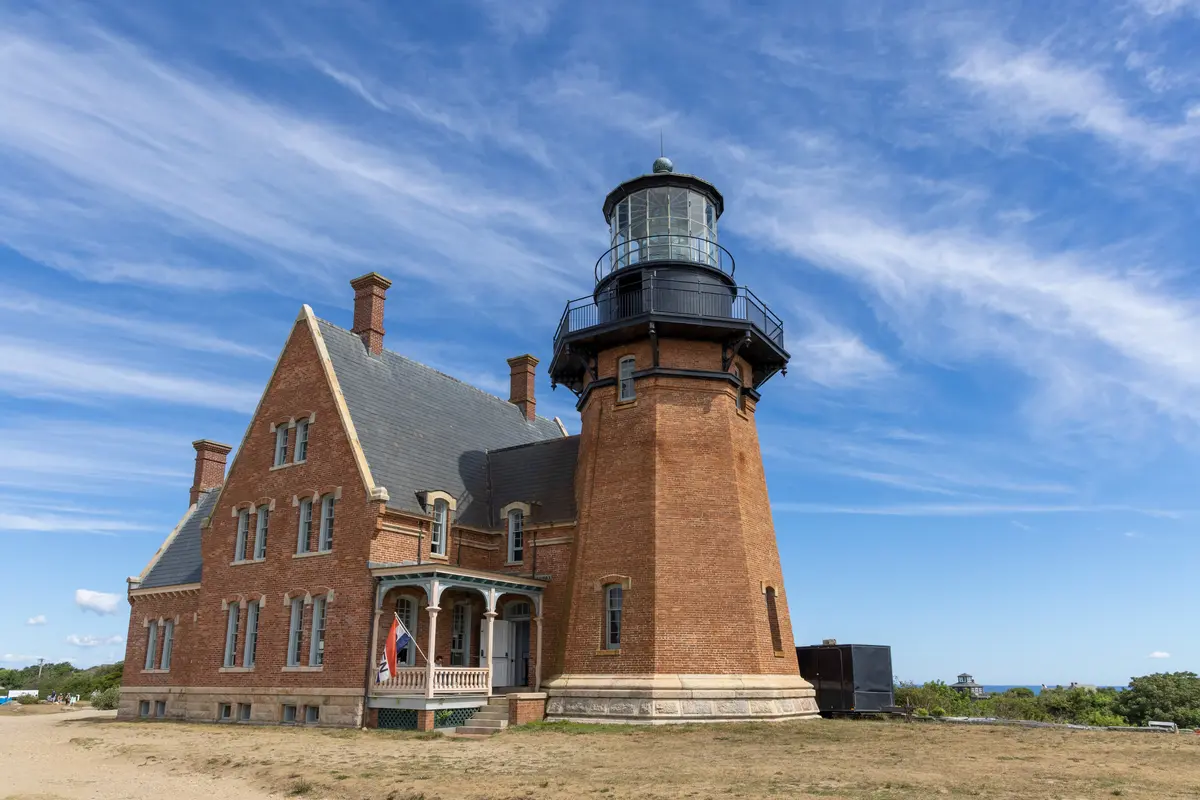
- Block Island Ferry (Point Judith): about 55 minutes traditional, roughly 30 minutes high-speed. Brings you to the Southeast Light above Mohegan Bluffs.
- Cape May–Lewes Ferry: 17 miles (27 km) across Delaware Bay, about 85 minutes — the link between the Cape May and Delaware lights.
- Hatteras–Ocracoke ferry: the free vehicle ferry you need to reach Ocracoke Light.
- Casco Bay cruises (Portland): narrated lighthouse runs from around $49 with Portland Discovery; private charters available through Casco Bay Custom Charters.
- Finestkind Nubble cruise (Perkins Cove): about 90 minutes for a sea-level pass of Nubble Light.
Boston Light is the oldest light station in the country, first lit in 1716. Its first keeper, George Worthylake, drowned in 1718 — a loss a young Benjamin Franklin turned into a ballad called “The Lighthouse Tragedy.” Knowing that story turns a harbor cruise into more than a boat ride.
Pro Tip: On the Block Island ferry, regulars drift to the bow as the Southeast Light’s brick tower rises over Mohegan Bluffs. Get there early to claim a spot at the rail — by the time the light appears, the front is three deep.
What Are the Best Mid-Atlantic and Outer Banks Lighthouses?
The Mid-Atlantic shifts from New England’s stone towers to cast-iron spirals and screw-pile Chesapeake lights. Cape May Light (199 steps), Thomas Point Shoal, and North Carolina’s four Outer Banks beacons — Currituck Beach, Bodie Island, Cape Hatteras, and Ocracoke — are the headline stops along NC Highway 12.
The two standouts north of the Outer Banks:
- Cape May Light (NJ): built in 1859, with 199 cast-iron spiral steps to the gallery. Climb tickets run about $12 adult / $8 child, and it pairs naturally with the Cape May–Lewes Ferry.
- Montauk Point Light (NY): the oldest lighthouse in New York, dating to 1792, standing 110 feet (34 m) tall, with a climb fee around $15.
If your timing lines up, New Jersey runs a Lighthouse Challenge every October — a weekend event that sends participants to lighthouses and life-saving stations from Sandy Hook down to Cape May. It’s a fun way to anchor a Mid-Atlantic loop around a route with a finish line.
Then comes the Outer Banks, the tightest and most rewarding sub-loop on the whole route, strung along NC Highway 12:
- Currituck Beach (Corolla): unpainted red brick, 162 feet (49 m), 220 steps, around $12 to climb.
- Bodie Island (Nags Head): 219 steps, roughly $10 adult / $5 senior and child, with a 260-pound weight limit; climbing runs seasonally, and tickets are sold same-day only on recreation.gov starting at 7 a.m.
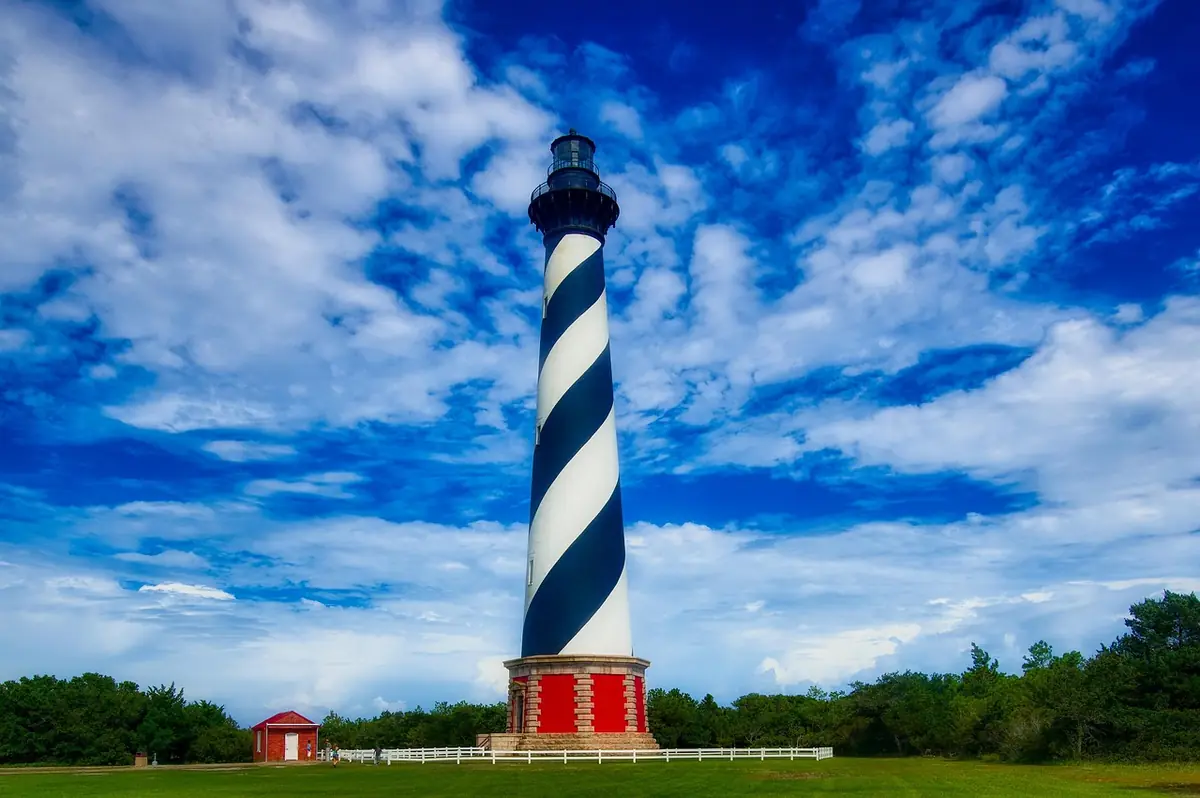
- Cape Hatteras (Buxton): the tallest brick lighthouse in the US at 198.5 feet (60 m), 257 steps, closed for restoration with the grounds open and free.
- Cape Lookout (Crystal Coast): the diamond “argyle” daymark tower, 207 steps, reachable by ferry only.
Cape Hatteras carries the best story on the coast. As the shoreline eroded toward its base, engineers rolled the entire 198.5-foot brick tower 2,900 feet (880 m) inland over 23 days in 1999. Under the restoration scaffolding, the scale of what they moved lands harder than any polished photo op — this is the “Graveyard of the Atlantic,” and the tower has the weight to match.
Which Southern Lighthouses Are Worth the Drive? (Georgia & Florida)
Georgia and Florida deliver the warm-weather finale. Tybee Island Light (178 steps, Georgia’s oldest), St. Augustine Light (219 steps, famous for its ghost tours), Ponce de Leon Inlet (Florida’s tallest at 175 feet), and Key West Light (88 steps) close out the route along the A1A Coastal Byway.
The southern climbs, with the fees that matter:
- Tybee Island (GA): about $12 to climb (kids 4 and under free); 178 steps; 20 minutes from Savannah; a station dating to 1736. The ticket also covers the keeper’s cottages and the WWII museum across the street.
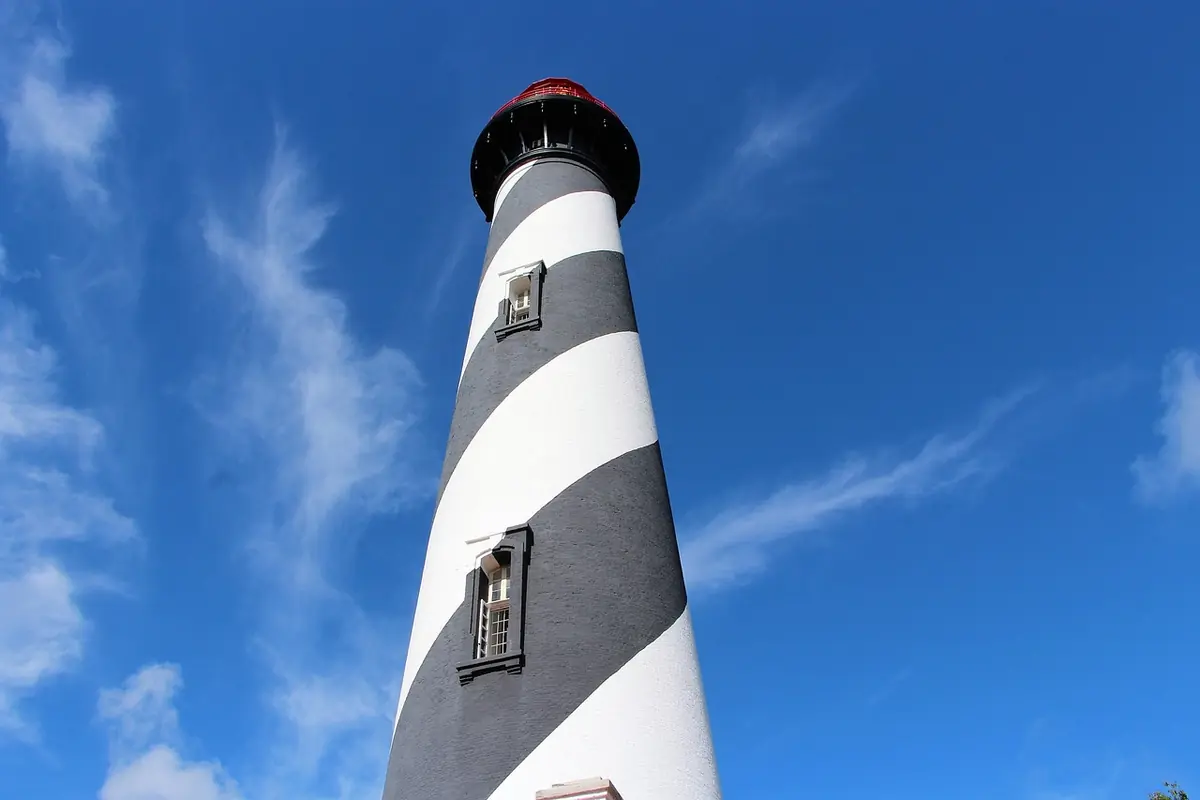
- St. Augustine (FL): general admission runs roughly $15–$18 adult, with a 44-inch minimum to climb by day; the after-dark Dark of the Moon ghost tour runs about $30 and is the only tour that gets you inside the tower at night. Same 219-step climb, very different experience after sundown. Details at the official site.
- Ponce de Leon Inlet (FL): about $6.95 adult / $1.95 child (ages 3–11); 203 steps; 175 feet (53 m), the tallest in Florida and second-tallest in the US, about 5 feet (1.5 m) shorter than Cape Hatteras.
- Jupiter Inlet (FL): a red brick tower with 105 steps.
- Key West (FL): 88 steps; about $17 at the door, $15.50 online; first lit in 1848, once kept by Barbara Mabrity, and a short walk from the Hemingway House. Tickets through the Key West Art & Historical Society.
Pro Tip: At St. Augustine the iron stairs hum underfoot as you climb. Pause at one of the window landings on the way up — the cross-breeze through the tower is the real air-conditioning, and the view earns the stop.
When Is the Best Time of Year to Visit East Coast Lighthouses?
Late spring through fall is the best window for an east coast lighthouse tour, when climbing seasons are open and the weather cooperates. Most northern towers are climbable from roughly mid-April through mid-October; fall brings New England foliage and thinner crowds, while Florida’s lights stay pleasant through winter.
| Region | Best months | Climbing season |
|---|---|---|
| Maine & New England | Late May–mid-October (foliage peaks early October) | Museums Memorial Day–mid-October |
| Mid-Atlantic & Outer Banks | Late April–October | NC climbs third Friday in April–mid-October |
| Georgia & Florida | Year-round; best in winter and spring | Open year-round |
Crowds swing hard by season. Between July and Labor Day it’s peak everywhere north of Florida, while the shoulder weeks in spring and fall give you open towers without the lines.
The Bass Harbor overlook makes the point. Midweek in October it can sit nearly empty — a few photographers and the wind — while the same spot on a July weekend turns shoulder-to-shoulder by late afternoon. If you can travel midweek in the shoulder season, do it.
Can You Stay Overnight in a Lighthouse?
Yes — several East Coast lighthouses rent out keeper’s quarters. Race Point Light in Provincetown rents rooms in its 1950s-era Keeper’s House for roughly $145–$185 a night, Pemaquid Point in Maine offers a second-floor apartment from around $275 a night off-season, and Rose Island near Newport offers weekly stays with optional keeper duties.
Your realistic overnight options, with what they cost:
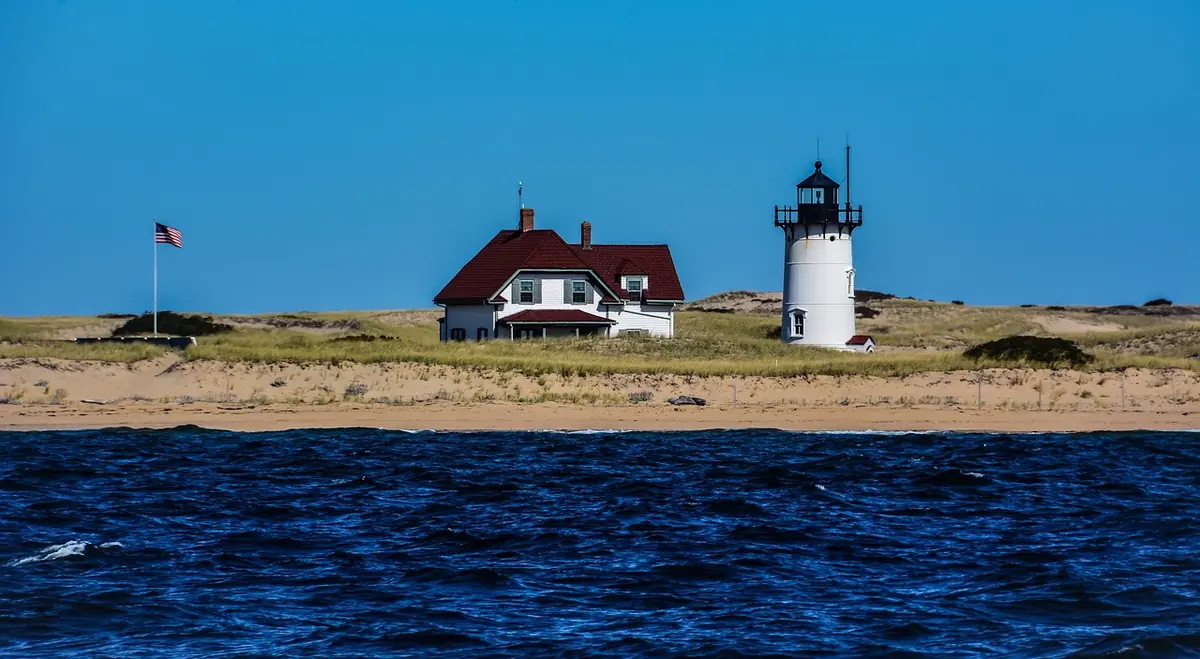
- Race Point Light (Provincetown, MA): about $145–$185 a night for one of three guest bedrooms, run by the American Lighthouse Foundation’s Cape Cod Chapter. Access is by four-wheel-drive over roughly 2 miles (3 km) of dune track, provided by the hosts. Book through the American Lighthouse Foundation.
- Pemaquid Point (Bristol, ME): a keeper’s apartment from around $275 a night, with a three-night minimum in the off-season.
- Rose Island (Newport, RI): weekly stays with optional keeper duties — you help run the place.
- Little River Light (Cutler, ME): a remote island stay in the warmer months.
- Haig Point (Daufuskie Island, SC): the upscale end of the spectrum.
These are run by small nonprofits, so book months ahead and contact the foundations directly rather than expecting a booking site. Race Point comes with real fine print: the house runs on solar and wind power, so there’s no microwave and cell service is spotty, and you bring your own linens, towels, food, and drinking water. The common areas are shared, B&B-style, with the other guests and a volunteer keeper.
Pro Tip: At Race Point, after the four-wheel-drive ride over the dunes, the only sounds after dark are surf and the foghorn. In summer, guests regularly report hearing humpbacks exhaling offshore — pack earplugs only if you’d rather sleep through it.
How Many Days Do You Need, and What Will It Cost?
The full Maine-to-Key West route covers more than 1,600 miles (2,575 km) and needs at least two weeks. A single region is far more realistic: a week for Maine and Massachusetts, a long weekend for the Mid-Atlantic and Outer Banks. Daily costs run roughly $90 budget to $400-plus luxury per person.
| Tier | Daily cost (per person) | What it covers |
|---|---|---|
| Budget | ~$90–$130 | Campsite or motel, free park lighthouses, one paid climb, packed lunches |
| Mid-range | ~$150–$250 | Coastal inn or B&B, 2–3 climbs, a narrated cruise, sit-down meals |
| Luxury | $400+ | Keeper’s-house or boutique inn, private charter, lobster dinners |
The line items that add up:
- Climb fees: free–$17
- Ferries: $12–$35
- Boat cruises: $30–$90
- Lodging: $145–$185 (keeper’s house) vs. $250+ (coastal inns)
- Acadia entry: $35 per vehicle (plus $100 per person for non-US residents)
- Maine lobster roll: around $25
Region timing that actually works: budget 6–8 days for Maine, a long weekend for the Outer Banks, and 4–5 days for Florida.
Pro Tip: The Bite Into Maine lobster-roll line at Fort Williams can run 30 minutes at noon. Go at 11 a.m., grab your roll before the rush, and eat it on the cliff with Portland Head in view — same food, no wait, better seat.
What to Book First (and What to Skip)
Pick one region and go deep; the whole coast in a single trip is the mistake nearly everyone makes on their first east coast lighthouse tour. Portland Head Light, Cape Hatteras, and Cape May anchor the three best loops, most towers cost under $17 to climb, a handful need a boat, and the keeper’s-house nights and ferry crossings are the parts you’ll actually remember.
Here’s the take most guides won’t put in writing: the best photos on the whole coast — Portland Head, Nubble, Bass Harbor — are free from public parks. You can build a genuinely great tour spending almost nothing on admission, then pour the money you saved into one keeper’s-house night you’ll be talking about for years.
If you’re only doing one loop, make it Maine. The density is unmatched — four anchor lights within a few hours of each other — and the free coastal parks mean your budget goes to lobster and a lighthouse sleepover instead of turnstiles.