

A Maine to Florida road trip runs about 1,500 miles down the East Coast, almost all of it on I-95 — and the first day is the hardest, not the last. Thread the Northeast cities right and the rest of the drive unspools into beaches and history. Here’s the route, the real costs, and where to actually stop.
Maine to Florida Road Trip at a Glance
The Maine to Florida drive covers about 1,500 miles (2,415 km) and roughly 24 hours behind the wheel, almost entirely on I-95. You can push through in two long days with one overnight, but three to five days is far more comfortable. Budget around $230–$270 in gas, $40–$70 in tolls, and one to four hotel nights.
- Distance: about 1,500 miles (2,415 km), roughly state line to state line
- Drive time: about 24 hours nonstop on I-95
- Days needed: 2 minimum, 3–5 comfortable, 5–9 for real sightseeing
- Gas (one-way): about $230–$270 for a 25-mpg car
- Tolls (one-way): $40–$70 with one E-ZPass
- Hotels: $90–$250+ per night depending on the city
- Best months: spring (March–May) and fall (September–October)

How Long Is the Drive From Maine to Florida?
From the Maine–New Hampshire line to the Florida state line, the drive is about 1,545 miles (2,486 km) and just over 23 hours of nonstop driving on I-95. Your real number swings hard with the endpoints: Boston to Orlando is closer to 1,300 miles, while far-northern Fort Kent, Maine to Key West tops 2,000 miles.
That “23 hours” assumes you never hit a wall of brake lights, which you will. The figure is door-to-door highway math; it doesn’t account for the Northeast corridor, where a single bad stretch through Connecticut or northern Virginia can add an hour on its own.
Where you start and end changes everything:
- Maine–NH line to FL state line: about 1,545 miles (2,486 km)
- Boston to Orlando: about 1,300 miles (2,092 km)
- Portland, ME to Orlando: about 1,600 miles (2,575 km)
- Fort Kent, ME to Key West: 2,000+ miles (3,219+ km)
Pro Tip: GPS apps routinely shave an hour or more off the true time. Treat any nonstop estimate as a best case and pad it for fuel, food, and the cities.
How Many Days Do You Need to Drive Maine to Florida?
You can do it in two days with one overnight near the Virginia–North Carolina border, but most people should plan three to five. Snowbirds chasing speed run it in two; families and sightseers should give themselves five to nine days to actually enjoy the cities strung along the way.
The sweet spot for most drivers is about four to five hours of driving a day, then an afternoon to explore. That cadence turns the trip from an endurance test into something you’d do again.
- Rushed (2 days): one overnight near Roanoke Rapids, NC (I-95 exit 173), a popular halfway point between New England and Orlando
- Balanced (3–5 days): overnights in spots like Richmond, Savannah, or St. Augustine
- Leisurely (5–9 days): time to walk Washington, eat through Savannah, and beach-hop in Florida
What’s the Best Route — I-95 or the Scenic Way?
I-95 is the fastest and most direct line from Maine to Florida at about 1,500 miles. For scenery, swap in US Route 1 along the coast or the Blue Ridge Parkway through the mountains. To dodge Northeast traffic, many veteran drivers cut inland on I-84 to I-81 to I-77, then rejoin I-95 in the Carolinas.
Here’s the contrarian move most guides skip: don’t blindly take I-95 the whole way. Through the snarl between New York and DC, the inland I-84 → I-81 → I-77 detour is slightly longer in miles but often shorter in actual hours and far easier on your nerves.
The Blue Ridge Parkway is the scenic showstopper, but it’s a commitment. It runs 469 miles with a speed limit that tops out at 45 mph and drops to 35 and 25 mph through curves and congested areas (per the National Park Service), and there are no gas stations on the parkway itself.
Pro Tip: The Blue Ridge Parkway has zero fuel along the route, and Skyline Drive has only one station. Top off in the towns the road crosses, not on the road.

I-95 vs. Scenic Routes Compared
Choose I-95 for speed, the Blue Ridge Parkway for mountains, and US Route 1 for coast. I-95 is about 1,500 miles and 24 hours; the parkway adds days because its speed limit caps at 45 mph and falls to 25 mph in the curves. The inland I-81 bypass trades scenery for sanity through the worst traffic.
| Route | Approx. Miles | Drive Time | Best For | The Downside |
|---|---|---|---|---|
| I-95 | ~1,500 | ~24 hrs | Speed, directness | Heavy traffic NYC–DC |
| Inland (I-84/I-81/I-77) | ~1,600 | ~25 hrs | Avoiding city gridlock | Fewer big-city stops |
| US Route 1 | 2,000+ | Several days | Coastal towns, small detours | Stoplights, slow going |
| Blue Ridge Parkway | +469 (segment) | Adds days | Mountain scenery | 45 mph max, no gas, weather closures |
Best Stops on the Maine to Florida Drive
The strongest stops heading south include Boston, New York City, Philadelphia, Washington DC, Richmond, Charleston, Savannah, and St. Augustine. Savannah’s Forsyth Park sits just a few miles off I-95, and St. Augustine — the oldest continuously occupied city in the US — is about five miles east at exit 318.
Before the marquee cities, a few quick-hit stops earn their pull-off:
- Boston: walk part of the Freedom Trail; grab a cannoli at Mike’s Pastry
- New York City: worth a night if you can stomach the parking; skip it entirely in an RV
- Philadelphia: Liberty Bell and Reading Terminal Market, both close to the highway
- Richmond, VA: an easy capital-city break before the long southern run
- South of the Border, SC: a kitschy fuel-and-photo stop right at the NC/SC line
Washington, D.C. — Free Museums Right Off I-95
The Smithsonian museums lining the National Mall are free, which makes DC the highest-value cultural stop on the entire drive. The trade-off is the traffic getting in and out — the Capital Beltway can swallow your afternoon if you time it wrong.
It’s a genuinely good overnight: park once, walk the Mall, and you’ve covered air-and-space, natural history, and American history without spending a dollar on admission.
- Location: National Mall, central Washington, D.C.
- Cost: museums free; parking $20–$40/day; hotels $150–$250/night
- Best for: history buffs, families, anyone who wants culture without a ticket price
- Time needed: half a day minimum, a full day to do it right

Charleston — Worth the Hour Detour
Charleston sits about an hour off I-95, and it’s the rare detour that pays you back. The historic district’s pastel rowhouses, the harbor breeze off the Battery, and the slow Lowcountry pace make it feel like a different trip entirely.
The catch is the time cost. An hour each way means you need to build Charleston into your day as a destination, not a quick stretch-your-legs stop.
- Location: Historic District, Charleston, SC (about 1 hour east of I-95)
- Cost: hotels $180–$350/night in season; free to walk the district
- Best for: couples, food lovers, history travelers
- Time needed: an overnight, or at least a long afternoon and dinner

Savannah — The Easiest Great City to Reach From the Highway
Savannah is the most accessible of the big southern stops — Forsyth Park and its fountain are only a few miles off I-95. Spanish moss hangs over the squares, and the live oaks throw enough shade that even a July walk stays bearable.
Leopold’s Ice Cream draws a line down the block by mid-afternoon, but it moves fast. The whole historic district is walkable, which makes it an easy one-night stop that doesn’t cost you much driving time.
- Location: Historic District / Forsyth Park, Savannah, GA (a few miles off I-95)
- Cost: hotels $150–$300/night; Leopold’s scoop around $5
- Best for: first-timers who want a great city with minimal detour
- Time needed: one night, or a half-day if you’re pressing south

St. Augustine — The Oldest City in the U.S.
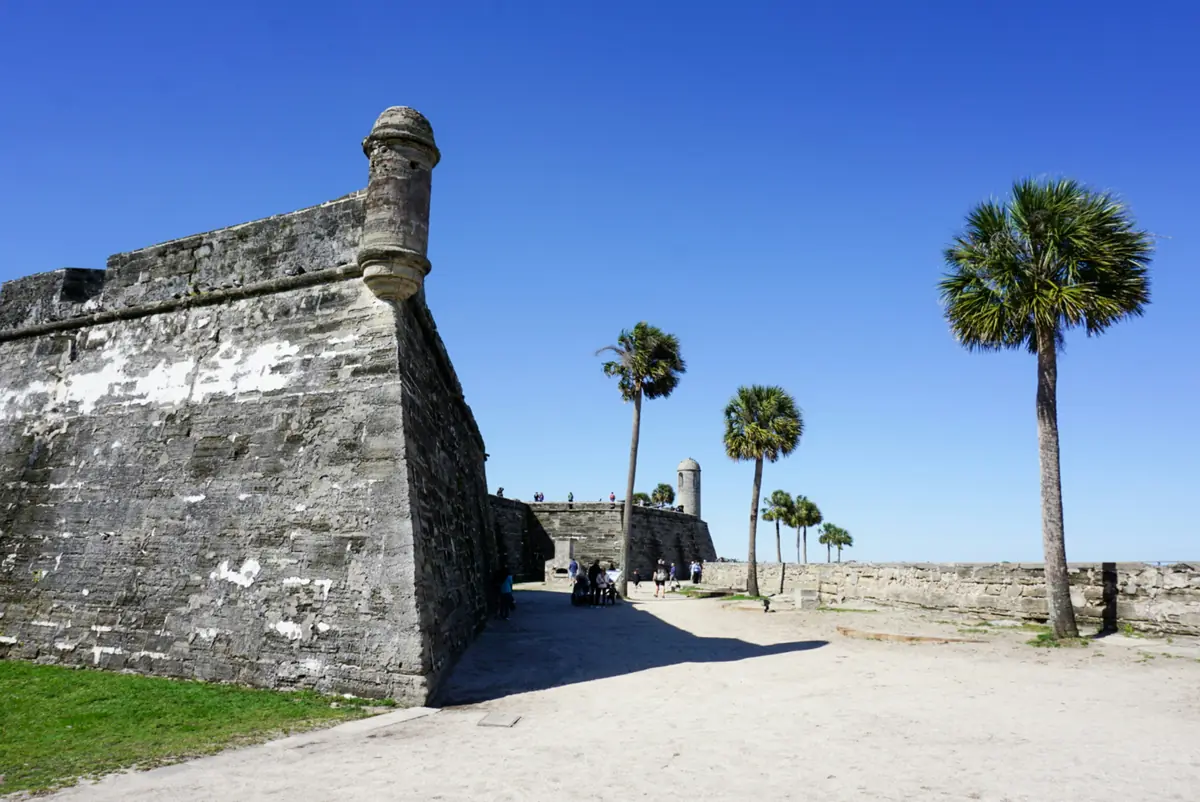
St. Augustine, the oldest continuously occupied European-founded city in the country, is about five miles east of I-95 at exit 318. The Castillo de San Marcos, a coquina-stone fort on the water, is the anchor, and the old town’s narrow streets are made for an evening walk.
It’s the natural last overnight before the Miami stretch — close to the highway, full of history, and right on the coast. One thing most guides skip: the Castillo ticket is good for seven straight days, so if you’re overnighting, you can walk the fort at dusk and come back the next morning on the same $15.
- Location: Historic District, St. Augustine, FL (about 5 miles east, I-95 exit 318)
- Cost: Castillo entry $15 per adult (16+), valid 7 days; kids 15 and under free; front-lot parking $2.50/hour; hotels $120–$280/night
- Best for: history travelers, couples, anyone wanting one last coastal night
- Time needed: an overnight, or a half-day for the fort and old town
Where Should You Stop Overnight?
For a two-day drive, the natural overnight is near the Virginia–North Carolina border — Roanoke Rapids, NC (I-95 exit 173) is a popular halfway point between New England and Orlando. For a slower trip, overnight in Washington DC, Richmond, Savannah, or St. Augustine instead.
The VA/NC border is roughly where the urban Northeast finally lets go of you. North of it, you’re fighting cities; south of it, the driving opens up.
- Two-day plan: overnight at the VA/NC line (Roanoke Rapids, exit 173)
- Three-to-five-day plan: DC, Richmond, Savannah, or St. Augustine
- Book ahead in snowbird season and summer — the I-95 motels near exits fill up fast
How Much Does a Maine to Florida Road Trip Cost?
Budget about $230–$270 in gas one-way for a 25-mpg car — roughly 62 gallons at a national average that hovers in the high-$3 to low-$4 range per gallon — plus $40–$70 in tolls and one to four hotel nights at $90–$250+ each. A bare-bones two-day solo drive can come in under $700 all-in; a leisurely family week runs well over $2,000.
Gas is the one cost you can shave on the road. Prices run noticeably cheaper in the Carolinas and Georgia than in the Northeast, so top off south of DC rather than filling up before you leave. AAA posts the day’s national average if you want the exact number before you go.
- Gas (one-way): about $230–$270 (1,545 miles, 25 mpg, ~62 gallons)
- Tolls (one-way): $40–$70 with E-ZPass (cheaper than cash)
- Hotels: DC $150–$250, Boston $250–$350, budget motels $35–$60
- Food: about $50–$60 per person per day
- Bare-bones solo (2 days): under $700 all-in
- Family week (5–7 days): $2,000+
| Traveler Type | Days | Rough One-Way Cost |
|---|---|---|
| Solo, budget | 2 | $500–$700 |
| Couple, balanced | 4 | $900–$1,400 |
| Snowbird, direct | 2 | $600–$900 |
| Family of four | 5–7 | $2,000+ |
Tolls and Transponders: E-ZPass vs. SunPass
One E-ZPass covers every toll on the I-95 route. The tolled stretches sit in the Northeast and Florida; South Carolina, Georgia, and North Carolina have no I-95 tolls at all. Florida’s SunPass and E-ZPass read each other, so a single transponder — your E-ZPass, or a $14.95 SunPass PRO if you’re starting from Florida — handles the whole corridor.
The thing most guides get wrong is interoperability — they tell you to carry two transponders. You don’t. One does the whole corridor.
- E-ZPass: reads on every tolled section of the route, including Florida’s SunPass lanes
- SunPass PRO: $14.95, works in Florida plus every E-ZPass state — the reverse option for Florida drivers
- No I-95 tolls in South Carolina, Georgia, or North Carolina
- Florida’s 95 Express lanes: dynamic congestion pricing — the posted rate changes with traffic
Pro Tip: Keep only one transponder active at a time. Two live transponders in the same car can get you double-charged at a single gantry.
When Is the Best Time of Year to Drive?
Spring (March–May) and fall (September–October) are the sweet spots — mild weather, highs in the 60s–70s°F (16–24°C), and lighter traffic. Snowbirds drive south in October–November and back north in March–April. Avoid the Atlantic hurricane peak at the Florida end, and watch for snow on the Maine-to-Virginia stretch in winter.
A late-fall southbound run threads the needle nicely: it ducks under the snow risk up north and past the worst of the hurricane window down south.
- Spring and fall: mild temps, fewer crowds, fall foliage on the scenic routes
- Snowbird season: south in October–November, north in March–April
- Hurricane season: June 1–November 30, peaking around September 10, with most activity mid-August to mid-October (per NOAA)
- Winter: snow and ice risk on the northern half; the Florida end stays mild
I-95 Traffic Chokepoints and How to Beat Them
The worst I-95 traffic is the Washington DC area — the Capital Beltway (I-495) — and southbound I-95 at Woodbridge, Virginia (exit 160, near the Occoquan River), which the National Capital Region Transportation Planning Board ranks as the region’s top bottleneck for both frequency and severity. Add New York City and Baltimore. Thread all of these mid-day or early morning, never during rush.
Drivers report the same trap around Fredericksburg — traffic compresses to a standstill the moment a downpour hits, where weather and volume conspire. The Occoquan jam has a cause you can picture: four southbound lanes drop to three just below the river, with barely 100 feet to merge in from VA-123. Leave a real buffer through Virginia.
- DC’s Capital Beltway (I-495): the corridor’s signature jam
- Woodbridge, VA (exit 160, Occoquan): ranked the region’s number-one bottleneck
- New York City and Baltimore (Fort McHenry Tunnel): plan around both
- Rush windows to avoid: 6–10 a.m. and 3–7 p.m.
Pro Tip: Use I-295 to bypass Richmond and Petersburg when I-95 backs up. It’s a more rural alignment that usually carries less traffic.
Snowbirds, Families, RVs, EVs, and Pets: Who Needs What
Snowbirds should go direct on I-95 (or inland via I-81 to skip the cities) and book overnights early. Families should plan a stop every two to three hours. RVers must avoid NYC and Philadelphia. EV drivers will find DC fast charging roughly every 150–180 miles on I-95. Pet owners should target pet-friendly chains and rest areas.
- Snowbirds: direct route, one transponder, early bookings; many ship the car one way and fly the other to skip a long haul
- Families: a break every 2–3 hours; Orlando theme parks as the natural payoff at the end
- RVs: skip NYC and Philadelphia entirely; campgrounds like Skidaway Island State Park near Savannah make good overnights
- EVs: Tesla Supercharger and Electrify America stations run roughly every 150–180 miles, but cold weather can cut winter range 20–40%
- Pets: stick to pet-friendly hotel chains and use rest areas with dog runs
Pro Tip: EV charging thins out north of Boston. Leave Massachusetts at 80–100% so you’re not hunting for a plug in the least-covered stretch of the trip.
Should You Fly or Drive From Maine to Florida?
Flying Portland to Orlando takes about three hours versus roughly 24 hours of driving, with round-trip fares often running $120–$700. Drive if you want your car in Florida, want to see the coast, or are traveling with pets or a lot of gear. Fly if speed and cost-per-day are what matter most.
For snowbirds, there’s a middle path worth knowing: ship the car one way and fly the other. It cuts one brutal long haul out of the season while still putting your own vehicle at your destination.
- Flight: about 3 hours; airfare $120–$700 round trip
- Drive: about 24 hours; you keep your car, gear, and pets with you
- Car shipping: a one-way option many snowbirds pair with a flight
Day-by-Day Maine to Florida Itinerary
A balanced five-day plan: Day 1 Portland to New York City (about five to six hours); Day 2 NYC to Washington DC (about four hours); Day 3 DC to Savannah (about seven to eight hours); Day 4 Savannah to St. Augustine (about two hours) and explore; Day 5 St. Augustine to Miami (about five hours). Stretch it to nine days or compress it to two — the bones hold either way.
The smart play is to front-load the dull, traffic-heavy Northeast miles early, so the back half of the trip is all beaches and history rather than gridlock.
| Day | Route | Approx. Miles | Drive Time | Where to Stop |
|---|---|---|---|---|
| 1 | Portland → New York City | ~330 | 5–6 hrs | NYC |
| 2 | NYC → Washington, D.C. | ~225 | ~4 hrs | Washington, D.C. |
| 3 | DC → Savannah | ~500 | 7–8 hrs | Savannah |
| 4 | Savannah → St. Augustine | ~130 | ~2 hrs | St. Augustine |
| 5 | St. Augustine → Miami | ~310 | ~5 hrs | Miami |
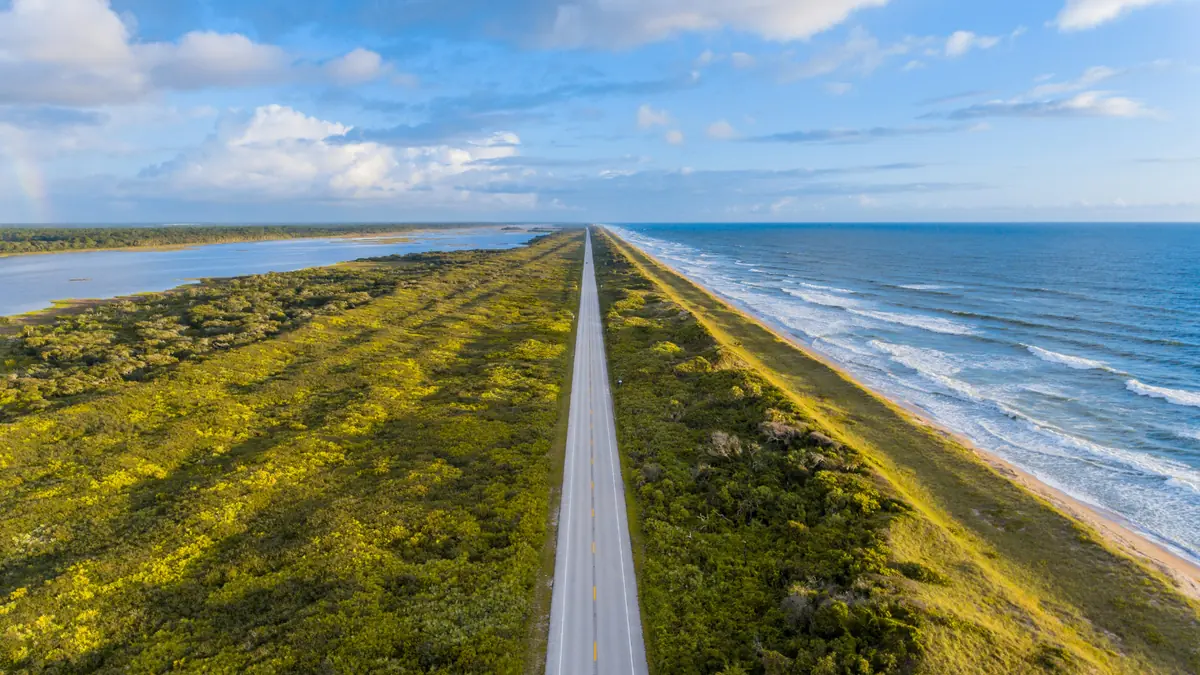
Pro Tip: The Florida stretch of I-95 runs inland and gets monotonous. Drop down to A1A near St. Augustine for an hour of ocean instead of median.
The Bottom Line on Driving Maine to Florida
Here’s the whole trip in one breath: about 1,500 miles and 24 hours on I-95, three to five days if you can spare them, one E-ZPass, a run through DC and Virginia timed outside rush hour, and a departure in spring or fall. Do that, and the hardest long drive on the East Coast turns into one of its best.
The whole trip is defined by the first day. Survive the Northeast corridor, and from the VA/NC line south it’s smooth, open, and genuinely fun. If you optimize one thing, optimize day one — get through the cities early and the rest takes care of itself.
Which stretch worries you more — the Northeast gauntlet up top or the long Florida flatlands at the bottom? Nail down where you’re starting and where you’re ending, and the overnight stops fall into place around the VA/NC line.