A Portugal honeymoon looks manageable on paper until the real details surface: which regions actually fit your pace, what the electronic toll system means for your rental car, and why a train seat upgrade changes the Lisbon-Porto leg completely. This guide covers the logistics, restaurants, and decisions that brochures skip — so you arrive knowing exactly what you’ve signed up for.
How does getting around Portugal actually work?
Portugal has excellent road and rail infrastructure, but two quirks will blindside you immediately if you are not prepared: the electronic toll system on highways and the seating layout on long-distance trains. Getting both right before you leave the rental lot sets the tone for the whole trip.
The Via Verde toll system and rental cars
Portuguese law requires all rental companies to equip their vehicles with a Via Verde electronic toll device. When you rent a car in Portugal today, you no longer need to ask for it separately — it will be active when you pick up the car. The charge is typically €1.50 to €2.21 (~$1.65 to $2.40) per day, added to your final invoice, plus the actual toll amounts.
The green lanes — marked with a white V on a green square — are the ones your rental device works in. Electronic-only highways have no physical booths at all. Without an active device, you drive through and receive a fine in the mail weeks later.
Pro Tip: The A22 — the main east-west highway across the Algarve — is now toll-free. If the Algarve is your destination, highway driving there costs significantly less than it used to. The change covers the full length of the road.
- Cost: €1.50–€2.21 (~$1.65–$2.40) per day + actual toll amounts
- How it works: Device is pre-installed in the rental car; tolls are charged to your rental invoice automatically
- Green lane markers: White “V” on a green square above the lane
Should you take the Alfa Pendular train between Lisbon and Porto?
Yes — skip the car for this leg. The Alfa Pendular is the flagship route for train travel in Portugal — it covers the Lisbon to Porto route in about three hours and cuts through farmland and river gorges that are worth watching. Book early if you want privacy, because not all seats are equal.
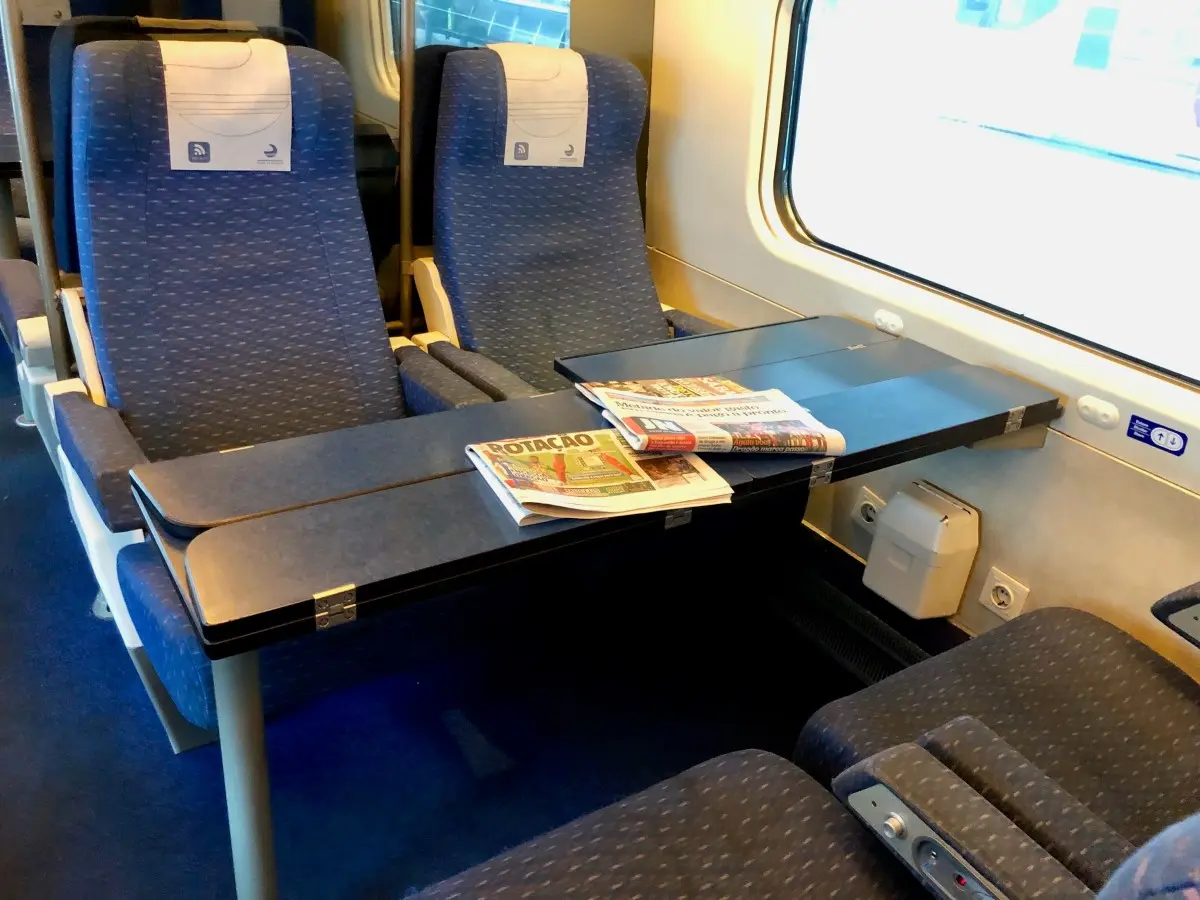
First Class (marketed as “Conforto”) uses a 1+2 seating layout, which means you can claim a single window seat on the solo side of the aisle and have your own space. Tourist Class runs 2+2. For honeymooners, the difference is real.
Pro Tip: Booking 60 days ahead often unlocks First Class Promo fares at nearly the same price as standard tickets. Check the CP (Comboios de Portugal) website directly. Despite the First Class label, there is no at-seat drink service — grab coffee at the station before you board.
What is the best base for your Lisbon days?
Lisbon rewards walkers and punishes drivers. The neighborhoods of Chiado and Baixa are designated Red Zones for private vehicles, on-street parking caps at two hours with swift enforcement, and private garages cost more per hour than a rideshare across the city. Leave the rental car parked and use Uber or Bolt for everything.
On-street parking costs around €1.60 (~$1.75) per hour with a two-hour maximum. Private garages run €1.80 to €2.40 (~$2.00 to $2.60) for the first hour alone. Rides within the city typically cost €3 to €5 (~$3.25 to $5.50). Save the rental car for the day you leave.
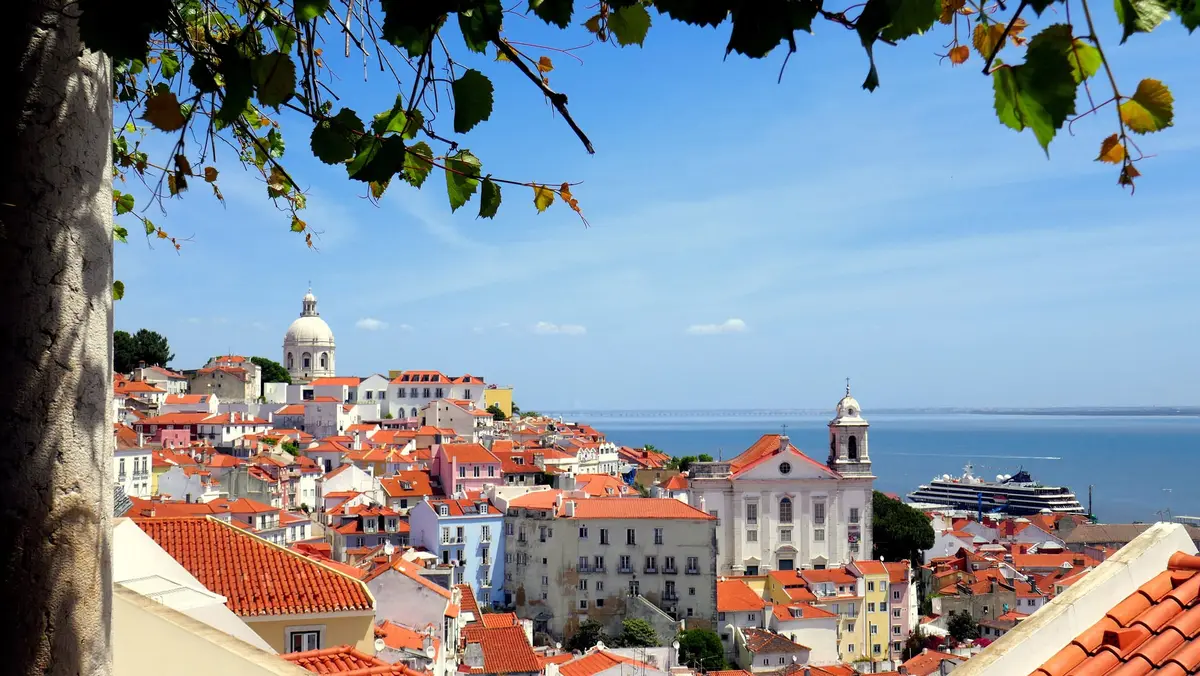
The afternoon light in the historic center — terracotta rooftops above the river, live Fado music drifting out of open doors in Alfama — is where Lisbon earns its reputation. The logistics in that same area are where it loses it. The two facts coexist and knowing both makes the trip better.
Where should you eat in Lisbon on a honeymoon?
Lisbon’s dining scene is competitive, and the most-talked-about tables book out months in advance. Plan three categories: the splurge reservation you book before you fly, the spontaneous rooftop session, and the photo-op meal across the river.
Belcanto — the Michelin splurge
Belcanto in Chiado holds two Michelin stars and sits at #42 on the World’s 50 Best Restaurants list. Chef José Avillez serves Portuguese ingredients with enough technique to justify the tab. The ten-table dining room is dark-paneled and intimate — no DJ, no view, just a sequence of dishes that take about two and a half hours to move through.
On my last visit, the room was quiet enough that you could hear the table next to you order. That is either a feature or a drawback depending on what you want from a big-night-out dinner.
- Location: Rua Serpa Pinto 10A, Chiado
- Cost: Tasting menu from €265 (~$290) per person; à la carte also available
- Best for: Couples who consider food a destination in itself
- Time needed: 2.5 to 3 hours
- Reservations: Book months ahead via the restaurant website
SEEN Sky Bar at Tivoli Avenida Liberdade — the cocktail-and-view stop
SEEN Sky Bar on the 9th floor of the Tivoli Avenida Liberdade is not primarily a dinner spot — it is a late-afternoon-into-evening destination. The panoramic view takes in São Jorge Castle to the left and the Tagus River behind. The vibe leans lounge: a resident DJ, cocktails, small plates, and a crowd that dresses for it.
Open daily from 3:30 p.m. and until 2 a.m. on weekends. No reservation required for drinks, but arrive before sunset if you want a rail seat with the full view.
- Location: Av. da Liberdade 185, 9th floor
- Cost: Cocktails from around €15 (~$16)
- Best for: Couples who want an elevated atmosphere without a full-restaurant commitment
- Time needed: 1 to 2 hours
Ponto Final in Almada — the photo-op dinner
Ponto Final sits on the south bank of the Tagus in Almada, with tables on a small wooden pier over the water. The view back across to Lisbon — the 25 de Abril bridge framing the skyline, Cristo Rei visible to the right — is one of the most striking dinner settings in the country. The Portuguese seafood is genuinely good. The monkfish stew is large enough to share between two.
Getting there is part of the experience: a 15-minute ferry from the Cais do Sodré terminal to Cacilhas (around €2/~$2.20 return), then a 10-minute walk along the riverside. Dinner reservations should be emailed to the restaurant months in advance for a waterfront table at sunset. Walk-ins join a queue that can stretch to an hour-plus wait.
- Location: Rua do Ginjal 72, Almada (ferry from Cais do Sodré)
- Cost: Moderate; expect €40–€60 (~$44–$66) for two with wine
- Best for: Couples who want a scenic, local-feeling meal without Michelin prices
- Time needed: 2.5 to 3 hours including the ferry
How do you explore Alfama without the tourist crowds?
Skip the Tram 28. By 10 a.m. it carries more cruise-ship passengers than locals, and by midday you are standing face-to-face with someone’s luggage. Walk Alfama instead, specifically in the late afternoon when the light turns the tile facades orange and the Tagus below goes metallic blue.
The grid of streets above the Largo das Portas do Sol is the best section: small taverns, Fado venues with hand-lettered signs, and viewpoints (miradouros) where the city drops away below you. Wear shoes with grip — Lisbon’s hills are steeper than they look on maps, and the cobblestones get slippery in the evening damp.

Is Sintra worth the trip from Lisbon?
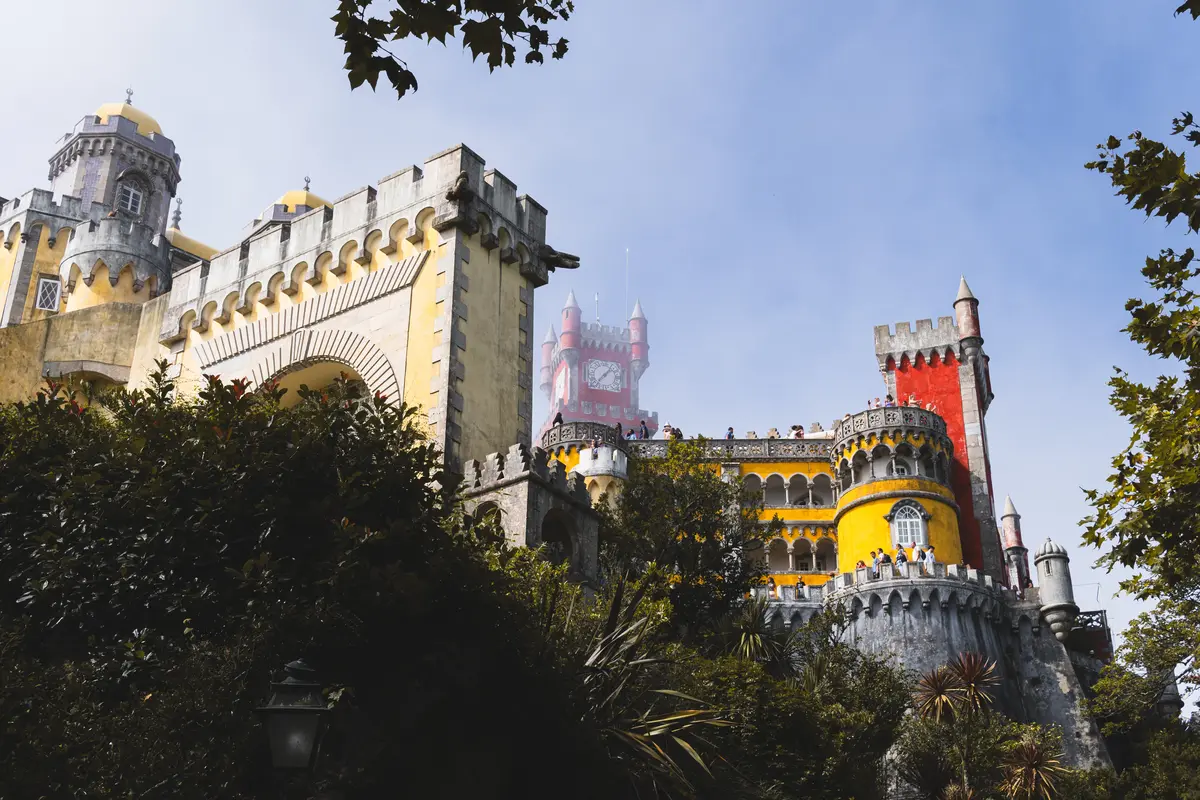
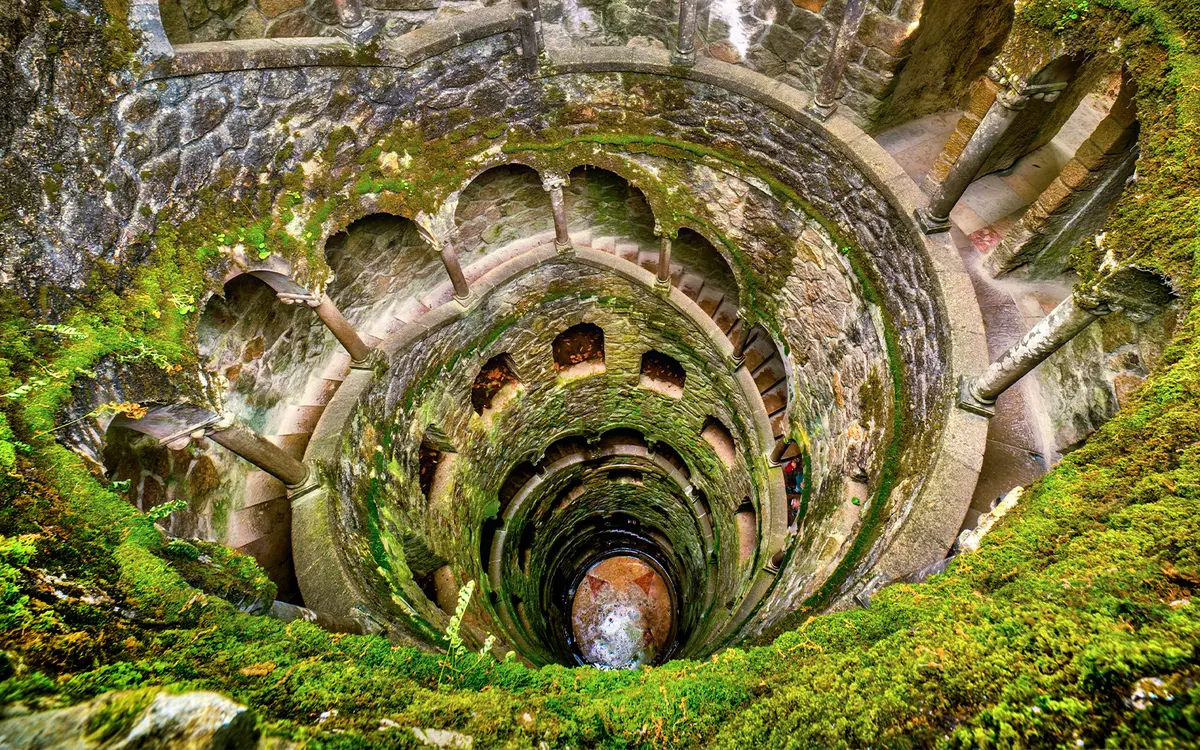
Yes, but only if you get the logistics right. Sintra’s palaces are as dramatic as the photos suggest — Pena Palace in yellow and red on a forested ridge, Quinta da Regaleira with its underground initiation wells, Cabo da Roca where the land literally ends. What the photos don’t show is the gridlock on the approach roads and the ticket-counter lines that form before 9 a.m.
Never drive to Sintra. The single-lane roads up to the palaces are jammed with tour buses, and parking near the main sites is effectively impossible by mid-morning. As the Sintra Portugal travel guide recommends, take the train from Rossio to Sintra (about 40 minutes), then use Bolt or Uber to hop between the palaces. This gives you flexibility without the parking problem.
Which palaces should you prioritize in Sintra?
Start at Pena Palace the moment it opens — the line at the entrance wraps around the outer wall by 10 a.m. and the interior corridors get genuinely cramped by midday. Then move to Quinta da Regaleira, which is the better choice for couples. The estate has initiation wells you descend by spiral staircase, underground grottos that connect to different parts of the gardens, and a general sense that you are walking through a fantasy novel. It filters out casual visitors because it requires actual movement and exploration — not everyone gets off the tour bus for that.
End the day at Cabo da Roca. There is nothing here but a lighthouse, a parking area, and the Atlantic crashing into 140-foot (43-meter) cliffs. It is the westernmost point of continental Europe. On a clear afternoon the light is different from anywhere else in Portugal — harder, brighter, with no land between you and America.
Pro Tip: Rideshare availability in Sintra gets tight between 1 p.m. and 3 p.m. when multiple tour groups are moving simultaneously. Either plan your Quinta da Regaleira visit to end before noon or be prepared to wait 20 to 30 minutes for a car.
Why should a Portugal honeymoon include Porto and the Douro Valley?
Porto and the Douro Valley offer the sharpest contrast in Portugal: a gritty, tile-covered river city followed by the most quietly extravagant wine region in the country. The two together cover about two and a half days and form the strongest argument for not spending your whole trip in Lisbon.
What makes Porto worth two nights?
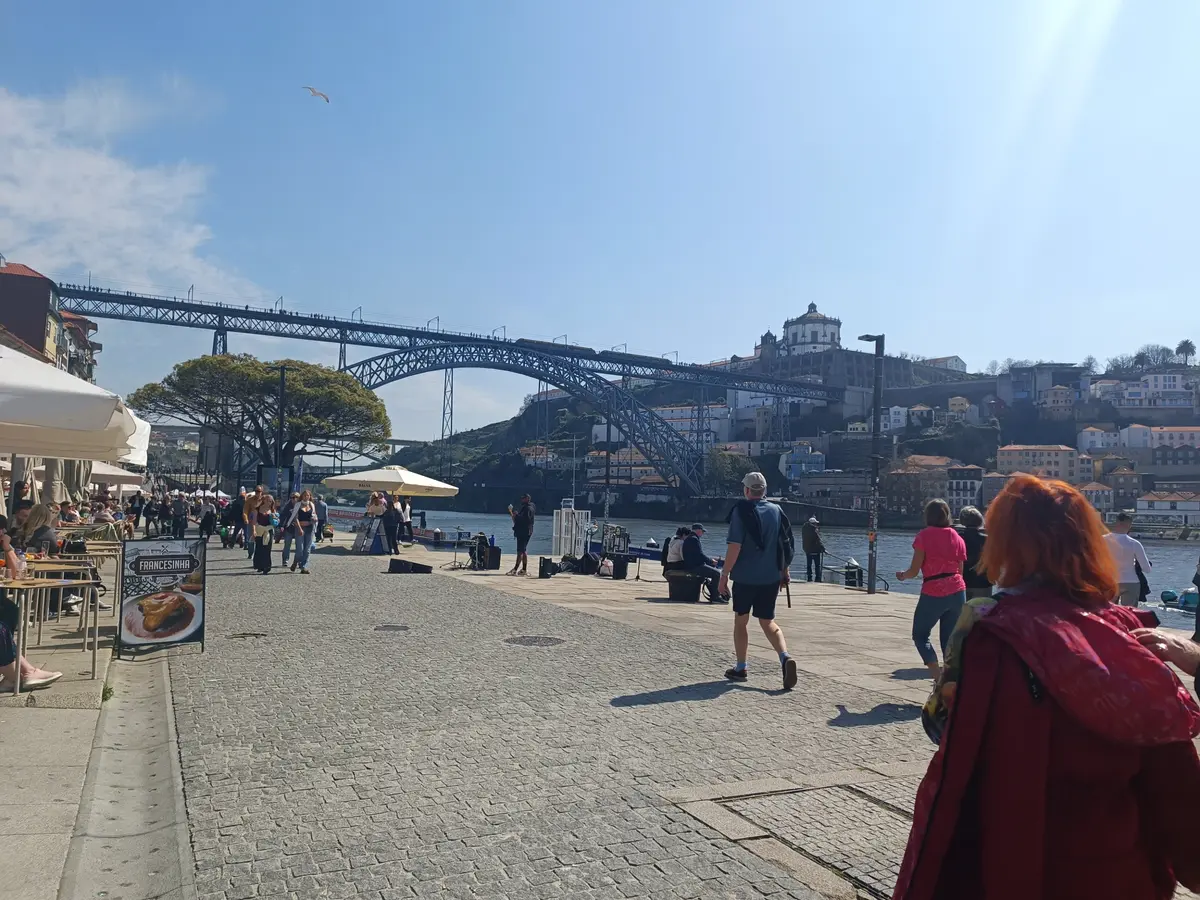
Porto’s Ribeira district runs along the north bank of the Douro — cobbled streets, restaurants with plastic chairs spilling onto the waterfront, and the double-decker Dom Luís I Bridge overhead. Cross the bridge on foot to Vila Nova de Gaia, the southern bank, where the major Port wine cellars in Porto are clustered.
Most cellars offer guided tastings for €10 to €20 (~$11 to $22), and the wine education is genuinely interesting. Vintage Port versus tawny versus ruby are not interchangeable concepts, and the cellars here make that concrete. Ramos Pinto and Graham’s both have decent tour setups without feeling like tourist processing lines.
The honest friction point: the waterfront restaurants in Ribeira are tourist traps. The tables facing the bridge are beautiful; the food and prices are calibrated for people who won’t come back. Walk one block inland and the quality doubles.
What makes the Douro Valley worth the extra day?
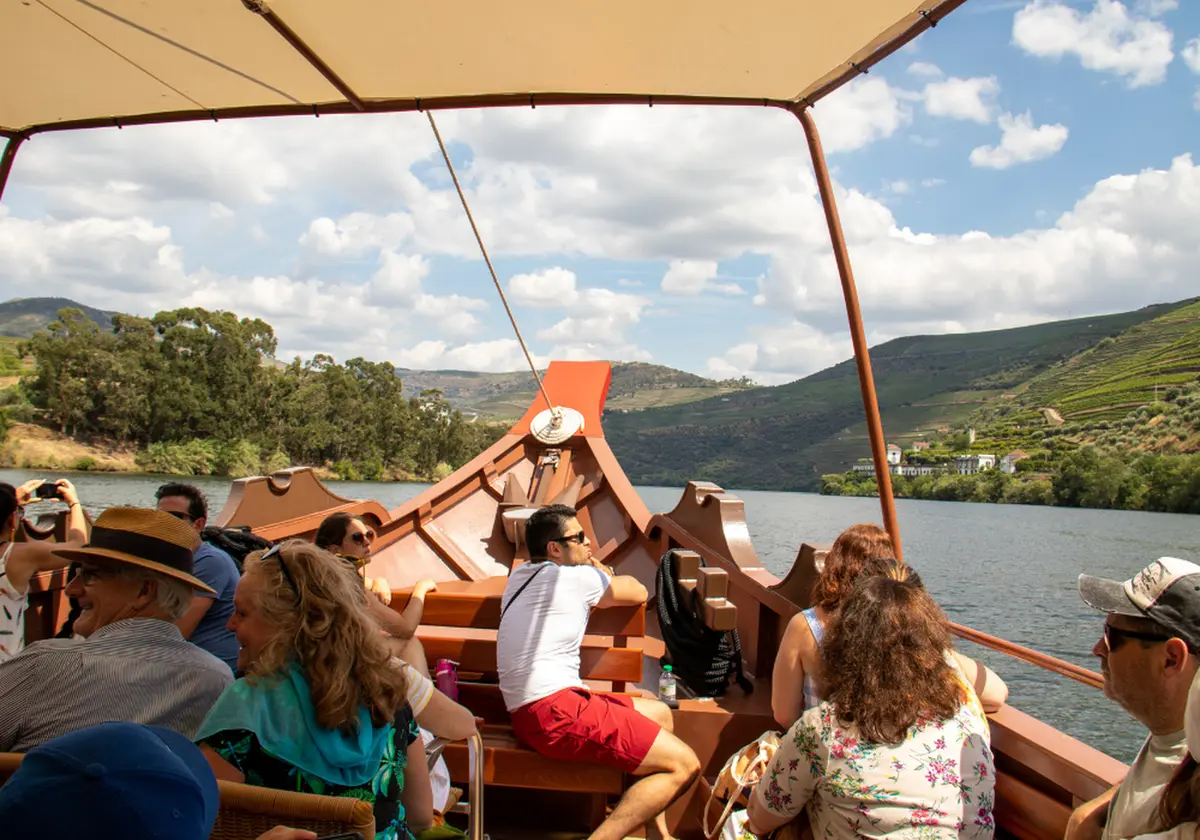
The Douro Valley‘s terraced vineyards are photographed constantly, but the images don’t fully convey the scale — rows of vines stacked hundreds of feet up shale slopes, all hand-farmed because no machine can operate on that grade. Standard river cruises from Pinhão cost €70 to €80 (~$76 to $87) per person and put you on a boat with 50 other people. The view is the same, but the experience is shared.
The Douro River Cruise that makes more sense for honeymooners is Pipadouro’s private charter — vintage wooden yachts, including the flagship Friendship I, a 66-foot vessel built for the British Royal Navy in 1957, that access small vineyard docks the big boats can’t reach. A private late-afternoon cruise costs around €990 (~$1,080) for your group, and the overnight option, where you sleep on the anchored boat surrounded by terraced vines, runs around €1,230 (~$1,340).
The price makes sense when you consider what you’re buying: a private boat, a knowledgeable crew, and the silence of the Douro at night without another tourist in earshot.
Pro Tip: If one of you is prone to motion sickness, the overnight on the boat is a gamble. The river is calm but not still, and the boat is wooden. For the standard afternoon charter, movement is minimal.
Alentejo or Algarve — which fits your Portugal honeymoon style?
This is the decision that shapes the second half of your trip. Algarve Portugal and the Alentejo are both in southern Portugal, but they are not interchangeable — the choice between them defines the entire mood of your final days. Choosing based on photos alone is how couples end up in the wrong place.
Is the Algarve right for you?
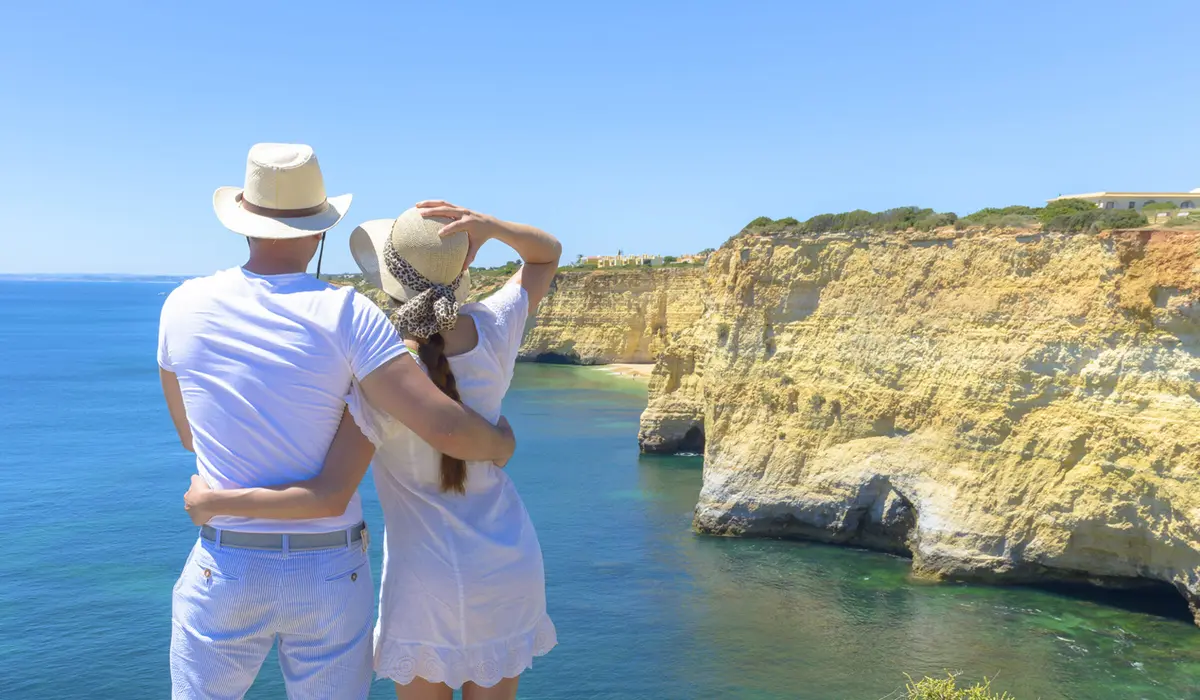
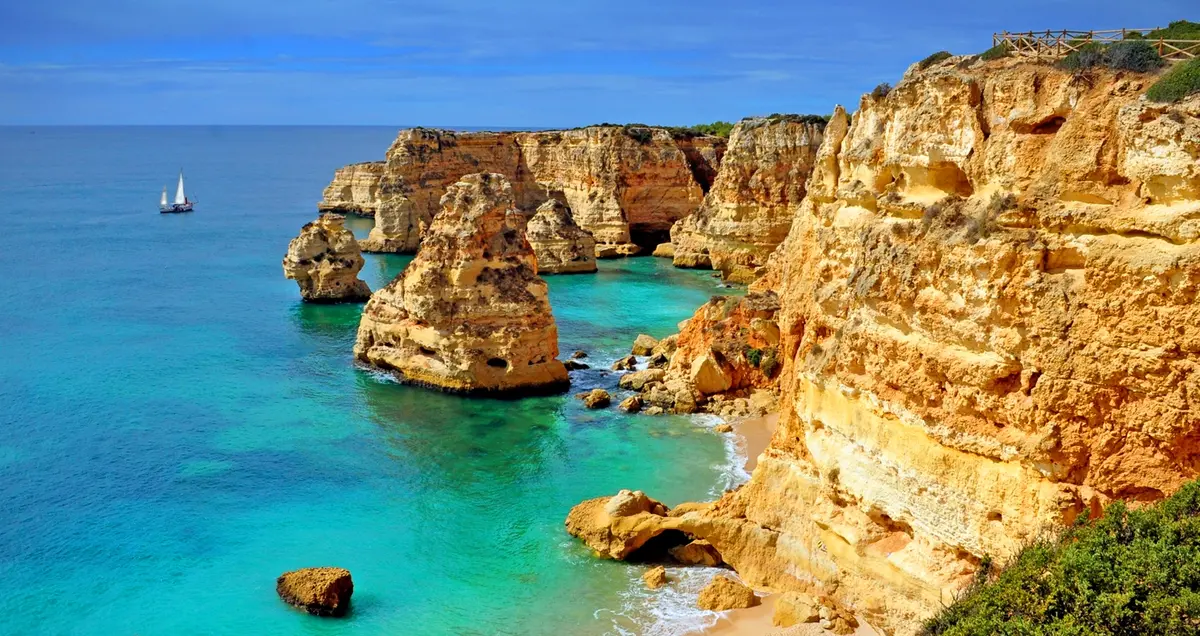
The Algarve is limestone-cliff country. The coastline between Lagos and Faro is broken into sea caves, hidden coves, and rock arches that you can reach only by kayak or on foot. The water is cold — Atlantic cold, not Mediterranean warm — and the light is sharp and high.
This region works for couples who want to move. The Seven Hanging Valleys Trail is one of the finest Portugal hiking routes for couples — 3.5 miles (5.7 km) one way from Praia da Marinha to Praia do Vale de Centeanes, following cliff tops above a coast that drops straight into blue water. The trail is rated moderate, but sections have loose rock and exposed edges — wear actual hiking shoes, not sandals.
The dining scene has genuinely leveled up. In Vale do Lobo, Barlume brings a Mediterranean-Italian concept with 30-plus Italian wines by the glass and a resident DJ after dinner. El Ta’koy, from Chef Luis Pous, is a two-level Hawaiian-Pacific restaurant with an Atlantic Sunset Terrace and the largest Tiki bar in Portugal. Both are in the resort’s central Praça.
One honest warning: in December through February, the smaller beach villages essentially close. Restaurants shutter, hotels go dark, and the energy disappears with the sun. If your honeymoon falls outside summer, stick to larger towns like Lagos or Tavira.
Is the Alentejo right for you?
The Alentejo is cork oak and silence. The landscape is a rolling plain of red earth, olive trees, and fortified hilltop villages with streets too narrow for cars. There are no beaches. The pace is not slow in a frustrating way — it is slow in the way that forces you to actually stop and sit with each other.
Stay at a monte — a restored farmhouse estate — to get the full effect. São Lourenço do Barrocal outside Monsaraz is the benchmark: stone walls, organic farm-to-table meals, a working farm attached, and vineyards that run to the horizon. It is not a hotel that happens to be in the countryside; it is genuinely embedded in it.
Private vineyard picnics at estates like Herdade da Malhadinha Nova cost €50 to €150 (~$55 to $165) depending on the package and the time of year. You are usually the only people there.
The non-negotiable for anyone spending a night in the Alentejo: the Dark Sky Alqueva Observatory near Monsaraz. The Alentejo has some of the lowest light pollution in Europe — on a clear night, the Milky Way is visible to the naked eye as a band across the sky, not a faint suggestion of one. Guided sessions run €25 to €30 (~$27 to $33) per person and last about 75 minutes. The observatory’s astronomers calibrate the telescopes to what is actually visible that evening, not a pre-set playlist of targets.
- Location: Dark Sky Alqueva Observatory, Cumeada, near Reguengos de Monsaraz
- Cost: €25–€30 (~$27–$33) per person
- Best for: Any couple willing to drive 20 minutes from their accommodation after dark
- Time needed: 75 minutes plus travel

What does a Portugal honeymoon actually cost?
Portugal costs less than France or Italy, but it has stopped being inexpensive. The gap between a comfortable trip and a genuinely good one is smaller than people expect, which means you do not have to spend a lot to have a memorable week — but you do need to budget honestly.
Running the numbers on Portugal travel cost for a seven-day trip, a mid-range couple should expect to spend €1,100 to €1,400 (~$1,200 to $1,530) per person. That breaks down to roughly €100 to €150 (~$110 to $165) per night on accommodations, €50 to €80 (~$55 to $88) daily on food, around €165 (~$180) on trains and rideshare, and €100 (~$110) on tours and entry fees.
A luxury version — five-star quintas, Michelin dinners, private yacht charters — runs €2,500 to €4,000 (~$2,700 to $4,360) per person for the same week.
The real value opportunity is in train tickets (Promo fares are genuinely cheap if you book early) and lunch (neighborhood tascas serve €8 three-course lunches that are better than many hotel restaurants). The most famous experiences — Belcanto, the Pipadouro yacht, São Lourenço do Barrocal — come with premium prices, and there is no way around that. You can save €40 per night by staying one neighborhood over from the main square, but you will spend €15 each way on rideshare to get to dinner. Do that math before you book.
The bottom line
TL;DR: A Portugal honeymoon works best when you stop trying to see everything and commit to a route. Lisbon and Sintra for three days, Porto and the Douro for two, then a deliberate choice between the active Algarve coast and the quiet Alentejo plains for the final stretch. Handle the logistics — tolls, train class, restaurant reservations — before you leave home, and the trip takes care of itself.
What are you prioritizing on your honeymoon — movement or stillness? That single answer should determine whether you head south to cliffs or to cork oaks.