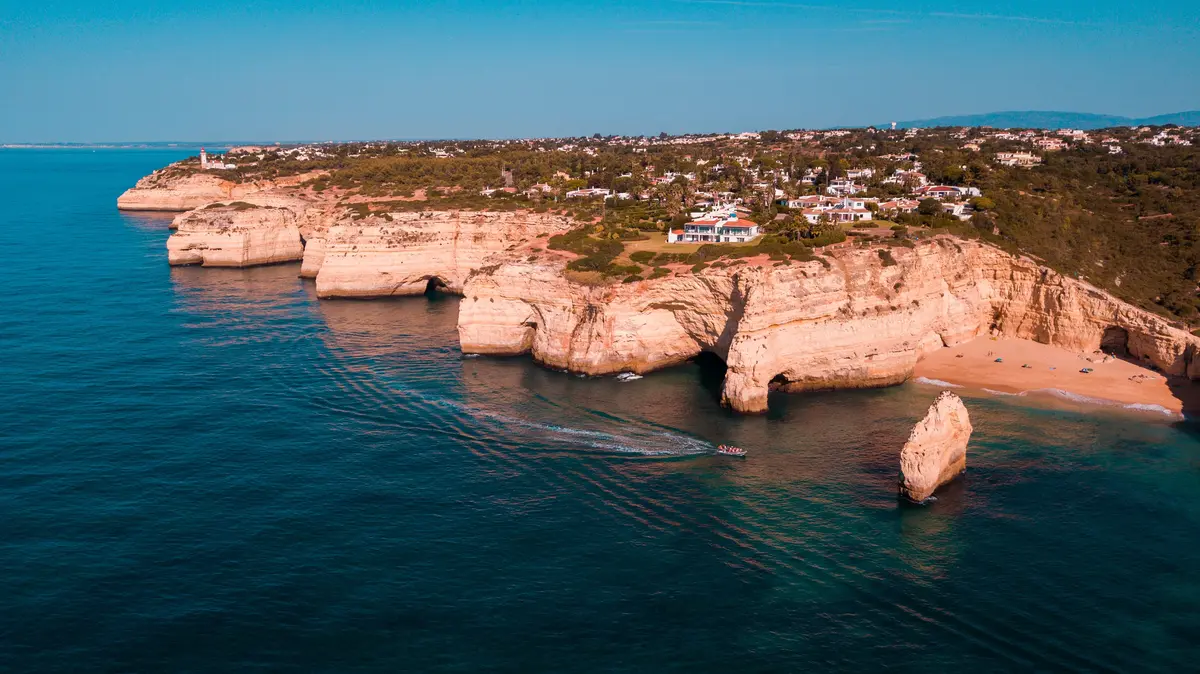
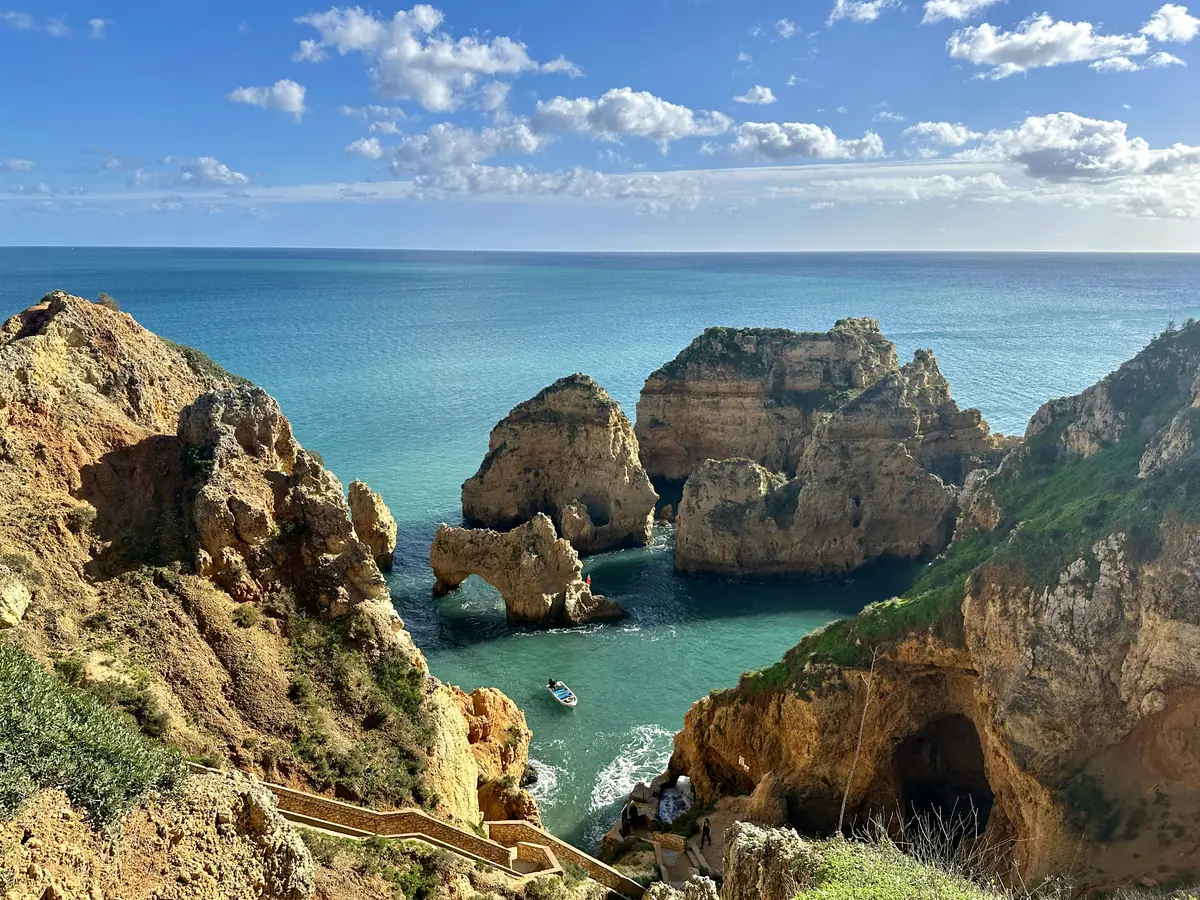
The Algarve is Portugal’s southern coast: the country’s best beaches, its warmest swimming, and a run of cliff-backed sea caves stacked along roughly 100 miles of shoreline. This guide covers where to base yourself, which beaches earn the hype, how to legally visit Benagil Cave, and the US logistics most guides skip.
Is the Algarve Worth Visiting?
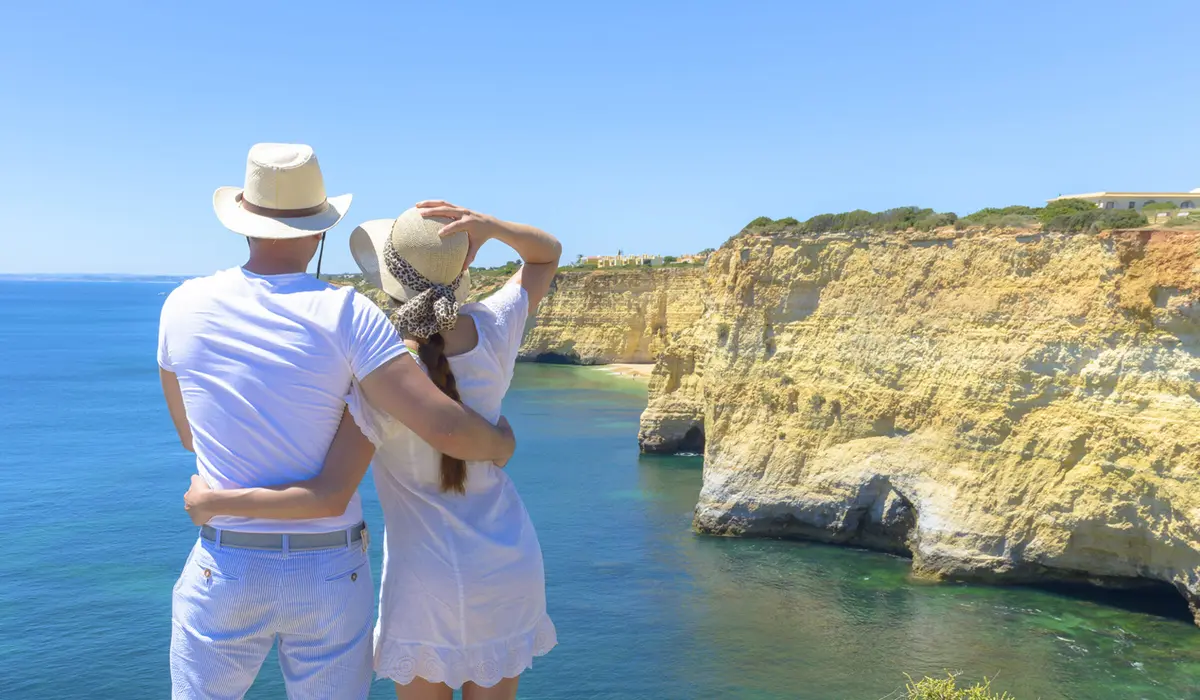
Yes — for beaches, it’s one of Europe’s best-value coastlines. The Algarve packs roughly 100 miles of golden cliffs, sea caves, and warm, sunny weather into Portugal’s southern edge, with prices below most of Western Europe. The trade-offs: July and August get hot and crowded, and the Atlantic runs cooler than many expect.
What pulls people here is a specific combination: dramatic limestone cliffs, calm coves you reach by staircase, the sea cave at Benagil, golf around the Vilamoura–Quinta do Lago “Golden Triangle,” and a climate that delivers something close to 3,000 hours of sunshine a year. Locals and travel writers sometimes call it the California of Europe, and for once the shorthand mostly holds.
The honest caveat is scale. The region’s resident population sits somewhere around 460,000 to 500,000, and in summer it roughly triples. If your mental image is empty cliffs and a quiet cove to yourself, aim for spring or fall instead of August.
When Is the Best Time to Visit the Algarve?
May–June and September–October are the sweet spot for timing your trip: daytime highs around 64–86°F (18–30°C), thinner crowds, and lodging roughly 30–40% cheaper than peak. July and August bring guaranteed beach heat — about 82–84°F (28–29°C), with rare spikes to 104°F (40°C) — plus the biggest crowds and prices. The sea is swimmable June through October.
The thing US travelers most often get wrong is water temperature. This is the Atlantic, not the Mediterranean, and it stays cooler than the beach photos suggest. The swimming window runs roughly June to October, peaking near 70–72°F (21–22°C) in late summer and dropping to around 60–61°F (16°C) by March.
Month-by-Month Weather and Sea Temperature
| Season | Months | Daytime High | Sea Temp | What to Expect |
|---|---|---|---|---|
| Winter | Dec–Feb | 59–64°F (15–18°C) | ~60°F (16°C) | Mild, quiet, wettest in Nov–Dec |
| Spring | Apr–May | 64–77°F (18–25°C) | 61–64°F (16–18°C) | Great for hiking and golf, fewer crowds |
| Early summer | Jun | 77–86°F (25–30°C) | ~66°F (19°C) | Warm days, crowds building |
| Peak | Jul–Aug | 82–84°F (28–29°C), up to 104°F (40°C) | 68–72°F (20–22°C) | Hottest, busiest, most expensive |
| Early fall | Sep–Oct | 64–86°F (18–30°C) | 70–72°F (21–22°C) | Warmest sea of the year, easy balance |
There’s also an east–west split. The eastern Algarve, around Tavira and the Ria Formosa islands, has the warmest mainland water — it can reach the high 70s°F on the island beaches — while the west coast near Sagres is colder and rougher. Cold-water upwelling can also drop temperatures suddenly anywhere along the coast, so don’t be shocked by a chilly afternoon in July.
Pro Tip: September often delivers the warmest sea of the year with slightly thinner crowds than August. If you want warm water without peak chaos, target mid-to-late September.
How Do You Get to the Algarve From the US?
Fly into Faro Airport (FAO), about 2 miles from Faro city. United runs a seasonal summer nonstop from Newark (EWR) — the first direct US–Algarve link — at roughly 7 hours 20 minutes. Year-round, most Americans connect through Lisbon or a European hub, then catch a 45–55-minute flight, a train, or a bus south.
The nonstop is the headline change for US travelers, but read the fine print. United operates Newark–Faro about four times a week on a Boeing 757-200, and only in the summer months — roughly June through September — so outside that window you’ll connect. The flight covers about 3,504 miles (5,638 km), and the airport is only a 10-minute taxi from Faro itself.
If you’re traveling off-season, or the nonstop is sold out, the reliable path is via Lisbon. Options from Lisbon (LIS):
- TAP shuttle flight: Lisbon–Faro, about 45–55 minutes, up to three daily
- Train: Lisbon to Faro in about 3 hours
- Bus: Lisbon to the Algarve in about 3+ hours
Faro Airport handles around 10 million passengers a year, and British travelers are its single largest group — which is why so much of the airport, and a lot of online advice, is pitched at a UK audience rather than a US one.
One practical note on entry rules: a US passport gets you into Portugal visa-free for short stays, but the EU is phasing in a new online travel authorization (ETIAS) and a biometric entry system at its borders. The rollout dates have shifted more than once, so check the current entry requirements before you book.
Pro Tip: a US driver’s license is valid in Portugal for up to six months, so you don’t strictly need an International Driving Permit — though some rental desks still prefer to see one.
How Do You Get Around the Algarve?
A car isn’t essential, but it’s the difference between roaming the whole coast and being tied to one stretch. Good news: the A22 (Via do Infante) highway is now toll-free. The coastal towns are also linked by train and bus, so a car-free trip works if you choose your base carefully and skip the far west.
Driving, the A22 and Tolls
For years, the standard advice was to set up an EasyToll account so the A22’s camera-based tolls didn’t ambush your rental bill. That advice is now out of date. The A22 — which runs from Lagos to the Spanish border, linking Faro, Portimão, and Lagos — is free, so you can ignore the old toll workarounds for this road.
The parallel free alternative, the EN125, still exists but is slower, with more roundabouts and town traffic. Keep it in mind for short hops, not long ones.
Tolls haven’t disappeared from Portugal entirely, though. The A2 motorway up to Lisbon still charges, and rental cars usually come fitted with a Via Verde transponder for exactly that. If yours doesn’t, EasyToll links your license plate to a credit card at the border. So: skip the toll fuss for the A22, but keep it in mind if you drive to Lisbon.
Trains and Buses Along the Coast
The Linha do Algarve rail line runs about 87 miles (139 km) from Lagos east to Vila Real de Santo António, passing Portimão, Albufeira, Faro, and Tavira. Sample one-way fares and times:
- Faro–Lagos: about $9 (€8.30), roughly 1 hour 40 minutes
- Faro–Tavira: about $4 (€3.60), roughly 30 minutes
- Faro–Olhão: under $2 (€1.60)
- Tourist Travel Card (unlimited regional travel): about $24 (€22.40) for 2 days, about $36 (€33.60) for 3 days
The catch is that several stations sit well outside their towns. Albufeira’s station is about 4 miles (7 km) from the old town, and Loulé and Silves are similar, so factor in a taxi or local bus on arrival.
Vamus buses connect the main resorts and are cheaper than the train, though slower on some routes — buy tickets through the Vamus app. There’s also a seasonal airport bus to the coast that runs in the warmer months with limited departures.
| Mode | Best For | Rough Cost | Notes |
|---|---|---|---|
| Rental car | Flexibility, west coast, inland villages | ~$30–40/day (shoulder) | A22 now toll-free; book ahead for summer |
| Train | Coastal town hops | Faro–Lagos ~$9, ~1h40m | Some stations far from town centers |
| Bus (Vamus) | Budget coastal travel | A few dollars per ride | Slower; ticket via the Vamus app |
Where Should You Stay in the Algarve?
It depends on your trip. Lagos suits first-timers and nightlife; Tavira and the eastern Algarve suit couples and quiet-seekers, with warmer, calmer water; Albufeira is the most central for day trips; Sagres is for surfers who don’t mind the remoteness. Pick one or two bases instead of repacking every night.
Lagos — Best for First-Timers and Nightlife
Lagos is the western Algarve’s anchor: a walled old town of cobbled lanes and tiled facades, with the cliffs of Ponta da Piedade and the coves of Dona Ana and Camilo a short hop away. It draws a younger, surf-leaning crowd, which means good nightlife and easy day tours but higher prices than quieter towns.
- Location: West Algarve, about 57 mi (91 km) / 1 hour from Faro Airport
- Best for: First-timers, couples, nightlife, surfers
- Nearby beaches: Dona Ana, Camilo, Meia Praia, Ponta da Piedade
- Trade-off: Popular and pricier; the far-west position means longer drives to central beaches like Marinha
Albufeira — Most Central, Biggest Resort Scene
Albufeira is the region’s largest resort and its most convenient base for day-tripping in every direction. It carries a party reputation thanks to “The Strip,” but that’s one loud zone — the old town is calmer than its name suggests, especially outside July and August.
- Location: Central Algarve, about 28 mi (45 km) / 40 minutes from Faro
- Best for: Convenience, day-trip base, families (in the quieter zones), nightlife (on The Strip)
- Nearby beaches: Praia da Falésia, the town beach
- Trade-off: The Strip is loud and built for crowds; charm depends heavily on which part of town you book
Carvoeiro — Small, Scenic and Family-Friendly
Carvoeiro is a smaller, prettier central-coast option built around a compact beach and clifftop boardwalk. It’s close to the Marinha–Benagil stretch and feels calmer than Albufeira, though that comes at a slightly higher price.
- Location: Central Algarve, near the Marinha and Benagil coast
- Best for: Families, couples wanting scenery over nightlife
- Trade-off: Limited nightlife; can run pricier than its size suggests
Tavira — The Quiet, Genuinely Portuguese East
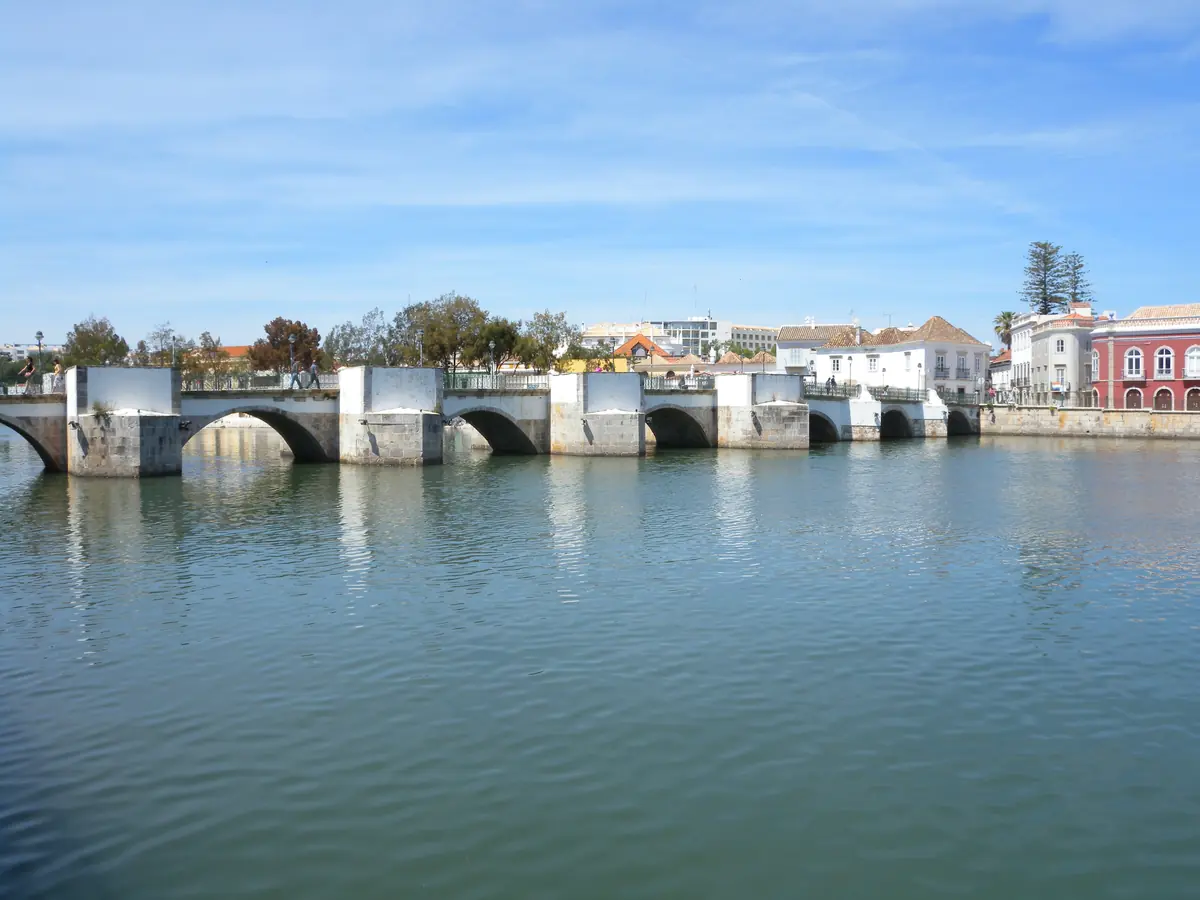
Tavira is the standout of the eastern Algarve: a handsome river town with a Roman-era bridge, church-dotted streets, and very little of the package-resort feel. Its beaches are out on the Ria Formosa islands, reached by a short ferry, and the water here is the warmest and calmest on the mainland.
- Location: Eastern Algarve, about 24 mi (38 km) / 30 minutes from Faro
- Best for: Couples, older travelers, anyone who wants real Portugal over a resort strip
- Nearby beaches: Ilha de Tavira and Praia do Barril (by ferry or footbridge)
- Trade-off: Quieter nightlife; you depend on ferries for the best beaches
Faro — Underrated Capital and Ria Formosa Gateway
Faro gets used as an airport and skipped as a base, which is a mistake for some travelers. The walled old town is small but genuine, the Ria Formosa lagoon starts at its doorstep, and rooms run cheaper than in the resort towns. If you want low cost and zero transfer hassle on arrival, it’s worth a night or two.
- Location: Eastern Algarve, at the airport
- Best for: Budget travelers, day-trippers, last-night-before-flight stays
- Trade-off: Not a classic beach base; the best beaches need a ferry or a drive
Sagres — Remote, Windswept Surf Country
Sagres sits at the wild southwestern tip, near Cabo de São Vicente — the dramatic headland tied to Portugal’s Age of Discoveries, where Henry the Navigator once gathered his sailors. It’s all surf, big skies, and end-of-Europe atmosphere, but it’s remote and thin on public transport, so a car is essential.
- Location: Far southwest Algarve, about 70 mi (113 km) / 1 hour 25 minutes from Faro
- Best for: Surfers and travelers who want solitude over convenience
- Trade-off: Long drives to the central beaches; limited transit means you need to drive
A few towns don’t make every shortlist but deserve a look. Alvor is a real fishing village with a long, safe beach and is a quietly strong mid-size pick. Praia da Rocha (Portimão) is livelier and cheaper than Lagos, with a wide town beach and a rail connection. Vilamoura, by contrast, is polished and golf-focused but short on Portuguese character — if you want atmosphere rather than marina condos, base in Alvor, Tavira, or Lagos instead.
| Town | Region | Best For | Character |
|---|---|---|---|
| Lagos | West | First-timers, couples, nightlife | Historic old town plus marquee cliffs |
| Albufeira | Central | Convenience, families, nightlife | Big resort, best day-trip base |
| Carvoeiro | Central | Families, quieter scenic stays | Small, pretty, slightly pricier |
| Tavira | East | Couples, quiet-seekers, culture | Genuinely Portuguese, calm, warm water |
| Faro | East | Budget, airport convenience | Underrated walled capital |
| Sagres | Far SW | Surfers, solitude (car essential) | Remote, windswept, end-of-Europe |
What Are the Best Beaches in the Algarve?
The headline beaches line the central and western coast: Praia da Marinha for postcard cliffs, Dona Ana and Camilo near Lagos for sheltered coves, and Praia da Rocha for an easy town beach. For warm, calm water and room to spread out, head to the eastern island beaches off Tavira. For surf, the wild west coast near Sagres.
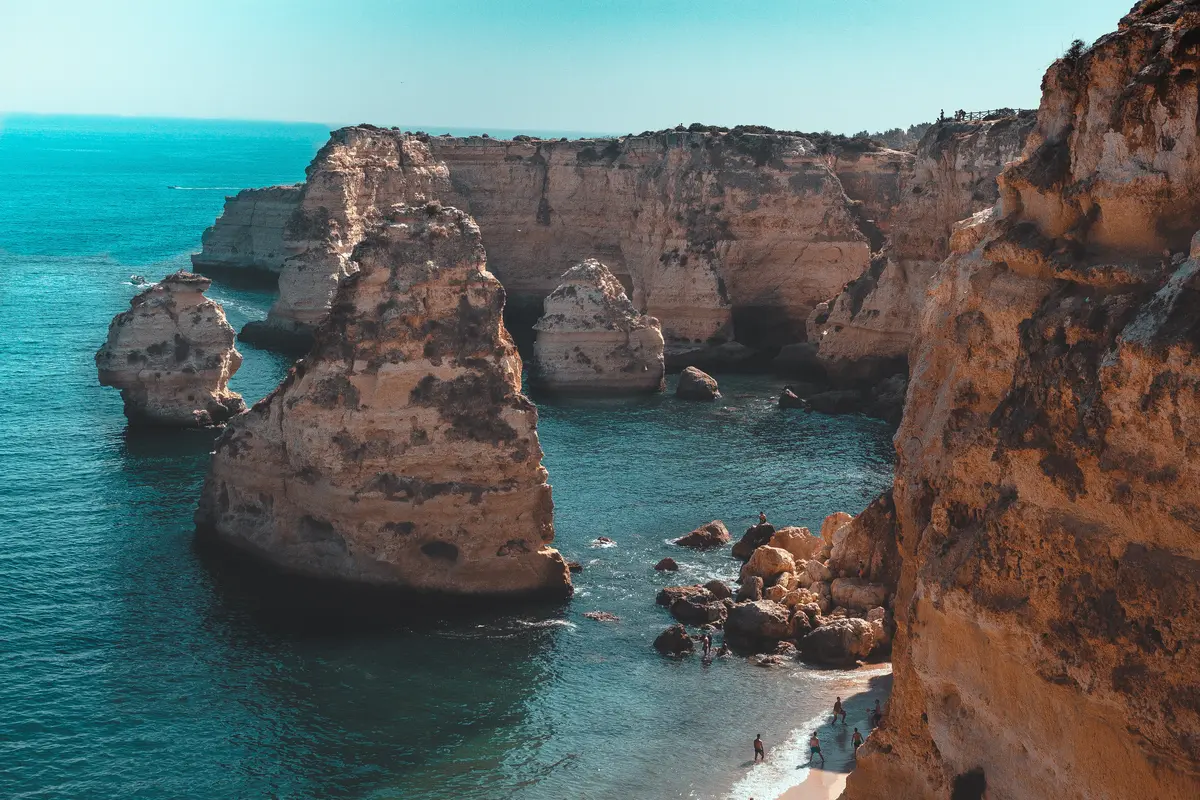
Praia da Marinha is the one you’ve seen on every Algarve cover — limestone arches above twin coves, and the start of the Seven Hanging Valleys Trail, about 3.5 miles (5.7 km) one way along the clifftops. Michelin’s guide has ranked it among Europe’s most beautiful beaches. The honest part: the actual sand is smaller than the aerial photos suggest, the staircase down is steep, and by late morning in summer you’ll share it.
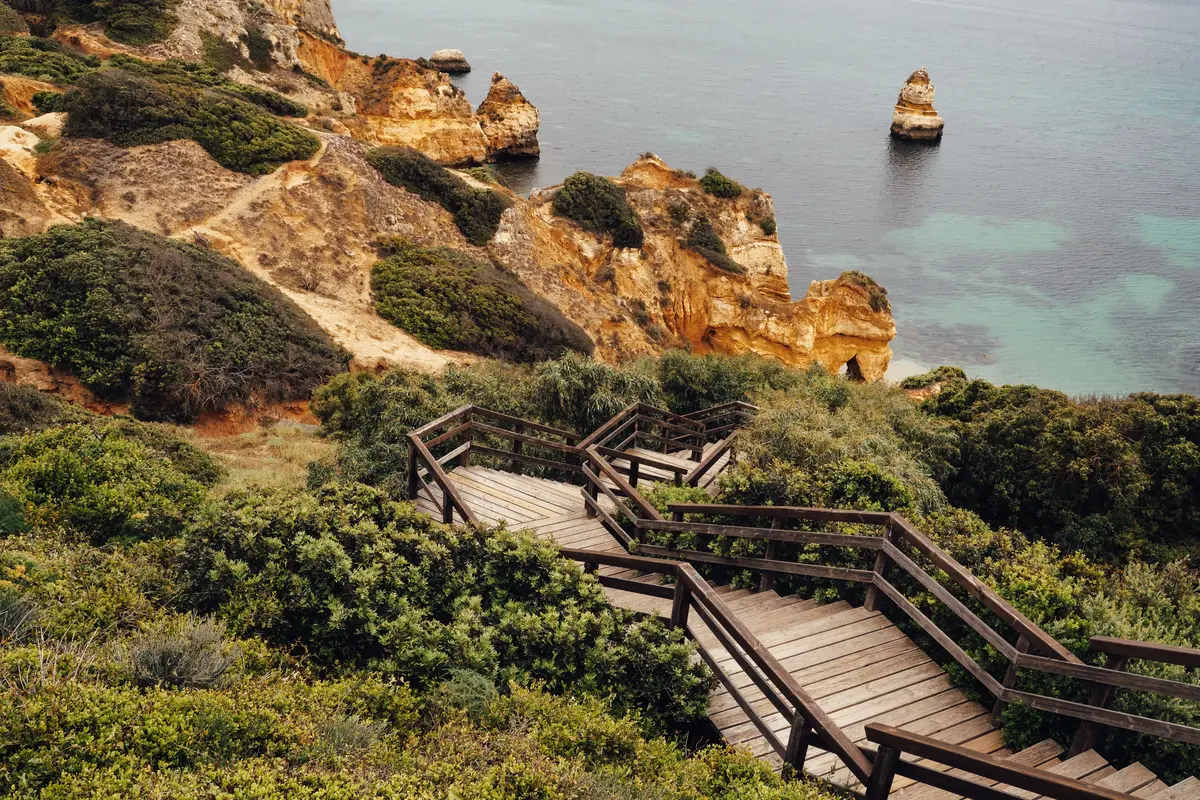
Near Lagos, two coves do the heavy lifting. Praia Dona Ana is sheltered and family-friendly, about 1.1 miles (1.8 km) from central Lagos, but its parking lot holds only around 70 cars and fills early — and you reach the sand by cliff steps, so it isn’t mobility-friendly. Praia do Camilo is the photogenic twin: roughly 200 wooden steps lead down to two small coves linked by a rock tunnel.
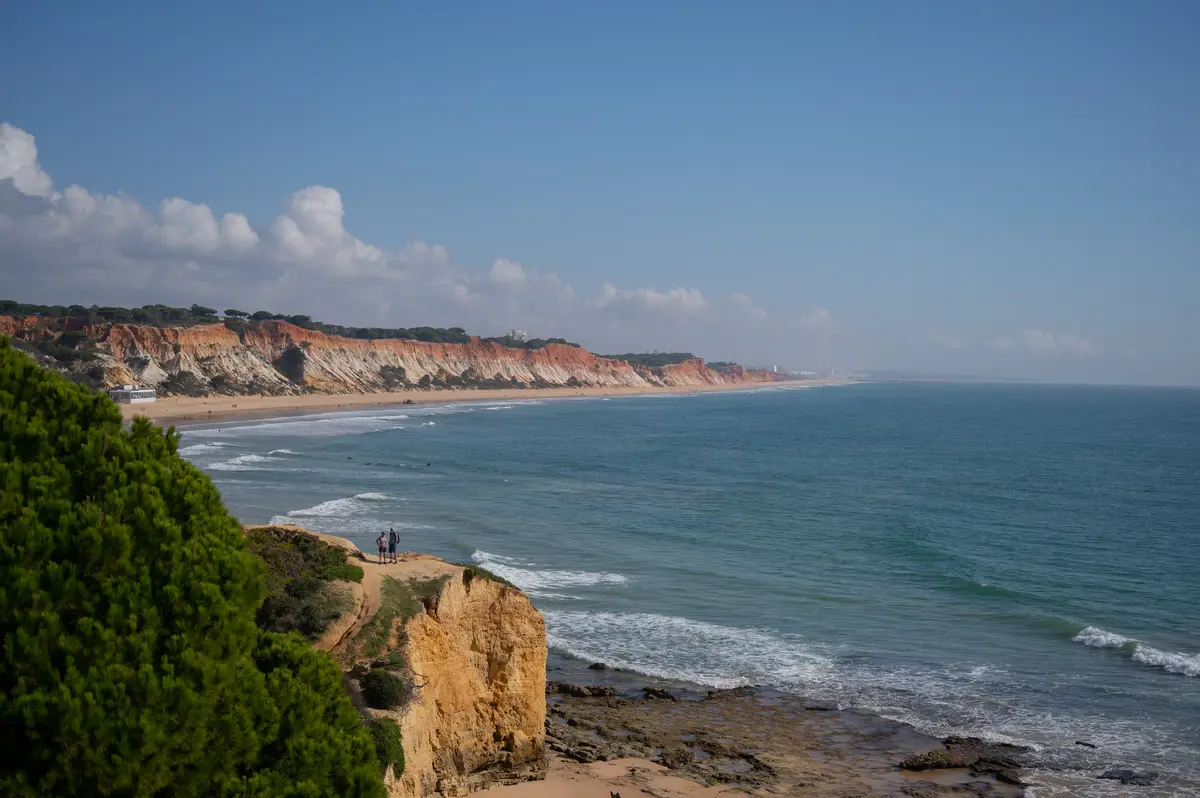
If you want size and easy access over a dramatic cove, Praia da Rocha in Portimão is a big, wide town beach with resort amenities, nightlife, and a rail connection — a solid family option. Praia da Falésia, stretching between Albufeira and Vilamoura, is one of the longest beaches in the region, backed by rust-red cliffs.
For warm, calm water, skip the west and head east to the Ria Formosa island beaches — Ilha de Tavira, Ilha Deserta, and Praia do Barril (reached by footbridge or a small train). These are flatter, warmer, and better for kids than the cove beaches. For the opposite experience, the west coast around Praia do Amado, Cordoama, Arrifana, and Bordeira delivers Atlantic surf, wild dunes, and far fewer crowds, with bigger waves in autumn and winter.
Pro Tip: at Dona Ana and Camilo, arrive before mid-morning. The lots are tiny, they fill fast in summer, and the cliff stairs turn into an oven by midday.
Can You Still Swim in Benagil Cave?
No. A Maritime Authority ruling now bans swimming into Benagil Cave and landing on its inside beach, and solo kayaks and SUPs aren’t allowed either. You can enter only on a licensed guided boat, kayak, or SUP tour, with time inside capped at roughly 5–10 minutes. Fines for swimmers have run into the thousands of euros.
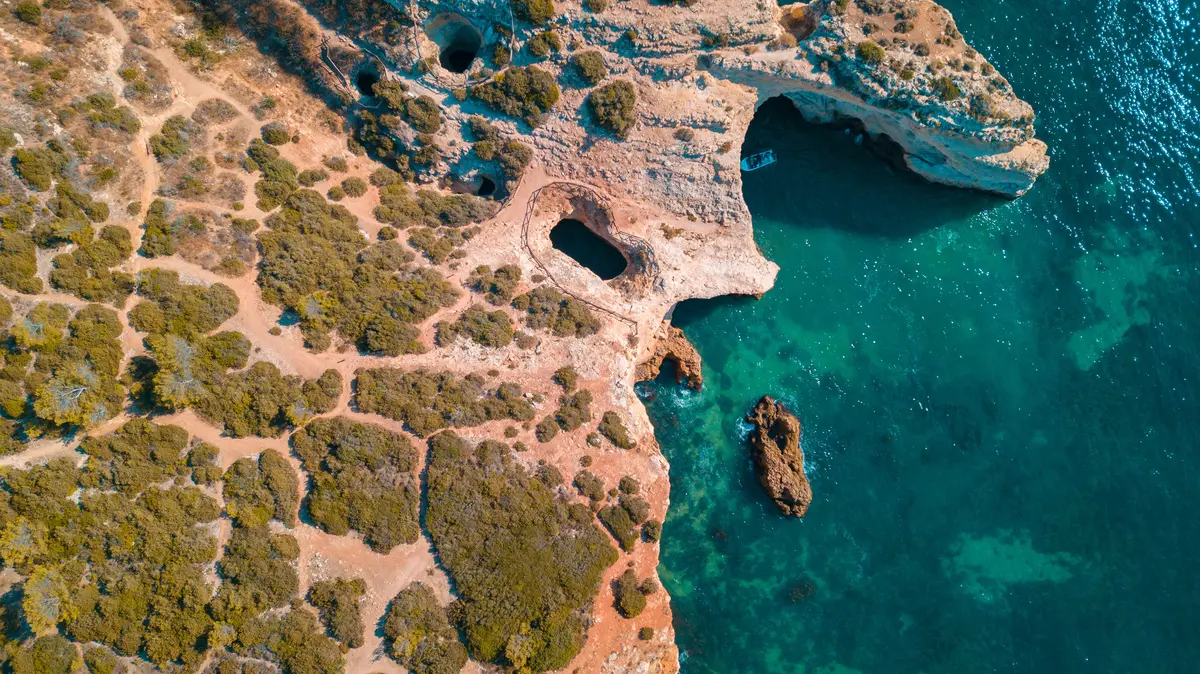
The cave — Algar de Benagil — is a domed sea cavern with a circular “eye” skylight in its roof and a sand floor, on the Lagoa coast between Carvoeiro and Armação de Pêra. It sits about 200 meters east of Benagil village beach and is reachable only from the water. The swim ban followed several drownings, and it’s enforced, so don’t plan on the old swim-in-at-dawn shot.
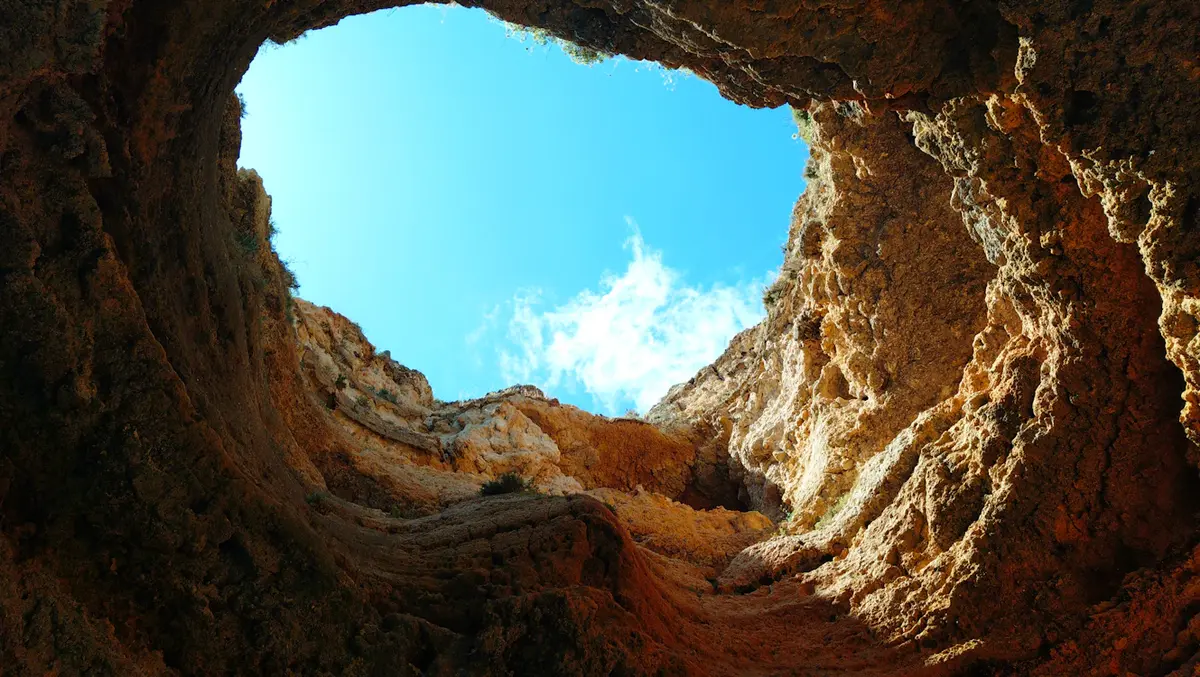
To visit legally, you have three options:
- Guided kayak tour: about 2–3 hours, roughly $38–55 (€35–50)
- Guided SUP tour: similar format and price
- Shared boat tour from Portimão, Lagos, Carvoeiro, Armação de Pêra, or Albufeira: roughly $27–55 (€25–50) per person
Here’s the take most guides won’t lead with: Benagil itself is a five-minute stop, and a crowded one. The real reward is the coastline around it — the arches at Marinha, the cove at Carvalho, and the Seven Hanging Valleys walk along the clifftops. Treat the cave as one beat in a half-day on this stretch, not the main event, and you won’t leave disappointed.
Pro Tip: book the first departure of the day. Tours stack up fast, and a calm-sea morning between May and October is your best shot at the cave with breathing room.
What Should You Eat and Drink in the Algarve?
Algarve food is coastal and unfussy. The signature dish is cataplana, a seafood stew steamed in a hinged copper pot. Round it out with grilled sardines in summer, piri-piri chicken (best in the inland town of Guia), and medronho, a fierce local berry brandy. At lunch, the menu do dia is the value play, often under $13.
Cataplana takes its name from the clam-shell copper pot it cooks in — a Moorish-origin design that steams everything inside. The seafood version, cataplana de marisco, is the dish to order at least once. In summer, sardinhas assadas (grilled sardines with bread, potatoes, and salad) are everywhere and cheap.
For piri-piri chicken, the inland town of Guia is the recognized capital, and its famous grill house has been turning out spicy whole birds for decades — a whole chicken runs about $14–15 (€13–14). To drink, medronho is the local arbutus-berry brandy, often homemade up in the Monchique hills and sipped as a digestif; amarguinha, an almond liqueur, is the sweeter alternative.
Save room for the sweets, which lean heavily on almonds and egg yolk. Look for Dom Rodrigo (almond and egg threads wrapped in foil, tied to the eastern Algarve), Doce Fino (marzipan shaped like fruit), and Queijo de Figo, a dense fig-and-almond cake.

Where Should You Go on a Day Trip From the Algarve?
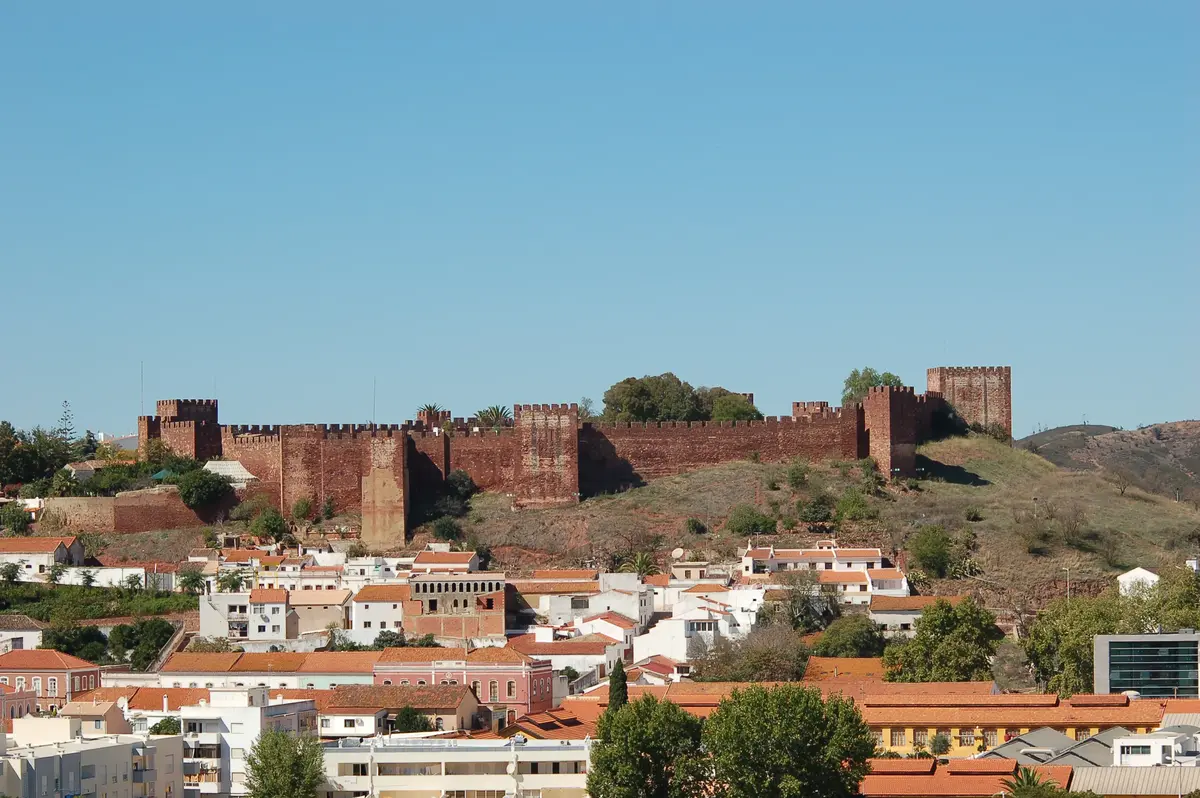
The best day trips mix Spain, history, and nature. Seville is about 2 to 2.5 hours by car (bring your passport for the border). Silves has a red-sandstone Moorish castle inland. Monchique climbs to the region’s highest point and thermal spas. And the Ria Formosa islands are a short boat ride from Faro, Olhão, or Tavira.
Seville is the big-ticket trip from the central and eastern Algarve, and organized coach tours make it easy — just carry your passport or ID for the Spain border crossing. A day trip to Lisbon is doable (about 3 hours each way from Faro by car or train), but it really wants an overnight to be worth it.
Inland, Silves rewards a half-day with its red-sandstone castle, the best-preserved Moorish fortress in the region. It pairs naturally with Serra de Monchique, about 45–50 minutes from Lagos or Albufeira, where you climb to Fóia — the highest point in the Algarve — past thermal spas and medronho country. Worth flagging: if your trip is short and Algarve-only, some travelers feel the Monchique drive doesn’t justify a full day, so weigh it against more beach time.
For nature without a long drive, the Ria Formosa islands are reachable by boat or ferry from Faro, Olhão, and Tavira, with calm beaches, birdlife, and flamingos in the lagoon.
How Much Does a Trip to the Algarve Cost?
Outside July and August, the Algarve is a value by Western European standards. Expect a beer around $2–3, a coffee near $1.20, and a grilled-fish lunch for $8–12. Budget travelers can manage on roughly $70–140 a day per person; mid-range runs about $145–240; beachfront-resort luxury starts near $335. Summer roughly doubles lodging.
Sample daily budgets, per person, based on two people sharing:
- Budget: about $70–140/day — hostel or guesthouse, tascas and grocery meals, buses, free beaches
- Mid-range: about $145–240/day — comfortable hotel, restaurant dinners with wine, a boat tour or two
- Luxury: about $335+/day — beachfront resort, fine dining, private tours
Typical on-the-ground prices in Portugal:
- Casual restaurant main: about $13 (€12); a three-course dinner for two, mid-range, around $43 (€40)
- Whole piri-piri chicken (Guia): about $14–15 (€13–14)
- Benagil or dolphin boat tour: from about $31 (€29) per person
- Rental car: about $30–40/day in shoulder season (often double in summer; as low as ~$16/day off-season), plus a roughly $16 airport pickup fee
- Lodging: hostel beds around $43 (€40); a typical Albufeira hotel room from about $96 in low season to about $179 at peak
The value play at every price point is lunch. The midday menu do dia — a set main, often with soup or a drink — is where you eat well for a fraction of dinner prices.
Is the Algarve Safe?
Yes. The U.S. State Department rates Portugal Level 1 — its lowest advisory — and it’s among the world’s most peaceful countries. The realistic risks are petty theft in busy tourist zones, strong Atlantic currents, and unstable cliffs. Violent crime is rare. The cliff hazard is the one most visitors underestimate, so keep well back from edges.
Petty theft — pickpocketing and bag-snatching — is the everyday concern in crowded spots like Lagos, Faro, and Albufeira, and it ticks up in summer. Normal city precautions cover it: watch your bag in busy markets and on transport, and don’t leave valuables on the beach while you swim.
The cliffs are the genuinely under-covered danger. Algarve sandstone is unstable, and rockfalls happen without warning. A cliff collapse at Albufeira’s Praia Maria Luísa killed five people, and falling rock still closes beaches and stairways periodically. The region runs regular safety campaigns for a reason, so stay behind posted safety lines, don’t picnic at the base of a cliff for a photo, and keep back from the edge above.
In the water, respect the lifeguard flags — Atlantic currents are strong, and conditions change fast. Inland, wildfire risk rises in summer, especially around Monchique. And if you drive, note that Portugal’s road-fatality rate runs higher than you might expect: in an accident, call 112 and don’t move the vehicle until told to.
Pro Tip: the single most useful safety habit here is cliff distance. The “perfect” edge photo is exactly where the ground gives way — shoot from a few steps back.
Before You Book
The Algarve rewards a little planning over a packed itinerary. Choose one or two bases, time your trip to dodge the summer crush, and don’t build the whole thing around a five-minute cave.
TL;DR: Base in Lagos or Albufeira for an easy first trip, Tavira or the eastern islands for warm calm water, Sagres for surf. Go in May–June or September–October to beat peak prices and crowds. See Benagil only by guided boat or kayak — and treat the cave as a quick stop, not the main event.
What’s pulling you to the Algarve — the beaches, the food, or a quieter base out east? Drop your travel dates and the kind of trip you’re after in the comments, and I’ll point you toward the right town to set up camp.