The Anjar ruins are the Middle East’s only complete Umayyad city — built, abandoned, and left alone for 1,300 years. This guide covers what you’ll actually see on the site, where to eat afterward, what it costs, and the question most other guides dodge: whether it’s safe to visit right now.
Why are the Anjar ruins so unusual?
The Anjar ruins are the only single-period Umayyad city in the Middle East, built between 705 and 715 AD by Caliph Walid I and abandoned just 40 years later after the Abbasid revolution of 744 AD. Unlike Baalbek, Byblos, or Tyre — which stack Roman, Crusader, and Ottoman layers on top of each other — every stone at this site is early 8th-century Islamic.
That short lifespan is why historians and architects travel here. There are no Roman foundations beneath the city and no Crusader fortifications built on top. What you walk through is a clean snapshot of how the Umayyads planned a city before their dynasty collapsed.
The location was commercial, not ceremonial. The city sat at the intersection of two major trade routes: the north-south axis connecting Homs to Tiberias, and the east-west route linking Beirut to Damascus. It was a fortified tax station built to control the agricultural wealth of the Bekaa Valley and the caravans moving between the Mediterranean coast and the inland capital.
UNESCO listed Anjar as a World Heritage Site in 1984, placing it among the country’s most significant archaeological sites. Following the latest Israeli military campaign in Lebanon, UNESCO also granted the site enhanced protection under the 1954 Hague Convention — the highest level of legal safeguard against being targeted or used for military purposes. UNESCO reports confirm the ruins themselves were not damaged during the most recent hostilities.
What will you actually see at the Anjar ruins?
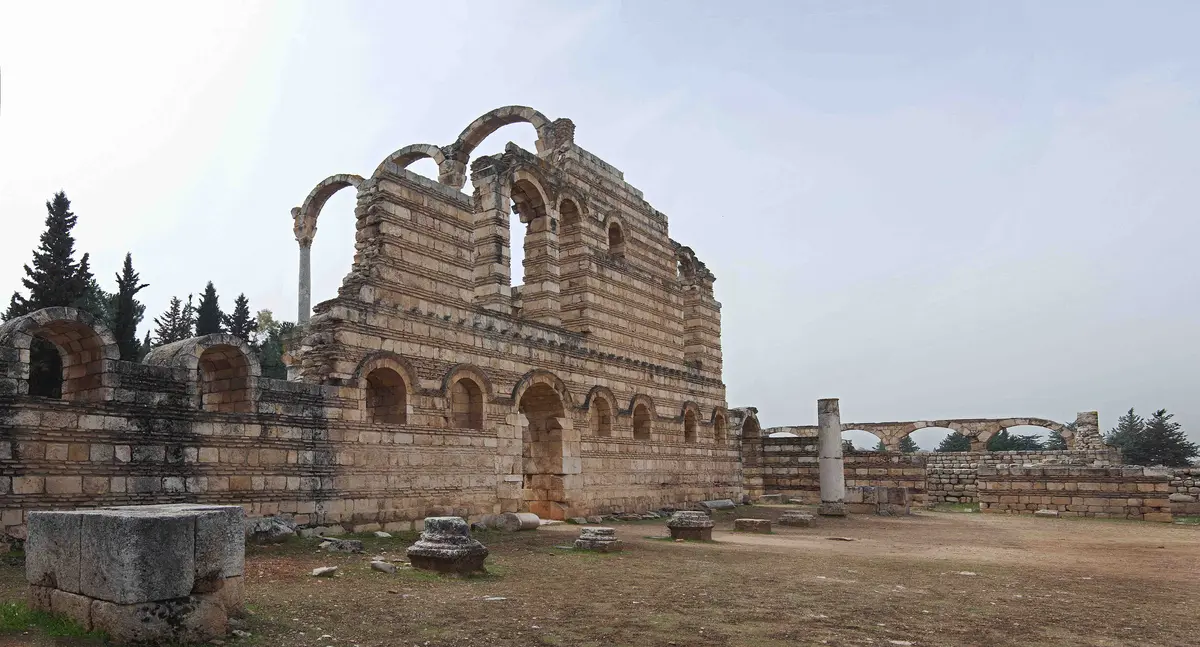
The site is a rectangular walled city — 385 x 350 meters (1,263 x 1,148 feet) — surrounded by 40 defensive towers and two main colonnaded streets that once held more than 600 shops. The whole complex covers roughly 134,000 square meters (33 acres), which you can walk in about 90 minutes without rushing.
The layout is almost military: a grid divided into four quadrants by two intersecting avenues, each quarter with a specific function — palace, mosque, baths, residential — mirroring a Roman castrum. Walls are over 23 feet (7 meters) tall and more than 6.5 feet (2 meters) thick, built using a striped alternation of limestone and fired brick called opus listatum. It looks decorative, but it was also earthquake engineering.
The Tetrapylon — your starting point
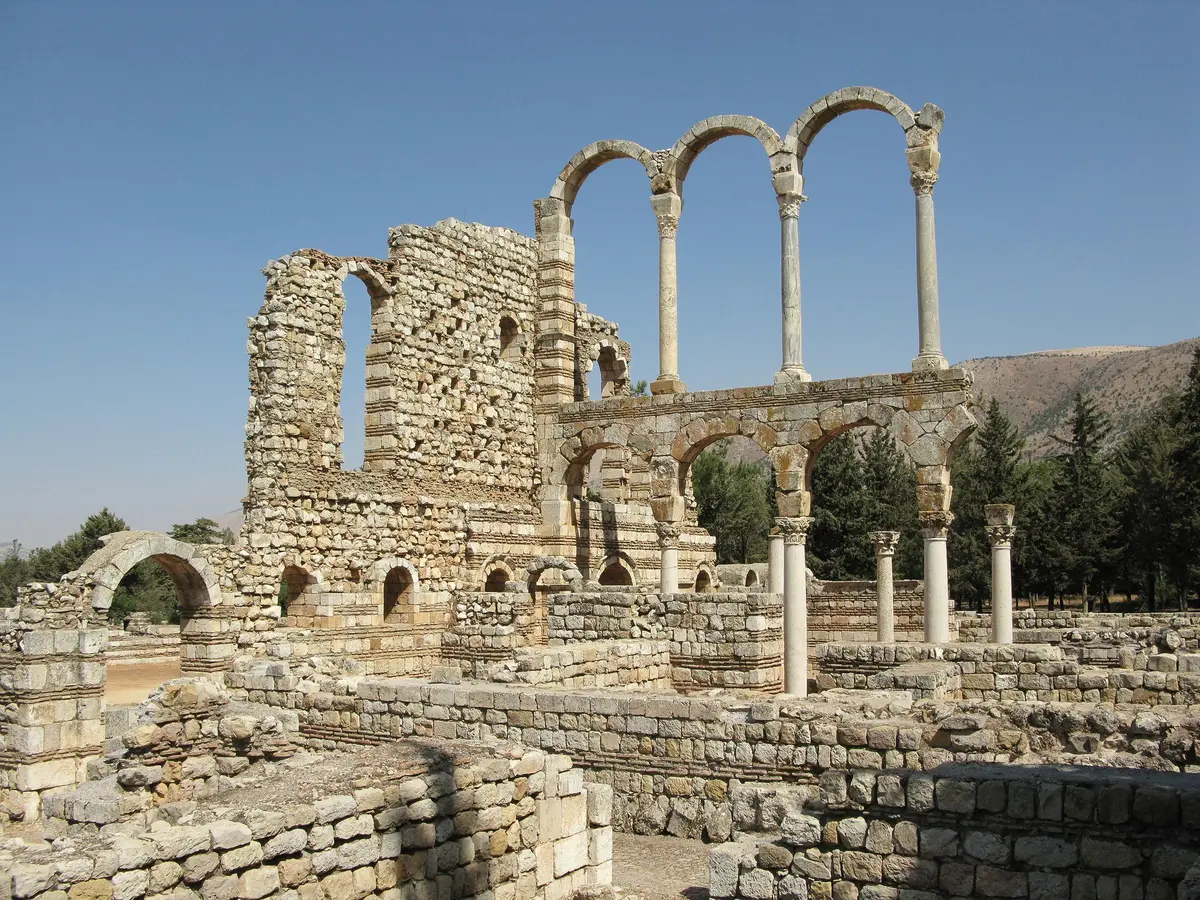
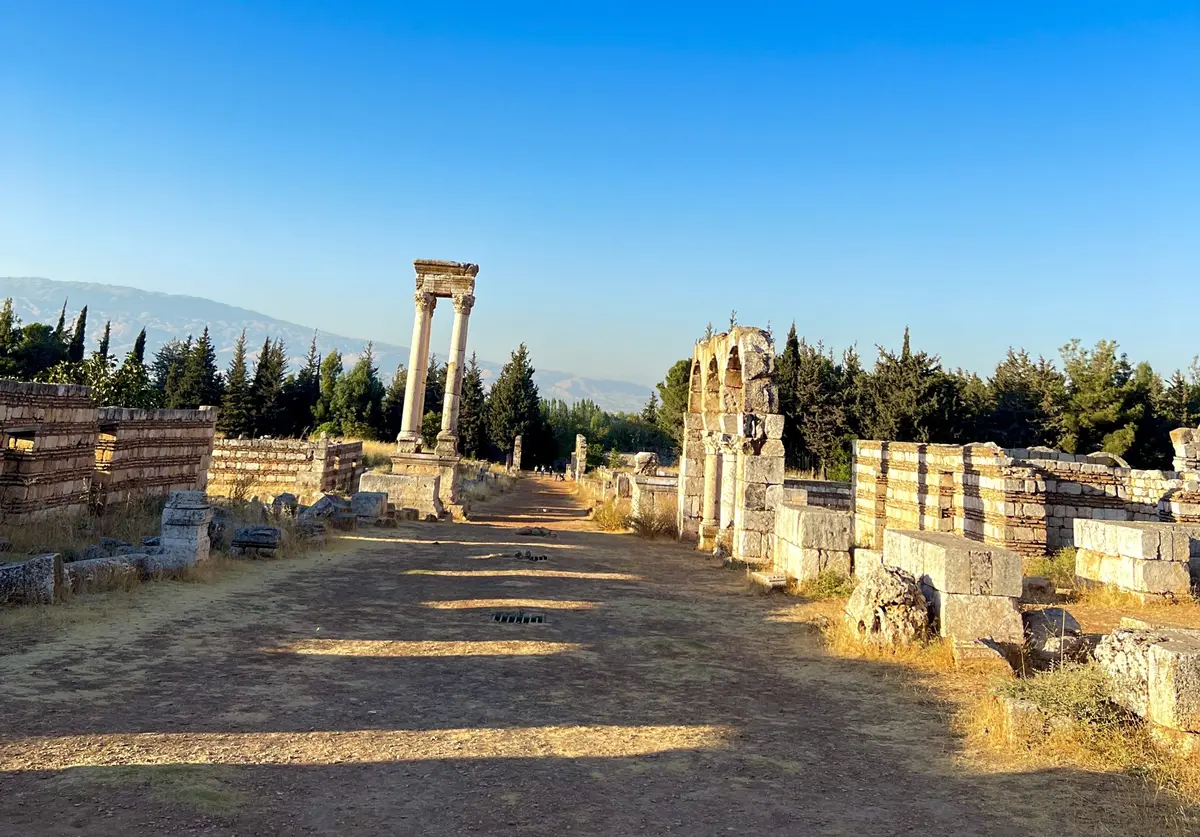
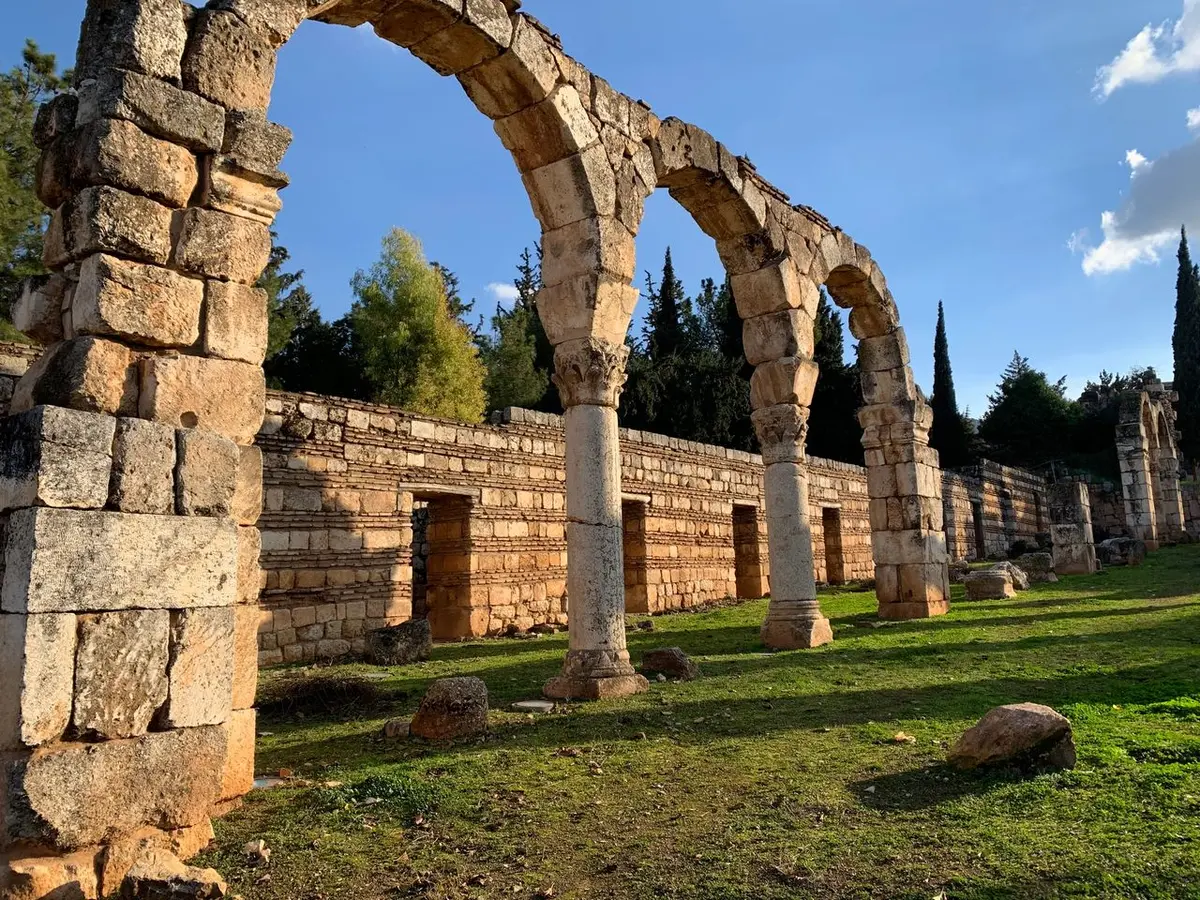
The four-way arch at the geographic center is the easiest orientation tool. Four pedestals support granite columns scavenged from older Roman buildings — a recycling practice called spolia that was standard in Umayyad construction. These columns originally held a dome or crossing vault over the main intersection, splitting the city into its four quadrants.
Pro Tip: Stand at the Tetrapylon about an hour before sunset. The low light throws the column shadows across the Cardo Maximus and frames the Anti-Lebanon mountains behind the arches — it’s the one shot every visitor ends up taking, even if they weren’t planning to.
The Great Palace and Mosque
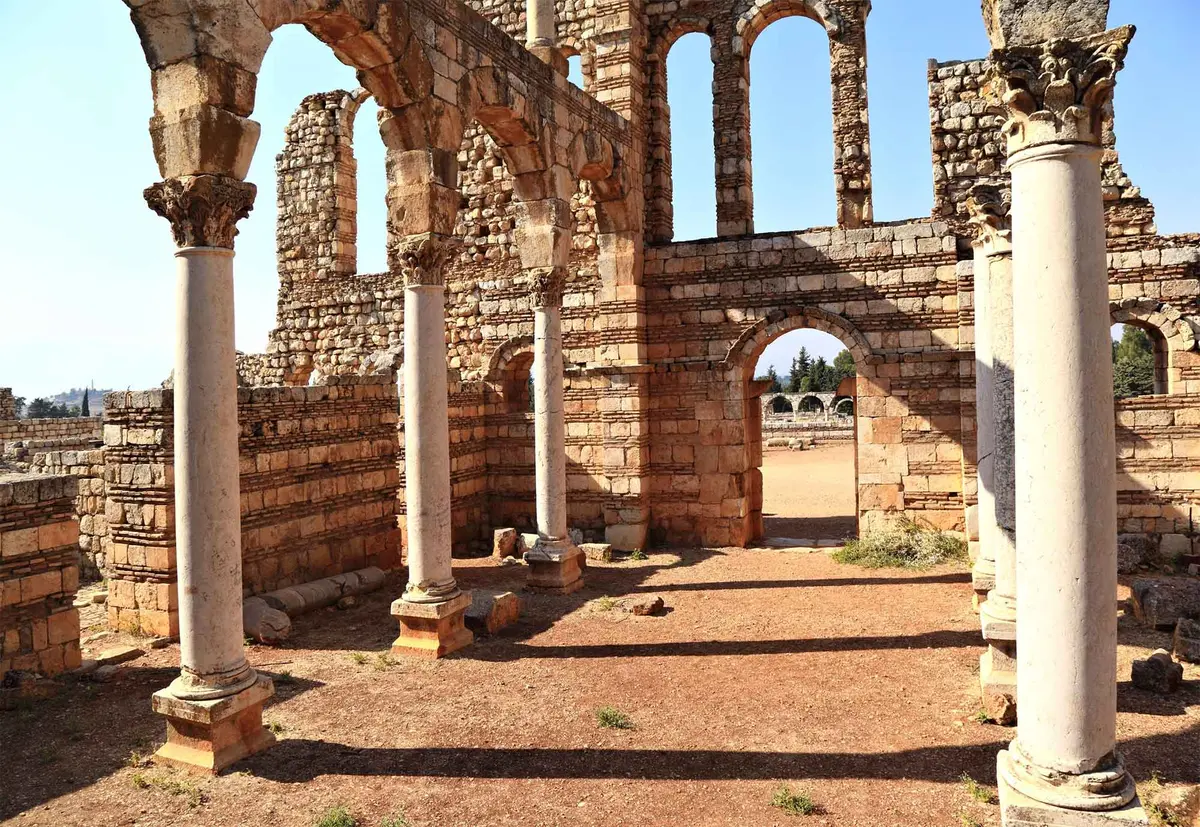
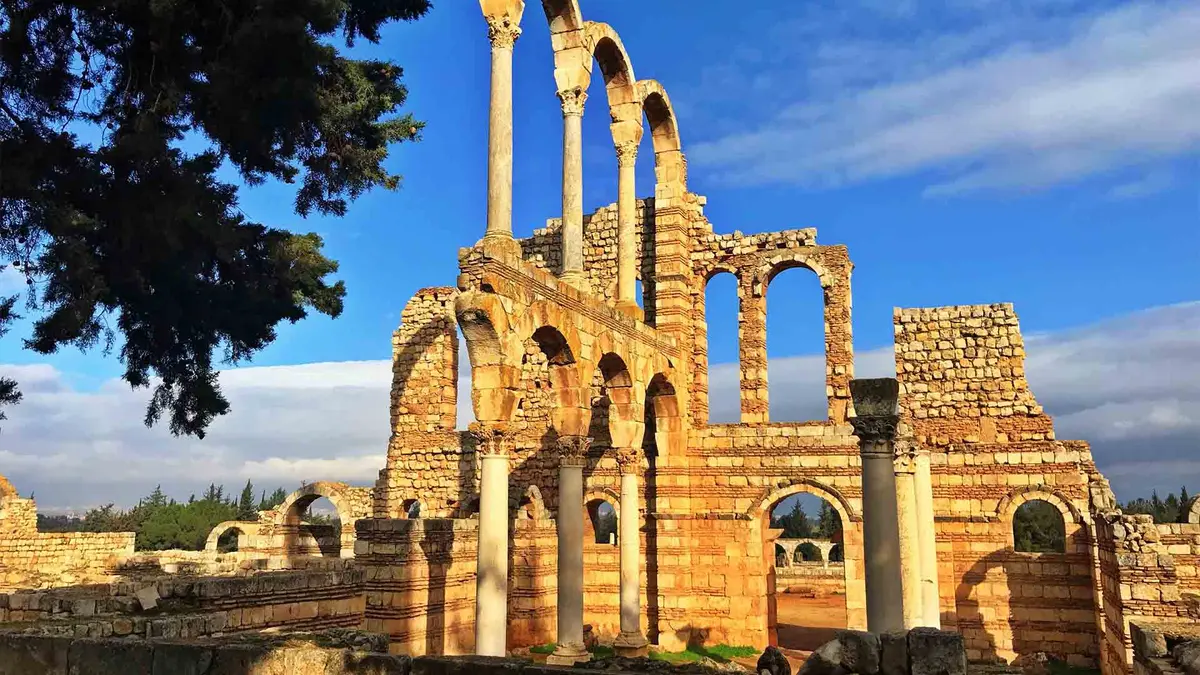
The southeast quadrant sits on the highest ground and held both religious and political power. The Great Palace is organized around a 131 x 131-foot (40 x 40-meter) central courtyard and shows the clearest examples of opus listatum — buildings that look like they’re wearing horizontal striped shirts.
The mosque sits directly north of the palace. The Caliph had private access from his residence straight into the Maqsura, the protected prayer area, which physically wired together temporal and spiritual authority. The triple-arched window on the palace’s southern façade is the image on every postcard of the Anjar ruins — line that up in a photo and you’ve got the shot.
The public baths and drainage system
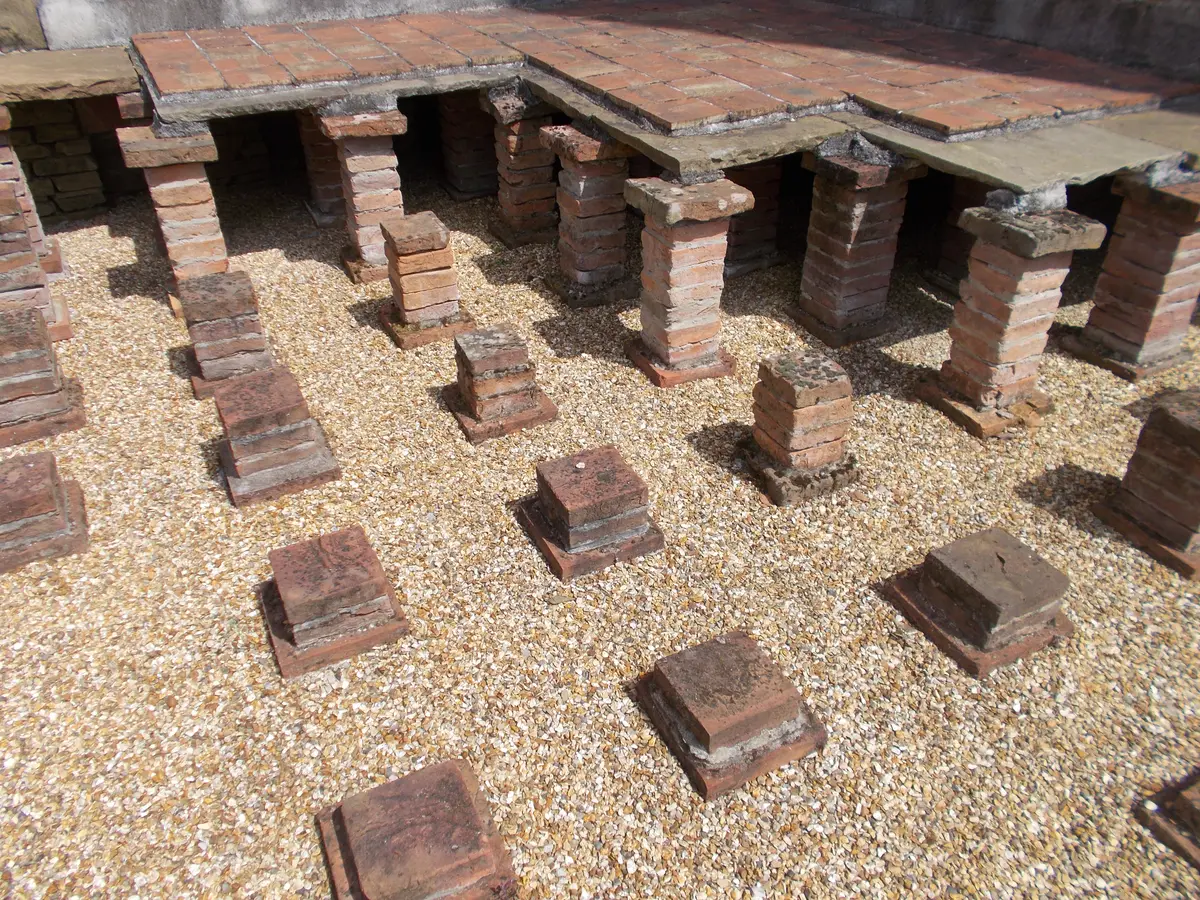
The hammam, or public baths, sit in the northeast quadrant. You can still trace the hypocaust system — underfloor channels where hot air from a furnace heated the floors and water. The layout follows standard Roman design: changing room, cold room, warm room, hot room.
Walk down the center of any main street and you’ll see manhole covers leading to the drainage collectors underneath. This was a working city with waste management, not a ceremonial palace complex. For 8th-century civic engineering, it was sophisticated.
Who are the Armenians of Anjar?
The modern town surrounding the ruins is almost entirely Armenian — descendants of refugees who arrived in 1939 after fleeing Musa Dagh (Mount Moses) on Turkey’s Mediterranean coast. Understanding this community is part of the visit; the archaeology sits inside a living Armenian enclave of roughly 2,400 people with its own schools, churches, and municipal police force.
The Musa Dagh story
During the Armenian genocide of 1915, villagers from Musa Dagh retreated up the mountain and held off the Ottoman army for 53 days before French warships evacuated them. Many were resettled in Syria, then moved again when French Mandate authorities relocated them to the Bekaa Valley on the site of the ancient city. The six neighborhoods of modern Anjar are each named after one of the six original Musa Dagh villages, and the town plan was laid out in the shape of an eagle with spread wings.
Cultural sites in the modern town
- St. Paul Armenian Apostolic Church: The second-largest Armenian church in Lebanon, and the spiritual center of the town. Open to respectful visitors outside of services.
- Mousa Ler Anjar Ethnographic Museum: A small museum with personal items the 1939 refugees brought with them — religious texts, photographs, and the actual rifles used to defend Musa Dagh. Worth 20 minutes.
- Haratch Calouste Gulbenkian Secondary School: The flagship Armenian-language school, built with funding from the Gulbenkian Foundation. Walking past at dismissal time gives you a real sense of how alive the community still is.
Most residents here speak four languages: Western Armenian, Lebanese Arabic, English, and the Mousadaghian dialect — a form of Armenian that survived because these villages carried it from Turkey to Syria to Lebanon.
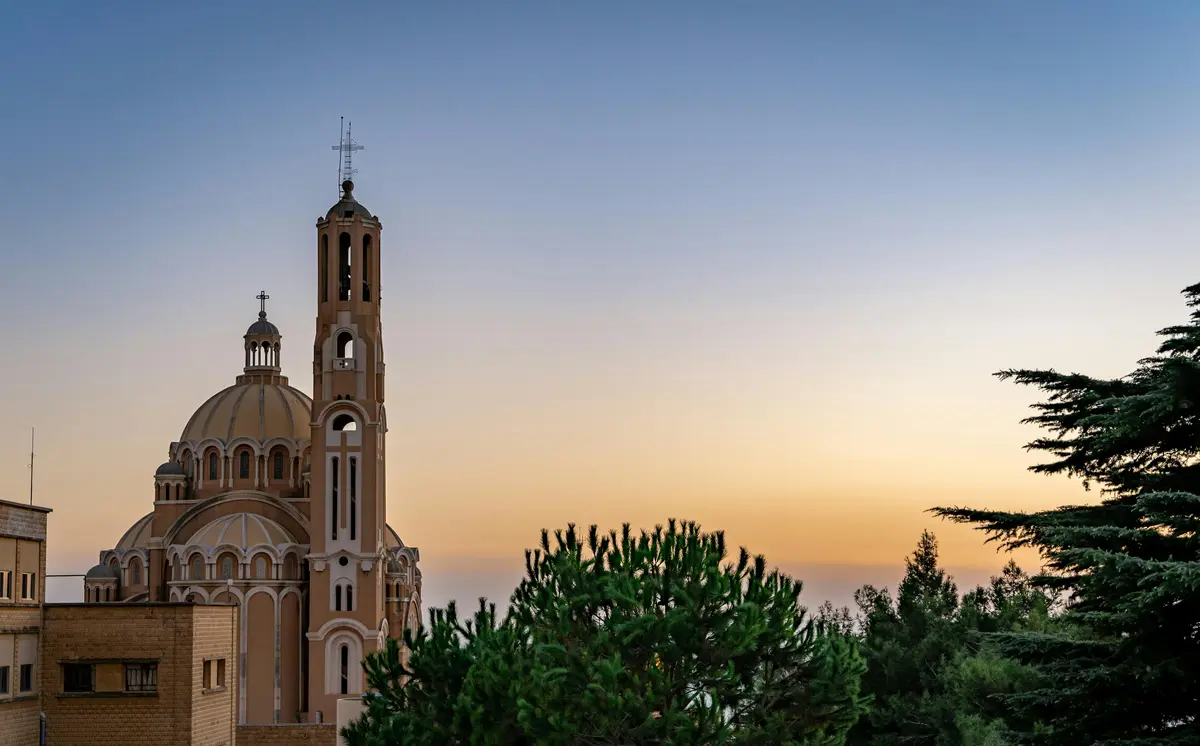
Al Shams — the Armenian-Lebanese restaurant worth the drive
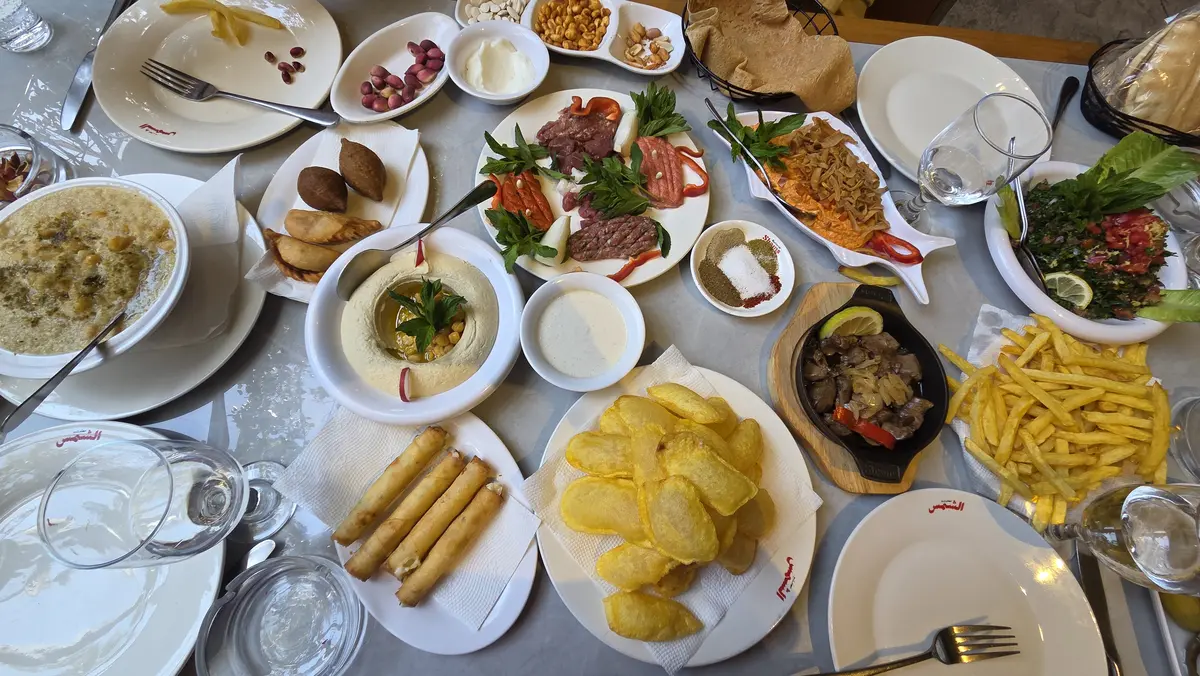
Founded in 1975 by the Zetlian family as a small cafeteria, Al Shams has grown into one of the largest restaurants in Lebanon, with seating for around 4,000 guests across indoor halls, garden terraces, fountains, and a full kids’ arcade with bowling and billiards. The scale is genuinely strange — it feels more like a compound than a restaurant — but the food is the reason every Beirut taxi driver knows the name.
Order the batata balloon first. These are thinly sliced potatoes fried in a technique that causes each slice to puff into a hollow, crisp sphere the size of a golf ball, served with a garlic dip strong enough to clear your sinuses. They’re pillowy inside, shatter-crisp outside, and they arrive hot enough to burn your fingers. Eat fast.
After that, build a mezze spread:
- Kherrovadz: Armenian-style grilled meat, spiced and prepared differently from Lebanese shish taouk or kafta.
- Itch: A red bulgur salad that’s tangier and wetter than tabbouleh, closer to a Turkish kisir.
- Mante: Tiny boat-shaped dumplings filled with spiced meat, served with yogurt and garlic.
- Sujuk: Armenian spicy sausage, grilled to order.
- Fresh trout: Al Shams runs its own trout fishery — skip this only if you’re vegetarian.
Quick Stats:
- Location: Main road, Anjar town, 2 minutes from the archaeological site
- Cost: $15-$25 per person for a full mezze spread; more for trout or grilled meats
- Best for: Groups, families, and anyone doing a Bekaa Valley day trip
- Time needed: 90 minutes to 2 hours — the kitchen is busy and the food arrives in waves
Pro Tip: Avoid Sundays. The restaurant is often fully booked with extended Lebanese families and the wait for food can stretch past an hour. Tuesday to Thursday lunch is the sweet spot.
How do you get to the Anjar ruins from Beirut?
Anjar sits about 36 miles (58 km) east of Beirut along the Damascus Highway, roughly 1 hour 15 minutes by car in normal traffic. The site is 4 miles (6 km) from the Syrian border, which is the main logistical and safety consideration — more on that below.
Four ways to get there, ranked by practicality:
- Private taxi for the day: $120-$150 round trip from Beirut. Most comfortable, fastest, and the driver waits at each stop. The best option if you don’t speak Arabic.
- Small group day tour: $45-$95 per person, usually combined with Baalbek and Château Ksara. Lunch at Al Shams is often included. Best value if the dates align.
- Minibus to Chtaura, then local taxi: $5-$10 for the bus from Cola intersection in Beirut to Chtaura, plus $5-$10 for the final 6 miles (10 km) to Anjar. Cheapest but slowest, and you need some Arabic.
- Self-drive rental: Possible but not recommended. Lebanese highway driving is aggressive, and checkpoints can be tense for anyone without local ID.
Most travelers bundle Anjar with Baalbek and at least one Bekaa Valley winery — Château Ksara is the most visited, but Château Kefraya and Massaya are both in the same valley. Doing all three in one day is tight but standard.
What does it cost to visit the Anjar ruins?
The archaeological site is open daily from 8:00 AM to 5:30 PM, with slightly shorter winter hours that track daylight. Entry is paid in Lebanese pounds and the USD equivalent fluctuates with the exchange rate, but expect roughly $4-$8 for foreign visitors. Budget 90 minutes to walk the full site.
Practical costs for a Beirut-based day trip:
- Site entrance: $4-$8 per adult
- Lunch at Al Shams: $15-$25 per person
- Transport (private taxi round trip): $120-$150, splittable among up to four people
- Optional guide at the site: $20-$30 for a 60-minute tour
- Total on a group tour: $70-$120 all-in for a solo traveler
- Total for two sharing a private taxi: $100-$130 per person
Bring cash in small USD bills. The Lebanese banking system is unreliable and many sites no longer accept cards.
Is it safe to visit the Anjar ruins right now?
No. The US State Department has issued a Level 4 “Do Not Travel” advisory for all of Lebanon, the UK Foreign Office advises against all travel to Beqaa Governorate where Anjar sits, and Canada, Australia, and Ireland maintain equivalent warnings. The Bekaa Valley has been a direct target in Israeli airstrikes, and the wider region around Baalbek has seen significant strike activity.
This is a change from how the site has historically been viewed. For years, Anjar was considered a safer Bekaa stop than Baalbek because the town is a tight-knit Christian-Armenian community with its own municipal police force, sitting on a major international highway patrolled by the Lebanese Army. Under stable conditions, organized tours ran daily without incident and travelers consistently reported feeling safe.
That calculus no longer holds. The Beirut-Damascus highway passes through areas that have seen airstrikes, and proximity to the Syrian border adds a second layer of risk. If you’re determined to visit anyway, the honest baseline:
- Check your government’s travel advisory the morning you travel, not the week before.
- Only go with a Beirut-based tour operator who knows which roads are open.
- Avoid the border demarcations completely — stick to the main tourist route.
- Keep your passport, some USD cash, and a working local SIM on you at all times.
- Understand that your travel insurance is likely void under a Level 4 advisory.
For most readers, the right move is to bookmark this guide and visit once advisories drop to Level 2 or below. Lebanon has done that before, and the site isn’t going anywhere — UNESCO’s enhanced protection status confirms the ruins themselves have not been damaged.
Anjar ruins or Baalbek — which should you choose?
If you have to pick one, choose based on what you want to feel. Baalbek is Roman, massive, and theatrical — the Temple of Bacchus alone is the size of a stadium and the columns of Jupiter’s temple are among the largest in the ancient world. The Anjar ruins are Umayyad, human-scale, and quiet. Baalbek makes you feel small. Anjar makes you feel like you’re walking through someone’s daily commute from 1,300 years ago.
The honest take: most travelers who visit both say Baalbek is the more photographable site but Anjar is the more thought-provoking one. The geometry of a planned city tells you more about how people actually lived than a temple complex does. If you only have one day and you’re a first-time visitor to Lebanon, do Baalbek for the scale and skip the rest. If you’re on a second or third trip, or you care about Islamic architecture specifically, Anjar is the better stop.
If you have a full day and a car, do both. They’re 40 miles (64 km) apart, and hitting Anjar on the way back from Baalbek lets you end the day with lunch at Al Shams.
Before you book
TL;DR: The Anjar ruins are the only complete Umayyad city in the Middle East, a compact 90-minute walk, and a 1-hour drive from Beirut — with one of the best Armenian-Lebanese meals in the country 2 minutes away at Al Shams. The catch: the Bekaa Valley sits under Level 4 travel advisories from every major Western government, so this trip is one to plan for the next stable window, not this week. If you’re building a 7-day Lebanon itinerary, keep this on the list — but slot it for the second half of the trip, once you’ve seen how the security picture looks on the ground.
Have you been to the Anjar ruins, or are you weighing a Bekaa Valley trip for when the situation calms? Drop your questions or on-the-ground updates in the comments — especially from anyone who’s visited in the past year.