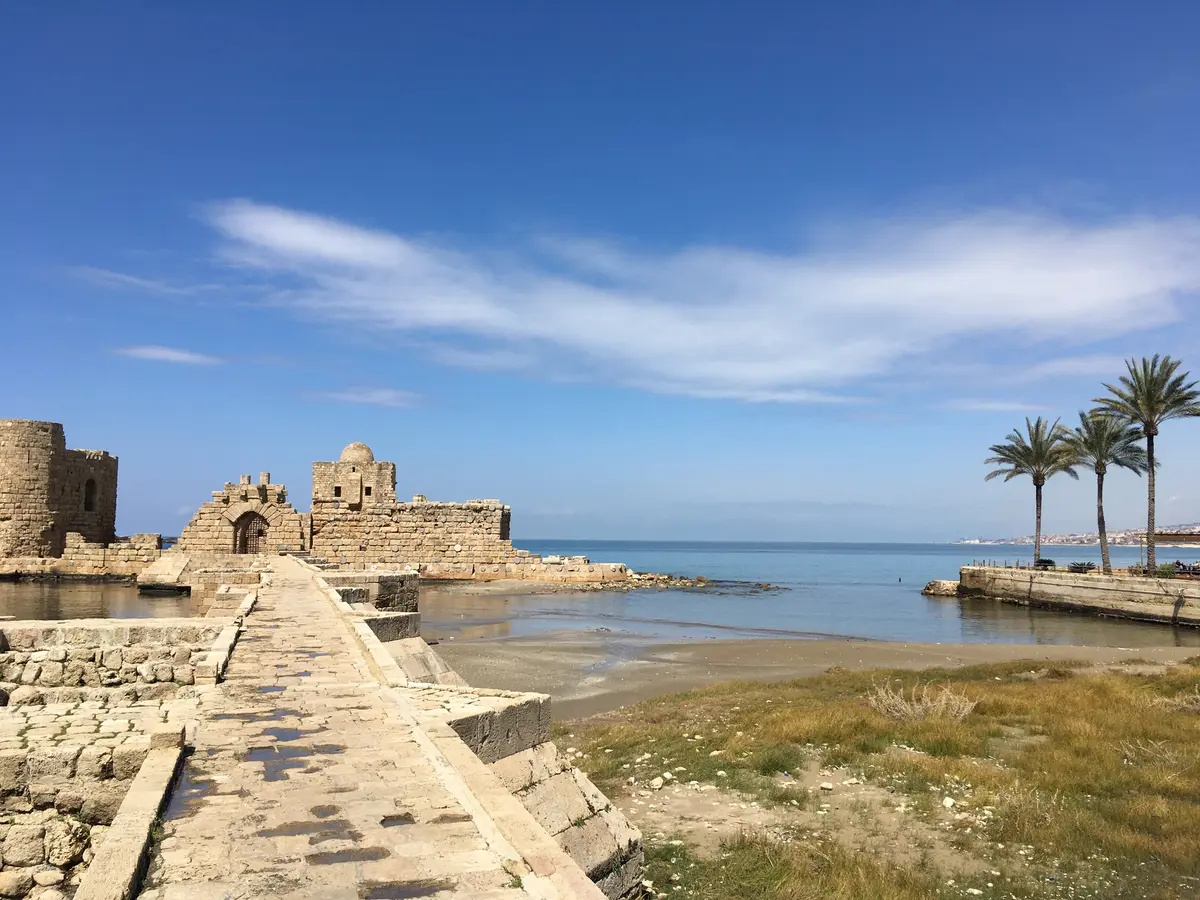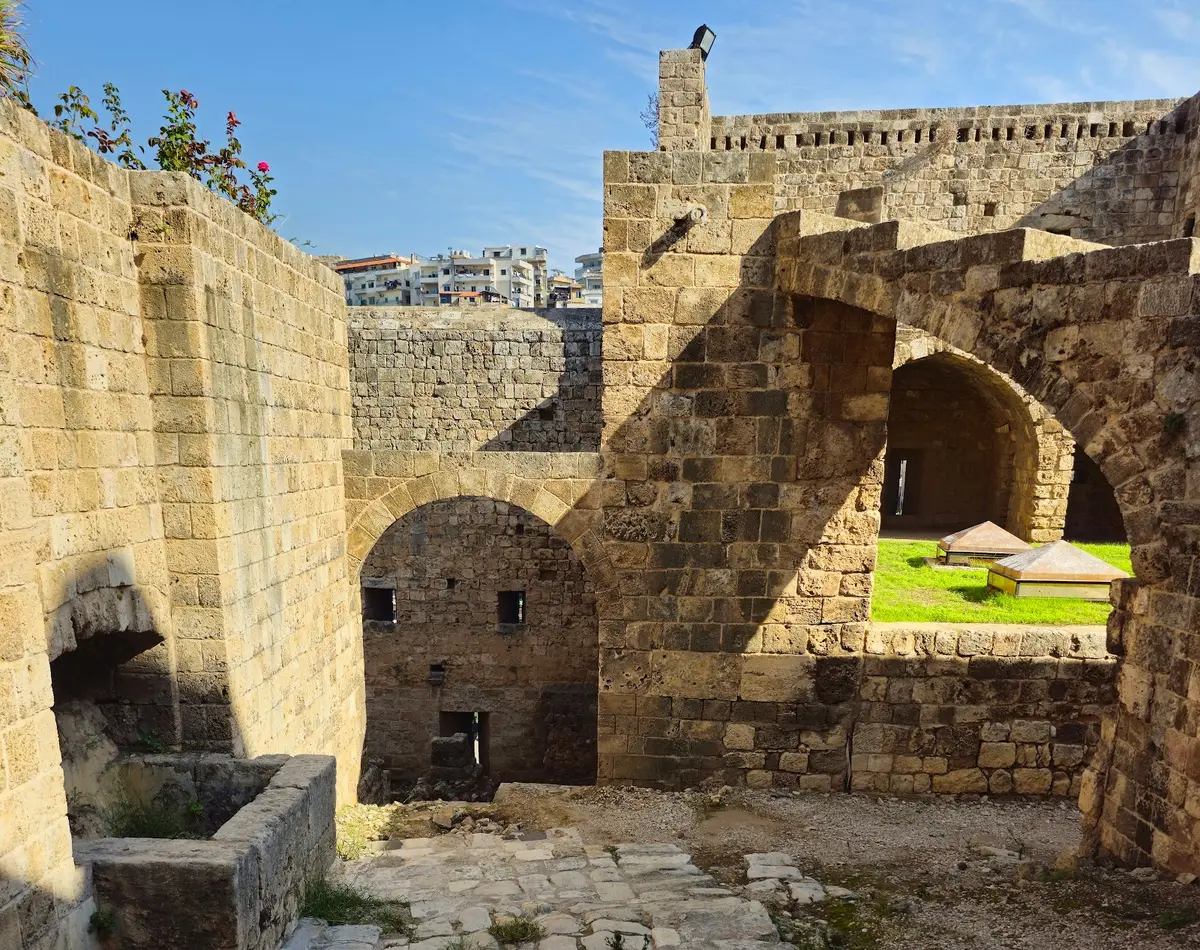
A Lebanon architecture tour isn’t a European ruin crawl. It’s an 800-ton Roman megalith in one valley and an unfinished Niemeyer concrete canopy two hours north, with Ottoman mosaics and bullet-scarred modernism in between. Six sites. Five millennia. One country the size of Connecticut. Here’s what to see, when, and what the other guides skip.
Before you go: The U.S. State Department maintains a Level 4 “Do Not Travel” advisory for Lebanon, citing armed conflict risk, the southern border, and the Bekaa Valley. Several sites in this Lebanon architecture tour sit inside zones the State Department tells Americans to avoid. Read the full logistics section at the end before you plan anything.
1. Baalbek — the Roman megalith in the Bekaa Valley
Photographs flatten Baalbek. Nothing prepares you for the first time you walk up to a 65-foot Corinthian column and realize everything you thought you knew about Roman scale was wrong. The wind moves differently through a space like that.
The site sits in the northern Bekaa Valley, roughly two hours from Beirut through checkpoints and vineyards. It stacks Phoenician sacred ground beneath Roman imperial ambition beneath medieval fortress rubble, and you can read the layers as you walk.
The Temple of Jupiter and the Trilithon
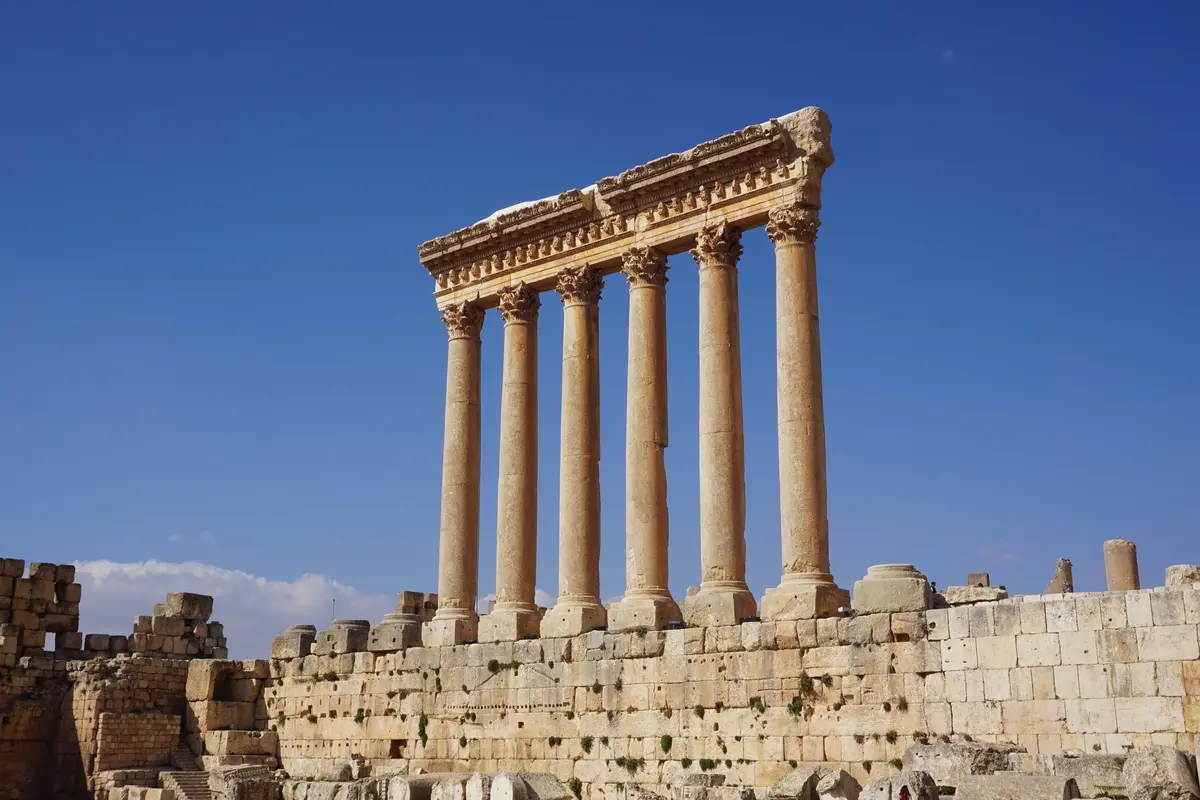
The Temple of Jupiter’s foundation rests on the Trilithon: three limestone blocks, each weighing roughly 800 tons (725 metric tonnes). Engineers still can’t fully agree on how the quarrymen moved them the half-mile (800 m) from the quarry to the podium. The podium wasn’t just structural — it was designed to psychologically shrink worshippers before they crossed the threshold.
Six of Jupiter’s original 54 columns still stand. They are 65 feet (20 m) tall, and they hold up a fragment of entablature that hasn’t moved in nearly two thousand years.
Pro Tip: Light on the Jupiter columns goes gold between 7:30 and 8:30 a.m. in spring. Tour buses don’t arrive until around 10, and the ticket booth opens at 9 sharp.
The Temple of Bacchus
Jupiter is about mass. Bacchus is about detail. It’s one of the best-preserved Roman temples anywhere because medieval fortress rubble buried and protected it for centuries — the Corinthian interior is still standing here when the temples in Rome itself are not.
The interior cella and adytum (inner sanctuary) remain intact. The doorway keystone shows an eagle clutching a caduceus. It slipped during the 1759 earthquake and now hangs suspended at an angle, held in place by friction and the weight of everything above it. Worth the 45 seconds it takes to look up.
On my first visit I spent 40 minutes inside the Bacchus cella without seeing another tourist. Arrive before 10 a.m. and the site is almost yours.
Quick Stats
- Location: Baalbek, northern Bekaa Valley — 53 miles (85 km) northeast of Beirut
- Cost: About $10 entry (1,000,000 LBP); private driver from Beirut $120–150 round-trip
- Best for: First-time visitors, Roman history buffs, travelers who liked Ephesus and wanted more
- Time needed: 2–3 hours on site; full day including transport
- Hours: 9 a.m. – 6 p.m. summer, 9 a.m. – 4 p.m. winter
2. Anjar — the precision-planned Umayyad city
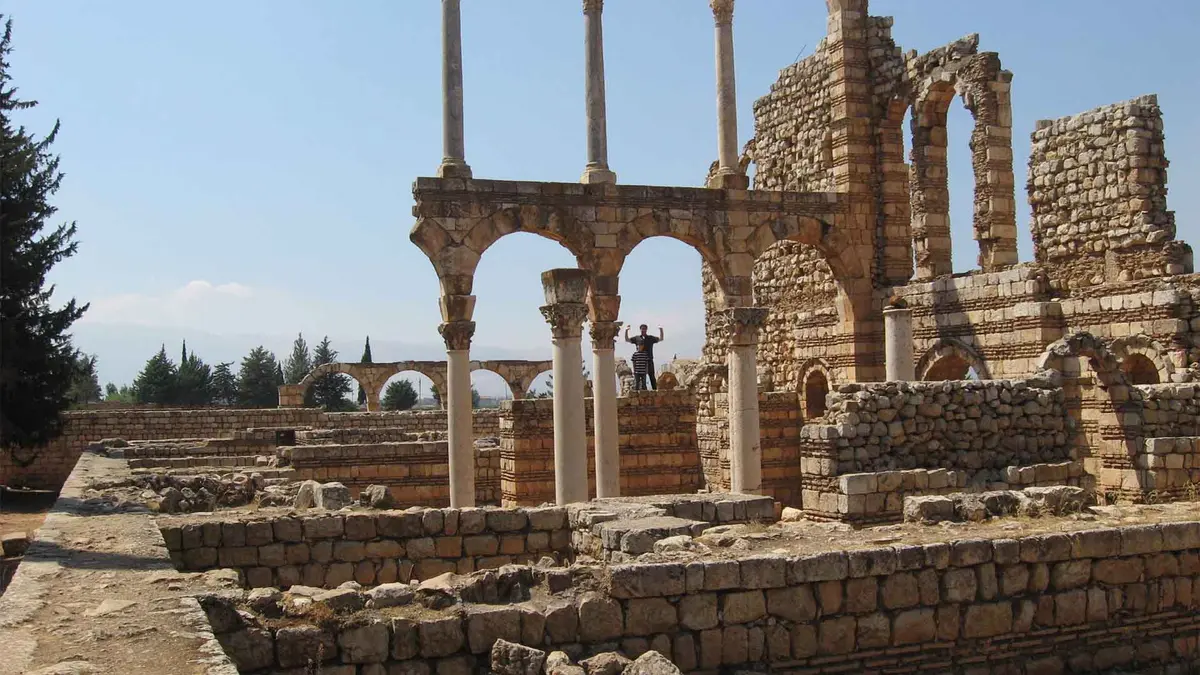
If Baalbek is about scale, the Umayyad city of Anjar is about clarity of thought. The whole city was built in a single 30-year burst under Umayyad Caliph Walid I in the early 8th century — then abandoned almost as fast. What’s left is a rare thing: an early Islamic city frozen at the moment of its founding, with no medieval or Ottoman overlay muddying the reading.
Urban layout and engineering
Anjar follows a strict Roman grid — a cardo and decumanus crossing at a tetrapylon, exactly the plan you’d find in a 2nd-century Roman colony. The difference is what’s on it: an Umayyad palace, a mosque, and shops laid out for commerce rather than military administration. The Umayyads took the Roman playbook and ran a different program on the same hardware.
Look for the opus listatum walls — alternating courses of limestone block and fired brick, borrowed from Byzantine construction. It provides seismic resilience and gives the walls a striped visual rhythm that photographs well against the morning sun.
The Great Palace
The Great Palace facades use slender vertical arches — a light, almost Andalusian aesthetic that feels centuries ahead of the rest of the site. That’s not an accident. Anjar is one of the connector points between the masonry vocabulary of Rome and the vocabulary that would end up in Córdoba 150 years later.
Quick Stats
- Location: Anjar, central Bekaa Valley — 36 miles (58 km) east of Beirut, 35 miles (56 km) south of Baalbek
- Cost: About $5 entry
- Best for: Travelers pairing it with Baalbek in a single day
- Time needed: 1–1.5 hours
- Hours: Typically 8:30 a.m. – 4:30 p.m.; confirm before traveling
Pro Tip: Combine Anjar and Baalbek in one day, and hit Anjar second. After Baalbek’s scale, Anjar’s restraint reads completely differently.
3. Deir el Qamar and Beiteddine — the “Lebanese house” heritage
The Lebanese House — a triple-arched central hall under a red tile roof — is the vernacular that shows up in every diaspora neighborhood from São Paulo to Sydney. To understand where it came from, you go to the Chouf mountains, about 30 miles (50 km) southeast of Beirut.
Deir el Qamar — the stone capital
Deir el Qamar is a working village, not a museum. The Fakhreddine Mosque (1493) is the oldest in Mount Lebanon, and its rare octagonal minaret is the kind of Mamluk detail you almost never see outside of Egypt and Syria.
The central Midane — the old main square — is flanked by the Serail palace of Yusuf Chehab, with heavy stone vaults and a courtyard layout built around privacy and defense. Walk up the cobbled streets behind it and you can trace the evolution from closed fortress architecture to the open triple-arched houses of the later Ottoman period in about 400 yards (365 m) of walking.
Beiteddine Palace — Lebanese Baroque
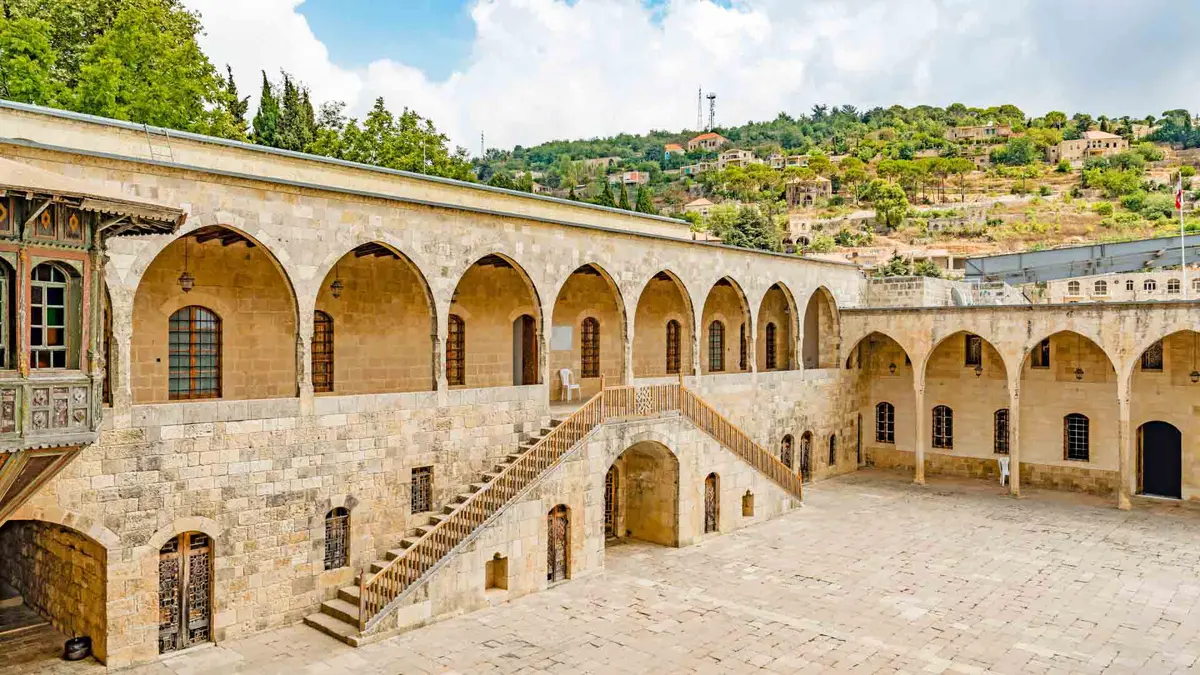
Beiteddine Palace sits on a ridge across the valley, about 4 miles (6 km) from Deir el Qamar. It was built between 1788 and 1818 by Emir Bashir Shihab II using Syrian craftsmen and Italian architects — the result is a fusion usually labeled “Lebanese Baroque.”
The complex organizes around three courtyards that progress from public to private:
- Dar el-Barrani: outer court for public gatherings
- Dar el-Wousta: middle court for administration
- Dar el-Harim: private residential quarters
This progression — public street to administrative middle to fully private bedroom — is the core principle of Arab-Islamic domestic architecture, and Beiteddine is the cleanest example of it in the country. The hammam ceilings are pierced with colored glass roundels that throw pinpoints of red and blue light across the marble when the sun is right.
Quick Stats
- Location: Chouf Mountains — Beiteddine is ~30 miles (50 km) southeast of Beirut; Deir el Qamar is ~4 miles (6 km) west of Beiteddine
- Cost: Beiteddine $5 entry; Deir el Qamar is free to walk
- Best for: Travelers interested in domestic architecture, Ottoman history, mountain scenery
- Time needed: Full day to do both comfortably
- Hours (Beiteddine): 9 a.m. – 6 p.m. summer, 9 a.m. – 4 p.m. winter
Pro Tip: Beiteddine is still the Lebanese president’s official summer residence, so sections close without notice when he’s in. Call the palace office at +961 5 500 077 if you’re making a dedicated trip.
4. Rashid Karami Fair — Niemeyer’s unfinished modernism
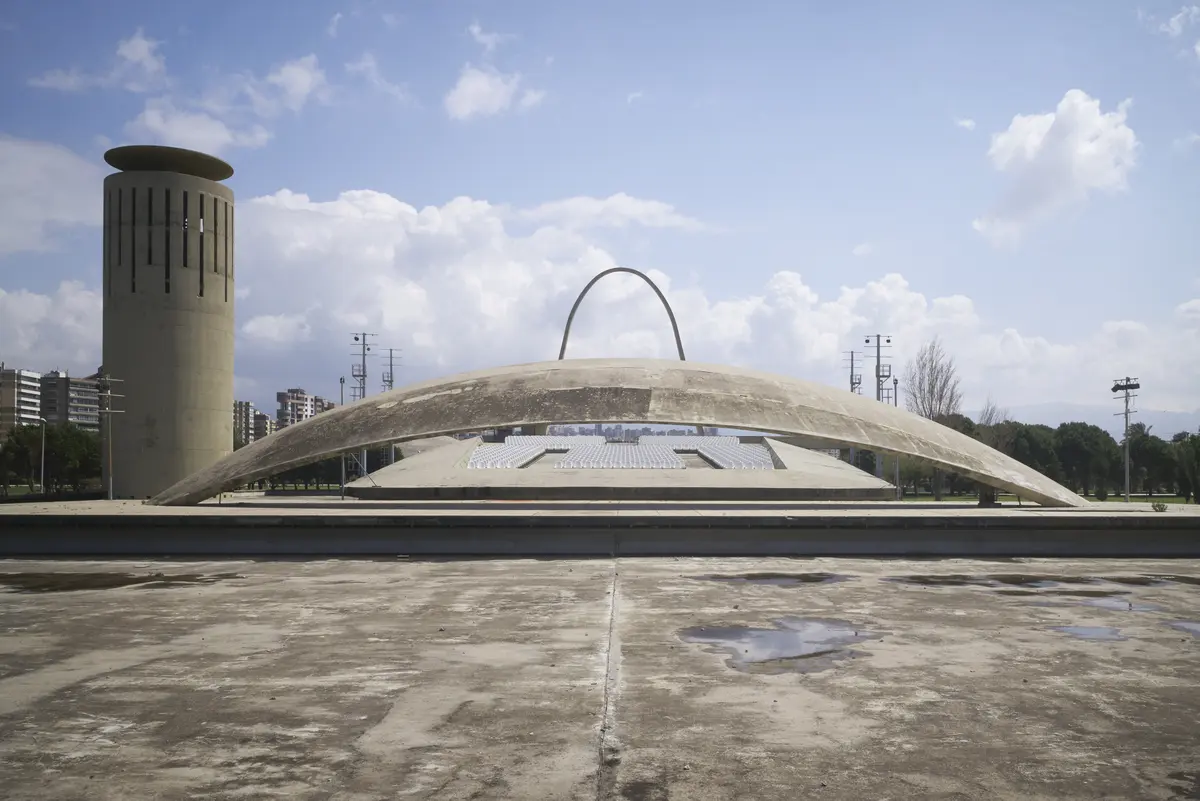
For mid-century architecture, this Tripoli site is probably the most important Modernist complex in the Arab world and one of the most important anywhere. Brazilian Pritzker laureate Oscar Niemeyer designed it in 1962. Construction began in 1964 and was still going when the Civil War broke out in 1975. Then everything stopped. It has never been finished.
UNESCO inscribed the complex on the World Heritage List and on the List of World Heritage in Danger simultaneously in January 2023 — a move reserved for sites where preservation urgency is critical. Access is possible but protocols have tightened.
The Grand Canopy and dome
The Grand Canopy is a 2,460-foot (750 m) boomerang-shaped concrete roof floating on V-shaped columns. It was designed to shelter the national pavilions of whoever came to trade. The length and thinness of the shell are the real engineering story — Niemeyer was pushing reinforced concrete as far as it would go.
The Experimental Theater dome is raw concrete outside and acoustically tuned inside. It was meant to be a live performance venue. It has essentially never hosted a performance.
The Space Museum (“the Mushroom”)
Locals call the helipad-shaped structure “the Mushroom.” It sits on top of what was designed to be an underground space museum — pure 1960s Space Age optimism, now weathering in silence next to reflective pools that have been empty for more than 50 years. It is one of the more melancholic sights in any modern city.
Quick Stats
- Location: Tripoli — 53 miles (85 km) north of Beirut
- Cost: Entry generally free; permit or guided access sometimes required at the gate
- Best for: Modernist architecture enthusiasts, Niemeyer completists, anyone writing a thesis
- Time needed: 2–3 hours
- Hours: Variable — contact the Rashid Karami Fair office or a local fixer before going
Pro Tip: The Niemeyer Heritage Foundation Tripoli (niemeyertripoli.org) can arrange guided access and is the easiest way to see the interiors. Show up unannounced and you may not get past the gate.
5. Beirut’s war architecture — memory in concrete and stone
You can’t read Lebanese architecture without the Civil War (1975–1990) and the August 2020 Port Blast. Beirut’s neighborhoods are where those events are legible in the walls.
Beit Beirut — the Yellow House
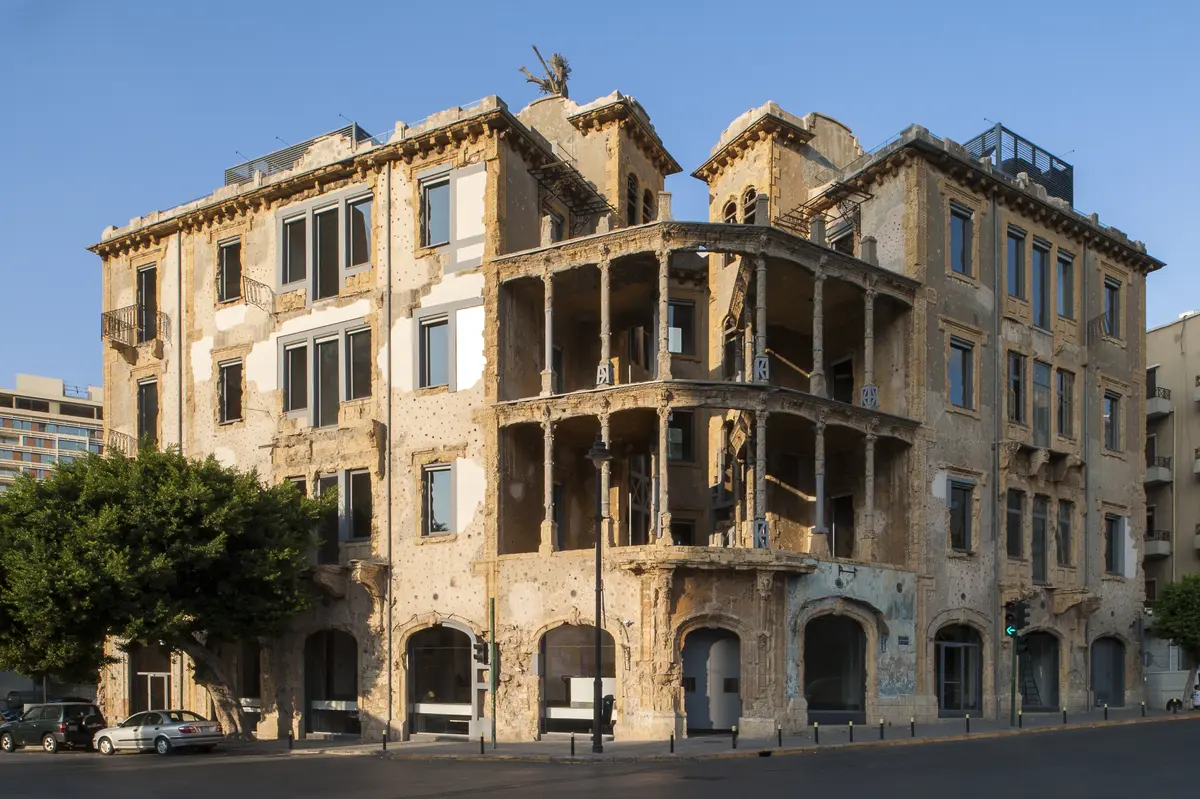
The Barakat building was designed in 1924 by Youssef Aftimus (who also did Beirut’s city hall) in an Ottoman-revival style using yellow Deir el Qamar limestone — hence the “Yellow House.” Its open corner layout gave every upper-floor room sight lines down two streets: an excellent domestic feature, and an excellent sniper’s nest. It sat directly on the Green Line and was occupied by militia snipers for most of the war.
Architect Youssef Haidar led the restoration. He refused to erase the damage. Sniper bunkers are preserved behind glass, bullet holes remain in the stone, and the new structural additions use steel and glass visually distinct from the original masonry. The point is that the “new” is never confused with the “wounded.”
Quick Stats
- Location: Intersection of Independence Street and Damascus Road, Sodeco, Achrafieh
- Cost: Free
- Best for: Civil War history, adaptive reuse, restoration case studies
- Time needed: 1–1.5 hours
- Hours: Wed–Sun, 12 p.m. – 8 p.m.
B018 and post-blast recovery
Bernard Khoury’s B018 nightclub is the sharpest contemporary meditation on war memory in the city. Built on the site of a former quarantine zone and refugee camp, the club is sunk into the ground like a communal grave, and the roof hydraulically retracts so dancers are exposed to open sky. It’s a building that forces a reckoning before it lets you order a drink.
After the August 2020 Port Blast, the Beirut Heritage Initiative mobilized to save hundreds of Ottoman and French Mandate heritage houses in Gemmayze and Mar Mikhael. Walk those two neighborhoods now and you can spot the difference between weathered pre-blast limestone and fresh restoration mortar. It’s a visual timeline you can read in about 20 minutes of slow walking.
Pro Tip: Start at Beit Beirut, then walk northwest through Gemmayze and Mar Mikhael toward the port. The architectural timeline — Ottoman townhouse, French Mandate apartment block, blast-damaged, restored — unfolds in sequence as you move.
6. Contemporary vision — Herzog & de Meuron and Zaha Hadid
Two recent buildings round out a complete Lebanon architecture tour by showing where the design language is heading.
Beirut Terraces
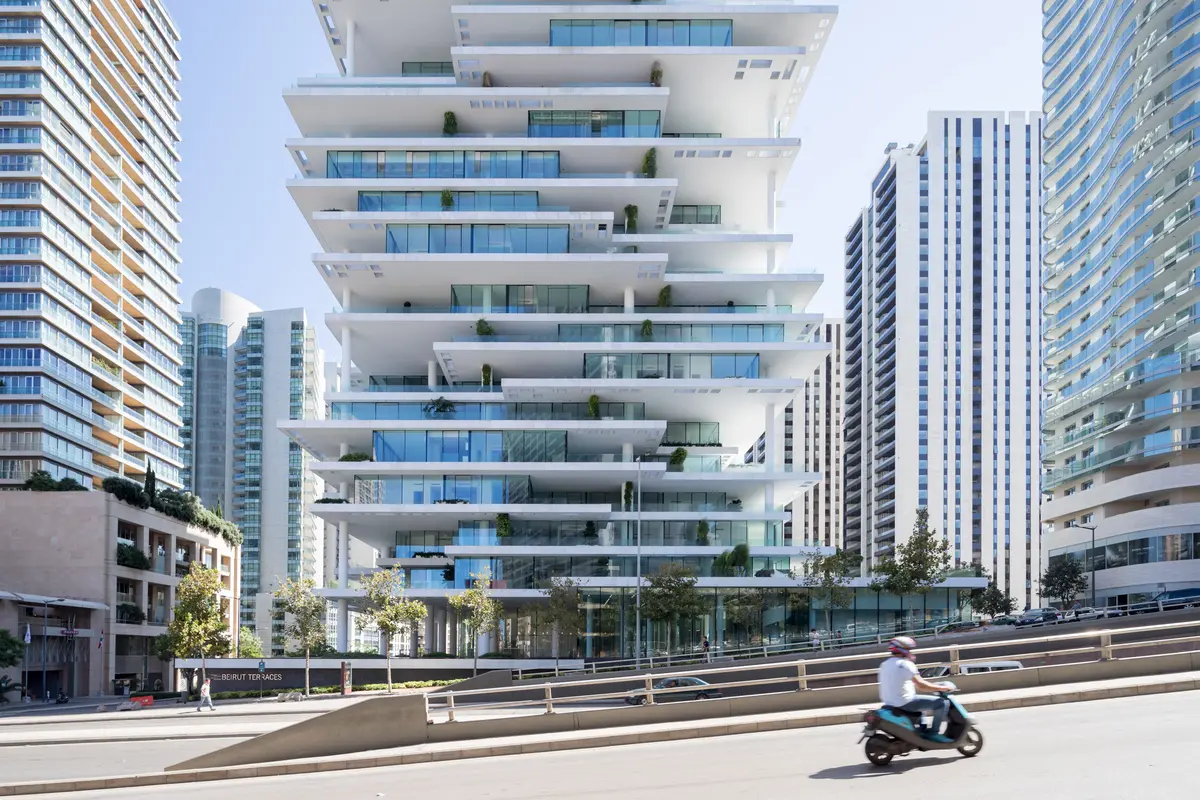
Beirut Terraces, in the Minet el Hosn district, is Herzog & de Meuron’s reinterpretation of the Lebanese House for vertical living. Staggered floor slabs create deep overhangs — a passive cooling strategy essential for Lebanon’s Mediterranean climate, and a way of giving every apartment a usable outdoor terrace. It’s the triple-arched shaded hall, pulled into the sky.
Issam Fares Institute
Zaha Hadid’s Issam Fares Institute on the American University of Beirut (AUB) campus cantilevers dramatically over a public courtyard, preserving the original ficus and cypress trees that were there before the building. The cantilever isn’t performing — it’s the only way to add a building without killing the trees.
Quick Stats
- Location: Beirut Terraces — Minet el Hosn (exterior only, residential); Issam Fares Institute — AUB main campus, Bliss Street
- Cost: Free (exterior viewing); AUB campus visit requires booking through the Visitors Bureau
- Best for: Contemporary architecture enthusiasts, design students
- Time needed: 1–2 hours combined
- Hours (AUB Visitors Bureau): Mon–Fri, 8 a.m. – 4 p.m.
How do you actually plan a Lebanon architecture tour?
If you’re asking whether Lebanon is safe for American tourists, start with the current U.S. State Department travel advisory. It sits at Level 4 “Do Not Travel” and cites armed conflict risk, the Lebanon–Syria border, the southern border with Israel, Beirut’s Dahieh suburb, and the Bekaa Valley. Several sites in this guide — Baalbek and Anjar in particular — sit inside zones the State Department tells Americans to avoid. Plan accordingly, and check the advisory the week you book.
If you decide to go, these are the practical points that matter:
- Safety: Avoid the southern border region, Beirut’s Dahieh suburb, Palestinian refugee camps, and the deep Bekaa. Byblos, Batroun, Beirut’s Achrafieh and Hamra districts, and the Christian Chouf have historically been the most stable areas.
- Currency: Lebanon is effectively dollarized. Bring crisp, new $100 bills — crumpled or marked notes get refused. Credit cards work at upscale hotels and restaurants in Beirut and almost nowhere else. Local ATMs are unreliable for foreign cards.
- Transport: Driving in Lebanon is chaotic and checkpoints are constant — do not rent a car. Hire a private English-speaking driver; expect to pay $100–150/day.
- Connectivity: Buy an Alfa or Touch SIM card at Beirut airport. Confirm your accommodation has 24/7 generator power — the state grid supplies only a few hours a day in most of the country.
- Best time: April–June and September–November. Summer is brutally hot in the Bekaa; winter closes mountain roads.
Pro Tip: If you’re a U.S. citizen and you go, enroll in the State Department’s Smart Traveler Enrollment Program (STEP) before you fly. It’s free, it takes five minutes, and it’s how the embassy reaches you if something happens.
Where should you stay on a Lebanon architecture tour?
The most useful base is Beirut itself — specifically the Gemmayze, Achrafieh, or Hamra neighborhoods. From there, every site in this guide is a reachable day trip by private driver. If you want the architecture to continue into the night, three guesthouses in the Lebanese mountains outside the capital are worth the detour:
- Beit Trad (Kfour): A 19th-century mansion in Keserwan with barrel-vaulted ceilings and the original stone stairwell intact
- Beit Douma (Douma): Stone-walled rooms with 12-foot (3.6 m) ceilings and classic triple-arched windows opening onto terraced gardens
- Villa Paradiso (Batroun): Coastal heritage architecture steps from the Phoenician Wall in one of the country’s most walkable small towns
Pro Tip: Skip the Four Seasons and the Phoenicia. They’re fine hotels, but you did not fly to Lebanon to sleep in the same lobby you could have slept in in Dubai.
What most guides won’t tell you
Lebanese architecture is about stubborn continuity. The country has been destroyed, rebuilt, occupied, liberated, and destroyed again — and the buildings keep standing. A Lebanon architecture tour reads like entries in the same logbook as Lebanon’s layered archaeological sites: Roman temple in the Bekaa, Niemeyer canopy in Tripoli, bullet-scarred Ottoman mansion in downtown Beirut — all variations on the same stubborn refusal to be erased.
TL;DR: A full Lebanon architecture tour is Baalbek for ancient scale, Anjar for early Islamic planning, Deir el Qamar and Beiteddine for the Lebanese house, Rashid Karami for modernism frozen in amber, Beit Beirut for war memory, and the AUB campus for what the next generation is doing with all of it. Plan 7–10 days, hire a driver, check the travel advisory the week you book, and bring twice the cash you think you need.
Which site would you prioritize if you only had three days on the ground?