Baalbek Lebanon holds the tallest classical columns on Earth and stones so massive engineers still argue about how Romans moved them. This guide covers what to see, how to get there from Beirut, current entry fees, and the safety reality on the ground — not the brochure version.
Is Baalbek Lebanon safe to visit right now?
Baalbek sits inside the US State Department’s Level 4 “Do Not Travel” zone for Lebanon, and the Beqaa Valley specifically is flagged for armed conflict and military activity. Independent travelers who reach the archaeological site usually report feeling secure within the town and ruins, but the security situation can shift in days. Before committing, read our honest assessment of whether Lebanon is safe for American tourists and check the official advisory.
The drive from Beirut passes military checkpoints that visitors describe as routine rather than threatening. Hezbollah flags and posters are visible throughout the town — this is the political reality of the region, but it rarely translates into hostility toward foreign visitors.
Pro Tip: Enroll in the Smart Traveler Enrollment Program (STEP) before you fly. It takes 5 minutes and gets you alert messages plus a faster line to embassy assistance if anything changes while you’re in-country.
Practical safety rules for first-time visitors
- Hire a reputable local driver or join a guided tour for your first trip — navigating checkpoints solo is the single biggest unforced error
- Skip political conversations and large gatherings entirely
- Dress modestly: shoulders and knees covered for both men and women
- Keep your passport and a printed hotel address in separate pockets
- Avoid driving the Beirut–Baalbek road after dark
What is the history behind Baalbek’s ruins?
Baalbek’s story stretches back roughly 9,000 years, beginning as a Phoenician settlement built around the worship of Baal — the Canaanite god of fertility and the sun. The name itself means “Lord of the Beqaa Valley.” After Alexander the Great’s conquest, the city was renamed Heliopolis, the “City of the Sun.”
The Roman transformation
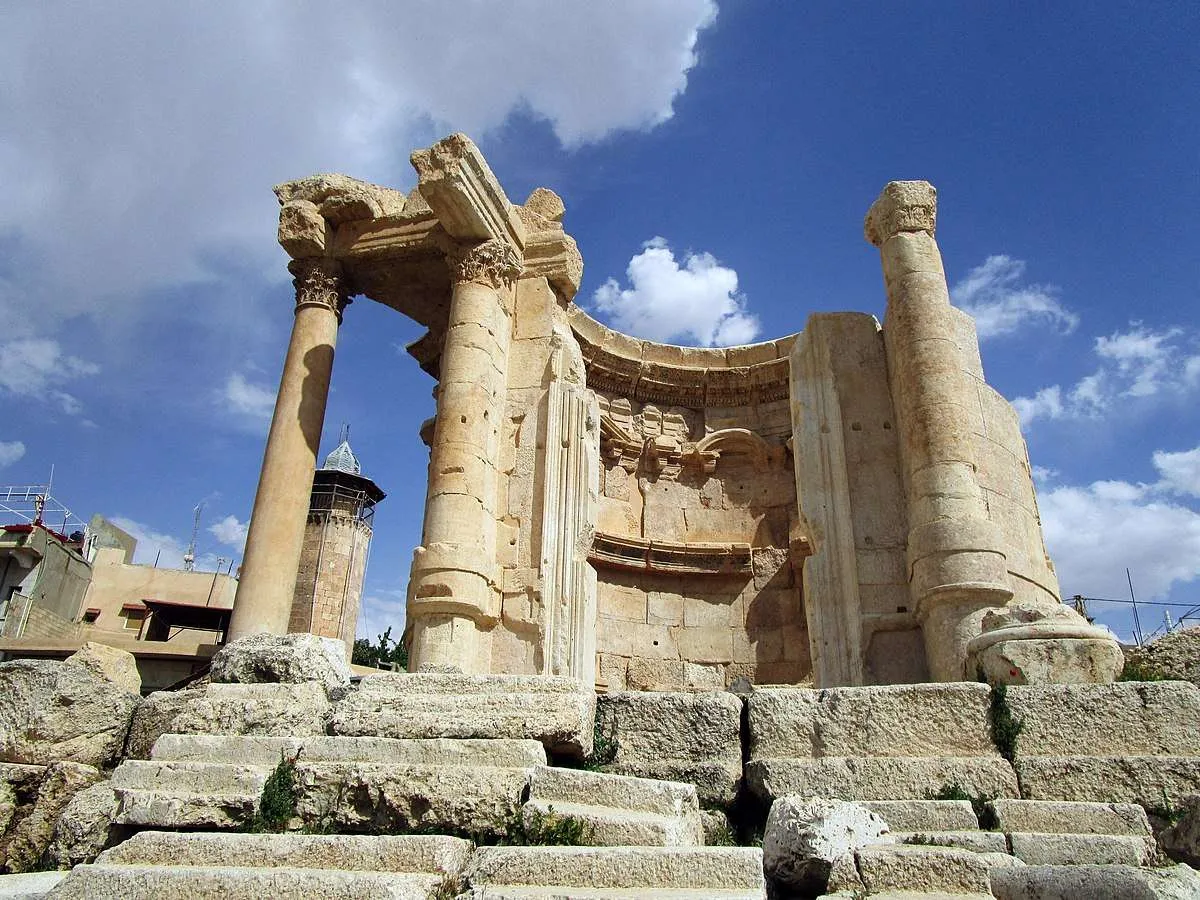
Julius Caesar made Baalbek a Roman colony in 47 BC, and over the next 250 years successive emperors poured staggering resources into a temple complex of unmatched scale, building on the earlier Phoenician foundations. The Romans merged their gods with local deities to create the Heliopolitan Triad: Jupiter (fused with Baal), Venus (linked to the Syrian goddess Atargatis), and Mercury.
Decline and rediscovery
Under Constantine in the 4th century AD, pagan worship was suppressed and construction stopped. His successor Theodosius destroyed the great Temple of Jupiter and built a basilica in its courtyard. After the Arab conquest of 637 AD, the complex became a fortified citadel. A devastating earthquake in 1759 toppled three of the Temple of Jupiter’s last nine standing columns. German archaeological expeditions from 1898 to 1903 conducted the systematic excavation that produced one of the most important archaeological sites in Lebanon visitors walk through today.
What can you see inside the temple complex?
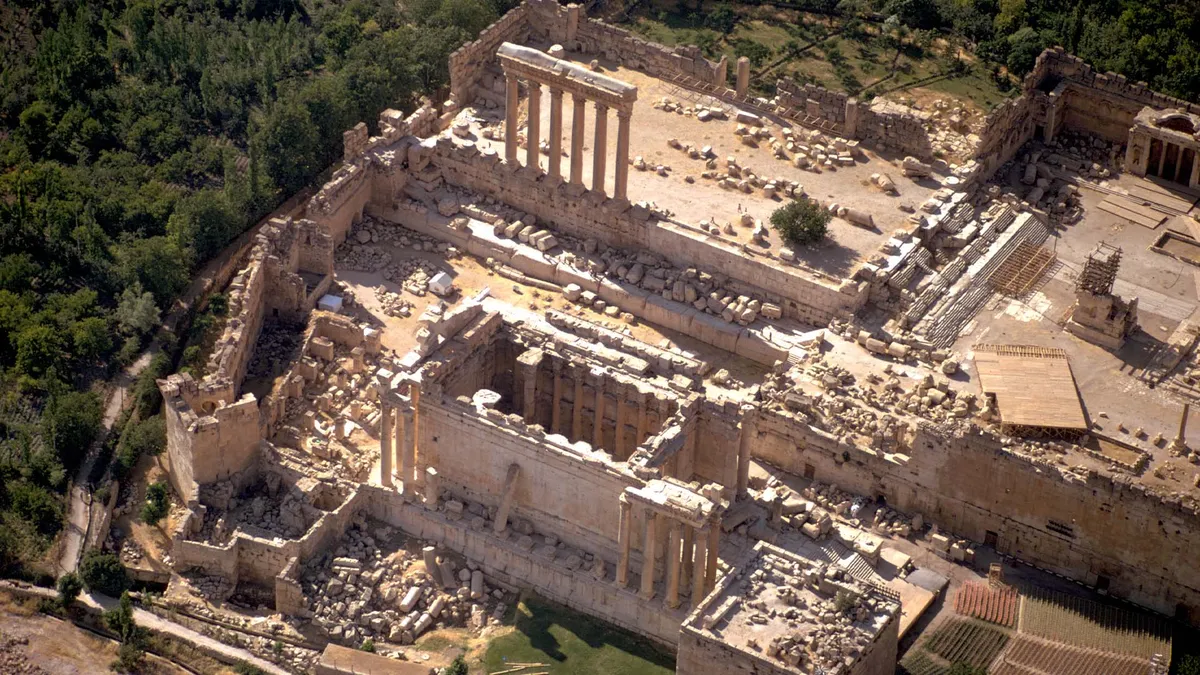
The complex breaks into five main areas: the Propylaea entrance, the Hexagonal Courtyard, the Great Court, the Temple of Jupiter, and the Temple of Bacchus. Plan a minimum of 2–3 hours to walk it without rushing. Most visitors underestimate the scale and end up running out of time before reaching the quarry stones outside the main gate.
The Propylaea — the ceremonial gateway
You climb a monumental staircase up to the Propylaea, completed in the mid-3rd century AD. It was originally fronted by twelve granite columns shipped from Aswan, Egypt — roughly 1,800 miles (2,900 km) up the Mediterranean. Two towers flanked the entrance to make the message obvious: you are leaving the mortal world.
The Hexagonal Courtyard
A six-sided forecourt unique in Roman architecture, originally roofed and supported by 30 columns. It’s roofless now, which actually works in your favor for photos around mid-morning when the light hits the eastern wall.
The Great Court
A rectangular plaza measuring over 330 feet (100 meters) on each side, surrounded by 84 pink and grey granite columns, with two altars at its center. This was where mass rituals happened.
The Temple of Jupiter — the largest in the Roman Empire
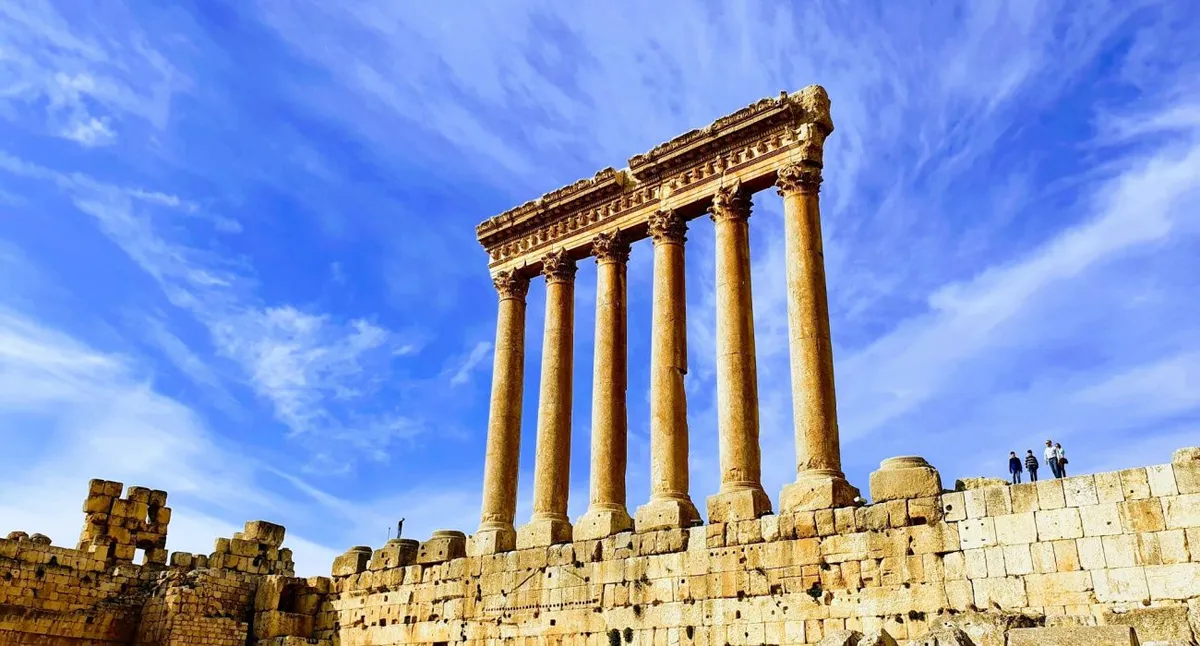
Only six of the original 54 Corinthian columns are still standing, and they’re worth the entire trip on their own. Each column reaches 75 feet (22.9 meters) — the tallest classical columns in the world — and each shaft was carved from a single stone.
The mind-bending part sits beneath the temple. The western retaining wall holds the Trilithon: three monolithic limestone blocks of roughly 800 tons each. How Roman engineers moved them is still actively debated.
The Temple of Bacchus — better preserved than anything in Rome
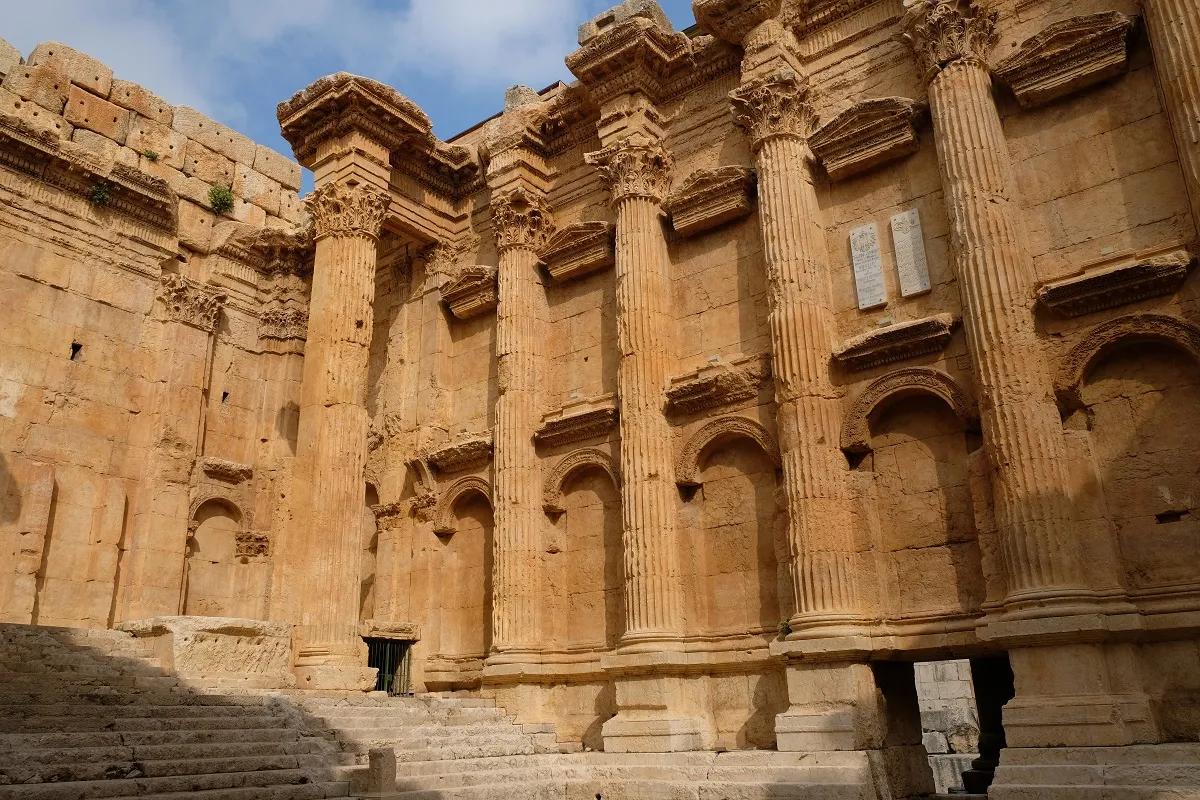
For most visitors, this is the highlight. It’s slightly smaller than the Temple of Jupiter but still larger than the Parthenon, encircled by 42 unfluted Corinthian columns standing nearly 65 feet (20 meters) high. The cella interior is intact enough to walk inside, and the carved doorway lintel — vines, poppies, dancing Maenads — is one of the finest pieces of stonework surviving from the Roman world.
For more on its construction and significance, see the full Baalbek Temple of Bacchus history.
Pro Tip: Walk into the Temple of Bacchus cella, then turn around and look back at the doorway from the inside. The carved lintel reads completely differently with the light behind it — most tour groups miss this because they’re already moving toward the next stop.
Why are the Baalbek megaliths so famous?
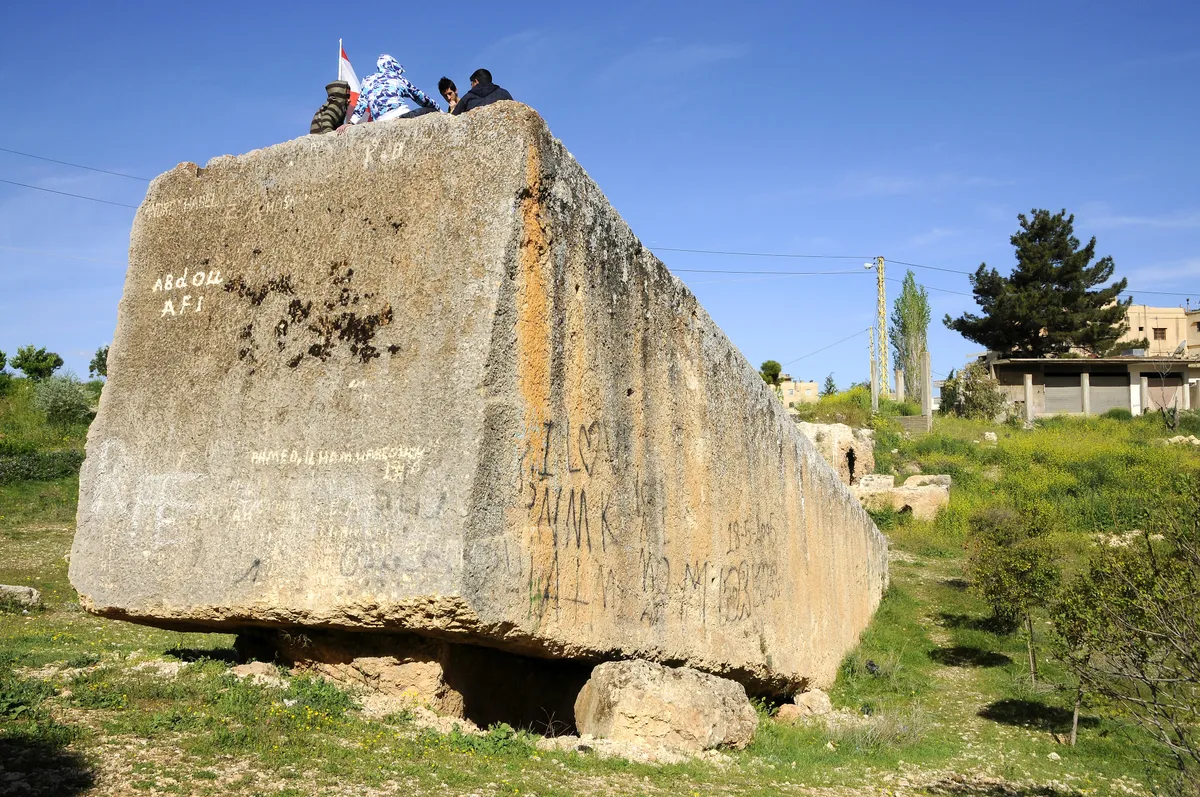
A short walk from the main complex leads to the ancient Roman quarry, where one limestone block — the Stone of the Pregnant Woman (Hajar el Hibla) — was cut from bedrock on three sides but never freed. It measures over 62 feet (19 meters) long and weighs an estimated 1,000 to 1,200 tons. That’s roughly the weight of three large commercial airplanes.
A second block in the same quarry, the “Stone of the South,” weighs up to 1,650 tons — likely the largest single stone block ever quarried in human history.
The realistic explanation is that a flaw was discovered during quarrying and the block was abandoned. Local legend tells of a pregnant woman who claimed she knew the secret to moving the stone if the townspeople fed her until she gave birth. I find the legend more entertaining than the engineering theories, and the contrast tells you everything about how this place gets under your skin.
How do you get to Baalbek from Beirut?
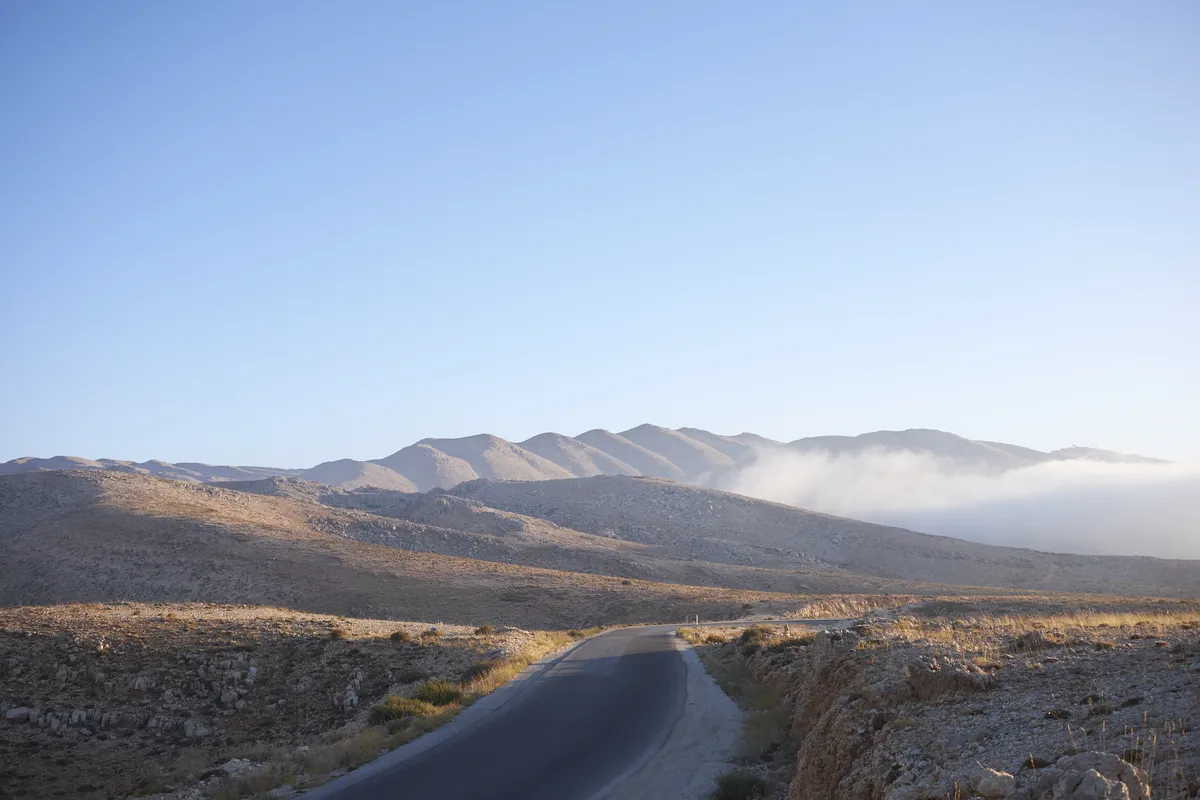
Baalbek sits about 53 miles (85 km) from Beirut, but the drive takes 1.5 to 3 hours depending on traffic and checkpoint activity. Three options matter, and renting a car in Lebanon yourself isn’t one I’d recommend — Lebanese driving plus military checkpoints is a combination first-time visitors should avoid.
Guided group tours — easiest option
- Cost: $55–$95 per person for a full day (8–9 hours)
- Includes: Often Anjar and Ksara winery, plus a guide
- Best for: First-time visitors who want zero logistics stress
- Trade-off: Fixed schedule, no flexibility on time at the ruins
Private taxi or driver — most flexible
- Cost: $95–$120 one way
- Travel time: 1.5–2.5 hours
- Best for: Couples or small groups who want a custom itinerary
- Trade-off: Most expensive option for solo travelers
Public minivan — cheapest option
- Cost: Around $8 one way
- Travel time: 2–4 hours including transfers
- Best for: Budget travelers comfortable with chaos
- Trade-off: Crowded, sometimes reckless driving, and the van may drop you 3 miles (5 km) from the site
What do you need to know before visiting the site?
The Baalbek ruins are open daily from 9:00 AM to 6:00 PM in summer and 9:00 AM to 4:00 PM in winter. Entrance is roughly $10 USD per person, with US dollars widely accepted alongside Lebanese pounds. Licensed guides are available at the gate for around $20 USD. The site itself is large, exposed, and almost entirely shadeless.
- Location: Baalbek town, Beqaa Valley, eastern Lebanon
- Cost: ~$10 USD entrance; ~$20 USD for a licensed guide
- Best for: History travelers, archaeology fans, photographers
- Time needed: 2–3 hours minimum; 4 hours if you visit the quarry
The shoulder seasons of spring (April to June) and autumn (September to November) deliver the best time to visit Lebanon for ruin-walking weather. Summer hits 95°F (35°C) and the stone radiates heat. Wear breathable clothing that covers shoulders and knees, sturdy shoes for uneven surfaces, and bring sunscreen, a wide-brimmed hat, and sunglasses — sun protection is non-negotiable.
Pro Tip: Arrive at 9:00 AM sharp. Tour buses from Beirut typically start rolling in around 11:00 AM, and the Temple of Bacchus interior is genuinely peaceful for the first 90 minutes of the day.
Where should you eat and stay in Baalbek?
The town’s signature dish is Sfiha Baalbakiyeh, small square-shaped meat pies that stand out among traditional Lebanese food and are noticeably different from the more common lahm bi ajin found elsewhere in Lebanon. The traditional way to eat them: buy fresh seasoned minced meat from a local butcher, then carry it to a nearby bakery (furn) where they bake the pies fresh on dough while you wait. Many local shops and bakeries close on Fridays, so plan accordingly.
For sit-down meals, Tavern Cezar sits directly opposite the ruins entrance and runs budget-friendly with generous portions. Baalbeck Palace is the more upmarket option for traditional Lebanese cuisine.
The Palmyra Hotel — staying inside history
Built in 1874, the Palmyra Hotel sits directly across from the ruins with temple views from several rooms. It has hosted Kaiser Wilhelm II, Charles de Gaulle, Jean Cocteau, Nina Simone, and Ella Fitzgerald over its 150 years, and the vintage furniture and old-world atmosphere are intact rather than reproduced.
- Location: Directly opposite the Baalbek ruins entrance
- Cost: Mid-range; varies seasonally
- Best for: History lovers who want atmosphere over modern amenities
- Time needed: Worth at least one overnight stay
What is the Baalbeck International Festival?
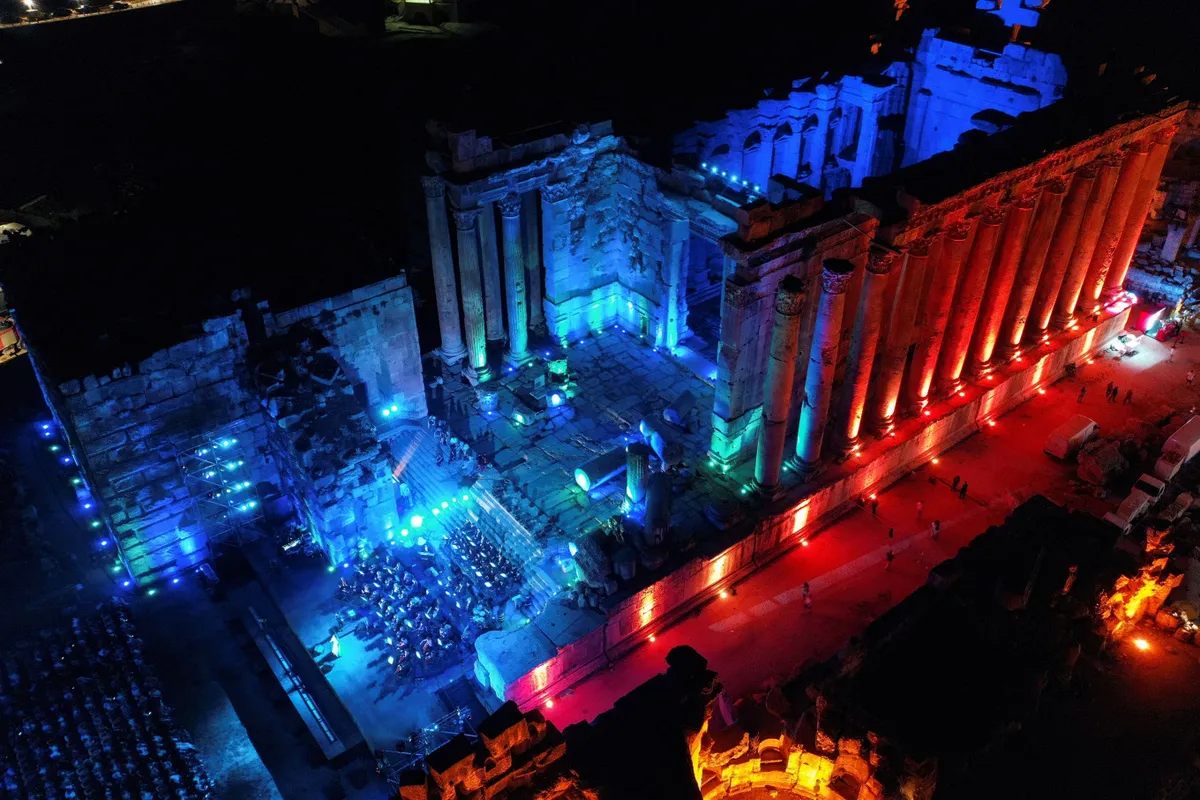
Since 1956, the ruins have hosted the Baalbeck International Festival — one of the Middle East’s most prestigious cultural events, with musical and dramatic performances staged inside the Temple of Bacchus and on the steps of the Temple of Jupiter. For dates, lineup, and ticket logistics, see our Baalbek International Festival guide.
What else can you see in the Beqaa Valley?
Most travelers pair Baalbek with two other sites that turn the trip into a full-day loop through Lebanon’s layered history.
Anjar — the Umayyad city built in 30 years
About an hour from Baalbek, Anjar is a UNESCO World Heritage site founded by the Umayyad Caliphate in the early 8th century AD. Unlike Baalbek’s organic growth over millennia, Anjar was built to a strict grid plan reminiscent of a Roman military camp, then abandoned after only 30 years — leaving a perfectly preserved snapshot of Umayyad urban planning.
Chateau Ksara — Lebanon’s oldest winery
A winery visit is the right way to end a day spent walking on ancient stones. Founded by Jesuit priests in 1857, Chateau Ksara is Lebanon’s oldest commercial winery, and tours include the Roman-era caves now used as cellars, followed by tastings. For a wider list, see the best wineries in Bekaa Valley to visit.
The bottom line
TL;DR: Baalbek holds Roman ruins on a scale you won’t find in Rome itself — the world’s tallest classical columns, an 800-ton wall, and a temple better preserved than the Parthenon. The site is safe to visit during stable periods, but US travelers should check the State Department advisory before booking and go with a reputable driver or tour rather than self-driving. Plan 2–3 hours on-site, arrive at 9:00 AM, and pair it with Anjar and Ksara for a full Beqaa Valley loop.
What part of Baalbek surprised you most — or what’s holding you back from booking the trip?