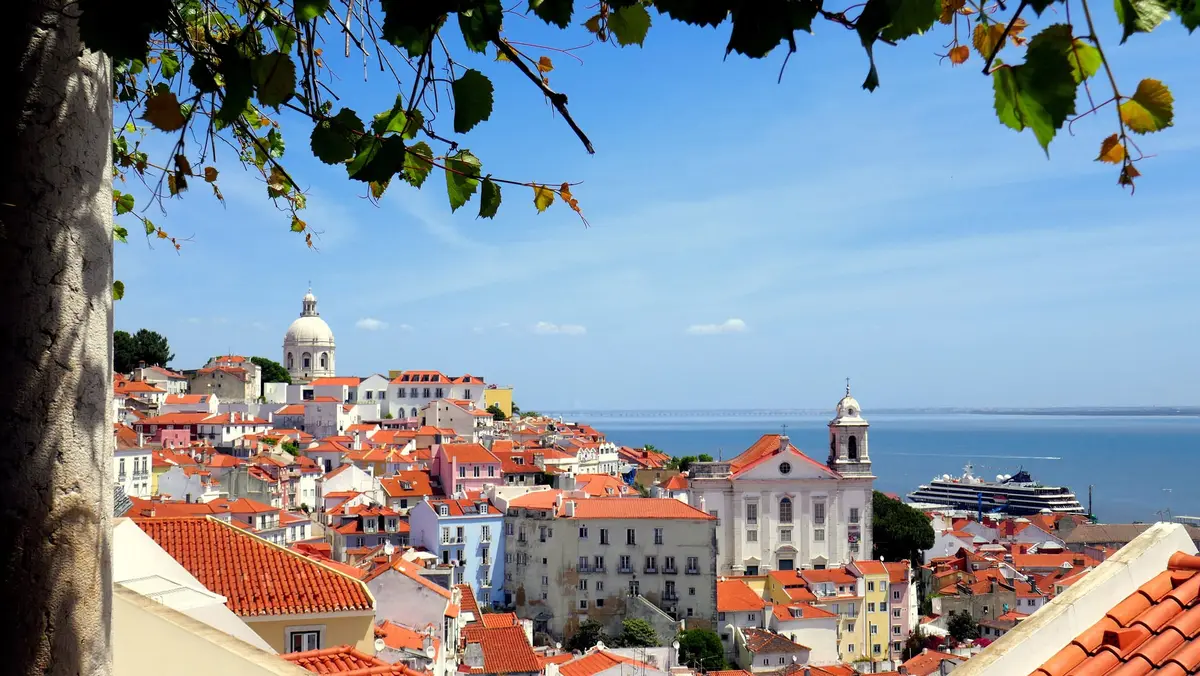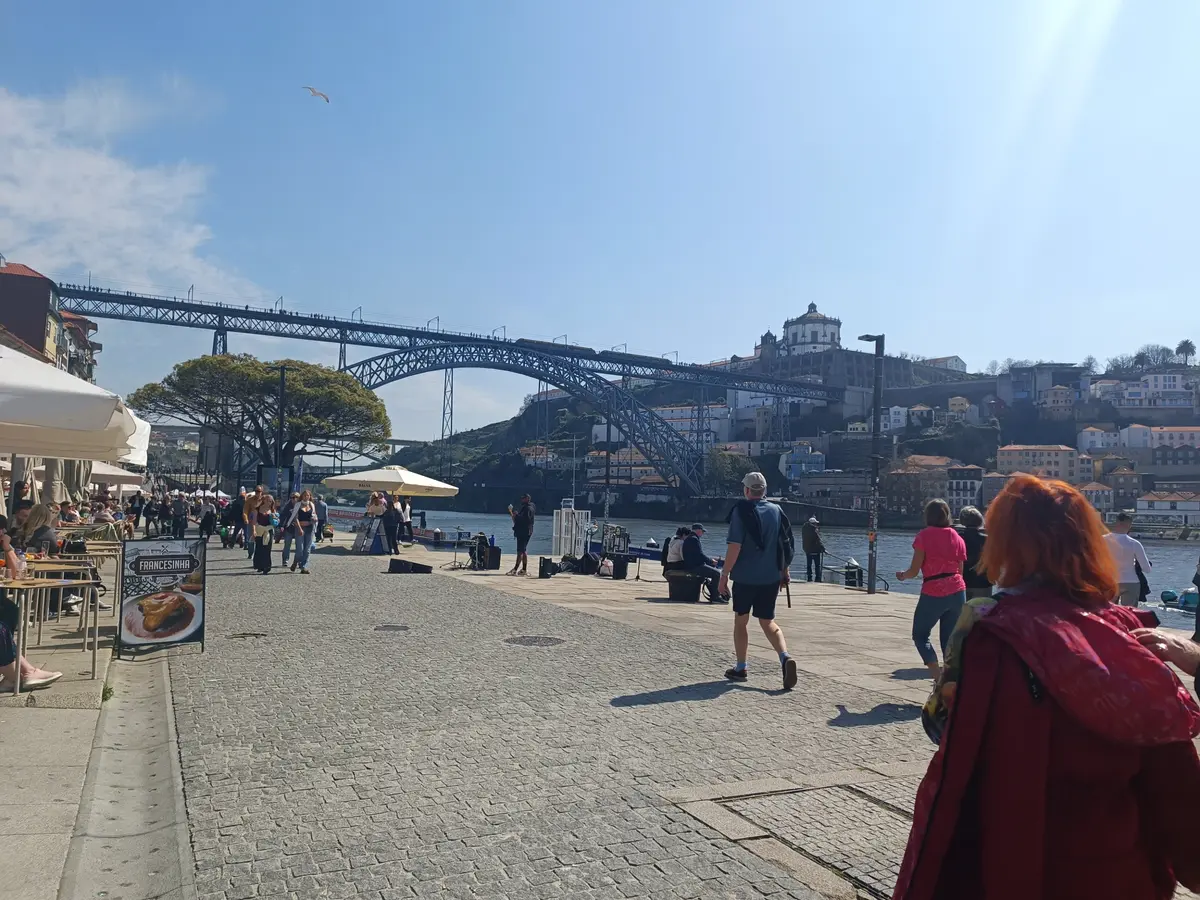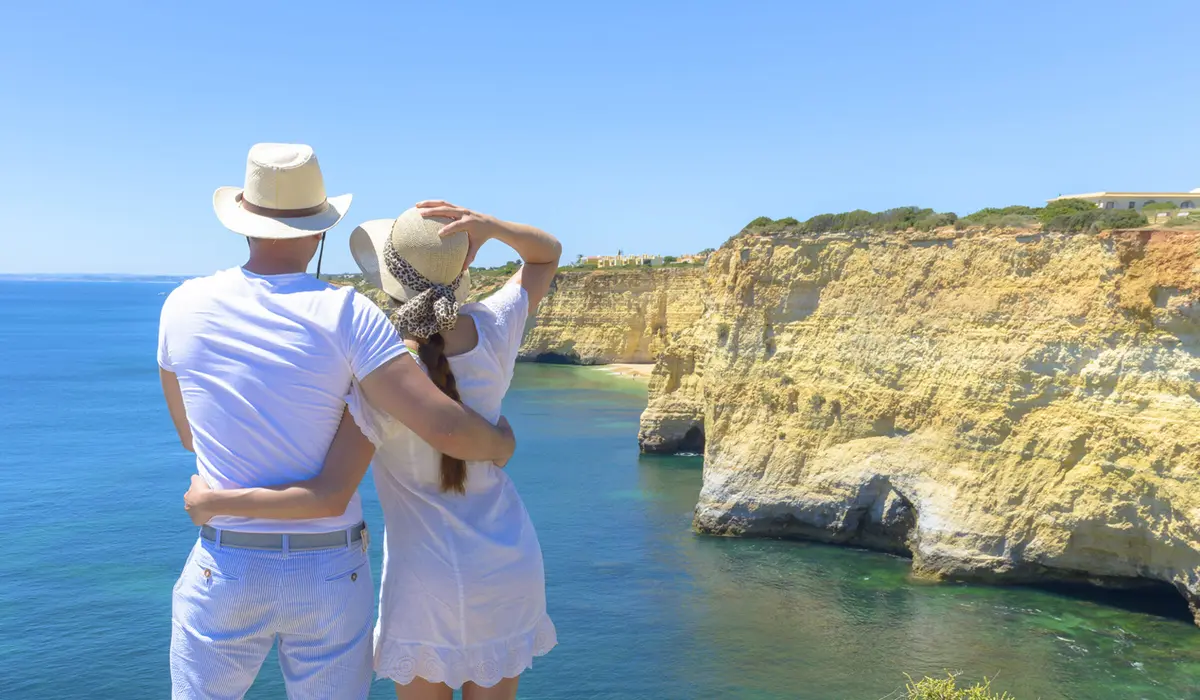

A 10-day Portugal itinerary has just enough room for Lisbon, Sintra, Porto, the Douro Valley and the Algarve — if you don’t lose days to the wrong legs. Here is the route day by day, with fares and entry prices checked against the operators themselves, plus the two costs and one cave rule most guides still get wrong.
The 10-Day Portugal Route at a Glance
- Days 1 to 3: Lisbon, Belém and a Sintra day trip
- Day 4: Lisbon to Porto by train
- Days 5 and 6: Porto and a Douro Valley day trip
- Day 7: Travel south to the Algarve
- Days 8 and 9: Lagos, Benagil Cave and the cliff beaches
- Day 10: Return to Lisbon, or fly out of Faro and reclaim a half day
The route runs Lisbon first, then north, then south. Starting and ending in Lisbon gives US travelers the widest set of direct flights home. The Lisbon-to-Porto train window also frames about three hours of cork-oak country and river valleys, so the travel days earn their keep instead of just burning daylight.
Is 10 Days Enough for Portugal?
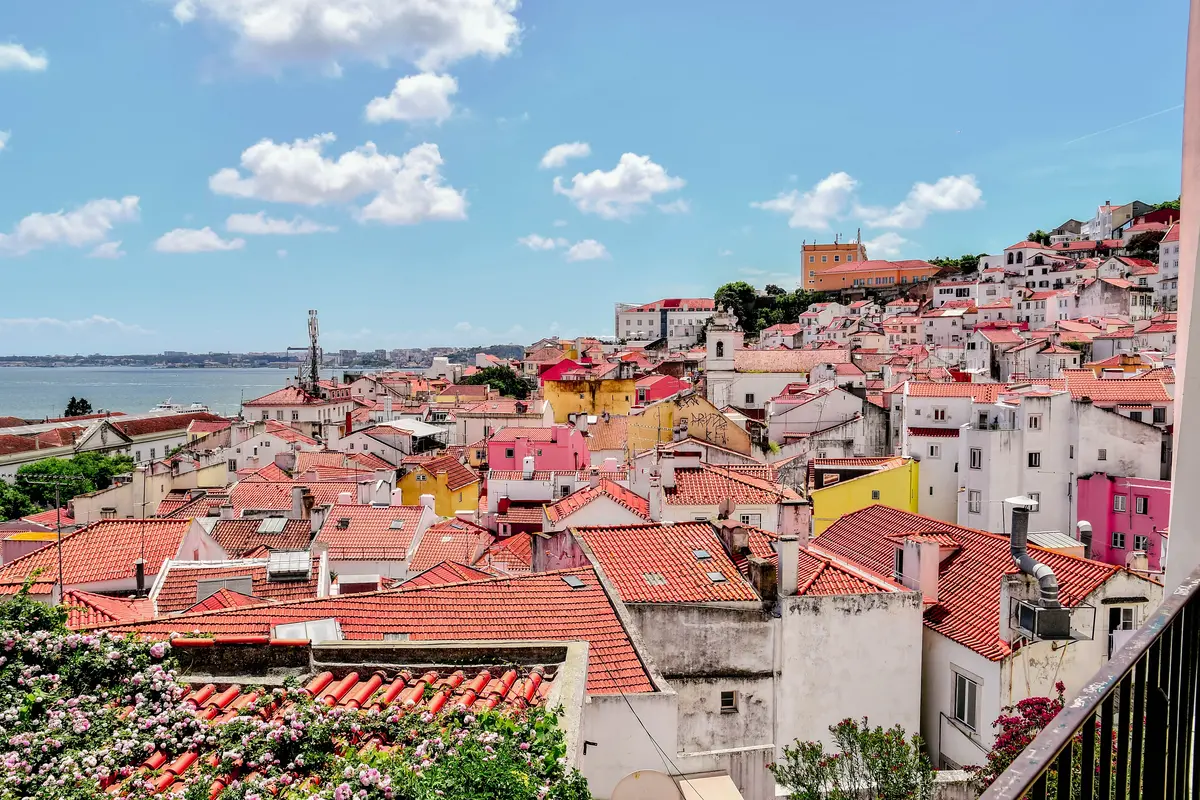
Ten days is the sweet spot for a first visit. It covers Lisbon, Porto and the Algarve, plus a Sintra day trip and a taste of the Douro Valley, without leaving you packing every morning. You trade depth for breadth. Nine days would force a cut; twelve would let you slow down.
Here is how the minimum dwell times shake out, based on what each place needs to feel worthwhile rather than rushed:
- Lisbon: 2 to 3 days (the city plus the Sintra day trip)
- Porto: 2 days (one for the city, one for the Douro)
- The Algarve: 2 to 3 days (one travel day, two on the coast)
By Day 7 the city-hopping has done its job, and a slow Algarve beach afternoon stops feeling like a luxury and starts feeling earned.
How Do You Get Around Portugal: Trains, Buses or a Car?
Trains connect Lisbon, Porto and the Algarve quickly and cheaply, so most 10-day trips run fine without renting a car. Rent one only for the Douro Valley, the Alentejo, or open-ended exploring along the Algarve coast — and drop it before you reach either big city, where hills and one-way grids turn a car into a liability.
There are two clean ways to run this route. Pick the track that matches your priorities.
The Train Track: Fares, Times and the Booking Trick
Comboios de Portugal raised fares across the network, so figures from older guides now run low. These are the current ones, published by CP:
- Lisbon to Porto, Alfa Pendular: about 2 hours 40 minutes to 3 hours; $41 (€35.70) in tourist class, or from about $11 (€9.50) on a promo fare booked 5 to 60 days out
- Lisbon to Porto, Intercidades: about 3 hours 15 minutes; $32 (€28.05) in second class
- Lisbon to Faro, Alfa Pendular: about 3 hours; roughly $37 to $48 (€32 to €42)
- Long-distance buses: Rede Expressos and FlixBus cover routes the trains skip, usually cheaper and slower
- Algarve local buses: Vamus links the coastal towns
Book direct on cp.pt or through the CP app. Tickets go on sale 60 days ahead, and the promo fares are the whole reason to book early — the same seat can cost four times as much bought on the day.
Pro Tip: When you book Lisbon to Porto, choose São Bento as your destination rather than Campanhã. The price is identical, and the free onward connection prints on your ticket with the departure time of the local train on it. Choose Campanhã and you get the same transfer, but you’ll be squinting at a departure board to find it.
The Self-Drive Track: Tolls, Costs and Where a Car Hurts
- Rental car: roughly $29 to $46 per day (€25 to €40), cheaper booked early
- Tolls: most highways use Via Verde electronic tolling. Rentals add a transponder for about $2 per day (€1.85), usually capped near $21 (€18.50). The A1 run from Lisbon to Porto alone costs about $25 (€21.50) in tolls — close to the price of the train
- Best use: the Douro Valley’s terraced backroads and the quieter Algarve beaches reward a car; the cities punish one
Drivers keep reporting the same thing about Porto: drop the car at the edge of the city and take the metro in. Circling for paid parking on cobbled one-ways can eat an hour you won’t get back.
Days 1 to 3: Lisbon, Belém and a Sintra Day Trip
Spend two days on Lisbon and the third on Sintra. It’s an efficient loop that hits the headline sights without doubling back.
Day One: Alfama, Baixa and São Jorge Castle
Start in the lower town. Praça do Comércio opens straight onto the river, and from there it’s an uphill climb through Alfama’s lanes to São Jorge Castle for the wide view back over the terracotta roofs.
Pro Tip: Board Tram 28 at the quieter Campo de Ourique (Prazeres) end rather than Martim Moniz. You’ll get a seat and watch the carriage fill as it grinds up the hills, instead of standing pressed against a window the whole route.
The Tram 28 route runs about 4.3 miles (7 km) in roughly 45 minutes. Paying the driver costs $3.75 (€3.30) and is cash only. Load a Navegante card with zapping credit at any metro machine instead and the same ride drops to about $2 (€1.72). If you’ll make four or more journeys in a day, the 24-hour Carris and Metro pass at $8.25 (€7.25) beats both. Current fares are published by Metro Lisboa.
Day Two: Belém and the Monastery
Day two belongs to Belém, about 4 miles (6 km) west along the water. Two prices here have moved, and most guides still quote the old ones:
- Jerónimos Monastery: $14 (€12) for the cloisters. The Church of Santa Maria next door is free, always
- Belém Tower: $9 (€8) to climb the five levels
- Getting there: Tram 15 or the riverside train from Cais do Sodré
You’ll read that these monuments are free on Sunday mornings. They are — for people who live in Portugal. Visitors pay the full price seven days a week, so don’t build a Sunday around a discount you can’t claim.
Pro Tip: Take the earliest morning slot at Jerónimos. The lines that wrap the building by late morning barely exist at opening, and the cloisters are quiet enough to actually hear the space.
Day Three: Sintra and the Pena Palace Climb
Take the train from Rossio station, about 40 minutes, and head straight for Pena Palace before the crowds thicken. Prices come from Parques de Sintra:
- Park and palace (the Essential Visit): $23 (€20) for adults, $21 (€18) for youth and seniors
- Park only: $14 (€12) — you still get the terraces, the gardens and the Chalet of the Countess of Edla, and a long look at the palace from outside
- The shuttle almost nobody books: $5 (€4.50) round trip between the park gate and the palace door
- Add-ons if you have energy: the Moorish Castle at $14 (€12), or Quinta da Regaleira
That shuttle matters more than it sounds. The time printed on your Pena ticket is the time you enter the palace, not the park — and the walk between the two gates takes about 30 minutes uphill. Travelers miss their slot over this constantly. Either build the half hour in, or pay the $5 and ride.

Where to Base Yourself in Lisbon (and the Two Tarts to Try)
Baixa or Chiado for first-timer convenience. Alfama for atmosphere and steeper stairs. Either way, build in a pastel de nata stop — the custard tart is Lisbon’s defining bite, and the two benchmark bakeries are worth a direct comparison.
- Pastéis de Belém: the original recipe. The custard is more savory and eggy, and the shell shatters. A box of six runs about $10 (€9)
- Manteigaria: the city-center favorite, served warm with a louder caramelized top
Single tarts run about $1.50 to $1.75 (€1.30 to €1.55) almost everywhere. For something savory, a bifana (thin pork sandwich) or a bowl of caldo verde (kale and potato soup) keeps a lunch under $11.
Pro Tip: Sprinkle the table cinnamon over a warm Pastéis de Belém tart before the first bite. Crisp shell, warm custard, a dusting of cinnamon — that’s the whole point, and most visitors walk right past the shaker.
Day 4: Lisbon to Porto, and the Station Trap
Treat Day 4 as a half travel day, not a write-off. The Alfa Pendular covers the 209 miles (337 km) to Porto in under three hours, which leaves a full afternoon and evening to settle into Porto’s old town.
Here’s the part that trips up first-timers. Trains from Lisbon arrive at Porto’s Campanhã station, on the edge of the city — a 35-minute walk from anywhere you want to be. Your ticket already includes the fix:
- The transfer from Campanhã to São Bento, in the heart of the old town, is free with any mainline ticket
- Local trains make the run every 5 to 15 minutes and take 4 minutes
- The free transfer is valid in the hour before or after your mainline train, so it isn’t an open-ended pass — use it on arrival
- Sit on the left heading into São Bento for your first look at the Douro and the iron bridge
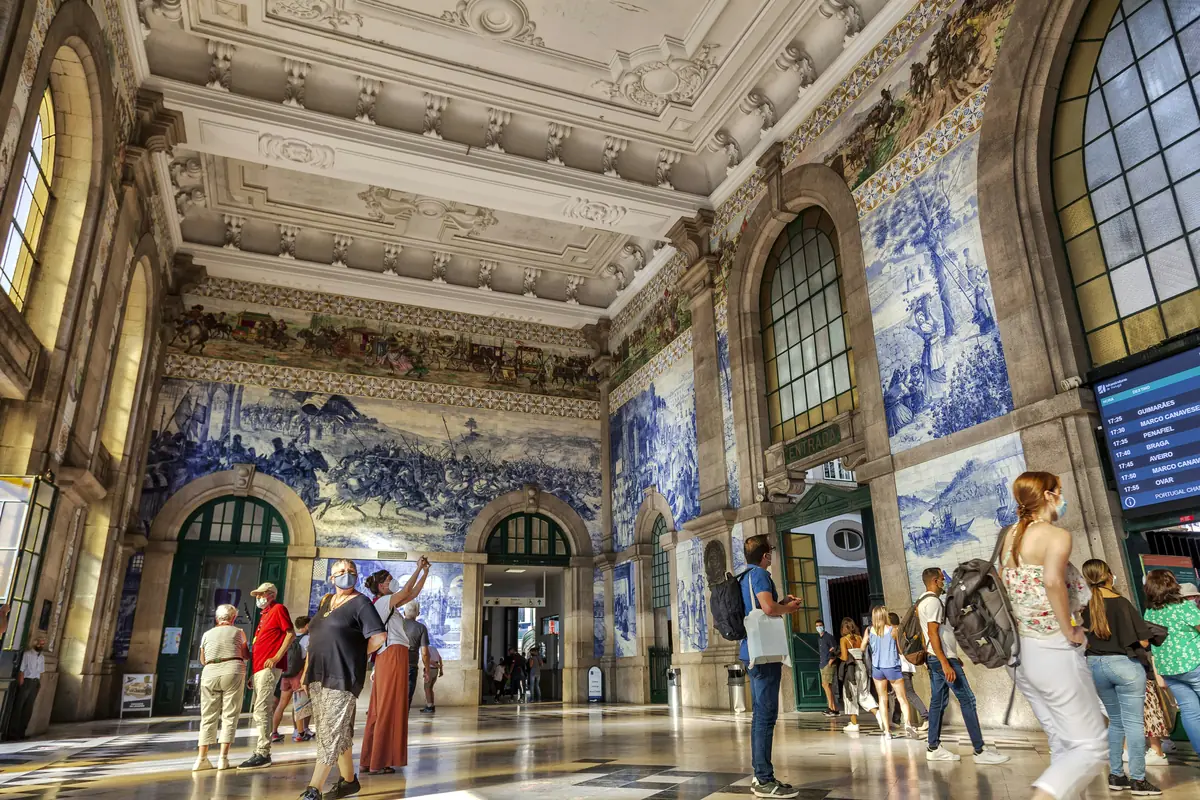
São Bento is worth arriving at for its own sake. The entrance hall is wrapped in about 20,000 blue azulejo tiles depicting Portuguese history, which beats stepping off onto a concrete platform.
Days 5 and 6: Porto and the Douro Valley
Give Day 5 to Porto itself and Day 6 to the Douro Valley.
Day Five: Ribeira, the Bridge and the Port Lodges
Porto on foot covers more than it looks. The Ribeira district stacks tiled houses above the river, and the upper deck of the Dom Luís I Bridge gives the best free vantage over the whole bend — you walk across it beside the metro line, and it costs nothing.
Across the water in Vila Nova de Gaia, the port cellars pour tastings of the fortified wine the city built its name on. Cálem is the busiest and the easiest introduction, from about $23 (€20). Croft, dating to 1588, reads more like a museum than a working cellar and finishes with three ports including the pink style it invented. Graham’s sits up the hill and rewards the climb with a view back over Porto; Cockburn’s runs closer to $46 (€40). Book the earliest slot of the day at any of them, because by mid-morning the tour groups arrive and the tastings get hurried.
Clérigos Tower costs $11 (€10) for the tower and museum, and the church at its base is free. It’s 240 narrow steps to a viewpoint 249 feet (76 m) up.
Day Six: The Douro Line to Pinhão
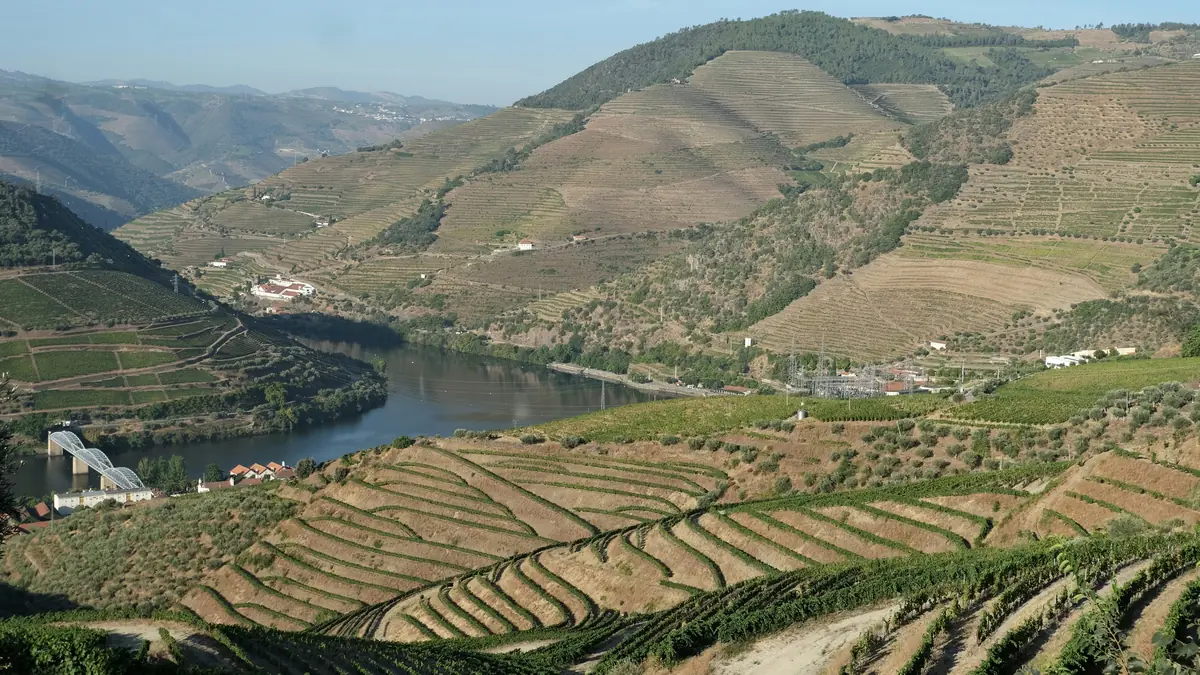
The train from São Bento up the river is the payoff, and it’s one of the best-value rides in Europe: about $14 (€12.45) each way to Pinhão, or $26 (€22.40) round trip, for roughly 2 hours 15 minutes of river.
Two things to know before you turn up at the station:
- Only two direct trains a day run from São Bento to Pinhão. Every other option on the timetable involves at least one change, usually at Régua. Check cp.pt and build the day around the direct departure
- There is no catering on board. Bring water and something to eat, or you’ll spend two hours looking at vineyards while hungry
Tickets on this line have no seat reservations and cannot sell out, so you can buy on the day. That also means seats go to whoever boards first.
Pro Tip: Sit on the right-hand side going out and the left coming back. The river runs on that side for the scenic stretch, and the wrong seat means staring at a rock cutting for an hour.
In Pinhão, Quinta do Bomfim is walkable from the station, and a rabelo boat trip on the river gives you the view up at the terraces rather than down at them.
Days 7 to 9: The Algarve Coast and Benagil Cave
Day 7 is the long haul south to the Algarve coast; Days 8 and 9 are for the cliffs and caves. From Lisbon it’s about 190 miles (300 km) by rail. From Porto it’s roughly 345 miles (555 km), so if you’re coming straight down from the Douro, a flight or a very early train saves real hours.
Where to Base Yourself: Lagos, Albufeira or Carvoeiro
Lagos
- Location: western Algarve, walkable old town inside the city walls
- Best for: first-timers who want to leave the car parked
- Getting to Benagil: boat tours from the marina, the longest and most scenic crossing
- Nearby: Ponta da Piedade, a cluster of gold rock arches and grottoes best seen from a small boat
Albufeira
- Location: central Algarve, the busiest strip on the coast
- Best for: restaurants, bars and a livelier night
- Getting to Benagil: boat tours from the marina, about 30 minutes by car to the cave village
- Trade-off: the most developed base, and it feels it in August
Carvoeiro
- Location: small clifftop town, closest of the three to Benagil
- Best for: a calmer, more scenic base
- Getting to Benagil: the shortest boat crossing on the coast
- Trade-off: quieter evenings, fewer dinner options
What the Benagil Rules Actually Let You Do
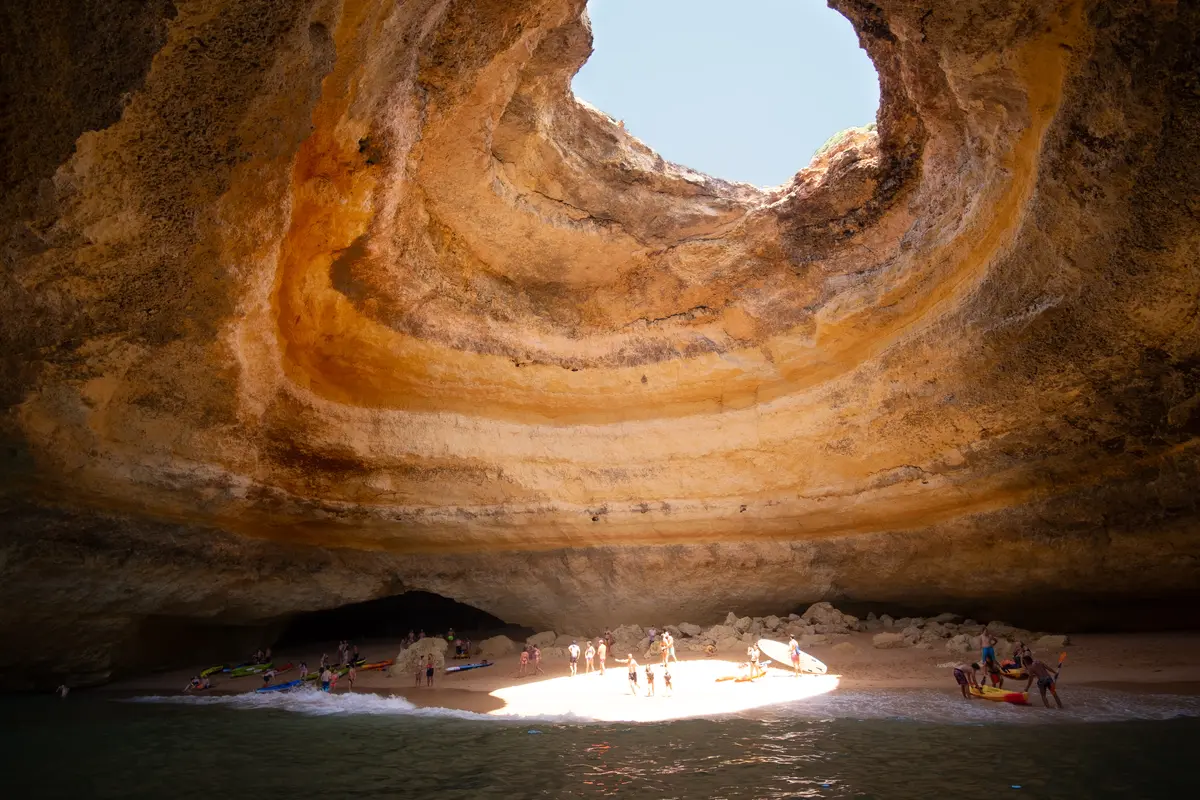
Benagil Cave is the domed sea cave with a hole in its roof, and the way you visit it has changed completely. The maritime authority in Portimão now governs access, and the rules are enforced with fines that run into six figures for operators. What that means in practice:
- You cannot swim into the cave. You cannot land on the sand inside it. Both are banned outright, for visitors and operators alike
- You cannot rent a kayak or SUP and paddle in on your own. Guided tours only, with one guide per six visitor kayaks
- Motorized boats get roughly two minutes inside the cave. Kayaks and paddleboards get about eight
- Boat tours run $29 to $57 (€25 to €50) and last two to three hours; guided kayak tours run $40 to $57 (€35 to €50)
Read those last two lines together, because that’s the honest math nobody prints: a two-hour boat tour buys you about two minutes inside the cave. It’s still worth doing — the rest of the coastline is the real product, and the tours pass sea caves and cliffs you can’t reach any other way. Just don’t book it expecting the empty-cave photo you saw online. That photo is no longer possible to take.
If you want time rather than a glimpse, take the kayak tour. Eight minutes and no engine noise is a different experience from two minutes and a churning propeller.
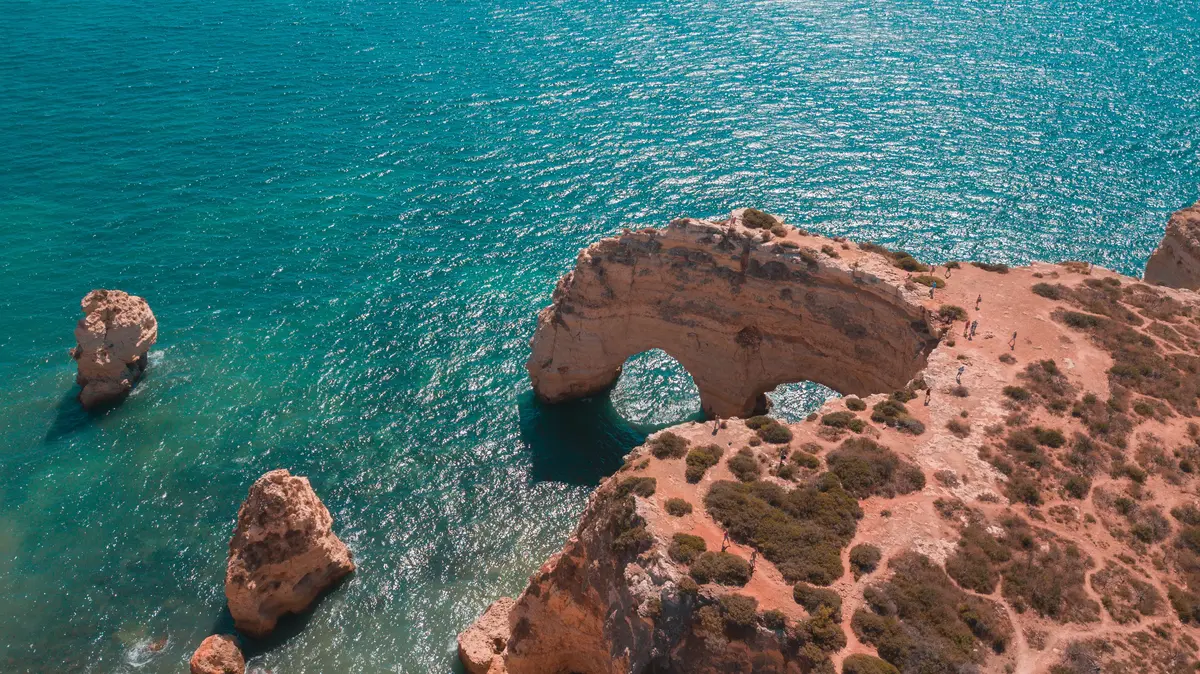
Praia da Marinha, the postcard beach with offshore rock stacks, sits nearby and is reached by a clifftop staircase. You can also walk the cliffs above Benagil for free and look down through the roof hole — the only way to see the cave without paying anyone.
Day 10: Getting Home From the Algarve
Day 10 is logistics. Either train back from the Algarve to Lisbon for a flight home, or fly out of Faro directly and reclaim a half day. Faro’s airport mainly serves European routes, so most US travelers connect through Lisbon either way.
- Faro to Lisbon by train: roughly 3 hours, putting you at Humberto Delgado Airport for an afternoon flight
- Fly out of Faro: skips the trip north entirely and can save half a day
- Lisbon airport access: the metro red line runs into the center in 20 to 25 minutes for $2.15 (€1.90), or about $2 (€1.72) on zapping credit, covering roughly 4.3 miles (7 km)
One last pastel de nata at the airport gate is a real Lisbon tradition, and the airport versions are better than they have any right to be. It’s a low-stakes way to end the trip.
How Much Does a 10-Day Portugal Itinerary Cost?
Budget around $150 to $200 per person per day, excluding the international flight. Lodging is the biggest variable and swings hardest by season. The fixed costs — trains, entries, one boat tour — come to roughly $210 to $260 per person across the whole 10 days, and unlike hotel rates, you can price them exactly before you go.
The Fixed Costs You Can Price Exactly
Here is how the Portugal trip cost breaks down for one person on the train-based version of this route:
- Lisbon to Porto, Alfa Pendular: $41 (€35.70), or from $11 on a promo fare
- Porto to Pinhão, round trip: $26 (€22.40)
- Lisbon to Faro, Alfa Pendular: about $41 (€36)
- Pena Palace, park and palace: $23 (€20)
- Jerónimos Monastery: $14 (€12)
- Clérigos Tower: $11 (€10)
- One port lodge tour and tasting: from $23 (€20)
- One Benagil boat tour: $29 to $57 (€25 to €50)
- Lisbon transport, card plus a week of zapping: about $20 (€17)
The Tourist Tax Nobody Budgets For
This one catches almost everyone, because it isn’t in the price you paid online. Portuguese municipalities charge a per-person, per-night tax collected by the property at check-in:
- Lisbon: $4.55 (€4) per person per night, capped at seven nights
- Porto: $3.40 (€3) per person per night, same cap
- Algarve towns: $1.15 to $2.30 (€1 to €2), and several charge it only from spring through fall
On this route — three nights in Lisbon, two in Porto, three on the coast — that’s about $27 per person, or $55 for a couple, handed over at reception in cash or on a card you thought you were done with. Children are exempt, though the cutoff age changes by city: under 13 in Lisbon, under 12 in Porto, under 16 in Faro.
What Everything Else Runs
- Lodging: a mid-range hotel in Lisbon or Porto runs $115 to $170 (€100 to €150) a night. The Algarve is the wild card — a room at $170 (€150) in May can hit $340 to $455 (€300 to €400) in August
- Lunch: order the prato do dia. A full plate, often with wine, runs $9 to $14 (€8 to €12)
- Dinner: $23 to $34 (€20 to €30) with wine at a neighborhood restaurant; more in the tourist strips
- Coffee: an espresso is about $1 standing at the counter
Small costs are the silent budget killer here. A few euros for a tram, a few for a tart, a few for a viewpoint. None of it stings alone, but it compounds across 10 days — which is exactly why the zapping card pays for itself in about three rides.
When Is the Best Time to Visit Portugal?
Late spring and early fall are the best windows to visit. Roughly late April through early June, and mid-September through early November, deliver warm days and thinner crowds. Summer brings heat and packed beaches; winter stays mild in the Algarve but cooler up north. Shoulder season is the comfortable middle, and it’s cheaper.
- Summer: Lisbon highs around 82°F (28°C), the Algarve around 86°F (30°C), and the heaviest crowds
- Spring and fall: comfortable days, shorter lines, and hotel rates 30 to 40 percent below the summer peak
- Winter: mild in the Algarve, cooler in Porto, which ranges roughly 43 to 76°F (6 to 24°C) across the year
- Festival timing: the Santos Populares fill Lisbon’s streets in June, São João turns Porto into a street party, and the Douro harvest peaks in early fall
The Douro is at its best when the vineyards turn gold during the harvest — the single strongest argument for timing this trip to autumn rather than summer.
What Should US Travelers Know Before Booking?
Portugal is in the Schengen area, so US passport holders can visit for up to 90 days in any 180-day period without a visa. Your passport needs at least three months of validity beyond the date you leave Europe. Two things at the border have changed, and one is still coming.
- Entry/Exit System (EES): live now. Instead of a passport stamp, you give fingerprints and a facial scan on arrival. It’s free, needs no advance application, and records your entries and exits automatically
- ETIAS: not live yet. When it launches, visa-exempt travelers including Americans will need to apply online before flying — about €20, valid three years, approved in minutes. Anyone selling it to you now is running a scam. Confirm the current status on the official EU portal before you book
- Airport timing: build in extra time at Lisbon in summer. Biometric processing has produced long queues at the busier Mediterranean airports during peak months
Pro Tip: TAP Air Portugal lets US flyers add a free stopover in Lisbon or Porto on the way to another European city. If Portugal is one leg of a bigger trip, that can fold a couple of days into a flight you were already taking.
What to Skip, and What to Add Instead
Most guides list everything. The better move is choosing. Four calls worth making:
- Belém Tower interior: skip it. The climb costs $9 (€8) and draws long lines for a modest view. In its defense, the interior covers five levels and holds the rhinoceros carved into the northwest turret, one of the earliest stone rhinos in Europe. But the outside is the photogenic part, and Jerónimos next door rewards the same hour far more
- The AeroBus: ignore the old advice. It was discontinued. Use the metro red line into Lisbon instead, for about $2
- The route home: flying out of Faro can reclaim a half day over backtracking to Lisbon
- The Costa Vicentina: add it. Trade a day on the resort strip for the wilder, near-empty beaches of the Costa Vicentina on the west coast. Colder water, dramatic cliffs, a fraction of the crowd
Before You Book Your First Night
This route works because it moves in one direction and only asks you to unpack three times. Lisbon and Sintra, then Porto and the Douro, then the Algarve. Take the trains between cities, rent a car only for wine country and the quiet coast, and time it for spring or fall.
It is not the right route for someone who wants to know one place deeply — ten days spread across five destinations is a survey, not a deep dive. If that’s what you’re after, cut the Algarve and give the days to the north.
For everyone else, the honest summary is this: book the promo train fares the day they open, buy the Pena ticket with the shuttle, and put the money you save on the Belém Tower climb toward a longer kayak tour at Benagil. The rest of it takes care of itself.