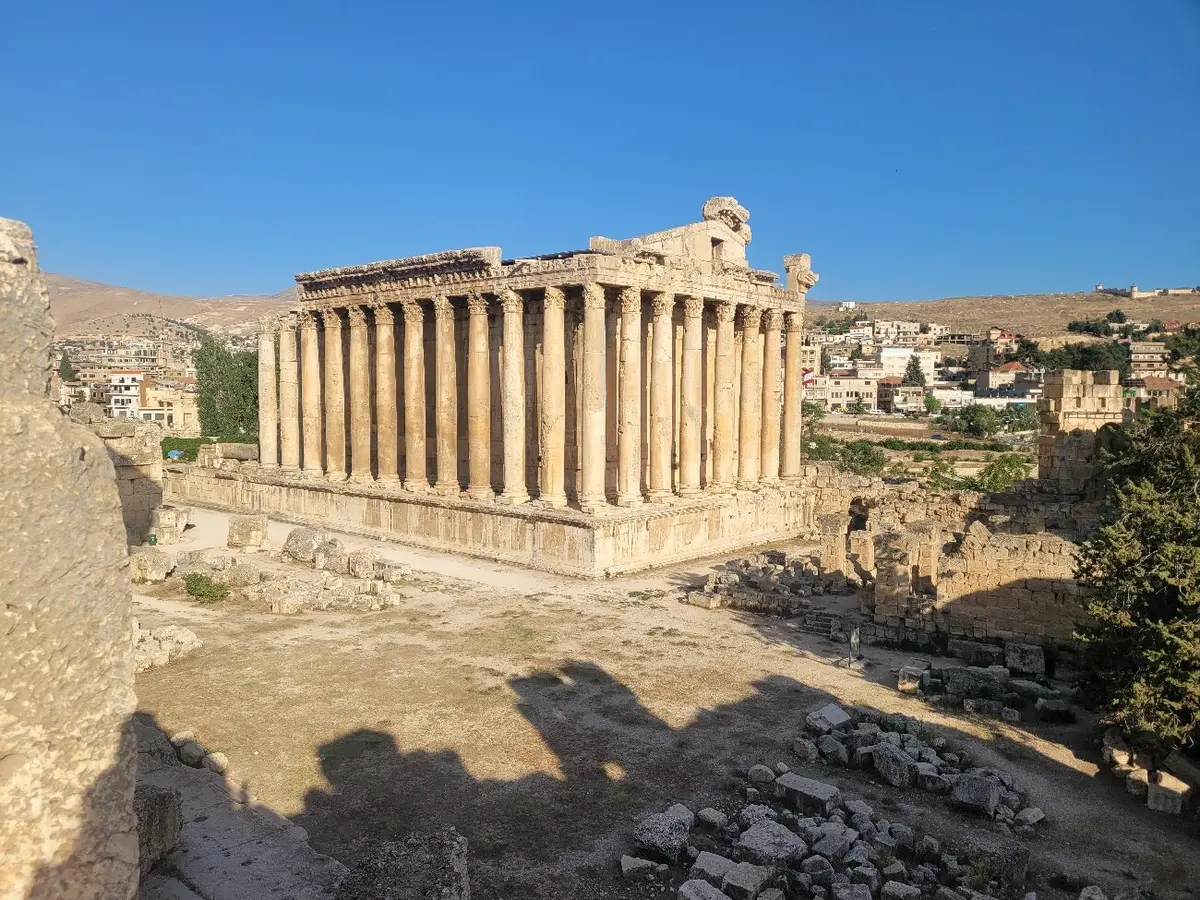
The Baalbek Temple of Bacchus is the best-preserved Roman temple anywhere in the world — bigger than the Parthenon, with 19 of its original 42 Corinthian columns still standing 62 feet (19 m) tall. It’s also sitting in the middle of an active conflict zone. Here’s the history, the architecture, and the honest answer about whether you can visit.
How old is the Baalbek Temple of Bacchus, and who built it?
The Baalbek Temple of Bacchus was commissioned around 150 CE during the reign of Emperor Antoninus Pius, with construction continuing into the Severan dynasty. The site itself is far older — archaeologists have found pottery dating to around 9000 BCE and continuous habitation since at least the Early Bronze Age (2900-2300 BCE), when Phoenicians worshipped a vegetation god named Adon on the same ground.
Unlike the state-funded Temple of Jupiter next door, the Bacchus temple was paid for by a consortium of local cities and wealthy donors. That’s an important clue. The decoration is denser, the craftsmanship more obsessive, the iconography more personal — what you build when the bill isn’t going to Rome.
The name “Baalbek” itself is a linguistic fossil from the Semitic past: “Baal” (Lord) of the “Bekaa” (Valley). When Alexander the Great rolled through in 332 BCE, the city was renamed Heliopolis — “City of the Sun” — and the local gods received Greek makeovers. Pompey annexed Phoenicia in 64 BCE, and Roman construction began on the colossal scale that defines the ruins today.
Pro Tip: Don’t skip the on-site museum tucked into the vaults beneath the Temple of Jupiter platform. It contextualizes the Phoenician layers most visitors walk past on their way to the columns.
Why is this temple called the “Small Temple”?
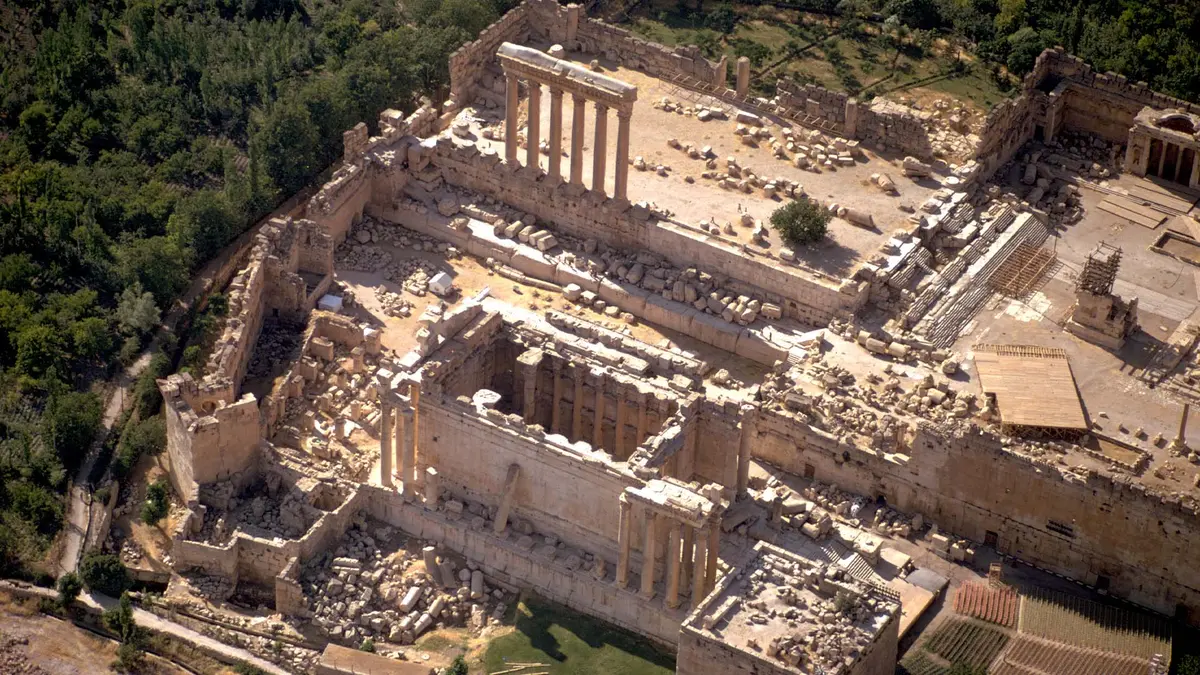
The Temple of Bacchus measures 216 feet (66 m) long, 115 feet (35 m) wide, and 102 feet (31 m) tall — roughly 25% larger than the Parthenon. It has been called the “Small Temple” for centuries only because it sits beside the colossal Temple of Jupiter, which was once the largest Roman temple ever built outside Italy. Scale here is relative.
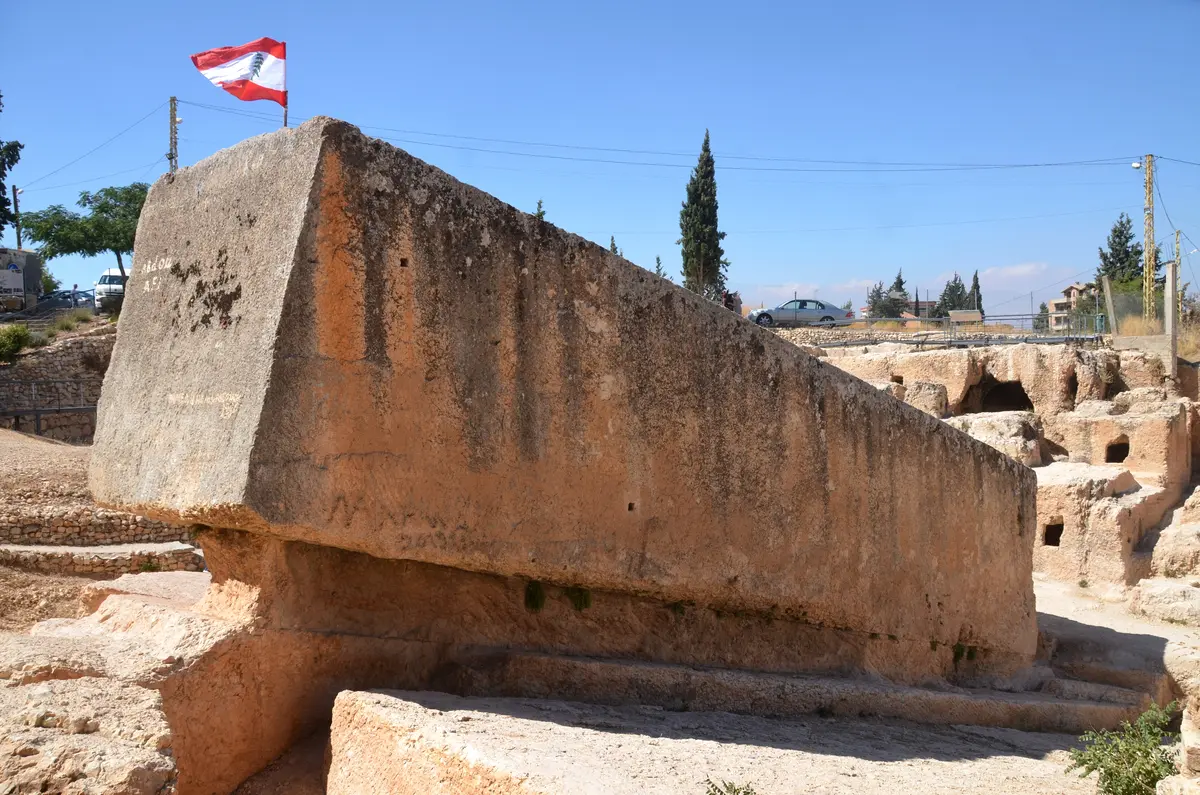
The Temple of Jupiter’s six surviving columns (out of an original 54) tower 65 feet (20 m) high, and its base sits on three of the largest cut stones ever moved by human hands — the Trilithon, with each block weighing more than 800 tons. Standing next to that, of course Bacchus looks small. Compared to anything else in the Roman world, it isn’t.
What does the Baalbek Temple of Bacchus look like up close?
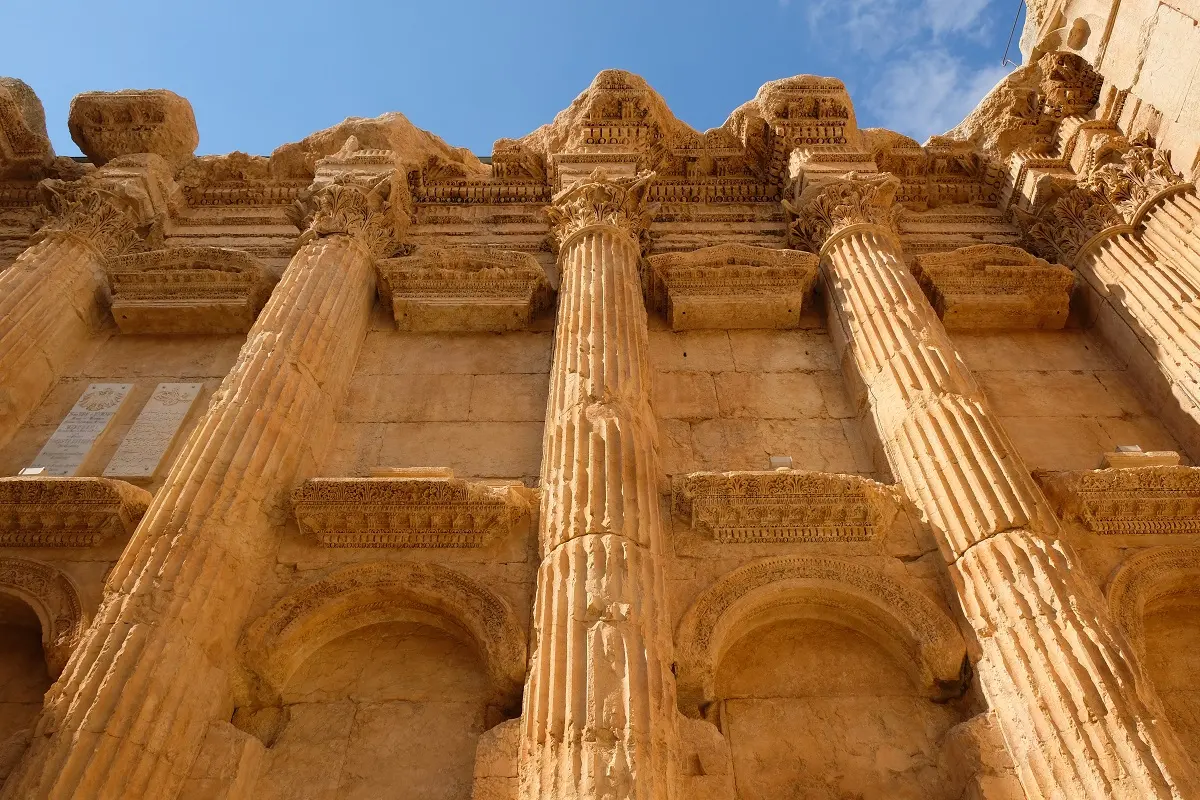
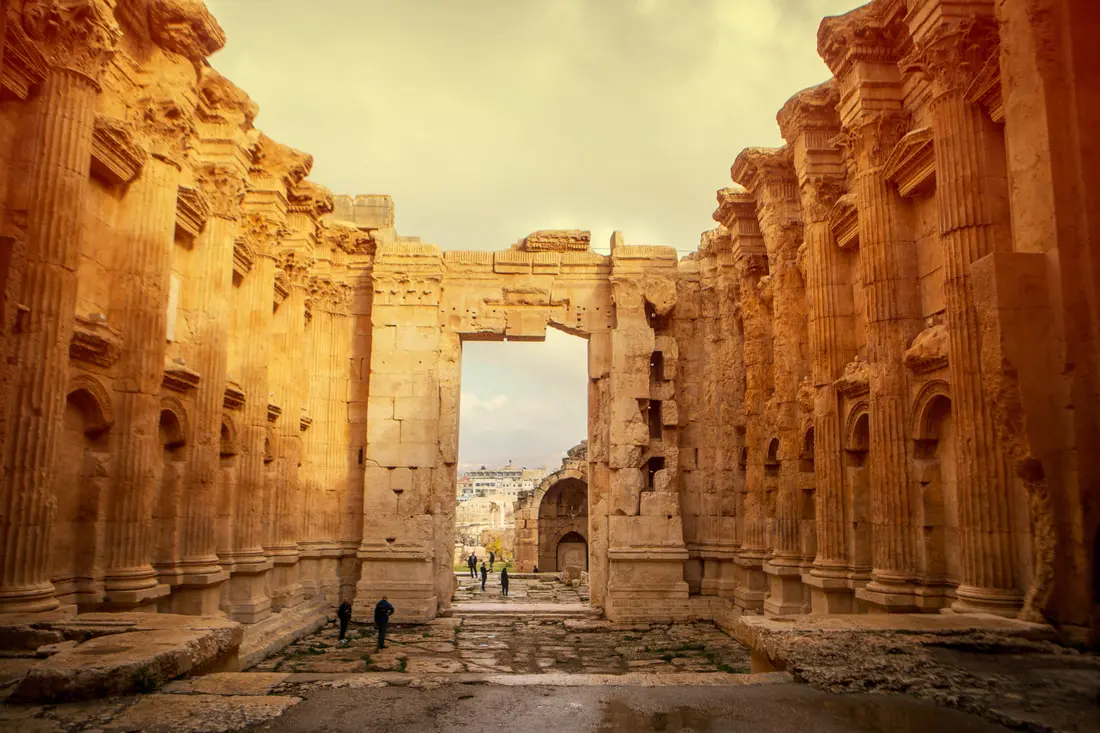
Nineteen of the original 42 unfluted Corinthian columns still stand, each 62 feet (19 m) high, with intact capitals and surviving entablature. A monumental 36-foot (11 m) portal frames the inner chamber, carved with vines, grapes, ivy, poppies, satyrs, Pan, and small Cupids. Inside, the cella runs 98 feet (30 m) deep, ending at a raised inner sanctuary reached by 13 steps.
The 42 Corinthian columns
Each column is built from three limestone drums joined with iron dowels set in lead. This dry-joint technique was deliberate — it allowed the columns to flex slightly during earthquakes rather than snap clean. It’s the reason 19 are still upright after almost two thousand years and at least three documented major seismic events.
Whether the unfluted (smooth) surface was an intentional design choice or a sign the temple was never finished is still debated. Given the obsessive fluting and detail on every other surface, the smooth shafts feel like a contrast — but they could just as easily be unfinished work the project simply ran out of time for.
The monumental portal and the suspended keystone
The 1759 earthquakes did real damage here, including to the keystone — the central wedge-shaped block at the top of the door lintel. It slid downward by about 2 feet (0.6 m) but never fell. It wedged itself between the two flanking blocks and stayed there, suspended.
A column of rough masonry was built underneath in the 1860s or ’70s to prevent the whole lintel from collapsing, which sadly hides the most famous detail: a soffit carving of an eagle gripping a caduceus (Mercury’s staff) in its talons. You can still see fragments of it on either side of the support pillar if you stand directly underneath and tilt your head back.
Inside the cella
The interior is divided into a 98-foot (30 m) nave and a raised 36-foot (11 m) adytum, or inner sanctuary, set 5 feet (1.5 m) above the main floor. Two tiers of niches line the side walls, framed by Corinthian half-columns and decorated with reliefs depicting scenes from the birth and life of Bacchus. The parapets carry dancing Maenads — the female followers of the god, which is part of why the Bacchus attribution stuck.
A fallen section of the ceiling lies on the cella floor, which is actually a gift to visitors. You can examine the carving up close at eye level, something almost impossible at any other Roman temple where the ceiling is either gone entirely or still 60 feet overhead.
How did medieval fortifications save the temple?
After the Muslim conquest of the region in 636 CE, Arab military engineers converted the temple complex into a defensive fortress. They filled the gaps between the columns with masonry walls, turning the open colonnade into a fortified perimeter. This accidentally shielded the carvings from wind erosion and absorbed seismic shock during the earthquakes that toppled neighboring structures.
The Temple of Jupiter, larger and more exposed, lost almost all its columns. The Temple of Bacchus, encased in centuries of military stonework, survived almost intact. By the time European antiquarians began seriously studying the site in the 19th century, the medieval walls were removed and the Roman temple inside emerged remarkably preserved. A German archaeological expedition in 1898-1903 excavated the major temples and began the reconstruction work that defines the visitor experience today. The full complex was inscribed as a UNESCO World Heritage Site in 1984, alongside several of Lebanon’s other major archaeological sites.
Pro Tip: The contrast in preservation between the Bacchus and Jupiter temples is the single best argument-by-evidence for the value of accidental conservation. Worth stopping between the two and taking a photo that captures both.
What’s the Phoenician backstory behind the Roman ruins?
Before Romans arrived, this was a cult center for a Phoenician trinity. Adon — the dying-and-rising vegetation god — was syncretized with Bacchus through interpretatio romana after Pompey annexed Phoenicia in 64 BCE. The carved vines, wheat, poppies, and grapes covering the temple aren’t generic Bacchic decoration. They reflect 4,000 years of continuous fertility worship at this exact spot, tied to the agricultural cycles of the Bekaa Valley.
The original Phoenician trinity worshipped here:
- Baal-Hadad: the storm god
- Atargatis: the fertility goddess
- Adon: the vegetation deity (later syncretized as Bacchus)
The Bekaa Valley was one of the most fertile farming regions in the ancient Near East and remains one of Lebanon’s primary wine-producing areas today. That continuity is why the Bacchus attribution, while not officially confirmed by inscription, is widely accepted. The decorative program is too consistent with what was already worshipped here to be coincidence.
Is it safe to visit Baalbek right now?
No. As of April 2026, the US State Department maintains a Level 4 “Do Not Travel” advisory for all of Lebanon, with the Bekaa Valley — where Baalbek sits — specifically named as one of the highest-risk regions. Israeli military operations against Hezbollah targets continue in the Bekaa Valley, the State Department has ordered the departure of non-emergency US personnel, and most international airlines have suspended scheduled flights to Beirut.
This isn’t the cautious, hedge-everything advisory tone the State Department applies to dozens of countries. The most recent update on February 23, 2026 ordered the actual physical departure of non-emergency US government personnel and family members from Lebanon. The US Embassy in Beirut has suspended routine consular services. The April 3 security alert from the embassy notes that airstrikes, drones, and rocket attacks occur throughout the country, particularly in the south, the Bekaa, and parts of Beirut.
What the US State Department says
- Travel Advisory Level: 4 (Do Not Travel) — the highest tier
- Specific high-risk regions: southern Lebanon, the Bekaa Valley, the Lebanon-Syria border, Beirut’s Dahieh suburb
- Embassy status: routine consular services suspended; non-emergency personnel ordered to depart
- US citizens already in Lebanon: strongly urged to depart while commercial flights remain available
What this means on the ground
The Bekaa Valley is not a quiet rural detour from Beirut anymore. It’s been a primary target of Israeli airstrikes since the conflict escalated in late 2024, and operations resumed in early 2026 despite a brief US-Iran ceasefire announced on April 7. Israeli leadership confirmed that the ceasefire does not extend to Lebanon. On April 8-9, Israel launched what it described as its largest offensive yet against Hezbollah targets across Beirut, southern Lebanon, and the Bekaa Valley.
Most international carriers have suspended Beirut service. As of mid-April 2026, only Middle East Airlines (MEA) and Royal Jordanian operate scheduled flights. The European Aviation Safety Agency (EASA) advisory effectively shuts down most European and international carriers from operating in the airspace. Travel insurance for Lebanon is largely uninsurable through major carriers.
If you’re an American with no compelling reason to be in Lebanon, the answer right now is straightforward: don’t go. The Baalbek ruins will still be there when conditions change. They’ve been there for 1,876 years.
Pro Tip: If you want to monitor changing conditions in real time without bouncing between dozens of news sources, enroll in the State Department’s STEP (Smart Traveler Enrollment Program) — even if you’re just researching for a future trip. You’ll get alerts the moment advisories change.
How much does it cost to visit Baalbek?
When travel becomes possible again, foreigners pay a fixed entrance fee of 1,000,000 LBP — about $11 USD at the April 2026 exchange rate of roughly 89,550 LBP per dollar. Add roughly $20 USD for a local guide inside the ruins, $10-$20 USD for lunch in town, and $90-$200 USD per person for a full-day private trip from Beirut, including the Anjar Roman ruins and Ksara Winery on the same loop.
A realistic budget breakdown when conditions allow:
- Entrance fee (foreigners): 1,000,000 LBP (~$11 USD)
- Local guide inside the ruins: ~$20 USD per group
- Lunch in Baalbek town: $10-$20 USD per person
- Private driver day trip from Beirut: $90-$200 USD per person
- Group day tour from Beirut: typically $90-$120 USD per person
Lebanon operates largely as a cash economy, and the banking system has been in collapse since 2019. Credit cards are rarely accepted outside high-end establishments in Beirut. Crisp, new US $100 bills are the de facto currency for tourist transactions — older, marked, or torn bills are often refused outright.
What’s the best way to get from Beirut to Baalbek?
Baalbek sits about 53 miles (85 km) northeast of Beirut in the Bekaa Valley, roughly a 90-minute drive on the main highway through the mountains. When the route is open to tourists, three transport options exist: a private driver (safest, most flexible), an organized small-group tour (cheaper per head, less flexibility), or the public minivan (cheapest, with significant driver-quality concerns).
Private driver
This is the option most independent travelers historically chose. A private driver knows the checkpoints, speaks Arabic with the security forces, and can route around any flashpoint on the day. You can combine the Baalbek visit with stops at the Anjar Umayyad ruins (another UNESCO site) and Ksara Winery in a single full-day loop. Cost typically lands between $90 and $200 USD per person depending on group size and inclusions.
Organized group tour
When tour operators are running — and many are not at the moment — small-group day trips from Beirut typically include door-to-door transport, an English-speaking guide, and the same Anjar/Ksara loop. The tradeoffs are predictable: less flexibility on timing, fixed lunch stops, and less ability to spend extra time in the temple if it grabs you. Pricing runs roughly the same as a shared private driver, around $90-$120 USD per person.
Public minivan
Public minivans depart from the Cola Junction transit area in Beirut and run to Baalbek for about $10-$15 USD round trip. Locals call them “vans of death” — and they’re not joking. Speeds are aggressive, seatbelts are aspirational, and the drivers know the route too well. Even seasoned backpackers tend to skip this option for the Bekaa run specifically.
Pro Tip: If you’re booking a private driver, agree on the price in cash USD before you get in the car, and bring exact change. The exchange rate volatility means quotes given in LBP can shift by the time you finish the day.
When’s the best time to visit?
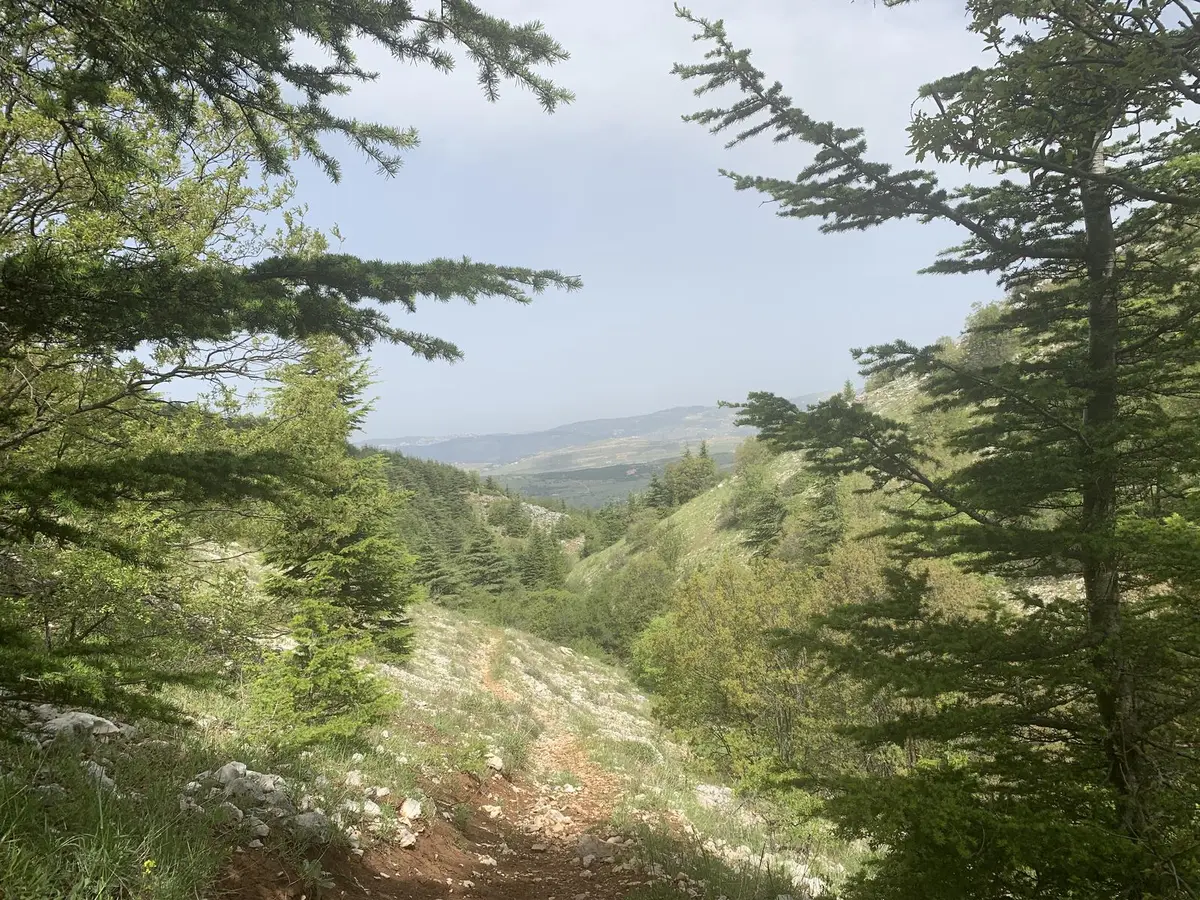
The Bekaa Valley sits at 3,770 feet (1,150 m) elevation, which makes it noticeably cooler than coastal Beirut. When you’re picking the best time to visit Lebanon, spring (April-May) and autumn (September-October) deliver the best combination — daytime temperatures in the 65-77°F (18-25°C) range, cool evenings, and clear skies for photography. Summer pushes into the 90s°F (32°C+), and winter brings cold rain and occasional snow that closes the road.
For photographers, the golden hour before sunset is genuinely worth planning around. The limestone columns turn from pale gray to deep gold and orange in the last 30 minutes before sundown, and the eastern face of the Temple of Bacchus is the side most directly hit by that warm light. The site closes at 6 PM in summer and 4 PM in winter, so timing the golden hour requires checking sunset against closing time for your specific date.
Friday is also worth flagging — most restaurants and shops in Baalbek town close that day. The ruins themselves stay open, but you’ll have a hard time finding lunch.
Before you book
The Baalbek Temple of Bacchus history is one of the most rewarding pieces of Roman architecture left standing anywhere in the world — and the trip to Baalbek itself is currently impossible to recommend in good faith. That tension is the whole story of this site: a 1,876-year-old monument that has survived earthquakes, conquests, and centuries of military repurposing, sitting in a region where the political situation can shift faster than you can rebook a flight.
TL;DR: The Baalbek Temple of Bacchus is bigger and better-preserved than the Parthenon, with 19 columns still standing 62 feet tall and a 1759-earthquake keystone suspended in midair. As of April 2026, the US State Department’s Level 4 “Do Not Travel” advisory makes a visit irresponsible. When conditions stabilize, expect to pay about $11 USD to enter, plan for spring or autumn, and budget $90-$200 USD per person for a full day trip from Beirut.
Have you been to Baalbek before the current conflict — or is it still on your list for the future? Drop your story or your questions in the comments.