A coastal road trip is the best way to see America — and the hardest to pick, with the Pacific Coast Highway, Oregon’s US-101, the Florida Keys Overseas Highway, North Carolina’s Outer Banks, and Maine’s Route 1 all fighting for your week. This guide compares them on miles, days, cost, and season so you choose right the first time.
For most travelers the Pacific Coast Highway (California Highway 1) is the best all-round coastal road trip: 656 miles (1,056 km) of cliffs and beaches from the Bay Area to Orange County, ideally over 4–7 days, with September delivering the clearest skies. For a shorter trip, the 113-mile (182 km) Florida Keys Overseas Highway wins.
How to Choose Your Coastal Route (Start Here)
Pick by time and coast. The Florida Keys Overseas Highway (113 miles / 182 km) suits a long weekend; the Pacific Coast Highway (656 miles / 1,056 km) and Oregon’s US-101 (363 miles / 584 km) need a week; Maine’s Route 1 rewards fall, the Outer Banks summer. Below, every route is compared on miles, days, season, and cost.
| Route | Distance | Drive Time Nonstop | Days Recommended | Best Season | Ballpark Cost |
|---|---|---|---|---|---|
| Pacific Coast Highway (CA-1) | 656 mi (1,056 km) | 10–12 hrs | 4–7 days | Sept–Oct | ~$200/day |
| Oregon Coast Highway (US-101) | 363 mi (584 km) | 10–12 hrs | 5–7 days | Sept–Oct | ~$180/day |
| Overseas Highway (US-1) | 113 mi (182 km) | 3.5–4 hrs | 2–3 days | Fall–early winter | ~$200/day |
| Outer Banks Byway (NC-12) | ~138 mi (222 km) | ~4 hrs + ferries | 3–5 days | Summer–early fall | ~$150/day |
| Coastal Maine (US-1) | ~280 mi (451 km) | ~5 hr 45 min | 5–7 days | September | ~$180/day |
| Hāna Highway (bonus, Maui) | 52–64 mi (84–103 km) | 2.5–4 hrs | 1–2 days | Year-round | varies |
One-way rentals cost more but save you from backtracking. On the PCH that math is easy: picking up at SFO and dropping at LAX beats retracing 600 miles, which defeats the point of a linear coast drive.
Pro Tip: A one-way drop fee usually runs $50–150 within California, far less than the gas and two extra days a round trip would cost on the PCH.
What Is the Most Scenic Coastal Drive in America?
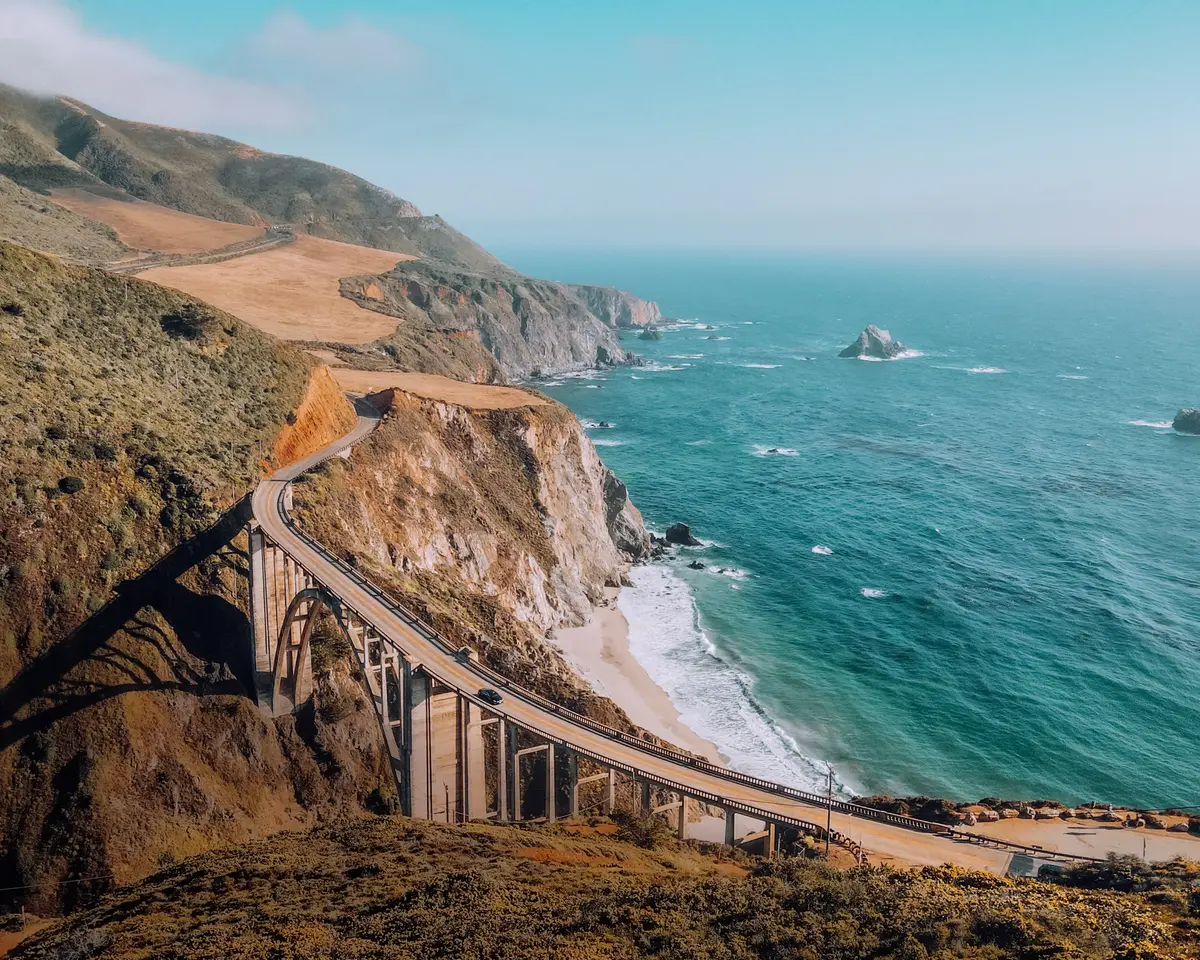
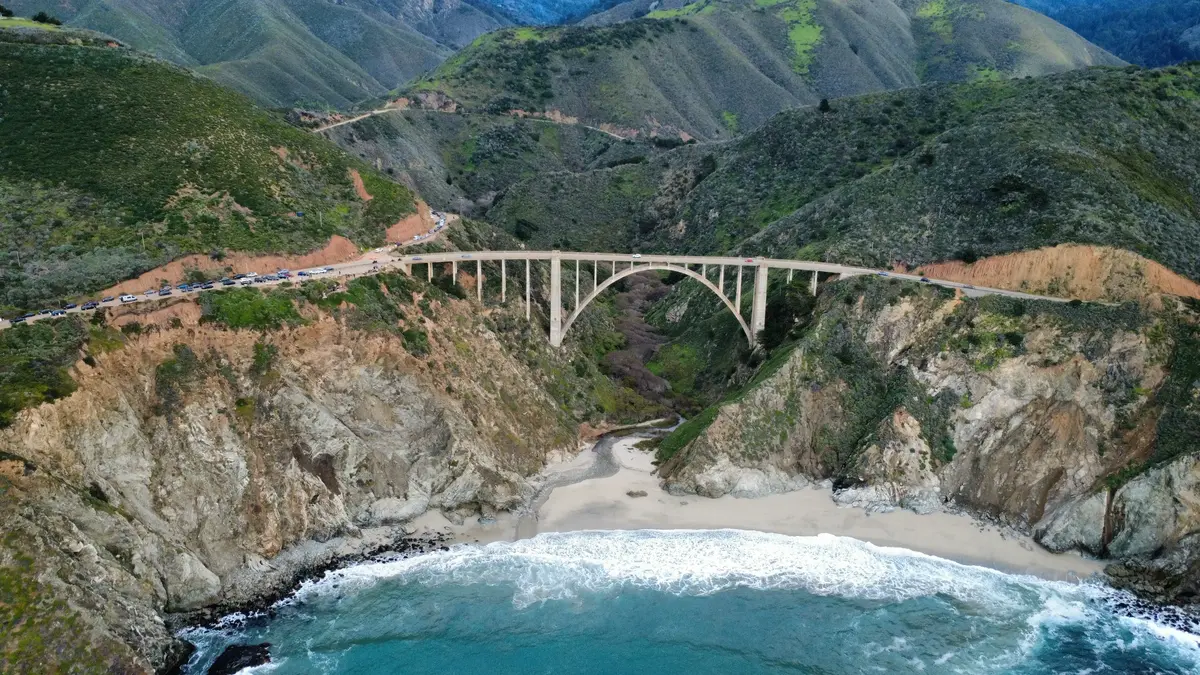
California’s Pacific Coast Highway (Highway 1) is widely considered the most scenic coastal drive in America. Its 90-mile Big Sur stretch — anchored by the 360-foot-span Bixby Creek Bridge and the 80-foot McWay Falls — pairs cliffs dropping straight into the Pacific with redwood canyons, setting the benchmark every other US coastal route is measured against.
Bixby Creek Bridge was completed in October 1932, with a main span of 360 feet (110 m), a total length of 714 feet (218 m), and a 260-foot (79 m) drop to the creek below. A few miles south, McWay Falls pours 80 feet (24 m) onto a cove beach in Julia Pfeiffer Burns State Park — one of the few waterfalls in the country that lands on sand.
The catch most guides skip: the marine layer locals call “June Gloom” often hides these views until it burns off near midday. Travelers report the same story at the Bixby overlook — a gray wall at 8 a.m., a clean blue horizon by early afternoon.
Pro Tip: Plan your Big Sur photo stops for noon to 4 p.m., when the fog has lifted but the afternoon layer hasn’t rolled back in.
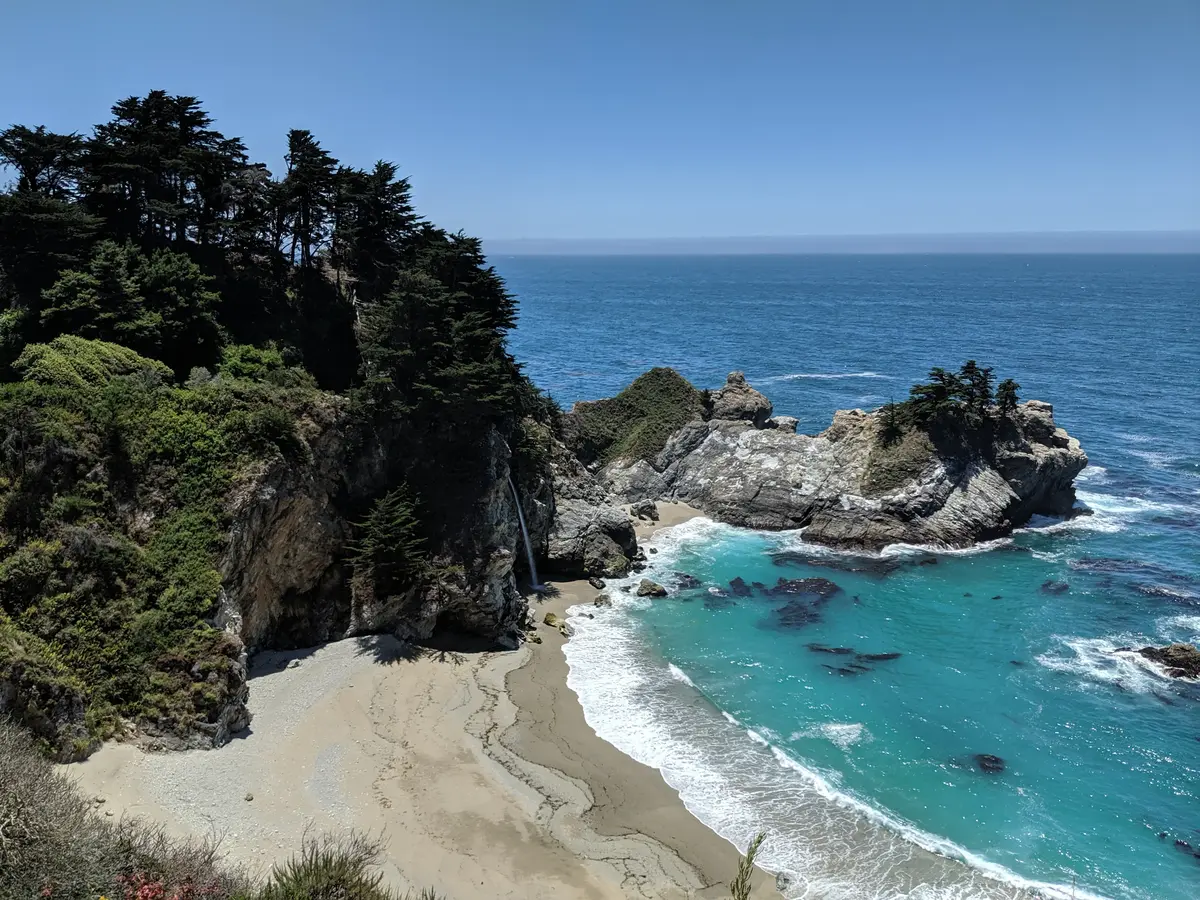
Pacific Coast Highway — California Highway 1
The Pacific Coast Highway runs 656 miles (1,056 km) along California Highway 1 from Leggett to Dana Point, though most people drive the San Francisco–to–San Diego stretch over 4–7 days. The highlights stack up fast: Big Sur, Bixby Bridge, Carmel-by-the-Sea, Santa Barbara, and Malibu. September and October bring the clearest, least foggy skies.
The drive earns its reputation in the middle third. Carmel and Monterey bookend the start, then the road narrows into Big Sur’s guardrail-free curves, where Nepenthe’s deck and Ragged Point give you a reason to stop every few miles. Hearst Castle at San Simeon is the inland detour worth the half-day.
The friction points are real, too. Big Sur has no gas for long stretches, cell service drops out, and summer traffic crawls behind RVs. Drive north-to-south so you’re in the right-hand, ocean-side lane at the pullouts — the views are better and the turnouts are far safer to enter.
- Distance: 656 miles (1,056 km), Leggett to Dana Point
- Drive time nonstop: 10–12 hours
- Days recommended: 4–7 days
- Best season: September–October for the clearest skies
- Ballpark cost: around $200/day, roughly $1,500 for 7 days per person
- Worth knowing: the 17-Mile Drive at Pebble Beach charges $12.25/vehicle, reimbursed with a $35+ purchase at a Pebble Beach Resorts restaurant
Pro Tip: Check the CalTrans QuickMap for live Big Sur road status before you commit — landslide closures can force a long inland detour with little warning.
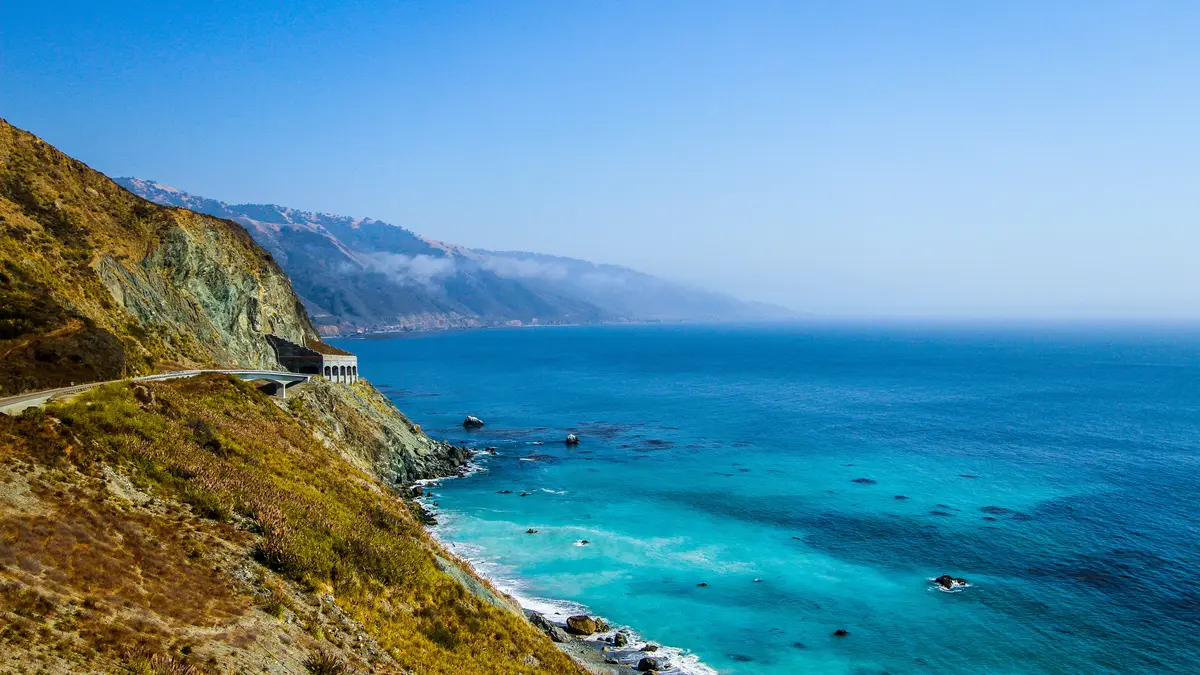
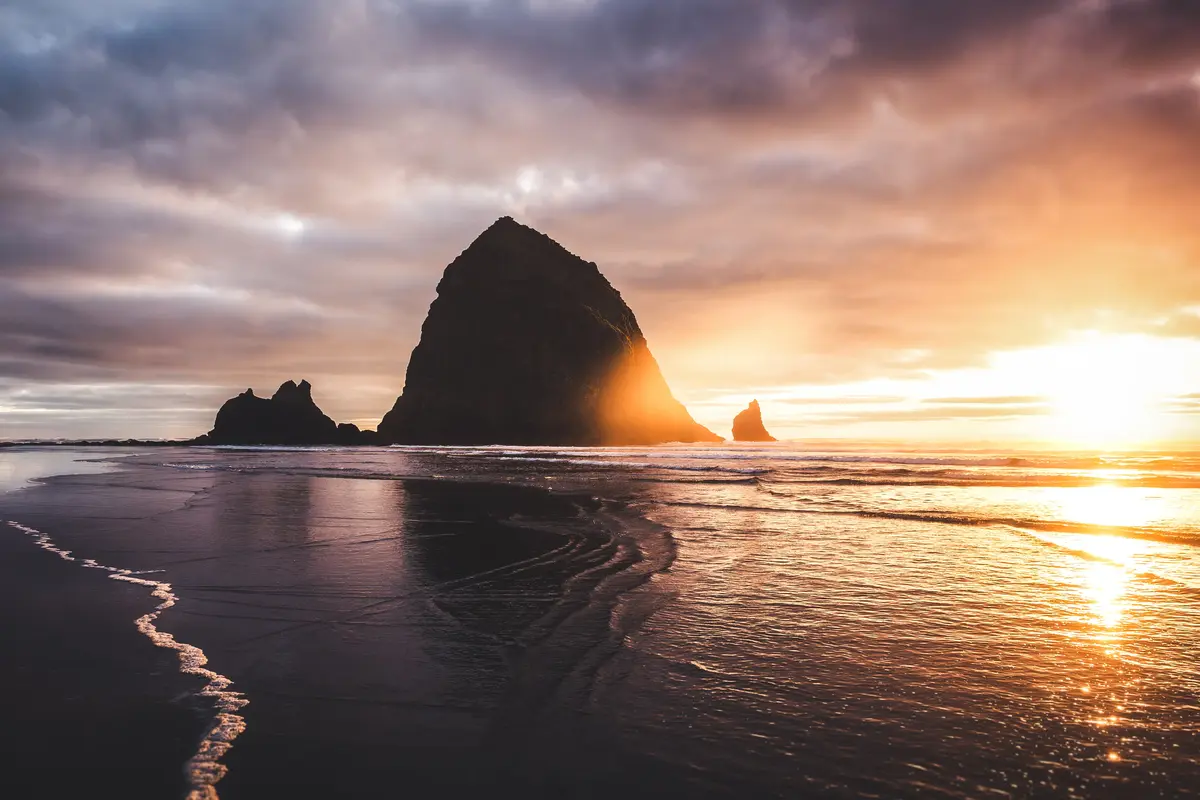
Oregon Coast Highway — US-101
Oregon’s Pacific Coast Scenic Byway follows US-101 for 363 miles (584 km) from Astoria to Brookings, a 10–12 hour drive best spread over 5–7 days. A state law keeps the entire coastline public — locals call it “The People’s Coast.” Expect sea stacks like the 235-foot Haystack Rock at Cannon Beach, historic lighthouses, towering dunes, and gray whales offshore.
This is the wilder, less-crowded Pacific alternative to California. Cannon Beach and Ecola State Park open the route, Heceta Head Lighthouse (first lit in 1894, its beam visible about 21 nautical miles out) anchors the middle, and the Samuel H. Boardman corridor near Brookings closes it with the most dramatic headlands on the coast. The Oregon Dunes run roughly 40 miles in between.
Pack for cold. The coast often sits 20°F (about 11°C) cooler than inland Portland, and fog can swallow Cannon Beach in minutes. Fly into PDX and you can be on the sand in under two hours.
- Distance: 363 miles (584 km), Astoria to Brookings
- Drive time nonstop: 10–12 hours
- Days recommended: 5–7 days
- Best season: September–October, drier and clearer than summer
- Ballpark cost: around $180/day for two
- Fly into: Portland (PDX)
Pro Tip: Keep a real waterproof jacket within reach, not buried in the trunk — coastal Oregon weather flips from sun to sideways drizzle in the time it takes to park.
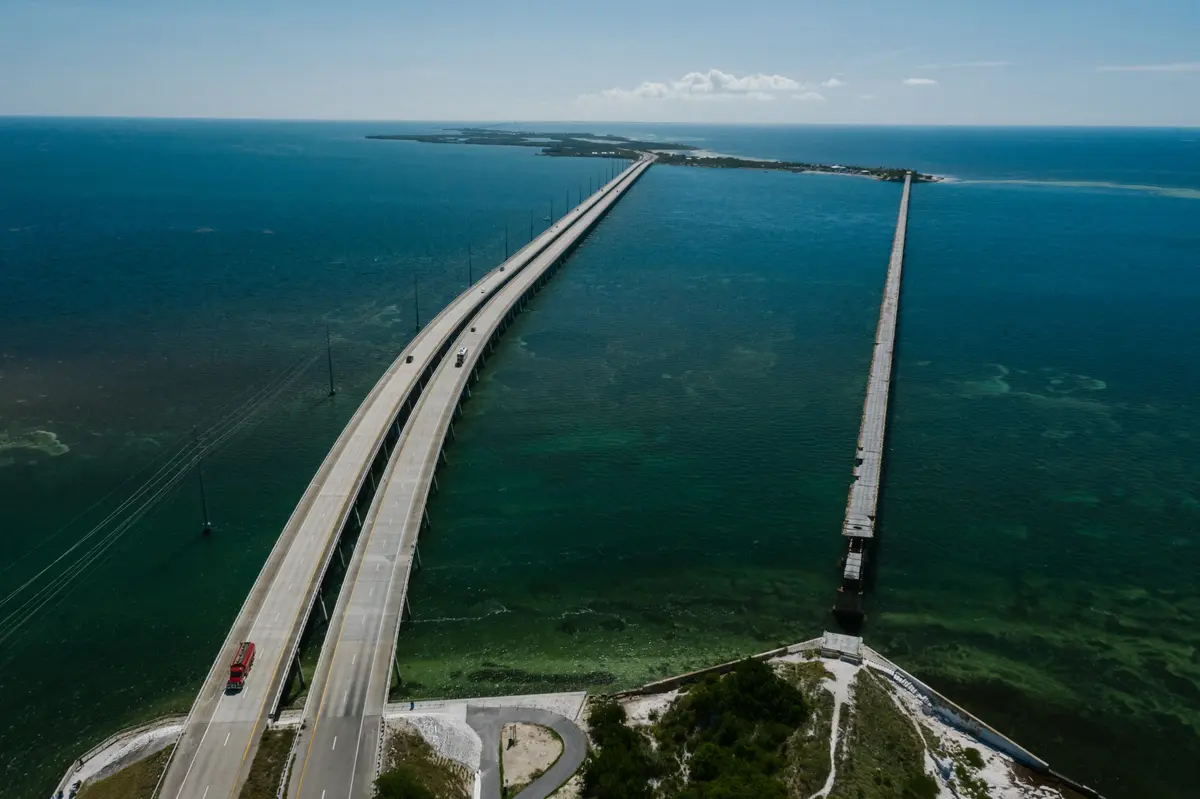
Florida Keys Overseas Highway — US-1
The Overseas Highway carries US-1 for 113 miles (182 km) from Key Largo to Key West across 42 bridges, including the 6.79-mile (10.93 km) Seven Mile Bridge. It’s toll-free, drivable in 3.5–4 hours nonstop, and best stretched over a long weekend with stops at Bahia Honda State Park and Islamorada along the way.
This is the “highway that goes to sea,” and the best short coastal road trip in the country. Navigation runs on green mile markers counting down from MM 113 in Key Largo to MM 0 in Key West, so directions here sound like “turn at MM 84.” Bahia Honda’s beach sits at MM 37; the old Bahia Honda Rail Bridge and the original Seven Mile Bridge are leftovers from Henry Flagler’s early railway.
You can walk a restored 2.2-mile segment of the old Seven Mile Bridge out toward Pigeon Key — reopened after a multi-year, $44 million refit that saved it from demolition. Look closely and the guardrails are repurposed railroad track from Flagler’s line, a detail most drivers blow past at 55 mph.
- Distance: 113 miles (182 km), Key Largo to Key West
- Drive time nonstop: 3.5–4 hours
- Days recommended: 2–3 days
- Best season: fall through early winter, before peak crowds
- Ballpark cost: around $200/day (Keys lodging runs high)
- Worth knowing: 42 bridges, toll-free, designated an All-American Road
Pro Tip: Fuel and groceries get pricier the farther south you go, so stock up in Key Largo or Islamorada rather than waiting for Key West prices.
Outer Banks Scenic Byway — North Carolina Highway 12
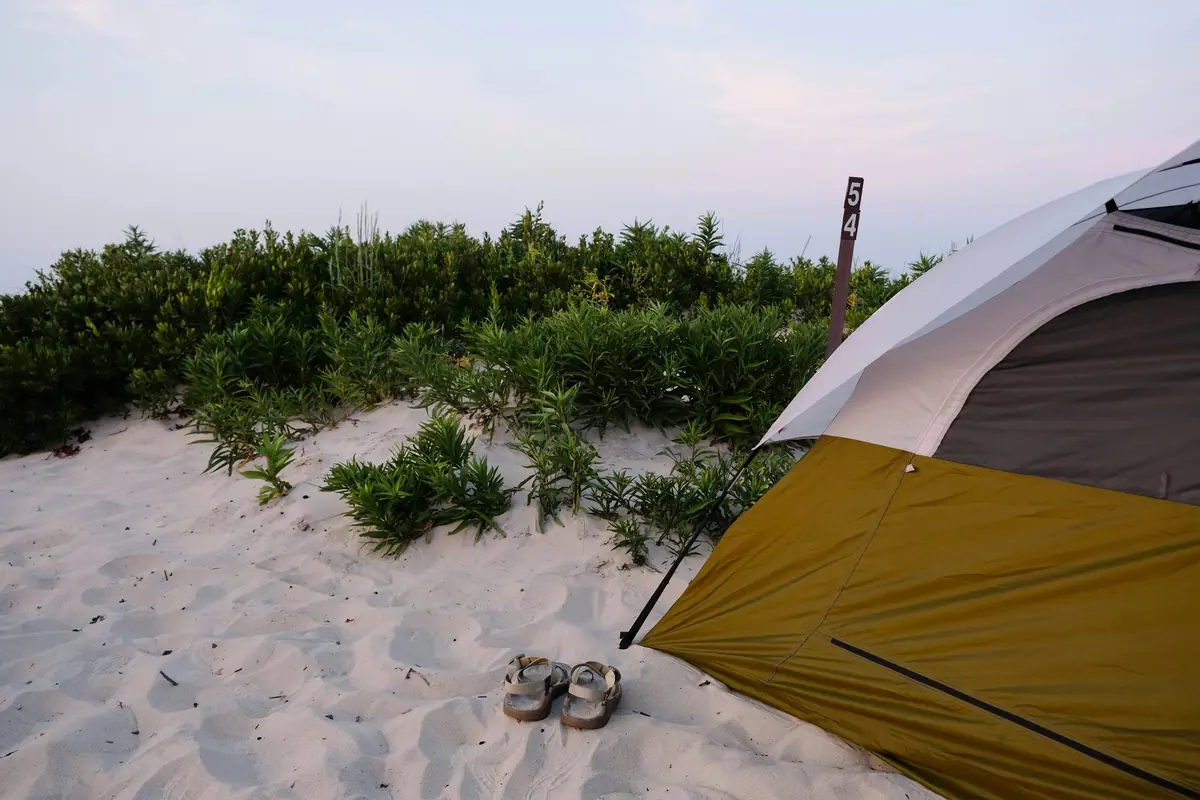
North Carolina Highway 12 threads the Outer Banks Scenic Byway for roughly 138 driveable miles (222 km) across barrier islands, linked by ferries including the free, roughly 70-minute Hatteras–Ocracoke crossing. Expect lighthouses, the Wright Brothers National Memorial, the dunes of Jockey’s Ridge, and wild horses near Corolla.
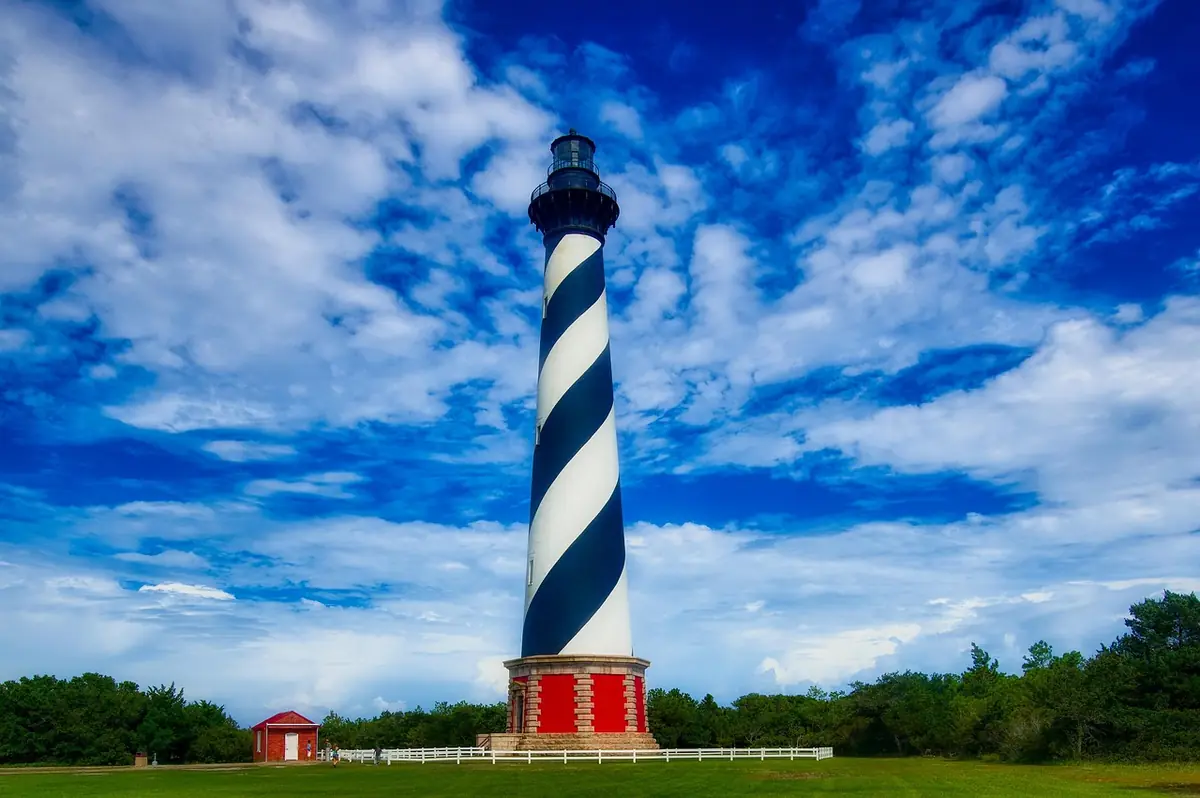
The drive is a string of 21 villages with the Atlantic on one side and the sound on the other, often within sight of both. Cape Hatteras National Seashore protects most of the southern stretch, and the black-and-white Bodie Island Lighthouse makes a good first stop. Ocracoke, reachable only by ferry, feels like the payoff — a small harbor town with no chain hotels.
The Hatteras–Ocracoke ferry is the variable. It’s first-come, first-served, free, and sails 365 days a year with no reservations taken — but it fills fast on summer mornings. Locals and the ferry division both flag Tuesday through Thursday, roughly 9 a.m. onward, as the worst window for day-trippers without a priority pass. There’s a standing local rule of thumb worth stealing: head over to Ocracoke in the evening and back toward Hatteras in the morning to skip the longest lines.
- Distance: ~138 miles (222 km) of driveable byway
- Drive time nonstop: ~4 hours plus ferry crossings
- Days recommended: 3–5 days
- Best season: summer into early fall, when ferries run most often
- Ballpark cost: around $150/day for two
- Worth knowing: Hatteras–Ocracoke ferry is free and reservation-free; reserve the longer Cedar Island and Swan Quarter routes ahead
Pro Tip: Carry cash for the longer toll ferries and for small village shops — card readers on the islands cut out as often as the cell signal does.
Coastal Maine — US Route 1 to Acadia
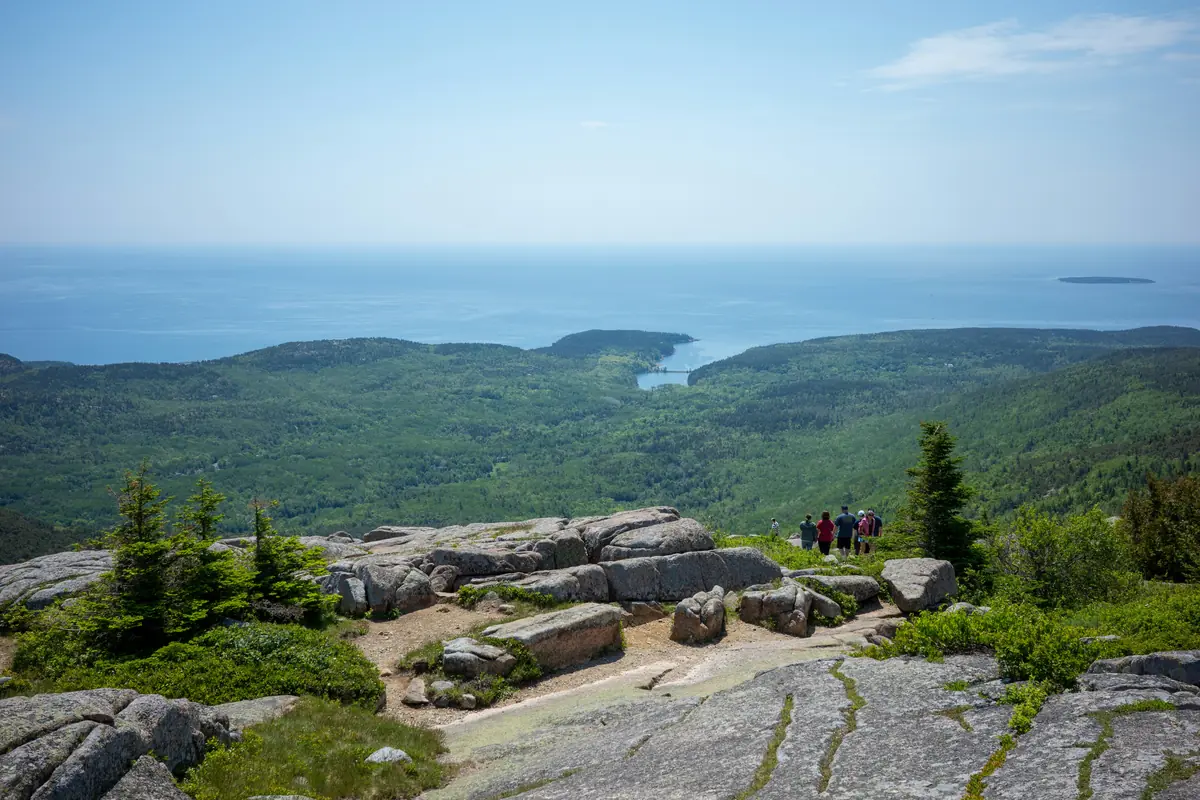
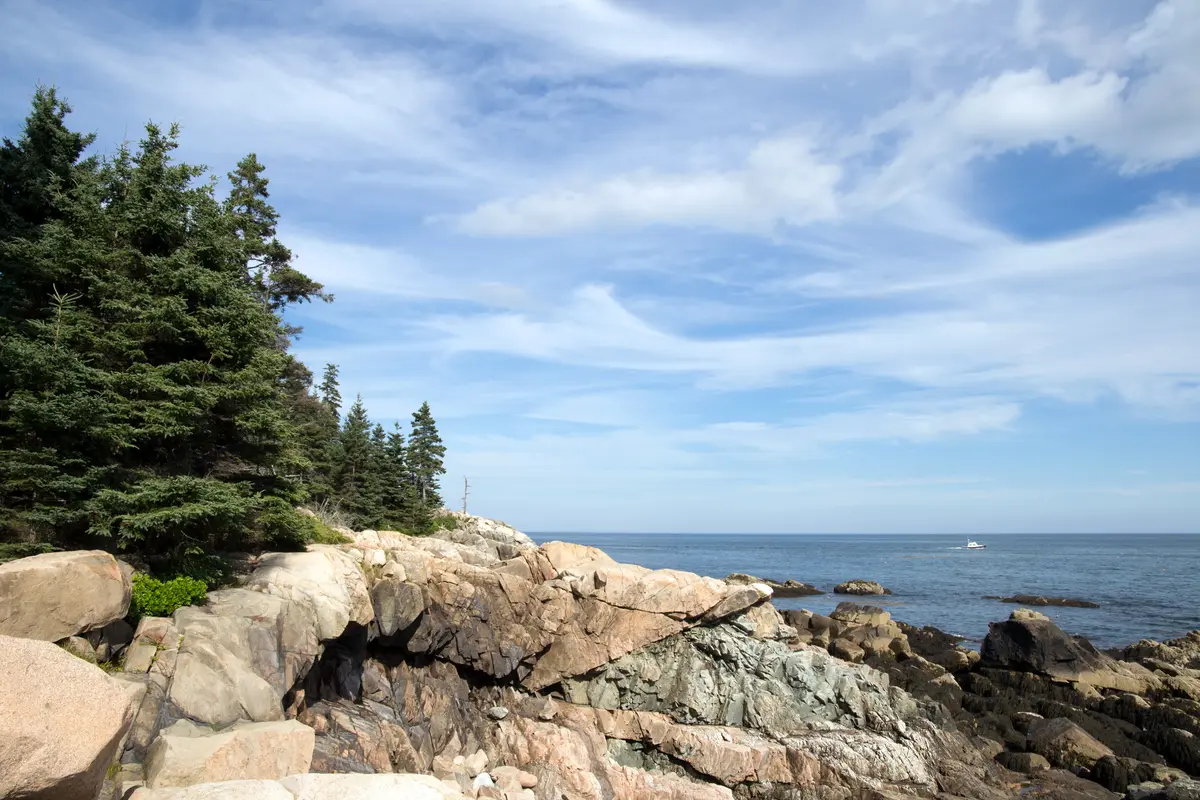
Coastal Maine’s US Route 1 runs about 280 miles (451 km) from Kittery to Bar Harbor — roughly 5 hours 45 minutes nonstop, but ideally a 5–7 day trip ending at Acadia National Park. September is the sweet spot: warm-enough water, thinner crowds, and seasonal lobster shacks still open before they close for winter.
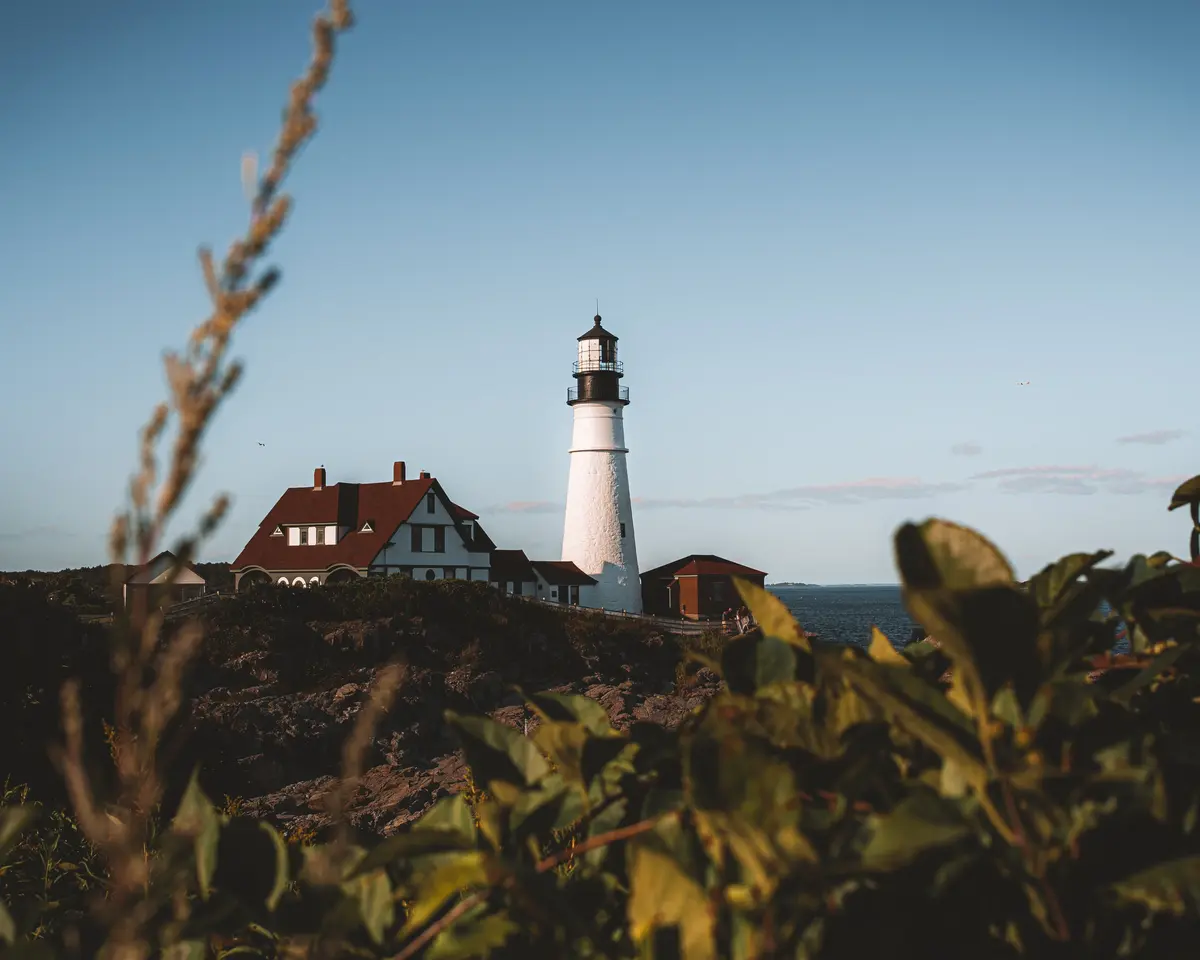
This is the lobster-and-lighthouse classic. Route 1 strings together Kennebunkport, Portland, Camden, and the Penobscot Narrows Bridge before delivering you to Acadia, where the 27-mile Park Loop Road circles the island. Cadillac Mountain — the first place in the country to catch sunrise for part of the year — sits behind a timed-entry vehicle reservation you book on Recreation.gov from late spring through late October: $6 per vehicle on top of the $35 park entrance pass. Thirty percent of slots release 90 days out and the other 70 percent drop two days ahead at 10 a.m. ET, so set an alarm.
The food is the budget line that surprises people. A lobster roll commonly runs $30–$45 at the famous shacks, and the roadside legend Red’s Eats in Wiscasset lands around $40, cash only, with a line that wraps the building by noon and can cost you an hour or more in July.
- Distance: ~280 miles (451 km), Kittery to Bar Harbor
- Drive time nonstop: ~5 hours 45 minutes
- Days recommended: 5–7 days
- Best season: September for water, weather, and open lobster shacks
- Ballpark cost: around $180/day for two
- Worth knowing: book a Cadillac Summit Road vehicle reservation ($6) and a park pass ($35) in advance for the reservation season
Pro Tip: Fly into Boston Logan instead of a Maine airport — summer rentals in Maine are brutally expensive, and the Route 1 drive up from the New Hampshire border is half the point.
East Coast vs. West Coast: Which Coastal Road Trip Is Right for You?
The West Coast wins for road trips: continuous cliff-hugging highways like the PCH and Oregon 101, national parks within reach, and dependable late-summer-to-fall weather. The East Coast suits travelers who want compact distances, colonial history, fall foliage, plus barrier-island drives like the Outer Banks and lobster towns along Maine’s Route 1.
The difference comes down to pacing. On the East Coast you can pass through several states in a single driving day, which makes shorter, denser trips easy. On the West Coast, one state — California — can eat a full week, and the coast road runs unbroken for hundreds of miles.
Weather splits them too. The West Coast is drier and more predictable in fall but foggy in summer; the East Coast gives you four real seasons, with October foliage as its own reason to go. If you want one long ribbon of ocean, go west. If you want variety packed close together, go east.
Pro Tip: If this is your first big coastal drive and you only have a long weekend, the East Coast’s compact distances let you actually finish a route instead of rushing a fraction of the PCH.
How Many Days Do You Need for a Coastal Road Trip?
It depends on the route. The 113-mile (182 km) Florida Keys Overseas Highway works as a long weekend of 2–3 days, while the 656-mile (1,056 km) Pacific Coast Highway rewards 4–7 days and the 363-mile (584 km) Oregon US-101 wants 5–7. Coastal Maine’s Route 1 to Acadia needs 5–7 days; the Outer Banks, 3–5.
Here’s the per-route breakdown for planning:
- Florida Keys Overseas Highway: 2–3 days
- Pacific Coast Highway: 4–7 days
- Oregon Coast US-101: 5–7 days
- Coastal Maine Route 1: 5–7 days
- Outer Banks NC-12: 3–5 days
The mistake is planning to the nonstop drive time. These roads are about the pullouts, not the mileage, and coastal fog, ferry waits, and the occasional landslide detour regularly cost half a day. Build in a buffer day on any trip of five days or more.
What Does a Coastal Road Trip Cost?
Budget roughly $150–$300 per day for two on a coastal road trip, covering gas, food, and a mid-range hotel. A 7-day Pacific Coast Highway trip runs about $1,500 per person, or close to $200/day. Rental cars average $50–$60/day, and many coastal parks plus the entire Overseas Highway are toll- and fee-light.
Here’s where the money actually goes:
- Rental car: $50–$60/day
- Gas: national-average price per gallon × total miles ÷ your vehicle’s MPG
- Mid-range hotel: $100–$150/night
- Budget motel: $60–$90/night
- Food: $40–$60/day per person
- Park and ferry fees: often free to modest; the Overseas Highway is toll-free
Gas is the one cost that swings hard by region. Gulf Coast states like Texas and Mississippi consistently have the cheapest fuel in the country, while California is the priciest. Fill the tank before you cross into California, and keep it above a quarter in Big Sur where stations are sparse and marked up.
Pro Tip: Shoulder-season lodging in fall is materially cheaper than summer rates on every one of these routes — the same room can drop 20–30% after the peak window closes.
Best Time of Year for a Coastal Road Trip
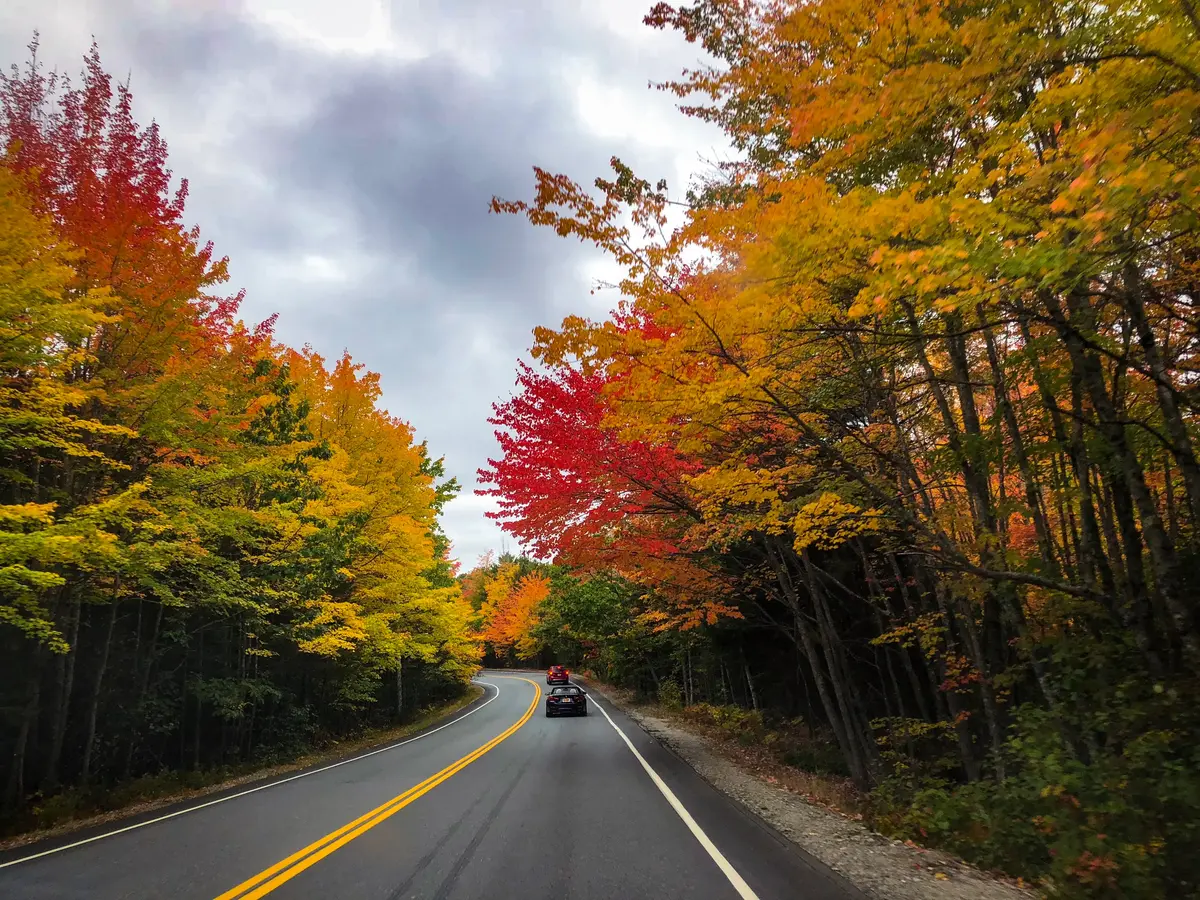
Fall, roughly September through October, is the best all-round window. The west coast’s marine layer lifts for the clearest skies, Maine’s crowds thin while lobster shacks stay open, and the Florida Keys sit just before peak winter season. Summer is warmest but the busiest and foggiest in Big Sur; winter brings west-coast storms and closures.
Temperatures vary widely by region, so match the route to the season:
- Big Sur, California: summer highs in the mid-70s°F (about 23°C), foggy mornings that clear by midday
- Oregon coast: cool year-round, often 20°F (about 11°C) below inland Portland
- Florida Keys: warm all year; fall is mild before the winter high season
- Coastal Maine: September water is warm-ish, with early-October foliage just inland
- Outer Banks: best from late spring through early fall, when ferries run most often
In Big Sur the fog usually burns off around midday and rolls back by late afternoon, so the same overlook looks completely different at 8 a.m. versus 2 p.m. Plan your driving around that rhythm and you’ll see twice as much.
Coastal Road Trip Packing and Safety Checklist
Pack layers and a real waterproof jacket — coastal weather flips fast. Download offline maps, because cell service drops in Big Sur and on stretches of Maine’s Route 1. Keep the tank above a quarter, carry cash for ferries and park booths, and check live road status before mountainous segments like Big Sur.
What to bring and do before you go:
- Offline maps downloaded for the full route
- Layers plus a genuinely waterproof jacket
- Cash for ferries, park booths, and small island shops
- A car charger and a backup battery pack
- Reusable water bottles and a small cooler for long gaps between towns
- Screenshots of your route through any no-signal stretch
The single most useful habit is checking conditions before each leg. Use the CalTrans QuickMap for Big Sur and the NCDOT ferry schedule for the Outer Banks. On the PCH, cell service vanishes shortly after Cambria heading into Big Sur — screenshot your directions in advance or you’ll be navigating blind.
Frequently Asked Questions
What Is the Best Coastal Road Trip in the US?
California’s Pacific Coast Highway (Highway 1) is the top all-round pick — 656 miles (1,056 km) of cliffs and beaches, best over 4–7 days. For a shorter trip, Florida’s 113-mile (182 km) Overseas Highway to Key West is ideal for a long weekend.
How Long Does It Take to Drive the Pacific Coast Highway?
California’s Highway 1 is 656 miles (1,056 km) and takes about 10–12 hours nonstop, but most travelers spend 4–7 days to enjoy Big Sur, Carmel, and Santa Barbara. The full West Coast route of roughly 1,650 miles needs 10 or more days.
How Many Bridges Are on the Florida Keys Overseas Highway?
The Overseas Highway crosses 42 bridges over its 113 miles (182 km) from Key Largo to Key West, including the 6.79-mile (10.93 km) Seven Mile Bridge. The entire route is toll-free and drivable in about 3.5–4 hours nonstop.
When Is the Best Time for a Coastal Road Trip?
Fall, September and October, is best overall. The west coast’s marine layer lifts for clear skies, Maine’s crowds thin while lobster shacks stay open, and temperatures stay mild. Summer is warmest but busiest and foggiest in Big Sur.
How Much Does a Coastal Road Trip Cost?
Budget roughly $150–$300 per day for two, covering gas, food, and a mid-range hotel ($100–$150/night). A 7-day Pacific Coast Highway trip averages about $1,500 per person; rental cars run $50–$60 per day.
The Bottom Line: Which Route Wins for You
Choose the Pacific Coast Highway for the best all-round drive, Oregon’s US-101 for fewer crowds, the Florida Keys Overseas Highway for a quick sun-soaked weekend, the Outer Banks for free-ferry island-hopping, and Maine’s Route 1 for fall foliage and lobster. Go in September, budget about $200/day, and pre-book the peak-season parks and ferries that fill up.
Whichever route you pick, the pullouts — not the destinations — are where the trip actually happens. The drivers who remember their coastal road trip are the ones who left time to stop, not the ones who clocked the fastest nonstop time. Leave the buffer, chase the midday light, and let the road set the pace.
Which route are you leaning toward — the cliffs of the PCH or the bridges of the Keys? Tell me where you’re starting from in the comments and I’ll help you map the days.