
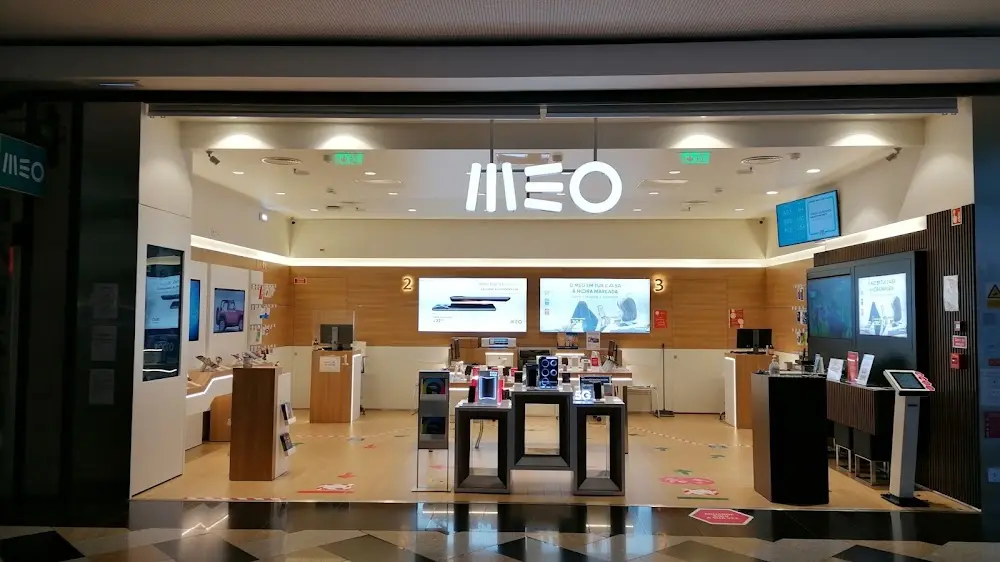
Picking up a local SIM card in Portugal is the single fastest way to cut your connectivity costs. After helping a steady stream of American travelers navigate this market — from Lisbon’s transit tunnels to the volcanic crater roads of the Azores — I can tell you the local options are faster, cheaper, and more reliable than anything your US carrier is going to offer. Here is exactly what to buy and where.
Should you use US roaming or buy a SIM card in Portugal?
For any trip longer than 48 hours, relying on your home carrier is the most expensive mistake you can make. Verizon TravelPass runs $12 per day in Portugal and throttles your speed to 3G after 5 GB in a single 24-hour session. AT&T’s International Day Pass costs the same $12 per day. On a 10-day trip, either carrier runs you $120 in roaming charges alone. A local Vodafone or MEO plan covering the same 10 days costs under $25 — a minor line in your overall Portugal travel budget.
The math is uncomfortable for anyone still defaulting to their carrier’s travel add-on. T-Mobile users need to confirm their specific plan tier — older tiers enforce throttled speeds that make navigation nearly impossible. Travelers on Consumer Cellular or other MVNOs may find their service simply stops working at the Portuguese border.
Pro Tip: Before your flight, call your carrier and confirm your unlock status. Verizon phones unlock automatically after 60 days of ownership. AT&T and T-Mobile devices must be fully paid off before they’ll accept a foreign SIM.
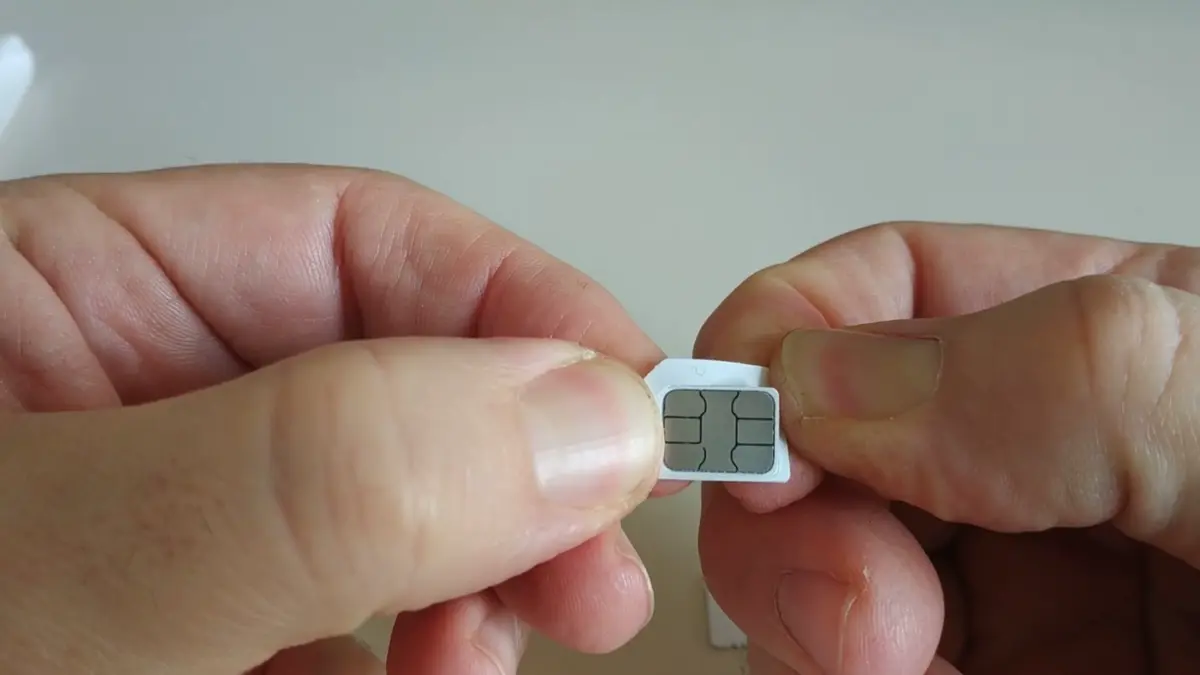
Which Portuguese carrier is right for your trip?
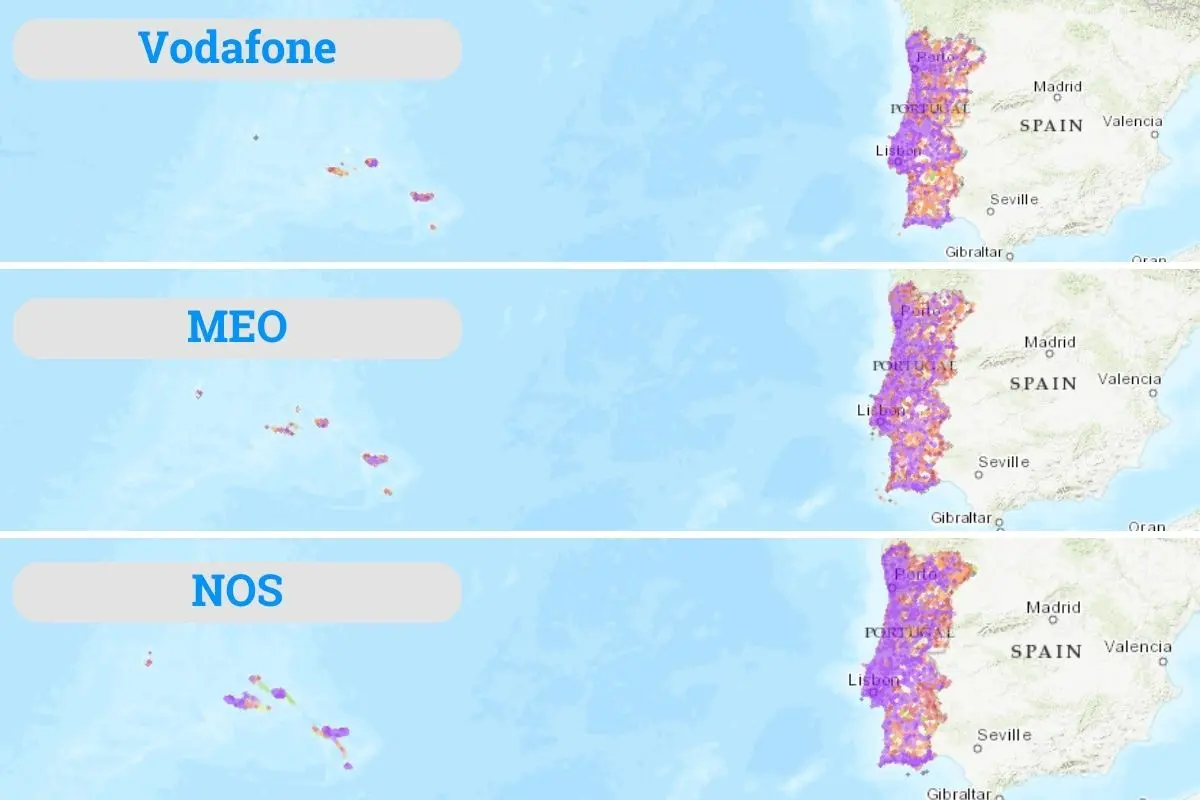
Portugal’s mobile market is split between three main networks. The right choice depends entirely on where your itinerary takes you — the coverage differences are real, not marginal.
MEO — best for remote areas and the islands
MEO built the original national infrastructure and still holds the most physical tower coverage in the country. If your itinerary includes the Aldeias do Xisto villages, deep Alentejo wine country, or any hiking in Peneda-Gerês National Park, MEO is your only logical option. Competing carriers frequently end up roaming onto MEO’s infrastructure in those pockets anyway.
For Azores and Madeira travel, MEO remains the strongest network in the volcanic highlands and along steep coastal cliff trails where signal gets thin fast.
- Location: Available at MEO stores nationwide and at Lisbon Airport (Terminal 1)
- Tourist plan: 30 GB for €15 (~$17), valid 15 days
- Best for: Off-grid explorers, island hikers, Alentejo road trips
- Passport required: Yes, to activate
NOS — best for city speed
NOS has invested heavily in 3.5 GHz 5G spectrum in Lisbon, Porto, and Faro, with independent network tests consistently ranking it the fastest download carrier in urban environments. In the right neighborhoods of Lisbon, 300–500 Mbps speeds are realistic, not marketing copy.
For digital nomads who need sub-20ms latency for video calls from a coworking space in Príncipe Real or a café in Porto’s Bonfim district, NOS is the call. The coverage advantage disappears the moment you leave the city ring roads.
- Location: NOS stores in city centers; not reliably stocked at airports
- Tourist plan: 30 GB for €30 (~$33), valid 30 days, includes EU roaming
- Best for: Digital nomads, urban-only itineraries, Lisbon and Porto stays
- Passport required: Yes, to activate
Vodafone — best for balanced coverage
Vodafone sits between NOS’s raw speed and MEO’s rural depth. In network tests, it consistently ranks at the top for 4G coverage in coastal areas and performs better than NOS at penetrating the thick stone walls of historic buildings — a detail that matters when your hotel is a 200-year-old converted townhouse.
As part of a global group, Vodafone also offers cleaner roaming arrangements if you’re combining a Portugal trip with time in Spain. Their tourist-facing plans are the most prominently stocked at airports, which makes them the default pickup for most arriving US travelers.
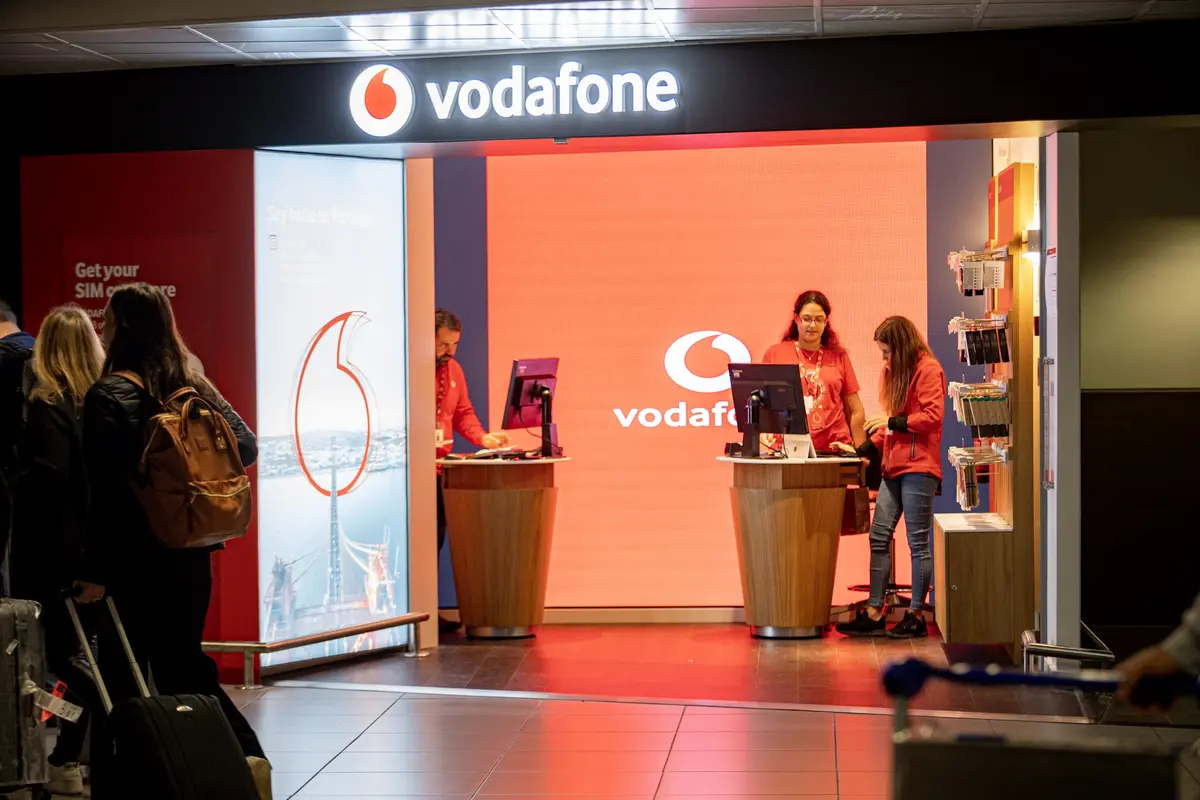
- Location: Kiosk in Terminal 1 at Lisbon Airport; main store in Porto Arrivals; kiosk at Faro
- Tourist plan (Vodafone Travellers): 20 GB + 500 domestic minutes/SMS + 50 international minutes for €20 (~$22), valid 30 days
- Best for: Coastal trips, city-hoppers combining Portugal with Spain, first-time buyers
- Passport required: Yes, to activate
Pro Tip: The Vodafone Travellers package at €20 from a city store includes 20 GB and EU roaming. The same Vodafone counter at the airport sometimes charges €25 for a package with less data. If you see the prices don’t match the city store rates, walk away and buy in town.
Are budget carriers worth it in Portugal?
Not always. Several discount operators have entered the Portuguese market, but most of them create friction that outweighs the savings for short-term US visitors.
Lycamobile piggybacks on the MEO network and genuinely undercuts the big three on price — roughly $10 for 25 GB from the Money Exchange counter at Lisbon Airport. The catch is real: users consistently report blocked tethering, aggressive promotional texts, and APN configuration that requires manual setup rather than auto-connecting on arrival.
Woo and UZO offer digital-first plans at strong prices but require a Portuguese NIF tax number or local bank account for ID verification. US passports get rejected at the checkout screen.
Digi entered the Portuguese market as a low-cost disruptor and has been building out towers for several years, but rural and coastal coverage remains inconsistent enough that I’d avoid it for any trip outside Lisbon or Porto.
Pro Tip: If the Lycamobile price at Lisbon Airport looks attractive, it is — but only if you’re tech-comfortable enough to manually enter APN settings and you don’t need your phone as a hotspot. For everyone else, pay the extra €10 for Vodafone.
Where does your signal actually hold up in Portugal?
Portugal’s geography creates coverage gaps that don’t appear on carrier maps until you’re standing in them.
Greater Lisbon and Porto
Any major carrier — MEO, NOS, Vodafone — delivers solid 5G here. NOS wins on download speed in the city center. Vodafone outperforms it inside historic stone buildings where signal attenuates through thick walls. For most urban travelers, the difference is invisible.
The Algarve and Costa Vicentina
Coverage across the Algarve, from Faro to Lagos, is solid with every major provider. The moment you move west to the Costa Vicentina cliffs and surf breaks around Aljezur, NOS gets unreliable. MEO or Vodafone are significantly more consistent on the rocky western headlands.
The Interior and the N2
Driving the N2 highway from Chaves to Faro — all 354 miles (570 km) of it — requires MEO. The interior villages of Trás-os-Montes and inland Alentejo are where MEO’s legacy infrastructure pays off. Vodafone holds signal in larger interior towns. NOS has genuine dead zones along stretches of the N2 that last long enough to get you lost.
Azores and Madeira
MEO is the dominant network for rural hiking on both island chains. Vodafone performs well in the main capitals — Ponta Delgada on São Miguel, Funchal on Madeira — and covers the coastal ring roads cleanly. For Levada trails in Madeira or caldera walks across the Azores, MEO is the only network I’d trust to hold a signal when you need navigation most.
Where can you buy a SIM card at the airport?
All three major international airports have carrier presence in arrivals, but the experience varies significantly.
Lisbon Airport (LIS)
Vodafone operates a kiosk in the Terminal 1 arrivals hall, and MEO has a counter nearby. The Vodafone line on busy summer mornings wraps past the currency exchange — I’ve seen waits of 45 minutes on a Tuesday in July. The MEO counter typically moves faster and sells an equally capable product, and having a working SIM before you sort out getting from Lisbon Airport to the city center makes every transport option — Metro, Aerobus, Uber — considerably easier.
- Location: Terminal 1, Arrivals hall
- Hours: Generally follows flight arrival patterns; confirm before late-night arrivals
- Best for: Getting online before you reach the taxi rank
Pro Tip: If the Vodafone queue looks long, go directly to the MEO counter. The 30 GB plan for €15 connects in under 10 minutes with no crowd.
Porto Airport (OPO)
The main Vodafone store sits directly in the Arrivals area and is easy to find. The problem is hours — late-night arrivals after 10 p.m. will find it closed. If your flight lands after dark, either pre-purchase an eSIM before departure or accept a night on hotel Wi-Fi.
- Location: Arrivals area, ground level
- Hours: Closes in the evening; not 24-hour
- Best for: Daytime arrivals only
Faro Airport (FAO)
Faro has both Vodafone and MEO presence in the terminal. Prices here carry the standard airport convenience markup. If you’re renting a car in Portugal from Faro, the 20-minute drive to a Portimão or Faro city store will save you €5–10 on the same package.
- Location: Arrivals terminal
- Cost premium: Roughly €5 more than city store prices for comparable packages
- Best for: Travelers not renting a car who need connectivity immediately
Is it cheaper to buy a SIM card in the city center?
Yes — consistently and significantly. The pre-packaged tourist plans sold in airport arrivals carry a markup that can reach 30–40% above city store pricing for equivalent data.
Walk into any MEO, Vodafone, or NOS store in a central neighborhood and ask explicitly for a standard prepaid plan rather than the “tourist” version behind the counter. Large electronics chains like Worten also carry network packages at their checkout counters, often at the same price as carrier stores.
The staff at city locations work without the pressure-and-volume dynamic of airport counters, which means more time to help you set up the SIM correctly. Bring your physical passport. Portuguese law requires it for SIM activation, and the same document covers you for standard Portugal entry requirements at the border.

Should you get an eSIM for Portugal instead?
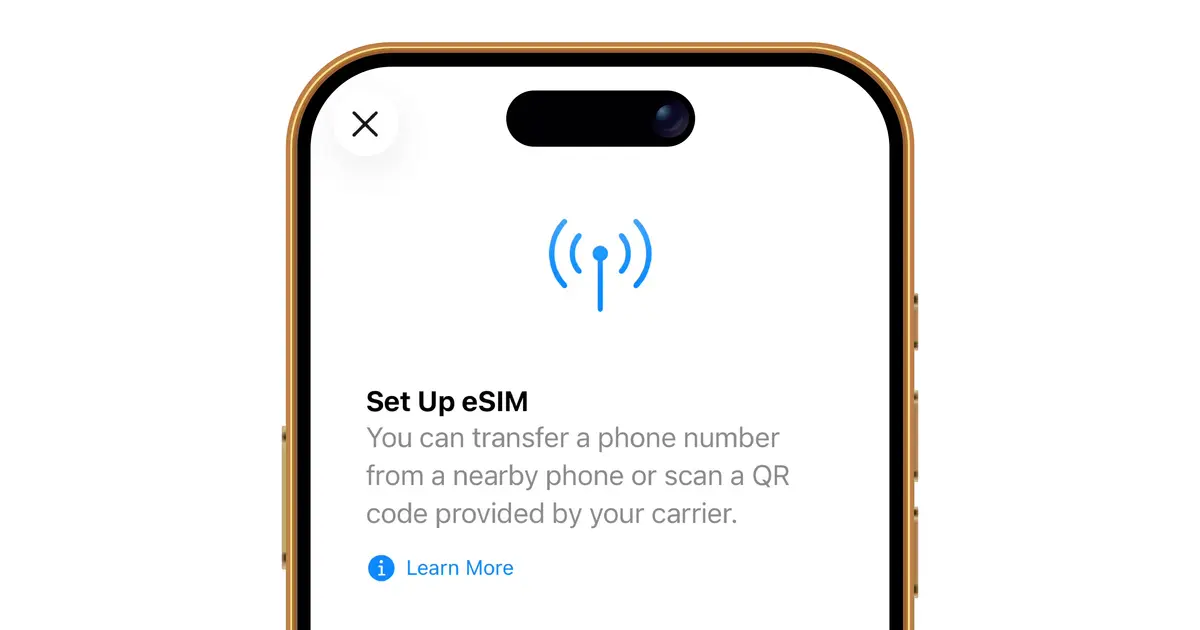
For most US travelers arriving with a modern unlocked iPhone or Android flagship, a digital eSIM is the better option. You install it before your flight and land with a working data connection — no queue, no passport fumbling in arrivals. While you’re loading pre-trip tools onto your phone, adding the right Portugal travel apps to your home screen takes care of maps, transit, and translations in one pass.
MEO sells an “Enjoy Portugal” eSIM directly on their website: 30 GB for €15, valid 15 days. On my last check, the plan activated on arrival without any store visit required and tethering worked cleanly.
Third-party providers like Airalo resell access to Portuguese networks at competitive prices — 10 GB plans run around $9–$17, 30 GB plans around $19, all valid for 7–30 days. The trade-off is that traffic sometimes routes through international proxy servers, which can add 10–20ms of latency versus buying directly from MEO.
Holafly heavily advertises unlimited data packages. The meaningful catch is a hard block on tethering — you cannot use your phone as a hotspot. That kills it for anyone planning to connect a laptop in a hotel room or café without Wi-Fi.
- Best eSIM for rural/island coverage: MEO direct
- Best eSIM for city-only itineraries: Airalo (NOS network)
- Avoid for hotspot use: Holafly
Will your US phone work in Portugal?
Yes, with two potential friction points to resolve before you leave home.
European networks use EMEA frequency bands. A budget-tier Android phone might lack Band 20 (800 MHz), which is the critical rural frequency in Portugal. Without Band 20, you’ll lose signal in exactly the areas where you need it most. Check your device’s supported bands before finalizing your plan.
For carrier locks: Verizon phones unlock automatically after 60 days from purchase. AT&T and T-Mobile devices must be fully paid off first — if you’re on a payment plan, contact customer service to confirm your unlock status before departure.
When you insert a physical SIM, most current smartphones auto-configure APN settings within a minute. If data fails to connect after a restart, go to Settings → Cellular → Cellular Data Network and enter the APN details from the carrier’s website. That resolves 90% of connection failures.

What should you actually pay for 10 days of data in Portugal?
If you’re mapping out a 10-day Portugal itinerary, here is how connectivity costs stack up:
- Verizon TravelPass: $120 total ($12/day × 10), 5 GB high-speed per day then 3G throttle
- AT&T International Day Pass: $120 total ($12/day, capped at 10 days per billing cycle), domestic plan data limit applies
- Vodafone Travellers (city store): €20 (~$22) for 20 GB, valid 30 days, includes EU roaming and 500 voice minutes
- MEO Enjoy Portugal (store or eSIM): €15 (~$17) for 30 GB, valid 15 days, tethering included
- Airalo eSIM (Airalo app): $9–$19 for 5–30 GB depending on package, valid 7–30 days
- Lycamobile (Lisbon Airport only): ~$10 for 25 GB — cheapest option if you can handle manual APN setup and don’t need hotspot
The local options cost between $17 and $22 for most use cases. That is an $100 gap versus a US carrier add-on on a 10-day trip — enough to cover two nights in a guesthouse in Évora or a full-day boat trip off the Algarve.
The bottom line
Skip the roaming plan. A local SIM card in Portugal costs a fraction of what Verizon or AT&T charge, and the networks here are fast, well-distributed, and easy to buy.
TL;DR: For rural areas, islands, and hiking, go MEO. For city speed and digital nomad use in Lisbon or Porto, NOS. For a balanced option you can buy at the airport on arrival, Vodafone Travellers at €20 from a city store. If your phone supports eSIM, buy a MEO or Airalo eSIM before you fly and skip the airport queues entirely. For the rest of your pre-trip planning, our complete Portugal travel guide covers everything from accommodation to transport.
Which carrier did you end up going with, and did it hold signal where you needed it?