A Saint Charbel monastery visit is a pilgrimage to one of the world’s most contested travel destinations — a small Maronite shrine in the Lebanese mountains drawing roughly four million people a year, in a country the U.S. State Department currently rates Level 4: Do Not Travel. This guide covers what’s true, what’s complicated, and what to plan for before you book a flight to Beirut.
Who was Saint Charbel and why does the monastery draw millions?
Saint Charbel Makhlouf was a Maronite hermit-monk who lived in the Lebanese mountains from 1828 to 1898. His tomb at the Monastery of Saint Maron in Annaya became a pilgrimage site after his body was found incorrupt for decades after death and exuded a blood-and-water fluid that medical commissions could not explain. Today his shrine attracts Christians, Muslims, and Druze in equal numbers.
From a mountain village to the hermitage
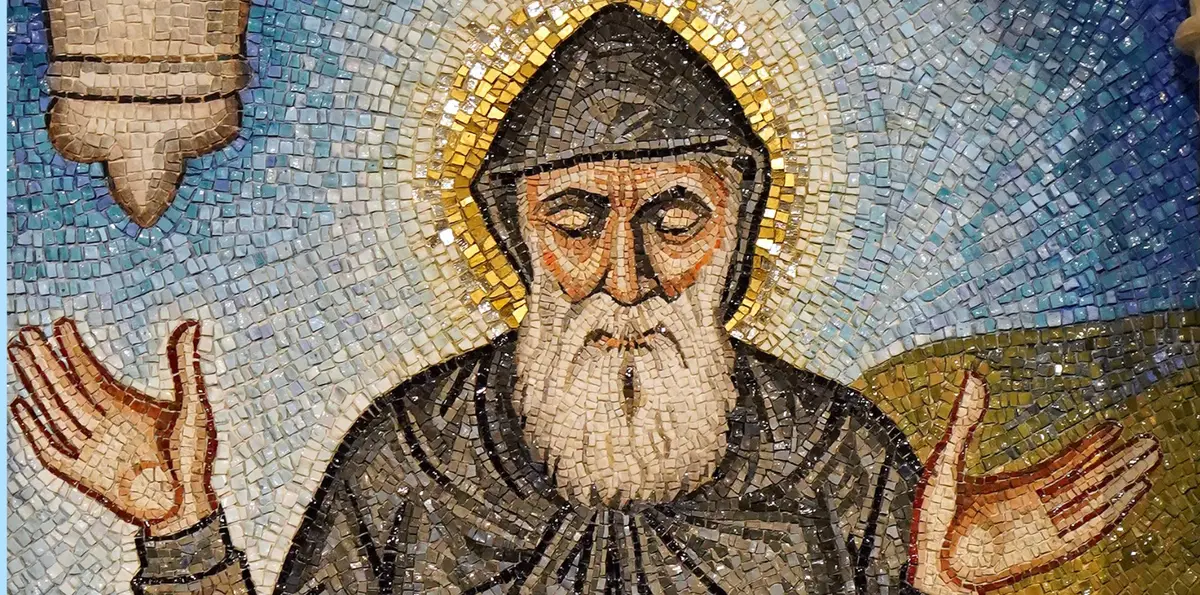
Born Youssef Antoun Makhlouf on May 8, 1828, in Bekaa Kafra — the highest inhabited village in Lebanon at over 5,400 ft (1,650 m) — he grew up in the harsh winters of the Qadisha Valley. He entered monastic life at 23 against his family’s wishes, taking the name Charbel after a 2nd-century martyr of Antioch.
He spent 16 years at the Monastery of Saint Maron in Annaya before being granted permission in 1875 to live as a hermit at the nearby Hermitage of Saints Peter and Paul, perched higher up the same hillside. He stayed there for 23 years, in a cell barely larger than a body, until a stroke during Mass on December 16, 1898, left him paralyzed. He died on Christmas Eve.
The 45 nights of light and the incorrupt body
For 45 consecutive nights after his burial, monks and villagers reported a glow over Charbel’s grave. On April 15, 1899 — four months after death — the body was exhumed with patriarchal permission and found floating in mud, fully flexible, sweating a reddish fluid that smelled sweet and soaked through every cloth and coffin used to contain it.
Doctors examined the body in 1927, 1950, 1952, 1955, and 1965, including non-Christian Lebanese government physicians, and could find no natural explanation. The body remained incorrupt for 67 years. By the 1965 beatification, only bones remained — but those bones still reportedly secrete the same reddish oil. The museum displays vestments soaked in the fluid as direct evidence.
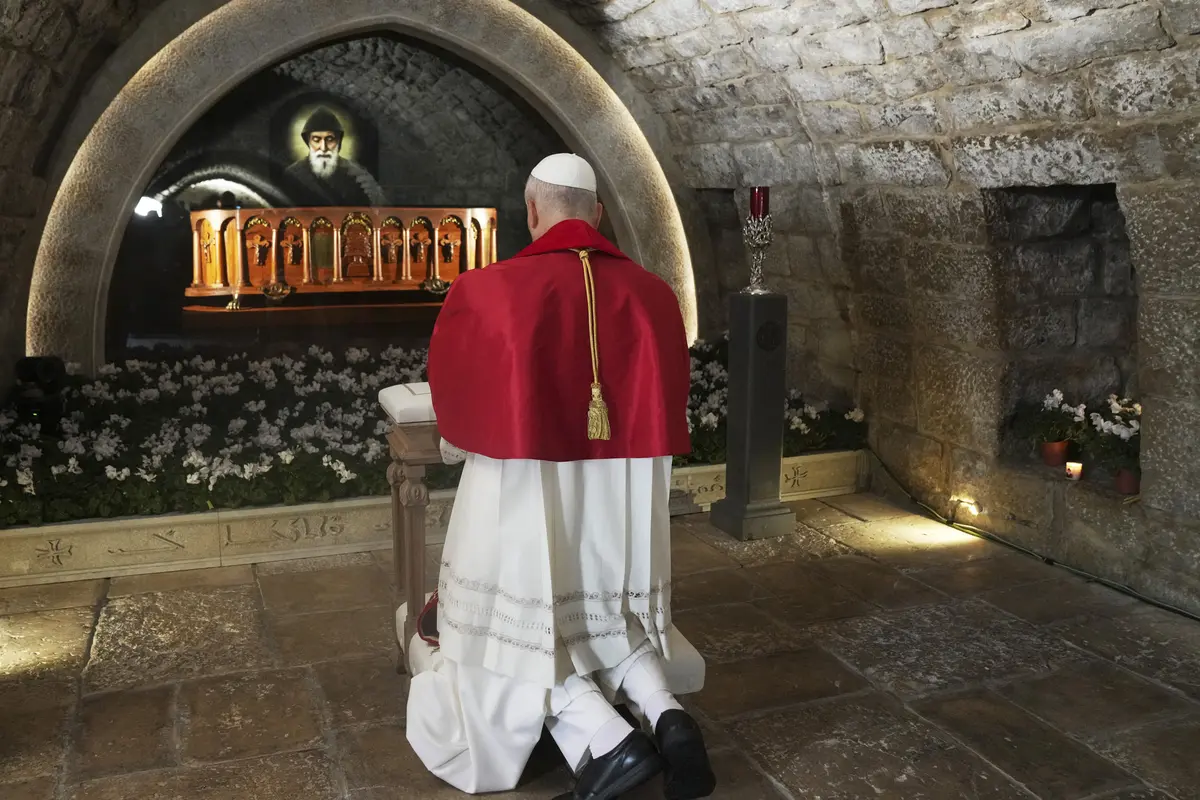
Charbel was beatified in 1965 and canonized in 1977 by Pope Paul VI. Pope Leo XIV personally knelt at the tomb on December 1, 2025, during an apostolic visit, calling Charbel a model of prayer, silence, humility, and poverty.
What can you actually see at the monastery complex?
The monastery sits at 3,937 ft (1,200 m) in the village of Annaya, about 10.5 miles (17 km) inland from Byblos. A complete Saint Charbel monastery visit moves between four spaces: the bronze statue and entrance plaza, the tomb inside the church, the museum, and the Hermitage of Saints Peter and Paul uphill. Plan three to four hours to see everything without rushing.
The bronze statue and entrance courtyard
The first thing you see is the bronze Saint Charbel — hand raised in blessing, valley dropping away behind it toward the Mediterranean. Pilgrims press their foreheads to the statue’s feet or lift small children to touch the hem of the robe. This is normal here. Stand back if you don’t want to be drawn into it. Maronite hymns play through speakers most of the day, which sets the tone before you’ve walked another twenty feet.
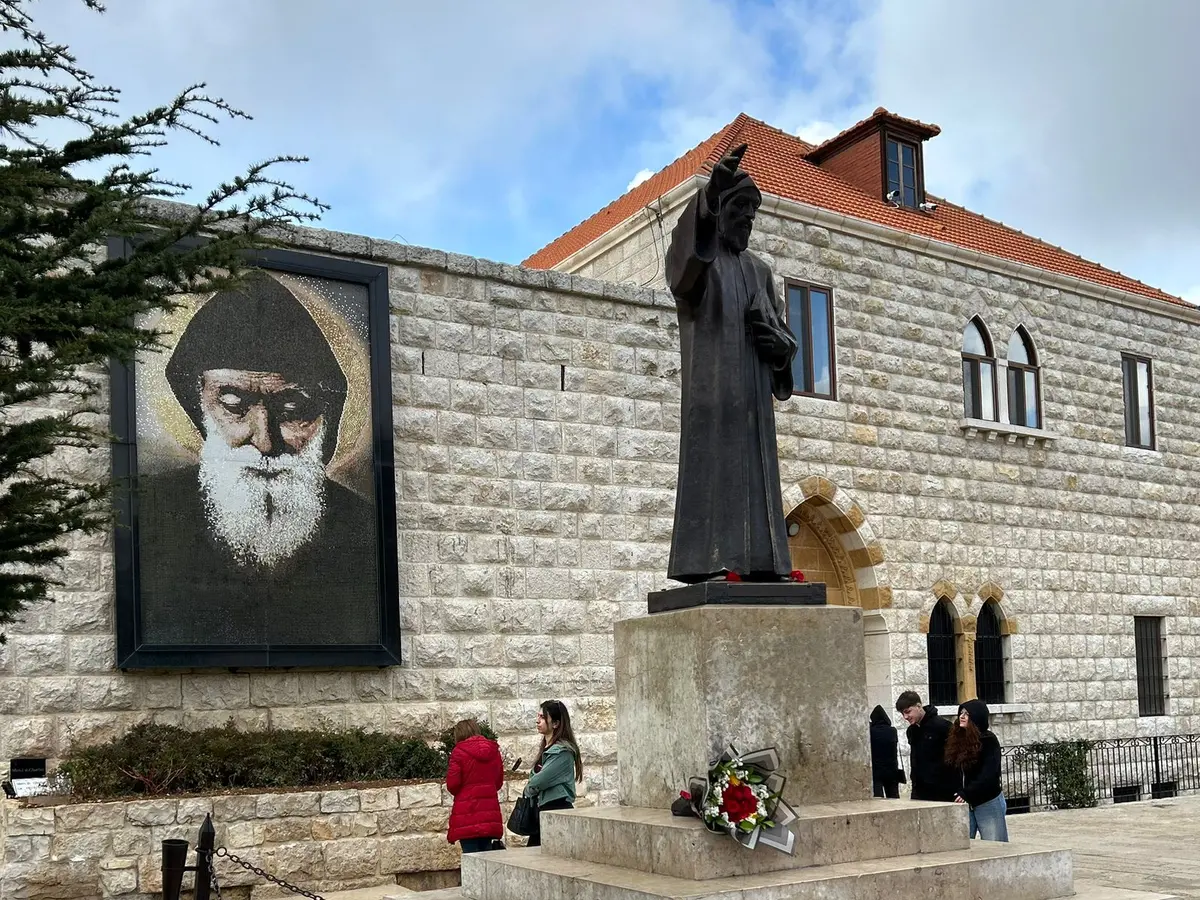
The tomb inside the church
The relics rest in a cedar coffin behind a glass-and-iron grate, inside a small dim chapel to the right of the main church. The space is loud in a way European cathedrals are not — people weep openly, speak aloud to Charbel by name, press handwritten prayer notes against the iron, kiss it, and stay until someone behind them gently asks for room. There is no hush. There is no decorum policing.
Pro Tip: The tomb area is wheelchair-accessible by ramp from the courtyard, but on the 22nd of any month, the crush of bodies makes it functionally unusable for anyone with mobility issues. Aim for a Tuesday or Wednesday morning instead.
The museum and Wall of Gratitude
Down a short flight of stairs sits the museum. The exhibits that stop people are not the most precious — it’s Charbel’s hair shirt, his oak-leaf mattress, a clay water jug, and the Wall of Gratitude. The wall is a packed display of crutches, leg braces, casts, prosthetics, and framed CT scans left by visitors who claim healing. I spent more time staring at it than at anything else on the property. Whatever your beliefs, the volume of objects is hard to dismiss as a symbol — these are physical things from real people.
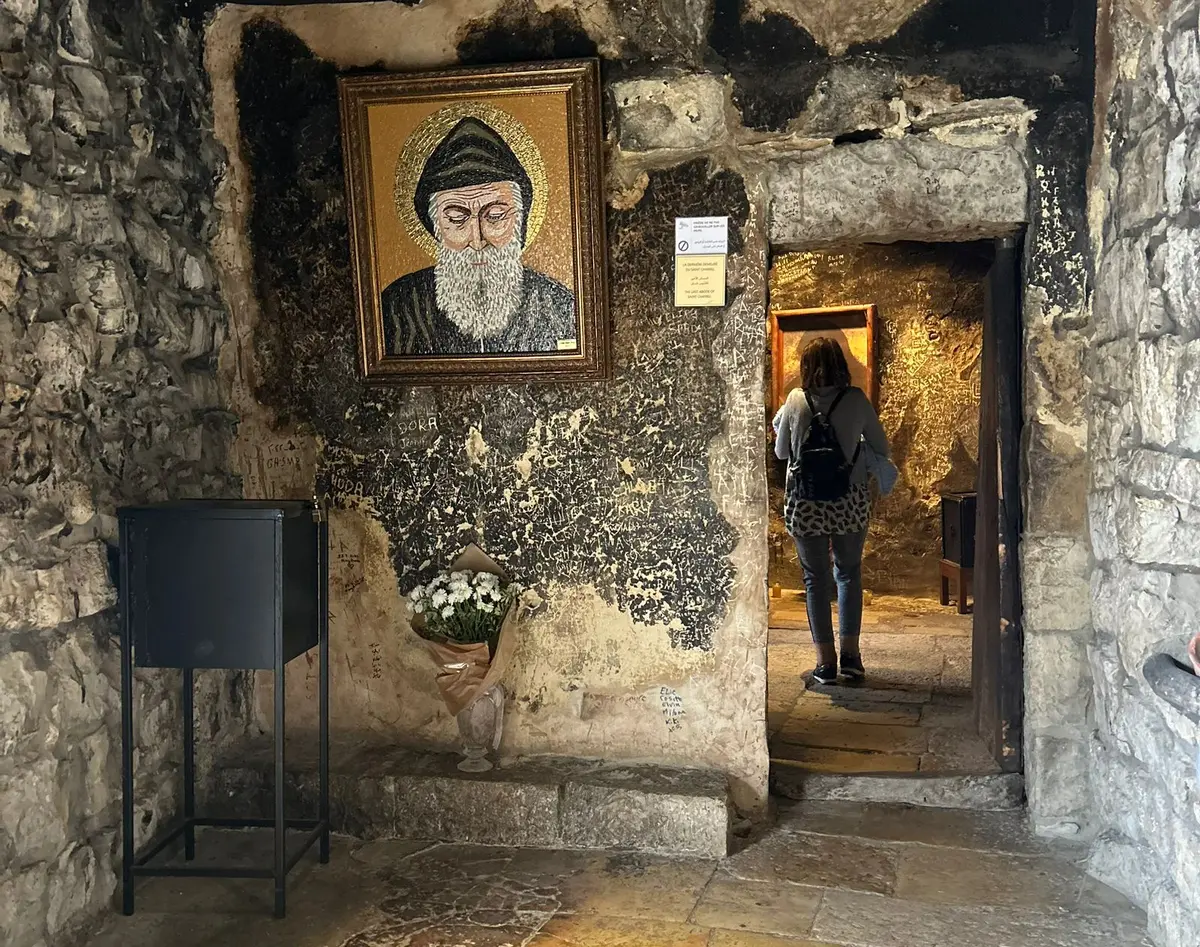
The Hermitage of Saints Peter and Paul
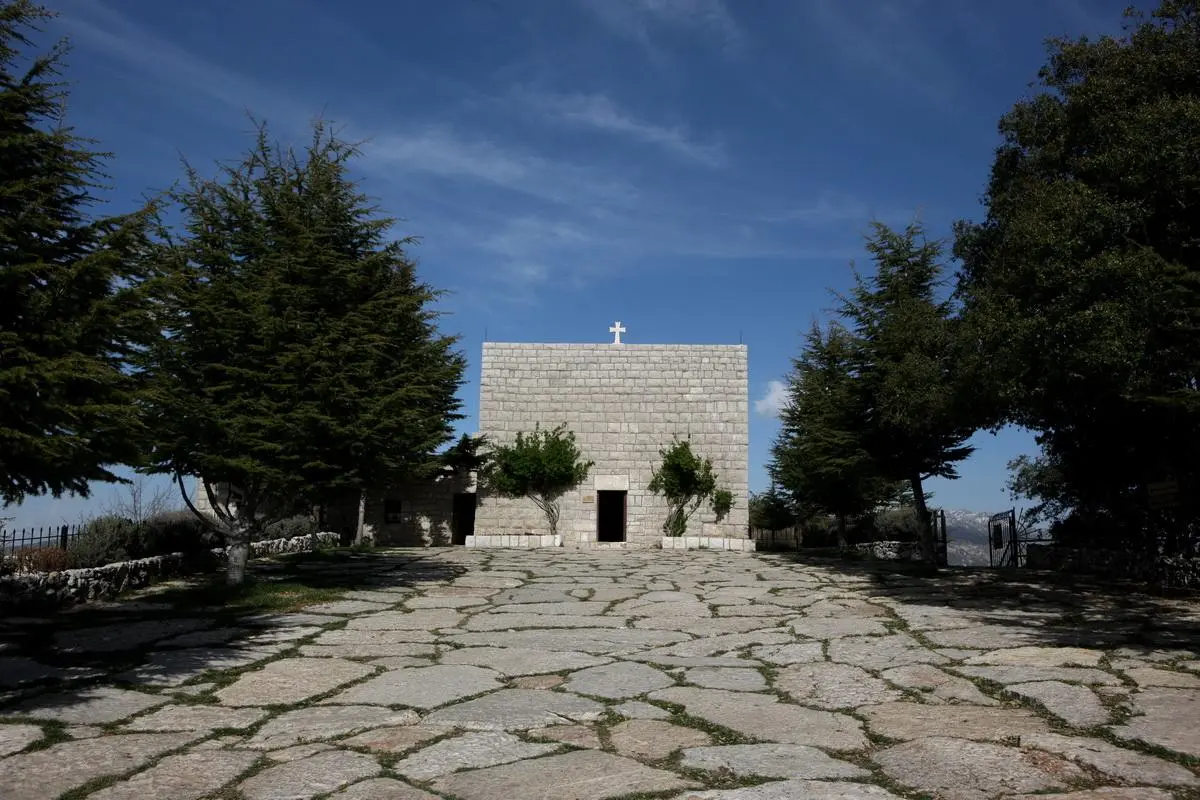
The hermitage is a 12-minute uphill walk from the main monastery, or a five-minute drive if you skip the climb. Many pilgrims walk it barefoot in thanksgiving — a local tradition called the Way of the Saints. The cell where Charbel slept is preserved exactly as he left it, and looking through the door at the dirt floor and cold stone is the part of the trip most visitors say they remember longest. The hermitage is also where the air thins, the wind picks up, and it becomes obvious why he chose this spot over the warmer monastery below.
Why does the 22nd of every month matter?
The 22nd is the monthly devotion day attached to a 1993 healing claim. Nohad El Shami, a Lebanese woman with paralysis from a stroke, said Charbel appeared to her in a dream on January 22, 1993, performed a vision-surgery on her neck, and instructed her to come to the hermitage on the 22nd of every month for the rest of her life. She walked out of bed cured the next morning, with two scars on her neck. She kept the monthly pilgrimage until her death in May 2025.
The tradition has not faded with her. Around four million pilgrims visit Annaya each year, and the 22nd remains the highest-traffic day of any month — now with the added weight of being a memorial to her as well as a thanksgiving.
What to expect on procession days
Hourly Masses run from early morning. The main Eucharistic procession moves from the hermitage down to the monastery plaza in the late morning, with thousands of candles, clouds of frankincense, and continuous chanting in Aramaic and Arabic. It is sensory overload, in a way that’s either powerful or overwhelming depending on your tolerance for crowds.
The road from Byblos, normally a 25-minute drive, can stretch to two hours of bumper-to-bumper on the 22nd. Annaya’s village infrastructure was not built for these numbers. If a quiet visit matters more to you than the procession, deliberately avoid this date — the crowds genuinely change the experience.
Is it safe to visit Lebanon right now?
The U.S. State Department classifies all of Lebanon as Level 4: Do Not Travel due to crime, terrorism, civil unrest, kidnapping, unexploded landmines, and armed conflict. Non-emergency U.S. government personnel were ordered to depart Lebanon on February 23, 2026, and the embassy has suspended routine consular services. This is a real warning, not boilerplate.
Annaya itself sits in the Christian heartland of Mount Lebanon, far from active flashpoints in the south, the Bekaa Valley, and along the Syrian border. But “far from” is not the same as “removed from” — airstrikes, drone activity, and rocket exchanges have occurred across multiple regions, and infrastructure (electricity, fuel, internet) is unreliable nationwide. A road accident on a mountain switchback is statistically a bigger risk than political violence in this specific area, but neither risk is zero.
If you are still planning a Saint Charbel monastery visit, take these steps:
- Enroll in your country’s traveler alert system (STEP for U.S. citizens) before you fly.
- Buy travel insurance that explicitly covers Lebanon and Level 4 destinations — most standard policies will not.
- Build a contingency plan for getting out fast if commercial flights at Beirut–Rafic Hariri International Airport are suspended.
- Avoid the south, the Bekaa, refugee settlements, and the Syrian border under any circumstances.
Pro Tip: Most pilgrims I’ve spoken with who completed the trip in the past year flew in for under five days, stayed in the Mount Lebanon Christian corridor between Byblos and Beirut, and pre-arranged a single trusted driver for every leg. They did not freelance with rideshare apps or street taxis.
How do you handle money in Lebanon’s cash economy?
Lebanon runs on cash, and specifically on crisp U.S. dollars. The Lebanese pound has lost over 98% of its value since the 2019 banking collapse, and the official exchange rate sits near 89,500 LBP per USD. Credit cards work in five-star hotels and a handful of upscale restaurants. Everywhere else — taxis, small restaurants, monastery donations, the souk — it’s USD or nothing.
Bring more cash than you think you need. New, undamaged bills only — drivers and shopkeepers reject anything torn, marked, or older-series. ATMs that accept foreign cards exist in Beirut and Byblos but routinely run dry, cap withdrawals, or dispense only LBP at unfavorable rates. Fransabank ATMs are generally the most reliable for foreign cards.
Carry small denominations: $1, $5, $10, $20. A $100 bill is often impossible to break in Annaya. For tipping or small village purchases, get a modest amount of LBP at licensed money changers (sarrafs) in Hamra or Verdun in Beirut — never the airport, never hotel desks.
How do you actually get to Annaya from Beirut?
The monastery sits about 28 miles (45 km) north of Beirut. Driving yourself in Lebanon is technically possible but inadvisable — Lebanese mountain roads have aggressive drivers, no shoulder, no streetlights after dusk, and minimal lane discipline. Rental insurance often excludes mountain villages, and apps like Google Maps consistently underestimate the time the switchbacks add.
The realistic options for your Saint Charbel monastery visit:
- Private driver for the day: $80-$150 USD round-trip from Beirut, depending on negotiation and waiting time. The standard model. Hotels can usually arrange a driver they vouch for.
- Pre-booked taxi from Byblos: $25-$40 USD round-trip if you’re already staying in Byblos. Have the driver wait — flagging a return ride from Annaya is unreliable.
- Bolt and Uber: Both run in Beirut, but pickups in Annaya are not realistic. Use only for the urban legs of the trip.
Pro Tip: Negotiate the full round-trip and waiting time in writing on WhatsApp before you get in the car. Drivers who agree verbally and renegotiate at the destination are common, and the leverage shifts the moment you’re up the mountain.
Where should you stay near the Saint Charbel monastery?
Three options cover almost every pilgrim profile: an on-site monastery guesthouse for the deepest immersion, a five-star in Byblos for comfort and reliable power, and a boutique hotel near Byblos Castle for travelers who want history and sea air alongside the pilgrimage.
1. Oasis Saint Charbel — staying steps from the tomb
A simple monastery-affiliated guesthouse less than a five-minute walk from the bronze statue. Rooms are clean, bathrooms private, decor monastic. Breakfast only — most pilgrims eat lunch and dinner at the restaurant directly across the lane. The reason to stay here is access: you can be at the tomb at 6 a.m. before any tour bus arrives, which is a different experience entirely from the midday crowds.
- Location: Annaya village, adjacent to the Monastery of Saint Maron
- Cost: budget; reservations by phone (+961 9 760241) are essential, especially around the 22nd
- Best for: Devout pilgrims, solo travelers seeking quiet, anyone attending the monthly procession
- Time needed: 1-2 nights
2. Maximus Hotel Byblos — comfort with continuous power
A five-star hotel in the Blat district above the Byblos Old Souk, about 4.4 miles (7 km) from the Saint Charbel tomb. The features that matter in Lebanon right now: backup generator power that actually carries through the daily power cuts, a heated pool open year-round, two restaurants on site, and a spa with sauna and steam room. About 28 miles (45 km) from Beirut airport.
- Location: Blat, Byblos (next to LAU Jbeil campus)
- Cost: from approximately $135/night
- Best for: Couples, travelers wanting comfort and reliable amenities
- Time needed: 2-3 nights to combine the pilgrimage with Byblos exploration
3. Aleph Boutique Hotel — Old Souk views and castle access
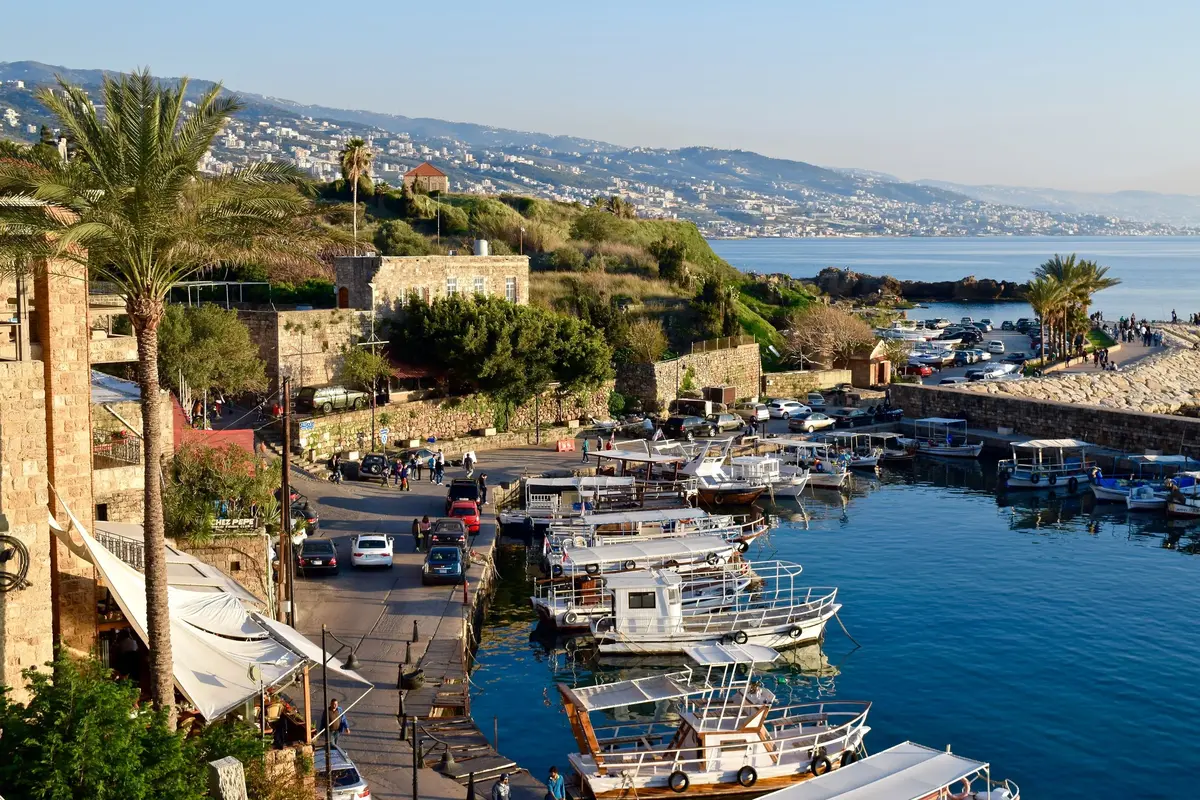
A 26-room boutique hotel in the heart of historic Byblos, a five-minute walk from the castle ruins and the old port. Rooftop terrace with Mediterranean views, breakfast included, rooms named after Phoenician cities. The location wins — you can walk to the souk, the castle, and the seafront in under ten minutes.
- Location: Kordahi Center, central Byblos
- Cost: from approximately $65/night
- Best for: Travelers combining the pilgrimage with historical sightseeing
- Time needed: 2-3 nights
You can find more details in our guide to the best boutique hotels in Byblos.
Before you book
A Saint Charbel monastery visit is one of the most spiritually significant pilgrimages in the Catholic world, and one of the more logistically and politically complex trips a US traveler can attempt. Be honest with yourself about why you’re going, who you’re going with, and whether the current security situation allows it.
TL;DR: Annaya sits in the safer Christian corridor of Mount Lebanon, but Lebanon overall is at Level 4 Do Not Travel. Bring cash USD only. Pre-book a private driver. Stay 1-2 nights at the on-site Oasis Saint Charbel guesthouse for the tomb experience, or in Byblos for comfort. Avoid the 22nd of the month unless the procession itself is the point of your trip.
Have you completed the pilgrimage to Annaya, or are you weighing whether to travel to Lebanon right now? What’s keeping you on the fence?